Australian Labor Party has no intention of developing nuclear power.

Labor doesn’t have ‘any desire’ to pursue nuclear: Tony Sheldon https://www.skynews.com.au/opinion/chris-kenny/labor-doesnt-have-any-desire-to-pursue-nuclear-tony-sheldon/video/be4936ec8a8dc0169ff85fcf26b8f2f1 19Oct 21,
Labor Senator Tony Sheldon says he doesn’t believe the party has “any desire” to go down a nuclear energy route to de-carbonise the economy.
“There is still substantially cheaper alternatives to that,” Mr Sheldon told Sky News host Chris Kenny.“We’re talking about making sure we develop those industries and develop that work – such as a hydrogen industry, which is going to be very critical into our future.”
Rowan Ramsey, Federal Member for nuclear waste dumping, ignores HUGE PORT AUGUSTA RENEWABLE ENERGY PARK (PAREP)

Kazzi Jai No nuclear waste dump anywhere in South Australia, 17 Oct 21, You CANNOT MISS the HUGE PORT AUGUSTA RENEWABLE ENERGY PARK (PAREP) just outside Port Augusta on the approach from Adelaide on Highway 1!
Why is Rowan Ramsey so quiet over this?
It is ALL HAPPENING in his Federal Seat of Grey – and NOT ONE PEEP OUT OF HIM!!!!
NOTHING!!
Maybe he really is ONLY the Federal Member for Council Area of Kimba with EYES ONLY for a NATIONAL NUCLEAR DUMP for Kimba after all!!
Heads up Rowan! – Kimba is NOT AN ISLAND!
You drag Kimba into being a National Nuclear Dump you drag the REST of South Australia along with it!!
And in case you don’t read the article – BHP Olympic Dam/Roxby Downs is and always has been a copper mine first and foremost. The uranium contaminates the copper and they can’t sell the copper contaminated! Gold, Silver and Uranium are really just sidelines. And copper is needed more than ever for renewable energy technology.
Committing to using Renewable Energy from the PORT AUGUSTA RENEWABLE ENERGY PARK (PAREP) by BHP actually fits like a hand in glove.
 |
https://www.facebook.com/groups/1314655315214929
|
Questions for Ministers Taylor, Birmingham and Hunt, on their extravagant claims about ANSTO’s ”great commercial future”

I suggest a proper independent and expert review and assessment by appropriately qualified experts. It would however be essential that ANSTO and all other government entities be compelled to provide on request all necessary information for the review
The Ministers released a joint statement -Technology. Safeguarding the future of critical medicine supply, 30 September 2021
Joint media release with the Minister for Finance, Senator the Hon Simon Birmingham and the Ministerfor Health and Aged Care, the Hon Greg Hunt MP MP,,
The Morrison Government is safeguarding Australia’s sovereign capability to produce vital nuclear medicines by launching a $30 millionproject to design a new world-leading manufacturing facility to be built at Lucas Heights in Sydney.
So many questions to be answered about this:
Question: What precisely is to be involved in this design project for a new manufacturing facility?
What will the new facility comprise in an engineering and technical sense?
In any case the purchase by Australia of overseas nuclear medicine during the several occasions when the OPAL reactor at Lucas Heights was shut down proved to be a relatively easy and cost effective manner of satisfying the local consumption with no greater sovereign risk than applicable to other essential imports
country.
Acting Minister for Industry, Science and Technology Angus Taylor said the new facility will not only help to improve health care in Australia, but will also support nearly 1000 highly-skilled jobs across the country.
Questions. How will the improved health care be achieved by the new facility in light of the continued reduction in using reactor generated nuclear medicine – this goes against all the known facts?
How many of the total staff complement of ANSTO are actually involved in the production and associated services for the nuclear medicine isotopes?
The actual staff of ANSTO is more like 1,200 but their number and nature of work are really questioned despite the high government funding involved. Is this not another scheme by ANSTO to fund its large staff levels and its operational expenses?
Minister Taylor ‘s claims of expanding production of nuclear medicine, creating many high skilled jobs, collaboration with other agencies and radiopharmaceutical companes —
Questions. Please identify which major or even medium sized pharmaceutical manufacturers internationally are involved at present in the manufacture of reactor generated isotopes
Who are the main overseas customers or purchasers of the ANSTO produced isotopes?
What price do they pay for them?
Will there be any third world countries who are unable to pay for their purchase as has already been the case for some years?
What price do they pay for them?
What are the full production costs of ANSTO for these isotopes? As it is known that the sales revenue derived by ANSTO is only a fraction of the production costs calculated in a properly commercial manner how and to what extent is this subsidised by the federal government?
Minister Hunt’s claims of improved health care across the nation.
Question. Again how will the improved health care be achieved?
Claims of expanding industry – Australia a world leader in nuclear radiopharmaceuticals.
COMMENT. You cannot surely be serious when the production and use of reactor generated isotopes is in major decline worldwide due to its inherent dangerous nature and many alternative methods with far
less risk are now being used for diagnostic and treatment procedures
**********************************
CONCLUDING COMMENTS
How will this sit with the proposed but somewhat limited inquiry by ARPANSA as to the public consultations for the licensing applications by ANSTO for what appears to be an unjustified
extension of its temporary but now described as interim solid ntermediate level nuclear waste facility at Lucas Heights?
If the now new proposal described by the government as the design a new world-leading manufacturing facility is to be built at Lucas Heights then I suggest that it be the subject of a proper independent
and expert review and assessment by appropriately qualified experts which should be as wide and far ranging as possible and include all related aspects.
I suggest this review in preference to a more formal parliamentary inquiry whether self constituted or called externally which ultimately will depend on research and advice by persons who would have limited knowledge and experience of the issue under consideration.
In all probability the review will need to be carried out by overseas experts since none is available locally.
Moreover this review should prove to be far more effective and suitable than a formal inquiry process and at a much lower cost.
It would however be essential that ANSTO and all other government entities be compelled to provide on request all necessary information for the review
Opal nuclear reactor at Lucas Heights is simply not economically viable
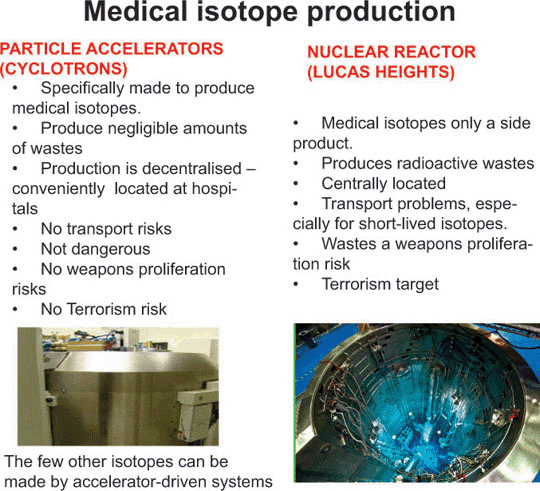
The BIG question is ECONOMIC VIABILITY given the continued uptake of cyclotrons worldwide. On this basis alone it will fail, but the Feds fervidly will try to continue to prop it up anyway – purely for political and NOT practical reasons!
In fact it is high time to move with the times! Canada has been through all of this already and decided to go with cyclotrons to produce their isotopes. They could no longer justify their taxpayers footing the bill for exporting isotopes and all of its inherent costs! And cyclotrons mean they can tailor make the isotopes they need rather than producing mass “available” isotopes which may or may not be used which is the model currently used for Australia!
Kazzi Jai shared a link. Fight to stop a nuclear waste dump in South Australia, 8 Oct 21,
So….what do you do when you are ACTING MINISTER FOR SCIENCE, INDUSTRY AND TECHNOLOGY? Seems the lucky ACTING MINISTER for that portfolio- Angus Taylor – knew EXACTLY what to do on 30th September 2021!
“ANSTO welcomes the joint announcement from The Acting Minister for Industry, Science and Technology, the Hon Angus Taylor MP, the Minister for Finance, Senator the Hon Simon Birmingham and the Minister for Health and Aged Care, the Hon Greg Hunt MP to safeguard the future of Australia’s nuclear medicine production. The government has announced it will safeguard Australia’s sovereign capability to produce vital nuclear medicines by launching a $30 million project to design a new world-leading manufacturing facility to be built at our Lucas Heights campus in Sydney. About 80 per cent of nuclear medicine isotopes used to fight diseases like cancer are produced at Lucas Heights and one of the key facilities that makes this possible is nearing the end of its operating life.” – ANSTO website “Safeguarding the future of Australia’s nuclear medicine”
When the likes of Angus Taylor uses the words “safeguard Australia’s sovereign capability”…you KNOW there’s something shonky going on! Too bad he isn’t worried about “Australia’s sovereign capability” with regards to iron, gas, water, ports, utilities, land acquisition etc etc….the list goes on!
Anyway, this “wish list” is separate to the brand new ANM facility (The Australian Nuclear Medicine Molydenum-99 Facility (ANM Mo99), which has now become known as ANSTO Nuclear Medicine Facility  ) which cost taxpayers $168 million and has had a number of teething problems since it was built in 2019 and only has become fully functional in March 2020.
Using the wording in the announcement, the “$30 million project to design a new world-leading manufacturing facility to be built”….means this is only a commitment by the Feds to give $30 million to DESIGN the facility which will replace “building 23” which is an “ageing nuclear medical facility” according to the now ex-CEO Adi Paterson back in 2018.Ideally, ANSTO would LOVE for the Feds to cough up $210 million to replace it – probably costing more than that now, since that was quoted 2018 figures not 2021 figures!!
The BIG question is ECONOMIC VIABILITY given the continued uptake of cyclotrons worldwide. On this basis alone it will fail, but the Feds fervidly will try to continue to prop it up anyway – purely for political and NOT practical reasons! In fact it is high time to move with the times! Canada has been through all of this already and decided to go with cyclotrons to produce their isotopes. They could no longer justify their taxpayers footing the bill for exporting isotopes and all of its inherent costs! And cyclotrons mean they can tailor make the isotopes they need rather than producing mass “available” isotopes which may or may not be used which is the model currently used for Australia!
With regard to treatment,which is only a tiny amount of what isotopes are used for – they are predominantly used for diagnostic imaging- the trend now is to do the least amount of damage to normal cells as is possible. Isotopes are rather a blunt instrument in that regards, and now techniques like immunotherapy and nanotechnology are the fields of advancement in that respect.There’s even advancements in radiotherapy which went to LINAC machines (linear accelerators) many decades ago…and now proton therapy units are finding their way into our major capital cities! Neither need nuclear reactors!https://www.minister.industry.gov.au/…/safeguarding… “MINISTER.INDUSTRY.GOV.AUSafeguarding the future of critical medicine supply | Ministers for the Department of Industry, Science, Energy and Resources https://www.facebook.com/groups/344452605899556
—
Nuclear power for Australia? It’s not going to happen!

Nuclear enthusiasts and fellow travellers like me once said of solar it’s the greatest future source of power and always will be. Solar investors may aim that rhetorical dart at small modular reactors and, indeed, the nuclear sector as its energy share, for years stagnant, proceeds to go backwards.
In Australia nuclear attracts not the remotest investor interest. If nuclear were an option a merchant bank or superannuation fund might be manoeuvring to own the space. They might have formed a consortium with a miner and a construction company or two, with a brace of lobbyists at work. It’s not happening.
The contrast with the surge to renewables is stark………..
[ED. An interesting and important piece here re the failure of nuclear power in today’s Australian.
Important because Bob Carr used to be pro-nuke and has changed in response to evidence.
This is timely and a good reinforcement to federal Labor re their strong opposition to any domestic nuclear industry.]
Nobody’s really interested in the nuclear option
BOB CARR, OCTOBER 7, 2021,THE AUSTRALIAN
Australians may be open to nuclear power, as evidenced by Tuesday’s Newspoll. But nuclear is not open for them.
Globally the industry is moribund. “The dream that failed,” says The Economist magazine, concluding it needs government money for life support.
In 2010 one enthusiast predicted within 10 years fourth-generation reactors and small modular reactors would be commonplace, including in Australia. None exists, here or abroad.
More damning, the industry lacks a single example in a Western country of a new power plant being built remotely on time and budget. According to the World Nuclear Industry Status Report, 94 plants were to come on line across the last decade but 98 get decommissioned. Yet 48 of those to be built are to be in China. Remove them and that leaves 46 coming online and – stubborn fact – 98 being decommissioned in the rest of the world.
In 2019, for the first time, renewable sources, excluding hydro, generated more power than nuclear.
In Australia nuclear attracts not the remotest investor interest. If nuclear were an option a merchant bank or superannuation fund might be manoeuvring to own the space. They might have formed a consortium with a miner and a construction company or two, with a brace of lobbyists at work. It’s not happening.
The contrast with the surge to renewables is stark. Andrew Forrest and Mike Cannon-Brookes are prepared to put their own funds into a vast solar farm in the Northern Territory and Forrest to make a huge commitment to hydrogen. There is no single investor with a comparable zest for nuclear power, either high net worth individual or institution.
Ziggy Switkowski produced a report on nuclear power for John Howard in 2007. It was to be the foundation of Australian nuclear power, a decades-long dream. Even with a partiality for the industry Switkowski could only conclude nuclear power, at double the price of coal and gas, would require a price on carbon – and even additional government subsidy.
Three prime ministers – Tony Abbott, Malcolm Turnbull, Scott Morrison – have not reopened the debate. For his part, by becoming chair of Crown in August, Switkowski seems to demonstrate more confidence in gaming-based tourism than the commercial potential of the nuclear fuel cycle.
I argued a pro-nuclear case within the Labor Party and scorned what I saw as the left phobia against the nuclear option. Like British scientist James Lovelock I thought coal more destructive and nuclear the bridge to the era of renewables.
But it’s now clear nuclear is lumbering, subject to breakdowns and cripplingly expensive. New renewable sources such as wind and solar increased by 184 gigawatts last year while nuclear grew by only 2.4GW. The number of active reactors has barely changed since the 1980s.
France was the poster child. But no new reactor has been connected to its grid since 1999. It closed its pressurised water reactor in 1991 and followed by terminating two fast breeder reactors and a small heavy-water reactor.
Poor reliability plagues the fleet. On any day at least four plants are at zero output because of technical failures. The average per plant is a month per year at zero production. But investment in upgrades faces competition from renewables and tough new EU energy efficiency standards.
Not even Scandinavian efficiency can provide a happy pro-nuclear narrative. Finland became the first country in western Europe to order a new nuclear reactor since 1988 but it’s running 13 years late, plagued with management and quality control issues, bankruptcies and investor withdrawals.
Who could have the faintest confidence that Australia could throw up a nuclear reactor with more panache – exceeding with efficiency not only the Finns but the British with their delays and cost blowouts and the Americans with their construction disasters in Georgia and South Carolina?
Doing big complex projects is hardly an Australian competitive edge. Think of the 50 years opining about a second Sydney airport, or – killer fact – the fumbling with submarines.
Where is the shire council putting up its hand to host a nuclear power plant? Harder to find than a sponsor for a high-temperature toxic waste incinerator.
Nobody in the Hunter Valley has urged nuclear for the Liddell site, even on the footprint of this coal-fired power plant scheduled to close. And not even invoking the prospect of a small modular reactor that 10 years back was the vanguard of the nuclear renaissance. About to be planted across the Indonesian archipelago and the rest of Asia, we were promised. Today they exist only on the Rolls-Royce drawing boards they have adorned since the 1970s.
Nuclear enthusiasts and fellow travellers like me once said of solar it’s the greatest future source of power and always will be. Solar investors may aim that rhetorical dart at small modular reactors and, indeed, the nuclear sector as its energy share, for years stagnant, proceeds to go backwards.
Bob Carr is the longest-serving premier of NSW and a former Australian foreign minister.
Danger in transporting nuclear wastes from Lucas Heights, and ANSTO’s conflict of interest.

profoundly increased risks to the security of nuclear material that occur during transport, which are obviously minimised if they stay at Lucas Heights, and that’s one of the key reasons that we’re in favour of extended interim storage at Lucas Heights rather than anywhere else.
They [ANSTO] are a nuclear operator, so of course they’re organisationally, professionally, bureaucratically and budget-wise invested in nuclear technology.……..They have no expertise or interest, and no history, in alternative technologies. So I think, from an institutional point of view, there’s probably a pretty clear conflict of interest here. – Tilman Ruff
PARLIAMENTARY STANDING COMMITTEE ON PUBLIC WORKS Intermediate level solid waste storage facility, Lucas Heights, New South Wales (Public) MONDAY, 13 SEPTEMBER 2021 BEAVIS, Dr Margaret, Vice President, Medical Association for Prevention of War (Australia) [by audio link] RUFF, Dr Tilman, AO, Member, Medical Association for Prevention of War (Australia) [by audio link]
Dr Ruff: Very briefly, I want to add one important element for the committee’s deliberations that would support not just the proposed facility—as the previous witness and, I think, most of the submissions that you’ll be deliberating on today have supported—but ongoing interim storage of Australia’s intermediate-level nuclear waste at Lucas Heights, and whatever facilities are planned or put in train now should be amenable to implementing that capacity.
The particular reason I just want to draw your attention to is the profoundly increased risks to the security of nuclear material that occur during transport, which are obviously minimised if they stay at Lucas Heights, and that’s one of the key reasons that we’re in favour of extended interim storage at Lucas Heights rather than anywhere else. But it would be a major concern for reliance on a plan to shift that waste—uncertain, as highlighted—to anywhere else but particularly to somewhere as distant as South Australia with either very long road transport through multiple states or sea transport through ports.
The two global databases on nuclear accidents and trafficking are run out of the United States. The public one and the International Atomic Energy Agency both highlight, including in their most recent reports, that around half of the total reported incidents with nuclear materials occur during transport, and they highlight this as a particular vulnerability. Lucas Heights has, to my knowledge, been the subject of six publicly known terrorist threats. A couple of them have involved identification of explosive materials on or near the site. A couple have involved prosecutions of people with clear evidence of significant stages of planning. If that’s an issue at Lucas Heights, then the vulnerability of transport is particularly highlighted.
And it’s clear in both the reports that I mentioned that there are well-organised terrorist groups of various kinds around the world that are interested in, and have a demonstrated track record in seeking to acquire, nuclear materials suitable for, essentially, dirty radiological bombs, and intermediate-level nuclear waste would be very suitable for that purpose. So that’s one of the key factors why, from a health point of view, we’re particularly concerned that multiple handling and, particularly, long-distance transport of hazardous nuclear waste be minimised.
Dr Beavis: The recommendations of MAPW ask for an open and independent review of nuclear waste production and disposal, and also that the committee recommend inquiry and research into shifting to cyclotrons rather than reactor based production of isotopes for nuclear medicine in a phased and transition manner. We’re not talking about anything that would threaten nuclear medical supplies but, as rapidly as is feasible, to reduce the amount of waste that is produced.
Dr Beavis: It’s a very complex market. Every year, the OECD and Nuclear Energy Agency—they haven’t done it last year—put out a report on the supply of medical isotopes, and there’s been a recurring theme on the problems with full-cost recovery and the problems with supply security. I’ll just read you a bit from the 2019 report which I have in front of me which says that governments are not always aware of the extent to which molybdenum-99 production—that’s the technetium precursor—relies on subsidies. I think all of us are aware.
The report goes on: Some governments were essentially subsidising the production of Mo-99 that was exported to other countries, thus subsidising imaging services in importing countries. And this report is very keen for full-cost recovery, or FCR so they’re trying to stop countries heavily subsidising exports because it’s making the provision of new suppliers not cost competitive. I’ll read a little further: Other countries have decided to allow older facilities that were operating below FCR— that’s full-cost recovery— to cease operations and have not subsidised extensions of their working lifetime. While this increased the risk of insufficient supply or challenged reserve capacity, decisions to end the operation of facilities … have been helpful in achieving the six NEA— the Nuclear Energy Agency— policy principles … by removing subsidised services from the market. These actions also reduced the level of subsidised reserve capacity and reduced perceived overcapacity within the market.
I can read you more, but, basically, what they’re saying is that, because nuclear reactors are very, very expensive to set up, Australia is actually going down the path that Canada chose not to continue in the late 2000s. In 2009 and 2010, there was a massive global shortage of nuclear medicine for this technetium isotope. That was because the Canadian reactor supplied about 25 to 30 percent of the market. Canada has chosen not to replace those reactors for a number of reasons but not least because they were tired of accumulating all the nuclear waste from the export business of isotopes around the world.
In fact, the OECD and the NEA are advocating that we should not be continuing to subsidise these nuclear medicine suppliers. It also means that, if you rely on a reactor, when that reactor breaks down, your tendency to create havoc in the global markets is much greater. It would be much better if there were decentralised, much cleaner production of isotopes.
But, because we have a reactor and because ANSTO, as a business entity, has decided that it wishes to increase its market share—which, as a business entity, it’s certainly entitled to do—it means that the Australian public is left with a great deal of waste. It’s going to double the waste inventory, as you’ve heard, without really any social licence to do so.
Given that the OECD and the NEA are saying that we should not be continuing to subsidise this, I think what we need to do, as I said, is a phasing transition. We need a phased and coordinated reduction in Australia’s production isotopes for an export business, and, for Australian owned nuclear medicine suppliers, we actually need to decentralise. Cyclotrons are about the size of a four-wheel drive and cost in the order of—actually, I shouldn’t get into that, but it would be less than $5 million per cyclotron to have the work done and dusted. They are much cheaper to run, they don’t produce the waste, they don’t leave us with 10,000-year intermediate-level waste doubling in the next few decades. So I think it’s something Australia should be looking at. I think the huge subsidies that are going into this export business—I’ll backtrack. With new technologies and cyclotrons now being demonstrated to work in Canada, we need to have a review of how we produce our nuclear medicine so that we can have more reliable, safer and cleaner supplies.
Mr ZAPPIA: Again, Chair, I would have had lots, but I will ask just one question based on those last few comments. Doctor, why do you believe that ANSTO is not going down the path that Canada has gone down and the path that you’re recommending—that is, to increase the production of cyclotrons as opposed to isotopes?
Dr Beavis: I would be hesitant to second-guess how ANSTO thinks. I find that a difficult question. They may wish to increase the income that comes into ANSTO as a natural entity. I think they are not factoring in the cost of the waste. They’ve said explicitly they do not want responsibility for this waste that they are generating, and I think if you don’t have to worry about the waste, then putting subsidised material out into the global community—
Dr Ruff: If I could add to that very briefly: without wanting to speak for ANSTO, I think the institutional context is worth looking at. They are a nuclear operator, so of course they’re organisationally, professionally, bureaucratically and budget-wise invested in nuclear technology. Setting up a reactor is very expensive. The OPAL reactor cost at least $400 million, so there’s a very high upfront cost, and they, presumably, like most other reactor operators, want to operate it as long as possible. They have no expertise or interest, and no history, in alternative technologies. So I think, from an institutional point of view, there’s probably a pretty clear conflict of interest here.
That’s why we’re deeply concerned that, in Australia, we’re being left behind with emerging technologies. Australian medicine is very well placed. Cyclotrons are already dispersed in pretty much all of the major hospitals around capital cities because they produce isotopes for PET scans and other modern nuclear medicine interventions. But that’s probably not an enterprise that ANSTO would be essentially involved in, and I suspect that’s the context in which you’re not hearing a peep from them or any active interest in progressing and advancing implementation of much safer technologies of the future.
Mr ZAPPIA: , what is the significant objection to something that’s in the heart of Sydney, fundamentally, and that has been managed safely for a significant amount of time versus something in a far less densely populated area? What’s the basis for the objection?
Dr Beavis: I think the expertise and security at ANSTO is far greater. I also think the risks from this waste pale into insignificance compared to the risks of the nuclear reactor. So, if you’re going to be keeping one large facility secure, you may as well keep it all there. The regulator has said quite clearly that there’s sufficient space at Lucas Heights to store this waste for decades to come. https://parlinfo.aph.gov.au/parlInfo/download/committees/commjnt/cfc4f9dc-b73c-4166-b484-eeaddcab5bc0/toc_pdf/Parliamentary%20Standing%20Committee%20on%20Public%20Works_2021_09_13_9111.pdf;fileType=application%2Fpdf?fbclid=IwAR0ZzP4j5ukpfZOgyipP2ak92avAEz19B2wqC_Zz4bcbCDXGB9cRcT2siFo#search=%22Australian%20Nuclear%20Scie
Minerals Council pushes for the nuclear industry, despite its failing record compared to renewables
Historic alliance reignites old debate over Australian nuclear energy, SMH , By Nick O’Malley, September 16, 2021 The head of the Minerals Council of Australia says the development of a nuclear submarine fleet provides the nation a great opportunity to build a domestic nuclear power capacity.
The council, which counts uranium miners among its members, has long supported the pro-nuclear case in a decades-old debate over the potential of a domestic nuclear energy industry for Australia, which the submarine announcement may reignite…….
Energy economist Bruce Mountain said he expected the submarine announcement would reignite the decades old debate over nuclear power in some quarters, but such a fleet would not change the Australian circumstances.
Wind and solar are now the cheapest sources of energy and nuclear remains by far the most expensive, he said.“Every single piece of key tech [in the mooted submarine program] would be imported, it is not the same as having an indigenous nuclear power industry,” he said.
Prime Minister Scott Morrison said Australia is not seeking to acquire nuclear weapons or establish a civil nuclear capability, and it would continue to meet all nuclear non-proliferation obligations……..
According to the World Nuclear Status Report, an analysis of the global industry published annually by the Paris-based energy analyst Mycle Schneider, the world’s fleet of nuclear reactors provides about 10 per cent of electricity, but is ageing and shrinking…….
Last year Mr Schneider told the Herald and The Age that though nuclear energy was emission-free, money spent on nuclear power was a drain on clean energy development as it misdirected funds that might have been spent on faster and cheaper clean energy projects. https://www.smh.com.au/national/historic-alliance-reignites-old-debate-over-australian-nuclear-energy-20210916-p58sc8.html
Can the Australian government ignore this powerful letter exposing the foolish decision to ”go nuclear” with submarines and AUKUS?
Ed. note. Here I summarise the points in this well-researched letter: Diplomatic Repercussions – Geopolitical Tensions and Australian National Security(Why the decision makes Australias national security worse not better) – We now have No Submarine Program at All. – But Is Nuclear the Best Stealth? – Can we Build them at Osborne? -Time to re-evaluate our Submarine Program? –The worst option is to do as we have now done. – Conclusion – This decision should be re-visited
Conclusion
The submarine decision, especially within the context of the new ‘AUKUS’ grouping, but even taken on its own:
—Worsens rather than improves Australias own national security, making us (more of) a nuclear target than we have ever been, and extending the targeting potentially from joint facilities to Australian cities and naval bases.
—Worsens rather than improves regional security, adding impetus to regional arms racing, and increasing the likelihood that other Governments may decide they would like to have submarines fueled by HEU
—Leaves Australia currently with no replacement program for the Collins Class submarines
—Makes no sense even within its own restricted terms of reference because it does not offer a submarine with the best stealth
—Requires a submarine that may not be possible to construct even in part at Osborne.
Letter Sent 5 October to Cabinet Security Cttee, Senate, Reps, DFAT, re Nuclear Subs, AUKUS,
PEOPLE FOR NUCLEAR DISARMAMENT
HUMAN SURVIVAL PROJECT – NUCLEAR SUBMARINES, AUKUS
Dear Prime Minister Scott Morrison, other decision-makers on the Australian nuclear submarines project, Cabinet National Security Committee, AUKUS:
Summary:
The decision to establish a new diplomatic/military grouping, AUKUS, deepens confrontational tendencies in the Indo-Pacific region and is hence destabilizing, and worsens rather than improves Australia’s national security. It helps to ‘paint nuclear targets on Australia’s backside’.
The decision to equip Australia with nuclear submarines fueled with highly enriched uranium is both destabilizing and proliferative even if technically within the letters of the NPT. The decision to go with HEU fueled subs in particular opens a proliferation ‘pandoras box’.
The new Australia, UK, and US nuclear submarine announcement: a terrible decision for the nonproliferation regime
The decision to ‘go nuclear’ with submarines has been justified on the supposed technical superiority of nuclear over conventional subs. However a look in detail at the real – world technical and operational characteristics of advanced conventional and nuclear subs shows clear technical superiorities on the part of advanced conventional submarines exactly where we are being told nuclear subs are superior – in the area of quietness and non-detectability. The technical case for nuclear over conventional submarines is not established.
No analysis, and no thought, has been given as to what are Australia’s real security needs, and into whether submarines of any description fit into it.
The decision leaves Australia with currently NO replacement program for the Collins Class subs.
The Submarine Decision and AUKUS
The decision to cancel an existing, well – established, contract with the French Naval Group for a diesel version of the Suffren class attack submarine has not met with universal acclaim, particularly from the French.
At the same time, the closely related decision to establish a new military/diplomatic grouping to be known as ‘AUKUS’ (Australia-UK-US) has also raised questions as to its geo-strategic impact, and contributed further to the deterioration of our relations with China, and possibly with Russia, with potentially catastrophic implications for Australias national security and the safety of all Australians.
It has quite reasonably been suggested that the establishment of ‘AUKUS” cements Australia into an ‘Anglo-sphere’ that is intrinsically limited in scope (how for example, does it relate to the ‘quad’ of India, Australia, Japan, US?), that excludes other nations that have strong Indo-Pacific interests and are allies (including France itself, now snubbed and smarting), and above all, that deepens confrontational attitudes in the region, especially with China.
It is by no means clear that the decision to substitute nuclear powered submarines is even the best decision on technical grounds, or that nuclear powered submarines are necessarily superior in the respects that might be important to Australia and particularly in extreme stealth – to conventionally powered submarines, either the existing Collins class, the erstwhile projected French submarine, or to an evolutionary successor to Collins.
Continue readingARPANSA may not give licence for Kimba nuclear waste dump. Nuclear wastes best managed at Lucas Heights
| |

ANSTO’s proposed public works appear premised on an ill-considered, unassured and, arguably, untenable proposed transfer of intermediate-level waste into indefinite above-ground storage in South Australia. That’s a plan which may never come to fruition, just as the prior proposal by then Prime Minister Howard’s federal government to impose transfer and storage of ANSTO’s nuclear waste into South Australia, which was run between 1998 and 2004, had to be abandoned as a flawed proposal.
As the CEO of ARPANSA has said, nuclear waste can be safely managed at ANSTO at Lucas Heights for decades to come. With respect, that should be the premise on which your committee addresses the works before you.
Parliamentary Standing Committee on Public Works 13/09/2021 Intermediate level solid waste storage facility, Lucas Heights, New South Wales
NOONAN, Mr David, Private capacity [by audio link] Mr Noonan : I have nearly 25 years experience of following nuclear waste issues in Australia, both in capacity, working for non-government organisations, and more recently as an individual—an independent consultant and campaigner.
My first key point is that the primary premise that your committee should consider, evaluate and scrutinise of ANSTO’s proposed works is in terms of the safety contingency set by the independent regulator ARPANSA to retain ANSTO’s nuclear waste at Lucas Heights until the availability of a final isolation and disposal option. With respect, I think that should be the primary matter that should have been addressed by ANSTO in their submission to you and apparently was not.
My second key point is that, in contrast, ANSTO, as, with respect, a vested-interest proponent, presents a plan of proposed works that relies on proposed transfer of intermediate-level waste into indefinite above-ground storage in South Australia—potentially for up to 100 years. Firstly, I’d say that is arguably untenable, and I’d welcome a question line on that if it suits the committee. Secondly, it appears to pre-empt the proper role of ARPANSA licensing decision-making. ARPANSA have said that they will require separate licence processes to assess potential siting, construction and operation of a proposed store for ANSTO intermediate-level waste in South Australia. ANSTO don’t have a right, in the design of their plan and works toward you, to pre-empt a potential grant of outcome to that, and ARPANSA have been clear that they may or may not grant those licences in future.
Thirdly, your mandate as a committee goes to both scrutinising and assessing proposed works. But it holds a fundamental provision, in that you have a right to alter the proposed works—and I would ask you to consider doing so—to make them best comply with the suitability of the overarching purpose of meeting the best public value in the proposed works and the best cost-effectiveness in expenditure of public funds. With respect, I would say that that assessment and the scrutiny which you provide to ANSTO’s application should be in terms of their capacity and willingness to match the safety contingencies set by the independent regulator to retain intermediate-level waste on site at Lucas Heights until availability of a final isolation and disposal option.
Fourthly: I think the scrutiny that your committee would conduct is best served by the highest level of transparency. In that respect, I would call for you to ask ANSTO to publicly release two fundamentally important reports with regard to their planning and capacities to manage intermediate-level waste at Lucas Heights that were due under their licensing conditions. These reports were due to the independent regulator mid last year, in June. Those reports, as far as I’m aware, are not before your committee in the public evidence, and they should be. With respect, I think they should have been available for members of the public to scrutinise in their preparation of submissions to you. Further, in terms of transparency, it would be best if you could bring onto the public record ARPANSA’s evaluation of those ANSTO reports on their plans and capacities to manage intermediate-level waste at Lucas Heights. Preferably, you would hear from the regulator, ARPANSA, given their overarching role in these public interest issues. They would give evidence before you as a witness, for instance, or you could at least put questions to them.
In conclusion, I would present that ANSTO’s proposed plan fails to meet the proper safety contingency for extended storage of intermediate-level waste on site at Lucas Heights. This is, with respect, the primary purpose and warranted public interest measure by which their work should be scrutinised, assessed and evaluated by your committee. In my view and experience, ANSTO’s proposed public works appear premised on an ill-considered, unassured and, arguably, untenable proposed transfer of intermediate-level waste into indefinite above-ground storage in South Australia. That’s a plan which may never come to fruition, just as the prior proposal by then Prime Minister Howard’s federal government to impose transfer and storage of ANSTO’s nuclear waste into South Australia, which was run between 1998 and 2004, had to be abandoned as a flawed proposal.
The then Prime Minister gave assurances that it wouldn’t be renewed for South Australia, and yet we have to face this federal government’s policy agenda to transfer waste out of Lucas Heights unnecessarily when, arguably, it could be safely and securely managed. As the CEO of ARPANSA has said, nuclear waste can be safely managed at ANSTO at Lucas Heights for decades to come. With respect, that should be the premise on which your committee addresses the works before you…. https://parlinfo.aph.gov.au/parlInfo/search/display/display.w3p;db=COMMITTEES;id=committees%2Fcommjnt%2Fcfc4f9dc-b73c-4166-b484-eeaddcab5bc0%2F0001;query=(Dataset%3Acommsen,commrep,commjnt,estimate,commbill%20SearchCategory_Phrase%3Acommittees)%20CommitteeName_Phrase%3A%22parliamentary%20standing%20committee%20on%20public%20works%22;rec=4
Trevor St Baker and the latest push for nuclear energy
Trevor St Baker and the latest push for nuclear energy, Independent Australia, By David Paull | 2 October 2021 Quickly following the Morrison Government’s new ill-defined arrangements to obtain nuclear technology from its UK and U.S. (AUKUS) alliance partners, we have seen a new push from nuclear advocates for a domestic nuclear power industry.
Senator Matt Canavan, the Australian Workers Union (AWU) and pieces appearing in the Murdoch media have been leading the charge. There was also a puzzling link made by Deputy PM Barnaby Joyce on ABC’s Insiders.”
It wasn’t too long ago when Energy Minister Angus Taylor’s inquiry into a new domestic nuclear energy sector was held. Submissions by the nuclear industry and their lobbyists were widely condemned as containing shiploads of misinformation regarding the cost of nuclear versus renewables and the greenwashing of the carbon footprint. The Committee, however, recommended a partial lifting of the standing nuclear energy ban for ‘new and emerging technologies’.
The leading “new and emerging technology” is a reference to small modular reactors (SMRs), designed specifically to provide baseload power to the grid via a network of nuclear generators. As it turns out, Taylor has been leaking information to a far-right media outlet on the need to develop this sector in Australia with the co-operation of expertise from the UK, even with the assistance of our nuclear agency ANSTO.And here emerges a key player in this debate in Australia — the managing director of the company set up to develop this industry, Trevor St Baker.
With respect to his acknowledged need to de-carbonise our economy, Mr St Baker is on the record for claiming that “to reduce CO2 we must go nuclear” and that a rush to renewables would be a disaster for the power network. He claims that “intermittent” renewables are only projected to supply little more “than 25% annually any time soon” and that “electricity supply grids need synchronous generation supply for at least 40% of electricity demand at any time”.
Inherent in this way of thinking is that a dispatchable renewable power system backed by batteries cannot meet a base-load (24 hour) demand, a common theme expressed by other nuclear and fossil fuel lobbyists but an argument nonetheless increasingly on shaky ground. Nonetheless, the nuclear lobbying effort is attempting for all its might to gain momentum.
St Baker, depending on how you look at it, is a very clever businessman, one of the richest in Australia or one who is extremely “well connected”. His position on energy seems to many to be incongruous, attacking banks for withdrawing support for new fossil fuel ventures on the one hand yet investing substantially in renewable projects such as EV recharging stations through his Energy Innovation Fund……….
The Australian Nuclear Association (ANA) is our leading nuclear lobby group whose views on the need for a domestic nuclear industry mirror those views articulated by St Baker, including the view that SMR reactors are more or less “ready to roll”. Their latest media maintains that a poll has been conducted showing that ‘Australians support for considering nuclear energy reaches 70%’. However, the polls mentioned were conducted by the Liberal Party-affiliated Menzies Research Centre, so it’s hardly an independent poll given the Government’s past position on the issue and given the Centre’s position that ‘nuclear is beautiful’.
Like the international fossil fuel lobbying network, there are national and international bodies operating in tandem in the nuclear sector. The ANA is an affiliate of the World Nuclear Association (WNA) who it seems is conducting a vamped-up PR campaign to open new markets for nuclear power. Central to this is an emphasis on small modular reactor technology, announcing the first such reactors in Russia in December 2019 and now is most concerned by issues with licensing and design of SMRs. Other themes include the suitability of such technology for rapid changes in energy systems in response to climate issues.
Of course, this is what St Baker is banking on, literally with his considerable investment in the SMR technology. It is clear that the ruling political party in Australia would dearly love to get behind the nuclear transition as quickly as possible. The only real stumbling block is Labor’s opposition to the concept, public opinion and our adherence to the Nuclear Non-Proliferation Treaty.https://independentaustralia.net/politics/politics-display/trevor-st-baker-and-the-latest-push-for-nuclear-energy,15578
Scott Morrison confirms he’s unlikely to attend UN climate summit in Glasgow
Scott Morrison confirms he’s unlikely to attend UN climate summit in Glasgow, SBS, 2 Oct 21, Scott Morrison says attending COP26 would require him to go into quarantine for a fourth time, disrupting his ability to “engage in my normal duties” as prime minister.
Scott Morrison has given the strongest indication yet he will not attend United Nations climate talks in Glasgow, blaming coronavirus quarantine requirements……
“I will have spent, if I do that, a total of four times 14-day quarantine, basically, in this building, not being able to engage in my normal duties around the country as much as I would like to.”
“That’s a long time for a prime minister to be in quarantine in a six-month period.”
More than 100 world leaders have so far indicated they will attend the summit in person………
Meanwhile, Nationals resisting coalition attempts to get a 2050 net zero emissions target over the line before Glasgow say they are yet to see the government’s plan for how to achieve it……… https://www.sbs.com.au/news/scott-morrison-confirms-he-s-unlikely-to-attend-un-climate-summit-in-glasgow/6649bcbf-6bcc-4ae5-8572-70e988624437
Liberal Coalition prepares for greenwashing at the Glascow climate summit
Right faction hardheads will accept greenwashing ahead of Glasgow if that’s required to keep the Coalition in power, Guardian Katharine Murphy 2 Oct 21, But even if Scott Morrison lands net zero he would rather market his climate pivot at home rather than abroad – there’s an election to prepare for……………………………………….. Right now, Morrison is trying to land new climate commitments ahead of the Cop26 in Glasgow. While senior people insist Morrison’s net zero plane is going to land, on a runway, with zero casualties, either in the second or third week of October, climate policy can be lethal territory for Australian prime ministers, and not just prime ministers called Malcolm Turnbull (as Kevin Rudd and Julia Gillard can attest).
Morrison’s current trouble seems to be confined to a handful of Queensland Nationals as opposed to the entire right faction of the Liberal party, which was Turnbull’s cross to bear during rounds one and two of his internal climate wars.
Thus far, the right has been quiet. People say the majority view is grudging acceptance because of the shifting politics – although some conservatives report a growing backlash bubbling up from the base about a net zero commitment.
Morrison referenced the shifting politics when he met a deputation of mainly moderate Liberals earlier this week. This group of MPs was given some face time with Morrison after they asked to see him. The objective was to send a clear message: the group wanted a commitment to the net zero target. They did not want a handful of Queensland Nationals writing the government’s climate change policy.
…… If the centre of political gravity has shifted in favour of climate action in parts of the country where the Liberals need to hold or win seats, then the Liberal party will need to act, or (more pertinently) at least look like it’s acting.
If that’s the electoral reality, political hard heads in the right faction of the Liberal party can hold their noses about net zero if they believe greenwashing ahead of Glasgow is what’s required to keep Labor out of power.
But for some hardcore conservatives, Morrison revisiting the Coalition’s climate crime scene will be a provocation. It will be yet more proof of his obnoxious dictatorial pragmatism. It is not clear yet whether or not conservative feet will be stamped or rhetorical punches thrown. Perhaps they won’t, because there are always consequences for picking fights. But wise prime ministers prepare for all contingencies………..
Assuming the prime minister can land his net zero deal with Barnaby Joyce, Morrison would rather market his climate pivot at home rather than abroad……….https://www.theguardian.com/australia-news/2021/oct/02/right-faction-hardheads-will-accept-greenwashing-ahead-of-glasgow-if-thats-required-to-keep-the-coalition-in-power
Australia the sucker for cash-strapped U.S, and U.K submarine companies General Dynamics and BAE Systems

UK Prime Minister Boris Johnson is close to BAE, the UK defence contractor whose nuclear subs program is struggling. The submarine program in the US too is foundering, so the game plan by our AUKUS partners is to rope in the dopey Aussies for a hundred billion dollars-plus to finance their distressed submarine sectors.
Both US submarine builder General Dynamics and its British counterpart BAE are looking for a new income stream from Downunder.
$66 Billion Reasons: did Scott Morrison get the French submarines right? By Michael West| September 30, 2021 ….. Michael West investigates the awkward AUKUS alliance and whether Scott Morrison made the right call on French submarines.As if ……….being dead last in the developed world on climate action , Scott Morrison and his Coalition have now burnished their reputation for incompetence on the global stage.
In one fell swoop, the sudden AUKUS declaration, they have achieved a stunning betrayal of the French, further peeved our biggest trading partner China, upset half of Europe, shown the bird to New Zealand and our neighbours in the Asian region, and waved an open cheque-book at the US and the UK military industrial complex.
Yet, in their ardour to crawl back to the Mother Country and bat their debutante eyes at Washington, they appear to have got something right: axing the French submarines. Are our self-described band of “Superior Economic Managers” accidental heroes, or did they mean to get it right?
If they double down and splash $100b plus on nuclear submarines, they will have got it doubly wrong.
Defence correspondent Michelle Fahy has documented here the $90b shocker which is Australia’s deal with French shipbuilder Naval Group. Naval itself has an ugly history of corruption and there are serious questions about how the deal came about in the first place, indeed serious questions about the billions in public money smoked every year in Defence procurement.
Murder, corruption, bombings – the company at centre of Australia’s submarine deal
The arms company at the centre of a deadly criminal saga and numerous global corruption scandals, Naval Group, was selected by the Australian government to build our new fleet of submarines – a deal heralded as ‘one of the world’s most lucrative defence contracts’. How did this happen? In this special investigation Michelle Fahy discovers significant gaps in anti-bribery and corruption measures.
Yet there is upside. Scott Morrison and co have junked a deal which would have delivered a fleet of expensive, obsolete submarines 20 years too late for the war which the government’s champions in the media keep telling us we might have to fight against China. Even though a war with China is nothing more than a grotesque proposition, scaremongering by the weapons lobby and media to distract from corruption and mismanagement at home. Media war porn.
The same might be said of the F-35 Strike Fighter debacle and the BAE frigates scandal. Every large defence procurement is marred by billions of dollars in waste. But here’s the thing with the subs; there is a solid body of work which suggests submarines are already obsolete, nuclear or not. They can be tracked; they are a titanic waste of money.
The National Security College (Federal Government and ANU) published a working paper in May 2020 saying nuclear powered ballistic missile submarines will be detectable at sea.
Meanwhile, the French are complaining we owe them $US66 billion for reneging on the deal with Naval. That’s an ambit claim, to be sure. It might cost the government $5b-$10b all up, some already sunk, the rest to stave off an embarrassing court action; but the result so far is: one, no obsolete subs deal with the French, and two, only a mooted nuclear subs deal with the Brits and Americans which may never happen. Hopefully.
UK Prime Minister Boris Johnson is close to BAE, the UK defence contractor whose nuclear subs program is struggling. The submarine program in the US too is foundering, so the game plan by our AUKUS partners is to rope in the dopey Aussies for a hundred billion dollars-plus to finance their distressed submarine sectors.
The doctrine of the gullible Aussie is getting airplay in the US press. According to war contractor expert Charles Tiefer in Forbes:
“Under the cloud of smoke around the Australian submarine deal, are the unspoken aspects of the enrichment of American military contractors. There is no public mention of which American contractors will build the expensive parts of the expensive Australian submarines.”
Both US submarine builder General Dynamics and its British counterpart BAE are looking for a new income stream from Downunder.
Should the Coalition stay true to its track record of dithering though, it may soon become evident that submarines in general are a leviathan waste of money and public money ought to be expended on something less wasteful.
Scott Morrison might, unwittingly, have got it right. He might not have to spend much on submarines at all. The question then becomes, what has he got us into?
Back to the future
As three former prime ministers in Paul Keating, Malcolm Turnbull and Kevin Rudd have already pointed out, AUKUS puts Australians in greater danger, renders Australia a vassal to foreign power and antagonises our neighbours in the region.
Depending on how you count them, there are probably already four US bases in operation now:
- Pine Gap near Alice Springs, Northern Territory,
- Naval Communication Station Harold E. Holt, north of the town of Exmouth, Western Australia,
- Robertson Barracks in Darwin, Northern Territory,
- Australian Defence Satellite Communications Station near Geraldton, WA.
However, the US military already has access to all major Australian Defence Force (ADF) training areas, northern Australian RAAF airfields, port facilities in Darwin and Fremantle, and probably future access too to an expanded Stirling naval base in Pe
Under AUKUS, this may just be the beginning. It was largely ignored during the AUKUS media blitz and the dramatic cuckolding of the French but Peter Dutton had this to say at his press conference on September 16,
Unveiling plans for new facilities on Australian soil for US naval, air, and ground forces would entail “combined logistics, sustainment, and capability for maintenance to support our enhanced activities, including … for our submarines and surface combatants”. That is on top of “rotational deployments of all types of US military aircraft to Australia”.
If the plan is to shred Australia’s sovereignty and make us a target for China, he is succeeding with aplomb. We are about to be swamped by US military.
Forward to the past
It is poetic too, that at this very time we are striking even stronger and even more unnecessary ties with Westminster and Washington. Boris Johnson’s government is beset by the chaos which is Brexit, such chaos now that it has spawned a global energy emergency. While the EU has the wobbles on its trade deal with Australia, Boris is in the market for a friend.
It is poetic too, that at this very time we are striking even stronger and even more unnecessary ties with Westminster and Washington. Boris Johnson’s government is beset by the chaos which is Brexit, such chaos now that it has spawned a global energy emergency. While the EU has the wobbles on its trade deal with Australia, Boris is in the market for a friend………… https://www.michaelwest.com.au/aukus-french-submarines-scott-morrison/
Australia’s nuclear submarines – a grand announcement leading to a grand shambles.
Bitter truth is we will likely never get any nuclear subs, https://www.theaustralian.com.au/commentary/yes-weve-cancelled-the-french-but-now-what/news-story/99b43465c2124c01a579672d8ef19349 Greg Sheridan, 30 Sept 21, As things stand, it is unlikely Australia will ever get a nuclear submarine. All that we have done so far is cancel the French submarine. My guess is this delays any submarine at all by at least 10 years. It fills me with regret to say this, but analytically the conclusion is inescapable that the nuclear subs under the AUKUS rubric will probably proceed the way of all our other submarine announcements. They will enjoy a brief flower of credibility before doubts creep in, critics become mobilised, the prime minister who ordered them moves on and eventually they are consigned to the dustbin for a new submarine announcement that can enjoy its brief season in the sun.
Our submarine acquisition process remains a complete shambles and the chances of anything significant emerging from it remain remote.
My colleague Dennis Shanahan reported from the recent prime ministerial trip to the US that the government was not interested in leasing a nuclear submarine from the US over the next several years. Instead it wanted to add new submarines to the allied fleet, rather than take a sub or two out of the existing US and British lines. On its own, this approach probably guarantees that nothing of consequence comes of this initiative.
It is impossible to understand why the Brits are in the mix, apart from PR. If we choose the British Astute sub and don’t modify it, that means ditching the jewel of our defence technology, the US combat system that we have on the Collins, as well as most of the US weapons we use on the Collins. So the US, at the end of all this, would be getting billions of dollars less work from us and our navies would be less integrated.
Malcolm Turnbull was savage in his National Press Club attack on the Morrison government’s decision to ditch the French subs and go nuclear. Turnbull exaggerates the diplomatic cost. However, his technical critique of the nuclear subs proposal was substantial. He drew attention to obvious contradictions in the process.
All we have done so far is cancel the French subs. As of now, we have no future submarine program at all. The Morrison government scored a diplomatic triumph in getting the Americans to agree to transfer nuclear submarine propulsion to us and in the way AUKUS was presented.
But the global reaction was based on the idea, wholly mistaken, that we would be getting the nuclear subs some time soon.In his first press conference, Scott Morrison said the subs would be built in Adelaide and he hoped we might start the build before the end of this decade and get the first one into service before the end of the next decade; that is, 2040. Here are some laws of the physical universe and the operation of logic that cannot be contradicted or transcended. If we do not lease a sub and instead make them all in Adelaide we will not get the first one before 2040. Frankly, even that date involves almost miraculous virtuosity.
Every major, complex naval build we’ve undertaken has come in way over budget and long over schedule.In the history of human habitation of this continent, nothing remotely comparable in complexity to building a nuclear submarine has ever been attempted.
Obviously, it makes no industrial or military sense to build the subs in Adelaide. Doing so will add years to the schedule and tens of billions of dollars to the cost. The French are criticised for prospective delays in their conventional subs, but we could have had them much more quickly if they were built in France.But here is a moral certainty. The dialectics of Australian politics will force both the Coalition and Labor, before the next election, to commit to building all the subs in Adelaide.
Say by some miracle the process stays on track and we actually get a boat in the water by 2040 – pretty unlikely, but not absolutely impossible – that does not mean we have our replacement submarine fleet by 2040. If we can build one nuclear sub every three years after that we will be doing very well. That means we would get our fleet of eight subs by 2061.In terms of military capability in the face of the strategic challenges we face in the next decade or two, that is truly a sick joke. It’s the three-card trick all over again.
The capability gap we have to bridge is not up to 2040 but up to, say, 2055, when we might get the sixth nuclear boat and can therefore replace, one for one, the Collins boats. Of course the nuclear subs will be much more capable than the Collins, but they’re no good at all if they don’t actually exist.
Australian submarine policy right now requires the Collins boats to remain our frontline submarine capability until at least the 2040s. No living Australian prime minister has commissioned a sub that actually got built. The last prime minister to do so was Bob Hawke. The Collins boats were commissioned in the 1980s, yet must serve into the 2040s. The frankly batshit crazy quality of our circumstances is evident in this comparison: it would be as if Britain commissioned a new weapons system under Queen Victoria in 1901 and it was still in service as the main British weapons system at the time of the Beatles in the 1960s.
It is impossible to understand why the Brits are in the mix, apart from PR. If we choose the British Astute sub and don’t modify it, that means ditching the jewel of our defence technology, the US combat system that we have on the Collins, as well as most of the US weapons we use on the Collins. So the US, at the end of all this, would be getting billions of dollars less work from us and our navies would be less integrated.
Alternatively, there is talk of choosing the Astute but putting a US combat system, US weapons and even US propulsion system into it. Dear God in heaven, if we embrace the insanity of designing a new nuclear sub just for Australia, even 2060 will be optimistic for the first boat.Or if we choose the Virginia, as we must, the Brits get nothing, yet Boris Johnson was assuring the British public that AUKUS meant hundreds and hundreds of well-paid jobs in Britain’s north. We made a mistake choosing the British Type 26 frigate, which still is not in service even in Britain and is two years behind schedule and counting. Just imagine a Brit submarine saga.
So the government has solved only the problem that its own incompetent, lazy and inexplicable failure to champion its own defence programs brought about, but so far has substituted nothing concrete for it.
The result is likely no submarine capability for us at all, except museum piece Collins boats and whatever submarine visits the Americans or Brits send along. We should have kept the French subs going, perhaps at a reduced number of six or even three, then gone nuclear in an orderly way.
Instead we have once more followed our own traditions of grand announcement leading to grand shambles.
A cynical interpretation might be that the Liberals never explained, championed or campaigned for their own choice of the French sub. Choosing Marise Payne and then Linda Reynolds as defence ministers was grotesque, by Turnbull and Morrison respectively, as neither could carry the debate or the portfolio.
So the government has solved only the problem that its own incompetent, lazy and inexplicable failure to champion its own defence programs brought about, but so far has substituted nothing concrete for it.The result is likely no submarine capability for us at all, except museum piece Collins boats and whatever submarine visits the Americans or Brits send along. We should have kept the French subs going, perhaps at a reduced number of six or even three, then gone nuclear in an orderly way.
Instead we have once more followed our own traditions of grand announcement leading to grand shambles.
Malcolm Turnbull on nuclear submarines – nothing is agreed. There is no design, no costing, no contract.
But nothing is agreed. There is no design, no costing, no contract. The only certainty is that we won’t have new submarines for 20 years and their cost will be a lot more than the French subs. However, high hopes and good intentions are in abundance. But there were plenty of them when we did the deal with France too.
Is it credible to have a hands-off plug and play nuclear reactor filled with weapons grade uranium and not inspect it for 35 years? The US and UK will know for sure in about thirty years. And until then if something does go wrong, both nations have extensive nuclear facilities and expertise to deal with it.
The French nuclear propulsion system however uses low enriched uranium (LEU) – somewhat more enriched than that used in civil nuclear plants. By law they inspect their reactors and refuel them every ten years. All submarines go in for a lengthy, year or more, refit every decade. The refueling of the French naval reactor takes a few weeks. In this regard at least, French naval nuclear reactor safety standards are stricter than those applied in the United States and the UK.
Australia does not.

Address to the National Press Club Malcolm Turnbull, September 29 2021 With the swirl of media soundbites, the impression has been created that the Australian Government has replaced a diesel electric French designed submarine for a nuclear powered American, or British, one. This is not the case.Australia now has no new submarine programme at all. We have cancelled the one we had with France and have a statement of intent with the UK and the US to examine the prospect of acquiring nuclear powered submarines.
Over the next eighteen months there will be a review of the possibilities – the biggest probably being whether the new submarine should be based on the UK Astute[1] submarine or the larger US Virginia class[2].
The hyperbole around the new AUKUS partnership has been dialed up to 11. No three nations in the world already have closer security, intelligence, and technology collaboration than Australia, the US and the UK. And it has been getting closer in recent years. As Canada’s Justin Trudeau observed this is all about selling submarines to Australia[3].
The Australian Government has chosen to terminate a contract with France’s largely state-owned Naval Group to build 12 Attack class submarines. While based on the design of France’s latest nuclear sub they were to be conventionally powered – a modification stipulated by Australia in the competitive tender process begun in 2015 and concluded in April 2016 when it was approved by my Government’s NSC of which the current Prime Minister, Defense Minister and Foreign Minister were all members.
But nothing is agreed. There is no design, no costing, no contract. The only certainty is that we won’t have new submarines for 20 years and their cost will be a lot more than the French subs. However, high hopes and good intentions are in abundance. But there were plenty of them when we did the deal with France too.
The first of the Attack class[4] submarines was to be in the water by 2032, with the rest of the fleet coming out of the shipyards every two years until the full complement had been constructed. It was the largest defence procurement in our history – a partnership of generations between France and Australia……………….
One of the attractions of the French subs was that they were originally designed for nuclear propulsion. So, if we decided to switch to nuclear we had a partner that had the expertise to do it with us.
n its natural state uranium is 99% made up of a stable isotope U238, the unstable radioactive isotope U235 is only about 0.7%. The more U235, the more radiation, reactivity and energy. Highly enriched Uranium (HEU) has a concentration of 20% or more U235. Low enriched uranium (LEU) as used in nuclear power stations is typically between 2-5%.
The United States, United Kingdom and Russia are the only countries still to use HEU in their naval reactors. It is enriched to about 95% and is drawn from stockpiles built up for nuclear weapons.
For Australia, a non-nuclear weapons state, using HEU in a submarine is not a breach of the Treaty on Non Proliferation (NPT), but it does set a precedent which other currently non-nuclear weapons states, like Iran, will seek to exploit as a justification for producing HEU.
Following the AUKUS announcement, I was advised by the Government that the work I had commenced on nuclear options continued and it had been concluded that Australia could use the modular HEU reactors currently deployed in the UK Astute and US Virginia class submarines which, because of their HEU fuel, do not require replacement during the 35 year life of the sub. This, it is contended, means that Australia could have a nuclear-powered submarine without any need to maintain, service or refuel the nuclear reactor.
This is very different advice to that given to the Government as recently as three years ago. It sounds too good to be true; Australia would have submarines powered by nuclear reactors running on weapons grade uranium. And we would not need to have any of our own nuclear facilities or expertise?
Is it credible to have a hands-off plug and play nuclear reactor filled with weapons grade uranium and not inspect it for 35 years? The US and UK will know for sure in about thirty years. And until then if something does go wrong, both nations have extensive nuclear facilities and expertise to deal with it.
Australia does not.
The French nuclear propulsion system however uses low enriched uranium (LEU) – somewhat more enriched than that used in civil nuclear plants. By law they inspect their reactors and refuel them every ten years. All submarines go in for a lengthy, year or more, refit every decade. The refueling of the French naval reactor takes a few weeks. In this regard at least, French naval nuclear reactor safety standards are stricter than those applied in the United States and the UK.
The new AUKUS submarines, we are told, will still be built in Adelaide. But if there are no nuclear facilities there, that must mean the submarine hulls will be transported to the US or the UK to have the reactor installed together with all of the safety and other systems connected to it.
You don’t need to be especially cynical to see it won’t be long before someone argues it looks much simpler to have the first submarine built in the US or the UK, and then the second, third and so on…..
Australia will be the first country without any civil nuclear industry to operate a nuclear submarine and the first non-nuclear weapon state to use HEU in a naval reactor. So, if we are not going to develop nuclear facilities of our own (as Mr Morrison has promised) then we will no more be sharing nuclear technology with the US than the owner of an iPhone is sharing smartphone technology with Apple.
A new submarine, under the new AUKUS arrangement, would not be in the water until 2040, we are told. That is about eight years after the first Attack class sub would have been in service. So, we are now without any new submarines for the best part of 20 years.
…………. Of course, now that the flurry of the media announcement is over, the question remains whether we will be able to negotiate a satisfactory deal with the US and UK to deliver a nuclear-powered submarine for Australia. If the Astute is preferred because of its size, then for practical purposes we will be price takers.
…………..the way we are getting there has been clumsy, deceitful, and costly. Too many questions are not being asked, and fewer answered. The blustering attempts to wedge those who seek answers do not serve our national interest.
Our national security does not rely on fleets and armies alone. And that is just as well, for we will never have military might to match that of potential rivals.
…..Diplomacy matters, and at the heart of diplomacy is trust. Australia’s reputation as a trusted and reliable partner has been an enormous asset to us on the international stage, just as a trustworthy reputation is an enormous asset to someone in business.
………….. . It was only a few years ago that our partnership with France was to be one for generations. As the sun set over Sydney Harbour in March 2018, from the deck of HMAS Canberra, President Macron described the partnership with Australia as the cornerstone of France’s Indo Pacific strategy. This was not just a contract to build submarines, it was a partnership between two nations in which France chose to entrust Australia with its most sensitive military secrets – the design of their latest submarines.
France is an Indo Pacific power. With two million citizens and 7,000 troops across the two oceans, drawing closer to France as a security partner made enormous sense both for us and the United States……….
Mr Morrison has not acted in good faith. He deliberately deceived France. He makes no defense of his conduct other than to say it was in Australia’s national interest. So, is that Mr Morrison’s ethical standard with which Australia is now tagged.: Australia will act honestly unless it is judged in our national interest to deceive?
It was as recently as 30 August that our Defence and Foreign Ministers met with their French counterparts and publicly re-emphasised the importance of the submarine programme. Two weeks later, on the day Mr Morrison dumped the President of France with a text message, the Department of Defence formally advised Naval Group that the project was on track and ready to enter into the next set of contracts.
The media has been gleefully briefed that Mr Morrison struck the deal with Boris Johnson and Joe Biden at the G20 in July shortly before going to Paris where the PM confirmed to President Macron his continuing commitment to the submarine deal.
France’s Foreign Minister has described Australia’s conduct as a stab in the back, a betrayal. Macron recalled his Ambassadors to Canberra and Washington. Dan Tehan can’t get a meeting with the French Trade Minister any more than he can with the Chinese Trade Minister.
France’s Europe Minister has already poured cold water on the prospects of concluding an EU-Australian free trade agreement. Australia has proved it can’t be trusted, he has said.
France believes it has been deceived and humiliated, and she was. This betrayal of trust will dog our relations with Europe for years. The Australian Government has treated the French Republic with contempt. It won’t be forgotten. Every time we seek to persuade another nation to trust us, somebody will be saying “Remember what they did to Macron? If they can throw France under a bus, what would they do to us?”
…………….. As Paul Kelly records[10] (with approbation), Scott Morrison deliberately and elaborately set out to persuade the French their deal was on foot and proceeding until he knew he had an alternative deal whereupon he dumped the French and his deceitful conduct was exposed………… https://www.malcolmturnbull.com.au/media/address-to-the-national-press-club-september-2021
1 This month

of the week – Australians for War Powers Reform (AWPR)
To see nuclear-related stories in greater depth and intensity
 Antinuclear