Today: AUKUS, nuclear submarines, hypersonic missiles – all lovely for Australia’s khaki election.
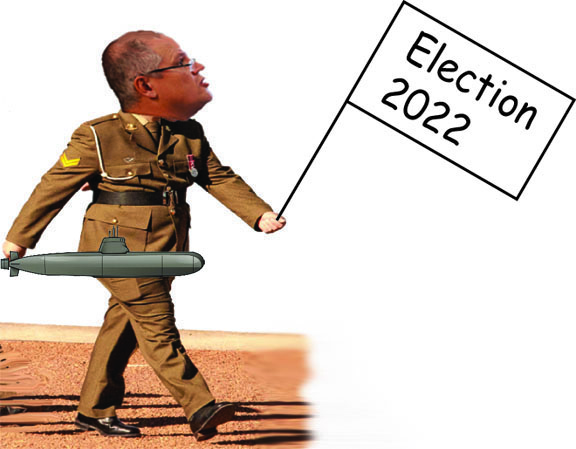
I must admit – the unsurpassed marketing genius Scotty Morrison has got off to a great start with the ”economics, jobs, jobs, ain’t it grand, mate” campaign. He was helped enormously by the Labor leader not being able to answer questions on unemployment and interest rates.
Nevertheless, I’m betting that dear old #ScotttyFromMarketing will before long revert to the war-mongering shtick. After all, he needs to nullify as much as possible, any criticism of the astronomic costs to all this militarism.
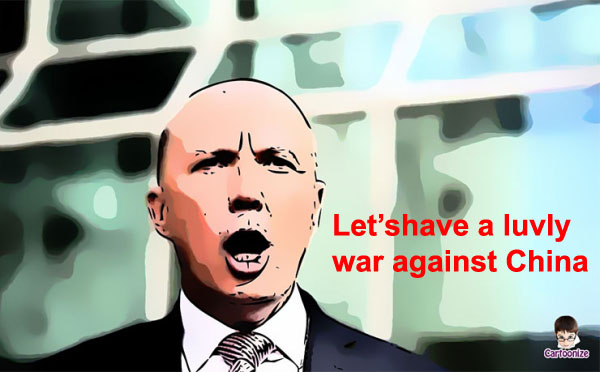
And – #ScottyFromMarketing needs to ward off any potential subversion by the gun-crazy Peter Dutton, who’s always there, salivating to take over the leadership.
Defence Dept blocks access to advice on location choice for Australia’s nuclear submarines base
Labor’s defence spokesperson, Brendan O’Connor, questioned whether the government was “hiding their advice because the prime minister has made a political decision in shortlisting three east coast submarine bases”.
“Australians deserve to know if the government went through rigorous processes or if these bases have been chosen on a whim close to an election.”
“The timing of this announcement just before an election and the fact that it departs from the Navy’s previous analysis is quite inexplicable,” Patrick said.
Defence blocks access to advice on location choice for Australia’s nuclear submarines base https://www.theguardian.com/australia-news/2022/apr/09/defence-blocks-access-to-advice-on-location-choice-for-australias-nuclear-submarines-base
Labor demands government reveal how it shortlisted Brisbane, Newcastle and Port Kembla as potential sites for base Daniel Hurst Foreign affairs and defence correspondent, @danielhurstbne, Sat 9 Apr 2022
Voters will be kept in the dark on how Scott Morrison’s government selected three potential bases for Australia’s planned nuclear-powered submarines, after the advice was blocked from release.
With the prime minister preparing to formally call the election within days, Labor demanded the government reveal how it shortlisted the locations to prove the announcement was “not just a marketing ploy”.
Morrison named Brisbane, Newcastle and Wollongong’s Port Kembla as three contenders for a new eastern submarine base, and revealed Aukus-related infrastructure works would cost up to $10bn, in a keynote national security speech last month.
The government is expected to lock in one of these sites late next year, once further studies and negotiations are completed.
Morrison said the “three preferred locations” were identified “following significant work by Defence reviewing 19 potential sites”, although a minister later said it was the cabinet’s national security committee that had “narrowed it down to three”.
Guardian Australia applied to the Department of Defence under freedom of information laws seeking the site analysis. The request also covered any advice, briefings or submissions prepared for the defence minister, Peter Dutton, regarding the preferred locations.
Continue readingNo – it turns out that the nuclear submarines not likely to be built in Australia – Morrison

I am in awe. The man is a marketing genius. He managed to make sure that the submarine development plan for Adelaide was shut down – by promising an even better nuclear submarine development in Adelaide. Now that wondeful new job-making enterprise vanishes into the ether. But – no worries – he”ll be able to convince us that an attack on Australia by China is imminent, -so natioal security tops employment. So no doubt Australians will rejoice and re-elect the champion marketer.
PM won’t commit to build nuclear subs locally Joseph Brookes,, https://www.innovationaus.com/pm-wont-commit-to-build-nuclear-subs-locally/ 6 April 2022 Prime Minister Scott Morrison will not commit to building Australia’s nuclear powered submarines locally, saying any industry development considerations will be trumped by the need to acquire the capability as soon as possible.
The refusal, made Wednesday as the AUKUS arrangement was expanded to other technologies, follows Defence Minister Peter Dutton also flagging Australia would need to “get the balance right” between supporting local industry and securing capabilities in response to rising foreign threats.
The AUKUS arrangement was announced in September and the “intent” to build new nuclear powered submarines in Australia was a welcome direction for the local defence industry because the new plan also meant the previous submarine program was being scrapped.
A taskforce is continuing to assess options for acquiring the new submarines, including which vessel type and where they will be built.
In February, Defence Minister Peter Dutton had to address concerns about local industry missing out after a high-ranking Defence official told an industry conference the department is “maturing beyond ascribing a percentage” of local industry involvement and was unlikely to set a minimum like previous major ship builds.
A few weeks later the minister suggested a decision on submarine type would be revealed before the election after the taskforce made significant progress earlier this year.
But he was promptly contradicted by Prime Minister Scott Morrison who said a decision was not anticipated before the election because of the processes that would be required stretching into a caretaker period.
On Wednesday, during an announcement about the expansion of the AUKUS arrangement to hypersonic technologies and electronic warfare, the Prime Minister backed away from any commitment to local industry.
He was asked if he could guarantee if the new submarines, beyond the nuclear reactor, would be built in Australia.
“We’re working through all of those issues at present what, and that is certainly our intention to maximise all of that [local manufacturing]. Of course it is,” he told reporters.
“But it’s also the paramount goal is to ensure we get that capability as soon as we can, and it’s in the best form that it can be working with our partners.”
Scott Morrison has no plan for the economic growth that would needed to pay for all his touted ”Defence – Security” stuff

What is Australia building? If the Morrison government were serious about the threat, you’d expect it to have a plan to increase the county’s economic vigour. To generate much greater economic growth, to generate much greater revenue, so that the country can manage the national debt and invest in the transformation of Australian security. In every dimension – in cutting-edge research and development, in military capability, in diplomacy and economic assistance. As well as the next generation of submarines.
Security money must match our political posturing, SMH, Peter HartcherPolitical and international editor 25 Mar 22,
The Morrison government’s favoured election policy themes will be the showpieces of next week’s federal budget. They are twofold. The Coalition claims to be the better party to build a stronger economy. And to strengthen national security.
One especially topical example. Before the US agreed to last year’s AUKUS arrangement to help Australia acquire nuclear-powered submarines, the Biden administration took a hard look at whether Australia could afford them in the years to come. The US didn’t want to entangle itself in any future Australian budgetary disaster. So judging whether to trust Australia with the so-called crown jewels of US military advantage demanded a judgment on whether to trust Australia to be able to pay for them. Crown jewels are expensive.
Recollecting the internal debate, an administration official told me: “This will be very expensive for Australia, perhaps more expensive than the French subs it will be replacing and there will be maintenance costs for decades.”
It was likely a correct assumption. The lifetime cost of the French conventional subs was estimated to be $90 billion while a preliminary guess at the price of merely acquiring the nuclear subs ranges from $116 billion to $171 billion, including anticipated inflation, according to the Australian Strategic Policy Institute.
The question we asked,” said the US official, “was, ‘Can Australia sustain the cost, which will be a not inconsiderable percentage of national GDP?’ And Australia’s force structure may need to be changed.”
Ultimately, Washington decided that Australia could manage the cost, but it was an act of faith in Australia’s future economic strength……………………………
So what’s the Morrison government’s plan? So far, we have nothing. There is no economic reform plan. Australian productivity growth has been falling for the entire nine-year term of three Liberal prime ministers and is now stagnant.
…………….. the Morrison-Frydenberg reform effort is desultory. And we can safely assume that next Tuesday’s budget will not change this sorry picture. How so? Because the Treasurer tells us he’s commissioned a report from the Productivity Commission to guide the reform agenda for the future.
But isn’t that exactly what the government should do? Well, yes, but it already did it. Five years ago. The Productivity Commission delivered its Shifting the Dial report to the then treasurer, Scott Morrison. Who did absolutely nothing. The commission’s website forlornly notes: “There has not been a government response to this inquiry yet.”
And Frydenberg’s request last month for a new report next year puts it safely on the post-budget, post-election never-never. The request for a new report is merely a fig leaf to cover the government’s studied inaction.
The measures that the government likes to declare as “reforms” are nothing more than housekeeping. Shuffling tax brackets is helpful but hardly transformative. This week’s fanfare about a change in cash flow arrangements for small business paying PAYG taxes is helpful but doesn’t actually cut their taxes. It’s all marginal.
Morrison and his ministers like to emphasise that Australia’s security is facing its most severe test since World War II. And fair enough.
The problems press in on Australia on many sides. The chief scientist, Cathy Foley, last month warned that Australia is at risk of losing its research edge on the serious tech frontier of quantum computing and quantum communication, an area which China has named a national priority with $US25 billion committed for research.
While Australia dithers over a national quantum strategy, China already can send unhackable communications. The signal can’t be intercepted because, in the eerie world of quantum communication, there is no signal. Imagine how that will transform future war. The US is scrambling to catch up.
The inaugural head of the Australian Defence Department’s Space Force, Air Vice-Marshal Catherine Roberts, this week warned that Australia has no way to protect its essential communications satellites from Russian or Chinese attack. If China decided to “take out the NBN”, all Australia could do would be to ask the US for help, she said. “We need to be able to protect our assets in space, otherwise it will change Australians’ way of life.”
………………………………………… What is Australia building? If the Morrison government were serious about the threat, you’d expect it to have a plan to increase the county’s economic vigour. To generate much greater economic growth, to generate much greater revenue, so that the country can manage the national debt and invest in the transformation of Australian security. In every dimension – in cutting-edge research and development, in military capability, in diplomacy and economic assistance. As well as the next generation of submarines.
To put its security money where its political mouth is, in short. If the government is serious about the security threat, it must be serious about the economic response.The post-pandemic recovery should be a springboard into an economic rejuvenation. Instead, it’s going to be designed as a springboard into an election campaign. The two needn’t be mutually exclusive. But Morrison and Frydenberg are only interested in drawing from the well of national prosperity, not replenishing it…………
. What do Morrison and Frydenberg propose as Australia’s national motto? “Stagnant country, feeble army” perhaps?
Until and unless an Australian government supercharges its economic prosperity to power its security, no Australian government can be taken seriously on either. https://www.smh.com.au/politics/federal/security-money-must-match-our-political-posturing-20220324-p5a7rm.html
Friends of the Earth Australia’s Submission to Environment Minister calls out the dishonesty in the proposal for a national nuclear waste dump at Kimba, South Australia
Provide reasons for why you believe this is/is not a controlled action.
As a significant “nuclear action” under the EPBC Act this Nuclear Radioactive Waste Management Facility (NRWMF) Referral is a “Controlled Action”.
IT REQUIRES A FULL ENVIRONMENTAL IMPACT ASSESSMENT / STATEMENT (EIA/EIS) AT THE HIGHEST LEVEL OF PUBLIC ASSESSMENT.
In a nuclear action “the whole environment” is the “Matter of National Environmental Significance” protected under the EPBC Act. An EIA/EIS is warranted to cover the scope of this protected matter.
The behaviour of the Morrison government and the Australian Radioactive Waste Agency (ARWA) in relation to the imposition of a national nuclear waste dump in SA has been disgraceful. If Minister Sussan Ley is minded to require anything less than a full EIA/EIS at the highest level of assessment, she should consider the following:
1. The new South Australian government is clearly opposed to the dump, primarily because of the crude racism of the Morrison’ government’s willingness to impose a dump on Barngarla country despite the unanimous opposition of Barngarla Traditional Owners. Expect a hardening of that opposition if anything less than a full EIA/EIS is required.
2. Media silence is far from guaranteed as evidenced by the extraordinary recent coverage in The Australian and The Advertiser ‒ both Murdoch publications ‒ regarding BHP’s mismanagement of the Olympic Dam mine and in particular its mistreatment of Traditional Owners:
https://www.theaustralian.com.au/business/mining-energy/dam-busters-aborigines-battle-bhp-over-water-rights/news-story/5771234ab2fca122009e83720ecbaf01
https://todayspaper.adelaidenow.com.au/infinity/article_popover_share.aspx?guid=23a5b7bd-e6d5-4a82-972e-347f65874b3a
And also widespread national and international media coverage of Rio Tinto’s crimes at Juukan Gorge.
3. Community opposition to the dump in South Australia is building. Expect it to build further if anything less than a full EIA/EIS is required.
Australian Radioactive Waste Agency (ARWA) is the ‘proponent’ in this NRWMF Referral, as a non-independent office of the Industry Department. The Environment Minister must not make a decision to approve and allow the nuclear dump to proceed on the inadequate limited basis of non-independent input by the proponent, or on the basis of anything less than a full EIA/EIS at the highest level of assessment.
A public impact assessment must be carried out under the Environmental Protection and Biodiversity Conservation Act ( EPBC Act). ARWA wants something less than a full EIA/EIS due to a separate ARPANSA licensing process, but the ARPANSA process covers different issues, under different legislation, and in no way could substitute for a full EIA/EIS under the EPBC Act. The ARPANS Act does not protect nor assess ‘the whole of environment’ protected matter involved here under the EPBC Act.
ARWA’s claim there is no alternative to the proposed dump is dishonest and Minister Ley is obliged to call out that dishonesty. Many alternatives are available. See for example the proposals in the paper online at:
https://nuclear.foe.org.au/wp-content/uploads/Responsible-Radioactive-Waste-Management-The-need-for-an-Inquiry-Final.pdf
In particular, the implicit claim that there is no alternative to ongoing storage of intermediate-level waste (ILW) at ANSTO is absurd and dishonest. Clearly ILW should remain at ANSTO because: a large majority of ILW is already stored there (well over 90 percent measured by radioactivity); Australia’s nuclear expertise is concentrated at ANSTO; security at ANSTO is vastly superior to that proposed at the Kimba dump site; it avoids unnecessary transportation; it avoids unnecessary double-handling given that the final disposal site for ILW will not be at Kimba (and could easily be in NSW or any state/territory).
The proposal to store ILW at Kimba is absurd and must be clearly rejected by Minister Ley.
Minister off-target with claim Labor cut billions from defence
AAP.com, William Summers March 14, 2022,
WHAT WAS CLAIMED Labor cut billions of dollars from the defence budget when it was last in government.
OUR VERDICT Misleading. Labor cut defence spending in two years while in office, but overall real-term spending went up while in government.
Defence Minister Peter Dutton has questioned the opposition’s commitment to national security by claiming Labor cut “literally billions” from the Defence budget when the party was last in office.
The claim is misleading. Labor increased overall spending on Defence when in government between 2007 and 2013, both in nominal terms and real terms. However, Labor did cut $1.9 billion from the portfolio in 2012/13, its last full year in office.
Mr Dutton made the claim during an appearance on ABC’s Radio National on March 8 in response to comments made by Labor’s shadow defence minister Brendan O’Connor about the need to consider the future role of Australia’s military during natural disasters.
Mr Dutton said: “Defence has record funding. A bit ironic to hear that from Brendan (O’Connor) when (Labor) pulled literally billions out of defence when they were last in government.” (audio mark 6 min 45sec)
When contacted by AAP FactCheck about the basis of the claim, Mr Dutton’s office pointed to budget papers from Labor’s time in office without providing further information. By that measure, Mr Dutton’s claim does not stack up.
Historical Defence portfolio budget papers provide detailed figures on projected spending as well as actual spending that took place in the previous budget year.
The Australian Strategic Policy Institute (ASPI) – a think tank majority-funded by the Department of Defence and other federal government agencies – has collated these figures going back to 1997/98 (see here). Its figures include spending on the Australian Signals Directorate, which provides cyber intelligence and other capabilities and falls under the Defence portfolio.
The previous Labor government was elected on November 24, 2007, and lost office on September 7, 2013. Therefore, to judge Labor’s spending record, AAP FactCheck looked at spending from 2007/08 – the fiscal year Labor first came into office – to 2012/13, Labor’s final full year in office.
……………………… Misleading – The claim is accurate in parts but information has also been presented incorrectly, out of context or omitted. https://www.aap.com.au/factcheck/minister-off-target-with-claim-labor-cut-billions-from-defence/
Scott Morrison has been urged to act over fears Australian uranium could be used to fuel Russia’s nuclear arsenal.
Fears Australian uranium could be seized by Russia for nuclear weapons arsenal
Scott Morrison has been urged to act over fears Australian uranium could be used to fuel Russia’s nuclear arsenal. news.com.au, Alex Blair 9 Mar 22.
The Electrical Trades Union of Australia has called on Scott Morrison to take immediate action over Australian uranium in Ukraine, which analysts believe could be seized by Russia and used to fuel its nuclear weapons arsenal..
In a letter sent to the Prime Minister this week, the ETU highlighted its concerns over Australian obligated nuclear material (AONM) which has been transferred to Ukraine under the Australia-Ukraine Nuclear Cooperation Agreement.
The ETU is urging the Prime Minister to reveal details on any contingency plans set in place following Russia’s invasion, as the Australian government has an “obligation to create a plan for the removal of nuclear material if it is at risk of a loss of regulatory control”.
The ETU has also requested information on whether uranium that was transferred to Ukraine is still stored in the besieged nation.
“Amongst many other horrors, the war in Ukraine is painfully highlighting the inherent problems with nuclear power,” ETU National Assistant Secretary Michael Wright said.
“If Russia is able to gain control of Australian uranium in Ukraine, the fallout could be catastrophic.
“Australians have a right to know if Australian uranium is at risk and what our nation’s obligations are in the event of an incident.
“We not only have an obligation under our own agreement with Ukraine but we owe it to the global community to ensure these materials are protected – preferably by leaving them in the ground.”
It came as Russian President Vladimir Putin was accused of using nuclear “blackmail” to keep the international community from interfering in his Ukraine invasion.
“This is one of the scariest moments really when it comes to nuclear weapons,” Beatrice Fihn, who leads the International Campaign to Abolish Nuclear Weapons, told AFP in an interview on Tuesday.
The 40-year-old, who has spearheaded the group’s global efforts to ban the weapons of mass destruction since 2013, said she had never in her lifetime seen the nuclear threat level so high.“It is incredibly worrying and overwhelming.”
Just days after Russia launched its full-scale invasion of its pro-Western neighbour on February 24, Putin ordered his country’s nuclear forces to be put on high alert, sparking global alarm…………………………… https://www.news.com.au/world/europe/fears-australian-uranium-could-be-seized-by-russia-for-nuclear-weapons-arsenal/news-story/565ae8e823834435ad1846798f4066d4
Sydney ruled out as nuclear submarine base – despite topping list of sites in Defence study
Sydney ruled out as nuclear submarine base – despite topping list of sites in Defence study https://www.theguardian.com/australia-news/2022/mar/09/sydney-ruled-out-as-nuclear-submarine-base-despite-topping-list-of-sites-in-defence-study
Questions raised about how Coalition settled on its three potential locations Daniel Hurst Foreign affairs and defence correspondent, @danielhurstbne, Wed 9 Mar 2022
Sydney Harbour has been ruled out as a site for the proposed new base for Australia’s nuclear-powered submarines, with officials insisting it was not viable because of “limitations on berth space and shore facilities”.
Questions have been raised about how the Morrison government settled on the three potential sites it announced this week – Port Kembla in Wollongong, Newcastle and Brisbane – given that these were not among the top five options listed in a previous Defence review.
A 2011 Defence report ranked potential options for a new east coast home port for submarines. The top three options were in Sydney Harbour, followed by two options in Jervis Bay, south of Sydney.
The same study said it “would be impractical” to develop a future submarine basing capability at Port Kembla, noting it had previously been found to be “a small and congested harbour with little space for substantial expansion”.
When asked by Guardian Australia to explain what had changed since that review, a Defence spokesperson said changes in commercial activity at Port Kembla had released a large pocket of land which was “now potentially suitable for creation of a new naval base”.
Jervis Bay had been “discounted as it is a gazetted marine park”, the spokesperson said.
The Garden Island defence precinct in Sydney Harbour, which already serves as the navy’s key operational base on the east coast, was also “not considered a viable long-term solution” for a permanent submarine base.
“The site is constrained with limitations on berth space and shore facilities and suffers considerable encroachment,” the Defence spokesperson said. “Construction of dedicated submarine facilities at GIDP would exacerbate existing pressures and further limit expansion options.”
Scott Morrison announced the three potential sites in a national security speech on Monday, even though the selection process will not be complete until next year. That sparked Labor accusations of a pre-election marketing “ploy”.
Both the prime minister’s speech and the government’s subsequent press release contained ambiguous language about who precisely had settled on the three final sites, after Defence did “significant work” to review “19 potential sites”.
“Three preferred locations on the east coast have been identified,” Morrison said. He did not explicitly state whether it was the department or cabinet ministers who had done the identifying, or whether the government’s decision was in line with Defence’s recommendations.
The employment minister, Stuart Robert, told Sky News on Tuesday: “The national security committee of cabinet has worked through a range of options and narrowed it down to three.”
That committee is chaired by Morrison and includes senior ministers, including the defence minister, Peter Dutton, and the foreign affairs minister, Marise Payne. Robert is not listed as a member.
But the Defence spokesperson told Guardian Australia each site had been “assessed against Defence’s evaluation criteria”.
The factors included “access to exercise areas and proximity to industrial infrastructure and significant population centres to support personnel and recruitment”.
The three options would be “subject to further review and consultation”, the spokesperson said.
In Defence’s 2011 future submarine basing study, Newcastle port was ranked sixth and the Port of Brisbane eighth. That review said Newcastle’s strengths were “compromised by its isolation from any other naval infrastructure, its susceptibility to flooding, and its sometimes difficult harbour entrance”.
Dutton was asked on Tuesday whether a Chinese state-owned corporation’s part-holding of the long-term lease over the port would affect the eventual decision on where to build the submarine base.
“All of that would be taken into consideration,” he told the ABC.
He bristled at any suggestion he and Morrison were at odds on the timeframe for deciding which submarine design Australia would adopt under the much-trumpeted Aukus partnership with the US and the UK.
Dutton had said on Sunday the government would announce the selected boat “within the next couple of months”, sparking speculation this may occur before the federal election due in May.
But Morrison ruled out making a decision before the election, noting that caretaker conventions were due to begin by April.
The defence minister told the Nine Network: “I didn’t say it would be before the election. Of course the ABC and the Guardian and others have tried to spin it into that but that’s not the case.”
The Labor party has offered its support for the Aukus, saying it accepts advice that the deteriorating strategic environment in the Indo-Pacific justifies the need for less easily detectible nuclear-propelled submarines.
That committee is chaired by Morrison and includes senior ministers, including the defence minister, Peter Dutton, and the foreign affairs minister, Marise Payne. Robert is not listed as a member.
But the Defence spokesperson told Guardian Australia each site had been “assessed against Defence’s evaluation criteria”.
The factors included “access to exercise areas and proximity to industrial infrastructure and significant population centres to support personnel and recruitment”.
But Labor’s defence spokesperson, Brendan O’Connor, said the party was seeking a briefing on the east coast base plans. He said Morrison had “taken a leaf out of his marketing playbook by making an announcement about a decision that will be made in 2023”.
Officials from the US and the UK have visited Australia in recent weeks. It is understood the three governments are examining the full set of requirements to allow for the delivery of at least eight nuclear-propelled submarines under Aukus.
These include the submarine design, construction, safety, operation, maintenance, disposal, regulation, training, environmental protection, installations and infrastructure, industrial base capacity, workforce and force structure.
While Morrison has previously said the first submarine was expected to be in the water by about 2040, Dutton has since argued the may be achievable sooner.
The government has also foreshadowed a likely increase in visits by British and US nuclear submarines in the meantime.
Australian government’s bungling incompetence over the record floods in Queensland and New South Wales
Government incompetence and lack of planning: it never rains but it pours
Michael West Media, By Callum Foote|March 9, 2022 The skies opened and the rains fell, hammering communities up and down the east coast. So how good is Australia in another time of tragedy? An FOI reveals that the government was warned about the increased likelihood of floods in November last year, and failed to properly prepare for the disaster, writes Callum Foote.
Better late than never. Two weeks into the floods that have devastated Queensland and NSW, Scott Morrison has announced a state of emergency. If only it was a problem of tardiness. In fact, the government knew for three months that this catastrophe was coming, and failed to act.
The Department of Home Affairs was given a briefing by the Director-General Emergency Management Australia, Joe Buffone, on November 5 warning that widespread flooding, severe storms and tropical cyclones are “more likely” than previous decades.
All the premiers and the PM were given this briefing, yet even today we still have Morrison talking about a once in 500-year event. Deputy PM and Minister for Infrastructure, Barnaby Joyce, has said that this is a “one in 3500 years” event and the New South Wales premier, Dominic Perrottet described the torrential rain in the north of the state as a “one-in-1000-year event”.
The presentation, released by the Department of Home Affairs under a freedom of information request by independent Senator Rex Patrick, also pointed to the effects of the La Nina weather pattern and a negative Indian Ocean Diapol (IOD) which both contribute to a wetter than average northern Australia………….
The report did not forecast regional hazards into autumn, but its mid-late summer predictions were that the eastern seaboard would experience flooding as a result of tropical cycles and widespread rain.
MWM has put questions to the Department of Home Affairs about what steps it took to prepare Australians for these hazards. We have not yet received a reply.
The agency responsible for addressing emergencies such as the current floods is the National Recovery and Resilience Agency. The NRRA’s $4.7 Emergency Response Fund has up to $50 million set aside to spend on disaster preparedness measures every year. Until Labor senator Murray Watt challenged Shane Stone, the co-ordinator general of the NRRA, in Senate estimates last year for not spending a cent of this money set aside, measures had not been taken.
Fifty million dollars was given out to fund flood mitigation infrastructure last May under the National Flood Mitigation Infrastructure Program 20-21. None of the three projects funded in Queensland was in the state’s south.
Applications for the 2021-22 program closed on February 4 and it has not announced any funding.
When did authorities know flooding was occurring?
The NRRA is housed within the Department of Prime Minister and Cabinet and overseen by the Minister for Emergency Management and National Recovery and Resilience, currently Bridget McKenzie.
The first reports of severe storms and flooding in South-East Queensland occurred on February 1, with the first reports of flooding in NSW occurring on February 11.
Morrison first issued a statement of support to the victims of the Queensland floods on February 27, almost a full month after the floods began. He followed it up the following day to include NSW flood victims also.
McKenzie addressed the floods on February 15, offering “disaster assistance” to Queensland Local Government Areas affected by the ongoing floods.
What money is on offer now?
The Australian Government Disaster Recovery Payment provides one-off financial assistance to eligible Australians adversely affected by the floods in Queensland and NSW. The rate is $1,000 per eligible adult and $400 per eligible child…………………….
Shane Stone: disaster fighter
Shane Stone stepped into the role of Coordinator-General of the super-agency after serving as coordinator-general of one of its subordinates, the former National Drought and North Queensland Flood Response and Recovery Agency.
Labor has called on Stone to resign over comments appearing to blame people who “want to live among the gum trees” for the cost of recovering from catastrophic floods.
Failure to spend
Watt uncovered in Senate Estimates late last month that zero-funding had been allocated to the now $4.7 billion Emergency Response Fund. This was despite the fund being cleared to allocate up to $50 million a year on preventive measures such as flood barriers, cyclone shelters and bushfire prevention works.
It appears from answers given to questions asked by MWM by an NRRA media spokesperson that since then, $50 million has been allocated to build flood mitigation infrastructure.
As coordinator-general. Stone also has considerable influence on the unutilised $4.7 billion Emergency Response Fund as the Ministers funding decisions are made following Stone’s advice. pours https://www.michaelwest.com.au/government-incompetence-and-lack-of-planning-it-never-rains-but-it-pour
 | |||
$10b plan for nuclear submarine base under fire over timing, potential site
$10b plan for nuclear submarine base under fire over timing, potential site, The Age, By David Crowe, March 7, 2022 . A federal plan for a $10 billion nuclear submarine base on Australia’s east coast has sparked Labor claims that the move is a ploy to get a headline while others say Sydney would be a better location than the official options of Brisbane, Newcastle or Port Kembla.
Labor has backed the plan to build a fleet of nuclear-powered submarines under the AUKUS alliance signed last year with the United Kingdom and United States but has demanded a briefing on the new base after being promised regular briefings last year.
Independent Senator Rex Patrick, a former submariner, also questioned the timing of the government move and said the Department of Defence had favoured Sydney in previous plans, questioning whether election factors had influenced the new proposal.
Prime Minister Scott Morrison outlined the options for the new base in a speech to the Lowy Institute on Monday that said Defence had reviewed 19 potential sites and estimated a $10 billion cost for the base at one of the preferred east coast sites to add to an existing base near Perth.
While Defence Minister Peter Dutton said on Sunday the government would bring forward a decision on whether to choose British or American nuclear submarines for construction in Australia, Mr Morrison said on Monday this did not mean an announcement before the election.
The timelines for the vast project suggest a decision on the east coast base should be made in 2023 and the first submarine would be in the water by around 2040.
Senator Patrick said a process to choose the new submarines began in 2009 but the government had failed to deliver since coming to power in 2013.
“We’re 13 years and $3 billion into a future submarine project and what do we have to show for it? We’ve got a study into getting a nuclear submarine and, now, a study into where we might put them,” he said.
“Call me cynical, but this is another Scott Morrison announcement designed to gloss over his government’s disgraceful national security failures that have left our country vulnerable.”
Senator Patrick gained documents from the Department of Defence under freedom of information law that showed the search for an east coast base canvassed locations including Jervis Bay on the south coast of NSW and Western Port Bay in Victoria as well as Sydney…….
Mr Patrick said Sydney should remain the leading option but appeared to be dropped for political reasons.
“The fact that Sydney is the only city in Australia with a nuclear reactor, and the experienced personnel that maintain and operate it, only strengthens Sydney’s case,” he said.
……………………… Labor candidate Alison Byrnes, who is aiming to replace sitting Labor MP Sharon Bird in the seat of Cunningham around Wollongong and Port Kembla, called for a full briefing from the government rather than being asked to respond to a government “drop” to the media.
With a decision not likely until 2023, critics of the government questioned the timing of Mr Morrison’s announcement and the need for a swift response to his proposal.
“The suggestion for a base for nuclear-powered submarines is just another ploy from the Prime Minister to get a headline without providing any detail of how this will be implemented or even when it will be delivered,” Labor defence spokesman Brendan O’Connor said.
“It seems like Scott Morrison is trying to divert attention from the fact the nuclear-powered submarines won’t come into effect for more than a decade, leaving Australia with a significant capability gap. https://www.theage.com.au/politics/federal/10b-plan-for-nuclear-submarine-base-under-fire-over-timing-potential-site-20220307-p5a2bi.html
Morrison’s selected sites for nuclear submarine base were not the Defence Dept choices – and opposed by the local towns.
Coalition shortlist for nuclear submarines base were not in Defence’s top five in 2011 review, https://www.theguardian.com/australia-news/2022/mar/08/coalition-shortlist-for-nuclear-submarines-base-were-not-in-defences-top-five-in-2011-reviewDaniel Hurst and Royce Kurmelovs. 8 Mar 22, ‘We are not getting lumped with their mess’, Newcastle mayor says of prospect of basing nuclear fleet in city while Wollongong mayor also concerned.
The mayors of Newcastle and Wollongong have expressed unease at the Morrison government naming their cities as a potential base for nuclear-powered submarines, with one describing the Aukus plans as a “fantasy”.
Questions have also been raised about the government’s process for shortlisting Newcastle, Port Kembla in Wollongong and Brisbane for a new east coast base, given that a previous Defence review had not backed them as most-preferred sites.
The South Australian independent senator Rex Patrick, a former submariner, said Scott Morrison’s announcement on Monday was “thick with political fog” with an election looming, noting the final site would not be selected until 2023.
Patrick said: “Why pork barrel in one electorate when you can – for the same price – pork barrel in three?”
Morrison said the government had “provisioned more than $10bn to meet the facilities and infrastructure requirements” for the transition from Australia’s existing Collins-class submarines to the nuclear-powered submarines to be acquired under the Aukus pact with the UK and the US.
He said Defence had looked at 19 potential sites and narrowed them down to the three preferred locations. Defence would now discuss the plans further with state and local governments and “begin negotiations on what will be an enormous undertaking”.
The moves come amid continuing uncertainty about when the first of the nuclear-powered submarines will be operating. Morrison originally estimated it would be by about 2040 but the government now insists it may be sooner.
The new base – which the Coalition wants to build in either Brisbane, Newcastle or Port Kembla – would “enable the regular visiting of US and UK nuclear-powered submarines”, Morrison said in a virtual address to the Lowy Institute.
However, the mayors of Newcastle and Wollongong both said they were not consulted about the decision. With both cities historically home to anti-war movements they expected considerable community opposition.
Both cities have passed official resolutions to make them nuclear-free zones.
There is also believed to be opposition to nuclear power, particularly where it is used to propel a weapon of war – although spent fuel rods from the Lucas Heights reactor have passed through Port Kembla on their way for processing in France.
Wollongong’s lord mayor, Gordon Bradbery, an independent, said he was waiting for more detail about the proposal before he would consult the local community.
“It’s not only nuclear power and nuclear-powered submarines, but it’s the location of a strategic defence asset and that would make anyone who gets this particular facility a target,” Bradbery said.
“International tensions now are playing on a lot of people’s minds and there would be concerns about our city as a location for nuclear-powered submarines.”
Bradbery said Wollongong city council had previously worked with Regional Development Australia to make a submission to the federal government to relocate naval activities from Garden Island in Sydney Harbour to Port Kembla, but this was for conventional submarines only.
“It just disappeared into the ether at the time,” Bradbery said. “Many suggested it was pie in the sky as the navy wasn’t keen on relocating from Garden Island.”
Newcastle’s Labor lord mayor, Nuatali Nelmes, said the city had no intention of giving up its nuclear-free status over a “fantasy”.
“The whole deal is a fantasy,” Nelmes said.
“This announcement, the Aukus decision and the absolutely hopeless way they have handled this submarine contract – we are not getting lumped with their mess.
“It is also typical of the federal government to have unilateral decision making where cities like Newcastle, which have been for many decades, a nuclear-free zone, would even be considered.”
But the Liberal premier of New South Wales, Dominic Perrottet, welcomed the inclusion of Port Kembla and Newcastle on the federal government’s shortlist , saying the world faced “very uncertain times”.
“Defence protection for our country is paramount and we have worked very closely with the federal government to identify these sites for our state,” Perrottet told the Nine Network.
A spokesperson for the Queensland Labor government said it was “yet to receive any detailed information from the commonwealth”.
Study found Port Kembla ‘impractical’
A 2011 Defence report ranked potential options for a new east coast home port for submarines. The top three options were in Sydney Harbour, followed by two options in Jervis Bay, south of Sydney.
“Newcastle has its strengths, but the slight edge that it has with respect to positive people factors is compromised by its isolation from any other naval infrastructure, its susceptibility to flooding, and its sometimes difficult harbour entrance,” the future submarine basing study said.
Newcastle Port was sixth on the list and the Port of Brisbane was eighth.
The report included the caveat that detailed costing and environmental impact analysis “may generate a different outcome”. It placed a priority on the proximity to fleet assets in Sydney.
Brisbane, Newcastle and Port Kembla shortlisted for nuclear submarine base on Australia’s east coast
Brisbane, Newcastle and Port Kembla shortlisted for nuclear submarine base on Australia’s east coast, ABC By defence correspondent Andrew Greene 7 Mar 22, A new submarine base will be built on Australia’s east coast to support the future nuclear-powered fleet being acquired under the AUKUS partnership, with Defence identifying Brisbane, Newcastle and Port Kembla as the most suitable locations.
Key points:
- The Prime Minister will announce a new “future submarine base” for Australia’s east coast to accommodate a nuclear fleet
- Defence believes Port Kembla in NSW is the best option, but the Commonwealth will also consider Brisbane and Newcastle
- The government is playing down the Defence Minister’s suggestion of a submarine design announcement ahead of this year’s election
Prime Minister Scott Morrison will unveil the plan in a national security speech today, when he will warn the strategic, political, economic and social implications of Russia’s invasion of Ukraine will “inevitably stretch to the Indo-Pacific”.
Australia’s fleet of six Collins-class submarines are currently based at Perth’s HMAS Stirling (Fleet Base West), while the ageing boats also regularly operate out of Sydney’s Garden Island Naval base (Fleet Base East).
During an address to the Lowy Institute, Mr Morrison will confirm the government has decided to establish “a future submarine base on the east coast of Australia to support basing and disposition of the future nuclear-powered submarines“. ……..
Australia’s fleet of six Collins-class submarines are currently based at Perth’s HMAS Stirling (Fleet Base West), while the ageing boats also regularly operate out of Sydney’s Garden Island Naval base (Fleet Base East).
During an address to the Lowy Institute, Mr Morrison will confirm the government has decided to establish “a future submarine base on the east coast of Australia to support basing and disposition of the future nuclear-powered submarines“.
The new facility would be the first new major defence base built in Australia since the Robertson Barracks in Darwin in the 1990s, with initial works expected to be completed by next year ahead of a final decision on the location.
Early estimates from Defence suggest more than $10 billion will be needed for facilities and infrastructure requirements to transition from Collins submarines to the future nuclear-powered fleet.
With the Coalition continuing to push national security as a major election issue against the backdrop of growing worldwide military tensions, Mr Morrison will declare Australia faces its most difficult and dangerous security environment in 80 years.
In his Monday speech, he will accuse Russia and China of aligning to try and reshape the international order to create a “transactional world, devoid of principle, accountability and transparency”.
A new arc of autocracy is instinctively aligning to challenge and reset the world order in their own image,” Mr Morrison will say, invoking President George W Bush’s 2002 declaration that Iran, North Korea, and Iraq formed an “axis of evil”.
Decision on sub design in ‘next couple of months’
On Sunday, Defence Minister Peter Dutton told the ABC’s Insiders program the government would decide “within the next couple of months” what submarines it would acquire under the AUKUS partnership
He said the nuclear-powered boats would be in Australia “much sooner” than 2040 and there would be a plan to provide capability in the interim, although the government later played down suggestions a design would be announced before the election.
Mr Dutton’s initial suggestion of a pre-election decision on Australia’s choice of nuclear-powered submarines caused shock among officials from AUKUS partners the United Kingdom and the United States.
“A lot of effort has gone into taking partisan politics out of the whole process – hopefully, this doesn’t derail it,” one diplomatic official told the ABC, speaking on the condition of anonymity. https://www.abc.net.au/news/2022-03-07/nuclear-submarine-base-shortlist-brisbane-newcastle-port-kembla/100887204
Peter Dutton enthuses – weapons to Taiwan, nuclear submarines ASAP
Peter Dutton flags Australia sending weapons to Taiwan, acquiring nuclear submarines before 2040, ABC 6 Mar 22
By political reporter Henry Belot and Jane Norman Defence Minister Peter Dutton has indicated Australia may send weapons to Taiwan in response to any future Chinese military aggression, drawing a direct comparison to support currently being sent to Ukraine in its fight against Russia.
Key points:
- Mr Dutton said China was acquiring nuclear weapons and amassing “huge” forces
- Labor said it was wrong for the Defence Minister to answer hypotheticals about military action
- Mr Dutton said Australia could acquire nuclear submarines earlier than 2040
Mr Dutton also revealed Australia might acquire nuclear submarines earlier than the expected 2040 timeline, with details on design and construction to be announced “within a couple of months” and possibly before a federal election.
Federal Labor has criticised Mr Dutton for previously saying it would be “inconceivable” for Australia not to join military action if the US defended Taiwan.
“It would be completely wrong and wrongheaded for us to be answering such hypotheticals, and we think the Defence Minister made a mistake in that regard,” Shadow Defence Minister Brendan O’Connor said on Sunday.
“I don’t recall any defence minister in our history, certainly recent history, that would ever answer a question in the positive about a hypothetical question about whether we would find ourselves engaged in a full-blown war with a nuclear superpower.”……………….
Mr Dutton confirmed that missiles and ammunition supplied by Western nations – including Australia – had now arrived in Ukraine.
Submarine timeline condensed
Mr Dutton also revealed the government would announce “within a couple of months” which nuclear-powered submarines it planned to acquire as part of the new AUKUS alliance with the United States and United Kingdom.
When AUKUS was unveiled in September last year, torpedoing Australia’s $90 billion submarine contract with France, the government said it would take 18 months to identify the best way to acquire and build the new fleet, using either US or UK technology.
However Mr Dutton is now indicating that timeline has been dramatically condensed, raising the prospect of a pre-election announcement.
“We will have an announcement within the next couple of months about which boat we are going with, what we can do in the interim,” he said……….. https://www.abc.net.au/news/2022-03-06/peter-dutton-flags-australian-military-support-for-taiwan/100886412
Peter Dutton’s war machine cult
Independent Australia, By Binoy Kampmark | 19 January 2022, The Federal Government has spent billions on defence equipment, ignoring issues such as the climate crisis and pandemic, writes Dr Binoy Kampmark.
THE OPERATING DOCTRINE of many a defence ministry is premised on fatuity. There is the industry prerogative and need for employment. There are the hectoring think tanks writing in oracular tones of warning that the next “strategic” change is peeking around the corner.
Purchases of weapons are then made to fight devils foreign and invisible, with the occasional lethal deployment against the local citizenry who misbehave. This often leads to purchases that should put the decision maker in therapy.
Australia’s war-wishing Defence Minister Peter Dutton may be in urgent need of such treatment, but he is unlikely to take up the suggestion, preferring to pursue an arms program of delusional proportions. His mental soundness was not helped by last year’s establishment of AUKUS and the signals of enthusiastic militarism from Washington.
Having cut ties with the French defence establishment over what was a trouble-plagued submarine contract, Dutton has been an important figure in ensuring that Australia will continue its naval problems with a future nuclear-powered submarine.
Submarines are seaborne phallic reassurances for the naval arm of defence. Stubbornly expensive and always stressing celebrated potential over proven reality, they stimulate the defence establishment. The land-based forces, however, will also have their toys and stimulants, their own slice of make believe. And Dutton is promising them a few, including tanks.
This month, the Minister announced that Australia will be spending $3.5 billion on 120 tanks and an assortment of other armoured vehicles, including 29 assault breacher vehicles and 17 joint assault bridge vehicles. All will be purchased from the U.S. military machine. This will also include 75 M1A2 main battle tanks, which will replace the 59 Abrams M1A1s purchased in 2007 and kept in blissful quarantine, untouched by actual combat.
Reading from the script of presumed military relevance, Dutton declared that:
“Teamed with the Infantry Fighting Vehicle, Combat Engineering Vehicles and self-propelled howitzers, the new Abrams will give our soldiers the best possibility of success and protection from harm.”
………….. To dispel any notion that this purchase simply confirmed Australian deference and obedience to U.S. military power, the Defence Minister also claimed that the new Abrams:
“…will incorporate the latest developments in Australian sovereign defence capabilities, including command, control, communications, computers and intelligence systems, and benefit from the intended manufacture of tank ammunition in Australia.”
In other words, once Australia finishes with these cherished, dear imports, adjusted as they are bound to be for the ADF, they are more likely to be extortionately priced museum pieces rather than operable weapons of flexible deployment…………
The last time Australia deployed tanks in combat was during the Vietnam War, that other grand failure of military adventurism. They were never used in Australia’s engagements in Iraq and Afghanistan, despite being lauded as being a necessary vehicle in beating down insurgency movements…………………….
Critics of the purchase have included otherwise hawkish pundits such as Greg Sheridan of The Australian, who spent some of last year shaking his head at the proposed acquisition after it was announced by the U.S. Defence Security Cooperation Agency. The decision, he opined unleashing his talons, was one of ‘sheer idiocy’, an ‘anachronistic frivolity’. Tanks and other heavy, tracked vehicles would ‘never be of the slightest military use to us’……………………..
The tank fraternity, a gathering of near cultic loyalty, are swooning in triumph. As Peter J Dean, director of the Defence and Security Institute at the University of Western Australia remarked last year, their membership has never proven shy. Cults tend to show that utility is secondary to the importance of st https://independentaustralia.net/politics/politics-display/peter-duttons-war-machine-cult,15952
Friendlyjordies allegations against Dutton met with silence.
Friendlyjordies allegations against Dutton met with silence, Independent Australia,
By Victoria Fielding | 7 March 2022 An exposé on Peter Dutton by independent journalist Friendlyjordies has been ignored by the mainstream media, writes Dr Victoria Fielding.
On Friday last week, independent investigative journalist, Jordan Shanks (Friendlyjordies), released an explosive video about one of the most powerful Ministers in the Morrison Government. Since then, the story has sunk without a trace. What is going on?
Is this the mainstream news media refusing to admit Friendlyjordies has beaten them to a scandal, or is Defence Minister Peter Dutton being protected from scrutiny by his mates in the media?
As of writing, over 300,000 people have watched the Friendlyjordies piece. The investigation intricately maps out some very specific allegations about the business dealings of Dutton’s friends, including sources alleging sex scandals, drugs and dodgy dealings in lucrative government contracts.
One of the people involved in the web of intrigue exposed by Shanks is Ryan Shaw, who up until Wednesday was the Liberal National Party’s candidate for the marginal seat of Lilley. Shaw, an Army veteran, has been campaigning in the seat for months, including with Prime Minister Scott Morrison.
The seat is held by Labor MP Anika Wells by the wafer-thin margin of 0.64 per cent. Not just any candidate gets placed in a must-win marginal seat. Shaw’s withdrawal, citing family and mental health issues, is a big loss to the L-NP considering they are left without a candidate weeks out from the Election and after the much-wasted investment of time and resources.
Although it is impossible to know exactly why Shaw withdrew, it is more than a little coincidental that the decision was made at the exact same time as Shanks and his team were questioning Shaw about his involvement with people in the incredibly suspect chain of events detailed in the video.
I’ve spent a lot of time around politics and I know a candidate doesn’t withdraw their cand
I’ve spent a lot of time around politics and I know a candidate doesn’t withdraw their candidacy over any small thing. The Friendlyjordies allegations, if they could be batted away, no doubt would have been to save Shaw’s position. Yet they weren’t.
But it isn’t just Shaw who had questions to answer over his association with people directly implicated by allegations in the explosive story. Peter Dutton is also associated with key players.
Not only does Dutton hold the powerful position of Minister for Defence, but he is also a contender for leader of the Liberal Party, should Morrison choose to step down after the Election. This scandal therefore has all the ingredients you would think the mainstream media would need to make it top priority for journalist follow up.
Senior Minister in the Morrison Government — check. A high profile candidate stepping down seemingly for no reason weeks out from the Election — check. Allegations of government contracts being used to enrich Liberal Party donors — check. Allegations of drug-fueled parties and drug-taking — check…………..
On Sunday, by chance, Peter Dutton was interviewed at length by David Speers on ABC’s Insiders program. It is true that there is much on the Defence Minister’s agenda, what with the war in Ukraine and the Queensland and NSW floods, but there was plenty of time for at least one question about the Shanks allegations in the video. The Minister is not meant to define the agenda of the interview; the whole point of such questioning is to hold the Minister to account. This opportunity was missed.
So, what makes this story so untouchable by mainstream journalists?…………………
Whatever role Dutton has played in this scandal, he should be answerable to the public. And if the news media refuses to even mention the story, let alone pressure Dutton to explain his involvement, then it is a very sad day indeed for democracy. https://independentaustralia.net/politics/politics-display/friendlyjordies-allegations-against-dutton-met-with-silence,16122
1 This month


Help Aunty Sue Protect Her Land and Sacred Sites From Destructive Rocket Testing.
.

Australians deserve the truth
about
AUKUS – https://aukuspublicinquiry.com/

PETITION – To: Prime Minister Anthony Albanese and the Australian Labor Government

of the week – Australians for War Powers Reform (AWPR)
To see nuclear-related stories in greater depth and intensity

