AUKUS and the nuclear submarines will have economic effects on Australia, and big defence spending.

Neglected in the flush of enthusiasm that accompanied the AUKUS announcement is the likely cost of Australia’s new defence spending under a “China containment policy”.
New drives to counter China come with a major risk: throwing fuel on the Indo-Pacific arms race SMH, Tony Walker Tony Walker is a Friend of The Conversation.Vice-chancellor’s fellow, La Trobe UniversitySeptember 27, 2021 “……………….. Australian defence spending likely to rise
What is absolutely certain in all of this is that an Indo-Pacific security environment will now become more, not less, contentious.
SIPRI notes that in 2020, military spending in Asia totalled $US528 billion (A$725 billion), 62% of which was attributable to China and India.
IISS singled out Japan and Australia, in particular, as countries that were increasing defence spending to take account of China. Tokyo, for example, is budgeting for record spending of $US50 billion (A$68 billion) for 2022-23.
Australia’s defence spending stands a tick over 2% of GDP in 2021-22 at A$44.6 billion, with plans for further increases in the forward estimates.
However, those projections will now have to be re-worked given the commitments that have been made under AUKUS.
Neglected in the flush of enthusiasm that accompanied the AUKUS announcement is the likely cost of Australia’s new defence spending under a “China containment policy”. It is hard to see these commitments being realised without significant increases in defence allocations to 3-4% of GDP.
This comes at a time when budgets will already be stretched due to relief spending as a consequence of the pandemic.
In addition to existing weapons acquisitions, Canberra has indicated it will ramp up its purchases of longer-range weapons. This includes Tomahawk cruise missiles for its warships and anti-ship missiles for its fighter aircraft.
At the same time, it will work with the US under the AUKUS arrangement to develop hypersonic missiles that would test even the most sophisticated defence systems……………
The price tag for this in terms of equipment and likely continuing economic fallout for Australian exporters will not come cheap. ………….. https://theconversation.com/new-drives-to-counter-china-come-with-a-major-risk-throwing-fuel-on-the-indo-pacific-arms-race-168734
Much posturing, but little content, on how AUKUS, and the nuclear submarines, will work
what does not make sense is a decision which, in essence, announces you are going to have a glorified interdepartmental committee look at whether it will actually work (the only missing ingredient from the Prime Minister’s usual modus operandi is mention of his department head Phil Gaetjens).
There are no details on just how this new alliance will work, but vast quantities of posturing, which is presumably designed to show the Chinese that we mean business.

However, a government desperate to avoid a referendum on pandemic management — and now threatened by challenges from independent candidates in blue-ribbon seats such as Kooyong and Wentworth over its inaction on climate change —— desperately needs something else to talk about.
Scott Morrison’s AUKUS submarine deal and ‘BFF theatre’ leaves Australia in a tricky spot, https://www.abc.net.au/news/2021-09-25/missing-details-on-australia-uk-us-submarine-deal/1004905647.30 / By Laura Tingle Sat 25 Sep 2021 The federal Coalition have always been keen advocates of contracting things out.
It started in the Howard years, when the delivery of services was contracted out and, over the intervening years, spread to contracting out policy advice — from the public service to richly rewarded consultants who sometimes produce little more than vacuous PowerPoint presentations.
The COVID-19 pandemic has shown the current government is willing to contract out responsibility for things such as quarantine, vaccines and vaccine-mandating rules to the states.
But who would ever have thought it would contract out our national security and defence strategy?
For, in a nutshell, that’s what has happened in the past week with the decision to embrace a new alliance with our old allies and “forever” friends, based on the decision to buy an (unspecified) nuclear submarine that will not go into service until 2040.
Capability gap
There is a vast amount to unpack in this decision, even amid a sense that, by the end of the week, the political caravan was moving on to climate change.
It is hard to think of a decision by Australia with such profound implications for our future that has been so redolent of symbolism, yet so completely lacking in substance.
A decision driven so much by valid concerns about defence capability, that leaves us so exposed as to not having any of that capability for the next 20 years — the time period when the power balance in our region is going to be decided.
In short, a massive strategic step-up announced to cover a massive capability gap.
The majority view in the political and strategic establishment in Australia says the strategic position has fundamentally shifted in the past five years and continues to rapidly evolve.
China’s capacity to scan the oceans, as well as both its military firepower and assertiveness, have all grown exponentially.
And most think that makes nuclear submarines, rather than conventionally powered ones, a rational decision.
It might also make sense to ramp-up your armaments — such as long-range Tomahawk Cruise Missiles — and talk of more US troops, planes and ships, and even British submarines, being based in Australia.
Looking to the US
However, what does not make sense is a decision which, in essence, announces you are going to have a glorified interdepartmental committee look at whether it will actually work (the only missing ingredient from the Prime Minister’s usual modus operandi is mention of his department head Phil Gaetjens).
There are no details on just how this new alliance will work, but vast quantities of posturing, which is presumably designed to show the Chinese that we mean business.
Things such as getting all our spooks to go to Washington this week.
Things such as emphasising the so-called Quad arrangement between the US, Australia, India and Japan, which makes it look like we have even more friends on our side.
Yet, when the Prime Minister holds a press conference in Washington DC ahead of the Quad meetings, what do you say it is about? Vaccines and energy policy.
No mention of China or strategic alliances here. And that sort of makes sense, given the constraints on Japanese military action, and that India has a very different take on Chinese issues to the Americans.
The implication in all this announcing is that the Americans are now committing to the region. That we can rely on Dad to sort out China for us.
All the talk of the new Cold War in the East raises obvious comparisons with the one in the West that occurred last century — and possibly even the crucial role the US played in Europe at that time.
Enduring questions
However, even among the more hawkish analysts, there is a gnawing question of how we (Australia) actually hold the feet of the Americans — and the British with their splendid history of reliable commitment to Asia and Australia in the 20th century — to the fire if things do indeed escalate with China.
And how do we now, on a day-to-day basis, differentiate ourselves from the US position on China when we have made so much not just of our operational dependence, but also of the whole “BFF theatre”?
This goes to questions of sovereign capability. That is, our capacity to run our own strategic policy, both in an operational sense and a diplomatic one.
Labor has backed the government’s decision on nuclear submarines with three caveats.
However, its foreign affairs spokesperson, Penny Wong, asked some valid questions on the point of sovereign capability in a speech on Thursday, such as: “How will we control the use of technology and capability that is not ours?”
“With the prospect of a higher level of technological dependence on the US, how does the Morrison-Joyce government assure Australians that we can act alone when need be; that we have the autonomy to defend ourselves, however and whenever we need to,” she said.
The alacrity and misrepresentation of Wong’s remarks by the Prime Minister in response only added to the suspicion that there is just a tad too much politics in the way this momentous dogleg in the country’s strategic position has been undertaken.
“Well, I think Australians would be puzzled as to why there can be bipartisan support for this initiative in the United States and within days, within days, the Labor Party seems to be having an each-way bet,” he said.
You can see why Labor has chosen to just stay as far away from this issue as it can, within the constraints of a responsibility to set out some reasonable questions about strategy, rather than nuclear submarines per se.
It is determined not to get wedged as it once was on Tampa.
The fallout
Labor’s determination not to get wedged may have taken away some of the political dividends of this huge shift, as has the debacle over informing the French of the decision, which has embarrassed not just Australia but the US.
And, of course, the Prime Minister’s ever-changing descriptions of how he had informed France’s Emmanuel Macron that he was tearing up a multi-billion dollar contract has been, well, just embarrassing.
“What I said was, is that I made direct contact with him,” he said in Washington on Thursday.
Having been unable to get Macron on the phone the night before the announcement, he said he “directly messaged him Australia’s decision in a personal correspondence”.
Australia dumped France, it appears, in a text message: A modus operandi more usually associated with 14-year-olds.
The nuclear subs decision may have all sorts of ramifications, from halting negotiations on a European Free Trade Agreement to entertaining prospects for cooperation between the US and China on climate change.
Its complexities are not best teased out in the lead-up to an election.
However, a government desperate to avoid a referendum on pandemic management — and now threatened by challenges from independent candidates in blue-ribbon seats such as Kooyong and Wentworth over its inaction on climate change — desperately needs something else to talk about.
$1.4 million election war chest, here’s how it will be spent for climate action with genuinely clean energy
$1.4 million election war chest, here’s how it will be spent
Climate 200 is an initiative co-founded by Simon Holmes a Court, clean energy advocate and son of corporate raider Robert and philantropist and businesswoman Janet. It will support progressive independents at the next federal election, building on the success of the likes of Zali Steggall.
Sutherland Shire doesn’t want any more nuclear waste stored at Lucas Heights in their Shire
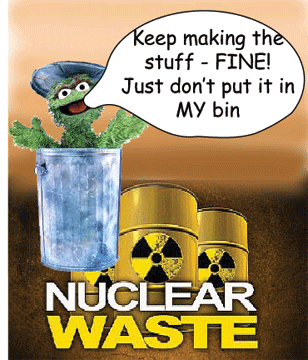
Council calls on Hughes MP to take stand against ANSTO nuclear waste expansion plan St George and Sutherland Shire Leader
Sutherland Shire Council is calling “in the strongest terms” for Hughes MP Craig Kelly to take a stand against a proposed new nuclear waste facility at ANSTO, Lucas Heights.
Mayor Steve Simpson told this week’s council meeting, “I would like to see less of his medical skills [COVID comments] and much more of an assertion that the [nuclear] waste should not be kept in his electorate”.
Mr Kelly hit back, accusing councillors of “scaremongering”.
The council unanimously resolved that, while continuing to support research and innovation at ANSTO and its benefits for treatments for cancer and in nuclear medicine, a submission be made to the independent regulator ARPANSA opposing the construction of an Intermediate Level Waste Capacity Increase (ILWCI) facility at the Lucas Heights campus.
A letter will also be written to the federal Minister for Resources and Water Keith Pitt, requesting the matter of the establishment of a National Radioactive Waste Management Facility be given urgent priority.
The final part of the motion stated: “Council puts in the strongest term Cr Michael Forshaw, a former senator, said previous MPs for Hughes, Robert Tickner and Danna Vale, “were strong on this issue in pushing the need for a permanent repository, or store, for our nuclear waste”…………. https://www.theleader.com.au/story/7435883/updated-council-challenges-craig-kelly-over-nuclear-waste/?fbclid=IwAR1dY5en839aPPJMae32D-5ivaPFQR7CWpn0sLX2lih3slzz4
Nuclear submarines must be ‘subject to rigorous parliamentary review’: Senator Rex Patrick
“There are many significant issues that will need to be properly considered and I fear that they haven’t yet.
“The Senate foreign affairs, defence and trade references committee will need to undertake a wide ranging and rigorous inquiry to inform government, opposition, the Parliament and most importantly the Australian people before the next election
Nuclear submarines must be ‘subject to rigorous parliamentary review’: Senator Rex Patrick, https://www.defenceconnect.com.au/maritime-antisub/8762-nuclear-submarines-must-be-subject-to-rigorous-parliamentary-review-senator-rex-patrick 24 Sept 21, South Australian senator Rex Patrick called on the Senate foreign affairs, defence and trade references committee to open an inquiry into the Commonwealth’s recent submarine announcement.
“This is a very big strategic decision with long-term national security, geopolitical, and economic consequences that must be the subject to rigorous and wide-ranging scrutiny,” Senator Patrick said.
“In these circumstances the Senate foreign affairs, defence and trade references committee should open an immediate inquiry to ensure that all the angles, including alternative conventionally-powered submarine procurement options, are fully explored and understood. The committee should produce an initial report prior to the federal election.
“I’ve been a strong critic of the French submarine deal. The delays and cost overruns are huge and unacceptable.
But we have to be careful we don’t move from one massive procurement disaster into something else that hasn’t been thought through properly.
“There are huge uncertainties about this announcement – including the selection of a US or British submarine, numbers, cost and schedule of acquisition and delivery.
“The proposed initial US-UK-Australia joint study to be undertaken over the next 18 months is a prudent step and will mean that further decisions will take place after Australia’s election.”
As reported by Defence Connect, the key points of the details are as follows:
- Australia is expected to become the only non-nuclear nation to possess nuclear submarine capabilities;
- Australia, UK and US expected to undertake knowledge sharing to enable the Royal Australian Navy to attain a nuclear powered fleet, the first time such knowledge sharing has taken place in over six decades;
- Prime Minister Scott Morrison confirmed that the submarines will be built in Adelaide, Australia;
- Creation of new “trilateral security dialogue” with Australia, UK and US;
- Naval Group expressed their disappointment with the decision, defending the capabilities of the Attack Class Submarine.
Prime Minister Scott Morrison has announced that Australia plans to build a fleet of nuclear submarines with the support of the US and UK, which the PM confirmed alongside his UK and US counterparts in a press conference this morning.
The once-in-a-generation technology sharing and support agreement forms part of a new “trilateral security partnership” between the countries dubbed AUKUS.
Although, Senator Patrick outlined that the current proposal will prove difficult for the Australian Defence Force and Commonwealth government without a domestic nuclear power capability.
“Either way there would be nuclear reactors sitting on hard-stands at Osborne and moored in the Port River,” he said.
“Acquiring, operating and maintaining a nuclear submarine fleet without a domestic nuclear power industry is a challenge that must not be underestimated.
“The nuclear safety and non-proliferation safeguards issues are unquestionably complex and likely to be controversial.
This proposed project would also most likely require new treaty level agreements with the United States and/or the United Kingdom, requiring congressional and parliamentary approval.
“There are many significant issues that will need to be properly considered and I fear that they haven’t yet.
“The Senate foreign affairs, defence and trade references committee will need to undertake a wide ranging and rigorous inquiry to inform government, opposition, the Parliament and most importantly the Australian people before the next election.”
The massive subsidy to nuclear submarines must not be used to justify subsidy to nuclear power
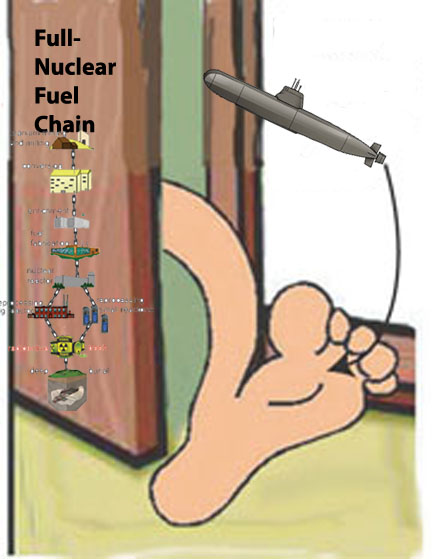
the massive public subsidy of this project must not be used to justify the much greater risks of nuclear power.
Australia is blessed with a bounty of sun and wind, and is well on the way to achieving 50% renewable energy by 2030, even without government help. No matter which way you look at it, nuclear power in Australia makes no sense at all.
Yes, Australia is buying a fleet of nuclear submarines. But nuclear-powered electricity must not come next https://theconversation.com/yes-australia-is-buying-a-fleet-of-nuclear-submarines-but-nuclear-powered-electricity-must-not-come-next-168110
Ian Lowe, Emeritus Professor, School of Science, Griffith UniversitySeptember 20, 2021 The federal government on Thursday announced a landmark defence pact with the United States and United Kingdom that involves this nation acquiring nuclear-powered submarines. The question of nuclear submarines in Australia has been bubbling along for some time – and with it, whether we should also develop a nuclear energy sector.
Prime Minister Scott Morrison insisted the defence deal did not mean Australia would look to develop a civil nuclear capability.
But there is strong support within Coalition ranks for a homegrown nuclear power industry. And the Minerals Council of Australia on Thursday quickly pointed out the “opportunity” the submarine announcement created for expanding nuclear technology in Australia.
The submarine announcement is sure to trigger a new round of debate on whether nuclear energy is right for Australia. But let’s be clear: the technology makes no sense for Australia, economically or politically, and would not be a timely response to climate change.
A twin discussion
The topics of nuclear submarines and nuclear energy are often discussed in tandem.
The technology is similar: the energy source for a nuclear submarine is basically a miniature version of that for a power station. And a similar supply chain is needed for mining and processing uranium, fuelling the reactor and managing waste. That also means both technologies require similar skills and regulatory frameworks.
The Minerals Council of Australia chief executive Tania Constable on Thursday responded to the submarine announcement, pointing out the apparent synergies with nuclear power:
This is an incredible opportunity for Australia’s economy – not only will we develop the skills and infrastructure to support this naval technology, but it connects us to the growing global nuclear power industry and its supply chains.
Now that Australia is acquiring nuclear submarines which use small reactors, there is no reason why Australia should not be considering [small modular reactors] for civilian use.
A former commander of Australia’s submarine force, Denis Mole, in April also questioned why Australia doesn’t have a larger and more diverse nuclear industry.
Mole argued that of the top 20 world economies, all have nuclear power except Australia, Italy and Saudi Arabia. And as nations commit to achieving net-zero carbon emissions by 2050 “it’s noteworthy that no major economy intends doing so without nuclear power in the mix”, he said.
And in February this year, Lindsay Hughes, a senior analyst in the Indo-Pacific program of research organisation Future Directions International, also suggested Australia should develop a nuclear power sector to support a nuclear submarine fleet.
Hughes argued a nuclear power sector would provide skills that could be transferred into the military domain, including nuclear-powered submarines, saying:
A nuclear power sector would demand university graduates with skills in engineering, physics and mathematics, the same skills and skill levels that the US Navy requires to operate its nuclear submarines. Australian graduates with similar skills could be employed on Australian nuclear-powered submarines.
Hughes concluded a nuclear power sector “could potentially provide much of the foundational skills required to maintain and operate a nuclear-power submarine fleet”.
That really is the military tail wagging the electricity industry dog.
Nuclear power is not the logical next step
Even if there’s agreement Australia needs nuclear submarines patrolling the South China Sea, there is no logical jump for a nuclear power sector to support that activity.
In an opinion piece in March this year, former defence minister Christopher Pyne wrote that without nuclear energy, Australia could not support nuclear submarines – but establishing the former would be difficult. He went on:
Australia does not have a nuclear industry. One cannot be created overnight. Even if there was the political will to create one, which there isn’t, what political party is going to waste its political capital on creating a legislative framework for a nuclear industry that can sustain nuclear submarines, that has zero chance of passing any Upper House in any jurisdiction in Australia.
A nuclear industry in Australia would need a solution for the safe storage and disposal of high-level radioactive waste – this appears unlikely, given the public opposition to establishing a site to dispose of even low-level nuclear waste in Australia.
And research suggests there would be little community support for nuclear power – especially following the Fukushima disaster – let alone a community willing to host a reactor.
The decision to build nuclear submarines raises a new set of issues about uranium processing, fuel fabrication and waste management. The Morrison government needs to tell the community how these will be managed.
What’s more, while nuclear power may have once been cheaper than wind or solar, the economics have since changed dramatically.
Nuclear power plants are very expensive to build and the economics of nuclear power are getting steadily worse. By contrast, renewables continue to come down in price.
Over the past 20 years, new nuclear reactors have struggled to establish a business case in any OECD country, with the potential exception of South Korea. The world has obviously made its decision on nuclear: last year 192 gigawtts of renewables came on line, compared with a net 3 gigawatts of nuclear power.
The future is renewables
Australia’s 2009 Defence White Paper noted the federal government had ruled out nuclear propulsion for submarines. Now the federal government will outlay huge amounts of money establishing the framework for the technology.
However, the massive public subsidy of this project must not be used to justify the much greater risks of nuclear power.
Australia is blessed with a bounty of sun and wind, and is well on the way to achieving 50% renewable energy by 2030, even without government help. No matter which way you look at it, nuclear power in Australia makes no sense at all.
USA has conned Australia into paying for its super-costly nuclear submarine project

Last week’s AUKUS announcement was nothing more than PR stunt in Australia, with the government merely committing to spend the next 18 months deciding what to buy—which conveniently kicks any actual the decision far enough down the road to avoid the next federal election.
Has PM put Australia on the hook to finance struggling UK, US submarine projects? Michael West Media, By Marcus Reubenstein| September 23, 2021,
“Almost comical”. Experts lambast Scott Morrison’s “crazy” AUKUS deal to buy nuclear submarine tech from parlous UK and US programs. Marcus Reubenstein finds a real prospect Australia will be used to “underwrite” the foundering foreign submarine industry.
Twenty-five years of ongoing maintenance delays for nuclear submarines, chronic shortage of both parts and skilled workers, under capacity at shipyards, and attack class submarines missing from deployments for up to nine months. These sound like potential problems for Australia’s future nuclear submarine fleet but they are actual problems right now confronting the US Navy and its fleet of 70 submarines.
The US is at the cutting edge of nuclear propulsion. It has the largest and most sophisticated submarine fleet in the world, its first nuclear submarine was commissioned 67 years ago, and the US has literally decommissioned twice as many nuclear subs as Australia is planning to buy.
If the US cannot manage to keep its fleet in the water, how can the Morrison government commit up to $100 billion of taxpayer money to secure nuclear submarines and guarantee they will be always operational and ready for deployment?
Professor Hugh White, ANU Professor of Strategic Studies, former Deputy Secretary of Defence and an eminent figure in strategic policy, wrote in The Saturday Paper, “The old plan was to build a conventionally powered version of a nuclear-powered French submarine. It was crazy.”
“The new plan—to buy a nuclear-powered submarine instead—is worse”.
Says White, “There is a reason why only six countries, all of them nuclear-armed, operate nuclear powered subs.”
The sales pitch is underway
Last week’s AUKUS announcement was nothing more than PR stunt in Australia, with the government merely committing to spend the next 18 months deciding what to buy—which conveniently kicks any actual the decision far enough down the road to avoid the next federal election.
The ripples of the announcement, however, reached British shores in double-quick time. Just two days after the AUKUS alliance UK Defence Secretary Ben Wallis announced a $320 million (£170m) grant to be shared between BAE Systems and Rolls Royce to develop technology for Britain’s next generation submarines.
According to Department of Finance figures, In the past twelve months BAE Systems has collected $1.88 billion from Australian taxpayers. The Astute class submarine, touted as one of the two options Australia is considering, is manufactured by BAE Systems.
US Naval analyst, and Forbes Defense columnist, Craig Hooper predicts AUKUS could give the US Navy a big shot in the arm as well. He says a deal with Australia could effectively underwrite major improvements to the US Navy’s outdated submarine maintenance facilities by supporting “America’s decade-long, $US25 billion ($34.6 billion) effort to refit the U.S. Navy’s four aging public shipyards. With yard repair costs already high, America would go to great lengths to welcome any additional bidders for shipyard capability improvements.”
US subs in dry dock In a report published six months ago, the US Congressional Budget Office (CBO) found: “The Navy’s four shipyards have experienced significant delays in completing maintenance on its submarines (all of which are nuclear-powered).” ………. Should Australia go down the nuclear sub path what choice will it have other than to outsource the fleet’s maintenance? …..
Her Majesty’s sub optimal fleet
Britain, touted as the alternative nuclear submarine supplier to Australia, has problems of its own. The Royal Navy operates ten submarines, only four of them were designed and commissioned this century.
Like their American nuclear counterparts there are systemic problems keeping these subs in service……
That report also indicated significant delays to the BAE Systems built Astute hunter-killer submarines, the same class of nuclear submarine being touted for Australian as part of the AUKUS deal………. https://www.michaelwest.com.au/has-pm-put-australia-on-the-hook-to-finance-struggling-uk-us-submarine-projects/
Former subs boss blasts ‘hocus pocus’ nuclear deal
Former subs boss blasts ‘hocus pocus’ nuclear deal
A former head of ASC has blasted Australia’s “insane deal” with the US and the UK to build nuclear-powered submarines in Adelaide, deriding a “hocus pocus” announcement he says raises major issues about nuclear and defence capability. https://indaily.com.au/news/2021/09/20/former-subs-boss-blasts-hocus-pocus-nuclear-deal/ Tom Richardson @tomrichardson
Hans Ohff, who was managing director and CEO of the then-Australian Submarine Corporation from 1993 to 2002, says he does not believe the mooted submarine deal will materialise as planned for Australia, saying: “I believe it will be stymied because the US military establishment will not underwrite the tacit agreement made between the US President, the British and Australian PMs.”
Ohff insists “there will be no transfer of technical know-how to Australia”, arguing “the submarine propulsion train – not just the reactor – will be a black box accessible only to the US”.
In an emailed statement sent to InDaily’s Your Views, Ohff, who is also a research fellow at Adelaide University, said it was incumbent on the federal government “to inform the Australian people on the strategic, environmental, commercial, and political ramifications and consequences before deciding on the acquisition of nuclear-powered attack submarines”.
“We need to fully appreciate the issues and complexities associated with the design, assembly, operation and maintenance of nuclear submarines powered with highly enriched… weapons-grade uranium,” he said.
“We need to understand that the acquisition of HEU [Highly Enriched Uranium]-235 fissile material would challenge the spirit if not the letter of the Treaty of Non- Proliferation of Nuclear Weapons.”
Speaking to InDaily, he went further, saying the plan would have “unbelievable consequences, both here and in Europe” as well as “massive consequences for Outer Harbor”.It’s almost comical – if it wasn’t so serious… Prime Minister Morrison and his Defence Minister have blown up the bridge behind them
“There are big issues with putting highly enriched uranium reactors anywhere in Australia, let alone Outer Harbor,” he said.
In further correspondence, he said “a nuclear-safe site has to be identified [and] a concerned population will have to agree to the warehousing, installation, launching and pre-commissioning of submarines that include HEU-235 reactors”.
Ohff described the centrepiece of the new AUKUS security pact as effectively “spur of the moment between Biden, Johnson and Morrison”, saying: “In the end we won’t get the subs the Government wants to procure – it’s all hocus pocus.”
In the end, the US military is unlikely to agree to the transfer of technology,” he said.
“It’s almost comical – if it wasn’t so serious.”
Ohff said he had received concerned reactions from industry contacts “all over the place”.
“In Europe, everyone over there is shaking their head,” he said.
Ohff said he “agreed entirely” with strong criticism of the new subs plan by independent senator and former submariner Rex Patrick, who – like him – has also been an outspoken critic of the now-scuppered deal with Naval to provide a fleet of Shortfin Barracuda Attack Class vessels.
Ohff wrote for the Australian Strategic Policy Institute in 2017 that the French model “unites design and building risks, high program costs and an extended delivery schedule [but] promises few or no capability gains.
He told InDaily today the design was “not suitable for anything” but “that’s not the issue”.
“The issue is how to get out of that contract properly and into a new one – who wants to deal with Australia now for next generation submarines?” he said.
“It appears that Prime Minister Morrison and his Defence Minister have blown up the bridge behind them before securing an alternative solution to the ill-conceived, impractical and expensive French Attack submarine design,” Ohff said.
He said if the nuclear-powered subs were built at all, “it won’t be till the 2040s, and the world will have changed dramatically by then”.
“By 2040 the Virginia class will be an outdated design, no longer built for the US Navy [and] unlikely to be relevant for warfare in the second half of the 21st century,” he said.
“Carrier Battle Groups will no longer be effective against autonomous weaponry; and the China question will be resolved one way or another.
“[Australia] requires submarines now.
“Nuclear boats in 20 to 30 years will not resolve this issue [and] leasing nuclear submarines from [Britain or the US] is unrealistic.”
Ohff said the Life-of-Type Extension of the Collins Class fleet would be “more complex, more time-consuming and more expensive” than the Government expects, “leaving the Navy without submarines to train submariners, let alone fight a war”,
“If the government doesn’t expedite the procurement of modern SSKs [diesel-electric submarines] for operational availability by the 2030s, the Royal Australian Navy will no longer be a submarine navy,” he said.
He said a next-generation Collins Class would have been the “obvious choice”, criticising diplomatic missteps to date, including “Tony Abbott’s handshake-agreement with Japanese PM Shinzo Abe being overturned by [Malcolm] Turnbull in favour of the French”.
He said the German tendered price had been “a fraction of the French proposal [but] they were not selected on unexplained or spurious grounds”.
He said Australians “need to be satisfied that we have capacity to develop and deploy the management systems and procedures necessary to safely operate and maintain these vessel at sea and in port
“Thus, if the government doesn’t immediately commit to six conventional-powered AIP [Air-independent propulsion] subs that can be in service by mid-2030 the RAN will have no submarine squadron, save for a few ageing Collins boats.”
He said basing “a squadron of US Navy nukes in Australian waters would be politically untenable”, arguing: “Deploying Astute or Virginia-type submarines in the littoral waters of the [South China Sea] would be suicidal.”
Former Labor PM Paul Keating castigates Labor for supporting the Liberals’ AUKUS and submarine deal.
Keating turns fury on Labor and government over AUKUS deal https://www.smh.com.au/politics/federal/keating-turns-fury-on-labor-and-government-over-aukus-deal-20210921-p58tlc.html By Deborah Snow, September 22, 2021 Former prime minister Paul Keating has escalated his attack on the new AUKUS security partnership unveiled by the Morrison government, unleashing fury on his own side for supporting the deal and characterising it as the “surrender” of Australia’s control of its military.
In a no-holds-barred statement, the former Labor leader said Prime Minister Scott Morrison has led Australia away from the Asian century and back towards a “jaded and faded Anglosphere”, with the current ALP leadership “complicit in [a] historic backslide”.
Mr Keating takes particular aim at Labor’s foreign affairs spokeswoman Senator Penny Wong, saying that in her five years in the role she has “by her muted complicity with the government’s foreign policy and posture… neutered Labor’s traditional stance as to Australia’s right to strategic autonomy”.
“Instead Wong went along with the stance of [former coalition foreign minister] Julie Bishop and [current foreign minister] Marise Payne … and did it with licence provided by Bill Shorten as leader, and now, Anthony Albanese”.
Mr Keating’s furious broadside comes amid worsening diplomatic fallout from the AUKUS announcement, which saw Australia dump its $90 billion contract to acquire conventionally powered submarines from France in favour of a new, trilateral “security partnership” with the UK and the US which would provide the Royal Australian Navy with eight nuclear-powered submarines, at an as-yet-unknown cost.
Mr Morrison hailed the pact, unveiled to a surprised world on September 16, as a means of fostering deeper integration of Australian, US and UK security interests in the Indo-Pacific, along with enhanced access to a range of cutting-edge defence technologies and munitions…….
Mr Keating, who served as a member of the international advisory board of the China Development Bank, (alongside, at one stage, the former US secretary of state Henry Kissinger), has long championed Australia forging its own destiny in Asia.
He accused Mr Morrison of “shopping” Australia’s sovereignty by “locking the country and its military forces into the force structure of the United States” through the planned nuclear submarine acquisition.
“It takes a monster level of incompetence to forfeit military control of one’s own state”, he said, “but this is what Scott Morrison and his government have managed to do”
Mr Keating’s intervention will be deeply discomfiting to Labor, which initially hailed the AUKUS announcement an affirmation of “what Labor has been calling for: deeper partnerships with allied and aligned nations to build a region which is stable, prosperous and respectful of sovereignty”. Opposition Leader Anthony Albanese said Labor would insist on transparency around costs, an assurance that the deal would not lead to a domestic civil nuclear industry and a boost in local jobs.
However, as the diplomatic fallout builds, Senator Wong has become more critical of Mr Morrison’s handling of the deal, saying it has been done with “insufficient regard to… how this positions Australia with other partners.”
Morrison and cronies have really botched this nuclear submarine deal
With an election deadline approaching, Scott Morrison and Peter Dutton perhaps have judged that a campaign fought on national security concerns will be much more successful in motivating a fearful public to vote to the right on the spectrum.
‘Sub-standard’: Submarine deal botched by Morrison and his cronies, Independent Australia, By George Grundy | 23 September 2021 ”………………. It’s unclear just how much money has been wasted on the now-abandoned French project, but it’s in the billions. Extraordinarily, Morrison didn’t even have the good grace to inform France of the change in plans until just prior to fronting the media. His claim that he “tried” to speak to the French President the night before the announcement is just another example of how stupid he must think the Australian public are.
Imagine the damage this does to Australia’s reputation abroad. Just imagine trying to negotiate in good faith any kind of bilateral or multinational agreement with Morrison still in charge. Our word is our bond and Scott Morrison has guaranteed that, in the near future at least, Australia’s word is worthless and not to be trusted.
Actually, we won’t have to wait: Australia is currently negotiating a free trade agreement with the EU, of which France is a key member. The threat of tougher tariffs for countries that, like Australia, don’t meet their Paris Climate Agreement targets is likely to be rigidly enforced and France is already trying to delay negotiations in order to punish Australia.
The Glasgow Climate Conference, in just six weeks, is now sure to be a doozy.
Then there is, as with every Morrison announcement, the sheer emptiness in the details. There is no contract, no design, no agreed budget. It’s not clear where the submarines will be built, what level of Australian involvement there will be or how the nuclear fuel will be handled………
If Australia becomes the first nation to rely solely on the supply of enriched uranium from partners abroad, it means a significant element in national defence strategy is entirely dependent on another sovereign country.
After all that spending, Australia’s new military posture will be more assertive yet more reliant on allies abroad. And if we even consider the second option, homemade fuel, it merely confirms very reasonable suspicions that this inevitably paves the way for a domestic nuclear program.
This is something that has long been the dream of those on the far-Right, who will find any way to avoid stopping digging up coal and see the fictitious “zero emissions” allure of nuclear power as a salve to those who give a damn about the environment………….
It should also be noted that China hasn’t involved itself in a single war since 1945. Instead, we have thrown in our lot with the belligerence of the UK and America, which has invaded fifteen countries in the last 40 years.
The deal also greatly enhances the chances of America’s “rotation” troop bases in Australia becoming permanent and larger, something Defence Minister Peter Dutton has already discussed. American fighter jets on Australian soil would, correctly, be viewed as a dramatic escalation by China and other Asia-Pacific nations……..
It is possible to hold the belief that China is a vital trading partner whilst at the same time harbouring concerns about Chinese military and territorial expansion, but at best these submarines will be arriving in 20 years. Destabilising a region while hoping things hold together for two decades until the cavalry arrives is not generally noted as a sound military strategy.
The insanity of this decision is best exposed when you consider the climate change disasters that are already ravaging the world with terrifying regularity. $90 billion would offer so many opportunities for climate risk mitigation it boggles the mind………
With an election deadline approaching, Scott Morrison and Peter Dutton perhaps have judged that a campaign fought on national security concerns will be much more successful in motivating a fearful public to vote to the right on the spectrum……. https://independentaustralia.net/politics/politics-display/sub-standard-submarine-deal-botched-by-morrison-and-his-cronies,15547
The Federal government’s nuclear submarine promotion masks a huge mess of its own making

I am going to press for the Senate to open an immediate inquiry to ensure that all the angles, including alternative conventionally-powered submarine procurement options, are fully explored and understood
We need such an inquiry to inform Government, Opposition, the Parliament and, most importantly, the Australian people before the next election.
This is a huge decision taken in response to a Liberal Party own goal which has cost the taxpayer and national security dearly. We don’t want an even bigger repeat of a failure and this massive project should not proceed further without full transparency and scrutiny.
Rex Patrick, a former submariner, is an independent senator for South Australia.
Nuclear-level spin masks a massive failure https://indaily.com.au/opinion/2021/09/17/nuclear-level-spin-masks-a-massive-failure/ 17 Sept 21
This week’s nuclear submarine announcement raises questions that need full and transparent examination. What is certain, writes Rex Patrick, is that the Federal Government’s atomic marketing efforts are designed to cover a huge mess of its own making.
In many respects Scott Morrison’s nuclear submarines announcement fits the Prime Minister’s standard modus operandi.
Having presided over a huge shambles, he’s always ready to pull down the curtain and then present something new and shiny to the electorate as a distraction to the failure.
In this case, however, he’s taken his marketing strategy to a new atomic level.
I’ve been a strong critic of the French submarine deal. The projected delays and cost overruns, jointly the fault of Defence and Naval Group, were huge and unacceptable. The Government managed to achieve Australia’s worst-ever defence procurement disaster – which is saying a lot.
Although they repeatedly refused to admit it, and fought tooth and nail to prevent the release of information about the problems with the Future Submarine Program, the Government knew they had a total lemon on their hands – a lemon of their own making.
Continue readingMaritime and electrical trades unions stand against nuclear submarines
Maritime and electrical trades unions stand against nuclear submarines https://www.greenleft.org.au/content/maritime-and-electrical-trades-unions-stand-against-nuclear-submarines Kerry SmithSeptember 21, 2021Issue 1320Australia On September 21, International Day of Peace, the Maritime Union of Australia (MUA) said it opposed Prime Minister Scott Morrison’s reckless commitment to develop nuclear-powered submarines as part of a military alliance with the United States and Britain.
At a time when Morrison should have been pursuing vaccination supplies and providing maximum support to our health system and millions of people in lockdown, he has been pursuing secret military deals”, the MUA said.
“The deal will continue to escalate unnecessary conflict with China. Workers have already been impacted, with seafarers stranded on coal ships and some trades shut down.”
The MUA said $90 billion had been “wasted with the previous submarine contract”, scrapped just five years after it was signed. Nuclear submarines will cost much more.
“Only six countries in the world have nuclear submarines, and they all have nuclear power stations”, the MUA said, adding: “Advocates for nuclear power and nuclear weapons have been emboldened. The submarines will use highly enriched uranium ideal for nuclear weapons.”
The government has repeatedly tried to set up nuclear waste dumps on First Nations people’s land and the decision will intensify that pressure.
Instead, the union is calling for the billions to be redirected to: building a strategic shipping fleet in Adelaide that could operate in cabotage and international trades; building renewable energy and offshore wind turbines to ensure we prevent global heating from exceeding 1.5°C; raising JobSeeker payments to well above poverty levels; pay rises for health workers and investment in public health systems; pay rises for teachers and investment in public schools to make them COVID-19 safe; and investment in firefighting capacity to be ready for the next bushfire season.
Workers have no interest in war with China or any other country”, the MUA said, adding that it stands in “solidarity with workers in all countries in opposing war and wasteful environmentally harmful military spending”.
The Electrical Trades Union (ETU) is also opposed to the nuclear submarine deal, saying on September 16 that it would expose Australia to greater danger on multiple fronts.
ETU National Assistant Secretary Michael Wright said: “This decision represents a betrayal of responsibility to Australia’s non-nuclear policy and a betrayal of two generations of highly-skilled, secure, well-paying Australian shipbuilding jobs.”
Further, Wright said, nuclear technology is inherently dangerous: “Has Morrison given any thought to where the spent fuel rods from these nuclear submarines will be stored? Australians have a right to know the answers to these important questions before the prime minister makes such dangerous decisions on our behalf.”
An incompetent threesome – Morrison, Biden; Johnson – out of their depth on nuclear submarine decision
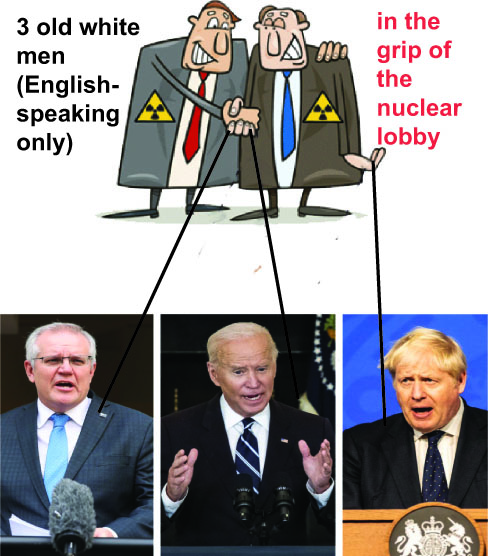
How to lose friends and infuriate people, SMH, Niki Savva 22 Sept 21 Scott Morrison’s momentous national security announcement last week should have been a turning point for him and the government. Instead, because he delayed making one tough call, leaving himself open to accusations of backstabbing and deception from a great friend and ally, he robbed himself of a much-needed reset.
A few days later he again squibbed what should have been a straightforward decision involving a senior colleague, on a matter which goes to the heart of transparency and probity.
Both were about trust. Both provided insights into the most troubling aspects of Morrison’s character and management style. Both have left a very bad smell.
The first was the big-bang unveiling of the new Anglospheric alliance – upending decades of diplomatic endeavours in Asia – which included the planned acquisition of nuclear submarines from the US or the UK.
By waiting until the night before the announcement to advise President Emmanuel Macron (Morrison’s office refuses to answer when asked if they actually spoke) he was torpedoing the $90-billion contract with France for conventional submarines, he guaranteed they went nuclear.
The second sounded like a transmission from a parallel universe. Morrison presented Christian Porter’s resignation from Cabinet as industry minister after refusing to disclose names of anonymous donors as the action of a man upholding standards………………….
Over breakfast, Australians watched Morrison standing beside a man who could not remember his name, who looked like he should have stayed in bed, and another man who looked like he had just got out of bed.
Sleepy Joe Biden, fresh from the Afghanistan withdrawal disaster, and Boris Johnson, who has had trouble counting the number of children he has, desperately seeking to create a place for Britain in the world post-Brexit.
One of Australia’s most senior and most respected former diplomats, John McCarthy, who chafes at the overhyping of the deal while not dismissing its importance, is still mulling over its implications. But he seems sure about one thing: none of those three leaders is up to the challenges which lie ahead.
McCarthy says Morrison has limited experience and probably lacks the smarts. Biden is not a bad man but is mediocre, and if Lord North, prime minister from 1770 to 1782 during most of the American War of Independence, is the worst the UK has ever produced, then Johnson is right up there with him.
McCarthy names two leaders he believes would be capable. One, Angela Merkel, has just retired and the other – cue the French horn – is Macron. https://www.smh.com.au/national/how-to-lose-friends-and-infuriate-people-20210922-p58toz.html
What is Scott Morrison doing in New York? Nothing on climate, it seems.

While other world leaders arrive in New York to discuss cooperation on Covid and climate, Morrison will trying to patch up his submarine blunder. The post What is Scott Morrison doing in New York? Nothing on climate, it seems appeared first on RenewEconomy.
What is Scott Morrison doing in New York? Nothing on climate, it seems — RenewEconomy
Scott Morrison has landed in New York for a week of meeting with international leaders, but the prime minister is likely to spend the time trying to mend damaged diplomatic relationships rather than engaging with other world leaders on climate issues.
World leaders are convening in New York this week for the next session of the UN General Assembly, which will largely be focused on the ongoing response to the Covid pandemic, fostering economic recovery, and preparations for the next round of climate change negotiations that will be held in Glasgow in a few weeks time.
Several critical meetings have already been held, including a call from the UN for leaders to “stop ignoring the science.” But, like his last visit to New York, when Morrison avoided a UN climate meeting in favour of dinner with Donald Trump, he has other priorities.
Morrison major focus now will be dealing with the ongoing fallout from the cancellation of Australia’s submarine deal with France. This self-inflicted blunder has seen relations sour with the broader European community while implicating allies the United States and the United Kingdom, and possibly putting a climate deal with China at risk.
The mishandling of that deal means Morrison arrives in New York with a new level of unpopularity amongst world leaders, and now needing to navigate a frosty diplomatic relationship with European leaders threatening to scuttle a free-trade agreement between Australia and the EU that has been years in the making.
Morrison will meet with leaders from Sweden and Austria and European Commission president Ursula von der Leyen, who has already described Australia’s treatment of France as “unacceptable”.
The European leaders could look to punish Australia on two fronts – to send a message over the cancelled $90 billion submarine deal, as well as following through with the introduction of export tariffs on Australia’s carbon intensive exports to account for Australia’s virtually non-existent price on carbon pollution.
While in the US, Morrison will meet with other leaders of the “quad” strategic dialogue, which includes US president Joe Biden, Japanese prime minister Yoshihide Suga and Indian prime minister Narendra Modi to discuss regional security measures.
However, it is unlikely that Morrison will engage in any discussions that relate to climate change policy – with Australia already on the outer of international talks due to a refusal to adopt stronger climate change targets.
Morrison is not listed to address the UN General Assembly, and Australia was not invited to participate in a climate change roundtable convened by UN secretary-general António Guterres and UK prime minister Boris Johnson……………… https://reneweconomy.com.au/what-is-scott-morrison-doing-in-new-york-nothing-on-climate-it-seems/
Ballarat Council considers supporting the U.N. Treaty on the Prohibition of Nuclear Weapons
Question raised as to why Ballarat councillors are discussing nuclear weapons, https://www.3ba.com.au/news/local-news/108123-question-raised-as-to-why-ballarat-councillors-are-discussing-nuclear-weaponsNuclear arms will be on the agenda at Wednesday night’s City of Ballarat council meeting, with one councillor labelling it a waste of time.
Councillors will vote on whether or not to support a treaty on the prohibition of nuclear weapons.
Cr Ben Taylor says it’s disappointing they are dealing with items that have nothing to do with Ballarat.
“We’re in the middle of a lockdown, people are worried about their jobs and their kids not going to school and Ballarat City Council seems to want to put their attention on the prohibition of nuclear weapons.”
“It’s got nothing to do with Ballarat and nothing to do with Australia,” Cr Taylor said.
1 This month

of the week – Australians for War Powers Reform (AWPR)
To see nuclear-related stories in greater depth and intensity
 Antinuclear