Nuclear powered submarines for Australia

But now, the federal government has secretly decided that Australia will acquire nuclear submarines and any consultation will likely be tokenistic. This is the DAD ‒ Decide, Announce, Defend ‒ approach which is the antithesis of good government.
Despite the government’s secrecy and obstinacy, the plan for nuclear submarines could easily collapse for any number of reasons ‒ economics, the availability of superior options, public and political opposition etc.
Dr. Jim Green, National nuclear campaigner, Friends of the Earth Australia, online at https://nuclear.foe.org.au/nuclear-powered-submarines-for-australia/ 16 Sept 21,
Following secret deliberations, the Morrison government has announced that Australia will acquire nuclear-powered submarines.
Alternatives
Because the process has been entirely secret, we have no way of knowing whether alternative options have been properly considered. These include the options of building fewer submarines (or none at all), and advanced lithium-ion battery technology to power submarines (South Korea’s choice after 30 months of comprehensive evaluation).
Weapons / security
Nuclear powered submarines typically use highly-enriched uranium (HEU) fuel. This would undermine global efforts to phase out the use of HEU because of WMD proliferation and security concerns.
The Nobel Peace Prize-winning International Campaign to Abolish Nuclear Weapons notes: “Military nuclear reactors in Australia would present a clear nuclear weapons proliferation risk and become potential sites for nuclear accidents and radiological contamination long into the future.”
The government wants to build nuclear submarines in suburban Adelaide. Does that put a target on our back? Is it prudent to build nuclear submarines in a city of 1.3 million people? What alternative locations have been considered, if any?
Does the government secretly want to bring Australia closer to a nuclear weapons capability with a nuclear submarine program? Do such deliberations explain why the Morrison government refuses to sign the UN’s Treaty on the Prohibition of Nuclear Weapons and has actively undermined the Treaty at every step? (In the late 1960s, John Gorton’s government actively pursued a nuclear power program and Gorton later acknowledged a hidden weapons agenda. Gorton actively opposed Australia signing the UN’s Nuclear Non-Proliferation Treaty.)
Broader nuclear industry?
Then Defence Minister Christopher Pyne noted that in 2019 that Australia would be the only country in the world with nuclear submarines but no domestic nuclear industry to back them up.
All countries operating nuclear submarines (the five ‘declared’ weapons states plus India) have both nuclear power and weapons.
Building a domestic nuclear industry to support nuclear submarines would be astronomically expensive and problematic in other respects. Nuclear power is vastly more expensive than renewables ‒ and significantly more expensive than renewables plus backup stored power (batteries, pumped hydro storage, etc.)
Opposition leader Anthony Albanese says that Labor support for nuclear submarines is conditional on there being no requirement for a domestic civil nuclear industry (among other conditions).
Nuclear waste
The government has been silent about disposal of the high-level and intermediate-level nuclear waste generated by a nuclear submarine program.
No country in the world has a repository for high-level nuclear waste. The only deep underground nuclear waste repository in the world ‒ the Waste Isolation Pilot Plant in the US, for disposal of long-lived intermediate-level nuclear waste ‒ was shut down from 2014 to 2017 following a chemical explosion in a waste barrel, with costs estimated at $2 billion (clean-up, lost income etc).
Waste from a nuclear submarine program would be dumped on Aboriginal land, as is the case with the federal government’s current plan to dump Australia’s nuclear waste at Kimba in SA despite the unanimous opposition of Barngarla Traditional Owners. It speaks volumes about the crude racism of the federal and SA Coalition governments that they are prepared to ignore unanimous Aboriginal opposition to a nuclear dump. The federal government even fought to exclude Traditional Owners from a so-called ‘community survey’. SA Labor’s policy is that Traditional Owners should have a right of veto over any proposed nuclear facility including a nuclear waste dump.
Economics
The high-level and long-lived intermediate-level nuclear waste generated by nuclear submarines would cost tens of billions of dollars to dispose of, based on cost estimates overseas. For example, the cost estimate for a high-level repository in France is A$40 billion. The US government estimates that to build a high-level nuclear waste repository and operate it for 150 years would cost A$130 billion. The South Australian Nuclear Fuel Royal Commission estimated a cost of A$145 billion over 120 years for construction, operation and decommissioning of a high-level nuclear waste repository.
It is highly unlikely that the government has considered these massive long-term costs in its secret deliberations.
Democracy
A 2019, a federal government-dominated parliamentary committee released a report on nuclear power titled ‘Not without your approval’. The report emphasised that nuclear power would not be pursued without community support.
But now, the federal government has secretly decided that Australia will acquire nuclear submarines and any consultation will likely be tokenistic. This is the DAD ‒ Decide, Announce, Defend ‒ approach which is the antithesis of good government.
Despite the government’s secrecy and obstinacy, the plan for nuclear submarines could easily collapse for any number of reasons ‒ economics, the availability of superior options, public and political opposition etc.
What does the nuclear submarines announcement mean for Australia?
The Australian Conservation Foundation’s Dave Sweeney explains what today’s
announcement – that Australia’s next submarine fleet will be nuclear-powered – might mean
for Australia.
“While there is much we still don’t know about the new defence deal with the USA and
Britain, this is a significant move with serious implications for Australia.
“Nuclear powered submarines pose specific environmental and security concerns – to
Australian ports, shipyards and seas.

16 Sept 21, “At this stage it’s not clear whether the plan is to manufacture nuclear-powered submarines in Australia or to assemble submarines that have been purchased from the UK and the US, but regardless this announcement raises concerns about the management of nuclear waste and the human and environmental impacts.
“This arrangement will further imbed Australia into global war-fighting plans and is a blow to Australian sovereignty.
“It is worth noting the UK and USA are both in breach of their international obligations on nuclear weapons.
“ACF welcomes the Prime Minister’s commitment today that this new arrangement does not signal a move towards domestic nuclear power or nuclear weapons. “Australians could have confidence in the Prime Minister’s statement if he signed and ratified the Treaty on the Prohibition of Nuclear Weapons now. “Not to do so leaves the door open for a future stealthy slide towards nuclear weapons.
“Nuclear submarines and aircraft carriers are powered by onboard nuclear reactors. “The controlled splitting of atoms releases heat which boils water and generates steam. This in turn drives turbines that power the propellor and provide electricity for the vessel. “Nuclear power does not require air, so the submarine can remain submerged for long
periods.
“It is likely these submarines would be prohibited from visiting New Zealand and many
Pacific nations that have bans on nuclear-powered vessels.
Too slow, too expensive: Why nuclear power makes no sense for Australia — RenewEconomy

Nuclear makes no sense economically and it makes no sense because we have better, cheaper and more viable energy alternatives right now. The post Too slow, too expensive: Why nuclear power makes no sense for Australia appeared first on RenewEconomy.
Too slow, too expensive: Why nuclear power makes no sense for Australia — RenewEconomy
As predictable as the sun rising in the east, or the Nationals having a leadership spill, Australia is once again facing a campaign from nuclear advocates to start a nuclear energy industry on our shores. This is a rabbit hole we have been down before and the basic facts haven’t changed – nuclear energy remains too expensive, too slow to build, and makes no sense for Australia.
It makes no sense economically and it makes no sense because we have better, cheaper and more viable energy alternatives right now. We should be pursuing the much cheaper alternative of firmed renewables that will reduce power bills for Australian households and businesses while also reducing Australia’s emissions. Nuclear is another
distraction obstructing us from realising our real need – affordable,clean and reliable energy.
Morrison says sub deal won’t lead to nuclear power push in Australia. Don’t believe him — RenewEconomy

Morrison says he has no plans for nuclear power plants despite nuclear subs deal. But conservatives and the pro-nuclear lobby won’t stop trying. The post Morrison says sub deal won’t lead to nuclear power push in Australia. Don’t believe him appeared first on RenewEconomy.
Morrison says sub deal won’t lead to nuclear power push in Australia. Don’t believe him — RenewEconomy
Prime minister Scott Morrison insisted on Thursday morning that the landmark nuclear submarine deal struck with US president Joe Biden and UK prime minister Boris Johnson won’t translate into a push for nuclear power plants in Australia.
“Let me be clear: Australia is not seeking to establish nuclear weapons or establish a civil nuclear capability. And we will continue to meet all of our nuclear non-proliferation obligations,” Morrison said.
On the issue of nuclear power plants, don’t believe him. Morrison could hardly have said anything else. It’s one thing to announce a switch to nuclear powered submarines without any broad social discussion, but quite another to commit the country to nuclear power.
But the pro-nuclear lobby – both within and without the federal Coalition government – won’t be able to help themselves, even if the reality is that the sub construction won’t likely even start for the best part of a decade, such is the complexity of the technology.
The lobby will say it is bizarre that Australia could be the only country in the world planning to sustain a nuclear powered submarine fleet without a civil nuclear industry. And the argument is already being put that if Australia is happy to host nuclear power in a tin can under the sea, then why not in a land-based power plant.
Australian Greens blast nuclear submarine deal.
Floating Chernobyls: : Greens blast sub deal https://www.perthnow.com.au/politics/floating-chernobyls-greens-blast-sub-deal-c-3978289, Matt CoughlanAAP, September 16, 2021
The Greens have warned Australia acquiring nuclear-powered submarines will create “floating Chernobyls” in the heart of major cities.
The UK and US will give Australia access to top secret nuclear propulsion technology for a fleet of new submarines to be built in Adelaide through new security pact AUKUS.

Greens leader Adam Bandt believes the move increases the prospect of nuclear war in the region and puts Australia in the firing line.
“It’s a dangerous decision that will make Australia less safe by putting floating Chernobyls in the heart of our major cities,” he told the ABC on Thursday.
It’s a terrible decision. It’s one of the worst security decisions in decades.”
Mr Bandt said the Greens would fight the decision and urged Labor to do the same.
“The prime minister needs to explain what will happen if there’s an accident with a nuclear reactor now in the heart of one of our major cities?” he said.
“How many people in Brisbane, Adelaide or Perth, will die as a result of it? What is going to happen if there is a problem with one of the nuclear reactors?”
It is understood the submarines will not require a civilian nuclear capability but rather will have reactors and fuel which will last the life of the vessel.
Independent senator and former submariner Rex Patrick wants an urgent parliamentary inquiry to report before the next federal election.
Senator Patrick, who has been a vocal critic of the $90 billion French submarine deal that is now over, said scrutiny was crucial.
We have to be careful we don’t move from one massive procurement disaster into something else that hasn’t been thought through properly,” he said.
The government has sunk $2.4 billion on the French program and is negotiating on other compensation, which remains commercial in confidence.
Labor leader Anthony Albanese and three senior frontbenchers received a briefing ahead of the announcement on Thursday morning.
Napandee radioactive waste dump plan – a nuclear waste of money.
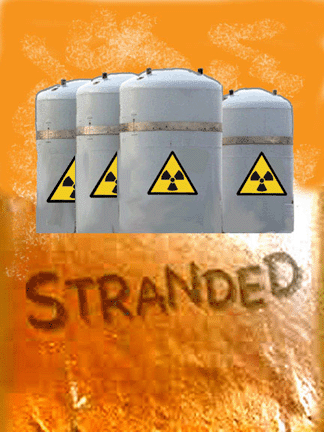
“A Nuclear waste of money – Greenies”The Advertiser 14Sept 2021 p.9 MICHELLE ETHERIDGE
RADIOACTIVE waste should be stored at an expanded nuclear medicine production site in Sydney, rather than shipped to Kimba, opponents of the Eyre Peninsula project say.
The federal government has set aside $59.8m over four years for an expansion of “temporary” nuclear waste storage at Lucas Heights, NSW. During a parliamentary committee hearing on Monday, conservation groups argued the project rendered unnecessary a plan to move intermediate-level waste to a new facility near Kimba, where it is to be stored for several decades.
The federal government says space for some types of nuclear waste at Lucas Heights will be exhausted by 2027 and the expansion will provide at least a further 10 years’ capacity until the new national radioactive waste site planned for Napandee, near Kimba, is operational about or after 2030. Conservation SA chief executive Craig Wilkins, said his organisation supported keeping the waste at Lucas Heights until a longterm deep geological (underground) repository was found.
“I and others are genuinely scratching our heads as to why this waste from ANSTO (Australian Nuclear Science and Technology) is being transferred from one temporary place that’s safe and secure to another place on an interim basis. This is … a phenomenal waste of money,” he said.
The Australian Conservation Foundation’s Dave Sweeney said waste could become stranded at Kimba in the absence of a long-term plan. ANSTO staff said the new Lucas Heights facility would have a life of about 50 years
Too late to pull out of Australia’s botched super-expensive submarines purchase?
‘Lost the plot’: How an obsession with local jobs blew out Australia’s $90 billion submarine program, By Anthony GallowaySEPTEMBER 14, 2021 Nick Minchin isn’t surprised Australia’s future submarines are arriving later than expected and $40 billion more expensive. He has seen it all before……..
I was staggered by that, no wonder we ran into financial difficulties with Defence’s estimates of maintaining and operating these things,” Minchin tells The Sydney Morning Herald and The Age…………
Now, history is repeating itself.
Australia’s 12 new attack-class submarines – Australia’s largest military acquisition in its history – were originally slated to cost between $40 billion and $50 billion. According to the latest projections they will now cost about $90 billion to build and $145 billion to maintain over their life cycle. Despite the fact former prime minister Tony Abbott promised the first of the submarines would be in the water by the mid-2020s, it is now not scheduled to become operational until the mid-2030s.
In the current debate on Australia’s submarine debacle, French-bashing has been all the rage. And with French builder Naval Group’s cost blowouts, schedule slippages and dubious commitments on meeting local content requirements – it’s been an easy sport. But it’s worth asking: would we have arrived at this point regardless of which bidder we chose? After all, Defence’s acquisition debacles are not confined to French-designed submarines…………….
And it’s not just submarines where there are inherent problems………..
………………. the Abbott government opted for a deeply flawed Competitive Evaluation Process which led to the current mess.”.
……….. On April 26, 2016, Turnbull announced France had won the hard-fought global race for the $50 billion contract and all the submarines would be built in Adelaide. According to Turnbull, the recommendation from Defence was “unequivocal” that the French proposal for a conventionally powered version of the latest French nuclear submarine design – the Shortfin Barracuda – was the best of the three options.
Is it too late to pull out?
Once Scott Morrison took over the prime ministership, the project was already going off course. By late 2019, Defence officials conceded that the cost of building and maintaining the submarines would total $225 billion over the life of the program, while concerns were mounting about Naval Group’s schedule slippages and its ability to meet its local content commitments, which were never written into the agreement.
…………. Morrison tasked Vice-Admiral Jonathan Mead and Commodore Tim Brown to look at alternative options for the submarine fleet, including long-range conventionally powered submarines that Swedish company Saab Kockums had offered the Dutch navy. The government also rejected Naval Group’s proposal outlining the next two-year phase of the program, telling the company it needed more information on how its cost and schedule projections would be met.
After taking over the defence portfolio, Peter Dutton told The Sydney Morning Herald and The Age he was having some “frank discussions” with his department. A month later, Dutton revealed he had ordered life-of-type extensions for all six Collins-class submarines, which involves completely rebuilding them so they can continue to operate beyond their planned retirement date of the mid-2020s. Dutton also tasked Defence to embrace more asymmetric warfare capabilities by acquiring long-range missiles and drones, which can be “produced in bulk, more quickly and cheaply, and where their loss would be more tolerable, without significantly impacting our force posture”.
After taking over the defence portfolio, Peter Dutton told The Sydney Morning Herald and The Age he was having some “frank discussions” with his department. A month later, Dutton revealed he had ordered life-of-type extensions for all six Collins-class submarines, which involves completely rebuilding them so they can continue to operate beyond their planned retirement date of the mid-2020s. Dutton also tasked Defence to embrace more asymmetric warfare capabilities by acquiring long-range missiles and drones, which can be “produced in bulk, more quickly and cheaply, and where their loss would be more tolerable, without significantly impacting our force posture”.
Within the next week, the government is expected to announce it has reached a deal with Naval Group on the next two-and-half years of the submarine program.
By then, it almost certainly will be too late to pull out. https://www.theage.com.au/politics/federal/lost-the-plot-how-an-obsession-with-local-jobs-blew-out-australia-s-90-billion-submarine-program-20210913-p58r34.html
News Corpse’s new snide approach on climate change – to help Morrison win next election?

“This may be more about giving Morrison cover going into an election year, by establishing the pathetically low bar of ‘net zero carbon by 2050’ as somehow constituting meaningful action, particularly given that he is being roundly criticised by the world community for his meager climate commitments going into COP26,” Mann said on Friday…….
“Focusing on a target of 2050, three decades away, kicks the can so far down the road that it’s largely meaningless.”….…
News Corp about-turn on emissions too little, too late, scientists say, The Age, By Nick O’Malley and Amelia McGuire, September 11, 2021 ”’……….. When The Sydney Morning Herald and The Age reported that News Corp papers were planning a climate push, it made news around the world……
One of the Journal’s own former editors tweeted of the paper’s climate coverage, “No group has been more clueless, duplicitous or irresponsible on climate change than the WSJ edit and op-ed crew.”
He attached a string of climate sceptic headlines from the past six weeks…….
It is hard to exaggerate how News Corp’s coverage of climate change – and of climate scientists themselves – have scarred the sector. In his recent book The New Climate Wars, leading climatologist Michael Mann wrote that the company’s amplification of a false conspiracy known as “climategate” helped derail the Copenhagen climate summit in 2009, setting back global efforts to rein in warming by crucial years.
In Australia critics say the coverage has contributed to decades of policy inertia on the issue………..
In December 2020, Wendy Bacon and Arunn Jegan analysed all news, features, opinion pieces, letters and editorials discussing climate change that appeared in The Daily Telegraph, Herald-Sun, Courier Mail and The Australian between April 2019 and March 2020.
They found 45 per cent of all coverage either rejected or cast doubt on consensus scientific findings. Their research asserted that most News Corp reporters do not promote sceptical views, but of 55 per cent of stories that accepted climate science, misunderstandings about that science were almost always promoted rather than explained, and the reporting on the effects of climate change was negligible.
Half of the news and feature stories either had no source or one source.
Nearly two thirds of published opinion pieces were sceptical of climate science. The top five climate sceptics were Sky News presenters Andrew Bolt, Tim Blair, Peta Credlin, Peter Gleeson and Chris Kenny…….
According to Marian Wilkinson, whose recent book The Carbon Club is a forensic analysis of the interplay between the political, media and industry actors who have stalled action on climate in Australia for decades, News Corp’s coverage influenced other media in the country.
She believes even the ABC “pulled its punches” on climate coverage for fear it would look soft when compared with the Murdoch press’s hardline climate denialism.
Wilkinson is one of many who believe that Australian climate and energy policy has been rudderless for decades, but she does not blame News alone.
Rather she says the Murdoch empire helped derail climate action along with well-connected fossil fuel industry lobbyists and complicit politicians from both parties………
“This may be more about giving Morrison cover going into an election year, by establishing the pathetically low bar of ‘net zero carbon by 2050’ as somehow constituting meaningful action, particularly given that he is being roundly criticised by the world community for his meager climate commitments going into COP26,” Mann said on Friday…….
“Focusing on a target of 2050, three decades away, kicks the can so far down the road that it’s largely meaningless.”……. https://www.theage.com.au/environment/climate-change/news-corp-about-turn-on-emissions-too-little-too-late-scientists-say-20210910-p58qja.html
Sloppy and unconvincing pro nuclear propaganda from the Australian Nationals and the Murdochracy

The Australian nuclear promotion is less persuasive. Coming predominantly from Murdoch media, the content of nuclear propaganda is sloppy, inaccurate, and at times downright weird.
The Nationals and Murdoch media support nuclear power ahead of COP26, Independent Australia,By Noel Wauchope | 9 September 2021.
On 1 September 2021, Senator Matt Canavan called for Australia to boycott the 2021 United Nations Climate Change Conference (COP26) to be held in Glasgow in November.
Was he speaking on behalf of the coal or oil industries? Well, not exactly.
This was the latest and strangest call from Australia’s noisy little band of pro-nuclear promoters. Canavan was responding to the news that the nuclear industry has been banned from having exhibits at COP26. He complained that the Climate Summit was a ”sham” for excluding nuclear power, a view supported by MP Ken O’Dowd.
O’Dowd said that nuclear power should be at the top of the climate agenda. Other National Party notables, David Littleproud and Bridget McKenzie, recently spoke out for nuclear power.
Like the nuclear industry worldwide, they are now taking up the cause of climate action with a vengeance. The nuclear lobby’s motives are clear. First, they likely want the tax exemptions and other subsidies that come with being declared as clean and sustainable. Secondly, they need that seal of approval, the public respectability which goes with acquiring the clean and green label.
The global lobby’s most persuasive argument is that a nuclear reactor’s operation generates a lot of electricity, with only a minuscule production of CO2.
They don’t, of course, talk about the processes of the nuclear fuel chain from uranium mining through to demolition of dead reactors and disposal of wastes. Their favourite phrase ”emissions-free energy” doesn’t count emissions of radioactive strontium-90.
The Australian nuclear promotion is less persuasive. Coming predominantly from Murdoch media, the content of nuclear propaganda is sloppy, inaccurate, and at times downright weird. The Australian newspaper provides two outstanding examples
The first is this eye-catching article ‘Savvy activists cast nuclear benefits in a fresh green light‘ subtitled:
‘For baby boomers, nuclear weapons and nuclear energy were conflated as an existential risk. This created an irrational fear that persists today.’
From the outset, the argument is an attack on anti-nuclear activists, instead of arguing the case for nuclear power.
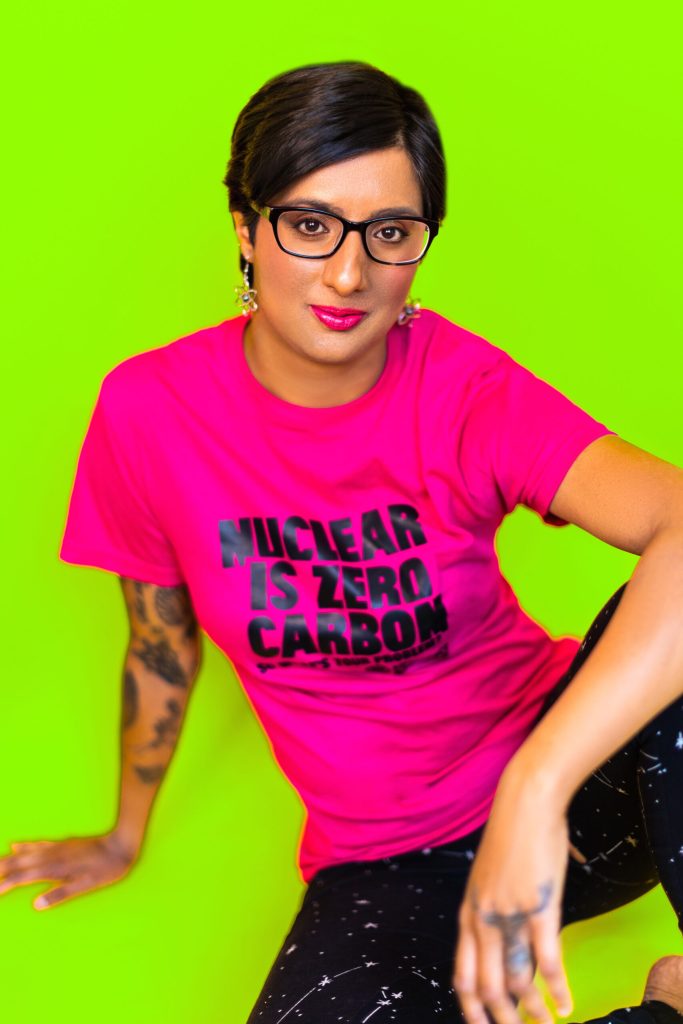
The hero of the piece is Zion Lights, formerly of Extinction Rebellion, who created her own pro-nuclear group, Emergency Reactor.
She works closely with Michael Shellenberger, who, himself, has lost the support of the general nuclear lobby, due to his many inaccurate statements. Zion Lights and The Australian go into a lengthy digression on the foibles of the baby boomers, who have ‘conflated nuclear weapons and nuclear energy as an existential risk that could wipe out humanity’.
The health effects of the Chernobyl and Fukushima disasters are minimised and renewable energy is rubbished as being ineffective.
The author, Claire Lehmann, concludes that the too-slow movement towards carbon neutrality is the fault of the misguided anti-nuclear baby boomers.
The second article is ‘Nuclear stacks up — cue the meltdown‘ by Greg Sheridan, who starts by accusing Australians as being ‘environmental outliers’ for prohibiting nuclear power…………..
the main thrust of this pro-nuclear argument moves on to an attack on Labor, the Greens and so forth:
‘… the deadly, wretched, wholly negative, nihilistic scare campaigns and demonising that the ALP left and its Green allies have conducted against nuclear energy.’
There is no attempt to address any of the worrying issues that surround nuclear power — costs, safety, environmental damage, radioactive waste. He reminds us that Bill Gates backs nuclear power. Well of course Gates does — he owns a nuclear power company, Terra Power.
He also quotes the European Union (EU) as backing nuclear power. While several EU countries do have nuclear power, the EU as a whole is not recommending nuclear powers as a climate solution. In fact, the nuclear industry is banned from exhibiting at the green zone at COP26………
As I write this comes the breathtaking news that the Murdoch media is changing its attitude to global warming. From a rather crude sort of climate denialism, they will likely move to supporting technical “climate fixes” spruiked by the fossil fuel industries. This is a more subtle way of sabotaging real climate action.
Perhaps we can expect them also to provide something more credible on the nuclear issue in the future. https://independentaustralia.net/environment/environment-display/the-nationals-and-murdoch-media-support-nuclear-power-ahead-of-cop26,15496
Senator Matt Canavan – a chameleon of contradictions on coal and nuclear power

One minute all for coal, the next it’s nuclear. Can you believe a word this guy says?
Resources Minister Matt Canavan has hosed down the prospect of nuclear power helping solve the nation’s energy woes, saying the disposal of low-level radioactive waste was already a problem.
Canavan cold on the push for nuclear powerhttps://www.afr.com/companies/energy/canavan-cold-on-the-push-for-nuclear-power-20190903-p52nir?fbclid=IwAR2dHiUWJ4cplt9pkNCTfajuqpIYTGoaCzMTWoirS2N2dpVTy2hOJllIhqgMark Ludlow
While there has been a push for nuclear energy to replace coal-fired power stations when they finally exit the National Energy Market, the pro-coal Queensland senator said he had his doubts, saying it was still too expensive and did not have bipartisan support.
The issue of disposal of radioactive waste was still a major hurdle to overcome, he said.
Senator Canavan said he was the minister responsible for trying to find a home for low and intermediate-level radioactive waste from the sole nuclear reactor at Lucas Heights in Sydney’s south-west that is used for the production of nuclear medicine.
We’ve been trying to find a home for 40 years for that waste. It’s difficult because of the concerns about managing that waste. I completely understand that,” he said before a speech to the Queensland Resources Media Club in Brisbane.
“Obviously, if we can’t find a long-term solution for that level of waste it’s pretty hard to fathom that we could go beyond that for the production of nuclear energy that does produce a larger amount and more waste of a higher category to manage.”
………. Pro-nuclear advocates say next-generation smaller nuclear reactors could be built for about $2.7 billion each. Other sceptics say nuclear power would not be viable for another 20 years – and only if there were some form of carbon price.
But Senator Canavan said despite the inquiry and the support of some prominent conservative politicians, he had reservations about the price of nuclear power. ”No one is going to make predictions about what happens in 20, 30 or 40 years’ time. All I want to see is a system which allows the most affordable and sustainable energy solutions coming forward,” he said.
“I have previously expressed that it’s relatively expensive and, obviously, we do have a task at hand domestically at the moment to get down our high power prices.
“We’re not afraid of the discussions or conversations and we have rightly said any change would have to be bipartisan, which is unlikely right now.”
Talking up coal
Senator Canavan talked up the prospects of coal exports………….https://www.afr.com/companies/energy/canavan-cold-on-the-push-for-nuclear-power-20190903-p52nir?fbclid=IwAR2dHiUWJ4cplt9pkNCTfajuqpIYTGoaCzMTWoirS2N2dpVTy2hOJllIhqgMark Ludlow
New Australian law allows security agencies to spy on, and manipulate your data – mainstream media ignores this.

Human rights violations now enshrined in legislation – in Australia, https://www.michaelwest.com.au/human-rights-violations-now-enshrined-in-legislation-in-australia/, By Greg Barns, September 5, 2021 Last week, the Morrison government, supported by the ALP, passed a law that allows for security agencies, on the most flimsy of pretexts, to access and manipulate the electronic data of any citizen. It continues the slide into authoritarianism that started with the Tampa affair 20 years ago.
The “Identity and Disrupt Bill 2021” shows the dangerous capture of the body politic by Australian Federal Police (AFP) and Australian Crime Commission (ACC) and other agencies is today. It shows little or no regard for the right to privacy and the rule of law more broadly. And it adds to the already wide suite of powers security agencies have acquired in recent years to surveil and track us.
Here is how this law works. An AFP or ACC officer “may apply to a judge or a member of the Administrative Appeals Tribunal” for what is called a “data disruption warrant”. This means the officer can add, copy, delete or alter data held in the computer.
The threshold for getting such a warrant is low. All the officer needs to show is that he or she “suspects on reasonable grounds that” an offence is being, or is “likely to be” committed or has been committed, and that disruption of data held in the computer “is likely to substantially assist in frustrating the commission of offences involving that computer”.
If that is not troubling enough, there is power for the officer to seek the immediate issue of the warrant, if it is “impracticable” for them to prepare an affidavit setting out the basis for seeking the warrant. The affidavit does not have to be filed until 3 days later. And they can get the warrant by “telephone, fax, email or any other means of communication.”
But this warrant is not the only new surveillance tool in the legislation. There is a “network activity warrant” which lets law enforcement access, for example, the dark web.
And perhaps most troubling of all, is the ability, again with a low threshold set, for law enforcement officials to take over a person’s online accounts. The so called “account takeover warrant” can be sought from magistrate if the AFP or ACC officer has the same reasonable grounds belief as for a data disruption warrant, and they are of the view that:
But don’t worry, because the law has a 5 year sunset clause. It will be overseen by the Inspector General of Intelligence and Security, and the Independent National Security Legislation Monitor will review the bill in 2024. Of course the minister responsible, Peter Dutton, will ensure the powers are not abused by the AFP and ACC.
The self-serving rhetoric and justification for this latest assault on the rule of law and human rights in Australia from the AFP and ACC is that they need to be able to fight online criminal activity with all available tools. When have you ever heard a security or law enforcement agency say anything different?
This legislation reflects another failure on the part of the legislature to scrutinise and check the power of executive government. But this is now de rigueur when it comes to legislation involving an increase of intrusive powers which governments of all persuasions introduce these days.
The capacity of the AFP and ACC to invade an individual’s online accounts could lead to the destruction of exculpatory data, the manipulation of data, and the unlawful sweeping up of “evidence” that is unrelated to the warrant; or even remove what may be used as proof of innocence.
There will also be the enhanced capacity to entrap individuals. This is a practice rightly outlawed in the US and most European democracies, but sadly condoned here by the High Court in a series of cases.
Australia does not have a national human rights charter or law. Such instruments are a bulwark against authoritarianism and help to ensure abuses of power by law enforcement and security agencies are kept in check. A proper human rights charter would render such sweeping powers as we see in the Identity and Disrupt Bill illegal.
The fourth estate is also not doing its job. Other than some coverage in the tech media, there has been very little by way of comment from the mainstream media. While the frenzied criticising of the Government’s use of Covid powers continues unabated, legislation that violates our rights to privacy and threatens our human rights hardly cause a stir.
Wollemi Mine? Experts label Barilaro’s plan for new coal “corrupt”, unviable
 |
|
Wollemi Mine? Experts label Barilaro’s plan for new coal “corrupt”, unviable Michael West Media, By Callum Foote|September 3, 2021
The NSW government is pushing through new coal exploration areas in the state’s mid-west, which have been labelled unviable and “corrupt” by independent experts even as the G7 call a halt on all new coal mining reports Callum Foote.
It’s better known for its rare Wollemi Pine but in the grotesque tradition of aggressive fossil fuel development, even as the world pulls out of coal mining, it may now be known for its Wollemi Mine.
Rylstone, a small town in the Central Tablelands of NSW, 25 km from Mudgee, is under threat from a suite of proposed coal exploration areas that the NSW government has been trying to auction off since mid-last year.
Despite the NSW government’s attempts to cultivate a green brand, John Barilaro’s 2020 Strategic Statement on Coal Exploration and Mining in NSW has opened up productive farmland, adjacent to the world-heritage listed Wollemi national park to brand new coal exploration.
Together, the proposed new coal release areas will encompass over 10 thousand hectares of land in Hawkins and Rumker areas surrounding Rylstone. This comes after the federal and Northern Territory governments together opened a landmass totalling 110,000km sq to gas exploration in 2021 alone.
Expert analysis
The NSW Government’s support of new coal infrastructure makes little sense to Rod Campbell, Research Director at The Australia Institute, “as an economist, it seems inconceivable that a new thermal mine in Rylstone, that couldn’t begin operations till 2030 could be economically viable.” According to Campbell, the proposed exploration areas “only makes sense that it is either a political deal or corruption.”
The NSW Government might have a difficult time finding buyers for their coal exploration licences as coal miners rush to disinvest from the industry. BPH, the worlds largest miner, is currently trying to pay anyone US$275 million to take Mt Authur, the biggest thermal coal mine in Australia, off their hands. In a report to investors this year, BHP wrote down a further $2.2 billion on their thermal coal assets as they attempt to transition to “future-facing” commodities.
Campbell believes that “it seems incredibly unlikely any serious mining company would be interested in developing a mine in the region.” Any proposed development would not be operational till “at least the second half of this decade and would face intense opposition and be very hard to finance,” said Campbell. ……………. https://www.michaelwest.com.au/wollemi-mine-experts-label-barilaros-plan-for-new-coal-corrupt-and-unviable/
Macedon Ranges joins 36 local councils to call on Australian government to sign and ratify the UN Treaty on the Prohibition of Nuclear Weapons.
Council raises voice on nuclear weapons Midland Express 01/09/2020 Macedon Ranges has joined the call for the federal government to sign and ratify the UN Treaty on the Prohibition of Nuclear Weapons.
The council last week joined 36 local councils to pass a motion in support of the International Campaign to Abolish Nuclear Weapons Cities for Peace Appeal.
Spearheading the move, Cr Annette Death was adamant that local government needed to consider the consequences of nuclear warfare and voice concern.
…….. Macedon Ranges doctor and Medical Association for Prevention of War member, Jenny Grounds, briefed the council in August on the impact nuclear war would inflict on local communities………… McEwen MP Rob Mitchell signed the International Campaign to Abolish Nuclear Weapons pledge in 2018, and last week welcomed the council’s move.
“Labor in government will sign and ratify the ban treaty and has recommitted to act with urgency and determination to rid the world of biological, chemical and nuclear weapons,” he said. https://midlandexpress.com.au/latest-news/2021/09/01/macedon-ranges-shire-council-adds-voice-to-anti-nuclear-campaign/
Morrison government moves to strengthen secrecy around energy ministers meetings

Details of key energy policy decisions could remain secret, as the Morrison government moves to protect National Cabinet deliberations from transparency laws. The post Morrison government moves to strengthen secrecy around energy ministers meetings appeared first on RenewEconomy.
Morrison government moves to strengthen secrecy around energy ministers meetings — RenewEconomy Michael Mazengarb 2 September 2021 The Morrison government has moved to strengthen the level of secrecy around the proceedings of National Cabinet – including the meetings of energy ministers – proposing new legislative amendments that will ensure the National Cabinet is exempt from a range of transparency measures, including freedom of information laws.
The move will extend to the ‘sub-committees’ of the National Cabinet, including the Energy National Cabinet Reform Committee chaired by federal energy minister Angus Taylor.
The new legislation, which will define the National Cabinet as a committee of the federal cabinet under a range of transparency laws, including the Freedom of Information Act, is designed to ensure the National Cabinet is protected from public disclosure obligations.
The legislation comes as a response to a landmark ruling of the Administrative Appeals Tribunal on a freedom of information request lodged by independent senator Rex Patrick, which ruled the National Cabinet was not covered by freedom of information exceptions, and documents relating to National Cabinet meetings should be disclosed publicly.
But the Morrison government has sought to effectively overturn this decision through the legislative amendments, ensuring the proceedings of National Cabinet, and its sub-committees, remain secret.
“Like the Commonwealth cabinet and its committees, all proceedings and documentation of the National Cabinet and its committees are confidential,” federal education minister Alan Tudge said when presenting the legislation.
In response, Patrick described prime minister Scott Morrison as a ‘sore loser’.
“Having acted outside and contrary to the law with regard to National Cabinet secrecy, the Prime Minister now wants to change the law,” Patrick said.
“He’s a sore loser who does not accept long-established conventions of Cabinet responsibility and democratic accountability. He hates scrutiny and is allergic to transparency.”
The creation of the Nation Cabinet came at the same time as the abolition of the COAG system, including the COAG Energy Council meeting of energy ministers. The change has allowed the Morrison government to take greater control of the National Cabinet process – and in the case of energy reforms – as meant that little detail of what is discussed amongst energy ministers is known publicly.
While state and territory ministers often publicly vented their frustration about the lack of national action on climate and energy policy around meetings of the former COAG Energy Council, the new National Cabinet regime means ministers are bound by cabinet confidentiality rules and have since been largely mute about any dissatisfaction they may harbour about the proceedings of the new committee.
The Energy National Cabinet Reform Committee has taken oversight for the work of the Energy Security Board. Its secrecy requirements have resulted in key information about energy market reforms being proposed by the Energy Security Board being withheld from the broader energy market for weeks after reform recommendations were delivered to ministers.
Much of the energy market was reliant on leaked information as their main source of knowledge about the Energy Security Board’s post-2025 re-design of the National Electricity Market – which will amount to the most significant shake-up of the market’s design since its formation.
The control that Taylor wields over the energy committee also meant that the first official public release of information about landmark energy market reforms was first released to news outlet
sympathetic to the Morrison government before it was released to the wider public.
The added protections being sought by the Morrison government will further prevent the release of information about meetings of the Energy National Cabinet Reform Committee – with the public left in the dark about even the agendas of meetings.
RenewEconomy has sought access to documents relating to meetings of the Energy National Cabinet Reform Committee on several occasions – as well as a wide range of documents relating to other government decisions through freedom of information laws, but access has been denied in most cases.
A recent review of freedom of information requests completed by the Grata Fund found that the Morrison government has often unlawfully blocked access to documents, undermining laws intended to support public transparency and accountability of government decisions.
The latest legislation looks set to be opposed by both Labor and the Greens. The Morrison government will likely be reliant on One Nation senators to pass the laws through the senate.
Need to investigate ANSTO’s tax-payer funded, loss-making, unnecessary nuclear medicine production

Australian government watcher, 28 Aug 21, The production of isotopes for medical purposes by nuclear reactors is a declining industry due to its inherently dangerous and risky nature and its extremely high manufacturing costs
These isotopes are being replaced by cyclotron produced isotopes which are practically and completely free of any risk to the patients and can be produced by relatively easier and safer means at a greatly reduced costs
The only reason that isotopes produced by nuclear reactors are used for medical purposes is that their manufacture is highly and unrealistically subsidised by government grants as is the case with ANSTO in Australia
The rapid growth in the international use of cyclotron isotopes for medical therapies is making the production of isotopes by nuclear reactors obsolete
As a result the continued production of isotopes for medical purposes by ANSTO at Lucas Heights could be stopped
immediately with huge savings in government expenditure and no effect on the provision of medical therapies
There were also arguments within ANSTO against the proposed corporatising of the medical isotopes production since this would expose all of its problems including its obsolete and outdated status and the extremely high production costs
In addition there are concerns both externally and within ANSTO internally about the cost and marketing difficulties with the Synroc technology which is far from the initially promoted commercial success and has been overtaken in many countries by their own developed alternatives to reduce the volume of nuclear waste and treat it to make it suitable for long-term storage and eventual disposal
In view of this it is essential for a full and proper independent inquiry and investigation into ANSTO to determine the true situation and make practical and hopefully cost saving recommendations as to its future operations
1 This month

of the week – Australians for War Powers Reform (AWPR)
To see nuclear-related stories in greater depth and intensity
 Antinuclear