Australian Labor Party backs bills to de-register most political parties
Australian Labor Party backs bills to de-register most political parties, WSWS, Mike Head, 25 August 2021 In a nakedly anti-democratic and self-serving move, the Labor Party’s parliamentary caucus this week agreed to assist the Liberal-National Coalition government push four far-reaching electoral bills through parliament with breakneck speed.
As a result of Labor’s complicity, the bills could be rammed through both houses of parliament and become law within days. In fact, the three main bills were rushed through the House of Representatives yesterday.There has been virtually no public discussion or media coverage on this historic attack, unveiled suddenly last week on the eve of the next federal election, which is due by May next year.
The bills contain a host of measures to suppress alternative political parties and the basic rights of voters. Neither the Morrison government nor Labor has offered any explanation as to why these bills have been brought forward now, seemingly out of the blue……..
The most sweeping provision in the bills seeks to strip party registration from every party not currently represented in parliament. It would compel parties to provide lists and details of 1,500 members—triple the existing requirement—within three months of the laws passing, all in the middle of widespread lockdowns.
Without party registration, federal election candidates for the Socialist Equality Party (SEP) and 35 other currently registered parties would be prevented from having their names and thus identifying their political affiliations on ballot papers. Their candidates would have to stand without any party name, or as undifferentiated and unexplained “independents.”
…….. Predictably, the existing parliamentary parties would continue to be exempt from any membership requirement whatsoever. They could well have difficulty nominating 1,500 members, unless they could count MPs, staffers, trade union officials and other office holders.
……… The only provision that Labor will not support is the lowering of “political campaigner” financial disclosure obligations for advocacy, welfare, environmental and other groups that participate in election campaigns.
…………. The same bipartisan front has been formed on every attack on fundamental democratic rights over the past two decades. This includes the repeated tightening of police-state “terrorism” laws, the “foreign interference” legislation to potentially outlaw links to international or overseas parties, and the 2017–2018 expulsion of members of parliament who were possibly entitled to dual citizenship, effectively disqualifying millions of people with immigrant backgrounds from even nominating for election.https://www.wsws.org/en/articles/2021/08/26/elea-a26.html
Political bribes beat the planet as gas fracking gets public hand-outs
Beetaloo Boondoggle: political bribes beat the planet as gas fracking gets public hand-outs, Michael West Media, Michael West| August 26, 2021
As a block, the two major parties voted to give our money, public money, to corporations to drill for coal seam gas in the Northern Territory, to open up a gigantic new territory, the Beetaloo Basin, for fracking.
The latest capitulation to corporate profits came yesterday morning as both the Coalition and Labor opposed a disallowance motion in Parliament to prevent $50m in public grants going to gas explorers in the Northern Territory. It was yet another political capitulation for corporate bribery, gas company donations.
And so it was that they voted to wreck the planet for their own financial gain. They even voted for money over common sense; because Australia is the world’s biggest gas exporter already. We don’t need more gas, that’s a myth peddled by Australia’s most powerful lobby groups such as APPEA, in turn controlled by foreign fossil fuel corporations such as Shell and Exxon.
They voted to make a US billionaire richer. For, among the prospective winners from this act of political betrayal, is Tamboran Resources, a speculative explorer backed by a US shale-oil billionaire.1
That company, incredibly, is threatening to sue Michael West Media and gas analyst Bruce Robertson from IEEFA, for defamation. So, effectively, Parliament has voted to give money to a US billionaire threatening to sue a small independent journalism business in Australia for exercising free speech, threatening to soak up the time in the Australian courts attempting to muzzle journalists with the menace of making them bankrupt.
Another winner from the escapade is senior Liberal Party figure Paul Espie, whose Empire Energy is slated to get half of the $50m in funding from his Beetaloo Cooperative Drilling grant program.
This is not just a case of our politicians being bought off yet again by corporations, bribed to push through a policy which wrecks the planet, it is a case of them using our money, public funds to pay foreign interests to poison the water tables of the world’s driest continent, to contaminate our most precious resource.
Meanwhile, 2700 kilometres south-east at Narrabri in NSW, Santos has won its long battle against farmers and the local community to frack for gas.
Santos is a large political donor to both major parties……….. https://www.michaelwest.com.au/beetaloo-boondoggle-political-bribes-beat-the-planet-as-gas-fracking-gets-public-hand-outs/
Tasmania: Liberals vote down Greens climate emergency motion with Premier claiming it ‘frightens’ children
Tasmania
Liberals vote down Greens climate emergency motion with Premier claiming it ‘frightens’ children
Premier Peter Gutwein has accused the Greens of “frightening” children after the party attempted to move a motion declaring a climate emergency based on the findings of the latest Intergovernmental Panel on Climate Change report.–
Kimba nuclear waste dump consultation? WHAT CONSULTATION?
Kazzi Jai Fight to stop a nuclear waste dump in South Australia, 24 Aug 21,
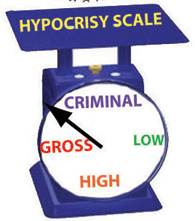
Consultation? What consultation? Right from the very start the whole dump process has been a SHAM! It has been nothing but a PR exercise laced with bribe money singling out South Australia as the dump site for all of ANSTO’s Lucas Heights NSW nuclear waste over 1700 kms away!
This is nuclear waste from industrial production of nuclear isotopes the bulk of which is exported overseas!! – It has nothing to do with loved ones in hospital actually using diagnostic isotopes for which that waste is held on site at the hospital and then officially released into normal waste streams – on a “retain and decay” basis as they are licenced by ARPANSA. This practice will not change with or without a dump!
This current proposal is nothing but a cheapskate attempt by the Feds to shaft nuclear waste onto South Australia so that it solely becomes South Australia’s responsibility, liability and problem! And the proposal is for the PERMANENT DISPOSAL of LOW LEVEL NUCLEAR WASTE in a TOTALLY ALL ABOVE GROUND DUMP!
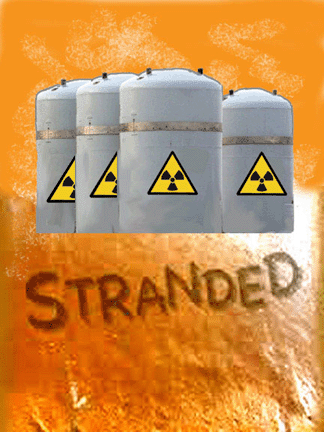
This is NOT STORAGE. This means the waste is there FOREVER! Should there be leakage or contamination from the waste – too bad – since it’s for PERMANENT DISPOSAL site ANYWAY!The “temporary” tag-a-long Intermediate Level Nuclear Waste will be stored as dry storage – as “temporary” designates “dry storage”.
The “temporary” tag on it certainly has nothing to do with any commitment by the Feds to deal with it anytime going into the future! It will become STRANDED waste which again, will remain solely South Australia’s responsibility, liability and problem!
And this is slap bang in the middle of wheat fields! A place which has NO past or present history with the nuclear industry!
And to add insult to injury, ANSTO relinquishes all responsibility of the waste once it hits SA’s soil! It’s off their books and they effectively wash their hands of it – it is no longer their problem!

Now Jeff Baldock may be foolish and naive, but given he has put up THREE pieces of land for this dump, seems more to be chasing the money coming from sale of his land!
This has NOT been an “open and transparent” process by any means!
The OBVIOUS LACK OF CONSULTATION is but one part of this very FLAWED proposal- a proposal which has not changed in FORTY YEARS mind you – and needs to be scrapped and take back to the drawing board – dealing with the Intermediate Level Nuclear Waste first and the Low Level Nuclear Waste can follow that – NO DOUBLE HANDLING! https://www.facebook.com/groups/344452605899556
Little chance for genuine community consultation on Napandee nuclear waste dump decision

MY COMMENTS
What is difficult about these legislative provisions is to know what they mean and why are they there
They are probably meaningless for it is only an invitation with no result to a very restricted group of persons.
I should have thought that if you had a right or interest in the nominated land then you would have been included in the formal nomination
The only persons with a right or interest may be Aboriginal peoples under customary or ancestral ownership
What’s the betting no one in Pitt’s group will have a proper answer or even knows what it means as it is extremely poor drafting
NATIONAL RADIOACTIVE WASTE MANAGEMENT ACT 2012 as amended in 2021
There appear to be only very limited rights for community consultation underthe National Radioactive Waste Management Act 2012 as recently amended despite statements to the contrary
The problem under subsections (5) and (6) of section 10 of this legislation – and replicated for a subsequent situation by subsections (2) and (3) of section 18 – is that there is reference to only persons with a right or interest in the land
Regrettably this is rather vague and on black letter law extremely narrow in its context – what is the right or interest in the land ? with whom and how is the consultation process started ?
These provisions do not encompass or provide for the general community consultations claimed by virtue of the ultimate amendments to the legislation
In fact the community consultation process under the new legislation is extensively restrictive and does no credit to the senators claiming to have achieved a basis for considerable and comprehensive consultations before a ministerial declaration is made under the legislation.
It is certainly not the strong community consultation lauded as having beenachieved by the recently agreed amendments
Added to the seemingly lack of knowledge or simply ignorance of the technicalities and dangerous nature of nuclear waste and its proper management becomes unintentionally a rather toxic combination playing right into the current responsible minister’s hands.
It is unrealistic to rely on the progressive development of the facility for community consultations as obviously the minister will want to rush throughThe the facility’s establishment without any impediments or delays
Section 10(5) of original 2012 legislation reads
Division 4—Procedural fairness in relation to Minister’s declarations and
approvals
10 Procedural fairness in relation to Minister’s declarations and approvals
Section 10
Eight vital questions about Australian Nuclear Science and Technology Organisation (ANSTO) and its nuclear wastes.

With respect to the new building being applied for by ANSTO, the extended storage of ANSTO’s Intermediate Level Nuclear Waste on-site at Lucas Heights is warranted – until there is an availability of a proper final disposal option for ALL of the nuclear waste which ANSTO produces and generates. This is the only way that Australians will accept shifting this nuclear waste anywhere other than leaving it safely on site!
What the proposed Kimba site is, put simply, is the last site standing, from a greedy nominator and a dubious selection process and a very flawed and out dated proposal!
Lucas Heights is the very best place for this waste currently. Until a proper solution is found for ALL of the waste ANSTO produces – trotting out the exact same proposal from forty years ago is not a solution.
The new Intermediate Level Solid Waste Storage Facility at ANSTO Lucas Heights should be supported. And here are the reasons why. Kazzi Jai , Fight to Stop a Nuclesr Waste Dump in the Flinders Ranges, 15 Aug 21,
ANSTO’s Work Health Safety and Environment Policy includes the statement,
“We are committed to effective stewardship, the sustainability of our operations and to responsibly interact with the local ecology and biosphere, and to protect it. We will minimize our environmental footprint through the sustainable use of resources and by the prevention, minimization and control of pollution.”
Powerful words, but does ANSTO mean them?
Their current “stewardship” is to safely and securely deal with ALL the waste that they produce on site. The usage of the word “interim” (or “temporary” which was used in the past) simply refers to dry storage. In other words it does not make Lucas Heights a permanent disposal site for this waste. Other nuclear reactors around the world hold their nuclear site close to where it is generated – it makes good logical sense, because that means it can be monitored and is safe and secure.
The “sustainability” of their operations should include ANSTO’s (given their expertise in this field over the decades) continued stewardship of the waste they generate and produce on site.
It is a logical conclusion, since they were in fact, allowed the replacement reactor (now known as OPAL) to be constructed with the continued stewardship of the nuclear waste right there on site.
This means that the sustainability of ANSTO is, and remains, contingent on responsibility of generating this nuclear waste in the first place.
- Why is OPAL research nuclear reactor being touted as commercial one?
.ANSTO’s OPAL reactor is after all a research reactor – and that should be its main objective – research. But it is being used for more than that – it is being used for the industrial production of isotopes primarily diagnostic isotopes.
The OPAL reactor is currently used predominately for the production of what is termed in general terms nuclear medicine…. of which approximately 80% of its primary usage is for the production of Molybdenum-99 – which then decays to Technitium-99m (Tc-99m) – which is then used in diagnostic imaging in nuclear medicine. Not all diagnostic imaging in nuclear medicine uses Tc-99m.
This is as pointed out earlier, a commercial industrial production usage of the OPAL reactor.
We are told that our use of Technitium-99m in Australia is approximately 550 000 “available” doses a year according to ANSTO. We were told by Adi Paterson in 2017 Senate Estimates that Australia was using 28% of Technitium-99m generated by ANSTO, and the rest (72%) was exported overseas. At that stage, the export quantity involved equated to 1% of global demand of Technitium-99m. (5) But now ANSTO wants to increase their commercial production of export to 10 MILLION DOSES PER YEAR FOR EXPORT! That would make ANSTO one of the FOUR MAJOR PRODUCERS of Technitium-99m in the world!(6) But with increased EXPORT comes INCREASED WASTE PRODUCTION!
ANSTO cites COMMERCIAL SENSITIVITY regarding whether the production of Technitium-99m is viable or not – the public are not privy to the details of this information. But the Australian public are the ones SUBSIDIZING this COMMERCIAL VENTURE! Canada got out of isotope production simply because they could no longer justify the cost to their taxpayers!
But not all is doom and gloom! Canada have just released (December 2020) the approval of cyclotron-produced technetium-99m by Health Canada. (1)
ANSTO is also somewhat careful not to mention that they own PETTECH (which trades as PETTECH Solutions), which operates two medical cyclotrons for radiopharmaceutical production at the Lucas Heights campus. PETTECH has routinely supplied NSW hospitals as part of a state tender. In 2019 they sold it off to private company Cyclotek. (2)
Cyclotrons are also found in our major cities. In fact Australia has 18 cyclotrons according to the International Atomic Energy Agency (IAEA) 2019 listing. (3)
Cyclotrons are usually found also in partnerships with imaging services. This is because cyclotrons are used generally with PET scans which allow very precise scans of many parts of the body to be achieved. The thing with cyclotrons is that they do not produce nuclear isotopes and therefore do not produce nuclear waste. Cyclotrons produce isotopes as required by demand.

The world is changing with regards to nuclear medicine. Cyclotrons are coming into their own right. The field of imaging and diagnosis doesn’t rely solely on one technology only. CT-scans, MRI -scans, Ultrasounds – all can be used in conjunction with PET or SPEC scans. And the cutting edge advancements in cancer treatment is now immunotherapy and nanotechnology. Even LINAC machines – the ones used in radiotherapy and do not use a nuclear source and therefore do not produce nuclear waste because they use a Linear Accelerator to produce a high density x-ray beam to treat cancers, may be superseded by proton therapy units which again use a specific accelerator to treat cancers on an atomic level with minimum disruption to normal cells. Minimizing the damage done to normal cells is becoming more and more important in treating cancers. This cannot be done with radioactive isotopes simply because there is no control with regards to their decay and release into normal tissue.
““We can get product from Sydney to Boston as efficiently as it can be shipped there from Europe,” Shaun Jenkinson, ANSTO Nuclear Business Group Executive boasted in 2014.
“With radioactive elements, time is of the essence. Technetium-99m has a half-life of just six hours, which means half of it will have decayed into something else in that time. This is why it is shipped as its precursor, molybdenum-99, which has a half-life of 2.75 days.”, he went on to say
.ANSTO’s molybdenum-99 exports bring in over $10 million each year to Australia. This figure is set to triple after 2016, when its new $100 million nuclear medicine processing facility starts up, bringing with it 250 new jobs.” (4)
Mr Jenkinson, who now is CEO of ANSTO replacing Adi Paterson, was at great pains in 2014 to point out that ANSTO could get “product” from Sydney to Boston efficiently. How about the other way round? Our usage of “product” – namely Molybdenium-99 (decays to Tc-99m) is very small in Australia. It actually hasn’t changed all that much even before the advent of OPAL replacing HIFAR in 2007, and with cyclotrons, will probably decrease even more in usage, given advancement in technologies – which is naturally what happens in any field! Why shouldn’t we produce Technitium-99m on cyclotrons like Canada are now doing, or import what we need in Australia – something we do regularly anyway when OPAL is offline for maintenance or other reasons for shutdown. Is ANSTO possibly providing Molybdenium99 (Technitium-99m isotope) below cost price simply to remain a player in the global market, and being propped up by the Australian taxpayer?
Is there still a window of opportunity for such a massive commitment to produce up to quarter of the world’s global demand given that the demand just may not be there any longer?
2. And anyway, is Lucas Height’s medical isotope still a viable proposition?
But is Is it still a viable proposition given the expense already occurring with dealing with the Intermediate Level Nuclear Waste generated by the industrial production of Molybdenium-99. In fact again in Senate Estimates Adi Paterson stated (as part of answers to questions) that increasing output of Molybdenium-99 will in fact increase generation of liquid Intermediate Level Nuclear Waste! (7)This is the liquid part of the production of Molybdenium-99 ….which in itself is classified as Intermediate Level Nuclear Waste. This is separate to the reprocessed spent fuel rods in TN-81 casks plus the Intermediate Level technological waste sent back as equivalent nuclear waste from France.
3.Is the expense of ANSTO’s Synroc process justified ?
Then we have the expense of putting the liquid intermediate level nuclear waste generated from the industrial production of Molybdenium-99 into solid form via a process only Australia uses – Synroc. Why has no other place in the world grabbed the technology using Synroc? Is it because it is too expensive to warrant using? Or is it because Synroc is no different to vitrification into glass which is already being used? Regardless, both techniques still require intact shielding of the final waste product – whether it be Synroc or glass.
4. Is tax-payer funded ANSTO accountable for the decisions they make?
All of these points made should be investigated, rather than rubber stamped by committees who say that “ANSTO is doing a great job” – without actually asking the hard questions, and making ANSTO accountable for the decisions they make.
5.Is it sensible to transport nuclear waste 1700km to a small agricultural community, far from the essential nuclear expertise
With respect to the new building being applied for by ANSTO, the extended storage of ANSTO’s Intermediate Level Nuclear Waste on-site at Lucas Heights is warranted – until there is an availability of a proper final disposal option for ALL of the nuclear waste which ANSTO produces and generates. This is the only way that Australians will accept shifting this nuclear waste anywhere other than leaving it safely on site! The current proposal is flawed in so many ways – the largest gaping flaw is the deliberate intention of transporting Intermediate Level Waste and Nuclear Fuel Waste over state border, over 1700 kms across Australia, into a small agricultural community which exports grain and sheep ….and which has NEVER had any past or current dealings with the nuclear industry EVER…and leave it there SIMPLY AS DRY STORAGE IN THE SAME WAY THAT IT IS HELD AT LUCAS HEIGHTS…without the SAME security, safety and monitoring expertise as Lucas Heights has right there on site at a moment’s notice!

Should there develop a problem with say the TN-81 cask, do you think ANSTO will want it transported back to Lucas Heights – back across 1700kms? Remember too, that the TN-81 casks have only a 40 year guaranteed manufacturer’s warranty. What will happen after 40 years, when in all likelihood the cask will need replacing? Where is the Hot Cell for dealing with this waste in any possible timeframe when a problem with the seal, or a crack in the shielding – the only thing actually enabling safe handling and storage – may develop? Where in the middle of a wheat field in the middle of Australia will the expertise be? It won’t be in Kimba! In fact it won’t be in South Australia! And in fact it won’t actually be ANSTO’s problem!!
What the proposed Kimba site is, put simply, is the last site standing, from a greedy nominator and a dubious selection process and a very flawed and out dated proposal! Read the AECOM report – which they take great pains to point out was preliminary at best – to find out more! Lots of mitigation required with the Kimba site! So much for dealing with this waste in the MOST SAFE way possible WITH NO EXPENSE SPARED, given that this waste is classified as requiring intact shielding to be handled safely and to stop possible contamination to the environment.
Nuclear Waste must be dealt with in the utmost safe conditions with no expense spared. Nuclear waste – this is classified by ARPANSA, so there is no subjective input into this classification – must be highly regulated when it comes to handling and dealing with it. And this also take into account classification as well as quantity. Low level nuclear waste has a classified life of 300 years to decay back to background levels. Intermediate Level Nuclear Waste has a classified life of 1000 years….and High Level Nuclear Waste 1000’s of years – much longer than any of us here today! Even 300 years for the Low Level Nuclear Waste in comparison is BEFORE European colonization of Australia – for that comparison to be put it into perspective!
6. Why the pretend urgency, when Lucas Heights can safely store the nuclear waste until 2060 or beyond?
ANSTO owns and manages approximately 500 hectares at Lucas Heights. Of that, only 70 hectares has been developed by ANSTO.The OPAL reactor has a lifetime of 50 years. It was commissioned in 2007. That takes us into 2060…and then even if it was the end of the use of the reactor, the spent fuel rods from the reactor must be kept ON SITE in the holding cooling ponds for a further 8-10 years BEFORE there is any chance of dealing with them. So there is no urgency to shift ANY of this waste until a proper solution is found to deal with ALL of this waste – Intermediate Level Nuclear Waste FIRST and the Low Level Nuclear Waste can follow that! Handled once only – no double handling! Double handling is definitely against International Best Practise!
7. How much Federal money goes to ANSTO, compared with other scientific research?
What would be interesting is to know how much the Federal Government injects into ANSTO budget every year since its inception! There are over 1000 staff employed at ANSTO. How much of the Federal science budget is used up by ANSTO? Is it at the expense of other sciences like CSIRO and other research endeavours not involving nuclear science?To include into the argument by ANSTO that the proviso of construction of the new Intermediate Level Nuclear Waste storage building at Lucas Heights is contingent on the National Radioactive Waste Management Facility (NRWMF) is up and running, is disingenuous since the NRWMF hasn’t even been declared yet!…let alone licenced!
8. Is it alright for ANSTO to cease all responsibility for its nuclear wastes, once they are sent to Kimba?
And keep in mind, ANSTO will ONLY be a customer for this proposed dump. ANSTO will not play any part in its management or development, apart from perhaps on a consultative basis. There is no “stewardship” involvement of ANSTO with this NRWMF – they wash their hands and books of all responsibility of the waste THAT THEY PRODUCE once it lands at the gates of the NRWMF!
The proposal part for the Intermediate Level Nuclear Waste and Nuclear Fuel Waste is to leave it in the proposed TOTALLY ALL ABOVE GROUND NRWMF in INDEFINITE STORAGE which means it will be there essentially forever – in layman’s terms known as STRANDED or ZOMBIE WASTE – not to be dealt with any time soon in the future!
This is a forty year old proposal which has been dragged out yet again, WITHOUT ONE RED CENT SPENT on dealing with the Intermediate Level Nuclear Waste properly at all! “Tag-a-long” does not equate to dealing with this waste properly!
It is simply making this a case of putting this waste “out of sight and out of mind”!
Lucas Heights is the very best place for this waste currently. Until a proper solution is found for ALL of the waste ANSTO produces – trotting out the exact same proposal from forty years ago is not a solution.
The indefinite Store for ANSTO nuclear fuel waste & ILW in South Australia IS UNTENABLE, as the CURRENT PROPOSAL by the Federal Government have put forward.
And that is why the additional Intermediate Level Nuclear Storage building must be allowed to be built at Lucas heights.
1. https://www.triumf.ca/…/cyclotron-produced-technetium…2. https://www.cyclotek.com/cyclotek-acquires-the-business…/3. https://nucleus.iaea.org/…/public_cyclotron_db_view.aspx4. https://www.ansto.gov.au/news/going-global-nuclear-medicine5. https://www.aph.gov.au/…/Industry/answers/AI-5_Ludlam.pdf6. https://www.aph.gov.au/…/Industry/answers/AI-6_Ludlam.pdf7. https://www.aph.gov.au/…/Industry/answers/AI-7_Ludlam.pdfAPH.GOV.AUwww.aph.gov.au
https://www.facebook.com/groups/941313402573199
Defence hides Australia’s weapon sales to Israel amid war crimes investigation into Palestine,
The Australian Centre for International Justice joined with the Palestinian Human Rights Organizations Council to write a submission to the Department of Foreign Affairs and Trade on the feasibility of a free trade agreement (FTA) with Israel. The organisations said Australia should not negotiate an FTA but should instead impose an arms embargo on Israel and suspend defence cooperation and defence industry partnerships.
This call was echoed in a petition signed by 22,000 Australians and tabled in federal parliament last week. The petition demanded targeted sanctions, an arms embargo, an end to defence cooperation and an end to all Australian support for Israeli settlements.
Defence hides Australia’s weapon sales to Israel amid war crimes investigation into Palestine, https://www.michaelwest.com.au/defence-hides-australias-weapon-sales-to-israel-amid-war-crimes-investigation-into-palestine/ By Michelle Fahy Revolving Doors|August 16, 2021
Defence has elevated “opportunities for Australian companies” over human rights and transparency in weapons sales, as an investigation by Michelle Fahy reveals 187 permits for military exports to Israel.
The Defence Department approved 187 permits for military exports to Israel in the six years to March 31, according to figures released under Freedom of Information (FOI).
The figures prompted questions about the ethics of Australia approving the export of weapons, military technology and other military goods to Israel, given its large number of documented violations of international human rights law in Palestine over decades.
In May, Israel conducted a devastating military campaign against the Gaza Strip and the West Bank. The bombardment lasted 11 days with the UN reporting more than 220 Palestinians killed, including 63 children, and thousands injured. At least 12 Israelis also died following indiscriminate rocket attacks by armed Palestinian groups.
There are Defence reports showing Australia has sent military exports to Israel from the early years of this century, but ties between the two countries have deepened in the past few years. Australia and Israel have recently expanded cooperation on national security, defence and cyber security. The two countries signed a defence industry cooperation agreement in October 2017. Eighteen months later, a new Australian Trade and Defence Office opened in West Jerusalem tasked with facilitating trade, investment and defence industry partnerships. Trade Minister Dan Tehan is also canvassing a free trade agreement with Israel.
“It is horrifying to learn that Australia is approving so many export permits to Israel – one of the most heavily militarised states in the world, which has been subjecting the Palestinian people to a brutal military occupation for over five decades,” said Rawan Arraf, Executive Director, Australian Centre for International Justice. “It’s highly likely then, that Australian goods are being used in aiding and abetting war crimes and crimes against humanity. We have a right to know what is being exported and to demand that it ends.”
Continue readingThe new push for a nuclear Australia

The government hasn’t wasted time in attempting to leverage nuclear energy’s supposed green credentials to shift public sentiment and open the door to overturning the moratorium.
A bomb in the basement’: The new push for a nuclear Australia, https://redflag.org.au/article/bomb-basement-new-push-nuclear-australia—Liz Ross, 20 July 2021
The Australian ruling class has long enthused about a nuclear-fuelled future. And as most of the rest of the world powers reduce their commitment to nuclear energy—Germany plans to shut down all of its nuclear plants by 2022, and only 16 percent of countries today have operational nuclear reactors—the Australian government wants to power up.
Australian governments have been nuclear supporters since the technology first emerged in the 1940s. The country had scientists involved in bomb research in the US during World War Two. During and after the war, in the wake of the horrors of Hiroshima and Nagasaki, it readily responded to UK and US requests for uranium, primarily for nuclear weaponry.
In his book Australia’s Bid for the Atomic Bomb, Wayne Reynolds spells out in detail the nuclear ambitions of wartime Labor Prime Minister John Curtin, his successor Ben Chifley and Liberal Party Prime Minister of the 1950s and ’60s Robert Menzies. He writes that many major projects of the postwar years, such as the Snowy Mountains scheme, were undertaken with a view to Australia becoming a nuclear state.
In 1952 the Australian Atomic Energy Commission was established to develop and train a cohort of researchers and workers to support a future nuclear industry. Defence and security planning also foresaw a central role for nuclear—the Australian air force, for example, purchased F-111 fighter jets precisely because of their nuclear weapons capability. The vision was not of an Australian state armed with nuclear weapons for defence, but one that could use such weapons to enhance its position as a regional imperialist power.
The main thing that has prevented the development of a nuclear industry in Australia is the anti-nuclear campaign and strong opposition from unions in the 1970s and ’80s. This campaign pushed state and federal governments to implement a moratorium on nuclear energy that has held ever since.
In recent years, however, there have been growing calls for the question to be revisited. Today’s nuclear proponents have a fresh angle for their propaganda campaign: a newly discovered concern about climate change. Though the Australian government refuses to commit to zero-carbon goals and pours billions into coal and gas, the need for improved sustainability is suddenly front and centre when it comes to arguments for nuclear power.
The government hasn’t wasted time in attempting to leverage nuclear energy’s supposed green credentials to shift public sentiment and open the door to overturning the moratorium. In August 2019 Energy Minister Angus Taylor set up a parliamentary inquiry—led by the Standing Committee on Energy and Environment—into “the prerequisites for nuclear energy in Australia”.
The result was a foregone conclusion because the Liberals hold four out of seven seats on the committee, although its two Labor members and the independent Zali Steggall wrote dissenting reports. “The Australian government”, the inquiry found, “should further consider the prospect of nuclear technology as part of its future energy mix”, and “consider lifting the current moratorium on nuclear energy … for new and emerging nuclear technologies”.
Recent reports suggest the government may be preparing to make good on these recommendations. “Morrison ministers lay groundwork for nuclear energy election plan”, read the headline of a 22 June article by Australian national editor Dennis Shanahan. According to Shanahan, “The option of taking a proposal for nuclear power in Australia to the next election has been considered in cabinet-level discussions as pressure grows within the Morrison government to prepare for a nuclear energy industry”.
“The top-level political and policy discussions including Liberal and Nationals ministers involved the argument that the moratorium on nuclear energy could be lifted in the decades ahead to cut greenhouse gas emissions and replace reliance on fossil fuels.”
Plans for a nuclear-fuelled Australia must be opposed. Nuclear is the “fool’s gold” solution to the climate crisis. As environmental scientist Mark Diesendorf says, “On top of the perennial challenges of global poverty and injustice, the two biggest threats facing human civilisation in the 21st century are climate change and nuclear war. It would be absurd to respond to one by increasing the risks of the other. Yet that is what nuclear power does”.
“The top-level political and policy discussions including Liberal and Nationals ministers involved the argument that the moratorium on nuclear energy could be lifted in the decades ahead to cut greenhouse gas emissions and replace reliance on fossil fuels.”
Plans for a nuclear-fuelled Australia must be opposed. Nuclear is the “fool’s gold” solution to the climate crisis. As environmental scientist Mark Diesendorf says, “On top of the perennial challenges of global poverty and injustice, the two biggest threats facing human civilisation in the 21st century are climate change and nuclear war. It would be absurd to respond to one by increasing the risks of the other. Yet that is what nuclear power does”.
The real motivation for the push for nuclear energy in Australia remains the same as it was in the 1950s and ’60s: the potential to develop nuclear weapons. The government, of course, isn’t prepared to say the quiet part out loud. Others, however, have no such qualms.
In an article published in the Financial Review in April, Patrick Porter—a professor of international security and strategy at the University of Birmingham—said what many in the Australian military and political establishment are no doubt thinking. In the context of growing instability in the region and the possibility of a war between the US and China, Australia should at least “create the option” to build its own nuclear arsenal, becoming “a latent nuclear state, with a so-called ‘bomb in the basement’: the ability to swiftly generate a deployable atomic arsenal if the world turns more threatening”.
A nuclear-armed Australia would be a disaster for workers here and around the world. It’s time to recapture the spirit of the anti-nuclear campaign of the 1970s and ’80s. And once again, if we’re to win we’ll need workers and unions at the forefront. Recent statements opposing the nuclear industry by the Electrical Trades Union and the Victorian branch of the CFMEU provide an example that other unions should follow.
Minister Pitt – an expert in ”weasel words”, obscuring the truth about nuclear waste
https://www.neimagazine.com/news/newsaustralian-government-names-preferred-site-for-waste-facility-8991297?fbclid=IwAR2ff81oErRTHbzggGt3GeqqghFSYmbu6HPECUgpUbBPOmlbKf1Sx5Fg0OE
—
Napandee station, near Kimba on South Australia’s Eyre Peninsula has been officially named as the preferred site for Australia’s domestically generated nuclear waste.

Note Minister Pitt’s declaration that waste classified as “intermediate” will only be stored “temporarily” and “sometimes”.
We’ve discussed the deceptive labeling of reprocessed spent fuel as intermediate level nuclear waste in this group before- other countries consider this substance to be high level nuclear waste.
Newcomers to this subject (ie. the general public) could be easily misled to believe that there is no spent nuclear fuel to be stored at the site through this wordsmithery.
Labor Party – State and National opinions on the plan for nuclear waste dump at Kimba, South Australia
Labor opinions on the waste dump (state and federal)
The Transcontinental Oct 2019 (Pt Augusta newspaper)
Deputy Opposition leader slams federal government’s nuclear waste site selection process
“We are utterly opposed to the process,” says Deputy Leader of the Opposition Susan Close regarding the current federal approach to a national radioactive waste facility in regional South Australia.
“We understand there is a need to do something with Australia’s domestic waste but they have gone about it so badly that they have put the community off.
“They haven’t done the due consideration that they ought to be doing of what the possibilities physically are.”
At a recent state conference, the South Australian Labor Party adopted a policy contesting the federal government’s site nomination and selection process.
They have called for full transparency, broad public input and best practice technical and consultative standards.
Ms Close condemned the federal government’s current approach to building a potential facility at sites in Kimba and Hawker.
“It is a federal issue but we just have a view about it that they have gone about it in an appalling way,” Ms Close said.
“They get to make the decision, we don’t have have any capacity even if we were in government to do anything, but what they have done is asked landholder if anyone wants to have this and left the Aboriginal community out.
“For some reason, the only three sites they are looking at are in South Australia which is very strange.”
ALP Media Release “Kimba site selection process flawed, waste dump plans must be scrapped. (Kimba is in Eddie Hughes’s electorate). Sept 15, 2020
Quotes attributable to Shadow Minister for Environment Susan Close
“This was a dreadful process from start to finish, resulting in fractures within the local community over the dump.
The SA ALP has committed to traditional owners having a right of veto over any nuclear waste sites, yet the federal government has shown no respect to the local Aboriginal people.”
Quotes attributable to Member for Giles Eddie Hughes
“This report clearly reflects that any mediation undertaken with the Barngarla people did not have any legal or political weight.
This has been a very divisive process from the beginning due to individual land owners nominating the sites.
Instead of rushing this quick fix by dumping in SA, the federal government should do the work on a long-term plan for the management of nuclear waste in Australia.
We clearly have an obligation to manage our domestic nuclear waste in a responsible way for the long term. This proposal falls far short of meeting that obligation.”
ALP Assistant Shadow Minister for the Environment Josh Wilson MP has stated in a speech “Social license missing from Coalition’s nuclear push” to federal Parliament (11 June 2020):
“But where is the evidence that there is any problem with the intermediate-level waste staying where it is, as it should do, until the government of Australia identifies and resources an appropriate permanent disposal site for intermediate-level waste? … But the claims that the government and government members in this place have made that intermediate-level storage needs to go to South Australia because there’s no room for it and that there are health and safety concerns about where it is currently are rubbish. And so it should stay where it is as a spur to the government to get on with the process, which currently hasn’t even started, of finding and resourcing a permanent-level disposal site. That is not occurring. … They need to immediately start and resource the process of a permanent disposal site for intermediate-level waste. They should commit to maintaining that waste where it is currently stored…”
ALP Senator Murray Watt stated in regard to a NRWMF Bill 2020 (Hansard p.20-21, 21 June 2021): “… Labor will act in accordance with scientific evidence and with full transparency, broad public input and best-practice technical and consultative standards, taking into account the views of traditional owners, to progress responsible radioactive waste management. … Labor is concerned that, to date, the government has been unable to provide any assurances on progress towards establishing a permanent facility for intermediate-level waste. We note that the community will expect a clear plan for a permanent facility to safely secure intermediate waste. It is hard to understand why, to date, so few resources have been allocated to the creation of a permanent, intermediate-level waste storage facility. In the absence of such resources or planning, the government should explain why the existing intermediate-level waste should be moved from one temporary storage facility to another. Labor will continue to hold the government to account and press for the department to explain how it plans to establish a permanent underground repository for waste of this nature.”
Labor Premier Mike Rann successfully fought the Howard government over a federal nuclear waste dump and Premier Jay Weatherill committed in 2017-18 to an Indigenous right of veto over any federal nuclear waste dump siting on their lands in SA. All South Australians have a right to a Say.
The SA legislation:
Nuclear Waste Storage Facility (Prohibition) Act 2000
We have SA legislation prohibiting the building of a dump, but according to the constitution, federal legislation overrides state legislation whenever there is a conflict. I’ve asked both Peter Malinauskas and Susan Close if SA Parliament would need to overturn our state prohibition legislation before building a dump, but they don’t know. The legislation requires “A Public inquiry into the environmental and socio-economic impact of nuclear waste storage facility if a licence or authority to construct a facility is granted.” – we need to ask Labor to do all they can to make sure this happens.
UN Declaration on the Rights of Indigenous People re Hazardous Waste disposalThe “United Nations Declaration on the Rights of Indigenous People” (2007) Article 29 calls on States “to ensure that no storage or disposal of hazardous material shall take place in the lands or territories of indigenous peoples without their free prior and informed consent.”
Senator Matt Canavan, and MP Ken O’Dowd ”happy to have a nuclear power station” in their backyard – (Gladstone Queensland).

Nats push to lift nuclear ban, senator happy to see plant in regional Queensland, Mandurah Mail , Jamieson Murphy , 11 Aug 21,
The Nationals will attempt to lift Australia’s ban on nuclear power, with a senior senator stating he’d be happy to see a nuclear power station in regional Queensland.
The Nationals senators will try to remove the prohibition with an amendment to the Environment Protection and Biodiversity Conservation (EPBC) Act, which is due to be debated as the government seeks to overhaul the regulations.
Queensland senator Matt Canavan said despite being a devisive issue, it was time to put the nuclear power option on the table……
“Myself and [Nationals] Member for Flynn, Ken O’Dowd, we’re happy to have one in our backyard.
“Gladstone, I think, would support a nuclear power station with open arms, because they want to keep their manufacturing jobs, their aluminium smelter, their refinery. There’s thousands of jobs there.”…….
Senator Canavan was asked if lifting the prohibition on nuclear power would be an olive branch to get the party to support a 2050 net-zero target.
“I don’t support a net-zero emissions target because it won’t change the environment and it will send thousands of Australian jobs to other countries,” Senator Canavan said.
The proposal appears unlikely to be supported by the Liberal Party.
Senator McMahon indicated the push to lift the ban on nuclear power was the policy of the Nationals senate team, rather than the party’s position.
This story Nats push to lift nuclear ban, senator happy to see plant in the regions first appeared on Farm Online. https://www.mandurahmail.com.au/story/7380478/nats-push-to-lift-nuclear-ban-senator-happy-to-see-plant-in-the-regions/?cs=9397&utm_source=website&utm_medium=index&utm_campaign=sidebar
Senator Matt Canavan all for nuclear energy; economists are not so sure

‘‘nuclear power is clearly a workable way of producing clean energy,” Senator Canavan said
Nationals senators call for end to ‘nonsensical’ nuclear power ban, SMH, By Mike Foley August 10, 2021 Nationals senators have called for Australia’s ban on nuclear power to be lifted so the technology can be explored as a clean energy source as the federal government faces increased pressure to set a deadline for net-zero emissions.
A Coalition-dominated parliamentary inquiry last year found the ban should be partially lifted but Energy and Emissions Reduction Minister Angus Taylor said at the time the government had no plans to alter the moratorium, which has been in place since 1998.
Speaking on behalf of the Nationals Senate team on Tuesday, Queensland senator Matt Canavan said Australia’s “nonsensical prohibition” on nuclear power prevented investigation of the technology, which in time could become an economically viable source of emission-free power.
…….nuclear power is clearly a workable way of producing clean energy,” Senator Canavan said.A government source said the Nationals senators had raised the issue in Tuesday’s joint party room meeting but there were no plans for a change of policy at this point………..
Senator Canavan, who has been a vocal supporter of public funding for new coal plants, conceded nuclear power was not currently commercially attractive but said the moratorium should be lifted so the technology could be developed.
……..Tim Buckley, an analyst with the Institute for Energy Economics and Financial Analysis, said there was “no economic logic” to pursuing nuclear power, noting the only viable current technology came from China and Russia.
“The National party are pushing a technology that, if we look at Hinkley Point in the UK, involves a power price that is three to four times the price of renewables in Australia today,” he said. “The average development time of the Finnish, French and British for nuclear power plants is about 20 years.
“Do the Nats understand the only technology comes from China and Russia?”
Environment Minister Sussan Ley was contacted for comment. https://www.smh.com.au/politics/federal/nationals-senators-call-for-end-to-nonsensical-nuclear-power-ban-20210810-p58hix.html
National Party rallies around for the nuclear industry

We need to make nuclear case: Littleproud, Manning River Times, Georgie Moore , 10 Aug 21,
Australians might not be ready for nuclear power, but deputy Nationals leader David Littleproud thinks it’s a good idea.
Nationals senator Sam McMahon is trying to overturn Australia’s nuclear power ban through changes to a bill aimed at simplify environmental hoops projects need to jump through…….
He said politicians needed to make the case for change to instil public confidence.
“At this juncture, I don’t think we can give them that confidence,” Mr Littleproud said.
………. “The only realistic way to bring down carbon emissions in our nation is to use our natural resources and move down a nuclear path.”
As it stands, the government is a vote short of getting its environmental approvals bill through the Senate.
It had been due for debate on Wednesday before being taken off the final draft of the Senate program.
Resources Minister Keith Pitt told parliament the environment reforms would help combat “green lawfare” against coal and gas projects.
One Nation leader Pauline Hanson flagged her party would give the government two of the three votes it needed.
Centre Alliance senator Stirling Griff, and independents Rex Patrick and Jacqui Lambie, are all understood to remain opposed to the bill.
They argue an independent watchdog and tougher environment standards are required before other changes could be considered.
Senator Lambie has questioned why Australia didn’t replace coal-fired power with nuclear to achieve emissions reduction goals. https://www.manningrivertimes.com.au/story/7380924/we-need-to-make-nuclear-case-littleproud/
National Party renews its push for nuclear energy, wants to change the Environment Protection Act
Nationals stir up uranium debate: ‘We need to move down a nuclear path’ Stockhead Eddy Sunarto 10 Aug 21,” …….. Speaking on the Sky News channel, deputy Nationals leader David Littleproud has called for a revival of Australia’s nuclear industry, saying that politicians need to make the case for an eventual nuclear energy use in the country.
Littleproud, who’s also the Minister of Agriculture, told Sky that politicians need to have a mature, broad conversation to convince the public of the need to lift the ban on nuclear energy.
His comments were backed by Nationals senator Sam McMahon, who wants the nuclear ban to be overturned through a bill aimed at streamlining environmental approvals.
The bill in question is the Environment Protection and Biodiversity Conservation Act of 1999, which currently restricts uranium mining to some degree but prohibits nuclear plants altogether.
“The only realistic way to bring down carbon emissions in our nation is to use our natural resources and move down a nuclear path,” McMahon said………. https://stockhead.com.au/energy/nationals-stir-up-uranium-debate-we-need-to-move-down-a-nuclear-path/
”Long Half-Life” – Professor Ian Lowe on Australia’s nuclear dilemma

AUSTRALIA’S NUCLEAR DILEMMA – PROF. IAN LOWE https://westender.com.au/australias-nuclear-dilemma-prof-ian-lowe/ by Kerrod Trott Aug 9, 2021 This book is a clarion call for sanity at a time when we can finally get the nuclear monkey off our back – highly recommended.’
Peter Garrett
Ian Lowe’s new book – Long Half-life – The Nuclear Industry in Australia – is a timely and riveting account of the political, social and scientific complexities of the nuclear industry, revealing the power of vested interests, the subjectivities of scientists and the transformative force of community passion.
In describing the book, Ian Lowe said:
The discovery of large uranium deposits in the Northern Territory suggested that Australia could become a major exporter of radioactive minerals. The Fox Report, commissioned by the Whitlam government to study the environmental impacts of the proposed Ranger uranium mine, broadened into an inquiry into the social and political issues of producing uranium.
The report concluded that exporting uranium would be quite profitable for the mining company but would have limited overall economic impact and provide modest employment. It also recommended that any decision to export uranium should recognise the inherent problems of nuclear energy, radioactive waste and weapons proliferation, so limits on expansion of production should be set and the policy “should be the subject of regular review”.
It noted that the 1976 UK Royal commission had argued that using nuclear power should be limited until it was convincingly demonstrated that the highly radioactive waste could be safely contained “for the indefinite future”. Deciding to approve export of uranium from Ranger, the Fraser government assured the public that the waste problem had been solved and that exports would be subject to the strictest safeguards. The waste problem had
not been solved, and still hasn’t, while the safeguards have been systematically watered down every time they looked like impeding sales.
The economic benefits turned out to be even more modest than the Fox report projected. Instead of exports from Ranger expanding to 30,000 tonnes a year, they amounted to 120,000 tonnes over 40 years, 3,000 tonnes a year. Similarly, when the Olympic Dam mine in SA was being developed in 1982, it was claimed it would employ nearly 3000 people and pay $100 million a year in royalties to government. By 1997 it employed about 950 people, while royalties for the first twenty years of operation totalled $60 million.
The 2016 SA Royal Commission concluded that there could be a significant economic opportunity in managing the waste from nuclear power stations in Japan, South Korea and Taiwan. The Commission warned such a major investment would require clear public support, so the government established a citizens’ jury to consider the issues; to the surprise of the elected politicians, the citizens strongly recommended against the proposal, which was subsequently dropped. The issue raised important questions about trust in experts and trust in governments to manage complex long-term issues.
Malcolm Fraser, the Liberal Prime minister who had in 1977 approved Australia becoming a major exporter of uranium, in later life realised the problems this was creating. Large volumes of high-level waste are still being stored near nuclear power stations, with most of the countries involved still having no clear plan to manage those materials for the unimaginably long periods required. The Nuclear Non-Proliferation Treaty has not led to the weapons-holding nations disarming, so predictably others have joined the nuclear club, with the real risk that tensions in the Korean peninsula, the Indian sub-continent or the Middle East could lead to the catastrophic consequences of nuclear weapons being used against cities.
Concern about the moral responsibility for the uses of Australian uranium raises the question of the social licence to continue exporting. Writing an opinion piece in 2014, Fraser warned that we have “the elements of a perfect storm for nuclear calamity” and urged Australia to become a global leader in the campaign to abolish nuclear weapons. Unless they are banned, he said, ‘the risks of nuclear weapons being used will grow towards inevitable use”. That warning should at least provoke a review of uranium exports, as recommended 45 years ago by the Fox Report.
ABOUT THE BOOK:
Long Half-life: The Nuclear Industry in Australia, Ian Lowe
Published August 2021 by Monash University Publishing
ABOUT THE AUTHOR:Professor Ian Lowe AO is emeritus professor of science, technology and society at Griffith University in Brisbane, as well as being an adjunct professor at Sunshine Coast University and Flinders University. His previous books include A Big Fix and Living in the Hothouse.
1 This month

of the week – Australians for War Powers Reform (AWPR)
To see nuclear-related stories in greater depth and intensity
 Antinuclear