Senate Debate on Nuclear waste dump Bill postponed till at least February 2nd 2021
 Kazzi Jai, NoNuclear Waste Dump Anywhere in South Australia, 7 Sec 20
Defence Minister Linda Reynolds announces hypersonic missiles for Australia

Australia to begin testing hypersonic missiles within months, The Age, By Anthony Galloway, December 1, 2020 Australia will begin testing hypersonic missiles that can travel at least five times the speed of sound within months under a new agreement with the United States to develop prototypes of the next-generation weapons…….
The Australian government will now begin talking with Australian industry about rolling out a range of technologies to bring the hypersonic missiles from the testing phase to the production line for the Royal Australian Air Force.
Defence will not reveal the estimated cost of developing the new hypersonic missiles but it is expected to run into billions of dollars. A total of $9.3 billion was earmarked in this year’s Force Structure Plan for high-speed long-range missile defences.
Under the plan, the hypersonic missiles would be carried by the RAAF’s existing arsenal of aircraft including the Growlers, Super Hornets, Joint Strike Fighters and Poseidon surveillance planes. The missiles could also be attached to unmanned aircraft such as the new Loyal Wingman drones.
The Australian Defence Minister said the experiments with the US would include demonstrations to show how the weapon performs in operational conditions, which would then inform future purchases.
“Developing this game-changing capability with the United States from an early stage is providing opportunities for Australian industry,” she said…..
Michael Kratsios, the Acting Under Secretary for Research and Engineering for the US’s Department of Defence, said the agreement was “essential to the future of hypersonic research and development, ensuring the US and our allies lead the world in the advancement of this transformational war-fighting capability”. ….. https://www.theage.com.au/politics/federal/australia-to-begin-testing-hypersonic-missiles-within-months-20201130-p56j5a.html
No uranium or thorium mining for Victoria
 Victoria blocks prospect for uranium mining, Australian Mining, Salomae Haselgrove
According to the report, the current Australian market for uranium or thorium products is receiving enough supply via international imports and the Lucas Heights open-pool Australian lightwater (OPAL) reactor in Sydney.
“In this report, the committee makes no recommendations and does not take a strong position on nuclear power as an alternative energy source in Australia and particularly in Victoria,” the committee stated…..
The committee is not convinced that uranium and thorium exploration activities are economically or technologically viable in Victoria.
This was backed up by comments from the Medical Association for Prevention of War (Australia) infectious diseases physician Tilman Ruff, who said export earnings did not even cover employment costs for miners.
“The industry has for over a decade never cracked close to $1 billion a year in export income,” Ruff said.
“They are a relatively small cohort. It employs, on the most recent estimates I have seen, a maximum of about 700 people.”
From the three operational uranium mines in Australia – Olympic Dam and Four Mile in South Australia and Ranger in the Northern Territory, which is closing in January – all uranium products are exported.
At present, the assessment and approval process for ministerial permission to develop a uranium mine takes at least three years.
With Victoria’s solid uranium mining ban, the Minerals Council of Australia stated that “Victoria effectively sends a message there is no point in investors considering Victoria in relation to uranium”…. https://www.australianmining.com.au/news/further-uranium-mining-unlikely-to-be-taken-up-in-australia/
Victorian Government Inquiry confirms that there is no future in nuclear power
 Inquiry confirms there is no future in nuclear, Mirage News 27 Nov 20, The Victorian Greens have said Parliament’s recently tabled report into nuclear power has confirmed what they’ve known all along: that there is no future in nuclear.The Greens say they expect this to be the last time Victorian Parliament has to consider nuclear, and say nuclear power must remain buried in the last century where it belongs.
Leader of the Victorian Greens, Samantha Ratnam, said she had serious concerns about Parliament wasting valuable time and resources on an inquiry into nuclear power, and that those concerns were confirmed today despite the nuclear industry trying to convince the committee otherwise.
She added that nuclear power was expensive and water hungry, and had failed at every attempt to become a viable industry in Australia.
All around the world, nuclear power plant proposals are falling over before they even begin.
It’s clear that nuclear power is the past, and renewable energy is the future. Solar and wind power with storage can meet all our energy needs without the need to dig up and manipulate dangerous nuclear material…… https://www.miragenews.com/inquiry-confirms-there-is-no-future-in-nuclear/
Australian government’s Bill to weaken Environmental Law will be rejected in the Senate
 Key crossbench senators say they won’t support bid to change Australia’s environment laws
The Coalition plan to hand development approval powers to the states hits a further roadblock after Senate inquiry, Guardian, Graham Readfearn, @readfearn 27 Nov 20,
A Morrison government plan to change Australia’s environment laws to allow development approval powers to be handed to the states has hit a further roadblock, with three key crossbench senators saying in a report they will not support them.
The crossbenchers’ opposition means that, together with Labor and the Greens, the Morrison government’s laws would be voted down in the Senate.
But one crossbench senator told Guardian Australia he could change his mind once he had seen details in documents that the government has so far withheld.
A rushed Senate inquiry into the controversial changes delivered four reports late Friday, with Labor, the Greens and a crossbench group all confirming their opposition.
The government had gagged debate to push the legislation through the lower house – a move that outraged the Greens and Labor.
A final report from a major review of the Environment Protection and Biodiversity Conservation (EPBC) Act, carried out by Prof Graeme Samuel, was handed to the environment minister, Sussan Ley, in early November.
That report supported a move to devolve powers to the states, even though Guardian Australia has revealed the government was making moves to devolve powers months before the Samuel review.
Samuel’s interim report, released in July, found the environment was in unsustainable decline and the EPBC Act was not fit-for-purpose.
In their dissenting report to the inquiry, the crossbench senators Rex Patrick, Jacqui Lambie and Stirling Griff said they could not support the bill while key information was withheld……… https://www.theguardian.com/australia-news/2020/nov/27/key-crossbench-senators-say-they-wont-support-bid-to-change-australias-environment-laws
Victorian Inquiry finds nuclear power costly and risky
 Inquiry confirms nuclear energy’s [‘proven risks’] https://www.miragenews.com/inquiry-confirms-nuclear-energy-s-proven-risks/ A Victorian parliamentary inquiry has found nuclear power is ‘significantly more expensive than other forms of power generation’ and remains economically unviable without subsidies.
The inquiry has confirmed nuclear energy’s ‘identified and proven risks’.
The Australian Conservation Foundation (ACF) welcomed comments made at the tabling of the inquiry that the Victorian government has an ‘unequivocal commitment’ to retain the state’s long-standing nuclear ban.
The upper house inquiry into the prospects for nuclear power and uranium mining in Victoria has found:
- Nuclear energy is ‘significantly more expensive than other forms of power generation’ (finding 3) and without subsidies, a nuclear power industry is economically unviable in Australia (finding 5).
- Supposed advantages to nuclear energy put forward by nuclear proponents are speculative and do not outweigh the identified and proven risks (finding 9).
“This long-standing protection has served Victoria well and its retention is prudent and positive.
“ACF welcomes comments by inquiry member Nina Taylor that the Andrews Government has an ‘unequivocal commitment’ to retain the nuclear ban.
“Nuclear power is high cost and high risk and a distraction from the real energy choices and challenges we face. Our energy future is renewable, not radioactive.”
Inquiry confirms nuclear energy’s ‘proven risks’
Inquiry confirms nuclear energy’s ‘proven risks’
A Victorian parliamentary inquiry has found nuclear power is ‘significantly more expensive than other forms of power generation’ and remains economically unviable without subsidies.
The inquiry has confirmed nuclear energy’s ‘identified and proven risks’.
The Australian Conservation Foundation (ACF) welcomed comments made at the tabling of the inquiry that the Victorian government has an ‘unequivocal commitment’ to retain the state’s long-standing nuclear ban.
The upper house inquiry into the prospects for nuclear power and uranium mining in Victoria has found:
- Nuclear energy is ‘significantly more expensive than other forms of power generation’ (finding 3) and without subsidies, a nuclear power industry is economically unviable in Australia (finding 5).
- Supposed advantages to nuclear energy put forward by nuclear proponents are speculative and do not outweigh the identified and proven risks (finding 9).
“In 1983 the Cain state Labor government introduced the Nuclear Activities (Prohibitions) Act which prohibits uranium mining, nuclear power and waste facilities in the state,” said ACF campaigner Dave Sweeney.
“This long-standing protection has served Victoria well and its retention is prudent and positive.
“ACF welcomes comments by inquiry member Nina Taylor that the Andrews Government has an ‘unequivocal commitment’ to retain the nuclear ban.
“Nuclear power is high cost and high risk and a distraction from the real energy choices and challenges we face. Our energy future is renewable, not radioactive.”
A broad coalition of faith, union, environmental, Aboriginal and public health groups, representing millions of Australians, last year declared nuclear power has no role in Australia’s energy future and is a dangerous distraction from the pressing climate challenges. Their united statement demonstrates widespread community opposition to nuclear power.
Victorian Parliament: Legislative Council Committee finds that nuclear ban should stay
Parliament of Victoria
Inquiry into nuclear prohibition
Legislative Council Environment and Planning Committee
November 2020
Findings
FINDING 1: Regardless of technology development, priority should be given to the security, stability and accessibility of energy supply and the need to lower carbon emissions due to climate change and to ensure affordable energy.
FINDING 2: Current estimates of the cost of nuclear energy in Australia are unreliable and accurately costing the full cost is not possible without a detailed business case being undertaken.
FINDING 3: Notwithstanding the ambiguities of the costings, the Committee received substantial evidence that nuclear power is significantly more expensive than other forms of power generation and it is recognised that, currently, nuclear is at the high end of the cost range across all technologies.
FINDING 4: A business case is unlikely to be undertaken, given its costs and resources required, while a prohibition of nuclear energy activities remains and there is not likelihood of a plant being able to be built.
FINDING 5: Without subsidisation a nuclear power industry will remain economically unviable in Australia for now.
FINDING 6: Discussion about Victorian participation in the nuclear fuel cycle is entirely theoretical while the Commonwealth prohibitions remain in place.
FINDING 7: Until there is a change in the Commonwealth position, detailed discussions about emerging technologies in Victoria related to the nuclear fuel cycle and power generation are unlikely to advance.
FINDING 8: The success of any radioactive waste strategy relies on a level of acceptance and confidence across government, industry and the broader community of its legitimacy, effectiveness and integrity in its ability to deal with all facets of waste management, storage and disposal, including the long-term health and safety of workers, affected communities, particularly First Nations Peoples, and the environment.
FINDING 9: Those who propose a policy shift have not presented any argument, data or proof in support of their position that cannot be nullified by those arguing against. Any advantages are speculative in nature, and do not outweigh the identified and proven risks.
FINDING 10: The nuclear medicine industry is not hindered significantly by the current prohibitions against uranium or thorium exploration and mining. Current legislative prohibitions only prohibit mining and the construction or operation of certain nuclear facilities, such as nuclear reactors. This does exclude Victoria from hosting a nuclear research reactor or other nuclear facilities which could be used to increase supply of radioisotopes for medical or industrial purposes. The Committee notes that if Victoria did seek to establish a research reactor, Victorian and Commonwealth prohibitions would need to be repealed to allow this to happen. Therefore, a repeal of just Victorian legislation would not be sufficient to expand
our involvement in nuclear medicine beyond what is currently permissible.
FINDING 11: The current market for this material is receiving enough supply from international import and the OPAL reactor at Lucas Heights. The Committee does not believe that fully repealing the Nuclear Activities (Prohibitions) Act 1983 would have a material influence on the nuclear medicine sector, as it is unlikely Victoria’s involvement would increase beyond its current capacity.
FINDING 12: The Committee is not convinced that thorium exploration and mining is economically or technologically viable.
Contents…….. https://www.parliament.vic.gov.au/epc-lc/article/4350
Exposing the deceptions of Keith Pitt, Minister for Resources, on the failed nuclear waste dump plan
 Peter Remta, 23 Nov 20, With some reluctance and an apology I really must now enter the fray because of the misleading and disingenuous statements on behalf of the government regarding the choice of Kimba for the government’s nuclear waste facility
on Keith Pitt, Minister forResources
Pitt keeps claiming that Kimba is “marginal” and “low value” land and hence the ideal site for the nuclear waste facility yet it is regarded as one of the prime and best agricultural areas in this country with an international reputation as to the wheat crop from that region
He is arguing against strong opinion and advice from many agricultural experts and economists
His next claim is that Kimba is the ideal and most suitable location for the facility which is completely at odds from the knowledgeable opinions and advice by international experts in nuclear waste management
In justifying the storage of intermediate level waste at Kimba Pitt claims that it will take many years and huge expense to find and develop a suitable permanent disposal facility for that waste
This is completely false as the Leonora site for an underground nuclear waste repository has been described by one of the leading and largest nuclear waste engineering consultants asglobally an outstanding location for the proposed underground repository
This view is shared by many other overseas experts who cannot understand Australia’s proposals for the above program facility at Kimba
Added to this the Leonora site can be brought to operational standards in line with all international safety requirements and prescriptions for less than $50 million compared to the government estimate of up to $350 million for the inadequate facility at Kimba
This is shown by the concept planning and designs already undertaken for the repository at Leonora which are far more advanced than the government’s proposals for Kimba
What next as the Senate rejects the mandatory selection of Napandee as nuclear waste dump?
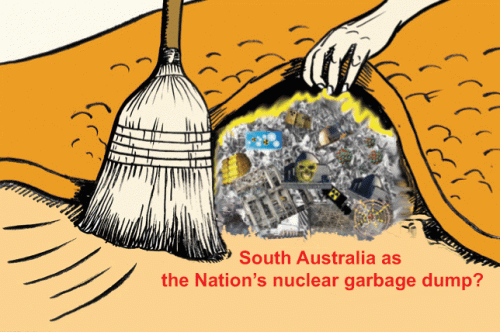
Minister Pitt insists he is not giving up on the legislation. Expert in radiation impacts Dr Tilman Ruff has recently called out Pitt’s recent declaration of ‘the urgent need of this facility’ in ‘saving lives’ as ‘reckless claims.’
A new stage in fight against radioactive waste bill, https://www.eurekastreet.com.au/article/a-new-stage-in-fight-against-radioactive-waste-bill?utm_medium=email&utm_campaign=Eureka%20Street%20Daily%20-%20Tuesday%2017%20November%202020&utm_content=Eureka%20Street%20Daily%20-%20Tuesday%2017%20Nove– Michele Madigan -17 November 2020
-
- ‘We have spent two very productive days at Parliament House speaking about our concerns regarding the proposed Kimba dump site and the Government’s attempts to pass legislation that intentionally takes away our rights to judicial review. Thank you to all of our supporters who helped get us there, this has been a long and expensive fight, but our voices are being heard.’
- This message from the No Radioactive Waste on Agricultural Land in Kimba or SA group (No Rad Waste) Radioactive Waste Management Amendment Bill 2020 was a good intimation that day to anxious followers that the hoped for blocking in the Senate of the Coalition’s Radioactive Waste Management Amendment Bill 2020 was indeed going to happen. ACF’s progressive checking of the Senate Agenda had already revealed that the Bill, listed as number 8 on Monday 9/11, had by Tuesday 10/11 slipped to number 23. On Wednesday 11/11 it had disappeared off the list.Did this mean the government, knowing it didn’t have the numbers, had given up on the legislation — at least for the present?Hope was confirmed for sure the next day. An Adelaide Advertiser’s 12th November article heading read: ‘Pauline Hanson’s One Nation torpedoes Kimba nuclear waste dump in SA.’
The article confirmed ‘The One Nation leader… has confirmed she will not back legislation to build the nuclear waste storage site at Napandee farm, near Kimba.’ The article then went on to explain that ‘Without One Nation’s two crucial votes — and Labor, the Greens, and independent senator Rex Patrick not backing the Bill — the government does not have enough votes for it to pass parliament without changes.’
- As Senator Hanson had told The Advertiser reporter, she ‘had serious concerns about the process to select Napandee, the level of community support, the waste site being built on farming land, and the facility storing intermediate radioactive waste above ground.’
-
So in the long journey of nearly five years since the Australianfederal government’s renewed search for a national radioactive waste facility, it seems a new stage has been reached.Here’s a question: did the federal Minister for Resources overreach himself? With the power to simply name the government’s preferred site, Minister Keith Pitt went a step further by presenting to Parliament the naming of the site.This meant that a passing of the government’s Amendment Bill would block off the chances for any opponent group ton take the processes leading to that decision to the courts — no judicial review.
I wrote of the progress of the bill in the House and later of the Senate Inquiry hearings.In a style reminiscent of recently ex-Minister, Joel Fitzgibbon, in the inquiry Labor Senators Carr and Gallacher chose to side with government in their questioning, comments and final vote.
However Labor, with their knowledge of community concerns, decided to follow Senator Jenny McAllister’s dissenting report and its unease regarding judicial review. Their resolution was ‘to ask for the amendment of removing the name of the Napandee site with the proviso, “Should our amendment be unsuccessful, we willoppose the Bill in the Senate.”’
The reasons? ‘This is a contentious issue and should have the highest levels of scrutiny to ensure that the principles of procedural fairness and natural justice have been applied given the national significance of this matter.’ This from the leader of the Opposition in the Senate, SA Senator Penny Wong’s Office to the Josephite SA Reconciliation Circle on 26th October.
In the meantime, president of No Radioactive Waste on Agricultural Land in Kimba or SA Peter Woolford had first heard of the Minister’s Pitt’s long awaited visit to Kimba and the Napandee site via an ABC’s North and West reporter on Tuesday October 27th. The Minister eventually confirmed that four of their group were permitted to meet with him. As well, of course, were meetings with the executive of the pro-dump District Council of Kimba and theWorking for Future pro-dump group.
‘A PR box ticking exercise’ was how Woolford named the Minister’s visit with their group. After the event it was harder to be dispassionate: ‘Pitt and Ramsey (the federal Member) certainly know what we think and the impact it’s had… it certainly got a little heated at times… We had 45 minutes and we raised many issues relating to the doubling handlingof ILW (intermediate-level waste), the vote unfairness, jobs, judicial review etc.’
With three crossbench votes needed in addition to the Greens and Labor to defeat the Bill, the Barngarla Determination Aboriginal Corporation (BDAC), headed by Chair Jason Bilney had long planned to travel to Canberra to meet with legislators.
COVID restrictions meant that the vital trip was delayed but perhaps providence meant that it took place at just the right time for the November Senate session. Both key opposition groups have long supported each others’ concerns.
So with the government unable to get the Senate numbers, what will happen next?
Minister Pitt insists he is not giving up on the legislation. Expert in radiation impacts Dr Tilman Ruff has recently called out Pitt’s recent declaration of ‘the urgent need of this facility’ in ‘saving lives’ as ‘reckless claims.’
Independent SA Senator Rex Patrick has long been involved with both BDAC and No Rad Waste groups. The Advertiser November 12th report above continued with the voice representing the other two of the vital No votes: ‘I want to make the right decision, not for the interim, I want to make the right decision for future generations,’ Senator Hanson said. ‘I’m not going to be badgered or pushed into this… It’s about looking after thepeople of SA, but also the whole of Australia.’
The SA Stock Journal’s September survey recorded 70 per cent of respondents were against the federal nuclear dump plan. In Aboriginal Way Spring 2020, Karina Lester, Chair of YNTAC, reported that four Aboriginal groups ‘right across the state’ including the Yankunyjatjara Native Title
Aboriginal Corporation have ‘submitted their concern.’
In November, it’s good to hear that South Australians aren’t alone in actively recognising that simply storing above ground, for at least ‘decades,’ nuclear waste that will be radioactive for 10,000 years is a pertinent national issue.
Australian government weakening of Environmental Law will weaken nuclear and uranium safeguards
• The National Environmental Standards for MNES should include one for nuclear actions. To provide community confidence, the Standard should reflect the regulatory guidelines and protocols of all relevant national laws and requirements.”
This scope is necessary to respect Indigenous rights and interests to protect their country & culture.
I commend the strong Arabana Aboriginal Corporation Submission No.92 (11 August) to the federal Juukan Caves Inquiry and the Arabana Chairperson’s call for protection of their GAB Springs: …… “
Australian government is rushing to weaken Environmental Laws
David Noonan, 18 Nov 20, The Federal Liberal gov has called a rushed Committee of Inquiry into Federal Environment and Nature Laws.
But limited the scope of their Inquiry to their Abbott era untenable ‘One Stop Shop’ Bill to divest EPBC Act Approval powers to the States & Territories…
Public submissions close tomorrow Wednesday 18th, and only one day of Hearings is to be allowed.
New Inquiry: Environment Protection and Biodiversity Conservation Amendment (Streamlining Environmental Approvals) Bill 2020
Date Referred: 12 November 2020 to the Senate Environment and Communications Legislation Committee,
Reporting Date: 27 November 2020
see Inquiry homepage:
My 3-page input of concern at a rushed Inquiry & a flawed Bill itakes a national interest focus on ‘nuclear actions’,
Extracts:
Due process and the national interest responsibility to the protection of Matters of National Environmental Significance (NES) are compromised by this deeply flawed Bill and rushed Inquiry. …
It appears reckless that a core pre-requisite audit of State resourcing and capacity to undertake EPBC Approvals and enforcement roles has not been undertaken at this late stage of events. …
Community confidence requires the EPBC Act to retain Approval powers at a Federal level, and to retain the “whole of environment” scope of Assessment and Protection of the Environment in ‘nuclear actions’ as has been required in our national EPBC Act laws since 1999.
This Inquiry should take up the Arabana People’s call for Federal protection of their GAB Springs.
Contacts: The Committee Secretary
Senate Standing Committees on Environment and Communications
Phone: +61 2 6277 3526
Fax: +61 2 6277 5818
ec.sen@aph.gov.au
Note the ACF has provided a proforma sign on letter option to this Inquiry – which you may wish to avail of,. (see sidebar at right.)
Corporate vested interests win as Australian Government weakens Environmental Laws
This Bill is fundamentally flawed in the core untenable proposal to divest national environmental responsibilities to States & Territories. State Approvals of major resource, mining and development projects are mired in ‘conflict of interest’, corporate influence and vested – not public – interests.
David Noonan, Full Submission to the Federal Environment Inquiry, 18 Nov 20, To: The Inquiry Chairperson Senator the Hon David Fawcett, , Senate Environment and Communications Legislative Committee , By email: ec.sen@aph.gov.au
Concern regards this rushed Inquiry into the flawed Environment Protection and Biodiversity Conservation Amendment (Streamlining Environmental Approvals) Bill 2020
Dear Secretary
This Inquiry is an unacceptably rushed process, and the Bill takes a pre-emptive and flawed approach to the EPBC Act. The public and the Parliament have a right to see and consider the Samuels Final Report, and the full suite of proposed EPBC Act Reform, National Standards and Amendments.
This Bill is fundamentally flawed in the core untenable proposal to divest national environmental responsibilities to States & Territories. State Approvals of major resource, mining and development projects are mired in ‘conflict of interest’, corporate influence and vested – not public – interests.
Due process and the national interest responsibility to the Protection of Matters of National Environmental Significance (NES) are compromised by this deeply flawed Bill and rushed Inquiry.
State control of EPBC Approvals is proposed through use of unenforceable “Bilateral Approval Agreement” instruments that are not fit for purpose, with little or no State law in place across Australia to even reflect the Objects, obligations and requirements of the EPBC Act.
The Bill unacceptably provides for ‘National Standards’ to be added to Bilateral Agreements with States, rather than legislated in the national interest in the EPBC Act and subject to national consultation and enforcement, with required national resourcing – rather than State paucity. The proposed accreditation process for States to take up federal EPBC powers is not even transparent.
It appears reckless that a core pre-requisite audit of State resourcing and capacity to undertake EPBC Approvals and enforcement roles has not been carried out at this late stage of events.
The Federal government is trying to expedite relinquishing national roles to Protect the Environment while declining to fund States to do so. This is a disrespectful indifference to Matters of NES.
Existing Cth-State Bilateral Assessment Agreements are not enforceable instruments and are not fit for purpose. For instance, no legislative or other mandated changes having been made in South Australia since taking up EPBC Act Assessment roles and responsibilities some years ago.
The non-statutory “EPBC Act Condition-setting Policy” further aligns the Commonwealth to defer to State Conditions of Approval and not set warranted Federal Conditions to properly protect MNES.
I have made a submission to the Independent Review of the EPBC Act, focusing on operation of the Act in protection of MNES under the “nuclear actions” trigger, and Discussion Paper Q.14 on failings of State roles through a case study on BHP Olympic Dam copper-uranium mine public interest issues.
******************
In the case of EPBC “nuclear actions”, including EPBC Act Section 21 & 22 controlled actions in uranium mining and milling, the EPBC Act protected Matter of NES is “the environment” – requiring “whole of environment” scope of impact assessments, and Protection of the Environment such that authorized actions do not have unacceptable or unsustainable impacts.
******************
The Samuel Review, Box 12 Nuclear activities (p.52) states: “To be able to ensure community confidence in these ‘nuclear’ activities, the Commonwealth should maintain the capacity to intervene. To achieve this, the key reform directions proposed by the Review are:
The National Environmental Standards for MNES should include one for nuclear actions. To provide community confidence, the Standard should reflect the regulatory guidelines and protocols of all relevant national laws and requirements.”
**************
However, the Samuel Review (p.110) specifies inadequate ARPANSA Codes as a ‘National Standard’ for nuclear action assessments; OR use of State frameworks judged compliant with these Codes.
********************
In addition, “graded” (limited) assessments as set out in ARPANSA Codes are to replace the scope of “whole of environment” impact Assessments for ‘nuclear actions’ – including for uranium mining.
******************
ARPANSA Codes can reflect vested nuclear industry practices rather than best scientific evidentiary standards. For instance, applying outdated 1991 era ionising radiation occupational exposure limits.
******************
Australia already has a failing record in regulation of uranium mining, in environmental protection and mine rehabilitation issues. Transferring Approvals to States and use of ARPANSA Codes in graded assessments will further compromise environmental protection standards and practise.
******************
By January 2021 South Australia will be the only Australian jurisdiction conducting uranium mining. A case study of BHP Olympic Dam provides a cogent context to evaluate this Bill & Samuel proposals.
******************
Importantly, “whole of environment” scope of uranium mining impact assessment encompasses social, economic, cultural and spiritual impacts, and not just environmental & radiological impacts.
******************
Outdated BHP Olympic Dam legal privileges that override Indigenous Heritage are now under scrutiny before Parliament’s Juukan Caves Inquiry, see Submission No.73 and 73.1 by David Noonan.
******************
It is typical that uranium mining disproportionately affects Indigenous People. ARPANSA Codes do not provide an appropriate basis to assess or respect Indigenous and Cultural Heritage issues.
******************
State governments in SA have failed to revoke BHP’s untenable Olympic Dam legal privileges.
******************
It is a travesty that BHP has deliberately retained 1982 era over-rides of Aboriginal Heritage across the 12,000 km2 “Stuart Shelf Area” around the Olympic Dam mine, and retains outdated legal rights to take excessive volumes of GAB waters affecting the integrity and very survival of GAB Springs.
******************
BHP’s influence in excessive mining of Great Artesian Basin water for Olympic Dam mine shows a State’s inability,
and given real ‘conflict of interest’, a State’s unwillingness to reform such issues.
******************
This scope is necessary to respect Indigenous rights and interests to protect their country & culture.
******************
It is a warning to this Inquiry that the State of SA has failed to protect the unique and fragile Mound Springs. The integrity of Springs relies on continued natural flows and pressure of GAB waters.
These Springs are a protected Matter of NES under the EPBC Act as a listed Endangered Ecological Community and are of significant ongoing cultural and spiritual importance to Aboriginal traditional owners, the Arabana People, who have called for real effective Federal protection of the Springs.
I commend the strong Arabana Aboriginal Corporation Submission No.92 (11 August) to the federal Juukan Caves Inquiry and the Arabana Chairperson’s call for protection of their GAB Springs: ……
“Unfortunately, our springs are disappearing. … The cause of the disappearance of our springs, is water that is being taken from the Great Artesian Basin by BHP’s mine at Roxby Downs. … Unless something is done by the Commonwealth, our springs will disappear… It is unsustainable, destructive of nature, and destructive of our culture to allow the springs to die. Will you please enact laws that ensure our mound springs and culture are recognised, respected and protected?”
This Inquiry must not condemn the GAB Springs to State control of EPBC Act Approval powers.
Pre-conditions to protect GAB Springs from BHP water extraction were set by the Labor Federal government in 2011 but were not applied as BHP abandoned a proposed open pit mine expansion.
If this Bill were to go ahead, the State of SA’s ‘conflict of interest’ role and BHP’s influence in mining GAB waters will combine to continue the exploitation of underground water reserves and the decline in the integrity and very survival of the unique and fragile GAB Springs.
Community confidence requires the EPBC Act to retain Approval powers at a Federal level, and to retain the “whole of environment” scope of Assessments and Protection of the Environment in ‘nuclear actions’ as has been required in our national EPBC Act laws since 1999.
The Inquiry should take up the Arabana People’s call for Federal protection of their GAB Springs.
This brief summary of input is based on my experience: Including some sixteen years as an Australian Conservation Foundation (ACF) Environment Campaigner 1996-2011; as lead author consultant on Joint ENGO submissions (ACF, Conservation SA, and Friends of the Earth Australia) to three BHP EPBC Act Olympic Dam Referrals in 2019; and with 25 years involvement across public interest issues in Olympic Dam mine operations and in matters of environment protection legislation.
Please feel free for the Secretary, Members of the Committee and any of their staff, to contact on any aspect of these issues, for further information, clarification or discussion.
Australia’s Department of Defence captured by foreign weapons makers Thales, BAE,
|
Department of Defence captured by foreign weapons makers Thales, BAE, Michael West Media, by Michelle Fahy | Nov 17, 2020 Department of Defence secretly investigates itself, does not make public the review’s existence or its terms of reference, and keeps any resulting report secret. Defence recommends buying hundreds of vehicles from Thales, despite no need for them, just so Thales can keep its factory open. Houston, we have a problem, writes Michelle Fahy. The culture of cosiness; the revolving door; and undue influence. The relationship between government and military industrial companies is just one strand of the evidence showing the urgent need for a national anti-corruption commission. “Undue influence” is a noted marker for corruption. In a recent investigation we examined how the then $50 billion (now $80 billion) submarine contract was awarded to Naval Group, despite it being under investigation in numerous countries over probity issues, including bribery and corruption concerns. The multinational weapons maker Thales has also exerted influence on successive governments. There has been considerable coverage of how Thales pressured federal Attorney General Christian Porter to censor key parts of the auditor general’s report into the procurement process for the Thales Hawkei vehicle. There is more to that story than the censored sections. Then there is yet another key supplier to Defence, the UK multinational BAE Systems, which in 2018 won the $35 billion future frigate contract to build the navy’s nine new anti-submarine warships. The new contract was awarded even though there had reportedly been “long-running concerns” inside Defence about alleged inflation of invoices by tens of millions of dollars by BAE for its work on the navy’s elderly Adelaide-class of frigates (now decommissioned). An internal audit by Defence reportedly found BAE’s Adelaide contract “riddled with cost overruns, with the British company consistently invoicing questionable charges”. By May 2019, Defence had launched a fresh investigation. Thales and the Hawkei: “Extensive industry lobbying”A 2018 Australian National Audit Office (ANAO) report details the acquisition process for the Thales Hawkei vehicle, which was ultimately selected as the ‘light’ vehicle within a multi-phase procurement started in 2003 to replace Australian Defence Force field vehicles and trailers………. In September 2013 the Coalition defeated Labor in the federal election. In March 2015 Thales appointed Brendan Nelson – Liberal defence minister prior to Labor’s 2007 election win – to its “advisory board”. Five months later, the Coalition government approved the Thales Hawkei acquisition and in October the contract was signed. The ANAO report contains many significant revelations; the following are just some of the concerns raised:
|
|
Minister Pitt on Kimba nuclear waste dump plan – inept, badly briefed, or just plain lying?
Peter Remta, 14 Nov 20, THE HON KEITH PITT MP Minister for Resources, Water and Northern Australia Member for Hinkler MEDIA RELEASE 12 November 2020
NATIONAL RADIOACTIVE WASTE MANAGEMENT FACILITY
‘‘The National Radioactive Waste Management Facility is a vital piece of national infrastructure, which will support the ongoing development of our nuclear medicine and research industries.”
He still fails to explain how and why
All of this waste is classified as intermediate level waste although when France returned the reprocessed spent fuel to Australia it classified it as high level waste
There has not been any suggestion by either ANSTO or ARPANSA that this waste is causing any lack of storage space or other problems at Lucas Heights.
What difference does that make?
1 This month

of the week – Australians for War Powers Reform (AWPR)
To see nuclear-related stories in greater depth and intensity
 Antinuclear