Morrison government rushing to make Austraia’s environment laws even weaker: a recipe for extinctions
 ‘Recipe for extinction’: why Australia’s rush to change environment laws is sparking widespread concern
Critics argue shifting approval powers to the states without an independent regulator will fail to protect the environment, Guardian, Lisa Cox– 6 Sept 20
Anger over proposed changes to national environmental laws is escalating, with legal, health and conservation groups urging that they not pass the Senate, with some warning it would increase the extinction rate.
The government rammed its legislation to change Australia’s Environment Protection and Biodiversity Conservation Act through the lower house on Thursday night, prompting outrage from Labor, the Greens and crossbench.
WWF-Australia says the bill in its current reform is a “recipe for extinction” and lacks standards that would ensure strong protections for nature, as well as a commitment to an independent regulator to enforce the law.
“There is more than just wildlife at stake here,” Rachel Lowry, WWF-Australia’s chief conservation officer, says. “If approved, this bill will fail Australians at this critical moment in time because it fails to incentivise win-win solutions that stimulate our economy and protect the places and animals we love.
“Shifting approval powers to the states without an independent regulator to ensure enforcement would be the most damaging environmental decision to occur within Australia in recent decades.”
The government’s bill would amend Australia’s environmental laws, clearing the way for the transfer of development approval powers to state and territory governments.
The prime minister, Scott Morrison, and the environment minister, Sussan Ley, have argued the changes are necessary to aid Australia’s economic recovery from the Covid-19 pandemic.
The proposed changes passed the lower house on Thursday night after the government used its numbers to gag debate on the bill and amendments proposed by Labor and the crossbench.
No member of the government spoke on the bill, which still has to pass the Senate and will likely be debated during the October budget sittings.
Rachel Walmsley, the policy and law reform director at the Environmental Defenders Office, says the government is trying to avoid scrutiny.
She warns the bill has the potential to undermine the statutory review of the EPBC Act, chaired by the former competition watchdog head Graeme Samuel, which is not due to table its final report until the end of October.
The key finding of Samuel’s interim report was that Australia’s system of environmental protections had failed and the decline of wildlife and habitat was unsustainable.
“It was a fairly atrocious process that, moments before adjournment, they rammed it through,” Walmsley says.
“The gagging of the debate, the fact they prevented voting on amendments and the fact no government MP stood up to justify the policy – it prevented proper parliamentary scrutiny.”
The Climate and Health Alliance, which is a coalition of Australian health organisations, has called on the Senate to block the amendments.
“Australia’s natural environment is declining on every possible measure. We lead the world in animal extinctions,” says the alliance’s executive director, Fiona Armstrong. “There is no economy without a healthy environment.
“The government is trying to rush through amendments to our environmental protection laws that would weaken them in favour of expanding gas and fossil fuel projects that harm the environment and threaten human health.”
The Law Council of Australia has called for the bill to be put before a parliamentary committee for inquiry and not rushed through the Senate.
The government and One Nation have blocked several attempts by the Greens to have a parliamentary committee examine the bill.
International obligations
The Law Council says the government needs to make sure it retains oversight of matters of national environmental significance if it enters into bilateral approval agreements with state and territory governments.
The council says this is particularly important for ensuring Australia still meets its obligations under some 33 international treaties and protocols to which it is signatory, including for world heritage sites…….. https://www.theguardian.com/australia-news/2020/sep/06/recipe-for-extinction-why-australias-rush-to-change-environment-laws-is-sparking-widespread-concern
Environment Law: Scott Morrison’s government shows its disdain for ZaliSteggall and the cross-benchers
Independent MPs furious as government rams environmental law changes through lower house, https://www.sbs.com.au/news/independent-mps-furious-as-government-rams-environmental-law-changes-through-lower-house 4 Sept 20 The Morrison government has been branded a “bully in action” for pushing its environment law changes through the lower house without following usual process.
Independent MPs are furious with the Morrison government for throwing due process out the window and ramming controversial environmental laws through the lower house.
Crossbench MP Zali Steggall flagged amendments to the bill but the government refused to allow them to be voted on.
Instead, the coalition used its numbers to shove the bill through the lower house on Thursday night.
Ms Steggall described the government as a “bully in action”.
“The PM and every coalition MP made a mockery of due process for legislation and bulldozed environmental and water protection,” she said.
“And they were laughing while doing it. This is how they represent you. If you care, contact your MP.”
The changes to the national environment protection laws pave the way for states to take over approvals.
The states would have to abide by a set of national environment standards, which have not been developed.
The changes are in response to an interim review conducted by former competition watchdog Graeme Samuel.
Professor Samuel also recommended installing an independent environmental umpire, but the government has rejected that.
Independent Tasmanian MP Andrew Wilkie says the changes will water down environment protection.
“(The bill) hands decision-making to state and territory governments who have shown time and time again to be conflicted and incapable of protecting the environment,” he said.
“The passage of the amendment through the House of Representatives was also a chilling demonstration of the government’s complete contempt for democracy.
“Most members of the house were prevented from speaking, and foreshadowed amendments were blocked without debate. The government acted again like an elected dictatorship.”
Environment Minister Sussan Ley was quick to defend the changes after outrage over the process.
“There will be more reforms to follow,” she said.
“We will develop strong Commonwealth-led national environmental standards which will underpin new bilateral agreements with state governments.”
The bill is likely to be referred to a Senate committee for scrutiny, pumping the brakes on its progress.
Labor and the Greens oppose the legislation.
Australian government, masks its anti-environment action under the cover of Covid-19
|
And it does all this while lambasting the states for omissions and inefficiencies. Nowhere does it suggest devolving more power to these already incompetent entities. Of course this royal commission is largely focused on natural disasters rather than broader issues of environmental management and climate change, but its findings are telling in their precision: “Current arrangements do not provide a clear mechanism to elevate these matters to national leaders.” Is it possible that our national leaders don’t want these or any other tricky environmental matters elevated to them? What other conclusion can be reached when the government is trying with such energy to push through “new” legislation that greatly reduces its role in environmental issues? This is fundamentally the same proposal that Tony Abbott put forward as prime minister. It was defeated then, but the thought is that it might scrape through now under the cloak of Covid. That is the hard-nosed judgment of the same climate deniers and coal lobbyists who have run the Coalition all these years. And Scott Morrison’s hands remain as black as any. Since there is a full review of current environmental legislation being conducted by Graeme Samuel, which is due to deliver a final report in the blink of an eye (ie October this year) what possible justification can be given for ramrodding legislation into the parliament now?
Samuel’s interim report recommends “national enforceable standards” as an essential part of keeping the states honest in these matters. How necessary that is when, as Ken Henry so powerfully pointed out, the states have a complete conflict of interest in their receipt of royalties from projects and the fact that they are often the proponents of them. But there is no mention of these national standards in the proposal or of referring relevant conflicts to the federal government. …… The Australian government is the signatory to all our international commitments that relate to climate and the environment of which there are many, ranging from The World Heritage Convention to the Bonn Convention on the Conservation of Migratory Species and at least half a dozen others. The states are signatories to none. What is the logic in devolving power to the states at a time when these agreements and the obligations therein are becoming increasingly important? None?.. The root cause of all this ill-conceived thinking is a failure to understand what an economy is. In the government’s view it is an entity unto itself – it seems to operate independently of the world in which we live, until events wrench us back to it. According to this theory, the environment is somehow in conflict with the economy rather than the integral, vital essence of it. ……… https://www.theguardian.com/commentisfree/2020/sep/04/under-the-cloak-of-covid-the-government-is-rushing-ill-considered-changes-to-australias-environment-laws |
|

AUSTRALIAN GOVERNMENT ALLERGIC TO TRANSPARENCY AND A SENATE SHY IN ENFORCING IT


PARLIAMENT COVERS UP AUSTRALIA’S TRUE CARBON FOOTPRINT
 Parliament Covers Up Australia’s True Carbon Footprint, ByTasmanian Times, August 31, 2020 The House Standing Committee on the Environment and Energy today tabled its report on Andrew Wilkie MP’s National Greenhouse and Energy Reporting Amendment (Transparency in Carbon Emissions Accounting) Bill 2020 in Federal Parliament.
“Regrettably the Committee has voted to cover up Australia’s shameful role as one of the world’s biggest contributors to climate change,” Mr Wilkie said. “But the reasoning behind its recommendation for Parliament not to pass this Bill doesn’t stack up.”
Mr Wilkie’s Bill would require the Federal Government to include scope 3 emissions in reports of Australia’s carbon emissions, boosting transparency and accountability. Scope 3 emissions are the potential emissions contained in the gas and coal mined in Australia, which is then exported overseas. The Bill allows Australia to track its impact as one of the largest exporters of fossil fuels in the world, giving the public access to information about Australia’s role in very significantly contributing to global greenhouse gas emissions.
“Australia must have a clear picture of its contributions to global greenhouse gas emissions,” Mr Wilkie said. “This is essential as the world tries to limit warming to 1.5 degrees and halt catastrophic climate change. Keeping track of Australia’s scope 3 emissions is not double counting but gives a true picture of our responsibility for climate change around the globe.
The Committee can hardly argue that tracking scope 3 emissions is ‘too hard’ when the Department of Industry, Science, Energy and Resources has not even conducted an assessment of compliance costs. For goodness sake, the Committee acknowledges that more than a quarter of ASX200 companies already voluntarily report their scope 3 emissions.
“Further, the fact that this kind of tracking is not required by the Paris Agreement is beside the point. The Australian Government should be open and transparent for the sake of the community, rather than claiming that Australia can do little to influence climate change. The truth is that when the carbon in fossil fuel exports is taken into account, Australia accounts for about 5 per cent of the global total for fossil fuels.”
The full House Standing Committee on the Environment and Energy report can be found here.
2. ANALYSIS OF THE BILL………… HTTPS://TASMANIANTIMES.COM/2020/08/PARLIAMENT-COVERS-UP-AUSTRALIAS-TRUE-CARBON-FOOTPRINT/
Kazzi Jai reports on the latest Senate hearing on Nuclear Waste Amendment Bill
 Kazzi Jai Fight To Stop Nuclear Waste In The Flinders Ranges, 28 Aug 20, I will try and keep this summation as brief as possible regarding the Senate Hearing with DIIS this morning.
Book: The Carbon Club -Tony Abbott and the ‘people’s revolt’ against Gillard’s climate policy
 Tony Abbott and the ‘people’s revolt’ against Gillard’s climate policy
In her new book ‘The Carbon Club’ Marian Wilkinson exposes the truth behind Australia’s inaction on climate change. Crikey, MARGOT SAVILLE, AUG 28, 2020
For several years, award-winning journalist Marian Wilkinson has been investigating the relationship between climate-sceptic politicians, business leaders and their allies. For her latest book The Carbon Club, she has conducted scores of interviews with players on both sides in order to expose the truth behind Australia’s inaction on climate change.
Bernardi teamed up with young libertarian Tim Andrews, who had trained with the Koch Brothers’ internship in the US.
“The two helped create the ‘people’s revolt’ against the climate policy, using the power of social media and the tactics of the Tea Party movement that was gaining ground in the US Republican party.
“One of the driving ideas behind the campaign was to exploit the anger and disaffection among ordinary voters towards politicians,” Wilkinson writes. …..
The “people’s revolt” against Gillard and the emissions trading scheme passed by Kevin Rudd would fundamentally fracture conservative politics in Australia, fostering splinter parties and deepening divisions in the Liberals, Wilkinson writes.
“It would destroy any chance of uniting the major political parties to face the enormous challenge of climate change.”………
Marian Wilkinson will discuss her new book at a Crikey Talks event for Inside Access members next month. Visit our Inside Access page to upgrade https://www.crikey.com.au/2020/08/28/book-review-carbon-club/
Australia entangled in the military-industrial-intelligence-security complex

|
The military-industrial-intelligence-security complex https://johnmenadue.com/alison-broinowski-the-three-slash-complex/ By ALISON BROINOWSKI | On 25 August 2020 In 1961 President Eisenhower warned that a vast and permanent ‘military-industrial complex’ could produce ‘the disastrous rise of misplaced power’. Earlier, US Senators Robert La Follette and J. William Fulbright also foresaw the dangers of militarisation. Now we have a military/industrial/security/intelligence complex, and it is dangerous. Let’s start with ‘security’, which sounds harmless and desirable. Who welcomes insecurity? Our ‘safety and security’, various authorities assure us (never explaining the difference) are their prime concern, particularly after some egregious security failure on their part. Security abroad used to mean the First World remaining in control of opportunities, in its own interests. Security now additionally means controlling people euphemistically called ‘those who would do us harm’. Since 2001, national security has become an exponential, unassailable, growth area. Proliferating Australian laws criminalise knowing, revealing, or even asking anything about it. Despite some academics arguing that it includes food, health, social, economic, and environmental security, ‘hard-headed’ national security is the dominant growth area in universities and government. From there to intelligence. We lavishly fund the ‘community’ of ten security agencies which demand ever more power and resources. Several heads of ASIO, ASIS, ASD, and DFAT have followed each other in revolving door fashion. Some emerge occasionally to warn us of the new, dire, and continuing dangers we face. They can’t give details, of course, before WikiLeaks or the American media do, or until a tip-off to a Five Eyes partner inspires an ‘open source’ report. But they assure us of their best efforts – with a lot more staff – to keep us safe and secure. Their colleague from the American community, Mike Green, former Asia Director of the National Security Agency (the equivalent of ASIO), used to joke that the NSA’s job was to keep people frightened ‘so they’ll go on funding us’. From the community came the intelligence that government misused, or didn’t use, before the Bali bombing and the Lindt Café siege in Sydney. They provided intelligence that government used, or misused, to justify Australian forces’ illegal invasions of Iraq and Syria, to benefit Woodside Petroleum and disadvantage East Timor. Government is currently making an example of David McBride, a military lawyer who said what he saw Australian troops doing in Afghanistan, of Witness K, a former ASIS officer who said what he did in Dili, and of his former solicitor Bernard Collaery, who’s not allowed to say much, but who was raided in 2013 under anti-terrorism laws. The Attorney-General wants charges and court proceedings against them in the ACT to be secret, as in the Kafkaesque case of another, Witness J. The same applies in Britain, a common-law country, where a judge is likely in September to allow the extradition of Julian Assange to the US, whose CIA paid to have him spied on. Rule of law? The Australian government and opposition say nothing. To industry then. Canberra airport has become a hall of mirrors for American, British, and French arms producers. So has the Kerry Stokes-chaired Australian War Memorial, whose expansion is to cost $500 million. Less than a decade after the ‘Australia in the Asian Century’ report, Asian languages and the arts languish, and the National Library closes its Asian collection. Defence expenditure is exempt from the efficiency dividend, and much cannot be accounted for. Yet a government that criticised its predecessors for running up ‘debt and deficit’ tries to please the Americans by exceeding 2 percent of GDP, even for aircraft that are not delivered and are denied the technologies the US allows Israel, and for submarines that will lack crew and be obsolete and over budget before they hit the water. Diversification of suppliers is commendable, and local manufacture too, but value for money? Japan would have undercut the French price and delivery date for the submarines, and might not have dangled the option of nuclear power. By 1967 the US was ‘the greatest purveyor of violence in the world today’, said Martin Luther King. Now the war industry (let’s call it by its name) has proliferated in Australia, as in the US and UK. Its promises of local employment ̶ often more jobs than are delivered ̶ attract votes, particularly in South Australia. The merchants of death are to be joined by Australia as the tenth largest arms exporter. And we won’t ban nuclear weapons. So why bother searching for a vaccine to stop millions dying in the pandemic? Fourth, military. In most democracies, elected civilians debate where the armed forces should go, what they should do, what they need to do it, and when they should return. Some constitutions even require reports on progress, and independent inquiries afterwards. That worked before the undeclared, endless war. Now potential conflicts are planned years in advance, the security state identifies the priorities, the war industry gears up, and inter-operable allied forces that are not already embedded get their American orders on a given date. So the Australian military tail in effect wags the government dog. Moreover, inviting US military bases to proliferate in northern Australia, and expanding our war-games, not only makes Australia a bigger target but inevitably America’s endless wars become Australia’s. The putative enemies China, Russia, and Iran need not be Australia’s enemies. The risk grows of Australia being used as an example by China of what it could do to the US, to its real enemy. If Australia is not to be dragged into war against China or Iran by the US, our Ministers while in quarantine might reflect on the invertebrate performance they gave at the AUSMin talks in July. Bipartisan Sinophobia was recently demonstrated against NSW parliamentarian Shaoquett Moselmane. Australian security would benefit if the opposition didn’t try to outdo the government’s ‘Communist China’ McCarthyism. Trump aimed to drain the Washington swamp by filling top White House positions with ex-military people. Most have departed, but this proto-fascist tendency continues in Australia where the governor-general, governors, politicians, and even academics with military backgrounds are conspicuous. Of these former fighters, only a few have the courage, as retired General Peter Leahy did in 2016, to deplore Australia’s lack of independent military strategy and the way we go to war. If the ADF is called out to enforce the law in Australia, fascism will be next. Dr Alison Broinowski AM is a former diplomat, academic, and author, and is Vice-President of Australians for War Powers Reform. |
|
Disarray in New South Wales Right-wing parties, over One Nation’s Bill to overturn ban on uranium mining
Environmental groups have been critical of the government’s consideration of Mr Latham’s bill, with the Nature Conservation Council warning uranium mining would threaten water supply.
Berejiklian government to pursue its own uranium push, By Alexandra Smith, August 24, 2020
The Berejiklian government will pursue its own push to allow uranium mining in NSW, after cabinet ministers backed away from supporting One Nation’s nuclear power bill in the upper house.
The bill, introduced by Mark Latham, would lift the 33-year ban on uranium mining and nuclear power, but on Monday night cabinet agreed that it would consider its own bill.
In March, Deputy Premier John Barilaro stunned colleagues when he said his party would support Mr Latham’s bill, despite not taking the issue to the Nationals’ party room.
Mr Barilaro, a long-time supporter of nuclear power, said the government should “lift the ban on nuclear energy” and confirmed his party would support it.
But the move angered several senior ministers, with one saying: “I did not get into Parliament to support a One Nation bill”, while another said: “Crossbenchers don’t set the government’s agenda”.
A shift in policy around uranium mining in NSW has still not been considered by the Coalition joint party rooms, which will not meet this week because only the upper house is sitting.
Mr Barilaro has now been tasked with commissioning more research around uranium mining and will report back to cabinet before any policy decisions are made.
A senior minister said Transport Minister Andrew Constance told cabinet that he could not support the One Nation bill because it could significantly impact electorates, including Bega.
Another minister told cabinet that there needed to be strategic and economic merit and community consultation around uranium mining.
Asked about the bill before it was presented to cabinet on Monday, NSW Energy Minister Matt Kean said uranium was not a viable resource.
“Right now the uranium price is about $30 per pound, that is well below the price needed to extract this from the ground. I think this is more about headlines than actually going to see anything result from digging it out of the ground,” Mr Kean said.
A senior minister, who spoke on the condition of anonymity because the issue was before cabinet, said “uranium mining will never happen so it’s just about letting Barra [Barilaro] have a win.”
“Sometimes the fights with Barra are just not worth it,” the minister said.
Mr Latham could bring the bill on for a vote this week, after the Legislative Council was recalled for another week of sitting days. The bill has been sitting on the business paper for more than a year.
The upper house is also expected to focus this week on troubled public insurer icare.
Environmental groups have been critical of the government’s consideration of Mr Latham’s bill, with the Nature Conservation Council warning uranium mining would threaten water supply.
The council’s chief executive Chris Gambian said the “sweetheart deal with One Nation yet again places multinationals ahead of the people of regional and rural NSW”.
A parliamentary inquiry report recommended the government support the nuclear power bill.
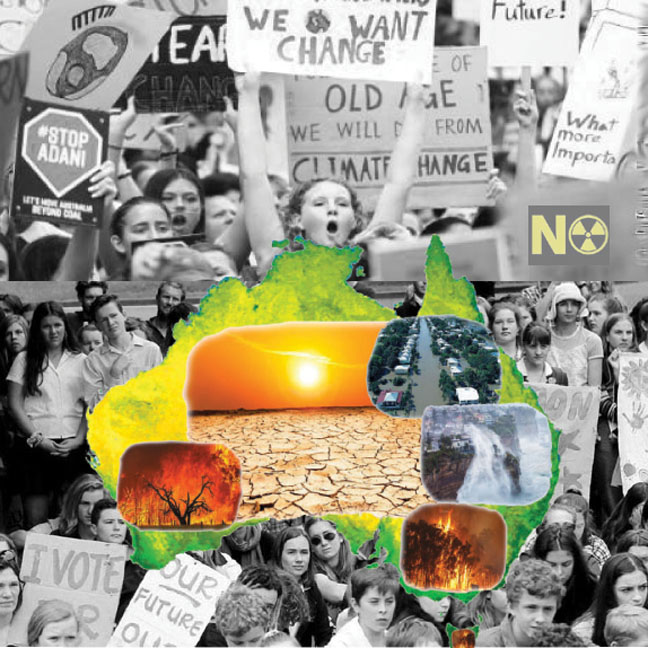
Nearly 90% of young Australians want real action on climate change
|
Young people send strong climate message, Pro Bono Maggie Coggan | 24 August
“We see the world in a different light. Politicians need to start listening to us and taking action,” a youth leader says.
Nearly 90 per cent of young people say they feel unprepared for future climate disasters and want politicians to give them a bigger voice on climate change, a new report finds. Conducted in the wake of the catastrophic summer bushfire season, the new Australian Institute for Disaster Resilience and World Vision Australia research found that despite hazards such as bushfires, floods, drought and tropical cyclones posing a greater threat, young people said they were more likely to learn about earthquakes at school. This left 88 per cent of survey respondents feeling unprepared and unable to protect themselves and their communities, even though nearly two-thirds (64 per cent) had experienced at least three events such as bushfires, heatwaves and drought in the past three years. “We anticipate that we will experience personal impacts from natural hazards in the future, whether we are living in capital cities, regional centres, or rural areas,” respondents said. “The 2020 bushfires demonstrated that you need not live in the bush to be affected by a bushfire. We are experiencing these persistent worries while having to contend with life, school, growing up and everything else that comes with being a young person in Australia.” It is the most comprehensive consultation of children and young people on climate change, disasters, and disaster-resilience in the country, with 1,500 people participating in the online survey, supported by UNICEF Australia, Plan International, Save the Children, Oaktree and Australian Red Cross. Young people concerned, but not heard ………… A full copy of the report can be found here. https://probonoaustralia.com.au/news/2020/08/young-people-send-strong-climate-message/ |
|
Uranium ban brought benefit to New South Wales
 Uranium ban brought us benefit, Newcastle Herald, Dave Sweeney, Australian Conservation Foundation 23 Aug 20,
THE state government’s proposed removal of a long-standing and popular ban on uranium mining in New South Wales flies in the face of evidence, community interest and market reality. The global uranium price remains depressed following the Fukushima nuclear disaster and is not likely to recover. The uranium market is over supplied and existing producers are shelving projects across Australia and around the world.
In November 2019 the CEO of the world’s largest uranium miner, Canadian company Cameco, stated that “not only does it not make sense to invest in future primary supply, even the lowest-cost producers are deciding to preserve long-term value by leaving uranium in the ground.”
The ban has served NSW well. It has provided policy certainty and avoided the radioactive waste and legacy mine issues affecting other places, including Kakadu, where a massive $1 billion clean-up is underway at the former Ranger mine. This poorly conceived piece of gesture politics could lead to lower tier and inexperienced mining companies cutting corners and increasing environmental and community risk and it simply makes no sense for NSW to jump aboard a sinking nuclear ship. NSW’s energy future is renewable, not radioactive.
Adam Bandt urges another Labor-Greens coalition for climate action
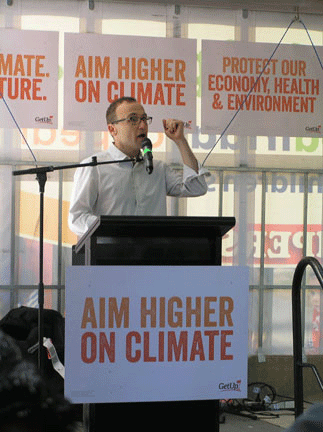 Adam Bandt urges another Labor-Greens coalition for climate action, https://www.theage.com.au/politics/federal/adam-bandt-urges-another-labor-greens-coalition-for-climate-action-20200820-p55nrc.html, By Rob Harris, August 21, 2020 —Greens leader Adam Bandt will mark 10 years since his party signed a deal to prop up the Gillard government by flagging he would be willing to again form a power-sharing deal with Labor to combat climate change.The Melbourne MP will use his address to the Greens National Conference on Saturday to urge Labor leader Anthony Albanese to commit to acting on carbon pollution by again entering into progressive pact
Labor is currently locked in a fierce internal battle over its support for coal and gas production as it wrestles with three successive election losses and poor results at the polls last year in resource-rich regional Queensland seats.
Veteran frontbencher Joel Fitzgibbon warned on Thursday his party could soon split in two, arguing it is struggling to be “all things to all people” across its inner city and regional voter bases.
Mr Bandt will tell his party faithful that it was only with the Greens holding the balance of power in both the House of Representatives and the Senate which led to “world leading climate action with a price on carbon”.
“In recent Australian history, there is one indisputable fact. The only time that climate pollution meaningfully dropped is when the Greens shared power,” Mr Bandt says in a draft copy of the speech.
“When the Greens, Labor and independents worked cooperatively and shared power like we did in 2010, we got a lot done.
As Liberal and Labor rush once more to give tax cuts to millionaires while embracing coal and gas, it is clear that Greens sharing power is the pathway to change.
Mr Bandt will also use the speech to say the climate deal reached with the Gillard government was stronger and more effective in reducing carbon emissions than the Rudd government’s scheme it blocked in the Senate.
Warning of a federal election within 12 months, Mr Bandt will say the path to climate policy progress was to put the Greens into shared power through a hung parliament.
Mr Bandt said the carbon tax legislation by Labor in 2010 with the backing of the Greens was “well-designed” and it reduced pollution for the first time in Australian industrial era history.
He will promise to “hammer” a straightforward message between now and the next election that the “only way to get real change is to vote for it and give the Greens shared power”.
“Many look longingly to New Zealand, where Jacinda Ardern leads a progressive multi-party government with Greens support, and wonder if it could happen here,” he will say.
Mr Albanese on Thursday said Labor had continually evolved and a modern party with “any self-respect” would be attempting to mitigate the effects of climate change.
In a rebuke to Mr Fitzgibbon, he said the issue of climate change was not a matter of geography because “wherever people live, they’re impacted by climate change”.
“Were about also holding the government to account. Putting forward an alternative agenda for the nation,” he said.
Slowing of population growth could be a good thing for Australia
Learning to live with less, Online Opinion,
Population growth has been a mantra of our property industry for as long as I can remember. And once again there are predictions of a surge in growth, driven (this time) by people allegedly fleeing Victoria. However, there are good reasons to think this may not happen, and that we may need to prepare for an extended period of minimal growth. This may not be a bad thing. One of the first things to understand about our recent rates of actual and predicted future population growth is that they have been extraordinary in terms of the actual numbers and also in terms of the rate (speed) of growth. On a global scale, our forecast rates of population growth in major cities exceeded many leading world cities and was on a par with places like Shanghai and Beijing. In just 15 years, Brisbane, Sydney and Melbourne were predicted to grow by around a third – roughly three times the rate of growth of cities we often like to compare ourselves with like Copenhagen (for some reason), Los Angeles, San Francisco, London or Paris. Given we started this forecast period with widely acknowledged urban infrastructure deficits (failing to keep up with population growth in the past), how we were supposed to not make the problem worse with these rates of growth is something smarter people than me might like to explain. Let’s just say the Chinese do things very differently so we can’t use Shanghai or Beijing as comparisons. These predicted rates of growth were driven by three components: international migration (net overseas migration or ‘NOM’); interstate growth (net interstate migration or ‘NIM’) and natural growth (more births over deaths). And all three now look severely compromised by the policy responses intended to manage Covid……….. each of three sources of population growth looks challenged in a post Covid Queensland, for the next few years at least. Less NOM, fewer NIM and less breeding. Is this such a bad thing though? Provided we continue with infrastructure projects, it could allow the State to begin to close the infrastructure gap which has widened significantly in recent decades. The pressure is everywhere to see – rising congestion, hospital waiting lists, rising school class numbers, and hostility to development generally. If Covid forces a breather on the rapid rates of population growth we’ve been used to, perhaps it will mean we can actually enhance our quality of life and standards of amenity in the process? It’s also worth keeping in mind that there are many global examples of low growth cities and regions which remain highly attractive and economically prosperous. The surplus of demand by people wanting to live and work there, relative to supply (deliberate limits on housing supply and population caps) invariably makes these very expensive real estate markets, completely unaffordable for many. But from a selfish property market point of view, they are still viable markets for development and redevelopment. Locally, think Noosa. Being horrendously expensive for residential or commercial property hasn’t stopped some of our other property markets before? https://www.onlineopinion.com.au/view.asp?article=21069&page=2 |
|
Pointless: Removal of New South Wales Uranium mining ban, as uranium glut continues, and nuclear industry declines
Nuke South Wales?, ACF, Dave Sweeney, 20 Aug 20,
The proposed removal of a long-standing and popular ban on uranium mining in New South Wales is empty gesture politics that flies in the face of community interest and market reality, the Australian Conservation Foundation (ACF) said.
The global uranium price remains depressed following the Fukushima nuclear disaster and is not likely to recover.
“The nuclear power age is winding up, so it makes no sense for NSW to jump aboard a sinking ship,” said ACF nuclear campaigner Dave Sweeney.
“The ban is popular and has served NSW well, providing policy certainty and avoiding the radioactive waste and legacy mine issues affecting other places, including Kakadu, where a massive $1 billion clean-up is underway at the former Ranger mine.
“This is empty gesture politics that could lead to lower tier and inexperienced mining companies cutting corners and increasing environmental and community risk.
“This poorly conceived plan puts political posturing above community benefit and could lead to increased pollution and risk for NSW communities and environment for scant gain.
“NSW’s energy future is renewable, not radioactive – this tired political fix is no substitute for a credible and effective energy policy.
“Deputy Premier Barilaro might see this as in the Nationals’ interest, but it is certainly not in the national interest.”
In November 2019 the CEO of the world’s largest uranium miner, Canadian company Cameco, stated, “Not only does it not make sense to invest in future primary supply, even the lowest-cost producers are deciding to preserve long-term value by leaving uranium in the ground.”
The global market is over supplied as existing producers exit or defer projects and higher-grade uranium ore deposits remain in the ground across Australia and around the world.
For context or comment contact Dave Sweeney on 0408 317 812
Uranium mining to become legal in NSW, as govt supports OneNation in nuclear push.
Uranium Mining. NSW govt to support One Nation in Nuclear Push. Daily Telegraph, 19 Aug 20,
Uranium mining looks set to become legal in NSW after a deal was struck between Premier Gladys Berejiklian and Deputy Premier John Barilaro to get it through cabinet. … (subscribers only) NSW to start mining uranium after agreement on plan to lift ban [$]
.
1 This month

of the week – Australians for War Powers Reform (AWPR)
To see nuclear-related stories in greater depth and intensity
 Antinuclear