In the Australian Capital Territory, (ACT), Labor to share power with The Greens
 Labor-Greens power-sharing deal set to be revealed on Monday, Canberra Times, Dan Jervis-Bardy, 30 Oct 20, Labor and the Greens are poised to unveil their power-sharing agreement for the next four years of government, following high-level talks between the two parties.
Chief Minister Andrew Barr and Greens leader Shane Rattenbury are aiming to finalise the new parliamentary agreement on Monday, ahead of a ceremonial sitting of the new ACT Legislative Assembly the following day.
Mr Barr and Mr Rattenbury, along with senior staff, have been locked in private talks throughout the week on the parliamentary agreement, thrashing out a list of shared priorities for the two parties and the terms under which the Greens will guarantee Labor’s hold on power……….. https://www.canberratimes.com.au/story/6992019/labor-greens-power-sharing-deal-set-to-be-unveiled-on-monday/?cs=14229
British Prime Minister urges Scott Morrison on climate action: Morrison twists the message
|
But a statement from Mr Morrison described the call differently, noting that Mr Johnson “welcomed” Australian emissions reduction initiatives and “strongly endorsed” the Australian approach. The UK has a policy of achieving net zero carbon emissions by 2050. A press release from 10 Downing Street following the call said Mr Johnson “stressed that we need bold action to address climate change, noting that the UK’s experience demonstrates that driving economic growth and reducing emissions can go hand-in-hand”. The equivalent statement from the Australian Prime Minister’s office stated: “PM Johnson welcomed our significant increase in emissions reduction programs announced through the Budget, and strongly endorsed our focus on unlocking practical pathways to reducing emissions,” it read. “Both countries agreed to work closely together to accelerate research and deployment of low-emission technologies ahead of COP26.” COP26, the 2021 United Nations Climate Change Conference, will be held next year in Glasgow. Policies to be set locally Labor Senator Penny Wong pressed Foreign Minister Marise Payne over the contrast during senate estimates. “There is no reference to net zero emissions [in Scott Morrison’s statement] there is no reference to bold action and there is no reference to ambitious targets,” Senator Wong said……. https://www.abc.net.au/news/2020-10-28/boris-johnson-scott-morrison-climate-change-bold-action/12817474 |
|
Labor aims to amend the Nuclear Waste Bill, removing Napandee as the stipulated dump site
Penny Wong office reply to Josephite SA Reconciliation Circle letter before the last Senate session 27 October 2020
From: “Wong, Penelope (Senator)” <Senator.Wong@aph.gov.au>Subject: RE: We plead with Labor Senators to vote NO to the undemocratic, unfair National Radioactive Waste Management Amendment Bill 2020
Date: 26 October 2020Dear Michele,
RE: NATIONAL RADIOACTIVE WASTE MANAGEMENT FACILITY PROPOSALThank you for your correspondence on the proposal for a national radioactive waste management facility in South Australia and the National Radioactive Waste Management Amendment (Site Specification, Community Fund and Other Measures) Bill 2020.Senator Wong is aware of different views in the community about this proposed facility.It is clear the Government’s proposal gives rise to issues surrounding Indigenous heritage, environmental concerns, public safety, as well as differing opinions on necessity of such a facility, all of which must be adequately resolved.Australians depend on nuclear technology for medicines used in the diagnosis of heart disease, skeletal injuries, as well as a range of cancers. Radioactive substances and wastes must be handled safely and with care.One effect of the Bill would be to amend the National Radioactive Waste Management Act 2012 to set aside the existing site selection and approval process, and instead specify the site selected and enable the acquisition of additional land for the facility.On 11 June 2020, the Bill passed the House of Representatives. As you noted, Labor opposed the Bill in the House. As you are aware, the Senate Economics Legislation Committee completed an inquiry into the Bill, and now it is up to the Government to decide when this bill will be debated in the Senate. Senator Wong followed the progress of the committee inquiry, in which Labor senators actively participated. We are pleased to see that you quoted from Labor senator Jenny McAllister’s dissenting report in your correspondence.Senator Wong encouraged members of the South Australian community to engage with the Senate Economics Legislation Committee inquiry in order to ensure committee members and parliamentarians more broadly are aware of community attitudes. Along with consultation that has taken place with stakeholders, as well as community views expressed to Labor parliamentarians in community meetings and through organised petitions and campaign emails, this informed Shadow Cabinet and Caucus as they finalised Labor’s position on the legislation.Labor has decided move an amendment to the legislation in the Senate that will remove the section of the Bill that nominates the site at Napandee, near Kimba, as the location of the national radioactive waste management facility, whilst maintaining the Community Fund established in the Bill for whatever community eventually hosts the site. Should our amendment be unsuccessful, we will oppose the Bill in the Senate.Labor’s proposed course of action does not prevent the Government from nominating the site under the existing legal process, something it could do today. However, retaining the existing process ensures this significant decision will be subject to judicial review so that the community can be assured the decision about where to locate the facility was reached as a result of a fair and properly conducted process. This is something we are aware that the representatives of the Barngarla People have expressed is particularly important to them.Ten years ago, Federal Labor deliberately amended the current legislation to include judicial review so that an affected party could challenge a decision made by the relevant minister. This is a contentious issue and should have the highest levels of scrutiny to ensure that the principles of procedural fairness and natural justice have been applied given the national significance of this matter.Thank you again for your correspondence.Yours sincerely,OFFICE OF SENATOR THE HONOURABLE PENNY WONG
South Australian Upper House reaffirms the State’s law opposing nuclear waste dump

Mark Parnell MLC , It was a great day back in 2016 when we won the campaign to stop the ill-conceived proposal to turn South Australia into the World’s dumping ground for deadly high-level radioactive waste. However, domestic nuclear waste and other radioactive subjects are still on the agenda of State Parliament.
Proposed Kimba Nuclear Waste Dump
Whilst the Federal Liberal Government seeks to push this unnecessary and divisive project through the Senate, the South Australian Upper House has reaffirmed its commitment to State law by opposing a domestic nuclear waste dump at Kimba or anywhere else in South Australia. Dangerous long-lived radioactive waste currently stored under guard at Lucas Heights should stay there until a permanent solution is found, not shipped 1700kms to another temporary storage site in SA. If this project proceeds, the Greens will ensure that a South Australian Parliamentary inquiry is held that properly consults all stakeholders, including the Barngarla Traditional Owners who were shamefully excluded from the original community ballot.
Banning Nuclear weapons
State Parliament has recognised the 75th anniversary of the dropping of atomic bombs on Hiroshima and Nagasaki. This horror has inspired 47 countries to ratify a 2017 UN Treaty that would ban nuclear weapons forever. Only 3 more nations are needed for the Treaty to become International Law. So far, Australia is refusing to sign, for fear for offending our US allies. You can add your voice here: https://icanw.org.au/
STOP PRESS: We’ve just learnt that the 50th nation has ratified the Treaty, which will now come into effect in 90 days.
Radiation Regulation
The State Government has re-written South Australia’s radiation protection laws. Whilst most changes were administrative, there are still some fundamental problems, not least of which is that BHP’s Olympic Dam mine at Roxby Downs continues to be exempt from most State laws. Both Liberal and Labor joined forces to ensure that BHP’s special treatment continues with their “Indenture” overriding laws that all other mining companies must comply with.
On a more positive note, a number of Green amendments to increase accountability and transparency were accepted. We also secured an amendment that allows South Australia to set its own safety standards for radiation exposure and not be limited to outdated and weak standards applied elsewhere.
The Greens had a remarkable win in Australian Capital Territory elections
 The Green wave that swept the 2020 A.C.T. Election, Independent Australia, By Chris Mordd Richards | 26 October 2020, In a result almost none saw coming, the A.C.T. Greens have tripled their seat count in the A.C.T. Legislative Assembly following the Election on 17 October.
Going from two seats to six, stealing two seats each from A.C.T. Labor and the Canberra Liberals in the process……..
Clearly any party which manages to increase its representation by 300% in a single election has done an excellent job, appealing to the voters not only as a party but as credible individual candidates as well.
Newly elected MLA Johnathan Davis, who was in a very tight race for Brindabella but emerged the victor at the final count, had this to say on behalf of the Greens:
“The A.C.T. Greens are so grateful for the support we’ve received from Conder to Kippax, from Forde to Fraser. Every single Canberran is now represented by the Greens. We commit to working hard and honouring the support offered to us. Together, we’ll work every single day to build a better normal.”….
While Labor did reasonably well in retaining government, it was instead the Greens’ message which most struck a chord with a particular key segment of voters across the entire Territory this time. …….
The Australian Greens will certainly be examining in detail how the local party pulled it off to see how they might replicate this result in other parts of the country. For now, the A.C.T. is once more the greenest jurisdiction in Australia. https://independentaustralia.net/politics/politics-display/the-green-wave-that-swept-the-2020-act-election,14448
Australian politics in the pandemic, climate, nuclear crises – theme for November 20
I’ve had to update this, in view of changed circustances:
- This site from now on will leave pandemic and climate coverage to others, as these issues are being covered so well by others,. Here we will focus on matters nuclear, which are being studiously ignored in Australia’s mainstream media.
- A dramatic win for fair process and against the nuclear lobby has just happened, as Labor and crossbench Senators rejected the government’s Bill to impose a nuclear waste dump on Kimba, South Australia. (But that battle will no doubt continue Minister Pitt, Trump-like, does not like losing)
******************************************************
To be fair, Prime Minister Scott Morrison did a good job – taking the advice of medical science, and promptly dealing with the onset of the coronavirus pandemic.
But – looking at the longer term – well, this government just doesn’t look at it!
They thought that coronavirus would magically all be over within a few months. They have no plan for the , longer term health and economic recovery,
Australia is a leper in the world community, as it refuses to take action against climate change.
The Australian government, hand in glove with weapons-makers, has its politicians freely moving into weapons-making jobs, and vice versa, ignoring the huge conflicts of interest.
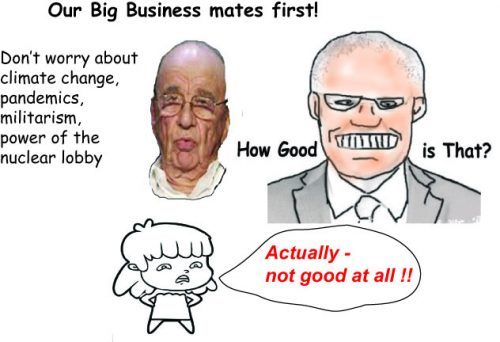
Morrison government’s devastating cuts to Environmental research and teaching
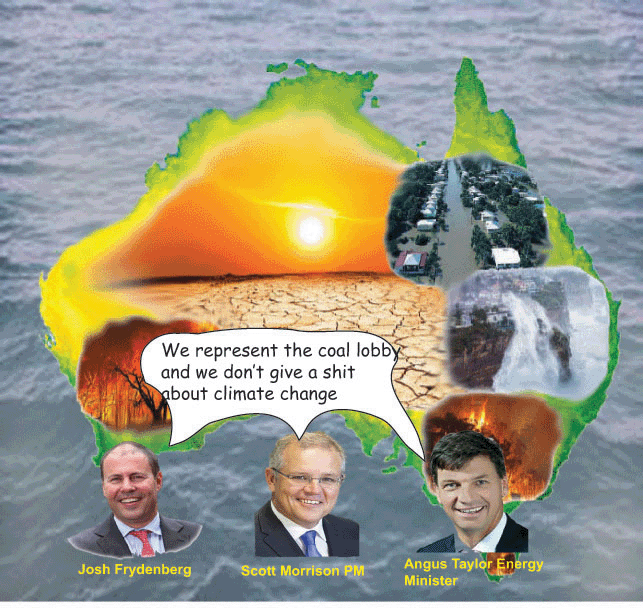 ‘Devastating’: The Morrison government cuts uni funding for environment courses by almost 30%, The Conversation, Dianne Gleeson, Professor, Science, University of Canberra, Ian Clark, Associate professor, University of South Australia, Stuart Parsons, Professor, Queensland University of Technology, 14 Oct 20,
 - agriculture, to address threats as diverse as water quality in the Great Barrier Reef, better retention of nitrogen fertilisers in soils and adaptation to climate change
- mining, for advice on site planning and restoration to ensure minimal environmental harm during and after the mine’s operation
- water management in rivers and wetlands, to respond to climate change and higher demand from growing populations…….
We need environmental experts
Australia’s recent, brutal experience with bushfires and drought shows just how badly we need world-class environmental expertise. As climate change grows ever worse, these experts will be critical in steering us through these challenges.
What’s more, the COVID-19 pandemic – linked to land clearing and more human-wildlife interaction – shows just what can happen under poor environmental management.
Australia is uniquely vulnerable to climate change, and in 2019, recorded its worst-ever environmental conditions. These university funding cuts affect the people with the answers to our pressing environmental problems – they are a blow to the future of all Australians.
Read more: A major scorecard gives the health of Australia’s environment less than 1 out of 10 https://theconversation.com/devastating-the-morrison-government-cuts-uni-funding-for-environment-courses-by-almost-30-147852
Michelle Fahy blows open the disgraceful collusion between Australian politicians and weapons industries
|
Sweeping policy changes by the Coalition, including bringing the military industry into the centre of defence planning and a 2018 strategy to catapult Australia into the world’s top 10 of weapons exporting nations, created a business bonanza in the military industry. The Turnbull government allocated $195 billion towards upgrading Australia’s military capability (since increased to $270 billion). Extraordinary amounts of money. When combined with the fundamental undeclared, and undealt with, conflicts of interest that have now become routine in Australia’s defence sector, the potential for corruption has increased markedly. Conflicts of interest have become entrenched because of the close integration of military industry interests with government policy. Corporate influence on government policy has been cultivated for years by a phenomenon at which the arms trade excels: the revolving door. This is how the revolving door works. Defence-related politicians and public officials and military personnel are regularly offered high-level, high-paying positions with weapons companies upon retirement. This provides a strong incentive for those in public service, with an eye to their future, to seek the best interests of these companies. Military industry executives in turn are welcomed into government as experts, consultants and employees. Legalised corruption of democracy? Corruption is defined as “the abuse of entrusted power for private gain, be it grand, petty, or political corruption” in the 2019 Australian research report, Governing for Integrity. The report says ‘undue influence’ is a marker for corruption, and that undue influence and the ‘revolving door’ are two key problems “eroding public confidence in parliamentarians and ministers, and weakening the fundamentals of democracy”. Take the case of former defence minister Christopher Pyne, who discussed his future with EY Defence while still in parliament, then nine days after leaving politics accepted a position with them. Pyne now also runs his own lobbying firm, lectures as an ‘industry professor’ at the University of South Australia, and is chair of the advisory board and investment committee of a new investment fund promoting high returns via investment in selected defence and cyber stocks. Pyne’s post-politics career made a mockery of the ministerial standards and lobbying rules and led to a senate inquiry, which included former foreign minister Julie Bishop, who only months after leaving parliament joined the board of multinational aid contractor Palladium. The revolving door yet again exposed the parliament’s unwillingness to manage risk factors for corruption, further eroding public confidence in the integrity of our political system. As noted by Transparency International Australia in its submission to the senate inquiry, it is quite the “culture of cosiness”. Although a particularly egregious case, Pyne isn’t the only former defence minister to have used the revolving door. The Liberals’ Peter Reith left his ministerial desk and popped up a few days later at Tenix, then Australia’s largest defence contractor. EY also secured the services of Labor’s Kim Beazley within a year of his political departure, along with former Labor defence minister Stephen Smith. Beazley joined the board of Lockheed Martin in between his public roles as US Ambassador and WA Governor. (The job description and the budget of the WA Governor has been expanded to enable Beazley to advocate for defence industry.) After a three-year association with EY, Smith has recently accepted directorships with cyber security companies ArchTIS and Sapien Cyber. Meanwhile, former Liberal David Johnston is being paid $3,000 a day for up to 180 days a year as the federal government’s chief weapons industry advocate, while sitting on the board of Saab Technologies (a significant contractor to the Defence Department). Brendan Nelson, a former Liberal party leader, defence minister and director of the Australian War Memorial, is now with Boeing (a multibillion-dollar contractor to Defence). Nelson’s move to Boeing was announced in January 2020, just a few weeks after his departure from the war memorial, a tenure that caused controversy given Nelson’s pursuit of sponsorship from arms manufacturers. (In Nelson’s final appearance at senate estimates in October 2019 he highlighted Boeing’s $1 million sponsorship of the memorial.) Nelson also raised eyebrows in March 2019 when his entry on the foreign influence transparency register revealed he had been on Thales Australia’s “advisory board” since March 2015. Thales is a global top 10 arms manufacturer, a multibillion-dollar contractor to Defence, and a sponsor of the war memorial. Then veterans affairs minister Michael Ronaldson approved Nelson’s extracurricular activity while noting the potential for conflict of interest. Nelson countered public concerns by saying he donated the fees he received to the war memorial. Current minister Linda Reynolds was briefly employed by missile-maker Raytheon in between military and political jobs in her pre-senate career. Politicians attract almost all the attention for using revolving door, but they aren’t the only ones using it. Privileged accessConsider the appointment to the Thales Australia board of former ASIO boss Duncan Lewis in February 2020, just five months after he left ASIO. The appointment attracted almost no attention. While the Sydney Morning Herald noted the appointment, no hard questions were asked and no analysis provided of Lewis’s swift move into an industry over which he had had oversight. Lewis had spent five years as ASIO’s Director-General, his final public role in a long career of public service that spanned the military (commander of special forces), the departments of the prime minister and cabinet and defence, as well as diplomatic roles (including as Australia’s ambassador to NATO)……… Weapons CEO moves into public serviceThe revolving door also ushers former weapons industry executives into public sector roles. Jim McDowell is a good example. After 17 years with BAE, the world’s sixth largest weapons-maker, including 10 years as chief executive of BAE Systems Australia, McDowell returned to Australia in December 2013 from his post in Saudia Arabia as the company’s chief executive and was immediately appointed to the board of the Australian Nuclear Science and Technology Organisation. He became ANSTO’s chair in August 2014. For the next four years while with ANSTO he also undertook numerous influential consulting roles with the Defence Department. (More details here.)…….. McDowell was chancellor of the University of South Australia (which has close links with military industry) and was on the board of numerous companies in the military industrial sector …… Part 2: There’s been plenty of talk about enhancing military capability but nothing about enhancing defence’s anti-corruption practices . https://www.michaelwest.com.au/culture-of-cosiness-colossal-conflicts-of-interest-in-defence-spending-blitz/ |
|

Murdoch media monopoly – an ‘arrogant cancer on our democracy’
 Australia’s high concentration of media ownership is eroding its democracy, getting in the way of critical action on issues like climate change and limiting what stories get told, media experts have warned. Australia’s high concentration of media ownership is eroding its democracy, getting in the way of critical action on issues like climate change and limiting what stories get told, media experts have warned.
The warning comes as former prime minister Kevin Rudd called for a royal commission into media concentration on Saturday, launching a petition to Parliament that amassed thousands of signatures within hours of going live. Australia’s media landscape is dominated by two players – Nine Entertainment, which owns the The Age and The Sydney Morning Herald mastheads among others, and News Corp, owned by former Australian Rupert Murdoch, which controls between 60 and 70 per cent of the metropolitan market. Mr Rudd decried the sheer concentration of the Murdoch empire, and pointed to News Corp mastheads’ support for the Liberal Party in the past 18 elections. Murdoch has become a cancer, an arrogant cancer, on our democracy,” Mr Rudd said. “I’m calling on the Parliament to establish a royal commission into the abuse of media monopoly in Australia, and particularly by the Murdoch media, to make recommendations to maximise media diversity ownership for the future lifeblood of our democratic system.” Mr Rudd has had a long-running feud with News Corp, which used its mastheads to hound him during his tenure as prime minister. A petition to Parliament is essentially a request for action, but it does not mean the sitting government has to implement its requests…….. Mr Murdoch’s influential newspapers and television stations have been widely criticised for spreading misinformation about climate change during Australia’s out-of-control bushfires. The Australian has repeatedly argued that this year’s fires are no worse than those of the past – a claim that scientists have dismissed as untrue…….. “We see story after story in the Murdoch papers saying there is no such thing as climate change, then that arsonists were responsible. “There’s never any apology or correcting the record.” News Corp has also been pursuing Victorian Premier Daniel Andrews over the issue of the state’s coronavirus lockdowns, she said. “Every story in The Australian is about ‘Dictator Dan’, it would be like the NZ publications going after ‘General Jacinda’, but there the coverage has been more considered,” Dr Price said. Her dream royal commission on media ownership would also focus on tabloid commentators and the ways in which they target and bully individuals they dislike. “I want a royal commission into the stream of columnists who should have to make amends for their fact-less columns,” Dr Price said………. Dr Muller said the Murdoch influence was not just apparent in Australia. “If you look at the two democracies in the most trouble, the UK and the US, in both the Murdoch empire is dominant and has been an active player in preferring right-wing governments,” he said. “When you have power like that which is not accountable you impair your democracy.”…….. https://thenewdaily.com.au/news/politics/2020/10/11/kevin-rudd-murdoch-royal-commission/ |
|
Queensland election – all about climate, coal, and minority parties
 ‘Queensland paradox’ pushes coal and climate to centre stage of election campaign, Guardian, Ben Smee @BenSmee, Sat 10 Oct 2020
 As Labor and the LNP try to woo regional and metro voters with at-times contradictory messages, minor parties thrive
On Sunday in Clermont – in the dusty heart of Queensland – the coal fanatic Liberal National party senator Matt Canavan and the mining magnate Clive Palmer will hold a rally, mocking the convoy of climate protesters who made a somewhat unwelcome voyage north last year.
Three days earlier, almost 1,000km away in Brisbane’s trendy western suburbs, the Greens announced state election plans to provide free school meals, funded by a $55bn increase to mining royalties.
Somewhere in between lies what the University of Queensland political scientist Glenn Kefford calls “the Queensland paradox” – the challenge for major parties to woo voters in both Toowong and Townsville with different, sometimes contradictory, messages.
“The state might appear a certain way to outsiders but it’s really interesting and diverse,” Kefford says.
As Labor and the LNP attempt to “walk both sides of the street”, divisive issues including coalmining and climate change have again been pushed to the forefront of the campaign………
Avoiding the third rail
Of course, it’s impossible to talk about Queensland, coal, climate and the election without mentioning the third rail of that debate: Adani.
On the eve of the election, Labor sought to neutralise a potential campaign problem by signing a long-delayed royalties deal for Adani’s under-construction Carmichael coalmine.
Polling released this week shows Labor extending its dominance over the LNP in greater Brisbane. The party also hopes to pick up seats on the Gold Coast and the southern Sunshine Coast.
Of most concern to Labor strategists are the party’s regional seats, including the working-class regional cities of Townsville, Mackay, Rockhampton and Gladstone, where voters swung fiercely towards the Coalition at the 2019 federal election.
The premier, Annastacia Palaszczuk, began her hi-vis “jobs, jobs and more jobs” campaign by hopping across north Queensland, pushing a pro-mining message.
Kefford said Labor appeared to be attempting to address failures from last year’s federal election campaign in north and central Queensland by running messaging tailored to suit local campaigns in regional areas……….
‘Frankenstein majority’
Queensland politics has become known for its embrace of minor parties,………
“There’s a good chance of [a hung parliament], there’s no doubt,” Kefford said. “The major parties, they have to rationalise what they’re doing and be strategic about their messaging. They can’t be everything to everyone.” https://www.theguardian.com/australia-news/2020/oct/10/queensland-paradox-pushes-coal-and-climate-to-centre-stage-of-election-campaign
Net zero emissions target for Australia could launch $63bn investment boom
|
Net zero emissions target for Australia could launch $63bn investment boom, Guardian, Lisa Cox, 12 Oct 20,
Modelling shows moving towards a net zero emissions economy would unlock financial prospects in sectors including renewables and manufacturing Australia could unlock an investment boom of $63bn over the next five years if it aligns its climate policies with a target of net zero emissions by 2050, according to new economic modelling. The analysis, by the Investor Group on Climate Change (IGCC), finds the investment opportunity created by an orderly transition to a net zero emissions economy would reach hundreds of billions of dollars by 2050 across sectors including renewable energy, manufacturing, carbon sequestration and transport. However, if the country keeps to its current targets and climate policies, investment worth $43bn would be lost over the next five years, growing to $250bn by 2050. The Investor Group on Climate Change represents investors in Australia and New Zealand who are focused on the effect of the climate crisis on the financial value of investments. Among its membership are institutional investors with funds under management worth more than $2 trillion. The organisation commissioned the consultancy Energetics to examine the domestic investment opportunities that would arise from an orderly transition to net zero emissions by 2050. The report finds a net zero scenario would unlock $63bn in investment over the next five years, including $15bn in manufacturing, $6bn in transport infrastructure such as charging stations, and $3bn in domestic green hydrogen production, as companies and governments moved towards the stronger emissions goal. ………. “What it shows is that the investment opportunities extend well beyond just the renewables industry,” said Erwin Jackson, the IGCC’s director of policy. “Renewables are the backbone of the transition but there are massive opportunities in other sectors such as manufacturing, restoring the land, and electrification of transport.” The report, which targets governments, companies, investors and financial regulators, says its estimates are conservative because they do not factor in the export potential of industries such as clean hydrogen. It argues that if governments set stable policy, and companies and investors collaborate to align their decisions with the goals of the Paris agreement, then billions of dollars over the short and long term could support the jobs and wealth of millions of Australians, particularly in regional areas. The Morrison government has refused to commit Australia to a net zero emissions target and has focused its climate policy on a new technology roadmap covering hydrogen, energy storage, “low carbon” steel and aluminium, carbon capture and storage, and soil carbon……… John Connor, the chief executive of the Carbon Market Institute, said the reality Australia faced was its economy was running “below capacity and it needs a new direction”. He said clean technologies like renewable energy and transport represented significant opportunities for Australia in a post-carbon world and the country’s vast land mass, with landscapes in need of regeneration, gave it a competitive advantage in carbon sequestration. “We can either coast off the cliff into the hothouse of economic and climate disaster, or we can turn a corner towards an orderly transition and the opportunities that are there,” Connor said. https://www.theguardian.com/australia-news/2020/oct/12/net-zero-emissions-target-for-australia-could-launch-63bn-investment-boom |
|
Australian government’s controversial Nuclear Waste Bill delayed – not yet debated in Senate
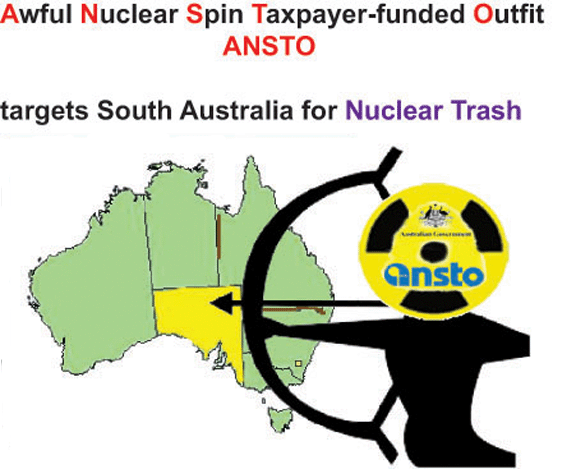 10 Oct 20, The dump legislation didn’t make it on to the Senate floor for debate and voting …
I think the government just ran out of time, they didn’t withdraw the Bill
So over the next week Non Government Organisations, and farmers and Traditional Owner s will be discussing how best to use the next month
China’s dramatic plan for switch to renewables – a warning to Australia’s fossil-fuel economy
 China just stunned the world with its step-up on climate action – and the implications for Australia may be huge, The Conversation, October 8, 2020, Hao Tan, Associate professor, University of Newcastle, Elizabeth Thurbon, Scientia Fellow and Associate Professor in International Relations / International Political Economy, UNSW, John Mathews, Professor Emeritus, Macquarie Business School, Macquarie University, Sung-Young Kim, Senior Lecturer in International Relations, Discipline of Politics & International Relations, Macquarie School of Social Sciences, Macquarie University China just stunned the world with its step-up on climate action – and the implications for Australia may be huge, The Conversation, October 8, 2020, Hao Tan, Associate professor, University of Newcastle, Elizabeth Thurbon, Scientia Fellow and Associate Professor in International Relations / International Political Economy, UNSW, John Mathews, Professor Emeritus, Macquarie Business School, Macquarie University, Sung-Young Kim, Senior Lecturer in International Relations, Discipline of Politics & International Relations, Macquarie School of Social Sciences, Macquarie University
|
|
Australia now the worst OECD country for climate change action
Back of the pack: Australia now the worst OECD country for climate change action, The New Daily, Cait Kelly, 7 Oct 20, Australia has become the worst-performing of all OECD countries when it comes to climate change, and will soon become a global pariah unless federal policies change fast, experts warn.It comes as UK Prime Minister Boris Johnson became the first democratic leader to outline a green-centred plan for rebuilding the country and creating jobs when the coronavirus crisis ends.
One of Australia’s leading experts in climate change, Professor Will Steffen said the UK’s announcement has left Australia in the dust.
“The UK is the first country to put forward a concrete plan but other OECD counties, particularly the Nordic ones – Denmark, Norway and Sweden – already have advanced plans,” he told The New Daily.
“We and the United States are stumbling around while most European countries are trying to get it done.”
He said depending on how the US election plays out, Australia could soon become an outlier.
We’re pretty much alone now and who knows how the US is going to go,” Professor Steffen said. If the election changes the government, you’ll see much more action on climate change. They’ve got great wind resources. They’ve got enormous tech capability. If they get the politics right, they could change fast.
We have enormous renewable sources, but we’re being held back by politics.”
The stark warning we have fallen behind the pack comes as new analysis from WWF reveals that in terms of committing to stimulus spending on renewables, Australia lags even further behind.
We are currently spending five times less than the conservative UK government and 10 times less than South Korea – a major trading partner……….
The government has focused Australia’s economic recovery from COVID-19 on fossil fuels, namely gas. ……. https://thenewdaily.com.au/news/national/2020/10/07/australia-climate-change-oecd/
Morrison government again fails on climate ation, snubs renewable energy
But investment in renewable energy was largely shunned. Notably, the government allocated just A$5 million for electric vehicles. It confirmed funding for the Australian Renewable Energy Agency (ARENA) for another decade, but the money is far less than what’s needed.
The COVID-19 pandemic has seen the Morrison government abandon long-held dogma on debt and deficits. However, the federal budget shows when it comes to climate and energy, the government is singing from the same old songbook.
A techno-fix
The budget doubled down on the Morrison government’s rhetoric of “technology, not taxes”, by choosing preferred technologies for investment.
This “picking winners” approach would have some chance of addressing climate change if it were based on a comprehensive analysis of the best path to zero emissions. But instead, the government has largely made offerings at the altars of technologies worshipped by the conservative side of politics.
The government will spend an as-yet undisclosed sum, possibly A$11 million, to refurbish the Vales Point coal-fired power station. The commitment to this coal infrastructure, co-owned by prominent Liberal party donor Trevor St Baker, is a disgraceful misuse of public money. It will also do little to halt the steady decline of coal-fired power generation.
As previously announced, the government will spend A$52.9 million to support the gas industry, which Frydenberg says will lower prices and support more manufacturing jobs. It includes money for gas infrastructure planning and to open up five gas basins, starting with Beetaloo Basin in the Northern Territory.
The budget confirms A$50 million for carbon capture and storage (CCS) to fund projects to cut emissions from industry. But proving the viability of large-scale CCS projects is extremely difficult, as experience in the United States and Canada has shown. In this context, allocating just A$50 million to get the technology off the ground is simply laughable.
History suggests the spending offers little return on investment. Research by the Australia Institute in 2017 revealed federal governments have spent A$1.3 billion in taxpayers’ money on CCS projects, with very little to show for it.
Renewables snubbed
Meanwhile, last night’s budget largely shunned investment in renewable energy.
The budget confirmed A$1.4 billion in ARENA funding for a further ten years, including a pretty paltry A$223.9 million over the next four years. Separately, the government will also seek to pass legislation to change ARENA’s investment mandate, enabling it to fund gas and carbon capture projects.
The government has allocated a tiny A$5 million towards electric vehicle development, including money towards a manufacturing facility in South Australia. It’s good to see electric vehicles on the government’s radar. But the commitment is dwarfed by investment overseas, including a reported US$300 billion set aside by global car makers over the next decade to bring electric vehicles to mass production.
The measly spending on clean energy technology does not make economic sense. The renewable energy sector is standing by to slash emissions and deliver lower energy prices – if only the right policy environment existed.
The budget was also an opportunity for the government to ditch its irrational opposition to carbon pricing. Recent research has comprehensively shown carbon pricing slows growth in greenhouse gas emissions.
Vehement carbon pricing critics, such as conservatives Tony Abbott, Craig Kelly and Barnaby Joyce, are now either discredited or out of parliament altogether. And scores of countries around the world have implemented some form of price on carbon.
A global outlier
Most obviously, the budget was an opportunity to commit to net-zero emissions by 2050, as many developed countries have done.
The Morrison government has already used dodgy accounting tricks to meet Australia’s Paris Agreement commitment – reducing emissions by 26% on 2005 levels. The absence of a net-zero target suggests the government intends to allow emissions to grow indefinitely after 2030.
This approach is out of step with many of Australia’s international peers. Democratic presidential candidate Joe Biden, now the clear favourite to win the US election in November, is campaigning on what has been described as “the most aggressive climate platform” ever put forward by a presidential nominee.
1 This month


Help Aunty Sue Protect Her Land and Sacred Sites From Destructive Rocket Testing.
.

Australians deserve the truth
about
AUKUS – https://aukuspublicinquiry.com/

PETITION – To: Prime Minister Anthony Albanese and the Australian Labor Government

of the week – Australians for War Powers Reform (AWPR)
To see nuclear-related stories in greater depth and intensity

