Senate dumps on the Australian government’s radioactive waste plan
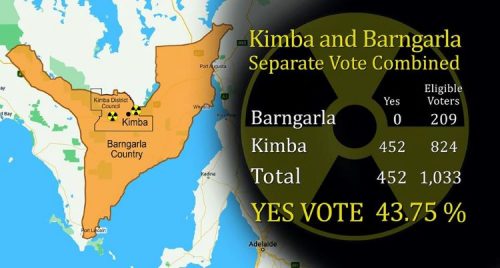 Senate dumps on government’s radioactive waste plan
The federal government should drop its plans for a national radioactive waste facility in regional South Australia after One Nation joined Labor, the Greens and others on the Senate crossbench in rejecting the government’s proposal for a site near Kimba.
One Nation confirmed it will not support the federal government’s bill to remove the right of affected communities to legally contest the decision to make Kimba the site for a radioactive waste facility and is instead seeking ‘to make the right decision for future generations’.
With Labor, the Greens, other crossbenchers and now One Nation opposed, the government appears to lack the numbers in the Senate to advance the plan.
“The federal plan is politically divisive, technically deficient and increasingly uncertain,” said the Australian Conservation Foundation’s nuclear campaigner Dave Sweeney.
“It has failed the test in the broader community and now also in Canberra.
“The government’s proposal is based on excluding people from consultation and review processes. It is based on the heavy handed overriding of legal principles and the unnecessary double handling of long-lived intermediate level waste.
“Access to a day in court is a fundamental democratic right that should not be jettisoned – especially on an issue with such significant and lasting impacts as radioactive waste.
“Many state and national civil society groups, Aboriginal and professional groups, the South Australian Upper House, SA Labor and Unions SA opposed the government’s approach.
“The government should now stop playing politics and start paying attention.
“This waste lasts longer that any politician and needs to be responsibly managed.
“We need a new approach that is based on evidence, inclusion and respect.”
Further information, context or comment: Dave Sweeney on 0408 317 812
Read ACF’s 3-page background brief on the federal radioactive waste plans
Australian govt’s Kimba nuclear waste dump plan will be torpedoed in the Senate
 Pauline Hanson’s One Nation torpedoes Kimba nuclear waste dump in SA, Claire Bickers, Federal Politics Reporter, The Advertiser, November 11, 2020
Pauline Hanson will torpedo the Federal Government’s bid to build a radioactive waste dump in regional South Australia.
The One Nation leader, who aims to win a seat in SA at the next federal election, has confirmed she will not back legislation to build the nuclear waste storage site at Napandee farm, near Kimba.
Without One Nation’s two crucial votes – and Labor, the Greens, and independent senator Rex Patrick not backing the Bill – the government does not have enough votes for it to pass parliament without changes.
Senator Hanson told The Advertiser she had serious concerns about the process to select Napandee, the level of community support, the waste site being built on farming land, and the facility storing intermediate radioactive waste above ground.
“I want to make the right decision, not for the interim, I want to make the right decision for future generations,” Senator Hanson said.
“I’m not going to be badgered or pushed into this.
“It’s about looking after the people of SA, but also the whole of Australia.”
Senator Hanson said One Nation wanted to win a seat in SA at the next election, and she hoped South Australians would take into account her strong stance on the waste site.
One Nation adviser Jennifer Game, who ran as the party’s SA Senate candidate at the 2019 election, has been leading research and consultation on the Kimba site.
“I think the government has rushed the decision to have it there,” Senator Hanson said.
Almost 62 per cent of 734 Kimba residents supported the facility in a postal vote in 2019 but Senator Hanson said locals had indicated to the party that closer to half of the town did not support the facility.
The region’s native title holders, the Barngarla people, were also not given a say in the official vote.
Senator Hanson was concerned other locations that may be suitable were not investigated, such as an old mining site in Leonora, in Western Australia, which may be able to store the waste underground.
“We don’t know what the future is going to hold, we don’t know if war is going to touch our shores,” she said.
“Do we really want a facility that is above ground that could be problems further down the track, if anything happens?”…https://www.adelaidenow.com.au/news/south-australia/pauline-hansons-one-nation-torpedoes-kimba-nuclear-waste-dump-in-sa/news-story/9043c46fa44ecd8a1b4e46be111745f3
Sneator Sam McMahon going all out for Small Nuclear Reactors

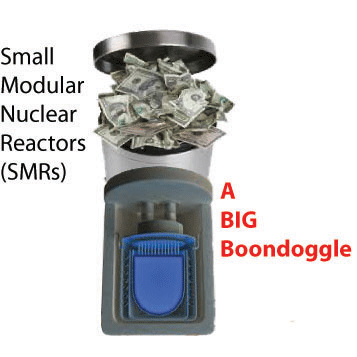
Senator McMahon is looking beyond currently commercialised nuclear technology, to Small Modular Reactors (SMRs). None of these exist in service anywhere in the world and as the WNISR2020 report points out, will cost more per kilowatt than conventional nuclear energy – and beyond a few prototypes SMRs are unlikely to come into play.
So, as renewables are perceived to be expensive when backed by storage, the solution is to shoot for a technology that may never hit prime time and even if it does, will be even more expensive than conventional nuclear, push up energy prices and erode carbon mitigation outcomes?
Perhaps channelling Senator Matt Canavan, this is some of what the senator had to say about renewables in late October:
“Renewables are the dole bludgers of the energy mix,” said Senator McMahon. “They are a great hoax perpetrated by the industry on the gullible.” Continue reading
Previous Chief Scientist not a fan of Small Nuclear Reactors
 Dr Finkel said it was “hard to see” small nuclear modular reactors being ready before 2040, and even after that Australia would have to monitor commercial installations overseas before allowing the technology.
“So, is it something we should be looking at hard at the moment? I am certainly not looking at it intensely at the moment,” he said. https://www.smh.com.au/politics/federal/gas-critical-for-renewable-energy-future-chief-scientist-says-20200212-p54026.html?fbclid=IwAR00ucWlw1Lsq_gNEPkPQ8ru301_hEmu9gXMxdG3CunZHBXyf_zE4E9QB3E
Since Penny Sackett, Australia’s Chief Scientists have moved further towards the extractive industries

above – new Chief Scientist Cathy Foley
Penny Sackett, Chief Scientist 2008 – 2011, was the first and clearest voice to speak out on climate change.
Then we had Ian Chubb, who was a lot quieter about this.
Then we got Alan Finkel, – who agreed that climate change was a threat, but thought that gas was a big solution. However, he was very luke warm about nuclear power
Now we get Cathy Foley, a physicist with a background in the minerals industries, who talks about “no single solution” and ”a “whole range” of solutions ”. Could that mean carbon capture, and small nuclear reactors? Watch this space.
Senator Sam McMahon enthuses about Generation IV nuclear reactors for the Northern Territory
“In fact, when it comes to emissions, reliability and power output, nuclear is a clear winner.
“These facts are true of existing nuclear power stations, however, it is the emerging Generation IV nuclear reactors that I believe should be given greater consideration.”…….
“Currently, there are no SMR’s in service anywhere in the world but there are several projects being developed in Europe, China and the USA. The Australian Nuclear Science and Technology Organisation monitors advances in the various technologies and regularly reports on its findings. Australia is in a position to not only observe and learn, but also to contribute to this growing body of knowledge and technology.
“The NT is uniquely positioned to benefit from a nuclear industry in Australia, should we decide to go down that path.” https://www.goulburnpost.com.au/story/7004671/nuclear-must-be-part-of-debate-on-australias-future-energy-needs-mcmahon/?cs=9397
Australia’s freedom of information system hides climate documents
 Australia’s government agencies increasingly refusing environment-related FOIs, audit finds . Australian Conservation Foundation also finds growing delays in processing requests by departments and agencies. Guardian, Christopher Knaus, 9 Nov 20,Australia’s freedom of information system is increasingly hiding documents about climate and other environmental issues from the public, a trend driven by skyrocketing refusal rates, widespread delays and rising costs, an audit has found.
The audit, conducted by the Australian Conservation Foundation (ACF), examined five years of FOI requests for environment-related documents across federal and state departments and agencies.
It found the number of outright refusals for environment-related documents has more than doubled, from 12% to 25%, while the number of requests granted in full has dropped from 26% to 16%.
Delays in processing environment-related FOI requests were widespread, the audit found, with 60% of requests late by more than a month and 39.5% by more than two months.
The cost of processing environment-related FOIs was double the average, and lengthy review processes, which often took more than a year to complete, were becoming “a key tool for denying access to information”.
“It appears from our audit that environmental information is even more odiously inaccessible than other information subject to the [Freedom of Information] Act,” the ACF’s audit said.
ACF’s democracy campaigner, Jolene Elberth, said the findings of the audit should be a “wake-up call” to anyone who cares about transparency.
“Serious systemic flaws in our system are frustrating efforts to protect our precious natural ecosystems and tackle the climate crisis,” Elberth told the Guardian………
The Office of the Australian Information Commissioner’s (OAIC) latest annual report shows delays, complaints and refusals are all increasing over time.
Complaints about the FOI system increased by 79% in a single year, according to the OAIC’s annual report.
Practical refusals – used if a request is deemed to take too much time or effort to process or if documents cannot be found – went up by 71% in 12 months.
Delays are growing more protracted.
Last financial year, about 79% of all FOIs were processed in the time required by law. The year before it was 83% and in 2017-18 it was 85%.
In some government agencies, only 50% of FOI requests are being processed within the lawful timeframe, including the prime minister’s office, the office of the environment minister, the Australian Radiation Protection and Nuclear Safety Agency, the Australian Sports Anti-Doping Authority, Sports Australia, the Australian federal police, the Australian Broadcasting Corporation, the office of the infrastructure minister and Norfolk Island Regional Council.
Delays at the Department of Home Affairs, which receives by far the most FOI requests, have also increased…… https://www.theguardian.com/australia-news/2020/nov/09/australias-government-agencies-increasingly-refusing-environment-related-fois-audit-finds
New chief scientist says climate change has “no single solution” — RenewEconomy

This is a real worry. Cathey Foley has a background in the minerals industry. The ”no single solution” could be code for including gas, carbon capture, nuclear….
Australia’s new chief scientist, Cathy Foley, says climate change is a problem with “no single solution,” and one of the world’s greatest challenges. The post New chief scientist says climate change has “no single solution” appeared first on RenewEconomy.
New chief scientist says climate change has “no single solution” — RenewEconomy

Farmers to Canberra, to protest the law that forces a nuclear dump on Kimba’s agriculutral land
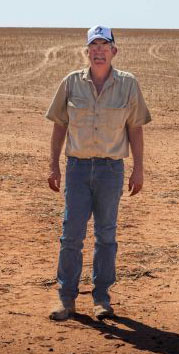
 We are members of the Kimba community and proud and productive grain farmers who have travelled to Canberra to meet with Labor, Green and cross-bench Senators to put a face to those directly impacted by the proposed legislation to name Kimba as the site for Australia’s radioactive waste dump.
In our view the process the Government has employed to site this facility in Kimba over the last five years has been unfair, manipulative and completely lacking in transparency.
We are extremely concerned that the Governments proposed legislation currently awaiting Senate consideration intentionally removes our right to contest the decision and denies basic protections .
It is clear that productive farming land in Kimba is not the best, or even the right place for our nations radioactive waste. We urge the federal government to step back and review their selection process rather than continue trying to force this decision through via Parliament.
Quotes can be attributed to Toni Scott – Secretary, No Radioactive Waste on Agricultural Land in Kimba or SA Committee Media Contact – Kellie Hunt – 0428 572 411
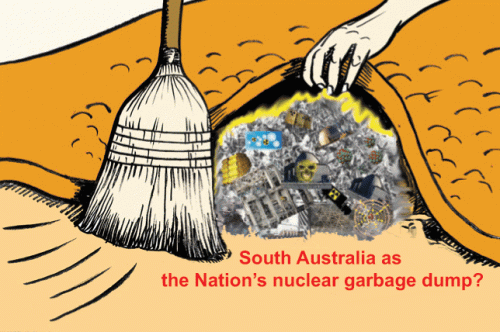
Out of site out of mind – Australian govt has NO PLAN for nuclear waste disposal.
Divisive campaign on South Australian facility highlights urgent need for long term nuclear waste management plan, Croakey, 6 Nov 20, Tillman Ruff
“……..No long term management plan for nuclear waste
Australia needs to develop a plan for long-term management and disposal of long-lived intermediate level nuclear waste, which must be kept strictly isolated from people and the environment for 10,000 years.
More than 90 percent of Australia’s radioactive waste comes from nuclear reactors managed by the Australian Nuclear Science and Technology Organisation (ANSTO) at Lucas Heights in southern Sydney. This waste is stored there in a dedicated Interim Waste Store facility at Australia’s principal nuclear facility, with the best expertise and capacity in the country to manage this safely, monitored 24/7 by the Australia Federal Police.
A serious, open, transparent, evidence-based process is required to carefully consider the options, and develop the most responsible plan for ongoing long-term management and disposal of this waste.
nstead, successive governments — both Coalition and Labor — have sought to impose a succession of ill-considered waste dump plans on SA and NT remote communities. All have previously failed because of deeply flawed processes and strong community opposition.
Transport, taxpayer burdens absent health need
The risks of accident or theft are greatest during transport of nuclear materials. Kimba is 1,700 km from Lucas Heights. Road or sea transport of radioactive waste would involve lengthy routes potentially traversing many communities in multiple states.
The nuclear regulator, the Australian Radiation Protection and Nuclear Safety Agency (ARPANSA) has recently confirmed to a Senate inquiry that Lucas Heights has the capacity to safely store Australia’s radioactive waste for several decades, and that there is no urgent need to relocate it.
The Senate Inquiry last month recommended the South Australian plan go ahead, but there was a split among the committee membership, with Senators Jenny McAllister (Labor), Sarah Hanson-Young (Greens) and Rex Patrick (Independent) dissenting.
The government’s repeated claim that an immediate interim radioactive waste dump is needed to ensure the continuation of nuclear medicine in Australia is false.
Every sizeable hospital currently manages their radioactive waste on a ‘delay and decay’ basis on site; the residual waste rapidly loses its radioactivity and is stored on-site until it has decayed and can be discarded with normal waste. This doesn’t need to and won’t change.
The emotive but fallacious claim that provision of nuclear medicine services needed for diagnosis and treatment of cancer will be jeopardised if a new nuclear waste dump is not urgently progressed is being dishonestly but persistently promoted.
To support passage of the government’s amendments, Federal Resources, Water and Northern Australia Minister Keith Pitt is believed to be planning a “nuclear medicine roundtable” at Parliament House on Monday 9 November.
The true driver of increasing need for waste management is ANSTO’s institutional nuclear ambitions, reflected in its current massive ramp-up of production of medical isotopes for export — from around one percent to a target of 25-30 percent of global supply over the next several years.
Not only are we left with the waste legacy of this expanding isotope export business, Australian taxpayers also pick up the bill, paying $400 million for the Lucas Heights OPAL reactor, and subsidising ANSTO on an annual basis for its nuclear operations.
ANSTO received $313.8 million in 2019-20, and was given an additional $238.1 million over 4 years in last month’s Budget.
Cost analyses in several other countries have found that medical isotope sales usually only recover 10-15 percent of the true cost of production once waste, decommissioning, insurance and other costs are factored in.
ANSTO’s export expansion push is increasing domestic nuclear waste pressures, and this is happening without proper public and parliamentary accountability and scrutiny………..
Out of sight, out of mind
The government’s approach, codified in the proposed amendments, would see long-lived radioactive intermediate level nuclear waste transported long distances from the best and most secure site to manage radioactive waste in Australia, to a distant site in South Australian farming country with no current expertise, facilities or experience in securely managing long-lived hazardous radioactive waste.
Effectively, this “temporary” storage facility for waste that must be kept safe from the environment for over 10,000 years will be a large shed.
There is currently no plan and no process to develop a plan for the long-term management and eventual disposal of this waste. Therefore the intermediate level waste will likely languish indefinitely above ground in a facility inadequate for safe long-term storage or disposal, but out of sight and out of mind from Canberra or Sydney.
Australia needs an open, transparent, evidence-based and independent review of Australia’s current and projected radioactive waste production. This review should examine and make recommendations on the best practice long-term management of Australia’s radioactive waste production and disposal.
It should be conducted independently of ANSTO, given their role as proponent of the current proposal and plans to significantly increase nuclear waste production over the next decade for reasons which are not based on the health or other needs of Australians.
It should be open to input from Indigenous organisations, civil society organisations, experts and the public, and be undertaken before any soil is turned for a dump in Kimba and before any waste is moved from Lucas Heights. We have ample time to do this properly.
Tilman Ruff AO is Associate Professor at the Nossal Institute for Global Health, University of Melbourne. He is Co-President of International Physicians for the Prevention of Nuclear War, and co-founder and founding chair of the International Campaign to Abolish Nuclear Weapons, both Nobel Peace Prize laureate organisations. https://www.croakey.org/divisive-campaign-on-sa-facility-highlights-urgent-need-for-long-term-nuclear-waste-management-plan/
Zali Steggall calls on Australia’s chief scientist to clarify position on net zero emissions by 2050
|
Zali Steggall calls on Australia’s chief scientist to clarify position on net zero emissions by 2050
More than 100 businesses and organisations have supported the independent MP’s climate change bill in ads in major newspapers, Guardian, Adam Morton Environment editor @adamlmorton, 6 Nov 20, The private member’s bill, which was announced in February but delayed due to Covid-19, is supported by Steggall’s fellow crossbenchers Rebekah Sharkie, Helen Haines, Andrew Wilkie and the Greens, and has been backed by climate scientists, economists and some business leaders, including the Business Council of Australia’s Jennifer Westacott, who described it as “sensible”. It is opposed by the government, which controls whether it will be debated in parliament and has rejected a 2050 net zero target……..https://www.theguardian.com/australia-news/2020/nov/07/zali-steggall-calls-on-australias-chief-scientist-to-clarify-position-on-net-zero-emissions-by-2050 |
|
Minister Keith Pitt reluctant to name property owner who sold land for nuclear dump
Australian government’s Nuclear Waste Bill – divisive, undemocratic and racist processes

Divisive campaign on South Australian facility highlights urgent need for long term nuclear waste management plan, Croakey, 6 Nov 20,
Tilman Ruff writes: Radioactive waste production and management need a sound evidence-based plan, not shoddy and racist imposition based on misguided nuclear ambition.
On Tuesday 6 October, under the cover of the Federal Budget, the Government planned to introduce controversial amendments to laws on radioactive waste management in the Senate.
The amendments were dropped from the Senate list the following day, only to reappear the following day, the last sitting day for this parliamentary session. They were ultimately not tabled, for reasons unstated, but most likely because the government was concerned it did not have the numbers to pass them.
The National Radioactive Waste Management Amendment (Site Specification, Community Fund and Other Measures) Bill 2020 seeks to confirm the siting of a national radioactive waste facility near Kimba in regional South Australia. It would also remove any legal right to review this decision.
These laws were opposed by Labor, minor party and independent members when they passed in the lower house in June, and remain actively contested in Parliament and more so in the community.
Nonetheless $103.6 million was allocated in the budget over the next four years for the planned radioactive waste dump at Kimba, a clear sign the government remains committed to this flawed legislation, which is again scheduled to be debated in the Senate next week.
The radioactive waste management plans it would lock in deserve greater public scrutiny than they have received to date…………
Divisive, undemocratic and racist processes
The government campaign to persuade the residents of Kimba to accept a radioactive waste dump has been misleading and divisive, with much inaccurate information about risks and benefits, inflated employment promises, and very poor process to assess genuine community views.
The people selected to vote on this proposal (with shifting and nebulous goalposts) were town-based, excluding many farmers who actually live closer to the site than those in Kimba township. The local community has become divided.
Crucially, despite multiple requests, Barngarla Native Title holders were explicitly excluded from the government’s community ballot, and remain actively opposed to the planned waste facility. The Barngarla people unsuccessfully attempted to have their exclusion from the consultation process struck down in the Federal Court in March on the grounds that it contravened the Racial Discrimination Act.
When the Barngarla people commissioned a survey themselves, 100 percent of those surveyed were opposed. Nonetheless the process has proceeded, despite government promises that Aboriginal views would be taken into account.
Minister Pitt visited Kimba for the first time in months on 3 November. His media release thanking the Kimba community and chronicling his meetings with the mayor, proposed waste site landowner and various local organisations mentions Barngarla people not once.
Removing the right to legal review
The clear and unacceptable rationale of the proposed amendments are to remove the right of legal challenge to the choice of a national radioactive waste facility near Kimba.
Minister Pitt already has the power under the existing National Radioactive Waste Management Act (2012) to advance the planned Kimba facility, however this would be subject to legal review.
The right to independent legal recourse is a fundamental principle of our democracy and should not be jettisoned without compelling reasons – especially on an issue with such significant long-term implications and impacts as radioactive waste.
To remove the right to judicial review for affected people is unfair, unnecessary and unjustified. It violates the rights of Aboriginal people. ……….. https://www.croakey.org/divisive-campaign-on-sa-facility-highlights-urgent-need-for-long-term-nuclear-waste-management-plan/
$3 trillion and 880,000 jobs to be lost, if Australia continues inaction on climate change
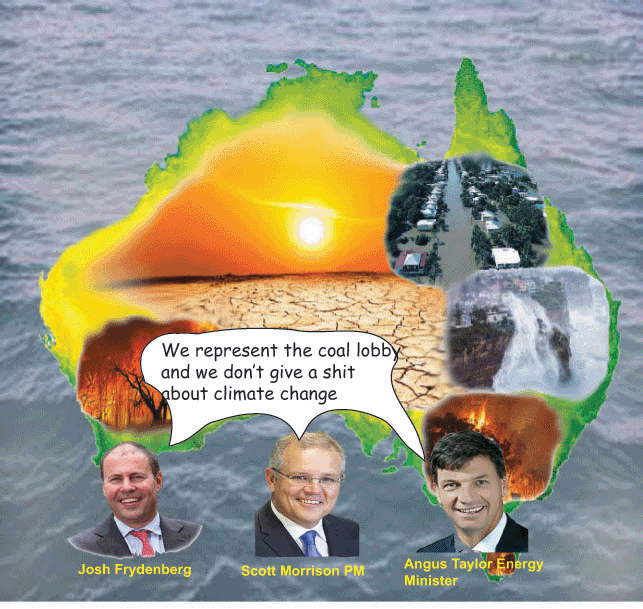 Australia will lose more than $3 trillion and 880,000 jobs over 50 years if climate change is not addressed, Deloitte says, ABC News, By Kathleen Calderwood– 1 Nov 20 The Australian economy will lose more than $3 trillion over the next 50 years if climate change is not addressed, according to a new report from Deloitte Access Economics.Key points: Australia will lose more than $3 trillion and 880,000 jobs over 50 years if climate change is not addressed, Deloitte says, ABC News, By Kathleen Calderwood– 1 Nov 20 The Australian economy will lose more than $3 trillion over the next 50 years if climate change is not addressed, according to a new report from Deloitte Access Economics.Key points:
The report found the economy could shrink by 6 per cent over the next 50 years and 880,000 jobs could be lost. Report author Pradeep Philip, who was a policy director for former prime minister Kevin Rudd, said there was also a lot to be gained if warming was kept below 1.5 degrees and Australia achieved net zero carbon emissions by 2050. “If we do act over the next few years then in just 50 years there is a benefit to the economy of $680 billion,” he said. “We’ll have an economy 2.6 per cent bigger, generating 250,000 jobs, so this tells us if you are pro-growth and pro-jobs then we need to act on climate change now……. Businesses ‘moving despite Government inaction’ Sheep grazier and chair of Farmers for Climate Action, Charlie Prell, says the pressure is already being felt in his industry, but opportunities are available to help agriculture businesses get by if climate change is addressed………. https://www.abc.net.au/news/2020-11-02/australian-economy-lose-$3-trillion-climate-change-inaction/12837244 |
|
|
Bushfire royal commission’s final report issues warning to Australia over climate change,
 Bushfire royal commission’s final report issues warning to Australia over climate change, ABC News, By national science, technology and environment reporter Michael Slezak, 1 Nov 20, Bushfire royal commission’s final report issues warning to Australia over climate change, ABC News, By national science, technology and environment reporter Michael Slezak, 1 Nov 20, The bushfire royal commission’s final report is a stark warning of a future marked by extreme weather impacts of climate change.The commissioners describe their task at the very top of the report as “looking to the future”. And they are very clear about what that means. “Extreme weather has already become more frequent and intense because of climate change; further global warming over the next 20 to 30 years is inevitable,” they say. And as for what that means for fire regimes, they don’t mince their words. “Catastrophic fire conditions may render traditional bushfire prediction models and firefighting techniques less effective,” they say. The report notes there’s essentially nothing we can do about “locked in” warming set to occur over the next two decades. But what happens after that is up to us. Warming “beyond the next 20 to 30 years is largely dependent on the trajectory of greenhouse gas emissions”, it says. The commissioners also highlight evidence that avoiding or mitigating risks is much more cost effective than responding to disasters after they happen — an approach they unequivocally state is not adequate. “We need to do much more than put out fires. A resilient nation will seek to mitigate the risk of disasters through a wide range of measures, and it will attend to all of the complex and sometimes long-term consequences,” they say. Many commentators, including former fire chiefs, cross bench politicians and conservation groups, have argued the implication from the findings is clear: that greenhouse gas emissions must be quickly reduced to net zero. But of the report’s 80 recommendations, the commissioners do not make any aimed at trying to stop global warming. Their only climate-related recommendation calls for climate models to be created that can provide projections for smaller geographical areas — making them more useful for local disaster preparedness. Arguably, making recommendations about Australia’s greenhouse gas emissions or trajectory was outside the inquiry’s terms of reference. But that hasn’t stopped others drawing their own conclusions. “The Bushfire Royal Commission has laid out the facts in no uncertain terms: climate change drove the Black Summer bushfires, and climate change is pushing us into a future of unprecedented bushfire severity,” said Greg Mullins, former commissioner of Fire and Rescue NSW and founder of Emergency Leaders for Climate Action. “The Federal Government absolutely must act on the root cause of worsening bushfires in Australia, and take urgent steps to reduce greenhouse gas emissions. This clearly means no new coal or gas, and a rapid transition to renewable energy.” ……….. https://www.abc.net.au/news/2020-10-31/bushfire-royal-commission-final-report-a-stark-warning/12835096 |
|
1 This month


Help Aunty Sue Protect Her Land and Sacred Sites From Destructive Rocket Testing.
.

Australians deserve the truth
about
AUKUS – https://aukuspublicinquiry.com/

PETITION – To: Prime Minister Anthony Albanese and the Australian Labor Government

of the week – Australians for War Powers Reform (AWPR)
To see nuclear-related stories in greater depth and intensity

