Government -owned Woomera a better site than agricultural land, for nuclear waste dump

|
Senator pushes Woomera instead of Kimba for waste facility, Port Lincoln Times, Jarrad Delaney , 12 June 20, South Australian senator Rex Patrick will push for the Woomera Prohibited Area to be the location of the National Radioactive Waste Management Facility instead of land near Kimba. The Centre Alliance senator has announced he will move amendments to the National Radioactive Waste Management Facility Bill, which would allow the Minister for Defence to nominate a site in the prohibited area. This comes as the National Radioactive Waste Management Amendment (Site Specification, Community Fund and Other Measures) Bill passed through the House of Representatives on Thursday.
The bill was tabled in February to formally name Napandee, near Kimba as the site for the National Radioactive Waste Management Facility. Minister for Resources, Water and Northern Australia Keith Pitt said it was an important milestone for the establishment of the facility.
However Mr Patrick said the bill was now before the Senate Economics Committee which is expected to report on July 31, although this could be extended. He said the act was based on volunteerism, as no site could be considered as a potential location for a radioactive waste management facility without the voluntary nomination of that site and agreement of persons with relevant rights and interests. “The Federal Parliament will be given a choice on whether the site should be on prime agricultural land on the Eyre Peninsula in a community that is bitterly divided about it being built there, or in the remote and highly secure Woomera Prohibited Area where a significant amount of low and intermediate level radioactive waste has been stored for more than two decades,” he said. Mr Patrick has pointed to a 2002 study which identified sites for a low level and short-lived intermediate level radioactive waste repository at three sites. These are located within the prohibited area near Koolymilka, about 20km east of Woomera and about 50km northeast of Woomera. Mr Patrick said there were already two radioactive waste storage facilities inside the prohibited area, one CSIRO building (Hanger 5 at Evetts Field) and one defence bunker (Koolymilka). “My amendment will, instead of selecting Kimba as the site, allow the Minister for Defence to nominate a site in the Woomera Prohibited Area,” he said. “If the Minister can’t find a suitable site somewhere within that 12.7 million hectares of desert, then she’s not looking hard enough. “My proposed amendments will require the Minister to consult with affected parties, including First Nation’s people, before making her decision as to the preferred Woomera site.” Mr Patrick said he would not seek to amend the community funding being directed at Kimba by the bill. However Mr Pitt said suggestions of a site in the Woomera area could be used for the facility was not practical due to the increase in Defence Force training activities that would limit access to the area……https://www.portlincolntimes.com.au/story/6788596/senator-pushes-woomera-for-waste-facility/ |
|
Former weapons chief executive now South Australian Premier’s top advisor
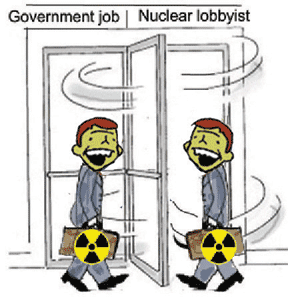

This could shed some light on the South Australian government’s silence on the Federal plan for a nuclear waste dump in South Australia. We can expect the South Australian government to now support the nuclear waste dump at Napandee, and to promote schemes to make south Australia a nuclear hub, especially with nuclear submarines production.
|
Weapons of Influence: BAE arms boss turns Premier’s right-hand man https://www.michaelwest.com.au/weapons-of-influence-bae-arms-boss-turns-premiers-right-hand-man/ Michael West Media, by Michelle Fahy | Jun 12, 2020 As part of her series of investigations into the close links between the military industry and politics, Michelle Fahy reports on former weapons chief executive for BAE, Jim McDowell, who is now at the centre of government in the Defence State, South Australia. Jim McDowell was employed in the weapons industry for 37 years. Born in Belfast, he studied law then spent 18 years with Northern Ireland firm Bombardier Shorts. After that, he joined British Aerospace (now BAE Systems) in Singapore and worked his way up through various positions in Asia. In 2001, McDowell was appointed CEO of BAE Systems Australia. During a decade in that role he oversaw BAE’s 2008 acquisition of Tenix Defence, a deal that doubled the size of the company and resulted in BAE becoming Australia’s largest weapons-maker at the time. It remains one of the largest today, mostly for building Australia’s warships, among other projects. In September 2011, Jim McDowell left Adelaide for Riyadh, where he ran BAE’s Saudi Arabian operation for a little over two years. Saudi Arabia is crucial to BAE’s business, its third largest market after the US and the UK (Australia is fourth). The company has been supplying combat aircraft to the Saudis since the 1960s. Several of its arms deals have been dogged by controversy (and continue to be due to the Saudi role in the humanitarian catastrophe in Yemen), and some by corruption. In the UK, a Serious Fraud Office investigation into BAE’s relationship with the Saudis was notoriously shut down in December 2006 following intense pressure from the Saudi government and the UK’s then prime minister Tony Blair, citing national security reasons. The capitulation of the Serious Fraud Office was later deemed “unlawful, an “abject surrender” and a “threat to the reputation of British justice” by the British High Court. By the time McDowell arrived, all that was in the past and it was back to business. In a media release describing a visit of the BAE Board to Saudi Arabia in March 2012, McDowell said, “Saudi Arabia is a key market for the company. We want to be considered as an industrial and a strategic partner for the Kingdom… The meeting was a wonderful way to strengthen relations.” Several multi-billion pound arms deals were concluded during the period McDowell was BAE’s chief executive in Saudi Arabia. Back to Australia with ANSTOIn December 2013, McDowell resigned from BAE and returned to Australia. He was immediately appointed to the board of the Australian Nuclear Science and Technology Organisation, as deputy chair. Then Industry Minister Ian Macfarlane said, “Mr McDowell’s business background coupled with his knowledge of international marketing and joint ventures will support the development of emerging business opportunities…” ANSTO’s chair, Dr Paul Greenfield, said, “This is a dynamic and exciting time for ANSTO and this is reflected in the overall contribution nuclear science and technology is now making across a range of key areas.” Earlier that year (in February 2013), ANSTO had signed a formal research cooperation agreement with the Defence Science and Technology (DST) Organisation. This was a period when DST, under Chief Defence Scientist Alex Zelinsky, signed a number of collaborative agreements with military industrial companies, including BAE in October 2013 and, as we have covered previously, Lockheed Martin in March 2014, among others. At the completion of Dr Greenfield’s term, in August 2014, McDowell was appointed chair of the ANSTO board, a position he held for the next four years. McDowell’s timely departure from the military industry created an influx of new opportunities for him from a government with a policy of recognising industry as a “fundamental input to capability”. Following his rapid appointment to the ANSTO board, over the next four years, McDowell was awarded lucrative contracts across six major areas by Defence (see table), which together totalled almost $1.5 million in consultancy fees. To supplement the government’s largesse, in the same four-year period, McDowell accepted appointments as Chancellor of the University of South Australia and to the Council of the Australian Strategic Policy Institute. He also joined the boards of eight public companies, most of which operate in the military industrial sector. In addition to those in the chart, McDowell was made chair of another two private companies, duMonde Group Pty Ltd and Total Construction Pty Ltd (dates of those appointments are not publicly available). In 2017, it appears McDowell was engaged simultaneously in at least 12 different roles. Continue reading |
Australia’s govt rushes nuclear waste Bill through Lower House, but this story is not over.
The federal government’s radioactive waste laws the House of Representatives today, however they failed to win broad support or approval.
Importantly, Labor joined with Greens, Centre Alliance and independents to vote against the contested push to move Australia’s radioactive waste from ANSTO’s secure Lucas Heights facility in southern Sydney to a site near Kimba in regional South Australia.
While accepting the need for improved radioactive waste management, Labor MPs highlighted deep concerns with the government’s approach and called for further detail and review.
Concerns included:
- The double handling of problematic and long-lived Intermediate Level Waste (ILW) through the unnecessary transport from an above-ground extended interim storage facility at ANSTO to an above-ground extended interim storage at a less resourced regional facility.
- The continuing opposition of the region’s Barngarla Traditional Owners.
- The lack of a rationale for a new set of waste laws.
- The government’s decision not to de-couple consideration of the different waste streams (ILW and Low Level Waste). Labor urged the government to allow wider project consideration, including through a current Senate review.
The Greens spoke strongly against the plan – as did Zali Steggall. Andrew Wilkie and Centre Alliance’s Rebekah Sharkie also voted against the legislation – further details in the Hansard transcript and voting record attached fyi
From here – among other things – we need to work to highlight and detail the unresolved concerns via the Senate review (still tracking to report at the end of July) and the subsequent Senate consideration and vote on these laws.
Today the government has had a short-term political win at the expense of building consensus or credibility – we saw a political numbers exercise but we did not see agreement, evidence or responsibility. The government’s plan is deeply deficient and more people are seeing and acknowledging this – this story will grow and change the approach to radioactive waste management.
Australia’s House of Representatives passed the National Radioactive Waste Management Amendment Bill
 11 June 2020, Federal govt just passed the National Radioactive Waste Management Amendment Bill through the lower house of federal parliament, which sounds like bad news but could be good news, an own goal by the government and minister Keith Pitt
Labor voted against the Bill and spoke strongly against it (including the shadow minister Brendan O’Connor, SA MP Tony Zappia and others) … raising issues of Traditional Owner opposition, double-handling of intermediate-level waste, etc etc. I’m guessing Labor also pointed out that voting on the Bill before the Senate Inquiry is complete is poor form.
Zalia Steggall spoke strongly, linking the dump to BLM and raising numerous other issues.
Andrew Wilkie voted against.
Some recent lobbying by Maritime Union of Australia might have been useful in getting the ALP to show some decency, as well as lobbying by Dave Sweeney and David Noonan
The Senate Committee is meeting tomorrow to discuss the inquiry into the Bill.
Desmond Menz – Constitutional problems in Nuclear Waste Bill – could lead to High Court case?

why ultimately was South Australia the only state to contain the final three sites?
A tiny community poll seems to have informed the final decision, and contradicts the Minister’s stated position of “broad community support”. Just 0.037% of the voting public in SA have had a say.
why did South Australia become the only state to be chosen for the nuclear waste site, knowing that a Citizens Jury in 2016 had rejected a major nuclear waste storage industry in South Australia following the outcomes of the Nuclear Fuel Cycle Royal Commission? The Citizens Jury was substantially more representative of the views of the people of SA, in comparison with the very small poll of the eligible residents of the District Council of Kimba..
former Minister Canavan’s snap decision? The decision on site selection was announced on Saturday morning 1 February 2020, and by the afternoon Senator Canavan had resigned
Desmond Menz SUBMISSION TO ECONOMICS LEGISLATION COMMITTEE OF THE
AUSTRALIAN PARLIAMENT ON THE National Radioactive Waste Management Amendment (Site Specification, Community Fund and Other Measures) Bill 2020 Submission 13
In September 2019 ….I raised critical concerns about the validity of the National Radioactive Waste Management Act 2012 (NRWM Act) in relation to the Australian Constitution, and also the lawfulness of the process about site selection. I also raised concerns about breaches of South Australian law. It seems that my concerns were either ignored or dismissed. I again raise these critical matters for the attention of the Economics Legislation Committee. If they are not responded to, then it would not be too much a stretch of the imagination to have them resolved in a higher court of law, quite possibly the High Court of Australia. In my view, the Economics Legislation Committee should not make any decision on the Amendment Bill until all issues I have countenanced have been resolved.
Main Concerns
1.It is contended that inconsistency between the federal National Radioactive Waste Management Act 2012 (NRWM Act) and the South Australian Nuclear Waste Storage (Prohibition) Act 2000 (NWSP Act) (and other similar state/territory laws), has been manufactured by the Australian Parliament. This is a serious issue, and one that not even the Senate Standing Committee for the Scrutiny of Bills has acknowledged. It is incomprehensible why this matter was not addressed way back in 2010 during the establishment of the NRWM Act.
It is also contended that there are Constitutional matters that need to be resolved to affirm the safety of the federal law, including the Amendment Bill, because at the moment there are sufficient concerns relating to inconsistency between federal and state laws to inhibit the lawful and constitutional passage of the Amendment Bill. [here he gives an example from a previous High Court case]……… Continue reading
Senator Rex Patrick – nuclear waste dump should not go on agricultural land

Australia’s very bad record on environment: it’s no time to weaken our laws
 Now is not the time to weaken our environmental protections, Canberra Times, Katherine Barraclough, Fiona Armstrong , 10 June 20 Now is not the time to weaken our environmental protections, Canberra Times, Katherine Barraclough, Fiona Armstrong , 10 June 20
As Australia’s primary environmental legislation undergoes a once-in-a-decade review, businesses and the government have spoken of the need to cut environmental bureaucracy (so-called “green tape”) and speed up approvals. However, health experts insist that environmental protections must be strengthened. Why? Because the stark reality is that our health is fundamentally dependent on the health of the natural world – for clean air, water and soils, food security, protection against infectious diseases and a stable climate. Nature is also the source of over half of all medicines we rely on. Last month, more than 180 health professionals and 19 health groups published an open letter to federal Environment Minister Sussan Ley, warning a failure to significantly reform Australia’s environmental law, the Environmental Protection and Biodiversity Conservation Act (EPBC Act), will risk fuelling further public health crises. Signatories included Nobel laureate Professor Peter Doherty, former Australian of the Year Professor Fiona Stanley and nutritionist and dietician Dr Rosemary Stanton. Despite being a wealthy, developed nation, Australia’s environmental track record is among the worst of all countries. We lead the world in mammal extinctions, have the highest rate of biodiversity loss bar Indonesia, and have been recognised as a land-clearing and deforestation “hotspot”. It is estimated that in Queensland and NSW alone, land clearing kills some 50 million mammals, birds and reptiles annually. Our scarce water resources are in decline, and some of our most precious marine environments, including the Great Barrier Reef, face collapse. Climate change constitutes one of the most serious threats to our natural environment and our nation’s public health, and yet Australia is one of the highest per-capita emitters of greenhouse gases. This degradation of our natural environment is, in essence, a dismantling of our life support systems. That it has occurred despite the existence of the EPBC Act is a clear indication that major environmental law reform is required. Unfortunately, examples of failed environmental protections in Australia are plentiful…….. https://www.canberratimes.com.au/story/6777567/now-is-not-the-time-to-weaken-our-environmental-protections/?cs=14230#gsc.tab=0 |
|
Another Australian former Senator glides easily into the weapons industry
Stephen Loosley AM, MILITARY INDUSTRY REVOLVING DOOR
Stephen Loosley was a NSW ALP Senator from 1990 to 1995. From November 2012 to September 2016 he was Chair of the Woomera Prohibited Area Advisory Board, a role required to be independent, yet he concurrently sat on the Thales Australia Advisory Board. Thales is one of the world’s top 10 weapons-makers….. https://www.michaelwest.com.au/stephen-loosley-am/
New Zealand puts Australia to shame – with its environment – pandemic recovery programme
Australia’s destructive COVID-19 recovery
An opportunity for Australia
Economic stimulus through conservation and land management is not yet recognised as a way for Australia to respond to both the COVID-19 crisis and long-standing conservation needs.
Australian governments, if they invested similarly to New Zealand, could create jobs in the short term in any desired target region, based on economic and environmental need….
|
Let’s fix Australia’s environment with any pandemic recovery aid – the Kiwis are doing it https://theconversation.com/lets-fix-australias-environment-with-any-pandemic-recovery-aid-the-kiwis-are-doing-it-139305 5 June 20, Lachlan G. Howell, John Clulow,John Rodger, Ryan R. Witt The COVID-19 pandemic is causing significant economic challenges for Australia. With April figures showing more than 800,000 people unemployed and last month 1.6 million on JobSeeker payments, a key focus will be job creation.
Lessons should be learned from what’s happening in New Zealand, where the government is funding projects that revive the environment. Unfortunately, Australia seems to be going the other way. New Zealand gets itAs part of New Zealand’s innovative Wellbeing Budget the government will invest NZ$50 billion in a direct COVID-19 recovery response. Of that, NZ$1.1 billion will be spent on creating 11,000 “nature jobs” to combat unemployment and supplement pandemic-affected sectors. This unique investment will be delivered in a number of targeted environmental programs. Continue reading
|
A reality check on the cost of nuclear power for Australia
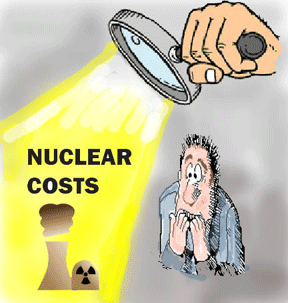 Nuclear cost and water consumption – The elephants in the control room, Open Forum.com.au. Peter Farley | December 20, 2019 Nuclear cost and water consumption – The elephants in the control room, Open Forum.com.au. Peter Farley | December 20, 2019 Cost There are four nuclear plants being built around the world where public information on costs is reasonably reliable.
These are Plant Vogtle in the US (US$27.5bn, 2.2GW), Framanville France (€12.4bn+, 1.6 GW), Olkiluoto in Finland (around €10 bn+, 1.6 GW) and Hinckley Point in the UK (₤22 bn+, 3.2 GW). There are two further plants whose power costs have been published, Akkuyu in Turkey US$127/MWh and Barakah in the Emirates US$110/MWh. It should be emphasised that none of these costs are the full cost recovery. For example in the British case it is estimated that some $10 bn has been spent by others on upgrading the grid and backup power supplies. In Turkey the cost of the plant is just that, and doesn’t include civil works, grid connections, cooling water supply. In the US plant Vogtle has benefited from some US$8bn of federal government loan guarantees and an unusual form of financing where customers have paid about 8% premium on their bills for 10-12 years before the plant is to be commissioned. All of the plants get catastrophe insurance and some security from their government and most have inadequate bond structures for long term waste storage. They also rarely pay for cooling water. Many have preferential supply agreements which will require other cheaper sources of power to turn off to allow the nuclear plants to keep running. However, even on the published information, nuclear power plants in democracies are running at about A$13m/MW. In our case we do not have an experienced nuclear workforce, Australian construction costs are higher by 20-30% for large projects – and there are 5,000 tradesmen on site at Plant Vogtle out of a workforce of 9,000 as nuclear power plants are very large projects. We do not have the heavy fabrication facilities required, and these cost hundreds of millions to build For example the Osborne Naval Shipyard design for 1/10th of the throughput of a nuclear fab shop cost $380m. Even the inspectors would have to be imported. So it is reasonable to suggest that new nuclear in Australia would cost at least A$16m per MW including subsidised construction finance, resulting in a first day of operation cost of a 2.2 GW plant of A$41 bn. Amortised over 50 years station life at a very low weighted average cost of capital at 5.5% – lower than plant Vogtle – that still works out at about $2.4 bn/yr. Due to the variability of demand in Australia the plants would be unlikely to be able to achieve a capacity factor above about 80% – halfway between the US and France and higher than Korea. So over a typical year a two unit 2.2 GW plant would be expected to generate about 15,500,000 MWh meaning the fixed costs per MWh would be $2.4bn/15.5m or $156/MWh. The daily running costs of US nuclear plants average out at US$40/MWh. This is lower than France and almost certainly lower than any new nuclear plant in Australia could achieve due to the much larger American skill base, higher utilisation and lower operating temperatures. The best case for Australia would be A$60+ for maintenace and operation. Thus an Australian nuclear power station could be expected to deliver power at a cost of A$216/MWh. Now if you use the cheaper Barrakah design at about US$5,300/MW and allow for 15 years of inflation at 1.5% to allow time for the project to come online, and a modest 10% Australian premium, power here could be produced at about A$10.4 bn per GW. After a slightly lower capacity factor of 75%, about the same as Korea, and a realistic WACC of 6.5% the ammortisation amounts to $107/MWh with a similar A$60/MWh operating and maintenance cost and the total delivered cost of power is a mere A $167/MWh. This figure aligns closely with the figure quoted by the CEO of the Barrakah plant some years ago at US$110/MWh The costs of a renewable alternative It should be noted that many of the arguments about relative costs are based on the figures used in the Finkel report. These are well out of date. Nuclear power has become even more expensive and actual renewable contracts in Australia are down 40-50% on the Finkel figures. Thus if we dispersed 2 GW of wind $3.6 bn, 1.2 GW of tracking solar $1.8bn, 2 GW of rooftop solar $2.5 bn, 1 GW of waste/biomass/geothermal $2.5bn and 1 GW/15GWh of pumped hydro $1.8 bn and 1 GW/ 2 GWh of batteries $1.2bn across the NEM the total cost would be $13.5 bn. Annual generation would be 17,500 GWh – more than the nuclear plant – and minimum available output would be 2.5 GW+. Typical hot day peak demand at 5pm would be about 4GW. About 30% of generation would go through storage at 85% efficiency, so net output would be around 16,500 GWh. Some would be curtailed so we can assume a similar annual output to the nuclear plant. However the operating costs average around $18 and the capital, even if amortised over 30 years are only $59/MWh for a total of $77 including backup. In summary, for 1/3rd of the investment, in one third of the time, we can get renewable power and backup for 1/3rd of the cost of nuclear power……https://www.openforum.com.au/nuclear-cost-and-water-consumption-the-elephants-in-the-control-room/?fbclid=IwAR2M3NxMjfrDJNWTG9tatKSARHGUKWVcG_CE-bSW5wtnAbwhGnYxd1ElugU |
|
COVID-19 Commission stacked with fossil-fuel bigwigs. Surprise surprise -they find gas is the answer
 Transparency called for in fossil fuel-stacked COVID-19 Commission, Independent Australia, Martin Hirst | 2 June 2020 Who’s running the country and where are they taking us? Dr Martin Hirst thinks the Canberra bubble is filling with gas.
IN THE LAST WEEK of March, right at the start of Australia’s response to the coronavirus pandemic, Prime Minister Scott Morrison announced the formation of the National COVID-19 Coordination Commission (NC-19CC). He said it would “solve problems” so “we all get through to the other side”.
Now, at the start of June, we have some idea of what the “other side” looks like according to the leading figures on the Coordination Commission. From what we can glean from the cheap seats in the bleachers, the future is going to be a gas — literally gas……
For a start, the NC-19CC is an energy sector lovefest.
The Commission chair is Neville (Nev) Power and he’s well connected to the Australian energy and mining industries. He is Deputy Chairman of Strike Energy Ltd and for nearly a decade was managing director and CEO of Fortescue Metals Group.
Catherine Tanna is the managing director of Energy Australia, ‘one of Australia’s leading electricity and gas retailers’ according to the helpful but rather anodyne biographies provided on the commission’s website.
The commission’s “special advisor” is the American chemical industry leader, Andrew Liveris, a former CEO and chairman of the Dow Chemical Company and on the board of a major Saudi oil company.
There are two other important members of NC-19CC: the head of the Department of Prime Minister and Cabinet, Phil Gaetjens and the head of Home Affairs, Mike Pezzulo. These are also political appointments — Gaetjens is a loyal fixer for Morrison and Pezzulo is Home Affairs Minister Peter Dutton’s lieutenant.
Who does the Commission report to?
Australians first heard of the Coordinating Commission when Morrison announced it at a media event on 25 March, but he didn’t tell us how the members were selected, or why, or by whom.
Presumably, it was a “captain’s pick” by Morrison……
In mid-May, the Senate select committee that is holding an ongoing inquiry into the Government’s response to the pandemic requested Mr Power come and chat with it, but he didn’t show up. Instead, the PM’s protector, Phil Gaetjens and Peter Harris, the CEO of the Commission, came to block any real scrutiny of the Commission.
All that the senators were able to learn was that there are no rules in place for managing conflicts of interest and that the Commission’s members and advisors were being handsomely paid for their time and service. According to the transcript, almost every other question was stonewalled.
Apparently, the commissioners are also recruiting other people “through their own networks” according to Phil Gaetjens, but who remain largely unknown to the public — to help across various things to do with the economy re-opening.
Greens Senator Peter Whish-Wilson grilled Phil Gaetjens about the advice the commissioners might provide, but the PM’s advisor would only say that most advice would be confidential.
This has not satisfied a coalition of public interest watchdog groups who collectively issued a statement calling for greater transparency round the discussions and decisions of the NC-19CC………
I should mention that many environmental groups are concerned that the COVID-19 Commission is stacked with fossil fuel advocates, and with good reason. …… https://independentaustralia.net/politics/politics-display/transparency-called-for-in-fossil-fuel-stacked-covid-19-commission,13954
Australia’s national environment laws ‘actually allow extinction to happen’
Australia’s national environment laws ‘actually allow extinction to happen’
Carnaby’s black-cockatoo, the grey range thick-billed grasswren and the swift parrot just three species in deep trouble after laws fail them, Guardian, Lisa Cox, Sun 31 May 2020 Scientists and conservationists are calling for changes to Australia’s national environment law to urgently address failures in how it is protecting native wildlife, including bird species that have declined significantly over the past decade.
Samantha Vine, the head of conservation at BirdLife Australia, says: “Our laws are actually allowing extinction to happen.”
With the Environment Protection and Biodiversity (EPBC) Act under review by the businessman Prof Graeme Samuel, environmentalists have pointed to several bird species as examples of the inadequate protection provided by the legislation…….https://www.theguardian.com/environment/2020/may/31/australias-national-environment-laws-actually-allow-extinction-to-happen
Megan Johnson: National Radioactive Waste Act – not democratic, not transparent, a hasty inadequate plan
I urge you to reject the bill until the community is presented with a transparent, democratic, comprehensive, long-term plan.
Megan Johnson to Senate Inquiry on National Radioactive Waste Management Amendment (Site Specification, Community Fund and Other Measures) Bill 2020 [Provisions]Submission 41
- Democratic Process
The Community Consultation process has not been adequate. This is a matter that affects all South Australians,
and all South Australians should have the democratic right to vote on it.
It is particularly concerning that the Barngarla were excluded from the vote – traditional landowners should be
entitled to a vote, just as residents of Kimba District were entitled to a vote.
The proposed facility is for permanent disposal of low-level waste and temporary storage of intermediate-level
waste. These are two very different concerns, but there has been a down-playing of the role of intermediate-level
waste at the facility. The term ’gloves-and-gowns’ waste has become common parlance in the discussion. This is
not an accurate description of intermediate-level waste, which will not decay to an acceptable level
“during the time for which institutional controls can be relied upon”.
waste. Therefore, intermediate level-waste should be given at least equal discussion.
into service only 5 years ago at Lucas Heights. No-one has been able to adequately explain what purpose is
served by moving intermediate-level waste from the Lucas Heights location to temporary storage at Napandee.
facility. However, the Aube facility is for permanent disposal of low-level waste only. It is not at all comparable
to the proposed facility at Napandee, and is therefore misleading. In the interest of balance, DIIS should have
brought representatives from a community that lives near a temporary storage facility for intermediate-level
waste.
be removed from Napandee between 50-100 years after it is installed. At this stage, the waste will be nowhere
near its half-life. There is no plan and no funding allocated for this re-location.
unintentionally. The community has not been given enough information to make an informed decision.
There are circumstances under which a nuclear waste facility could be the right deal for a community and a
permanent solution to our national waste management. However, the current offering is very poor – I urge you to
reject the bill until the community is presented with a transparent, democratic, comprehensive, long-term plan.
Friends of the Earth condemns shameful Radioactive Waste Management Bill, offers positive alternatives

Friends of the Earth,. to Senate Committee on National Radioactive Waste Management Amendment (Site Specification, Community Fund and Other Measures) Bill 2020 [Provisions] Submission 54
The National Radioactive Waste Management (NRWM) Amendment Bill is deeply flawed and should be rejected. Further, the existing Act is deeply flawed and should be repealed.
The proposal to proceed with the nuclear waste facility despite the unanimous opposition of the Barngarla Traditional Owners is unconscionable and must not be allowed to stand. Shamefully, the federal government excluded Barngarla Traditional Owners from a ‘community ballot’ held in 2019. Therefore the Barngarla Determination Aboriginal Corporation initiated a separate, confidential postal survey of Traditional Owners, conducted by Australian Election Company. This resulted in 100% of respondents voting ‘no’ to the proposed nuclear facility. If the results of the two ballots are combined, the overall level of support falls to just 43.8% of eligible voters (452/824 for the government-initiated
ballot, and 0/209 for the Barngarla ballot) ‒ well short of the government’s benchmark of 65% for ‘broad community support’.
committed the SA Labor Party to “support communities opposing the nomination of their lands or region for a dump site, and any workers who refuse to facilitate the construction and operation or transport and handling of radioactive waste material destined for any contested facility or sites including South Australian Port communities.”
committed the SA Labor Party to “support communities opposing the nomination of their lands or region for a dump site, and any workers who refuse to facilitate the construction and operation or transport and handling of radioactive waste material destined for any contested facility or sites including South Australian Port communities.”
Illegal under SA law: The proposed nuclear waste facility is illegal under South Australia’s
Nuclear Waste Facility (Prohibition) Act, introduced by the SA Liberal Government in the
year 2000 and strengthened by the SA Labor Government in 2002. The federal government is expected to take the draconian and unacceptable step of using regulations to specifically override the SA Nuclear Waste Facility (Prohibition) Act. South Australians are opposed to the proposed nuclear waste facility: a 2015 survey found just 15.7% support for a nuclear waste dump, and a 2018 survey found that those who strongly agreed with stopping the dump outnumbered those who strongly disagreed by a factor of three (41:14).
1 https://www.transcontinental.com.au/story/6454080/state-labor-party-weighs-in-on-nucleardebate/?
cs=1538
2 https://phys.org/news/2020-02-tribal-vote-nixes-radioactive-storage.html
in a region which has no known significant natural resources, including potentially valuable mineral deposits, and which has little or no potential for agriculture or outdoor recreational use”.
waste currently stored at ANSTO’s Lucas Heights site in NSW accounts for an overwhelming majority (>90%) of the waste destined for the nuclear waste facility in SA. There is no logic behind the proposal to move intermediate-level waste from interim abovegroundstorage at Lucas Heights to interim above-ground storage at the Kimba site. The proposed double-handling is illogical, it exposes communities to unnecessary risk, and ARPANSA’s Nuclear Safety Committee has indicated that it is not consistent with international best practice.
from Industry, Innovation and Science to another minister and department (e.g. health) who might do a better job.
Friends of the Earth Australia wishes to emphasise that not only is the NRWM Amendment Bill deploy flawed, the existing National Radioactive Waste Management Act 2012 (NRWMA) is undemocratic in many respects. The Act should either be repealed or radically amended to remove clauses which disempower Australians and in particular First Nations.The current Bill does the exact opposite..
The NRWMA gives the federal government the power to extinguish rights and interests in land targeted for a radioactive waste facility. In so doing the relevant Minister must “take into account any relevant comments by persons with a right or interest in the land” but there is no requirement to secure consent from Traditional Owners.
Muckaty in the Northern Territory.
Previous, failed attempts to establish a Commonwealth radioactive waste facility (repository and store) assumed the need for off-site, centralised facilities. This assumption continues with the current project configuration. However, a closer examination indicates both that this assumption may not be warranted and that there are major information gaps that need to be addressed before informed decisions can be made.
the adequacy/inadequacy of existing storage sites. The failure to actively address these basic issues has worked against progression to the resolution of this contentious public issue in recent decades.
that ANSTO is likely to be operating at its current site for many decades to come.
they significantly raise public-acceptance obstacles. The current co-location proposal would mean double handling i.e. transport to the interim national store then future transport to a currently non-determined disposal site. Such an approach would be likely fail the net benefit test that ARPANSA would need to apply in response to any license application
• Dr Clarence Hardy, Australian Nuclear Association: “It would be entirely feasible to keep storing it [radioactive waste] at Lucas Heights …”7
• Then ARPANSA CEO John Loy: “Should it come about that the national approach to a waste repository not proceed, it will be necessary for the Commonwealth to devise an approach to final disposal of LLW from Lucas Heights, including LLW generated by operation of the RRR [Replacement Research Reactor]. In the meantime, this waste will
have to be continued to be handled properly on the Lucas Heights site. I am satisfied, on the basis of my assessment of the present waste management plan, including the license and conditions applying to the waste operations on site, that it can be.”8
• Department of Education, Science and Tourism: “A significant factor is that ANSTO has the capacity to safety store considerable volumes of waste at Lucas Heights and is unlikely to seek the holding of frequent campaigns to disposal of waste holdings generated after the initial campaign.”9
“ANSTO is capable of handling and storing wastes for long periods of time. There is no difficulty with that. I think we’ve been doing it for many years. We have the capability and technology to do so.”5
3 Friends of the Earth, Beyond Nuclear Initiative, Australian Conservation Foundation, November
Commission Of Inquiry’, https://nuclear.foe.org.au/wp-content/uploads/Responsible-Radioactive-
http://web.archive.org/web/20040610143043/http://www.arpansa.gov.au/reposit/nrwr.htm#for
um
6 September 2008, www.abc.net.au/news/2008-09-22/new-nuclear-waste-site-for-sydney/517372
7 ARPANSA forum, Adelaide, 26 February 2004,
http://web.archive.org/web/20040610143043/http://www.arpansa.gov.au/reposit/nrwr.htm#for
6 September 2008,
7 ARPANSA forum, Adelaide, 26 February 2004,
Reactor at Lucas Heights. Reasons for Decision”, p.30.
9 Application to ARPANSA, 2003, Vol.iii Ch.9 Waste – Transfer and Documentation p.5.
BHP Olympic Dam copper-uranium mine operates on outdated 1991 era Occupational Radiation Exposure Limits:
BHP Olympic Dam copper-uranium mine operates on outdated 1991 era Occupational Radiation Exposure Limits:
A Bill for a new Radiation Protection and Control Act 2020 goes to the SA Parliament for debate on/from Tues 2nd June, involving a range of untenable 1982 Indenture Act legal privileges to BHP that are retained in the Bill and proposed to be just rolled over into a new Act – which is unfit for the 2020’s…
Please see a Briefing Paper (4 pages) – with sub-headings covering key points:
“BHP Olympic Dam operates under outdated 1991 era Radiation Exposure Standards”
Briefing Paper prepared by David Noonan, Independent Environment Campaigner, 18 May 2020
Strong evidence to Reform a 30-year old standard and apply a Safer Lower Worker Exposure Limit p.1
BHP Olympic Dam underground mine workers face a significant increase in cancer risk p.2
BHP Olympic Dam workers face radiation health impacts double that of cancer risks alone p.3
The Bill and the Olympic Dam mine expansion must trigger a Radiation Safety Review p.4
How long will SA wait to Review and Reform worker radiation exposure health risks?
1 This month

of the week – Australians for War Powers Reform (AWPR)
To see nuclear-related stories in greater depth and intensity
 Antinuclear