Australian government using COVID recovery strategy to bolster its mates in gas industry
There have been recent media reports that the commission advising the Morrison government on its COVID recovery strategy has recommended that taxpayers provide massive support to build gas and fuel infrastructure.
However, Australia is possibly suffering something of a “resource curse”, as capital markets increasingly won’t invest in – nor insure – new coal and gas projects.
With the world seeking to accelerate the transition to low-carbon economies and societies, this would see the Australian people being asked to invest in old-world industries and technologies, rather than new, emerging industries. Or in assisting some key industries that have been severely damaged by COVID-19 to reset.
It is not unfair to claim that Australia has never really had an effective industry policy.
Sure, we have often ridden on the backs of sheep and minerals booms, and enjoyed them while they lasted…….
The current special interest push for gas and fuel infrastructure defies common sense, is directly against our national interests.
It is to the detriment of other major export/employment sectors – such as education (especially universities) and international tourism – that have been severely impacted by the COVID-19 pandemic but are not being supported by government assistance.
Coal and gas are facing declining global demand; they are hardly “infant industries” the longer-term future of which could justify investment to assist them to grow up.
These projects just wouldn’t stack up as feasible, when full account is taken of their economic/commercial, social, and environmental costs and benefits.
Investors are also reassessing their climate risks and moving out of climate exposed investments, forcing many of the big oil, gas and coal companies to make significant write downs of the values of their assets.
By comparison, investments in renewable energy (including recognising its significant potential as an export, especially to Asia), as well as in the transition business opportunities as transport is decarbonised, in regenerative agriculture, and in a host of bioenergy/circular economy projects dealing with waste and fuel security will probably stack up on such a cost/benefit assessment…..
The tragedy is that the Morrison government gives priority to its mates. ….
Today, it’s more the mining industries and banks – and now the specific influence of some on the COVID Commission with gas and related interests.
It’s time for our government to think beyond the square, and in our national interest.
John Hewson is a professor at the Crawford School of Public Policy, ANU, and a former Liberal opposition leader. https://www.canberratimes.com.au/story/6877063/how-australia-is-suffering-a-resource-curse/?cs=14246
Radio 3CR interviews Dave Sweeney, on matters nuclear
 City Limits Interview with Dave Sweeney, Radio 3CR 12 Aug 20 (incomplete notes from this interview.)
There are 15000 nuclear weapons globally – most of them under the control of authoritarians – Putin and Trump The sabre-rattling as the USA election approaches is deeply concerning.
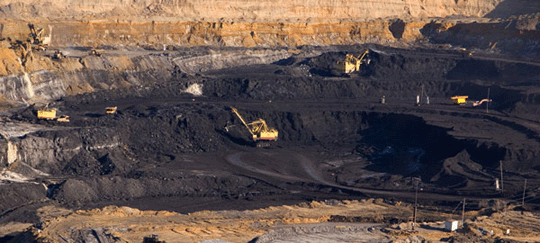
Australia must place climate action at centre of coronavirus recovery, chief UN economist says

|
Australia must place climate action at centre of coronavirus recovery, chief UN economist says, SBS, BY TOM STAYNER 12 Aug 20, A chief economist for the United Nations has urged Australia to prioritise climate action above pouring money into fossil fuels in its coronavirus recovery.
A United Nations chief economist has urged Australia and other countries across the world to place more ambitious climate action and investment in clean energy at the centre of their COVID-19 recovery plans. Elliott Harris is helping lead the UN’s development of policy advice for nations grappling with the pandemic. Mr Harris appeared on a webinar with progressive think tank the Australia Institute on Wednesday, where he was questioned about how the Australian government should shape its recovery from the pandemic. He said developed nations such as Australia must be willing to make difficult decisions and prioritise a “green recovery”.
“What we’ve seen in this COVID crisis is that governments are indeed capable of really ambitious, rather unorthodox, extremely important and even massive interventions,” he told the webinar. “I can think of no stakes that are higher than the climate crisis that we are living in right now.” UN Secretary General Antonio Guterres has stressed coal should play no part in any country’s post-coronavirus stimulus plan, while business leaders in Australia have also been putting pressure on the federal government to prioritise renewable energy projects. The head of the federal government’s COVID advisory committee Nev Power told a Senate committee on Tuesday he has been approached about locking in a low emission future……… Mr Harris said Australia should focus on making long-term “sustainable” investments, rather than subsidising further fossil fuel projects. “This is a critical choice that all countries have to make and all investors have to make,” he said. “There is a very difficult trade-off, there is no doubt about it.” “[But] we really need to think about how we shift the flow of investment towards sustainability. “The fact of it is that, unfortunately, the world does not have the luxury of allowing itself of continuing down the path of fossil fuels.” Australia’s commitment to the Paris Agreement requires emissions reduction of at least 26 per cent by 2030, based on 2005 levels. But the government has come under scrutiny for not having a 2050 target, with the Business Council of Australia, Australian Industry Group and big miners Rio Tinto and BHP all backing a net zero-emissions goal by then. Australia is considered one of the world’s largest exporter of fossil fuels through coal and liquified natural gas projects, but also a leading investor in renewable energy. The UN has predicted the world economy will shrink by 3.2 per cent in 2020 because of the economic downturn forced by the pandemic. https://www.sbs.com.au/news/australia-must-place-climate-action-at-centre-of-coronavirus-recovery-chief-un-economist-says |
|
|
David Noonan: a new Submission to Senate Environment Inquiry – on BHP Olympic Dam
 David Noonan, Independent Environment Campaigner and Consultant, has provided a “BHP Olympic Dam
  Case Study” submission to a federal parliament JSCNA Inquiry, which has now made public by the Committee: “A case study on BHP Olympic Dam mine in SA under the Prime Minister’s ‘fast track’ EPBC Act mine expansion Assessment and Approvals“.
FYI – This submission includes a Joint ENGO Briefing Paper “BHP LEGAL PRIVILEGES IN THE OLYMPIC DAM INDENTURE ACT 1982 OVERRIDE SA LAWS” (June 2019) and refers to the Joint ENO Recommendations & Submission to federal government on Olympic Dam mine in Dec 2019.
David Noonan will be variously distributing this submission over the weekend – welcome to discuss any related matter if and as may suit & as raised in the sub.
In addition to the 1982 Indenture over riding Aboriginal Heritage and the PM’s ‘fast track’ assessment & approvals to BHP, my submission raises required protection of GAB Springs and associated cultural heritage from BHP water mining and proposed doubling of GAB water extraction for Olympic Dam mine expansion to 50 million litres a day (annual average) for a 25 year period.
See the JSCNA Inquiry Home Page:
https://www.aph.gov.au/Parliamentary_Business/Committees/Joint/Northern_Australia/CavesatJuukanGorge
Submissions:
Submission No.73 Mr David Noonan B.Sc., M.Env.St. (PDF 330 KB)
https://www.aph.gov.au/DocumentStore.ashx?id=f6b111ae-8125-4cb0-8edb-6f64dbd613c2&subId=690802
Labor’s carbon price proves effective climate policy is possible, Julia Gillard says
 Labor’s carbon price proves effective climate policy is possible, Julia Gillard says, https://www.sbs.com.au/news/labor-s-carbon-price-proves-effective-climate-policy-is-possible-julia-gillard-says The former prime minister says Australia would be in a different place on climate if the carbon tax had continued.
Former prime minister Julia Gillard doesn’t want climate policy put in the too-hard basket, saying Australia can have a scheme that reduces emissions.
It has been almost 10 years since Ms Gillard’s federal election win, with her minority Labor government introducing a short-lived carbon price scheme that saw emissions drop.
Emissions rose again after the Abbott government repealed the policy.
Ms Gillard says Australia would be in a different place on climate if the scheme had continued.
“One of the frustrations of sliding door moments is, other than in the famous movie, you don’t actually get to go back in time and run the parallel universe,” she told a webinar hosted by the Australia Institute think-tank on Wednesday.
Australia is one of the last developed countries actively considering new coal-fired power stations
“What I hope is remembered from that period and taken forward into the future … is that it’s possible to put in place a scheme in Australia that does reduce our carbon emissions.
“The perceived history is ‘oh we’ve been fighting forever, nothing gets done, it’s all too hard’. I would like us to unpack to the next level: it can get done, it was done.
“We can be informed by past experience and we can get on with the job. So I do want to push back against that sort of received helplessness that it’s all too hard.”
To coincide with the online discussion the Australia Institute released a report mapping where the nation’s emissions would be if the carbon price had remained. “What I hope is remembered from that period and taken forward into the future … is that it’s possible to put in place a scheme in Australia that does reduce our carbon emissions. The think-tank says given the policy reduced emissions by two per cent, levels would be 25 million tonnes lower this year than they are.
Links between Trump administration, Falun Gong, and Australia’s government
 Propaganda Wars: US state department funds anti-China news outlet in Australia https://www.michaelwest.com.au/propaganda-wars-us-state-department-funds-anti-china-news-outlet-in-australia/
by Marcus Reubenstein | Aug 4, 2020 Office bearers of US-backed Chinese language news service Decode China are linked with Falun Gong, the spiritual group that has spent millions backing Donald Trump through fake social media accounts. The same people are on the board of the National Foundation for Australia China Relations, raising scepticism about its ability to repair fractured relationships. Marcus Reubenstein investigates US state funding of anti-China media in Australia and links to global arms dealers via ASPI.
The US State Department is quietly funding a Chinese-language news service in Australia, a move more typically associated with China’s state media propagandists.
And two of the three office bearers of the news service, Decode China, are members of a taxpayer-funded independent board advising the Australian government on engagement with China.
Corporate records show Dr Wai Ling Yeung and Maree Ma became secretary and director, respectively, of Decode China Pty Ltd just eight weeks before Foreign Minister Marise Payne appointed them to the board of the National Foundation for Australia China Relations. The NFACR replaced the Australia China Council (ACC), which was set up by the Fraser government in 1978 and later chaired by former prime minister Gough Whitlam.
The retired Curtin University academic Dr Yeung is a vocal critic of the Chinese government, while Ma is the general manager of the Falun Gong-aligned, largely anti-Chinese government Vision Times newspaper. According to journalist and former Australian Falun Gong practitioner Ben Hurley, Vision Times is part of the apparatus of Falun Gong media in Australia, led by The Epoch Times and New Tang Dynasty Television.
The spiritual group Falun Gong is banned in China and there is substantial evidence that its mainland Chinese followers are harshly persecuted by the Chinese government.
However, former practitioners say it’s a dangerous cult, whose leaders claim to have the power of levitation and tell followers that aliens from other planets are responsible for interracial marriage and mixed-race children.
Falun Gong-aligned media affiliates in the US have been accused of pouring millions of dollars into fake social media accounts and Facebook advertising, since banned, supporting Donald Trump. A recent investigation by the ABC’s Foreign Correspondent and Background Briefing programs revealed Falun Gong-affiliated media in the US have spent more than US$11.5 million in social media advertising to promote Trump.
ASPI lurking in the background Continue reading
Despite Minerals Council lobbying, Australia’s Environmental Law prohibits nuclear and limits uranium mining
K-A Garlick, Nuclear Free WA, 22 July 20, This week, the interim report of the review into the Environmental Protection Biodiversity Conservation (EPBC) Act – Australia’s federal environmental laws was released. This found that the Federal government should maintain the capacity to intervene in uranium mining and that there be no change to the existing prohibition on nuclear activities, including domestic nuclear power.
Environment groups have given a cautious welcome to this continuation of the status quo, especially in the face of lobbying by the Mineral Council of Australia to weaken nuclear protections and scrutiny. This outcome is a tribute to the efforts of those who have worked hard over years to highlight the deep community concerns with the nuclear industry.
While no amount of regulation can make uranium mining socially or environmentally acceptable, it can reduce the impacts. The reports sensible approach means it is now incumbent on both State and Federal government to ensure the highest standards or rigour, transparency and public interest.
The nuclear power ban has been retained despite years of concerted effort by the Mineral Council of Australia and pro-nuclear lobbyists to have this removed. Again, this is testimony to the power, importance and effectiveness of sustained community advocacy and action.
In future updates, there will be more information on further developments and action to take, but in the meantime zip over to the excellent resource page, Don’t Nuke the Climate, Australia for all information and myth-busting to keep sharing that nuclear power cannot solve the climate crisis. Click on website link https://dont-nuke-the-climate.org.au/
Hasty and crummy pro nuclear media release from Messrs Pitt, Ramsey and Van Holst Pellekaan
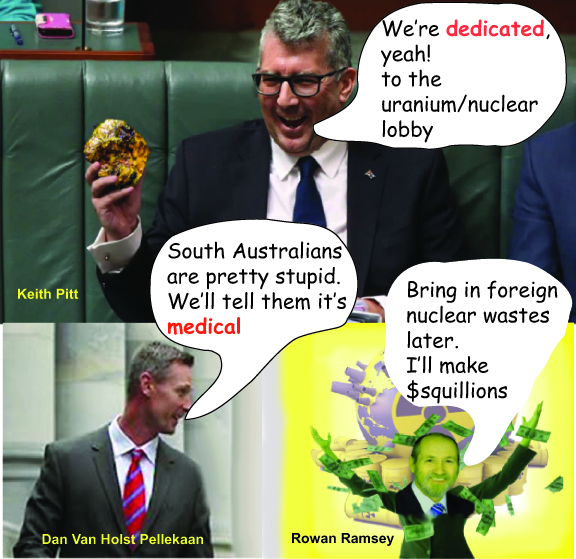
Peter Remta, 22 July 2020. Here we go again.
This is a very poorly and hastily planned and quite ill-conceived attempt to deflect from the true situation with the proposed facility at Napandee which only shows up the incompetence and lack of knowledge within the federal government as to the management of nuclear waste
The joint media release is inconsistent within itself and with other previous reports and is surely an embarrassment to the two ministers while confirming the long-held partiality of the local member It is hoped that ANSTO will not be relying on this quite meaningless release as part of its licensing submission requirements for ARPANSA which in turn should immediately as the regulatory and licensing authority require a full explanation of the reasons behind the release
ARPANSA must not on this occasion hide behind its licensing independence in refraining from strong comment as the release could be viewed to be an attempt to usurp its status and functions
I will separately comment on the different parts of the release
Minister Against the Environment, Sussan Ley, in a hurry for Environment Laws to help mining industries?
 Environment Minister Sussan Ley is in a tearing hurry to embrace nature law reform – and that’s a worry The Conversation Peter Burnett, Honorary Associate Professor, ANU College of Law, Australian National University, July 20, 2020 The Morrison government on Monday released a long-awaited interim review into Australia’s federal environment law. The ten-year review found Australia’s natural environment is declining and under increasing threat. The current environmental trajectory is “unsustainable” and the law “ineffective”.
The report, by businessman Graeme Samuel, called for fundamental reform of the law, know as the Environmental Protection and Biodiversity Conservation (EPBC) Act. The Act, Samuel says:
[…] does not enable the Commonwealth to play its role in protecting and conserving environmental matters that are important for the nation. It is not fit to address current or future environmental challenges.
Samuel confirmed the health of Australia’s environment is in dire straits, and proposes many good ways to address this.
Worryingly though, Environment Minister Sussan Ley immediately seized on proposed reforms that seem to suit her government’s agenda – notably, streamlining the environmental approvals process – and will start working towards them. This is before the review has been finalised, and before public comment on the draft has been received.
This rushed response is very concerning. I was a federal environment official for 13 years, and from 2007 to 2012 was responsible for administering and reforming the Act. I know the huge undertaking involved in reform of the scale Samuel suggests. The stakes are far too high to risk squandering this once-a-decade reform opportunity for quick wins.
‘Fundamental reform’ needed: Samuel
The EPBC Act is designed to protect and conserve Australia’s most important environmental and heritage assets – most commonly, threatened plant and animal species.
Samuel’s diagnosis is on the money: the current trajectory of environmental decline is clearly unsustainable. And reform is long overdue – although unlike Samuel, I would put the blame less on the Act itself and more on government failings, such as a badly under-resourced federal environment department.
Samuel also hits the sweet spot in terms of a solution, at least in principle. National environmental standards, legally binding on the states and others, would switch the focus from the development approvals process to environmental outcomes. In essence, the Commonwealth would regulate the states for environmental results, rather than proponents for (mostly) process. …….
From the outset, the government framed Samuel’s review around a narrative of cutting the “green tape” that it believed unnecessarily held up development.
In June the government announced fast-tracked approvals for 15 major infrastructure projects in response to the COVID-19 economic slowdown. And on Monday, Ley indicated the government will prioritise the new national environmental standards, including further streamlining approval processes……..
Here’s where the danger lies. The government wants to introduce legislation in August. Ley said “prototype” environmental standards proposed by Samuel will be introduced at the same time. This is well before Samuel’s final report, due in October.
I believe this timeframe is unwise, and wildly ambitious……
The government’s fixation with cutting “green tape” should not unduly colour its reform direction. By rushing efforts to streamline approvals, the government risks creating a jumbled process with, once again, poor environmental outcomes. https://theconversation.com/environment-minister-sussan-ley-is-in-a-tearing-hurry-to-embrace-nature-law-reform-and-thats-a-worry-141697
Indigenous Australians have been failed by the nation’s environmental protection laws, a review has found.
|
Indigenous ‘tokenism’ in environment laws HTTPS://WWW.BENDIGOADVERTISER.COM.AU/STORY/6841657/INDIGENOUS-TOKENISM-IN-ENVIRONMENT-LAWS/, Rebecca Gredley, 21 July 20, Indigenous Australians have been failed by the nation’s environmental protection laws, a review has found. Forrmer ACCC chairman Graeme Samuel on Monday released his interim review of the Environment Protection and Biodiversity Conservation Act, which says the laws are not fit for purpose. The laws are supposed to recognise the role of Indigenous Australians in conservation, protect cultural places and promote the use of Indigenous biodiversity knowledge. But Professor Samuel says that’s not occurring. “Traditional knowledge is not valued,” he said.
“There is a culture of tokenism and symbolism…. Indigenous Australians want and frankly, they deserve and we deserve stronger protection of Indigenous culture and heritage.” Prof Samuel said the EPBC Act should have an Indigenous knowledge and engagement committee to provide the federal environment minister with advice. He said there should be a standard for best practice for Indigenous engagement and a comprehensive review of national laws to protect Indigenous cultural heritage. “The EPBC Act has failed to fulfil its objectives as they relate to Indigenous Australians,” the interim report says. “Indigenous Australians’ traditional knowledge and views are not fully valued in decision-making, and the Act does not meet the aspirations of traditional owners for managing their land.” Australia’s Indigenous heritage protections recently came under scrutiny after mining giant Rio Tinto destroyed a significant site in Western Australia that dated back 46,000 years. The Australian Conservation Foundation’s Dave Sweeney said there were many examples of when the national laws failed Indigenous communities. Although Tjiwarl native title holders had taken Western Australia to court to prevent a uranium project, the federal government gave expedited approval in 2019. “Right now, the federal government is seeking to build a national radioactive waste store and dump site near Kimba in regional SA,” Mr Sweeney told AAP. “The area’s traditional owners, the Barngarla people, were not included in a local council’s regional ballot to test the public mood on this and remain strongly opposed to the waste plan.” Federal Environment Minister Sussan Ley and Indigenous Australians Minister Ken Wyatt will hold a meeting with their state counterparts in a bid to improve protections. WA-based Labor MP Josh Wilson said the ministers must be clear about a timetable for reform so change can happen. “Labor will consider all and any reasonable changes to legislation that will deliver proper protection of First Nations heritage, stronger consultation with First Nations people, and greater clarity for all stakeholders,” he said. |
|
Federal environment law review calls for independent cop, but Morrison Government rules it out
Federal environment law review calls for independent cop, but Morrison Government rules it out, ABC News, By national science, technology and environment reporter Michael Slezak 21 July 20,
Key points:
The 124-page interim report comes 20 years after the laws were first implemented by the Howard government
The report’s author has called for a “strong, independent cop” on the environment beat
The Federal Government has accepted some recommendations, but rejected the report’s call for an independent regulatorThe independent review into the 20-year-old Environment Protection and Biodiversity Conservation Act (EPBC), released this morning, also flagged legally enforceable “national standards” to stop the decline of Australia’s natural environment.
“The foundation of the report was that there is too much focus on process and not enough focus on outcomes and that should be changed entirely,” Graeme Samuel, the review’s independent author, said.
He concluded that Australia’s environment was getting worse under the laws designed to protect it.
“Australia’s natural environment and iconic places are in an overall state of decline and are under increasing threat,” he said.
Environment Minister Sussan Ley immediately moved to rule out an “independent cop”, which was policy taken to the last federal election by the Opposition.
But the Federal Government accepted the recommendation for national standards, which she said would form the basis of agreements with states, allowing federal approvals to be devolved to the states.
If brought into law it would establish a “one-stop shop” or “single-touch approvals”.
The devolving of federal approval powers to states has long been the aim of the Federal Government.
The report calls for the Government to maintain the power to step in on any decisions it deems important, or when a failure of state processes has been identified.
The 124-page interim report comes 20 years after the laws were first implemented by the Howard government……….
Independent cop call
In his review, Professor Samuel, the former chair of the Australian Competition and Consumer Commission, said a “strong, independent cop on the beat is required”.
“An independent compliance and enforcement regulator, that is not subject to actual or implied political direction from the Government Minister, should be established,” he said.
“The regulator should be responsible for monitoring compliance, enforcement and assurance. It should be properly resourced and have available to it a full toolkit of powers.”
The call echoes Labor Party policy from the last election, which called for a federal environmental protection agency — a move backed by the Australian Conservation Foundation (ACF).
ACF chief executive, Kelly O’Shanassy, said at the moment protecting nature was “optional”.
Regardless, Ms Ley moved quickly to rule out any new regulator……….
Funding cuts and approval delays
The review began in November 2019 but its findings were delayed by the bushfires and then the coronavirus crisis.
While the report was being prepared, the Auditor General released a report finding 80 per cent of approvals under the laws were non-compliant or contained errors.
Federal Labor analysed those findings and concluded that since the Coalition came to power, there had been a 510 per cent blowout in the number of environmental approvals delayed beyond time frames indicated in the laws.
The delays came as the government cut funding to the environment department, which Labor said was now 40 per cent lower than it was before the Coalition came to power……. https://www.abc.net.au/news/2020-07-20/epbc-act-environmental-review-report-recommends-independent-cop/12392594
Nuclear status quo in federal environmental law review
Mineral Policy Institute and Friends of the Earth Australia, 20 July 2020
National and state environment groups have given a cautious welcome to the continuation of long-standing protections against nuclear risks in the current statutory review of the Environmental Protection Biodiversity Conservation Act – Australia’s federal environmental laws. The interim report released today has stated that the Commonwealth should maintain the capacity to intervene in uranium mining and made no recommendation to change existing prohibitions on nuclear activities, including domestic nuclear power.
Civil society groups made a joint submission to the EPBC review calling for the retention of the long standing ban on nuclear power and continuing federal oversight of uranium mining. The EPBC review committee’s interim report has flagged an intention to continue both protections despite lobbying from the Mineral Council of Australia to weaken these.
However, environment groups are concerned about a possible weakening of uranium mining regulations flagged in the interim report. Associate Professor Gavin Mudd, Chair of the Mineral Policy Institute, said: “The interim report proposes the further devolution of uranium mining regulation to states and territories, coupled to the establishment of ‘National Environmental Standards’. An obvious risk is that the standards will be weak, enforcement will be deficient as is already the case, and devolution will weaken the already inadequate oversight of uranium mining.”
“Uranium mining is different to other types of mining. Australia’s uranium mining sector has been dominated by license breaches, accidents, spills and a persistent failure to rehabilitate as promised. The last thing we need is a weakening of regulations and oversight. Apart from SA and NT every state and territory have a ban or prohibition on uranium mining. It is unsafe and unpopular and needs greater scrutiny, not less,” Assoc. Prof. Mudd said.
The Review’s interim report makes no recommendation to repeal the long-standing prohibition on domestic nuclear power. “Nuclear power is expensive, dangerous and unpopular,” said Dr Jim Green, national nuclear campaigner with Friends of the Earth Australia. “The prohibition in the EPBC Act reflects this. Nuclear is thirsty, produces high level nuclear waste for which there are no safe storage options and produces materials that can be diverted into nuclear weapons. It is a profound security and safety risk. And nuclear power is absurdly expensive.”
“Recent comments from the current Environment Minister and Opposition Leader show a clear bipartisan rejection of nuclear power. There is broad opposition among civil society as shown through a joint statement by over 60 organisations representing millions of Australians. Given the lack of social license for nuclear power in Australia we welcome the continuation of this prudent prohibition,” Dr Green said.
Following the Australian uranium-fuelled Fukushima nuclear disaster the UN Secretary General called for all uranium producing countries to conduct a cost-benefit analysis of the industry. Groups have called on the Morrison government to now hold an independent review of the uranium sector.
Cory Bernardi resuscitated – renewed zeal for nuclear and “Advance Australia”

Failed extreme right-wing politician Cory Bernardi seemed to have disappeared from the news. His zeal for the nuclear industry did not go down well with the Australian public.
But no, Cory is now resuscitated in the media – well, not exactly the reliable and respected news media. But he has found his natural habitat – where else but at right-wing paradise – Sky News?
And where has Cory found the political embrace that he craves? in the Advance Australia lobby group – perfect for Cory – climate denialism, pro nuclear fanaticism, and ever so coy about where they get their funding.
So-here’s Cory’s Sky News spiel: Nuclear is the ‘gold standard of power’ ticking all the boxes – “Nuclear energy solves the climate wars unravelling around the world” [Ed. note hang on, I thought that Advance Australia didn’t believe that climate change is real] “You want reliable and cheap, affordable energy? Nuclear ticks that box too,”
Advance Australia Director Liz Storer told Sky News: “The sooner we get nuclear off the ground the better,” she said. “It’s the gold standard of power.”
“Advance Australia” – a group of older rich white men, aiming to get richer.
What is Advance Australia, the new conservative lobby group taking on Get Up! 7.30, By Ashlynne McGhee, ABC News 21 November 2018 Australia has a new conservative lobby group that wants to knock on your door, get in your ear and ultimately swing your vote.
Advance Australia’s named with a nod to our anthem and the hope it can rival the powerful left-wing lobby Get Up!
It has some prominent backers and a bold mission — but can it succeed? The group’s financially and ideologically backed by a group of prominent business leaders including storage king Sam Kennard, businessman and former ABC chairman Maurice Newman and the Australian Jewish Association’s Dr David Adler.
Its national director is Gerard Benedet, who was the chief of staff to former Queensland LNP Treasurer Tim Nicholls in a previous life. “We’re not aligned to any political party,” he told 7.30.
“We’re an independent movement of mainstream Australians, who are determined to protect, advance and defend mainstream values and freedoms.”
Get Up! National Director Paul Oosting says that’s rubbish.
“Advance Australia is a group of rich white men on a campaign to make themselves richer,” he said.
“They want to work on issues that are in their own self-interest, that are the vested interests of the corporate lobby they represent.”………..
Who’s donating and who’s joining? It’s a little unclear. Membership is free, so money isn’t necessarily flowing from new recruits…….. https://www.abc.net.au/news/2018-11-21/what-is-advance-australia/10520122
“Advance Australia” -the extreme right wing lobby group, says that climate change is a hoax
From Wikipedia 20 July 20 The national director of Advance Australia was Gerard Benedet, a former Liberal Party staffer who led the organisation during the 2019 Australian federal election.[3] Benedet stood down in September 2019, and was replaced by Liz Storer, former City of Gosnells councillor,[4][5] and advisor to Liberal senator Zed Seselja.[6]
High-profile backers include businessmen such as Maurice Newman, Kennards Self Storage managing director Sam Kennard, and Australian Jewish Association president David Adler.[2][3] Other members of the advisory council include security specialist Sean Jacobs and journalist Kerry Wakefield.[7] Queensland businessman James Power is also said to have been involved.[8]….
Benedet says the membership is 60 per cent male and has an average age of about 50.[1]
Advance Australia has been accused of astroturfing and being little more than a front for the Liberal Party, much as GetUp has been accused of being a front for the Australian Labor Party.[11] Advance Australia’s independence has yet to be tested, whereas GetUp has been cleared of ties to the Labor Party on three occasions by the Australian Electoral Commission.[12].
The group believes that anthropogenic climate change is a “hoax”[6], with current national director Liz Storer describing of the teaching of the predominant scientific view as “the other side of the story being shoved down their throats. It’s already happening. The left have infiltrated our education systems. Any aware parent knows that their child is being taught the left’s ideology. ”
1 This month


Help Aunty Sue Protect Her Land and Sacred Sites From Destructive Rocket Testing.
.

Australians deserve the truth
about
AUKUS – https://aukuspublicinquiry.com/

PETITION – To: Prime Minister Anthony Albanese and the Australian Labor Government

of the week – Australians for War Powers Reform (AWPR)
To see nuclear-related stories in greater depth and intensity

