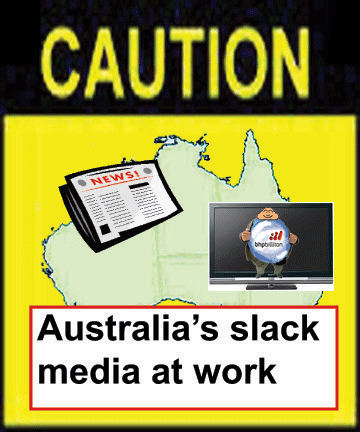
Australian media is not doing its job to expose power and corruption
|
What lies beneath must be resurfaced — or the media is not doing its job to expose power and corruption
And yesterday, the government released a discussion paper proposing that the declining role of gas in Australia’s energy production and manufacturing sectors instead be significantly expanded, which would also directly benefit Santos. In between, the government’s COVID economic recovery panel, chaired by another energy company executive, also urged that gas be used as part of Australia’s economic recovery. Both ideas would require massive government subsidies for gas companies like Santos. As a result Santos has had a good week. Last Friday, the company saw its share price close at $4.60. Yesterday it closed at $5.29, a 15% rise compared to just 3% on the ASX 200. This represents a handy return on investment. Santos is the country’s second-biggest fossil fuel industry political donor after Clive Palmer, having given over $1 million to the Coalition in the last decade. It has a rich history of exchanging staff with Coalition governments…… [In the media coverage] The story was treated as an energy or climate policy story, rather than one about corruption and power……. When even good, experienced journalists fail to give a full account of the fossil fuel companies working to not merely stymie climate action but to turn climate policies to their financial advantage, it points to a serious problem in our media — an inability to explore how surface events reflect underlying structures of power in Australia. And it results in a normalisation of corruption. Why do we instinctively see corruption if Trump does something, but if the government here does exactly the same thing, it’s written up seriously as an energy policy story, with the government and business on one side of a serious debate and “green groups” on the other? We see through the words a figure like Trump uses to disguise their corruption; here, the same words are taken at face value, and debated as serious contributions to policy…… Turnbull at least spoke and wrote about the role of fossil fuel interests and News Corp (which he correctly described as a foreign political party, rather than what it purports to be, an Australian media company) ….. Despite the woeful level of transparency around influence-peddling, there is considerable information available about the financial and personal links between key stakeholders and policymakers across federal politics.
At the ABC, Stephen Long is one of the few mainstream media journalists who sees his “investigative” role as extending to the structures of power rather than simply the surface. Paul Karp of The Guardian is also attuned to the tendency of donors to benefit from political parties. But they are, sadly, exceptions. We’ve seen before what happens when the media ignores the underlying reasons for decisions by policymakers. For years, the extensive donations by the major banks to the Liberal Party, and the revolving door between the executive suites of banks and the ranks of both ministerial staff and ministers themselves, was ignored by the media. The donations and revolving doors operated for both political parties, but the Liberals had — and have — by far the deepest and richest links with the banks. But the role of these financial and personal links in the Liberals’ long-running protection of the banks from regulation, and their constant attacks on industry superannuation funds, received little attention……. Australia’s political system is corrupted. Corrupted not merely or even particularly in the NSW Labor way of bags of cash and dodgy deals for mates, but systemically, institutionally corrupt, a pervasive soft corruption in which the powerful use money and lobbying to influence policymakers and get favourable policies, indeed, as we’ve seen this week, often get to craft policy themselves. All it takes to understand and explain that is to look beneath the surface. Is the Australian media holding policymakers to account? Let us know your thoughts by writing to letters@crikey.com.au. Please include your full name to be considered for publication in Crikey’s Your Say column. https://www.crikey.com.au/2020/05/22/political-reporters-not-doing-their-job-power-corruption/ |
|

#ScottyFromMarketing – yes Australia is run by an otherwise talentless marketing man
 Scotty from Marketing: What a way to run a country, Independent Australia, By Jennifer Wilson | 26 May 2020, Word is, Prime Minister Scott Morrison intensely dislikes the moniker “Scotty from Marketing” bestowed upon him last year by the Betoota Advocate.
It’s difficult to escape the strong impression that one of Morrison’s few talents is the grand announcement that, not much later, turns out to have minimum substance. Just one example is the $2 billion bushfire fund — $1.6 billion of which remains unallocated while survivors who lost everything are still living in tents and caravans without running water and toilet facilities…….
For the Prime Minister, the thrill is in the making of the promise, not the delivery of its substance, as may be in keeping with the general goals of a marketing man. Delivery is long and boring. Gratification comes immediately with the grand announcement and the praise with which it is greeted, particularly by the media. Who cares if the damn thing actually works or not?
So what if the $130 billion JobKeeper wage subsidy program has gone astoundingly awry in so many ways, not least of which is that it was overestimated to the tune of some $60 billion? Who cares? Announcing “the biggest economic lifeline in the country’s history”, as Morrison proclaimed at the time, brought him peak gratification and was immediately rewarded by lavish praise from business groups and the mainstream media……
Morrison’s primary goal is to persuade the punters he’s a good “dad” to the country and to this end, he seeks to dwell in the eternal present. The past is a country he increasingly needs to move on from, with a vicious cattle dog nipping at his heels — unless of course it’s got something to do with Labor that can be spun to his advantage. The future is of equal irrelevance, outside of Morrison’s personal ambitions. The Liberal Party itself is little more than a vehicle for the realisation of these personal ambitions, as is Morrison’s affiliation with his church — the man would likely hurl both of them under the bus if they in got in the way of the gaping maw of his gluttonous ambition.
Morrison’s primary talent is marketing himself. He did actually win the last Federal Election almost entirely without assistance from his ratbag crew of discontents and right-wing loons — and this is an indicator of his bottomless supply of self-belief and enviable lack of doubt.
Which brings us to China. On 22 April this year, Morrison had a phone chat with U.S. President, Donald Trump…….
What the mainstream media is far too inclined to overlook is Morrison’s utter ruthlessness. He is pragmatic and many appear to admire that quality, but it is a pragmatism whose genesis is to be found in breathtaking ruthlessness, and overweening self-interest — and it is not admirable. ……..
This is Scotty from Marketing. Find something to sell, and sell it regardless of the consequences. It’s the selling, stupid. What a way to run a country.https://independentaustralia.net/politics/politics-display/scotty-from-marketing-what-a-way-to-run-a-country,13931#.XsyKe2S6_gA.twitter
Australian government’s climate and post-Covid policy is a sop to the fossil fuel industries
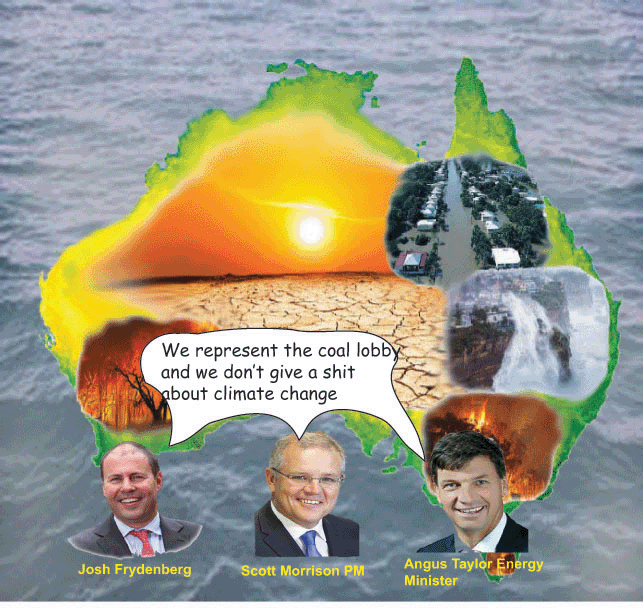
Angus Taylor suggesting it is not government policy to achieve net zero emissions by 2050, and the government giving in-principle support to recommendations made by a panel headed by a former CEO of Origin Energy, Grant King, to allow the Australian Renewable Energy Agency and the Clean Energy Finance Corporation fund projects involving carbon capture and storage.
pushes for the same energy mixes that were being advocated a decade ago – more gas, the discredited carbon capture, as well as nuclear power.
The climate crisis looms as the Coalition fiddles with fossil fuels https://www.theguardian.com/commentisfree/2020/may/24/the-climate-crisis-looms-as-the-coalition-fiddles-with-fossil-fuelsGreg Jericho The government is like a smoker switching to low-tar cigarettes. Its energy policy is just a sop
We may be dealing with a health crisis, but the climate change crisis has not gone away, nor become any less urgent. In fact, the opposite.
A few conservative commentators have suggested Covid-19 shows what a real crisis looks like compared with, in their opinion, the hyperventilating over climate change.
What bollocks.
Nasa estimates that last month was the hottest April on record and the first four months of this year are the second hottest start to a year.
The past seven months have all been 1C or higher than the 1951-1980 average (roughly around 1.3C above the pre-industrial average) – tied with the longest streak set from October 2015 to April 2016. But unlike in 2015 and 2016 the Bureau of Meteorology records we are currently not in El Niño.
That very much suggests the pace of warming is speeding up.
The linear trend of temperatures over the past 60 years suggests we will hit 2C above pre-industrial levels in 50 years; the trend of the past 20 years has it happening in around 30 years, but the trend of the past decade would see us hit that level in 2038 –just 18 years’ time.
And no, the virus has not bought us more time.
A study published this week in Nature Climate Change estimates the annual global drop in emissions due to virus shutdowns will be “comparable to the rates of decrease needed year-on-year over the next decades to limit climate change to a 1.5°C warming”.
That it took forcing people to stop their lives to achieve such cuts highlights just how big the job ahead of us is and how it cannot be done through individual action alone.
Cutting emissions without crippling the economy requires not everyone self-isolating, but changing industries and the very foundations of our economy.
We need to move away from oil, coal and gas to renewable energy.
And so it should be of great concern that the government is using the coronavirus as cover to push fossil fuels.
This week Adam Morton revealed that a manufacturing taskforce, headed by Dow Chemical executive and Saudi Aramco board member Andrew Liveris, is recommending to the National Covid-19 Coordination Commission (itself headed by the current deputy chairman of Strike Energy, Neville Power) that “the Morrison government make sweeping changes to ‘create the market’ for gas and build fossil fuel infrastructure that would operate for decades”.
It comes off the back of Angus Taylor suggesting it is not government policy to achieve net zero emissions by 2050, and the government giving in-principle support to recommendations made by a panel headed by a former CEO of Origin Energy, Grant King, to allow the Australian Renewable Energy Agency and the Clean Energy Finance Corporation fund projects involving carbon capture and storage.
Taylor also this week released a discussion paper for a “framework to accelerate low emissions technologies”. While suggesting renewables are vital, it essentially pushes for the same energy mixes that were being advocated a decade ago – more gas, the discredited carbon capture, as well as nuclear power.
It’s the wrong policy at precisely the wrong time.
As Morton has reported, organisations and governments around the world are advocating using economic stimulus measures to push towards a greener economy.
A report released this week by the Australian Conservation Foundation echoed the Grattan Institute’s recent “Start with steel: A practical plan to support carbon workers and cut emissions” report, arguing that we should see the virus as an opportunity to transform our economy and invest in renewable energy.
But no. It is clear the government remains wedded to a fossil-fuel based economy in which its climate change policy is merely a sop rather being designed to deal with a major crisis that is only becoming more urgent.
Leading doctors in Australia (over 180 of them) want Australia’s Australia’s Environmental Protection and Biodiversity Conservation Act 1999 (EPBC Act) made stronger, not weaker
 More than 180 doctors sign open letter calling for overhaul of ‘failing’ environmental laws, https://www.sbs.com.au/news/more-than-180-doctors-sign-open-letter-calling-for-overhaul-of-failing-environmental-laws 25 May 20, More than 180 health professionals have signed a letter warning the Commonwealth must strengthen Australia’s environmental laws to protect people’s health.
Doctors for the Environment Australia and the Climate and Health Alliance have sent an open letter to federal Environment Minister Sussan Ley as she undertakes a once-in-a-decade review of environmental protection laws.
Australia’s Environmental Protection and Biodiversity Conservation Act 1999 (EPBC Act) was established more than 20 years ago at a time when the doctors say the effects of climate change and its links to human health were not widely considered to be related.
The review comes amid the COVID-19 pandemic and follows Australia’s catastrophic summer bushfires with the health professionals warning that failing to conserve the environment will expose Australians to further devastation and health risks.
“We must protect the natural environment in order to prevent further and potentially even more deadly pandemics,” the letter says.
“The degradation of Australia’s natural environment and loss of our unique biodiversity is in effect a dismantling of our life support systems.”
The doctors argue the laws have failed as Australia has the second-highest rate of biodiversity in the world and is recognised as a land clearing and deforestation hotspot.
“The EPBC Act has failed to achieve its objectives of protecting Australia’s environment and promoting ecologically sustainable development and biodiversity conservation,” the letter says.
The letter, also signed by former Australian of the Year Professor Fiona Stanley, calls for an “entirely new generation” of environmental laws that focus on the impacts on human health and which have greater protections in place for biodiversity.
Associate Professor Katherine Barraclough from Doctors for the Environment Australia argues clearing forests and wildlife habitat increases the risk of infectious diseases being transferred from wildlife to people.
“The COVID-19 pandemic and the summer’s fires serve as a wake-up call. We must recognise the interconnections between humans, animals and natural places,” she said in a statement.
Climate and Health Alliance founder Fiona Armstrong said the government listened to the science in its response to COVID-19 and should do the same in regards to the environment and climate change.
An interim report into the Environment Protection and Biodiversity Conservation Act review is expected mid-year with the final report expected in October.
National Coordination COVID-19 Commission – a fossil fuel mates’ rort of staggering proportions.
 Coalition’s COVID-19 Commission: Another reason for a Federal ICAC Now! Independent Australia By Ross Jones | 25 May 2020 Just how much slush do you reckon is going to wash around the Coalition’s so-called National Coordination COVID-19 Commission? Coalition’s COVID-19 Commission: Another reason for a Federal ICAC Now! Independent Australia By Ross Jones | 25 May 2020 Just how much slush do you reckon is going to wash around the Coalition’s so-called National Coordination COVID-19 Commission?
It is brutally evident that, much like birds in a Hitchcock movie, masses of spivs are preening their flight feathers, readying themselves for a terrifying assault on Australia’s fragile environment to line their own – and others’ – already luxurious nests. This is going to be a mates’ rort of staggering proportions. There are a lot of approaches Australia could take to emerge from the COVID-19 problem a better place. Certainly, Australia is awash with economic problems — high unemployment, battered production capabilities, smashed asset values and a looming surplus of exports are just the start. As you would expect, the Morrison Government eschewed any sensible approaches to these problems, like rebooting manufacturing to set the country up for efficient, long-term solutions, which would enable us to contribute to global attempts to slow climate change while boosting levels of meaningful employment. Instead, the Coalition wants to unleash the dogs of destruction, just to make sure no other generation of Australians has anywhere near the opportunity this lot of privileged elitists has enjoyed. Once fracked and drilled, that land – our children’s land – will be rendered useless. Destroyed. Why are they doing this? Money. Lots of it. Greed, bribes, backhanders and sly winks will ensure the brown paper bags – or Cayman Island cupboards – are nice and plump for all the abusers of our long-term well-being to jam their porky little mitts into. This is exactly why we need an empowered Federal ICAC and that is exactly the reason IA is proposing the formation of a new Australian political party to be named — Federal ICAC Now (FIN). A Federal ICAC won’t stop all the malfeasance but it could put a fair-sized dent in it. Also, it would be great to have a few senators in the House whose focus is on corruption detection and prevention. The next half-senate election, when the term of those elected in 2016 expires, can be held as early as 7 August 2021 but must be held by 30 June 2022. Before the election, and especially in the last months leading up to the big event a registered FIN party would have a presence alerting voters to the issues. At the election, the above-the-line party might just have a chance. A previous IA article floated the idea of FIN and asked readers if they would be willing to join such a party………. https://independentaustralia.net/politics/politics-display/coalitions-covid-19-commission-another-reason-for-a-federal-icac-now,13928 |
|
Small Modular Nuclear Reactors included in Morrison govt’s energy plan?
 New nuclear technologies to be examined in planning Australia’s energy mix, The government is looking at incorporating ‘emerging nuclear
Small modular reactors ‘have potential’, investment roadmap discussion paper says, Guardian, Katharine Murphy Political editor @murpharoo, Thu 21 May 2020
The Morrison government has flagged examining “emerging nuclear technologies” as part of Australia’s energy mix in the future in a new discussion paper kicking off the process of developing its much-vaunted technology investment roadmap.
Facing sustained pressure to adopt a 2050 target of net zero emissions, pressure it is continuing to resist, the government plans instead to develop the roadmap as the cornerstone of the Coalition’s mid-century emissions reduction strategy.
The new framework will identify the government’s investment priorities in emissions-reducing technologies for 2022, 2030 and 2050, although the paper makes clear the government will only countenance “incentivising voluntary emissions reductions on a broad scale” – not schemes that penalise polluters.
The discussion paper to be released on Thursday floats a range of potential technologies for future deployment, including small modular nuclear reactors. It says emerging nuclear technologies “have potential but require R&D and identified deployment pathways”.
While clearly flagging that prospect, the paper also notes that engineering, cost and environmental challenges, “alongside social acceptability of nuclear power in Australia, will be key determinants of any future As well as championing the prospects for hydrogen, the paper also flags the importance of negative emission technologies, including carbon capture and storage, as well as soil carbon and tree planting.
This week the government has signalled its intention to use the existing $2.5bn emissions reduction fund to support CCS projects – a move championed by Australia’s oil and gas industries. The new paper says the geo-sequestration of carbon dioxide “represents a significant opportunity for abatement in export gas” – nominating the Gorgon project as a case in point. Growth in emissions in Australia is largely driven by fugitive emissions from the booming LNG export sector.
The paper does acknowledge that solar and wind – renewable technologies – are now “projected to be cheaper than new thermal generation over all time horizons to 2050”. But it adds a caveat, contending that “the cost of firming is still a major issue, and will require much more work”……. https://www.theguardian.com/australia-news/2020/may/21/new-nuclear-technologies-to-be-examined-in-planning-australias-energy-mix
Minerals Council of Australia keen to keep Australia’s environmental law the same, (or make it even worse)
May 19, 2020 The fossil fuel lobby, led by the Minerals Council of Australia, seem pretty happy with the current system of environment laws. In a submission to a review of the Environment Protection and Biodiversity Conservation (EPBC) Act, it “broadly” supports the existing laws and does not want them replaced.True, the group says the laws impose unnecessary burdens on industry that hinder post-pandemic economic recovery. It wants delays and duplication in environmental regulation reduced to provide consistency and certainty.
But for the fossil fuel industry to broadly back the current regime of environmental protection is remarkable. It suggests deep problems with the current laws, which have allowed decision-making driven by politics, rather than independent science.
So let’s look at the resources industry’s stance on environment laws, and what it tells us.
Cut duplication
The Minerals Council’s submission calls for “eliminating or reducing duplication” of federal and state laws.
The fossil fuel lobby has long railed against environmental law – the EPBC Act in particular – disparaging it as “green tape” that it claims slows projects unnecessarily and costs the industry money.
On this, the federal government and the mining industry are singing from the same songbook. Announcing the review of the laws last year, the government flagged changes that it claimed would speed up approvals and reduce costs to industry.
Previous governments have tried to reduce duplication of environmental laws. In 2013 the Abbott government proposed a “one-stop shop” in which it claimed projects would be considered under a single environmental assessment and approval process, rather than scrutinised separately by state and federal authorities.
That proposal hit many political and other hurdles and was never enacted. But it appears to remain on the federal government’s policy agenda.
It’s true the federal EPBC Act often duplicates state approvals for mining and other activities. But it still provides a safety net that in theory allows the federal government to stop damaging projects approved by state governments.
The Commonwealth rarely uses this power, but has done so in the past. In the most famous example, the Labor party led by Bob Hawke won the federal election in 1983 and stopped the Tasmanian Liberal government led by Robin Gray building a major hydroelectric dam on the Gordon River below its junction with the Franklin River.
The High Court’s decision in that dispute laid the foundation for the EPBC Act, which was enacted in 1999.
In 2009 Peter Garrett, Labor’s then-federal environment minister, refused the Queensland Labor government’s proposed Traveston Crossing Dam on the Mary River under the EPBC Act due to an unacceptable impact on threatened species.
The Conversation put these arguments to the Minerals Council of Australia, and CEO Tania Constable said:
The MCA’s submission states that Australia’s world-leading minerals sector is committed to the protection of our unique environment, including upholding leading practice environmental protection based on sound science and robust risk-based approaches.
Reforms to the operation of the EPBC Act are needed to address unnecessary duplication and complexity, providing greater certainty for businesses and the community while achieving sound environmental outcomes.
But don’t change the current system much
Generally, the Minerals Council and other resources groups aren’t lobbying for the current system to be changed too much.
The groups support the federal environment minister retaining the role of decision maker under the law. This isn’t surprising, given a succession of ministers has, for the past 20 years, given almost unwavering approval to resource projects.
For example, in 2019 the then-minister Melissa Price approved the Adani coal mine’s groundwater management plan, despite major shortcomings and gaps in knowledge and data about its impacts.
Independent scientific advice against the mine over the last ten years was sidelined in the minister’s final decision.
Countless more examples demonstrate how the current system works in the favour of mining interests – even when the industry itself claims otherwise.
The Minerals Council submission refers to an unnamed “Queensland open-cut coal expansion project” to argue against excessive duplication of federal and state processes around water use.
I believe this is a reference to the New Acland Coal Mine Stage 3 expansion project. I have acted since 2016 as a barrister for a local landholder group in litigation against that project.
When approached by The Conversation, the Minerals Council did not confirm it was referring to the New Acland project. Tania Constable said:
The case studies were submitted from a range of companies, and are representative of the regulatory inefficiency and uncertainty which deters investment and increases costs while greatly limiting job opportunities and economic benefits for regional communities from mining.
The New Acland mine expansion is on prime agricultural land on the Darling Downs, Queensland’s southern food bowl. Nearby farmers strongly opposed the project over fears of damage to groundwater, the creation of noise and dust, and climate change impacts.
But the Minerals Council fails to mention that since 2016, the mine has been building a massive new pit covering 150 hectares.
When mining of this pit began, the mine’s expansion was still being assessed under state and federal laws. Half of the pit was subsequently approved under the EPBC Act in 2017.
But the Queensland environment department never stopped the work, despite the Land Court of Queensland in 2018 alerting it to the powers it had to act.
Based on my own research using satellite imagery and comparing the publicly available application documents, mining of West Pit started while Stage 3 of the mine was still being assessed under the EPBC Act. And after approval was given, mining was conducted outside the approved footprint.
Despite these apparent breaches, the federal environment department has taken no enforcement action.
The Conversation contacted New Hope Group, the company that owns New Acland mine, for comment, and they refuted this assertion. Chief Operating Officer Andrew Boyd said:
New Hope Group strongly deny any allegations that New Hope Coal has in any way acted unlawfully.
New Acland Coal had and still has all necessary approvals relating to the development of the pit Dr McGrath refers to. It is also not correct to say that the Land Court alerted the Department of its powers to act with regards to this pit.
The Department is obviously aware of its enforcement powers and was aware of the development of the pit well before 2018. Further, the Land Court in 2018 rejected Dr McGrath’s arguments and accepted New Acland Coal’s position that any issues relating to the lawfulness of the pit were not within the jurisdiction of the Land Court on the rehearing in 2018.
Accordingly, the lawfulness of the pit was irrelevant to the 2018 Land Court hearing.
Dr McGrath also fails to mention that his client had originally accepted in the original Land Court hearing (2015-2017) that the development of the pit was lawful only to completely change its position in the 2018.
State and federal environmental laws work in favour of the fossil fuel industry in other ways. “Regulatory capture” occurs when government regulators essentially stop enforcing the law against industries they are supposed to regulate.
This can occur for many reasons, including agency survival and to avoid confrontation with powerful political groups such as farmers or the mining sector.
In one apparent example of this, the federal environment department decided in 2019 not to recommend two critically endangered Murray-Darling wetlands for protection under the EPBC Act because the minister was unlikely to support the listings following a campaign against them by the National Irrigators Council.
Holes in our green safety net
Recent ecological disasters are proof our laws are failing us catastrophically. And they make the mining industry’s calls to speed-up project approvals particularly audacious.
We need look only to repeated, mass coral bleaching as the Great Barrier Reef collapses in front of us, or a catastrophic summer of bushfires.
Read more: Environment laws have failed to tackle the extinction emergency. Here’s the proof
Both tragedies are driven by climate change, caused by burning fossil fuels. It’s clear Australia should be looking to fix the glaring holes in our green safety net, not widen them.
Leaked plan for huge gas subsidies
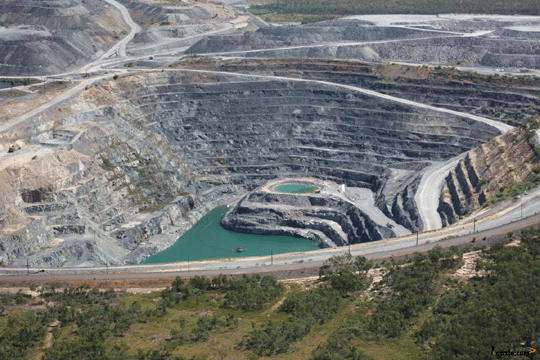
Australian govt and ERA squabble over monitoring of Ranger uranium clean-up
|
Ranger Mine locked in stoush over funding for Kakadu uranium rehabilitation monitoring https://www.abc.net.au/news/2020-05-19/nt-kakadu-uranium-stoush-ranger-mine-rehabilitation/12260130 By Jane Bardon,
The Federal Government is locked in a stoush with the company mining uranium on the edge of the Northern Territory’s Kakadu National Park over whether it will continue to fund monitoring of the site’s rehabilitation. Energy Resources of Australia (ERA) has flagged it wants to pull out of paying $2.5 million a year for the Supervising Scientist Branch independent monitoring agency, which it funds with the Commonwealth, at the end of June.
Community members of ERA’s independent technical consultation committee, including Dr Gavin Mudd, an Associate Professor of Environmental Engineering at RMIT University, have been told by the Supervising Scientist Branch its future research is in doubt because of the funding uncertainty. “That funding is no longer guaranteed for next year is a major concern,” Dr Mudd said. “This work is needed to give us confidence that what is done at Ranger actually works, including the restoration of ecosystems, how stable the landform is, the radioactivity and the surface and groundwater water quality issues.” Dr Mudd said failures in the rehabilitation of other Northern Territory uranium mines, including Rum Jungle near Bachelor, have demonstrated that there will need to be monitoring for decades after Ranger’s closure. ERA, which is owned by Rio Tinto, has been forced to close the mine by 2021 after a series of uranium leaks and spills into the Alligator Rivers system during its 35 years of operations. The company has promised the mine site will be returned to a pristine state, suitable for inclusion in the Kakadu World Heritage park by 2026, and that monitoring by the Supervising Scientist will prove that. The Federal Government provides three-quarters of the Supervising Scientist’s $8 million annual operating budget. ERA told the ABC it hasn’t made a final decision on the funding. “There has been no decision that ERA’s contribution would cease. But a spokesman for the Federal Environment Minister told the ABC the Government felt it was “unfortunate that ERA is choosing to dispute its ongoing contribution under the Deed”. “The role of the Supervising Scientist ensures the unique environment of Kakadu National Park, its Indigenous culture and its stunning wildlife are protected from the effects of uranium mining within that rehabilitation process and into the future,” he said. “The Commonwealth view is that ERA needs to continue to make an appropriate contribution to support ongoing research during the rehabilitation phase of the mine to ensure there are no shortfalls.” The spokesman added that the Minister Sussan Ley has asked the Environment Department to mediate with ERA to try to resolve the dispute. |
|
The Morrison government manipulates, to paint the coal industry as “clean” and “renewable”

The Clean Energy Finance Corporation has this awkward word “Clean”
The Australian Renewable Energy Agency has this awkward word “Renewable”
How can the those agencies put coal into those categories? With some difficulty.
My heart goes out to them, -like those poor gardeners in “Alice in Wonderland” – forced to paint red all the white roses , lest the Queen should cut off their heads.
Government looks to carbon capture for climate action, The Age By Mike Foley, May 19, 2020 The Morrison government is considering legislative changes to allow its clean energy agencies to fund carbon capture and storage from fossil fuel projects in a bid to unlock $2 billion of private investment to reduce greenhouse gases.
Energy and Emissions Reduction Minister Angus Taylor has accepted 21 of the 26 recommendations from an independent panel reviewing the $2 billion Emissions Reduction Fund, including all those relating to carbon capture and storage.
The panel, chaired by former Business Council of Australia president Grant King, said the government would attract more private investment in the Emissions Reduction Fund if legislation were amended to “enable a method to be developed for carbon capture and storage”.
The King report also recommended an “expanded, technology-neutral remit” for the Clean Energy Finance Corp (CEFC) and the Australian Renewable Energy Agency so they too could attract more private investment in a wider range of technologies outside renewables, such as coal or gas-fired power incorporating carbon capture and storage. This would be a significant change to the remit of the agencies, which were set up to promote the development of renewable wind and solar supplied to the electricity grid.
Carbon capture and storage, which has not yet been successfully implemented on a commercial basis, involves capturing carbon dioxide from industrial processes and transporting it to a suitable storage site for safe, long-term storage deep underground.
Mr Taylor said emissions reduction policy driven by “technology not taxes” would attract significant private investment.
“The government will target dollar-for-dollar co-investment from the private sector and other levels of government to drive at least $4 billion of investment that will reduce emissions across Australia,” he said in a statement accompanying the report’s release.
The Climate Solutions Fund was set up in 2015 with $2.5 billion funding under the Abbott government as an alternative to a carbon tax. It pays polluters to employ cleaner technologies and funds carbon capture through tree planting, soil carbon sequestration on farms and energy efficient systems in commercial properties, as well as methane capture from landfill and waste management.
Last year, the Morrison government topped up the fund with another $2 billion and rebadged it the Climate Solutions Fund. To date, it has issued 450 contracts to abate a cumulative 190 million tonnes of carbon at a total cost of $2.3 billion, or an average of $12 a tonne of carbon…….
Current legislation prohibits CEFC from investing in carbon capture and storage. But changing the legislation would enable the $1 billion Grid Reliability Fund to invest in new gas, hydrogen and coal projects relying on carbon capture.
….
Morrison govt plans to direct climate action measures to promote coal industry
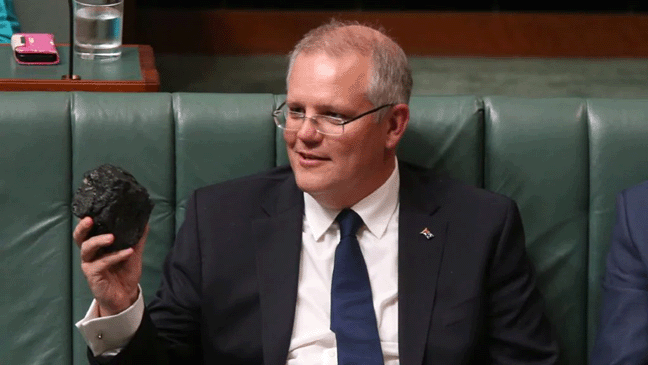 Coalition reveals new emissions reduction measures, including paying polluters to stay under cap
Morrison government also plans to allow businesses to bid for carbon capture projects via the $2.55bn emissions reduction fund Guardian Adam Morton Environment editor @adamlmorton 19 May 2020
Big polluters will be able to earn revenue by emitting less than their allocated limit under new emissionsThe Morrison government has promised new measures to reduce greenhouse gas emissions, including introducing an incentive scheme to allow big industrial polluters to earn revenue by emitting less than an agreed limit.
It also plans to allow businesses to bid for funding from its main climate policy, the $2.55bn emissions reduction fund, for projects that capture emissions and either use them or store them underground.
Angus Taylor, the energy and emissions reduction minister, said the government had agreed to 21 of 26 recommendations in a review headed by former Business Council of Australia president Grant King, who was charged with coming up with new ways to cheaply cut emissions.
The appointment in October of the panel of business leaders and policy experts was not publicly announced, and was seen by observers as an effective concession the emissions reduction fund, now rebadged as a climate solutions fund, was failing to cut national pollution………
Recommendations agreed by the government included allowing carbon capture and storage projects to qualify under the fund, a step the government said it had began consulting with industry on last month.
In a shift likely to be criticised by clean energy advocates, the government gave in-principle support for two agencies, the Australian Renewable Energy Agency (Arena) and the Clean Energy Finance Corporation (CEFC), to be given a “technology neutral remit” to support “the widest possible range of technologies that reduce emissions”. The Greens previously accused the government of planning changes to the CEFC to allow it to fund more fossil fuel projects……
Recommendations agreed by the government included allowing carbon capture and storage projects to qualify under the fund, a step the government said it had began consulting with industry on last month.
In a shift likely to be criticised by clean energy advocates, the government gave in-principle support for two agencies, the Australian Renewable Energy Agency (Arena) and the Clean Energy Finance Corporation (CEFC), to be given a “technology neutral remit” to support “the widest possible range of technologies that reduce emissions”. The Greens previously accused the government of planning changes to the CEFC to allow it to fund more fossil fuel projects…….https://www.theguardian.com/environment/2020/may/19/coalition-reveals-new-emissions-reduction-measures-including-paying-polluters-to-stay-under-cap
John Barilaro got it so wrong about Britain and small nuclear reactors
|
Electrical Review 4th May 2020
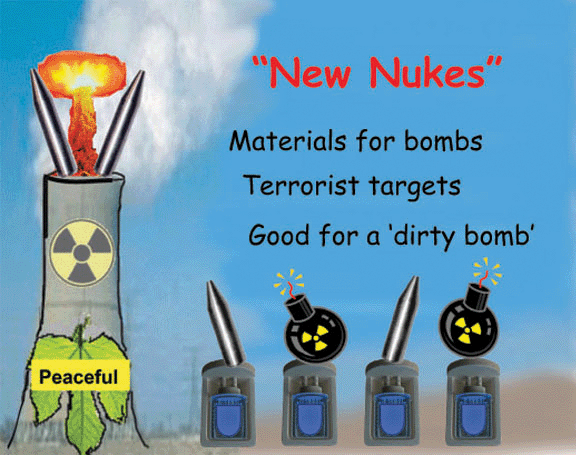 I have to conclude that the Deputy Premier of New South Wales, John Barilaro, is a remarkable clairvoyant. He has announced unequivocally on Australian media that Rolls Royce is set to build up to 15 new small-size nuclear reactors in Britain over the next nine years. I have to conclude that the Deputy Premier of New South Wales, John Barilaro, is a remarkable clairvoyant. He has announced unequivocally on Australian media that Rolls Royce is set to build up to 15 new small-size nuclear reactors in Britain over the next nine years.Strange this. Just 18 months ago, according to the Financial Times, Rolls-Royce was preparing to shut down altogether its R&D project to develop small modular nuclear reactors, unless the British government agreed to an outrageous set of demands and subsidies. Granted the Johnson government has bunged them a few million to keep the R&D going.
But there is as yet no sign of anything being oven-ready to come to the marketplace, let alone 15 up and running. But there remain some rather disturbing connections between small reactor projects and nuclear weapons proliferation. And Rolls-Royce does offer up one of the most glaring examples. Part of the company’s current sales pitch to the British government includes the argument that a civil small-reactor industry in the UK “would relieve the Ministry of Defence of the burden of developing and retaining skills and capability” for its weapons programme. It may be true. But it is not really Atoms for Peace, , is it? https://electricalreview.co.uk/features-mm/13082-mystic-meg-from-down-under |
|
The push to weaken Australia’s law regulating the uranium industry, in the review of Environmental Protection and Biodiversity Conservation (EPBC) Act
Uranium, extinction, expedited approvals and extreme risks: the need for stronger environmental laws, https://www.onlineopinion.com.au/view.asp?article=20887
| By Mia Pepper – 14 May 2020 |
This year a Review Committee is examining the cornerstone of Australia’s environmental laws – the Environmental Protection and Biodiversity Conservation (EPBC) Act 1999. This review comes hot on the heels of three inquiries into nuclear power driven by conservative politicians and pressure from the nuclear lobby. This cohort are pushing for the removal of laws banning nuclear power, a push the current federal government has already ruled out.
They are also pushing to weaken regulatory requirements for uranium mine assessments through the EPBC Act. There is currently no national prohibition on uranium mining, but prohibitions exist in Victoria, NSW, Queensland, WA, Tasmania and Victoria. SA and the NT have a long and contested history of supplying uranium to fuel nuclear power plants overseas. Uranium from SA and the NT fuelled the Fukushima reactor during the 2011 meltdowns, fires and explosions ‒ a discomforting legacy given that there was ample evidence long before the Fukushima disaster of corruption and inadequate safety standards in Japan’s nuclear industry.
Following the Fukushima disaster the UN Secretary General advised that Australia have “an in-depth assessment of the net cost impact of the impacts of mining fissionable material on local communities and ecosystems.” No such assessment has been carried out. Worse still, the appointment of a former uranium mining company executive to the EPBC Review Committee suggests that there may be some support within the government for a weakening of uranium mining regulations rather than the necessary strengthening.
The reality of uranium mining in Australia has been one of leaks, spills, accidents, license breaches and a failure to rehabilitate. Of the 15 uranium mines that have operated, just two are still mining (Olympic Dam and Beverley Four Mile), one is preparing for closure (Ranger), another is preparing for a second round of rehabilitation failing previous attempts (Rum Jungle), three are on life support in extended care and maintenance; and the remaining sites are all contaminated and require ongoing monitoring and maintenance at the expense of taxpayers.
That track-record strongly suggests the need for greater scrutiny and a strengthening not a weakening of regulations. Proposed changes by the nuclear industry include changing the definition of ‘nuclear actions’ in the EPBC Act to remove the “mining and milling” of uranium. The impact of this would reduce requirements for whole-of-environment assessments for uranium projects and reduce federal oversight. Existing processes desperately need improvement given recent failures around transparency, upholding principles and objects of environmental laws, political influence in decision making, expedited process and unfounded exemptions.
The Ranger uranium mine in the tropical NT, owned by Rio Tinto and operated by ERA, will begin rehabilitation in 2021, a project set to cost in excess of $1 billion. There are ongoing concerns about the funding and adequacy of the proposed rehabilitation. Meeting the regulatory requirement to secure radioactive wastes and other toxins from the environment for 10,000 years is inherently difficult, not least because there is a long history of routine, daily leakage of large volumes of contaminated liquid.
Not far from Ranger, the government-owned Rum Jungle mine has been leaking radioactive and acidic materials into the East Branch of the Finniss River since it was closed in 1971. The NT government has released new plans to remediate the site which is likely to cost in excess of $300 million, but there is still no commitment from the NT or Federal governments to fund this important work.
The legacy threats from uranium mines are unlike the threats from other mines and a repeated failure to contain this waste suggests that mining uranium should be banned, or at the very least have the strictest possible regulations.
There are many other examples of industry and regulatory failure. At the former uranium mine at Radium Hill in SA, the tailings dam was shoddily constructed and was not capped when the mine closed. The Port Pirie uranium treatment plant in SA is still contaminated over 50 years after its closure. SA regulators failed to detect a mining exploration company’s dumping of low-level radioactive waste in the Arkaroola Wilderness Sanctuary. At the Beverley Four Mile in-situ leach uranium mine in SA, contaminated wastewater is routinely dumped in groundwater ‒ a process permitted by regulators who should know better.
In yet another regulatory failure, BHP’s proposal for a new tailing’s facility at its Olympic Dam copper/uranium mine in SA has been fast-tracked without requirements for federal approval. The decision not to assess the new tailings dam came after the Australian National Committee on Large Dams gave three existing tailings dams at Olympic Dam a risk ranking of ‘extreme’ – this ranking is given to tailings facilities that if failed would cause the death of over 100 people. The independent review of tailings followed the Samarco tailings disaster in Brazil, a joint venture project between BHP and Vale, which killed 19 people. The new proposed tailings should be assessed to determine the risk and likelihood of failure; instead, the facility has been fast-tracked avoiding scrutiny under the EPBC Act.
Cameco’s proposed Yeelirrie mine in WA provides another example of unseemly haste and unseemly exemptions. The WA EPA recommended that Yeelirrie not be approved because of the likelihood the mine would cause multiple species extinctions. Despite this recommendation the former State Environment Minister approved the mine weeks before losing his seat and the Liberal party lost Government in the 2017 WA election. In a similar scenario, the mine was given federal approval on the eve of announcing the 2019 federal election. That federal approval followed direct lobbying of Ministers and the Department and resulted in a set of conditions that no longer require the company to prove the mine won’t cause species extinction.
A 2003 report by the federal Senate References and Legislation Committee found “a pattern of underperformance and non-compliance” in the uranium mining industry and it concluded that changes were necessary “in order to protect the environment and its inhabitants from serious or irreversible damage”. The same could be said now. Subsequent reviews of uranium mining regulations in Queensland, WA and Canada identify unique risks with uranium mining and calls for improved and increased regulations that meet those specific challenges and risks.
The push from the industry to weaken regulations should be wholeheartedly rejected and instead the EPBC Committee could consider advice from former UN Secretary General to hold an “in-depth” assessment of the uranium sector and its impacts.
Australian Radiation Protection and Nuclear Safety Agency now has the chance to prove they put health and safety first
James Shepherdson No Nuclear Waste Dump Anywhere in South Australia , 13 May 20, This should be a huge opportunity for arpansa to step up and prove to the Australian people that they really are going to put public safety at the forefront of their decision and reject any licence application for the temporary secondary storage of intermediate level waste . If not one can only conclude that they are just as corrupt as our pollies ,not independent at all and prepared to ignore what they themselves claim to be world’s best practice https://www.facebook.com/groups/1314655315214929/
Environment Minister Sussan Ley not to support protection of Murray-Darling river systems
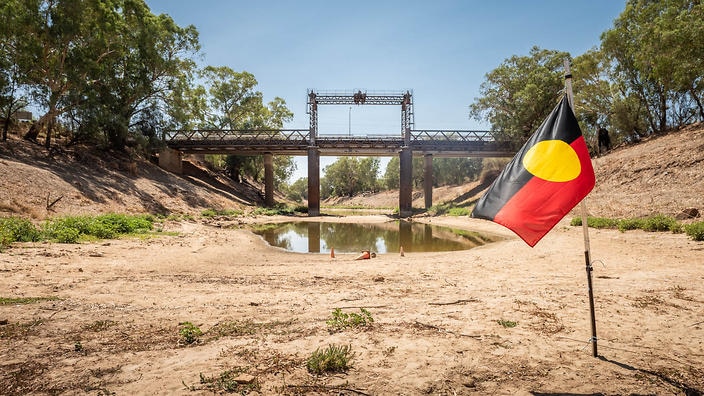
Murray-Darling systems not assessed for endangered listing after officials warned Coalition would not  support it
FoI documents reveal struggling systems were ‘clear candidates’ for protection but Sussan Ley ‘unlikely to support’ it, Guardian, Lisa Cox, Wed 13 May 2020 Struggling river and wetland systems in the Murray-Darling Basin were not assessed for listing as critically endangered after officials warned the Morrison government would not support protecting them.
Environment department staff said the two ecological communities were “clear candidates” for assessment for a critically endangered listing, documents released under freedom of information show. But the environment minister, Sussan Ley, was “unlikely to support” their inclusion on the 2019 list of species and habitats under consideration for protection, they told the threatened species scientific committee.
The department also told the committee the work required to do the assessment would have “significant resource implications”.
The two communities are known as the “wetland and inner floodplain of the Macquarie Marshes”, and the “Lower Murray River and associated wetlands, floodplains and groundwater systems from the junction of the Darling River to the sea”.
Both were listed as critically endangered by then environment minister Mark Butler in the final days of the Labor government in 2013.
After the Coalition won government, both listings were disallowed under the new environment minister, Greg Hunt. It followed a campaign against the critically endangered listings by the National Irrigators Council.
Humane Society International, the organisation behind the nomination that led to the 2013 listings, renominated the river and wetlands systems for assessment for a critically endangered listing last year.
In a briefing to the threatened species scientific committee, officials said a tool the department used for conservation assessments had ranked the two communities as the highest priorities from a conservation perspective among a group of five ecological communities nominated for listing in 2019.
But neither made it on to the proposed priority assessment list, which is given to the environment minister to consider before they determine the nominations that will make it on to the final list.
The briefing to the committee is the same document that led to Guardian Australia last week revealing the government had stopped listing major threats to species under national environmental laws…….
Labor’s environment spokeswoman, Terri Butler, said it was “outrageous” the Morrison government had not followed scientific advice. She said the government was attempting “to influence the outcomes of scientific processes designed to protect our environment”.
Richard Kingsford, the director of the Centre for Ecosystem Science at the University of New South Wales, said the scientific research on the two communities showed both had high levels of biodiversity and were degrading significantly as a result of reduced flooding.
“The question would be: why were they ruled out at that first step?” he said…… https://www.theguardian.com/environment/2020/may/13/murray-darling-systems-not-assessed-for-endangered-listing-after-officials-warned-coalition-would-not-support-it
1 This month


Help Aunty Sue Protect Her Land and Sacred Sites From Destructive Rocket Testing.
.

Australians deserve the truth
about
AUKUS – https://aukuspublicinquiry.com/

PETITION – To: Prime Minister Anthony Albanese and the Australian Labor Government

of the week – Australians for War Powers Reform (AWPR)
To see nuclear-related stories in greater depth and intensity

