The Institute of Public Affairs has poisoned climate discussion in Australia
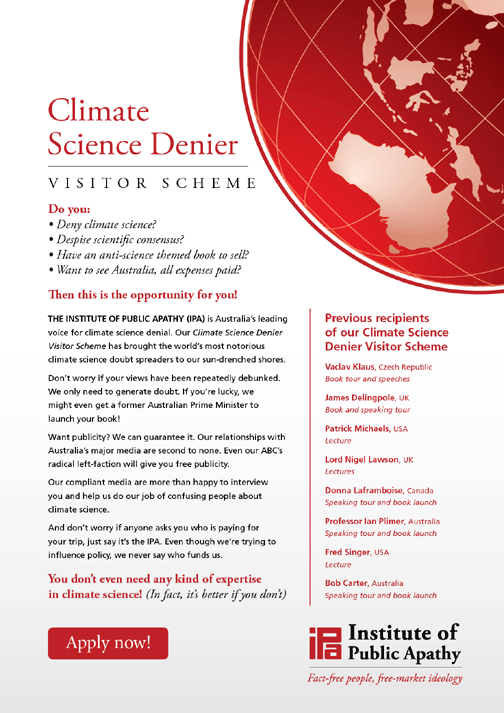
How one think tank poisoned Australia’s climate debate, Crikey NAPIER-RAMAN, JAN 29, 2019 One of the Institute of Public Affair’s greatest successes has been to stitch climate denialism into the very fabric of the conservative political identity.
From anti-vaxxers to climate deniers to a general simmering scepticism of science, denialism in all its forms is everywhere. Crikey is presenting a four-part series on how the seeds of doubt are planted and how they blossom through media and politics. Read the first three parts here.
In the 1980s, long before there was widespread public awareness of the proximity of imminent environmental apocalypse, before climate change became a wedge issue that toppled Australian prime ministers and divided politics, free market think tanks like the Institute of Public Affairs were busy sowing the seeds of doubt.
Today, those seeds have grown into vast tendrils which have a stranglehold on politics. The IPA exists as a conduit between the respectable mainstream right, represented by the Liberal Party, and fringe climate deniers, whose marginal views are largely rejected by the rest of the scientific community. Their greatest success, mirroring that of other free market think tanks in the United States, has been to stitch climate denialism into the very fabric of the conservative political identity. Continue reading
Michael Mann- climate change is now upon Australia
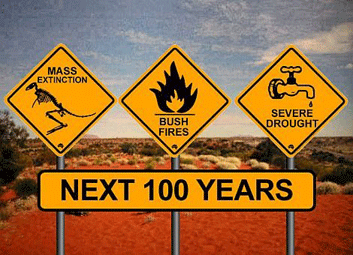
Australia, your country is burning – dangerous climate change is here with you now , Guardian, Michael Mann 1 Jan 2020, I am a climate scientist on holiday in the Blue Mountains, watching climate change in action,
After years studying the climate, my work has brought me to Sydney where I’m studying the linkages between climate change and extreme weather events.
Prior to beginning my sabbatical stay in Sydney, I took the opportunity this holiday season to vacation in Australia with my family. We went to see the Great Barrier Reef – one of the great wonders of this planet – while we still can. Subject to the twin assaults of warming-caused bleaching and ocean acidification, it will be gone in a matter of decades in the absence of a dramatic reduction in global carbon emissions.
We also travelled to the Blue Mountains, another of Australia’s natural wonders, known for its lush temperate rainforests, majestic cliffs and rock formations and panoramic vistas that challenge any the world has to offer. It too is now threatened by climate change.
I witnessed this firsthand.
I did not see vast expanses of rainforest framed by distant blue-tinged mountain ranges. Instead I looked out into smoke-filled valleys, with only the faintest ghosts of distant ridges and peaks in the background. The iconic blue tint (which derives from a haze formed from “terpenes” emitted by the Eucalyptus trees that are so plentiful here) was replaced by a brown haze. The blue sky, too, had been replaced by that brown haze. ……
The brown skies I observed in the Blue Mountains this week are a product of human-caused climate change. Take record heat, combine it with unprecedented drought in already dry regions and you get unprecedented bushfires like the ones engulfing the Blue Mountains and spreading across the continent. It’s not complicated.
The warming of our planet – and the changes in climate associated with it – are due to the fossil fuels we’re burning: oil, whether at midnight or any other hour of the day, natural gas, and the biggest culprit of all, coal. That’s not complicated either.
When we mine for coal, like the controversial planned Adani coalmine, which would more than double Australia’s coal-based carbon emissions, we are literally mining away at our blue skies. The Adani coalmine could rightly be renamed the Blue Sky mine.
In Australia, beds are burning. So are entire towns, irreplaceable forests and endangered and precious animal species such as the koala (arguably the world’s only living plush toy) are perishing in massive numbers due to the unprecedented bushfires.
The continent of Australia is figuratively – and in some sense literally – on fire.
Yet the prime minister, Scott Morrison, appears remarkably indifferent to the climate emergency Australia is suffering through, having chosen to vacation in Hawaii as Australians are left to contend with unprecedented heat and bushfires.
Morrison has shown himself to be beholden to coal interests and his administration is considered to have conspired with a small number of petrostates to sabotage the recent UN climate conference in Madrid (“COP25”), seen as a last ditch effort to keep planetary warming below a level (1.5C) considered by many to constitute “dangerous” planetary warming.
But Australians need only wake up in the morning, turn on the television, read the newspaper or look out the window to see what is increasingly obvious to many – for Australia, dangerous climate change is already here. It’s simply a matter of how much worse we’re willing to allow it to get.
Australia is experiencing a climate emergency. It is literally burning. It needs leadership that is able to recognise that and act. And it needs voters to hold politicians accountable at the ballot box.
Australians must vote out fossil-fuelled politicians who have chosen to be part of the problem and vote in climate champions who are willing to solve it.
- Michael E Mann is distinguished professor of atmospheric science at Pennsylvania State University. His most recent book, with Tom Toles, is The Madhouse Effect: How Climate Change Denial Is Threatening Our Planet, Destroying Our Politics, and Driving Us Crazy (Columbia University Press, 2016).
Scott Morrison’s govt under pressure for its lack of climate policy
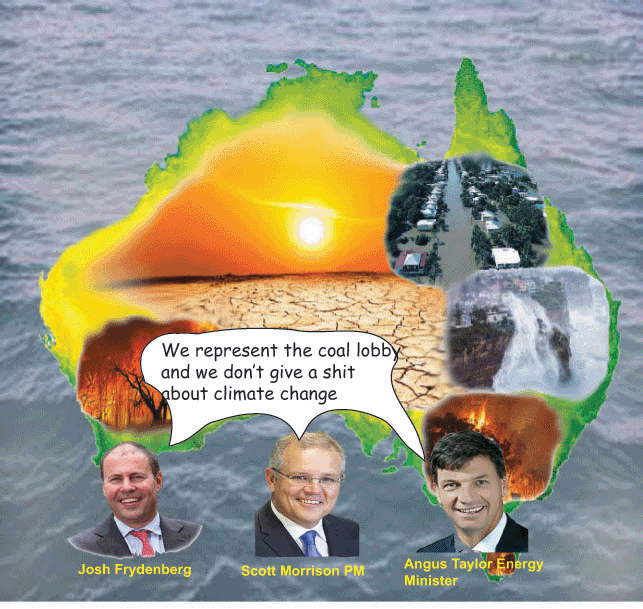
Australia bushfires: PM’s climate stance criticised as thousands flee blazes
Scott Morrison’s government under pressure as fires feared to have killed 17 people,Guardian, Ben Smee , Calla Wahlquist Helen Davidson in Sydney and Jon Henley– 2 Jan 2020
Navy ships and army aircraft have been dispatched to help fight devastating bushfires on Australia’s south-east coast that are feared to have killed at least 17 people, amid a spiralling debate over the government’s stance on the climate emergency.
Thousands of people have fled apocalyptic scenes, abandoning their homes and huddling on beaches to escape raging columns of flame and smoke that have plunged whole towns into darkness and destroyed more than 4m hectares of land.
Thousands of firefighters were still battling more than 100 blazes in New South Wales (NSW) state and nearly 40 in Victoria on Wednesday, with new fires being sparked daily by hot and windy conditions and, more recently, dry lightning strikes created by the fires themselves.
At the end of Australia’s hottest-ever decade, Canberra, the capital, was blanketed in a cloud of dense smoke that left its air quality more than 21 times the hazardous rating and could be seen more than 1,200 miles (2,000km) away, on the South Island of New Zealand, where it turned the daytime sky orange.
Fanned by soaring temperatures, strong winds and a terrible three-year drought, huge blazes have ravaged a tinder-dry landscape, causing immense destruction: since November, more than 900 homes have been lost in NSW alone.
With three months of the summer still to go, the early and devastating start to the country’s fire season has led authorities to rate it the worst on record and prompted urgent questions about whether the conservative government of the prime minister, Scott Morrison, has taken enough action on global heating.
Polls show a large majority of Australians see the climate emergency as an urgent threat and want tougher government action, but Morrison has focused instead on the nation’s response to the bushfire crisis and defending Australian business, while other government officials have publicly disparaged climate activists.
In his New Year’s Eve address to the nation, Morrison did not make any connection between the bushfires and global heating, suggesting that while they were a terrible ordeal, Australians had faced similar trials throughout history.
Past generations had “also faced natural disasters, floods, fires, global conflicts, disease and drought” and overcome them, the prime minister said in a video message. “That is the spirit of Australians, that is the spirit that is on display, that is a spirit that we can celebrate as Australians.”…….
Criticism of the Morrison government’s climate stance has intensified as the fires have raged. Australia is the world’s largest exporter of coal and liquefied natural gas, but the prime minister, who won a surprise election victory in May, last month rejected calls to downsize Australia’s lucrative coal industry.
His government has pledged to cut greenhouse gas emissions by 26-28% by 2030, a modest figure compared with the centre-left opposition Labor party’s pledge of 45%. The leader of the minor Australian Greens party, Richard Di Natale, demanded a royal commission, the nation’s highest form of inquiry, on the crisis.
“If he (Morrison) refuses to do so, we will be moving for a parliamentary commission of inquiry with royal commission-like powers as soon as parliament returns,” Di Natale said in a statement……. https://www.theguardian.com/australia-news/2020/jan/01/australia-bushfires-defence-forces-sent-to-help-battle-huge-blazes
Fact checking Angus Taylor: does Australia have a climate change record to be proud of?
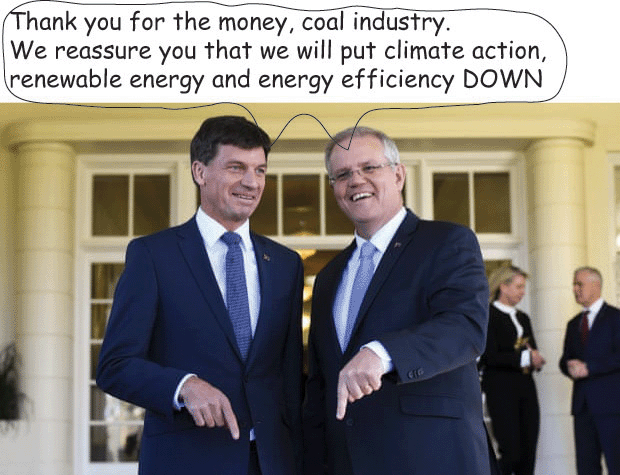
On a day of extraordinary bushfires the energy minister argued that the country has ‘strong targets, clear plans and an enviable track record’ on reducing emissions. Is he right? Guardian, Graham Readfearn
Angus Taylor spoke at the COP25 climate summit in Madrid. The energy minister says Australia has an enviable record on climate change – the Guardian fact checks his claims.
Australians should be proud of the country’s achievements on climate change, energy minister Angus Taylor has argued in a newspaper column that claims “quiet Australians” don’t accept the “shrill cries” of the government’s climate critics.
The column, published in The Australian, makes a series of claims about Australia’s emissions and how they compare to other countries, as well as highlighting exports such as LNG that are “dramatically reducing emissions” in other countries.
So is Australia really a paragon of climate virtue – cutting emissions at home while helping the world to cut emissions?
As is always the case when it comes to climate and energy policy, there is much to check and understand in Taylor’s article.
Prof Frank Jotzo, director of the Centre for Climate and Energy Policy at the ANU Crawford School of Public Policy, told Guardian Australia: “I would characterise [Taylor’s article] as a selective use of statistics that make Australia’s emissions trajectory look good, when in reality it does not look good at all.”
Tiny footprint?
Taylor writes that Australia is “responsible for only 1.3 per cent of global emissions, so we can’t single-handedly have a meaningful impact without the co-operation of the largest emitters such as China and the US.”
In the context of global emissions, there is much that Australia can, and does, do that has a meaningful impact.
The 1.3% figure does not account for Australia’s contribution to global emissions from the fossil fuels we dig up and export.
If this exported coal and gas was accounted for, one analysis suggests Australia would be responsible for almost 5% of the global carbon footprint from fossil fuel burning.
When countries report their emissions to the United Nations Framework Convention on Climate Change, they only report emissions occurring inside their borders, so it could be argued that using this larger number is unfair.
But the problem is that elsewhere in Taylor’s article, he says Australia’s exporting of LNG is helping countries cut emissions.
Jotzo says: “If we are going to talk about impacts on global emissions of Australia’s energy exports, then we need to consider all fuels, including coal. Any exporting of coal will result in higher global emissions because it increases the availability and lowers the price of coal, and encourages the use of coal.”
While Taylor admits that LNG processing in Australia has pushed domestic emissions higher, he claims that “our LNG exports are dramatically reducing emissions in customer countries such as Japan, South Korea and China — the equivalent of up to 30 per cent of our emissions each year”.
He says the “lion’s share” of the exports will actually replace gas from other sources, rather than displacing coal generation. There is also a risk, he says, that increasing LNG exports also encourages countries to build more gas infrastructure, making it harder to move away from the fossil fuel.
He adds: “It is not clear that the availability of Australian LNG decreases emissions internationally.”
Easy target
“Australia meets and beats its emission-reductions targets, every time,” writes Taylor. “We beat our first Kyoto targets by 128 million tonnes. We expect to beat our 2020 targets by 411 million tonnes.”
The key reason why Australia has easily beaten its targets, is that they were very low to begin with.
Australia’s first Kyoto target allowed it to increase emissions by 8% between 1990 and 2010. The second target period required a 5% cut below 2000 levels by 2020.
Much of Australia’s cuts to emissions in recent decades, says Jotzo, has been achieved through drops in land clearing, rather than reductions in other parts of the economy the government could have influence over.
Australia wants to use some 411 million tonnes of CO2 “credits” amassed over the Kyoto periods against future targets under the separate Paris agreement, even though it admits it is probably the only country looking to use these “carryover credits”.
Using carryover credits would cut the amount of emissions reductions Australia would need to find to meet its Paris target by about a half.
At the latest UN climate talks in Madrid, Australia came under harsh criticism from more than 100 countries for its desire to use the credits, which some analysts say is a proposal with no legal basis.
Proud and quiet Aussies?
According to Taylor, “Australia has strong targets, clear plans, an enviable track record” on climate change, and Australians should be proud of it.
But when overseas groups look at Australia’s record compared to the rest of the world, the assessments come out differently.
An analysis by Climate Action Tracker says Australia’s Paris targets are “insufficient” and inconsistent with the Paris goal of keeping global warming well below 2C.
Australia has been placed consistently towards the bottom in the annual Climate Change Policy Index analysis of the world’s top 57 emitting nations.
The most recent analysis ranked Australia as the sixth worst country on climate change overall.
Jotzo, who attended the Madrid climate talks as an observer, said: “Australia was highly regarded at the talks for its technical competence, and it always has. But Australia is not highly regarded at all for its policies or for its efforts to water down effective ambition of the Paris agreement.”
Jotzo adds: “They are flabbergasted that Australia is digging in to its stance of getting an easier deal when it would so obviously be in its national interest to encourage strong global action.” https://www.theguardian.com/australia-news/2019/dec/31/fact-checking-angus-taylor-does-australia-have-a-climate-change-record-to-be-proud-of
South Australia’s Liberals keen to weaken health and safety laws on uranium
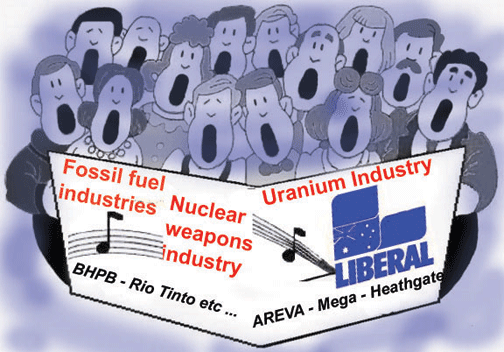
Push to cut green tape for new uranium mines in South Australia, https://www.adelaidenow.com.au/news/south-australia/push-to-cut-green-tape-for-new-uranium-mines-in-south-australia/news-story/5cee611673d15b550eabeb7210afdf8f?fbclid=IwAR3nf_aFghOlO3glVVwF964xz0H9dvJJ_GeX-libfDWV1ehu9o6R-allX2Q
29 Dec 19 “Unnecessary” green tape is choking the potential for lucrative new uranium mines in South Australia, the State Government says.
The Marshall Government is calling for Canberra to slash federal environmental approvals to pave the way for new mines as a once in a decade review of the nation’s environmental laws gets underway.
SA already has four of the country’s six uranium mines, which have produced 24,300 tonnes and $2.1 billion worth of uranium over five years.
But SA has made a submission to a federal inquiry into nuclear power calling for Canberra to axe the requirement for Commonwealth environmental approvals, in addition to state approvals, for new uranium mines.
It argues the removal of this duplication “will not diminish existing standards of regulation safety and compliance and will increase efficiency, reduce costs bourne by industry”.
It would also boost SA’s status as a “favourable investment destination”.
The submission notes “unnecessary” extra green tape is a “significant barrier to the viability of new uranium mine developments” in SA.
It also calls for changes to the Environment Protection and Biodiversity Conservation Act to remove the ‘nuclear action trigger’ for uranium and other mines with naturally occurring radioactive minerals, to stop the need for federal approvals.
SA will push for the power to go it alone in a once in a decade review of the EPBC Act, currently being conducted by former ACCC chair Graeme Samuel.
A state government spokesman said SA wanted the federal and state approval duplications removed “so costs can be reduced and economic benefits increased”.
“The nature of our State’s geology means radioactive impurities found in other productive ores are inadvertently captured by the nuclear action trigger, and the review is an important opportunity to address this anomaly,” he said.
Two of SA’s uranium mines are operational, while Boss Resource’s Honeymoon mine is in the process of restarting.
BHP has also discovered copper, which uranium could potentially be found near, at the Oak Dam site 65km from its existing Olympic Dam mine.
New Liberal senator for SA Alex Antic has called for SA to look at using nuclear power generation along with a nuclear fuel waste storage facility, saying it could add
“billions of dollars from our participation in the nuclear fuel cycle”.
The state government’s submission said nuclear power was “unviable now and into the foreseeable future” in SA but noted it could be used in remote mining if small modular reactor technology advanced, although the state was currently looking at renewables with power storage for those situations.
The submission also highlighted that nuclear power could be viable in other states, which would create more demand for SA’s “significant” uranium deposits.
Senator Antic welcomed the possibility of next generation nuclear power technologies playing a role in SA’s future energy grid.
He hit out at nuclear power critics, saying: “Those who tell us that we are in the middle of a climate emergency can’t have their ideological cake and eat it too.”
“Nuclear power has proven to be virtually emission free, reliable, and safe.”
SA Chamber of Mines & Energy chief executive Rebecca Knol welcomed the call to slash “unnecessary duplication” of approvals, saying it could save an estimated $426 million in regulatory and operational costs.
It could help SA achieve its 3 per cent annual growth target, she said.
Mr Samuel is due to report to federal Environment Minister Sussan Ley by October.
A spokesman for the Minister said she had been clear that “stringent environmental protection” was fundamental to any review outcomes.
Nuclear Groundhog Day in Australia
it is right-wing ideologues who continually resurrect nuclear power
historically-informed judgments matter, as energy policy specialists like Benjamin Sovacool realize, writing that SMRs are almost entirely rhetorical fantasies built upon utopian expectations.
Do you ever get the feeling that the continual resuscitation of the nuclear power option is just one more continual delay in meaningful reform of our energy portfolio? One more continual delay in meaningful reduction of CO2 emissions and the shifting of the electricity grid toward significant incorporation of renewables?
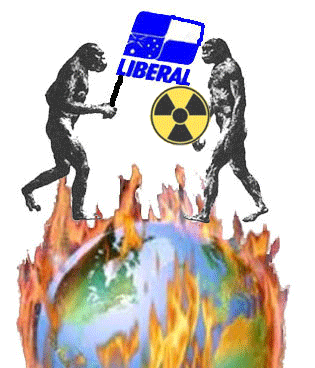 Australia’s nuclear fantasies: the technological creationism of nuclear power, Nuclear Monitor, December 2019, Dr. Darrin Durant ‒ Lecturer in Science and Technology Studies at the University of Melbourne Australia’s nuclear fantasies: the technological creationism of nuclear power, Nuclear Monitor, December 2019, Dr. Darrin Durant ‒ Lecturer in Science and Technology Studies at the University of MelbourneIt is just a little past Nuclear Groundhog Day in Australia. A 2019 parliamentary inquiry 1 into the conditions under which future Governments might consider nuclear power in Australia recently concluded that emerging nuclear technologies were a clean energy pathway for Australia.2 This recommendation was immediately opposed by Labor and the Greens, and even opened up divisions within the Coalition, while also failing to resolve how partially lifting Australia’s nuclear ban (for one type of nuclear generating technology) could practically work. Much ink and even more pixels have been and will continue to be splayed everywhere on this polarized issue, but the untold story of the nuclear option is that it is in fact a technological form of Creationism. Let me explain. Nuclear power is like a wild goose chase where the goose is a zombie that cannot be killed. The nuclear option in Australia has been buried at least three times previously, only to be brought back from the dead. Nuclear power was originally prohibited by legislation. Section 10 of the Australian Radiation Protection and Nuclear Safety Act 1998 prohibits fuel fabrication, enrichment or processing, and nuclear reactors.3 Section 140A of the Environmental Protection and Biodiversity Conservation Act 1999 prohibits the federal Minister from approving an action leading to such installations.4 Yet a federal Government review of 2006 (the Switkowski Report) considered the potential to establish such installations, although it concluded nuclear power in Australia was uneconomic.5 A 2016 South Australian royal commission to investigate the potential for SA to participate in the nuclear fuel cycle similarly concluded nuclear power in Australia was not commercially viable.6 Nuclear power does not affect its own resurrection by virtue of its own divine power. Instead, like Lazarus was said to have been resurrected by Jesus four days after retirement, nuclear power has divine ideologues on its side. Obviously not the Labor Party, which thinks resurrecting the nuclear option signals the indulging of political fantasies7 , nor the Greens, who think resurrecting the nuclear option is the stuff of crackpot lunatic cowboys.8 Instead, as Friends of the Earth wrote, it is right-wing ideologues who continually resurrect nuclear power, in a culture war trying to wedge the political Left.9 Or as the economist John Quiggin wrote, support for nuclear power is de facto support for coal.10 Given the decades of lead time required for nuclear power to feed into the electricity grid and, assuming publics and politicians swallow the argument that renewables cannot satisfy base-load power requirements, coal is advertised as the only viable option until nuclear comes online. The technological creationism of nuclear power But the nuclear option has more than the business-as-usual commitments of right-wing ideologues on its side. The nuclear option has inherited an argumentative strategy from American Creationists, which the evolutionary biologist Eugenie Carol Scott coined the Gish Gallop.11 Named after the Creationist Duane Gish12, Scott wrote that the strategy involves making “a simple declarative sentence, and you have to deal with not an easily-grasped factual error, but a logical error and a methodological error, which will take you far longer to explain… [Creationists present] half-truth non-sequiturs that the audience misunderstands as relevant points. These can be very difficult to counter in a debate situation, unless you have a lot of time. And you never have enough time to deal with even a fraction of the halftruths or plain erroneous statements”.13 We can miss the Gish Gallop at the heart of pro-nuclear advocacy if we chase the controversy. We know nuclear power is politically polarizing and it is easy to report on clashing protagonists making seemingly alternate-reality claims. Thus the Australia Institute’s submission to the parliamentary inquiry dismissed nuclear power as uneconomic, climate unfriendly because of high water use in an already drought-prone Australia, and as lacking a social license.14 In black mirror fashion, the Minerals Council of Australia strongly supported nuclear power as affordable, climate friendly because of zero-emissions, and as enjoying rising public support.15 Like chasing Creationists down the rabbit holes of their homespun Gish Gallops, opponents of nuclear power can spend a fruitless amount of intellectual and emotional energy rebutting half-truths and methodological sleights of hand. The fruitlessness stems from earnestly interpreting the opponents’ claims ‘straight’ and tackling them head on. The Minerals Council of Australia For instance, the Minerals Council of Australia (MCA) argues that nuclear power is affordable and that Small Modular Reactors (SMR) represent a cheap and feasible option for Australia.15 By contrast, the (independent) World Nuclear Industry Status Report found that nuclear power costs 5-10 times more per kWh than renewables, and that there is no sign of a technological or commercial breakthrough that would render SMRs viable.16 Similarly, the MCA argues that climate change is real, and that nuclear power is the only way Australia can meet our Paris Agreement goals without sacrificing jobs and prosperity. But are the MCA really climate defenders? The thinktank InfluenceMap – which tracks climate policy opponents – ranks the MCA -59 (or 8th worst Trade Group) in its carbon policy footprint scores (-100 is highly and negatively influencing climate policy; +100 highly and positively influencing climate policy).17 Unfortunately, straight rebuttals matter little to technological creationists. Anything can be cheap, depending upon how you trim the costs. Everything can be feasible, depending upon your tolerance for fantasy. Anyone can be green, depending upon your degree of gullibility Gish Gallop The difficulty presented by the Gish Gallop argumentative strategy is that only on the surface is the critic confronted by factual claims open to empirical challenge. Deeper down, we have pregnant misdirection, diversionary reframing, and strategic incompleteness. The strategy does not even have to be deliberate gaslighting18, where the aim is to disorient and destabilize the audience in a quest to leave the speaker the beneficiary of the disenchantment of truth. Instead, the Gish Gallop simply entices the audience to run off in multiple directions at once, earnestly looking for the grounding of a claim that is in fact a groundless fog. For instance, are nuclear reactors zero emissions, as the MCA claims? There is a grain of truth there, if the nuclear life cycle is restricted to reactor operation. But as the energy analyst and environmentalist Mark Diesendorf has shown, to calculate the emissions from nuclear power one must account for fossil fuel use in every other aspect of the nuclear life cycle (mining, milling, fuel fabrication, enrichment, reactor construction, decommissioning and waste management). Moreover, the lower the grade of uranium ore, the higher the resulting emissions, so that nuclear power will emit more CO2 over time as highergrade ores are used up.19 Some analysts try to be fair, concluding that emissions from nuclear power are neither zero nor high and made complex by multiple uncertainties20, or that unstated assumptions about the carbon footprints of energy supplied in the non-operational phases of the nuclear fuel cycle strongly determine the ultimate carbon footprint.21 But notice how it is the audience that must supply the context for assessing pro-nuclear technological creationist claims? The necessary context for assessing claims – zero emissions, etc. – is willfully deleted from the message itself. SMRs Similarly, the MCA writes that SMRs ‘are simply an evolution of a proven mature technology’.15 Specific claims about an unproven technology (SMR) are then treated as general warrants for a technology which possesses an actual track record (where the track record is not supplied). Again, straight responses are possible. The anti-nuclear activist Noel Wauchope lists seven reasons why SMRs are unwise 22, and Quiggin questions whether the plant that is supposedly going to manufacture the technology even exists.23 But it is the context deleted by the MCA that is of most relevance, so we must ask about the track record of this ‘mature’ technology and whether SMRs are just an unproblematic next step. The maturity claim typically means nuclear technology has benefited from economies of scale and social learning, so that construction times and costs would go down over time. But as the World Nuclear Industry Status Report (and previous versions) shows, nuclear power lacks an upward learning curve.16 Reactor cost blowouts in time and money have been the norm since the technology’s inception. SMRs have inherited that legacy, with a survey of eight countries showing SMRs are even less economically competitive than large nuclear plants. The Gish Gallop strategy here is simply to delete history from the evaluative criterion. But historically-informed judgments matter, as energy policy specialists like Benjamin Sovacool realize, writing that SMRs are almost entirely rhetorical fantasies built upon utopian expectations.24 Indeed, the broader case for nuclear power in Australia is similarly built upon a Gish Gallop strategy of strategic deletion perversely coupled with proliferating half-truths. For instance, the MCA claims that surveys indicate increasing public support for nuclear power. But closer analysis shows that support varies if nuclear power is framed as a solution to climate change, indicating the support may reflect desired action on climate change itself.25 Moreover, most have no desire to live near a reactor. Climate wedges But this entire argument about a technology-neutral approach being premised on the need to pursue all elements in an energy portfolio at once rests on willfully deleting the context for assessing energy choices. The climate wedge idea derives from a 2004 paper by Stephen Pacala and Robert Socolow.27 A wedge represents an activity that reduces emissions to the atmosphere starting at zero today and increases linearly until it accounts for one billion metric tonnes of reduced carbon emissions in 50 years. But as Pacala and Socolow noted, “although no element is a credible candidate for doing the entire job (or even half the job) by itself, the portfolio as a whole is large enough that not every element has to be used”.27 Not every element! The technology-neutral, all-of-the-above approach is both bad energy economics and deceptive politics, because passive and complacent business-as-usual masquerades as active and concerned political choice. Was democratic debate really meant to be this way? When we say democratic debate is about letting each side have its say, is the kind of argumentative sleight of hand practiced by pro-nuclear technological creationists really what we were imagining? To anticipate a reply that might be offered as complementary but is a mistake: no, truth is not the answer. Truth can be despotic, as the political philosopher Hannah Arendt argued in 1967, peremptorily demanding to be recognized and precluding debate by relying on the coercive force of self-evidence.28 Or put differently, truth is great when you have it on your side, until everyone claims it is on their side, and politics reduces to who coerces last But nor is the abandonment of truth to opinion the answer either. In the phrase of another political philosopher, Nadia Urbinati, to be unpolitical is to remove an issue in need of deciding from the open arena of competing political visions, political groups, and partisan views.29 Urbinati advises we defend the merits of political deliberation, because it allows for contestation and revision, and be wary of forensic decisions by experts. But is a little more of the unpolitical – a little less political deliberation – sometimes a wise move? Do you ever get the feeling that the continual resuscitation of the nuclear power option is just one more continual delay in meaningful reform of our energy portfolio? One more continual delay in meaningful reduction of CO2 emissions and the shifting of the electricity grid toward significant incorporation of renewables? The nuclear power option has had its day but lives to tell another day because we tell ourselves that debating all the options is always good, even if we should really be saying some option needs to be retired. The context at work making this continual resuscitation possible is not just the persistence of business-as-usual elites, but the political ecology in which those elites reside. Political populism radically polarizes public forums and delegitimates the independent advice-giving institutions of democracy. Media and cultural partisans have turned political deliberation into a spectator sport. The business-as-usual ethos exploits that weakened ground of consensus-formation to suggest old options are better than new options. A crisis of truth, authority and legitimacy As the historian of science Steven Shapin has suggested, we are facing a crisis of truth not because facts are being routinely contested or even because facts are being routinely made up, but because our institutions are suffering a crisis of authority and legitimacy.30 We have lost track of who knows and does not know, which is a dearth of social knowledge about reputation and integrity. Keeping the spectre of nuclear power at bay will require rethinking our institutions and how they can assist in making the objects of our political deliberation worthy objects. We can neither give up on experts nor citizens, but we do need to revisit how we think about each. As myself and some fellow sociologists of science have argued, experts at the service of business-as-usual will never escape institutional delegitimisation effects, so we must look to expertise playing the role of a check and balance within our pluralist democracies.31 Similarly, citizens do need to engage with public claims to test their contextual merits and coherency. But as analysts of public participation like Matthew Kearnes and Jason Chilvers have warned, until organizations and institutions are more transparent and candid about their assumptions, values and interests, the burden of proof will fall unevenly on the less powerful.32 In each case, experts and citizens, what we need from them is interrogation of context. Not simply can they be our fact checkers, but can they be our redeemers of context, our arbiters of whether half-truths are masquerading as full claims, and our unmaskers of the pretenders at coherence? Dr. Darrin Durant’s research focuses on how experts and citizens interact in democratic debate, especially in debates about energy politics. Recent books include Experts and the Will of the People (2019) and previous work on the nuclear fuel cycle including Nuclear Waste Management in Canada (2009). Reprinted from New Matilda, 17 Dec 2019, ‘Nuclear fantasies down under: the political and economic problems with old money power’, https://newmatilda. com/2019/12/17/nuclear-fantasies-down-under-thepolitical-and-economic-problems-with-old-money-power/
|
|
Call to Prime Minister Scott Morrison – Time to stop pretending that you have a climate policy
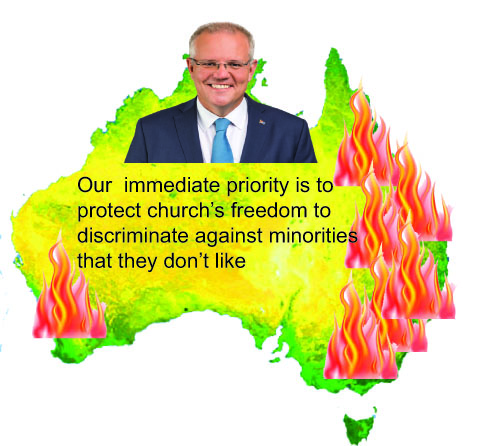 Prime minister, you need a credible climate policy. It’s too dangerous to keep pretending you have one, https://www.theguardian.com/australia-news/2019/dec/22/prime-minister-its-too-dangerous-to-keep-pretending-you-need-a-credible-climate-policy Lenore Taylor Scott Morrison’s press conference on the Australian fires was just more talking points and spin. The country needs more than words Prime minister, you need a credible climate policy. It’s too dangerous to keep pretending you have one, https://www.theguardian.com/australia-news/2019/dec/22/prime-minister-its-too-dangerous-to-keep-pretending-you-need-a-credible-climate-policy Lenore Taylor Scott Morrison’s press conference on the Australian fires was just more talking points and spin. The country needs more than words
@lenoretaylor, Sun 22 Dec 2019
Scott Morrison says this is not a time for division, or partisanship, or point scoring. He says we should unite in response to the current crisis. That’s certainly true. We have been. But prime minister, this is also time to stop pretending. Talking about Australia’s woefully inadequate climate policy at this time is not partisan, it is essential. And, with respect, the same same old talking points you rolled out on your return from Hawaii just don’t cut it any more. As you acknowledged, we are facing Christmas with dread. The immediate losses – of loved people, homes, safety, breathable air, passable highways upon which to drive to holiday, blue summer sky – those are deeply unsettling and sad. But the realisation that this is how Christmas may often be for our children, not carefree like the long summers we remember, but orange-skyed, fearful, choking and desperate – that is dreadful in the truest sense of the word. As you said, we are all grateful for the firefighters’ selfless efforts, but you’re right, we need to ask whether we can really expect this from them year after year, and those questions become more urgent if we face up to the fact that this is now the way things are going to be more often. You ignored the desperate, and as it turns out prescient, warnings from the former fire and emergency chiefs in the lead-up to this season. Your acting prime minister, just this weekend, again dismissed those experts because they had been funded by the Climate Council. Surely it is now time to put those political talking points aside and start to listen. We know global heating is fuelling this unprecedented fire emergency; we’ve been warned this would happen for decades. We know it is also contributing to the drought. Not directly causing, but certainly exacerbating. Surely it is time for your government to face these facts, instead of reciting Dorothea Mackellar or diverting blame to self-combusting manure or falsely claiming “greens” are somehow to blame by preventing hazard reduction burning. They haven’t, just for the record, and those former fire chiefs you refused to meet actually had some advice about hazard reduction burns, had you chosen to listen. That requires something more than just agreeing there is a link between global heating and fires, as you now have done. This isn’t about an adjustment to your language, it requires an adjustment to your policy, it requires a credible policy, the kind of policy we know could benefit us economically, that business is begging you to enact so that they can invest. And we know that would mean we could fight for effective international action rather than continue to act as a hindrance. We know we can’t solve the heating that is exacerbating this crisis on our own, so please don’t insult our intelligence again with that “1.3% of global emissions” argument like you did at the start of this fire season. Given the consequences we are suffering, we should be doing everything we can, and we know that we are not. You’ve just kept pretending. We’ve watched your Coalition immobilised by its climate denialist faction for more than a decade, destroying repeated political efforts to do something. We watched it dispense with Malcolm Turnbull as prime minister to avoid implementing a policy that was supported by industry and green groups alike. We watched you, prime minister, hold up a coal-industry supplied lump-of-coal prop in the parliament and urge us all not to fear it, but then go to the election with a policy that was little more than a sham, enough to appease the electorate’s concerns but with fine print that didn’t promise to do anything much to reduce domestic emissions, and that didn’t offer any explanation of how you would do the things you did promise, like reduce vehicle emissions. We’ve watched our domestic emissions continue to rise, or flatline because of the terrible impact of the drought, according to the latest accounts. We’ve watched Angus Taylor act against reaching an agreement at the most recent climate talks in Madrid, by insisting – against howls of international protest – that Australia be allowed to continue using an accounting trick to meet our emission reduction obligations. Days later, there he was again, interviewed against the orange backdrop of his own burning electorate, still mouthing the same discredited talking points about Australia “meeting and beating” its emission reduction target by the use of that loophole. You just used the same line yourself. It’s too close now, too terrifyingly dangerous and loud in the fire regions, too unendurably long in the regions parched by drought, to keep pretending like this. We need to know how you’re going to transition our economy. We understand that’s a complicated long-term process, so don’t treat us like idiots, as your deputy did on Saturday with the straw-man argument that those concerned about climate change are asking for all coalmining to cease tomorrow and risking the lights going out. Katharine Murphy spelled out your political choices in her final column for the year –you could once again try to damp down our fears and hope the backlash from this summer of fires will ease when the skies do eventually clear, or you could change policy course. On your return from holidays you seemed to choose the former, which is a tragedy, because there really is no more time to waste. We are past the point where the absence of credible policy can be papered over with talking points and spin. Your predecessor knows it, your former departmental head knows it, business, unions and farmers know it, scientists and environmentalists have known it for decades. You asked us all to be kind to one another, and we certainly should be. One kind thing you could do now is to finally stop pretending.
|
|
Scott Morrison’s brand damaged by silly cover-up of his Hawaii holiday
 Prime Minister Scott Morrison pulls pin on Hawaii family holiday, but the damage is already done, ABC , By political editor Andrew Probyn , 20 Dec 19, Australia’s marketing expert Prime Minister has just had his first major product recall.Scott Morrison’s brand has been damaged, as he wings his way back to Australia from Hawaii, a trifle shop-soiled and humiliated.
And all because Morrison and his office thought they could engineer silence on a family holiday.
As so often in politics, it’s the cover-up that gets you.
No-one begrudges the fellow going on holiday with his wife and lovely girls who have probably seen less of their dad this year than any in their short lives.
And he’s undoubtedly knackered from a hectic year in which he pulled off a miracle election win…….
There was no official public note issued of his absence and when one Press Gallery journalist inquired with the Deputy Prime Minister’s office as to whether Michael McCormack was Acting PM, the journalist was referred back to the PM’s Office.
And when a couple of journos asked the PMO to confirm the boss was in Hawaii, they were told this was incorrect.
Here’s a tip for the PM’s minders: don’t compound a fudge with a fib……
Morrison is actually lucky more pressure hasn’t been appliedMorrison can be grateful that Anthony Albanese has been very measured this week. Albanese has visited members of the Rural Fire Service, making breakfast for volunteers, but has constrained his commentary……
It is now very clear that the Coalition must recalibrate its climate and energy policies.
Amid the smoke haze, the community horror and angst, this is a point of real clarity.
Morrison’s attempt last week to reassure Sydneysiders concerned by the incessant bushfire haze, by asserting he’d seen it all before, didn’t cut it. Nor does it now…..https://www.abc.net.au/news/2019-12-20/andrew-probyn-analysis-scott-morrison-hawaii-holiday/11817356
Students’climate protest outside Scott Morrison’s residence. Greens MP arrested
‘Time politicians did something’: Greens MP among arrested at Kirribilli climate rally, Students rallied outside Scott Morrison’s Sydney prime ministerial residence to demand action on climate change. SBS News, BY TYRON BUTSON, 20 Dec 19, NSW Greens MP David Shoebridge was among 10 people arrested by police outside Sydney’s Kirribilli House as they demanded the prime minister take action on climate change.
Demonstrators rallied outside Prime Minister Scott Morrison’s official Sydney residence on Thursday, protesting the PM’s overseas holidays as unprecedented bushfires burn across the state.
Some protesters had vowed to camp out on site until the PM returned from holidays until they were confronted by police on Thursday afternoon.
Mr Shoebridge, a NSW Upper House Greens MP, was among those protesters charged with failing to move on. He took aim at Mr Morrison, saying it was high time politicians left parliament to join the community demanding climate action.
Mr Shoebridge, who alleges he was trying to comply with police directives to move on when he was arrested, will face Manly Local Court on 16 January. ….
Some of the demonstrates were clad in Hawaiian shirts, while others carried placards asking “ScoMo where the bloody hell are ya?” and “When do our firefighters get a holiday?”…. HTTPS://WWW.SBS.COM.AU/NEWS/TIME-POLITICIANS-DID-SOMETHING-GREENS-MP-AMONG-ARRESTED-AT-KIRRIBILLI-CLIMATE-RALLY
Flaws in the Senate Committee’s nuclear report
Parliamentary Committee Supports Nuclear – But Only If Everyone Is Into It , Solar Quotes, December 19, 2019 by Ronald Brakels “……..The Parliamentary Nuclear Committee used 214 pages to come to the wrong conclusion. But arriving at the right conclusion can’t be easy if you have no ability to smell bullshit in your own research.
One Solar Panel Does Not Cause 0.8 Tonnes Of CO2 Emissions
Take a look at this table included in the report, taken from a publication that advocates nuclear power:
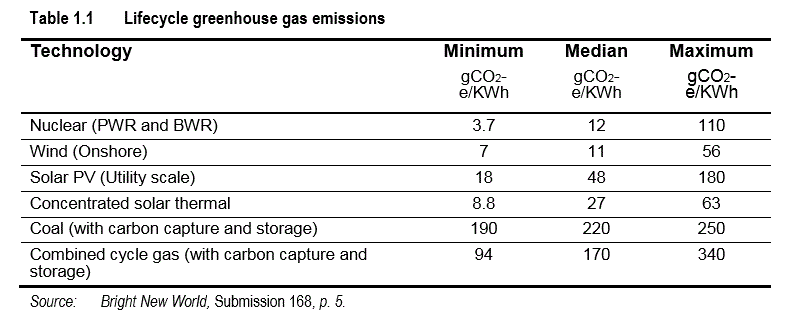
Casually looking at that you might think CO2 emissions for both nuclear energy and solar PV are pretty low. But if we stop for one minute and use basic mathematical ability that’s available to anyone who doesn’t have to take their socks off to count to 20, then we can see that a Parliamentary committee saw fit to include a table in an official report that gives ridiculous results.
Looking at their minimum figure for Solar PV (Utility scale), I see they are claiming a large solar farm will result in at least 18 grams of CO2 emissions per kilowatt-hour generated. While generating electricity from PV doesn’t result in any emissions, they are involved in the manufacture of solar panels, so they aren’t completely emissions-free. However, they are a lot bloody closer to emission free than this table suggests.
These days a typical standard sized solar panel is around 300 watts. In a solar farm in Australia on a fixed mount it will generate around 12,300 kilowatt-hours over 25 years. This means they are saying the solar panel will result in a minimum of 222 kilograms of CO2 emissions. If we use their maximum figure it will result in 2.22 tonnes of CO2, all for a panel that weighs about 18 kilograms. So they are saying manufacturing and installing one solar panel results in emissions equal to burning 80-800 or more kilograms of coal.
Jinko Solar, the world’s largest solar panel manufacturer, has a figure from 2017 of just 2.19 grams of CO2 per kilowatt-hour generated by a solar farm. As this has been decreasing year by year it will be even lower now. However, this is just for the solar panel and doesn’t include emissions from the construction of its ground mount or inverter, so I’ll double it to 4.4 grams. This means the actual emissions per kilowatt-hour are probably less than the best figure on the table and more than 40 times less than the worst figure. Even if we triple the Jinko figure it still comes to less than their median emissions for nuclear energy and less than 4% of their maximum figure for PV.
It’s clear the committee had no ability to detect figures that were bullshit — or they simply didn’t care.
Renewable Energy Increases The Cost Of Nuclear
Here is section 1.50 of the report:
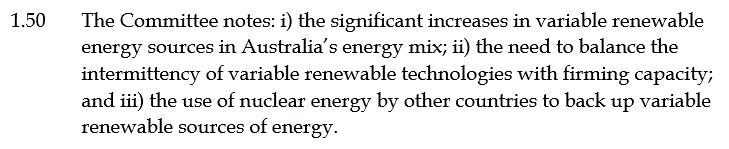
I note the committee has failed to understand the economics of nuclear power if they think it works well with solar and wind energy. This is because if a nuclear power station produces half the energy its capable of, it almost doubles the cost of that energy. This is due to nuclear fuel being very cheap1 per kilowatt-hour, so very little money is saved by ramping down, while nearly all other costs remain the same.
This means nuclear power, which is already too expensive when operated in the most economical way — almost continuously at full normal power — becomes even more expensive when used in a grid with a significant amount of solar energy and/or wind power capacity. Australia already has more than enough to adversely affect the economics of nuclear energy and, even if we approve and build a nuclear power station in one quarter the average time it has taken overseas this century, things will be much worse for its economics by the time it’s complete….. https://www.solarquotes.com.au/blog/nuclear-energy-australia/
Australia’s big problem – P.M. Scott Morrison’s lack of leadership
 “…….Scott Morrison’s holiday is not the problem, his lack of leadership on the bushfires is
The prime minister’s badly timed holiday has become a source of anger but while the reaction is valid it’s the wrong thing to focus on, Guardian, Katharine Murphy Political editor, @murpharoo, Wed 18 Dec 2019 Let’s talk about Scott Morrison’s holiday. The prime minister is on holidays, presently, while the country is still burning.
Morrison’s ill-judged holiday has become a thing, a totem, a social media event. It somehow epitomises everything that’s wrong with this bloke. As well as failing to show up at a critical time, leaving the running of the country to Michael McCormack, who struggles to run his own mulish political party, let alone anything else, Morrison is a hypocrite because he once blasted Christine Nixon for eating dinner during a bushfire…..
I think it might actually be a productive thing if Morrison stops moving for five minutes, stops trying to be the self-appointed hero of the hour. If he stops moving, then he might think more often. I think the country would benefit if Morrison thought more often, more deeply, about more things. We really do need him to think, rather than just maintain the constant barrage of humblebrag and marketing. If there’s been any lessons from the back half of this year, I think that’s the lesson. …..
What I give a shit about is we have a government, led by him, which is, in many different ways, failing to rise to the challenges of our time.
They. Are. Failing.
I get very impatient about that.
I get very worried about that.
People are angry about Morrison’s mini-break because it symbolises the lack of leadership he has shown on the bushfires; the lack of principled leadership Australia showed last week in Madrid on climate change and the Coalition’s indefensible record on climate at home; the lack of velocity in the government’s response to Australia’s stuttering economy, which was underscored by the latest midyear economic forecast, which had downgrades as far as the eye could see.
The Morrison holiday has accumulated public outrage because it symbolises absence: a prime minister missing in action on important things. A prime minister too regularly substituting rhetoric for action. A prime minister apparently too pleased with himself to understand that people need more from government than they are getting.
I totally get it.
But I’m not fussed about the holiday. What I care about, what I am minutely focused on, and will go on being minutely focused on, is what this bloke does when he gets home. https://www.theguardian.com/australia-news/2019/dec/18/scott-morrisons-holiday-is-not-the-problem-his-lack-of-leadership-on-the-bushfires-is
Smaller Nuclear Power Is Not Cheaper Nuclear Power
 Parliamentary Committee Supports Nuclear – But Only If Everyone Is Into It , Solar Quotes, December 19, 2019 by Ronald Brakels “……..Smaller Is Not Cheaper
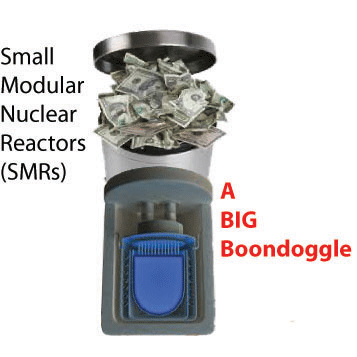
Small Modular Reactors (SMRs) are suggested in the report as a way of making nuclear power economically viable. The problem with this is they cost more per kilowatt than large ones. This fact should not be a surprise to anyone. The engineers who designed the large nuclear reactors in the world today are not idiots who are currently slapping their foreheads, saying, “I’m so stupid! If only I had thought of making them smaller instead of bigger!” Modern reactors are very large to keep their cost per kilowatt down. Going small has the opposite effect.
That small reactors are not cheap is made obvious by the fact Britain, which has the longest history of nuclear power generation of any country, decided to power their new aircraft carriers with kerosene and diesel rather than small nuclear reactors because of they are so expensive. This is despite the alternative being expensive oil products rather than much cheaper solar and wind energy.
An advantage given for SMRs is they will supposedly suffer from fewer cost overruns. But that sales pitch is not enough to make nuclear energy economically attractive — pay for a more expensive product so you’ll have less of a chance of unpleasant surprise expenses down the line.2…… https://www.solarquotes.com.au/blog/nuclear-energy-australia/
Australian Parliamentary Committee Want Money Wasted On More Nuclear Reports
Parliamentary Committee Supports Nuclear – But Only If Everyone Is Into It , Solar Quotes, December 19, 2019 by Ronald Brakels “….They Want Money Wasted On More Reports
The report suggests we get people to write another report on how much nuclear power will cost here:
But I have a different suggestion. A much cheaper one. We just wait for another country to build and operate a nuclear power plant at a low enough cost that would be competitive in Australia. Then we can look into it.
Better yet, to make sure they aren’t exaggerating how cheap their nuclear power is, we say:
“Hey, budget nuclear energy guys, how would you like to build a nuclear power station in Australia? We give you nothing, but you get the market price for whatever electricity you sell.”
If they say, “nyet” or “bu shi” or “piss off” then we can suspect it’s not as cheap as they’re making it out to be.
If they say, “yes” then we can talk about how they’ll be required to insure it for a reasonable amount based on the costs of nuclear accidents that have occurred in the past. While nuclear power is very safe, there must have been at least one or two minor little upsets.
Everyone Has To Love Nuclear Energy
The report says that social acceptance of nuclear power is necessary for it to go ahead. So it’s not going to go ahead because that’s not going to happen. Nuclear energy has turned out to be an economic disaster overseas, we have much cheaper alternatives, and now that I think about it there have been one or two major nuclear accidents overseas that have left a bad impression.
There was a problem with a nuclear power station in Fukushima, Japan. The Japanese Government estimated the cost at around $270 billion dollars. As our government is currently willing to spend around $4.5 million to save an Australian life through public health and safety measures, if we lost that amount of money it would represent around 60,000 Australian lives that potentially could have been saved with it.
Since nuclear power — at the costs we see overseas — is only going to increase electricity bills, and we have far cheaper ways to reduce emissions that are quicker to deploy, and because Australians aren’t in love with a very very small chance of a nuclear accident that has a very high cost, there will never be acceptance for nuclear power in this country. Not in its current form. But be sure to let me know when a DeLorean compatible Mr Fusion becomes available.
I’m guessing the entire section on social acceptance is only in the report so when nuclear power doesn’t get built, its supporters can say, “It’s the fault of normal Australians for not believing in the nuclear economic viability fairy hard enough”, rather than admit they themselves were wrong.
The Moratorium Means Nothing
Currently there is a moratorium on nuclear power in Australia. This means you’re not allowed to build it without special permission from the government. Well, guess what? In this country you are never going to be allowed to build a nuclear reactor without permission from the government. That’s just the way it is. I know it’s a terrible infringement of our right to build nuclear reactors in our backyards and squash courts. But on the other hand, it does support our right not to live next door to someone who’s building a nuclear reactor in their backyard, so I could go either way on this one.
The report suggests scrapping the moratorium or partially lifting it. I’m not sure what partially lifting it means. Maybe you have to ask for permission but you don’t have to say pretty please or maybe it just means they won’t be too worried if you have an eye patch, a cool scar, and introduce yourself as “The Jackal”.
Because the moratorium doesn’t really mean anything, there may not be any harm in lifting it and shutting up a few idiots who think the only reason nuclear power isn’t currently under construction in this country is because the government hasn’t muttered the magic words, “The moratorium is lifted!” So they may as well say moratorium leviosa and be done with it.
It’s not as if nuclear power is going to be built in this country one way or the other. Supporters will soon discover no one’s lining up to build reactors even with our current high wholesale electricity prices. The only way they will get built is with very substantial subsidies and the government is too busy trying to keep coal power afloat while Australia burns to waste its energy subsidising nuclear. https://www.solarquotes.com.au/blog/nuclear-energy-australia/


Liberal-Party-dominated committee recommends removing Australia’s ban on nuclear power
 The Energy Minister says there are no plans to lift the moratorium, and any lifting has to be bipartisan. Labor wrote a dissenting report so there seems to be no chance of bipartisanship.
|
|
Parliamentary committee recommends lifting ban on modern nuclear power technology The Advertiser,14 Dec 19
Stopping short of a full go-ahead, the government-dominated committee called for more economic and scientific analysis…… However, Labor members of the committee said the economics did not stack up and it would be “irrational” to pursue nuclear power. “There is simply no case for wasting time and resources on a technology that is literally the slowest, most expensive, most dangerous, and least flexible form of new power generation,” committee deputy chair Josh Wilson and fellow Labor members said in a dissenting report. Labor and independent Zali Steggall both called for a national energy policy but the recommendation was struck down. “A national energy policy is an essential prerequisite to the consideration of lifting the moratorium on nuclear energy,” she said. Energy and Emissions Reduction Minister Angus Taylor, who initiated the inquiry, said the Government would take its time to consider the report. “The Government has no plans to lift the longstanding moratorium on nuclear energy,” he said. “Any changes … would need bipartisan support and broad community acceptance.” The committee, which received more than 300 submissions and held hearings around the country, made three broad recommendations. Firstly, it called for a holistic, strategic approach that would learn from international partners, identify opportunities, build bipartisanship and put “the community at the centre”. Secondly, the Australian Nuclear Science and Technology Organisation should be tasked with categorising nuclear into old and new technology — so-called Generation III+ and beyond which have in-built safety features. The Productivity Commission should look at economics and the Australian Radiation Protection and Nuclear Safety Agency at safety, waste, skills and governance. In addition an unspecified expert body should “educate and inform Australians”. Thirdly, the Federal Parliament should lift the ban on Generation III+ and beyond, conditional on the recommended scientific assessments. Finally, with state and territory government, the Commonwealth should commit to any approval only after “the prior informed consent of local impacted communities”.  |
|
In fealty to the global nuclear industry, the Liberals line up the nuclear dump site, amendments to law, deepwater port
 1. Kimba = ‘Napandee’ to be announced by Canavan as the National radioactive Suppository in January;
2. Very shortly, ANSTO & ARPANSA will say that they cannot implement the recommendations from the nuclear energy select committee unless the Environment Conservation & Biodiversity Act is amended ~ so the Libs will attempt to cripple that legislation. Once they achieve that, then
3. This deep water port connected by rail to Kimba will allow not only the shipment of Australian, but also the  importation of international waste……
Through connection to the national rail and road network, Cape Hardy will become an internationally significant intermodal hub for agriculture, mining, and energy investment that can drive the region’s economy into the next century.
https://minister.infrastructure.gov.au/mccormack/media-release/25-million-support-cape-hardy-port-precinct?utm_source=miragenews&utm_medium=miragenews&utm_campaign=news
1 This month
17 October, Free Public Talk on Nuclear Issues in South Australia
David Noonan will speak on public interest concerns over the new Roxby Downs Indenture Act 2026 on BHP copper-uranium mining and ore processing in SA, and on how AUKUS may face SA with a High-Level nuclear waste agenda.
Dr Jim Green will discuss international developments in the field of nuclear power including ‘small modular reactors’ and Generation 4 ‘advanced’ nuclear reactor concepts.


Help Aunty Sue Protect Her Land and Sacred Sites From Destructive Rocket Testing.
.

Australians deserve the truth
about
AUKUS – https://aukuspublicinquiry.com/

PETITION – To: Prime Minister Anthony Albanese and the Australian Labor Government

of the week – Australians for War Powers Reform (AWPR)
To see nuclear-related stories in greater depth and intensity

