Bob Carr says Aukus a ‘colossal surrender of sovereignty’ if submarines do not arrive under Australian control

Former foreign minister says it is ‘inevitable’ US won’t supply nuclear-powered submarines under Aukus.
Guardian, Ben Doherty, 20 Mar 25
Australia faces a “colossal surrender of sovereignty” if promised US nuclear-powered submarines do not arrive under Australian control, former foreign affairs minister Bob Carr has said, arguing the US is “utterly not a reliable ally” to Australia.
“It’s inevitable we’re not getting them,” Carr told the Guardian, ahead of the release of a report from Australians for War Powers Reform that argues the multibillion-dollar Aukus deal had been imposed upon Australia without sufficient public or parliamentary scrutiny.
“The evidence is mounting that we’re not going to get Virginia-class subs from the United States,” Carr said, “for the simple reason they’re not building enough for their own needs and will not, in the early 2030s, be peeling off subs from their own navy to sell to us.”
Under “pillar one” of the planned Aukus arrangement, it is proposed the US would sell Australia between three and five of its Virginia-class nuclear-powered submarines in the early 2030s before the Aukus-class submarines were built, first in the UK, then in Australia
However, the US has already forecast it might not have capacity to spare any of its Virginia-class boats, the Congressional Research Service instead floating a proposal in which: “instead of … them being sold to Australia, these additional boats would instead be retained in US Navy service and operated out of Australia”.
Carr said that alternative would leave Australia without Australian-flagged submarines and no control of when, and to where, those boats were deployed.
“It involves the total loss of any sovereign submarine capacity and, more than that, a colossal surrender of Australian sovereignty in general.”
Australia, Carr said, needed to look past the “cheerful flag-waving propaganda” of the proclaimed Aukus deal, saying the alternative likely to be presented by the US would leave Australia “totally integrated in American defence planning and we’ll be hosting even more potential nuclear targets”.
Australians for War Powers Reform, a group that advocates for parliamentary oversight of the decision to send Australian troops to war, launched a report on Thursday morning arguing that the Aukus deal – signed by the Morrison government in 2021 and adopted by its Albanese-led successor – had been instituted without any public or parliamentary scrutiny.
“The public and the national parliament have been kept in the dark every step of the way,” the report argues.
“The Aukus pact has become a textbook example of how to disenfranchise the community, providing almost no transparency or democracy in a sweeping decision which will affect Australia for decades.”
Aukus and the Surrender of Transparency, Accountability, Sovereignty argues the multi-decade, multibillion-dollar Aukus deal was presented to the Australian public without any discussion, consultation, and without parliamentary debate. The current forecast cost of “pillar one” of Aukus – to buy US Virginia-class submarines and build Aukus subs – is $368bn to the 2050s.
The report raises concerns over vague “political commitments” offered by Australia in exchange for the Aukus deal, as well as practical concerns such as where and how nuclear waste would be stored in Australia.
“Aukus has no legitimate social licence because the public has been shut out of the process, and as a result, scepticism and cynicism have increased.”
Dr Alison Broinowski, AWPR committee member and a former Australian diplomat, said Australia’s agreement to the Aukus deal was manifestation of a structural flaw in Australia’s democracy, where decisions to go to war, or to make consequential defence decisions, were not subject to parliamentary scrutiny or public debate.
Broinowski said Aukus was acutely significant because of its size and potential consequence “and yet the same failure to be frank with the people characterises every government this country has had, during every war there’s been”.
She argued Australia had no control over Aukus. “We don’t know what Trump’s going to do and we have no control over what he does. And so we’re left hoping for the best, fearing the worst and with absolutely no way of controlling or influencing what happens, unless we first get ourselves out of Aukus.”……………………………….more https://www.theguardian.com/australia-news/2025/mar/19/bob-carr-aukus-submarine-deal-us-australia-relationship
Nuclear policy blocking Liberal gains

Liberals Against Nuclear, 19 Mar 25
A Redbridge poll released today confirms what Liberals Against Nuclear has been warning about: the Coalition’s nuclear energy position is actively preventing its path to an election win.
New RedBridge polling puts Labor ahead 51-49 on two-party preferred terms. The data reveals that despite the Coalition’s leadership’saggressive pro-nuclear campaign, voters aren’t buying it. Those believing nuclear energy is unsafe rising from 35% to 39% over the past year. Only 38% of voters believe nuclear would reduce power prices – barely moving from 37% a year ago
“The nuclear power policy is the single biggest roadblock preventing the Liberals from winning government,” said Andrew Gregson, spokesperson for Liberals Against Nuclear. “The Liberal Party’s nuclear fixation is alienating the very voters we need to win back.
“The numbers don’t lie. This policy betrays core liberal principles by requiring tens of billions in government borrowing, expanding bureaucracy, and imposing massive taxpayer-backed risk. It’s driving free-market centrist voters directly to the Teals and independents in must-win seats.”
RedBridge director Tony Barry, a former Coalition strategist, is quoted in today’s News Corp papers emphasizing that “the Coalition needs to return to its key equities of economic management.”
The data confirms the coming election will likely be decided by preferences, with both major parties struggling to reach the 76 seats needed for majority government. This makes winning middle-ground voters crucial – exactly the demographic being alienated by the nuclear position.
“We’re urging party leadership to pivot back to our core economic management strengths and abandon this policy that contradicts core principles.”
Media Contact: Andrew Gregson +61 432 478 066
www.liberalsagainstnuclear.au
Liberals Against Nuclear launches campaign to return party to core values.
Liberals Against Nuclear
A new advocacy group, “Liberals Against Nuclear,” launched today with an advertising campaign aimed at persuading the Liberal Party to abandon its nuclear energy policy position so it can win the coming election.
The group spokesman is Andrew Gregson, former Tasmanian Liberal director, candidate, and small businessman.
“Nuclear power is the big road block preventing the Liberals getting to the Lodge,” Gregson said. “This is big government waste that betrays liberal values, splits the party, and hands Government back to Labor. It’s time for our party to dump nuclear.
“This policy contradicts core liberal principles by requiring tens of billions in government borrowing, swelling the bureaucracy, and imposing massive taxpayer-backed risk.”
The campaign launch includes television advertising, digital content, and billboards questioning the Liberal Party’s support for nuclear. The ads highlight how nuclear energy requires billions in upfront government borrowing, with international experience showing inevitable cost blowouts.
“As John Howard said: “For Liberals the role of government should be strategic and limited.” Yet this nuclear policy gives us bigger government, higher taxes to pay for it, more debt, and less freedom as the state takes over energy production,” Gregson said.
The group warns that the nuclear policy is driving free market and middle ground voters directly to the Teals and other independents in must-win seats. Recent polling shows just 35% of Australians support nuclear energy, with support collapsing once voters understand the policy details.
The group warns that the nuclear policy is driving free market and middle ground voters directly to the Teals and other independents in must-win seats. Recent polling shows just 35% of Australians support nuclear energy, with support collapsing once voters understand the policy details. https://liberalsagainstnuclear.au/
The Coalition MP who tried to stop the solar farm that will help save thousands of local jobs

What is clear is that if the LNP had its way, and was in a position to deliver on its ideological infatuation with coal and nuclear, old energy paradigms and its obsession with “baseload”, then the smelters and the refineries would not survive beyond the end of the decade.
Giles Parkinson, Mar 16, 2025, https://reneweconomy.com.au/the-coalition-mp-who-tried-to-stop-the-solar-farm-that-will-help-save-thousands-of-local-jobs/
If you ever need an example of the idiocy and the ignorance behind the Coalition and LNP campaign against renewable energy in Australia, a good place to start would be the federal MP for Flynn, Colin Boyce.
The LNP member has staged a relentless campaign against renewables, and the proposed Smoky Creek solar project in his electorate in particular. Boyce has argued that they are “reckless”, and he has amplified numerous scare campaigns about heat islands and toxic runoffs, and even homelessness that these projects allegedly cause.
Just a few weeks ago, Boyce argued that wind and solar could not possibly provide the necessary power for the biggest employer in his own electorate, and the biggest energy consumer in the state, the Boyne Island smelter.
“The Gladstone community and the Boyne smelter rely heavily on reliable, predictable and affordable power. The reality of wind and solar output, for anyone enjoying their air-conditioning in this current heat, is that it cannot provide any of this,” Boyce wrote on his web page on January 22.
“It is not a 24-hour baseload solution. It isn’t always windy and it’s certainly not that sunny after 7pm.” Nuclear, Boyce suggested, is the only solution to replace coal fired power.
How wrong, how ill-informed, and how irresponsible can a local MP be?
Last week, Rio Tinto – the owner of the Boyne Island aluminium smelter and the Yarwun and Queensland Alumina refineries that together employ more than 3,000 people in Gladstone alone – announced the future of these assets will be secured, precisely because they have been able to sign deals for wind, solar and battery storage.
Rio Tinto last week signed 20-year off take deal with the 600 MW Smoky Creek solar farm and its huge 600 MW, 2,400 MWh DC coupled battery, adding to the previously announced contracts with the 1.4 GW Bungaban wind project and the 1.2 GW Upper Calliope solar project.
“These agreements are integral to repowering our Gladstone aluminium operations with affordable, reliable and lower carbon energy for decades to come,” said the head of Rio Tinto Australia Kellie Parker.
“For the first time, we have integrated crucial battery storage in our efforts to make the Boyne aluminium smelter globally cost-competitive, as traditional energy sources become more expensive.”
Rio Tinto says the deal with the Smoky Creek solar and battery means the company now has contracts in place for 80 per cent of its bulk energy needs in Gladstone, and 30 per cent of its “firming” requirements. But it is confident, given the plunging cost of battery storage technologies, that this gap can be readily addressed.
What is clear is that if the LNP had its way, and was in a position to deliver on its ideological infatuation with coal and nuclear, old energy paradigms and its obsession with “baseload”, then the smelters and the refineries would not survive beyond the end of the decade.
Coal fired generation is now too costly and the local coal generators are getting old, the alumina and aluminium products must compete in a world that demands low emission supplies, and nuclear is too far away – and way too expensive – to help.
Boyce’s argument against Smoky Creek is a taste of the nonsense, lies and deliberate misinformation peddled by the LNP, the Murdoch media, conservative “think-tanks” and nuclear boosters and then recycled back through frightened and ill-informed constitutents.
Boyce’s arguments against the Smoky Creek project included claims about “run -off” from solar farms affecting the barrier reef, of destroyed farming land, of businesses lost, and homelessness.
He has warned of “heat islands” (a disproved nonsense) and in 2023 wrote to the regulator warning that his constituents were “lying awake at night, concerned about the radiation and heat energy will affect their herds, their families, and their health.”
Boyce has long campaigned against Smoky Creek, standing up in Queensland state parliament in May, 2021, as the then member for Callide, complaining that the project would only employ five people on a full time basis. He didn’t consider the thousands of jobs that could be saved by the project going ahead.
That speech to parliament – you can watch the video here – was delivered less than five hours after the Callide coal generator, experienced a devastating explosion that very nearly caused a state-wide blackout, and might have were it not for the intervention of big batteries that the Coalition still dismisses as useless.
But Boyce, without a hint of irony, declared that the Callide explosion “reiterates the fact that we need baseload power.”
The biggest employer in his electorate, and the biggest consumer of energy in Australia, begs to differ. Perhaps it’s time that Boyce and his LNP colleagues listen to what they have and other experts have to say.
Giles Parkinson is founder and editor of Renew Economy, and of its sister sites One Step Off The Grid and the EV-focused The Driven. He is the co-host of the weekly Energy Insiders Podcast. Giles has been a journalist for more than 40 years and is a former deputy editor of the Australian Financial Review. You can find him on LinkedIn and on Twitter.
‘In Defence of Dissent’

Mapping the repression of protest rights in Australia and identifying strategies communities can use to protect them.
Our new report in collaboration with Grata Fund analyses key trends in the restriction of protest rights in Australia – corporate clampdown on opposition, criminalisation of peaceful protest, over-policing, government misuse of emergency powers and the use of notification systems as approval regimes for protests. Using data from legal observer organisation and independent media sources, the report provides a picture of protest repression around Australia between 2019-2024.
The report identifies litigation and legislative pathways to protecting the right to protest that can be used by protestors, advocates, community organisations and campaigners.
Email the report to your MP
1. Find your local State and Federal MP’s email using this tool: https://heymp.com.au/
2. Email your State and Federal MP and cc’ing in anastasia.radievska@australiandemocracy.org.a
3. If you don’t get a response and have capacity, please call your MP to follow up.
A report from Australian Democracy Network and Grata Fund has found that protest rights in Australia are being severely restricted through corporate clampdown on opposition, criminalisation of peaceful protest, over-policing, government misuse of emergency powers and the use of notification systems as approval regimes for protests.
Key findings include:
Imprisonment sentences for civil disobedience have increased ten-fold in the last five years, with nine activists engaged in civil disobedience have been sentenced to a combined total of 50 months imprisonment.
Police appear to be engaging in over-policing, particularly at protests by marginalised groups including protests carried out by First Nations communities and South West Asian and North African (SWANA) communities.
Communities peacefully engaging in protest have been increasingly subject to heavy-handed militarised policing, including more frequent deployment of dangerous police weapons such as OC spray (pepper spray), tear gas, batons, rubber bullets and flash-bang grenades.
The use of OC spray has increased in the last year, having been used at 11 protests in 2023-24, compared to seven in the five years prior.
People with physical disabilities and children are being seriously impacted by heavy-handed, militarised policing. For example, three incidents involved people with disabilities, with police removing a person from their wheelchair in one instance, and forcefully moving and damaging a wheelchair in another. Four involved children, including four children aged 16 and under being pepper sprayed and a child in a pram caught up in a police kettle, a controversial police tactic also known as containment or corralling.
Protest notification and pre-approval regimes are increasingly operating as de facto ‘authorisation’ systems, which runs counter to Australia’s democratic obligations under international law. The use of permit systems as de-facto authorisation regimes has had a particular influence on First Nations groups, with a First Nations group in the NT having been required to pay for their own traffic control in January 2024 as a precondition to obtaining authorisation from police to carry out protests when there are no recorded instances of other groups having to do so.
Sign the Declaration of our Right to Protest
Delve into details before voting for Dutton’s nuclear vision

John Bushell, Surry Hills, NSW, https://www.afr.com/politics/federal/delve-into-details-before-voting-for-dutton-s-nuclear-vision-20250304-p5lgrs 4 Mar 25
Examination of detail will quickly demonstrate that the (would be) emperor has no clothes (“Dutton’s nuclear bid short on detail, but who cares?”).
From 2018 to 2023, electricity delivered globally to customers from various energy sources changed as follows: utility solar, plus 193 per cent; onshore wind, plus 80 per cent; nuclear, minus 1.1 per cent.
Independent international investment bank Lazard advised last year that the average electricity costs from these same energy sources, in US dollars per megawatt hour, were: utility solar 61; onshore wind 50; nuclear 182.
The International Energy Agency advised in January that solar and wind energy generation is being installed five times faster than all other new electricity sources combined, and it forecasts that renewable generation capacity globally from 2024 to 2030 will be triple that added from 2017 to 2023.
So, who do you think is right? Peter Dutton or the rest of the world?
It might be a good idea to find out before the federal election rather than after it.
Peter Dutton’s nuclear plan is off in the never-never, but our power bills and emissions pledge are not

Peter Dutton’s nuclear plan is off in the never-never, but our power bills and emissions pledge are not
Lenore Taylor, Guardian 28th Feb 2025 https://www.theguardian.com/australia-news/commentisfree/2025/mar/01/peter-duttons-nuclear-plan-is-off-in-the-never-never-but-our-power-bills-and-emissions-pledge-are-not
The nuclear plan handily leapfrogs the next 10 years – when a Dutton government might actually hold office – a critical time for emissions reduction.
I don’t often agree with Matt Canavan on matters to do with global heating. But when the senator labelled the Coalition’s nuclear plan a “political fix” last year, I think he was speaking the truth.
For 15 gruelling years the Coalition has been trying to distract a voting public, ever more aware of the climate crisis, from its inability to get a credible climate and energy policy past the climate sceptics and do-nothing-much-to-reduce-emissions exponents in its own ranks (including the Queensland senator).
Peter Dutton’s nuclear policy is the latest iteration, framing the “debate” as one between two different technological means to get to the same goal of net zero emissions by 2050, and those critical of nuclear power as “renewables only” ideologues who blindly refuse to consider a credible solution.
But even under the Coalition’s very optimistic calculations nuclear power cannot come onstream for a decade, so this is also a framing that handily leapfrogs the next 10 years; the decade when a Dutton government might actually hold office, and also a decade when today’s voters will still need to pay power bills and require a reliable energy supply, and when the world must reduce emissions to avoid the most disastrous impacts of heating.
Having so carefully set up the nuclear-in-the-never-never policy for some time now, the Coalition can be quite aggressive when anyone points out its many near-term deficiencies.
This week’s target was the Climate Change Authority, which found the Coalition’s plan – to slow the roll-out of renewable energy and somehow keep crumbling coal-fired power plants running until after 2040 when taxpayer-funded nuclear reactors might become available – would massively increase Australia’s carbon dioxide emissions, by more than 2bn tonnes.
It’s pretty obvious, really, that continuing to burn coal will produce more emissions, and it certainly wasn’t an outlandish estimate, being based on the Coalition’s own modelling, and broadly in line with estimates from energy experts at the University of New South Wales.
But the Coalition chose not to address it, but rather to shoot the messenger; in this case the independent authority and its chair, the former NSW Liberal minister Matt Kean. The authority, it said, had become “a puppet of Anthony Albanese and [energy minister] Chris Bowen”. There were strong hints that under a Dutton government Kean himself might be sacked.
Dutton’s claim that power prices will be 44% cheaper in the near term under his plan are also unsubstantiated and somehow also less scrutinised than all the competing assessments of what nuclear may or may not cost in the long term, if it is ever eventually built.
Experts say Dutton’s pronouncements on near-term costs show he clearly doesn’t know what he is talking about.
The opposition leader routinely cites modelling from Frontier Economics, itself contested, which did find that nuclear power would reduce the energy system costs in the longer term by 44%. Frontier’s managing director, Danny Price, confirms his work did not forecast household power bills or electricity prices, and that nearer term reductions in system costs were not quantified.
And then there are the deep fears, from the Australian Energy Market Operator, among others, about how the ageing coal-fired power system would hold together in the 10 years or more during which nuclear power was being developed.
Canavan’s criticism of his own party’s policy was made in the context of his argument that neither major party was being upfront about the challenges of keeping the energy system running while reaching net zero by 2050.
I disagree with him there. Australia is just starting to shake off the decades of stultifying climate wars to achieve a necessary and long-delayed energy transition. The east coast grid now runs on about 43% renewable energy. The lights are staying on. Investment is increasing.
As the AGL chief executive, Damien Nicks, said last week: “Both time and cost won’t allow nuclear to be done on time … the question right now is about getting on and getting this done as soon as we can.”
If Dutton wants to discuss nuclear as a long-term option, that’s fine, but it’s no substitute for knowing what his plan means for the here and now, for power bills, and emissions, and the promises we have made on the international stage. That is, if it is actually a serious policy rather than another tactic for delay.
Dutton’s nuclear gamble short on detail, but voters don’t seem to care

Dutton is unlikely to be bothered by the pockets of negativity towards nuclear, as they are concentrated among “high-information” voters who pay a lot of attention to politics………. he’s pitching himself to the so-called low information voters.”
the specific unpopularity of nuclear is unlikely to be politically significant in the outer-suburban electorates that Dutton covets.
The Coalition does not really want to talk about the practicalities of establishing nuclear energy in Australia. The question is: does anyone?
AFR, Ryan Cropp, 3 Mar 25
ppearing in front of local media in the north Queensland town of Ingham last month, Opposition Leader Peter Dutton was asked about his nuclear policy.
Did he expect the teals to support the Coalition’s nuclear plan? Dutton said yes, citing the new bipartisan support for nuclear in the UK and US, before unspooling a range of loosely related talking points: power bills, Victorian gas imports, and the floods that were affecting mobile phone and internet coverage.
For those opposed to Dutton’s nuclear policy, the pivot was telling. If elected, the Coalition has promised to build seven nuclear reactors, from scratch. But eight months since announcing the policy, Dutton has so far managed to dodge questions on many of the key details of his nuclear gamble.
Those details include the cost of building them, which Labor puts at $600 billion; the earliest a reactor could be built, arguably a decade later than Dutton’s plan; the extra billion tonnes of emissions caused by running old coal plants for longer, threatening Australia’s international commitments to reduce its carbon pollution; not to mention questions about water use, insurance and safety and health risks.
“It’s not clear exactly how they’re going to introduce nuclear,” says Tony Wood, an energy expert at the Grattan Institute.
“What is the policy plan? [There is a] vague idea that they’re going to have some big nuclear plants in seven places … and they’re also going to have these small ones – but they’re not too sure where and how they would run.
“It’s a high-risk strategy and the opposition is really not very clear on how they’re going to deliver on that.”
Despite the big outstanding questions, Labor has so far struggled to land any significant punches on the subject. The Coalition, it appears, does not really want to talk about the practicalities of establishing nuclear energy in Australia. The question is: does anyone?
Mentions of Dutton alongside nuclear in print and online media have halved since their peak in December 2024, when the Coalition released the policy costings, according to media intelligence provider Streem.
A survey of Dutton’s recent doorstop interviews and radio and television appearances also shows the nuclear issue falling from the top of the agenda, overwhelmed by concerns around antisemitism, Donald Trump and interest rates.
The longer Dutton can keep his big policy a small target, the longer he can keep the focus on his core message: cost-of-living, energy prices, and why Labor’s “renewables only” policies are making it worse.
That high-level, “vibes-based” messaging appears to be part of a broader political strategy.
Dutton wants to use nuclear to replace the country’s ageing coal-fired power generators and shore up the country’s energy security for decades to come. He says the first would be built in 2035 if a small modular reactor, or 2037 if a large power plant.
The policy ostensibly aligns a party with a large contingent of fierce climate sceptics behind Australia’s Paris Agreement commitments to net zero emissions by 2050. It also contrasts with Labor’s plan, which relies for the most part on a massive build-out of large-scale wind and solar, plus 10,000 kilometres of new poles and wires to connect it all to the grid.
According to one former senior Liberal who remains close to the party, Dutton’s nuclear gambit not only puts a Band-Aid over the party’s internal warfare on energy, but also shifts the debate over the green transition back onto Labor.
“He’s been able to change the debate with the government into a question of how you get [to net zero], and in doing so, has backed the government into the position of being seen to be the dogmatists,” said the former Liberal, who requested anonymity in order to speak freely.
For his part, shadow energy minister Ted O’Brien denies the small target strategy. “We’re not taking a small target approach – we’re leading the debate on how to fix Labor’s energy mess. The real question is: why is Labor running scared from serious conversations about nuclear?”
Opponents of Dutton’s nuclear plan take heart from a steady stream of studies that show the technology to be among the least favourable energy sources among voters.
Polling commissioned by the Clean Energy Council found only a third of voters supported nuclear, with half supporting gas and close to 80 per cent favouring rooftop solar.
Similar Australian Financial Review/Freshwater polling over the last two years has consistently shown that nuclear comes in only marginally above coal on a net favorability basis, and is well behind renewable sources of power like solar and wind.
But according to the former Liberal politician, Dutton is unlikely to be bothered by the pockets of negativity towards nuclear, as they are concentrated among “high-information” voters who pay a lot of attention to politics.
“That’s not where Dutton is pitching himself,” the former Liberal says. “In this area – and in a lot of other areas – he’s pitching himself to the so-called low information voters.”
“These are people who are not particularly interested in politics anyway, but they hear through the fog: ‘Oh, Dutton wants nuclear. The government’s against it. That’s interesting.’ That’s all they hear.”
Voters are ‘not resistant’ to nuclear
That’s a view shared by electoral experts, who say that the specific unpopularity of nuclear is unlikely to be politically significant in the outer-suburban electorates that Dutton covets.
To win government, the Coalition is targeting voters aggrieved by the difficult economic circumstances of the post-COVID years – many of whom live in mortgage belt seats held by Labor.
Dutton, pollsters say, will not be overwhelmed with demands for details of his nuclear policy on the streets of western Sydney.
Redbridge analyst Kos Samaras says there is not a huge amount of opposition to the idea of nuclear energy in Australia…………………………………
Rural support is key to the Coalition’s plan. Under Labor’s preferred energy mix, copious new solar and wind facilities need to be built in the regions, then connected to the grid by a vast new network of poles and wires. Many of these projects have been plagued by pockets of intense community pushback, undermining the social licence required for the renewables rollout to proceed…………………………………..
Also significant in the opposition’s calculations is the apparent age differential on support for nuclear, which Samaras says is clearly evident, but not likely to be a huge vote-swinger.
“I don’t believe nuclear is an issue in the marginal seats.”— John Black, demographic analyst
“Younger Australians in particular don’t want to rule out all solutions,” he said. “But it is nuanced. When it comes to nuclear, young people do have some reservations about things like safety.”
This age dynamic is well understood within Coalition ranks, according to two party sources not authorised to speak publicly….. those of a younger vintage are open to persuasion……………………………………
The most recent cost of energy report published by US investment bank Lazard, which looks at global averages, also found large-scale onshore wind and solar to be substantially cheaper than nuclear.
On top of the cost, Labor has zeroed in on the logistical difficulties of actually building the reactors, on time and on budget. Experts appearing at a recent Labor-led inquiry into nuclear energy estimated that in a best-case scenario, the earliest Australia was likely to get a nuclear plant up and running from a standing start was the mid-2040s – well beyond the Coalition’s estimates.
In addition to production and supply chain difficulties, the switch to nuclear would also involve overturning a handful of state and federal laws, as well as navigating even more complex planning and environmental approvals.
And given the cost and timing blowouts of other large infrastructure projects like Snowy Hydro and the National Broadband Network, only the most optimistic of nuclear boosters would be willing to put money on a facility being up and running in just over a decade.
And that delay comes with its own costs. In a dramatic intervention last week, the government’s independent advisory body, the Climate Change Authority, said that even under the optimistic scenario modelled by Frontier Economics, the Coalition’s plan to extend coal and gas generation until nuclear comes online would produce an additional billion tonnes of carbon emissions from the electricity sector alone………………………………………
Dutton should expect the government to keep up the negative messaging. On Friday, the prime minister advised Australians to “buy some popcorn” after Bowen invited O’Brien to debate him on nuclear at the National Press Club.
The opposition leader, for his part, lets it all roll off his back.
With recent polls showing the Coalition edging ahead of the government on a two-party preferred basis, it appears nuclear is not registering as the political liability many on the Labor side of politics think it could be………………..https://www.afr.com/companies/energy/dutton-s-nuclear-gamble-short-on-detail-but-voters-don-t-seem-to-care-20250219-p5ldj0
Why the Coalition should stop trying to silence nuclear power critics

SMH, Nick O’Malley February 27, 2025 ,
News emerged on Monday that the Climate Change Authority had concluded the Coalition’s nuclear power plan would create an extra two billion tonnes of greenhouse gas emissions by extending the life of the nation’s geriatric coal power plants.
The Coalition’s response was swift and emphatic. It attacked the Climate Change Authority as partisan – the CCA that is headed by former NSW Liberal treasurer and energy minister Matt Kean.
“The Climate Change Authority has become a puppet of Anthony Albanese and [Climate Change and Energy Minister] Chris Bowen, as its latest report parrots Labor’s untruthful anti-nuclear scare campaign,” said Coalition energy spokesman Ted O’Brien, as reported by the Australian Financial Review.
The opposition’s finance spokeswoman Jane Hume suggested that should the Coalition win government in coming months, Kean, or the agency he heads, might have to go. “I cannot imagine that we possibly maintain a Climate Change Authority that has been so badly politicised,” she told ABC TV.
“It simply isn’t serving its purpose to provide independent advice to the government on its climate change policy.”
The problem the opposition faces is that if it was to abolish all the bodies casting doubt on its nuclear power plan, it would have to do a lot of abolishing.
Both the CSIRO and the Australian Energy Market Operator have published findings that the opposition’s nuclear plan would be a slower and more expensive way to replace the coal stations than the government’s policy of speeding up deployment of wind and solar, backed by gas and energy storage infrastructure including batteries and pumped hydro.
Both those bodies have copped criticism from the Coalition for stating their case, too.
On Wednesday, a (Labor-dominated) parliamentary inquiry into nuclear power published its interim report, which also found that nuclear would be more costly – in cash and emissions – than the renewables path charted by Labor
O’Brien dismissed the inquiry as a “sham”.
Messenger-shooting is an old sport in politics and has a particularly rich history in climate and energy policy.
Just over a decade ago, the incoming Abbott government wasted no time in knocking off the Climate Commission, an advisory body established by Kevin Rudd. Its chief commissioner, Tim Flannery, was sacked over the phone within hours of the government being sworn in. A few months later, the CSIRO’s “Climate Adaptation Flagship” was also knocked on the head.
Now, in the US, the Trump administration is at work not just unpicking the considerable achievements of Joe Biden in climate, as we have reported, but even scrubbing references to climate change from official websites, including that of the White House.
This week the president ramped up his attack on the very fabric of the science the world is relying on in its response to climate change by preventing a group of scientists from attending a planning meeting of the Intergovernmental Panel on Climate Change, the UN’s key climate science body……………………………………..
as heating accelerates, the world can little afford to have its elected representatives solving political problems by shooting the messengers that serve us all. https://www.smh.com.au/environment/climate-change/why-the-coalition-should-stop-trying-to-silence-nuclear-power-critics-20250227-p5lfnw.html
Too slow, too risky, too impractical: Interim senate report pans nuclear
February 26, 2025 AIMN Editorial, https://theaimn.net/too-slow-too-risky-too-impractical-interim-senate-report-pans-nuclear/
Greenpeace Australia Pacific has welcomed findings by an interim senate report that “there is limited utility in pursuing nuclear power at this point,” and called for parties to focus on delivering achievable and affordable, renewable energy solutions instead.
“The Senate Inquiry heard evidence from thousands of people and reached the logical conclusion that nuclear is unlikely to be developed in Australia until the mid-2040s at the earliest, is deeply unpopular among Australians, and will be more expensive to build than renewable energy,” Susie Byers, Head of Advocacy, Greenpeace Australia Pacific, said.
“Taking into account the additional significant risks associated with nuclear waste management and accidents, there are dozens of reasons why nuclear just doesn’t make sense for Australia; and not a single proven reason to support it.
“This evidence-based report underscores that the Coalition’s nuclear fantasy is nothing more than a dangerous, nonsensical distraction, and a blatant ploy to keep coal and gas in our system until the 2040s, worsening climate change to deadly extremes.
“Remarks by Coalition MP Andrew Constance revealing the party’s plans to take the Paris Agreement’s 2035 target “off the table” earlier this week further underscore the Coalition’s absolute disinterest in doing anything to stop the worsening bushfires, floods, and storms that have devastated millions of Australians in recent years.
“Nuclear is a waste of Australians’ time, money, and a bet against a safe climate future for all of us. It will also impose potentially catastrophic risks on communities where the reactors and nuclear waste sites will be located.
“Choosing nuclear for Australia’s energy future will threaten our economy, air, land and water, and our kids’ futures, while backing in 100% affordable, safe, proven renewable energy, will strengthen our place in a global clean economy and help avoid unsurvivable consequences of climate change. The choice is clear.
New report skewers Coalition’s contentious nuclear plan – and reignites Australia’s energy debate
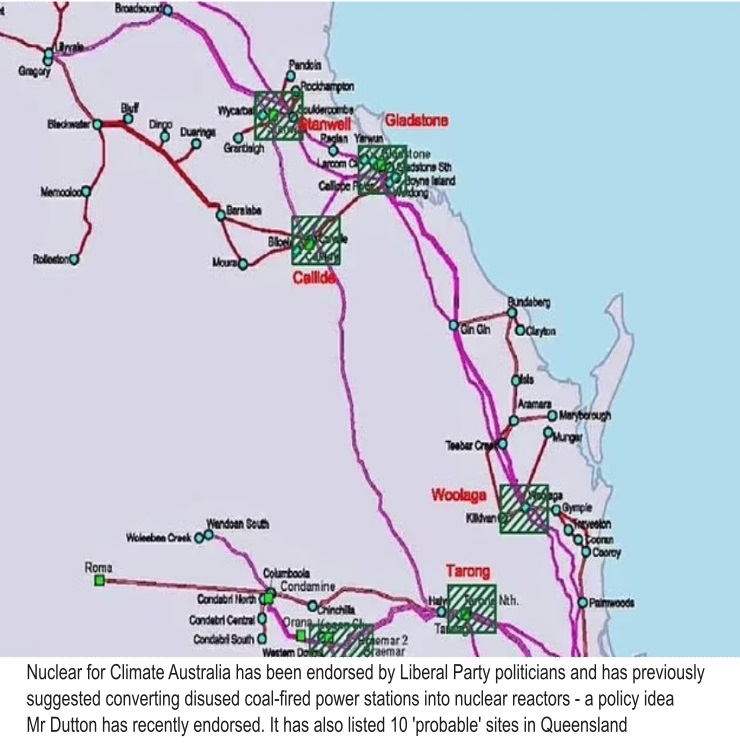
John Quiggin, Professor, School of Economics, The University of Queensland: February 26, 2025, The Conversation
Debate over the future of Australia’s energy system has erupted again after a federal parliamentary inquiry delivered a report into the deployment of nuclear power in Australia.
The report casts doubt on the Coalition’s plan to build seven nuclear reactors on former coal sites across Australia should it win government. The reactors would be Commonwealth-owned and built.
The report’s central conclusions – rejected by the Coalition – are relatively unsurprising. It found nuclear power would be far more expensive than the projected path of shifting to mostly renewable energy. And delivering nuclear generation before the mid-2040s will be extremely challenging.
The report also reveals important weaknesses in the Coalition’s defence of its plan to deploy nuclear energy across Australia, if elected. In particular, the idea of cheap, factory-built nuclear reactors is very likely a mirage.
A divisive inquiry
In October last year, a House of Representatives select committee was formed to investigate the deployment of nuclear energy in Australia.
Chaired by Labor MP Dan Repacholi, it has so far involved 19 public hearings and 858 written submissions from nuclear energy companies and experts, government agencies, scientists, Indigenous groups and others. Evidence I gave to a hearing was quoted in the interim report.
The committee’s final report is due by April 30 this year. It tabled an interim report late on Tuesday, focused on the timeframes and costs involved. These issues dominated evidence presented to the inquiry.
The findings of the interim report were endorsed by the committee’s Labor and independent members, but rejected by Coalition members.
What did the report find on cost?
The report said evidence presented so far showed the deployment of nuclear power generation in Australia “is currently not a viable investment of taxpayer money”.
Nuclear energy was shown to be more expensive than the alternatives. These include a power grid consistent with current projections: one dominated by renewable energy and backed up by a combination of battery storage and a limited number of gas peaking plants…………………………..
What about the timing of nuclear?
On the matter of when nuclear energy in Australia would be up and running, the committee found “significant challenges” in achieving this before the mid-2040s.
This is consistent with findings from the CSIRO that nuclear power would take at least 15 years to deploy in Australia. But is it at odds with Coalition claims that the first two plants would be operating by 2035 and 2037 respectively.
The mid-2040s is well beyond the lifetime of Australia’s existing coal-fired power stations. This raises questions about how the Coalition would ensure reliable electricity supplies after coal plants close. It also raises questions over how Australia would meet its global emissions-reduction obligations.
Recent experience in other developed countries suggests the committee’s timeframe estimates are highly conservative.
Take, for example, a 1.6GW reactor at Flamanville, France. The project, originally scheduled to be completed in 2012, was not connected to the grid until 2024. Costs blew out from an original estimate of A$5.5 billion to $22 billion.
The builder, Électricité de France (EDF), was pushed to the edge of bankruptcy. The French government was forced to nationalise the company, reversing an earlier decision to privatise it…………………………………………………………………..
Looking ahead
Undoubtedly, existing nuclear power plants will play a continued role in the global energy transition.
But starting a nuclear power industry from scratch in Australia is a nonsensical idea for many reasons – not least because it is too expensive and will take too long.
In the context of the coming federal election, the nuclear policy is arguably a red herring – one designed to distract voters from a Coalition policy program that slows the transition to renewables and drags out the life of dirty and unreliable coal-fired power.
Parliamentary inquiry finds nuclear is high risk, zero reward.
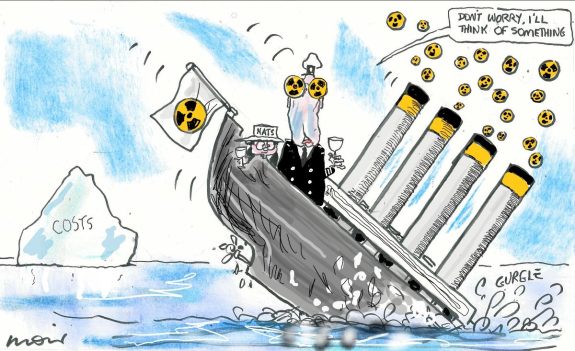
RenewEconomy, Jim Green, Feb 26, 2025
An Interim Report was released on Tuesday by the House Select Committee on Nuclear Energy, and splits on party lines, with the independent MP Monique Ryan listing a myriad reasons why nuclear is unsuitable for Australia.
Labor MPs have the numbers on the committee and their majority report states that nuclear power “cannot be deployed in time to support Australia’s critical energy transition targets and climate commitments, or to assist the coal workforce and communities in their transition away from the coal industry.”
The interim report says the committee “received compelling evidence nuclear power would cost consumers more to use”. The report continues:
“Evidence received about the private sector’s lack of interest in investing in nuclear power in Australia and the history of issues with private investment in nuclear power internationally highlights the financial challenges for this source of power, making taxpayer funding of an uncertain nuclear venture during a cost-of-living crisis a significant risk.”
The report notes that the evidence the committee received “strongly indicated SMR [small modular reactor] technology is not yet commercially available and so is not a viable option for Australia’s energy needs.”
Climate Change and Energy Minister Chris Bowen commented on the report’s findings:
“Peter Dutton is determined to ignore the experts, reverse policies that bring the cost of energy down, and stick his head in the sand until the 2040s wishing his $600bn nuclear scheme will fix everything. It’s a disaster for our energy system now, and a guaranteed recipe for big bills, blackouts, and bad investments. “
“We already have a solution that works for today, and for this critical decade, that delivers jobs for people transitioning away from coal now, that reduces emissions, and that gets more of the cheapest form of energy into the grid. That solution is reliable renewable energy and the Albanese Government is delivering it.”
Independent MP Monique Ryan
If the Coalition hoped to sway independent MP and committee member Dr. Monique Ryan, they were sorely disappointed. Dr. Ryan said in her ‘Additional Comments’ to the main report that an “ongoing pursuit of nuclear energy options will only perpetuate and increase Australia’s reliance on coal and gas”.
Dr. Ryan reached the following conclusions:
* There are considerable roadblocks to nuclear energy in this country
* Necessary regulatory framework for health, safety, security, environmental impacts, and transport of fuels and waste would likely take some years to develop
* Australia currently lacks the workforce and technical capability required for building multiple large-scale nuclear reactors
* Independent experts (including from the CSIRO and Australian Energy Regulator) repeatedly told the Inquiry that it would take at least 15 years to build a single nuclear reactor — possibly as long as 25 years
* The Coalition’s proposal would provide only 15% of the country’s electricity requirements by 2050
* Under current projections, by 2030 more than 84% of the main national electricity grid will be powered by renewables; 96% by 2035
* Nuclear power is the most expensive form of energy
* Nuclear power does not compete economically
* Australians would pay more for electricity generated from nuclear plants
* Nuclear energy lacks social licence in many parts of Australia
* The impact of nuclear power generation on Australia’s water supplies has been inadequately considered by the Coalition in its proposal.
Coalition dissenting report
The Coalition committee member’s dissenting report goes to some lengths to defend that Coalition’s indefensible claim that nuclear power would reduce energy costs and power bills. Those claims have been thoroughly debunked…………………………………………..
Nuclear Thuggery and Threats: Response to Interim Report of the House Select Committee on Nuclear Energy
February 26, 2025 AIMN Editorial, https://theaimn.net/nuclear-thuggery-and-threats-response-to-interim-report-of-the-house-select-committee-on-nuclear-energy/
Friends of the Earth (FoE) welcomes the Interim Report released by the House Select Committee on Nuclear Energy.
The Interim Report states that nuclear power “cannot be deployed in time to support Australia’s critical energy transition targets and climate commitments, or to assist the coal workforce and communities in their transition away from the coal industry.” It warns that “taxpayer funding of an uncertain nuclear venture during a cost-of-living crisis is a significant risk.”
In ‘Additional Comments’ to the Committee’s report, Kooyong MP Dr. Monique Ryan concludes that an “ongoing pursuit of nuclear energy options will only perpetuate and increase Australia’s reliance on coal and gas”.
FoE Australia’s national nuclear campaigner Dr. Jim Green said:
“The House Select Committee has found that nuclear power is too expensive and too slow. The Coalition hid its bogus economic costings until the Committee’s work was nearly complete, but the absurdity of those costings has now been thoroughly exposed.
“The simple fact is that recent reactor projects in the US, the UK and France have cost A$27-45 billion per reactor ‒ several times higher than the Coalition’s absurd assumption. No amount of sophistry and creative accounting changes the plain facts.
“This week the Climate Change Authority released a detailed analysis concluding that the Coalition’s energy plan would result in an additional two billion tonnes of greenhouse emissions. The Coalition’s response was to threaten to sack the Authority’s chair Matt Kean (a former NSW Liberal energy minister and treasurer) and to scrap the Authority just as a previous Coalition government defunded the independent Climate Commission and tried to kill off the Climate Change Authority and the Australian Renewable Energy Agency.
“The threat to the independent, expert Climate Change Authority is pure thuggery, as is Peter Dutton’s threat to use compulsory acquisition laws to acquire sites to build nuclear reactors from energy companies that are openly critical of the Coalition’s nuclear plan. Those companies are planning their exit from coal and its replacement with renewables and storage projects.
“The Dutton Coalition’s threat to override state governments and state laws is nuclear thuggery. And the threat to override community opposition is nuclear thuggery. Peter Dutton says it is in “the national interest to proceed” with nuclear reactors even in the face of adamant public opposition.
“The Dutton Coalition’s all-embracing nuclear thuggery stands in stark contrast to shadow energy minister Ted O’Brien’s comments in 2019 that a future government should only proceed with nuclear power on the condition that it make ‘a commitment to community consent as a condition of approval for any nuclear power or nuclear waste disposal facility’.”
Peter Dutton’s nuclear accounting trick #3: Hide the costs of keeping coal
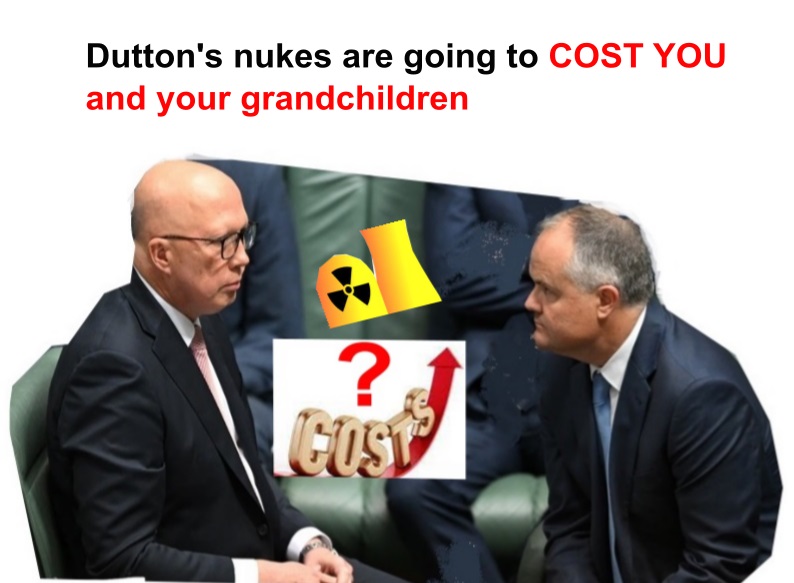
RENEW ECONOMY. Tristan Edis, Feb 21, 2025
This is part 4 of a five part series of articles examining the four accounting tricks that the Liberal-National Party employed in the costing of their energy plan to slow the roll-out of renewables and rely instead on nuclear power. The first article, which provides the overarching context is published here. Part 2 is here. Part 3 is here.
These four accounting tricks act to mislead voters that the Liberal-National Party could lower energy bills through a shift to nuclear when in reality it is likely to increase power bills.
This article focuses on accounting trick three of four: Hide most of the cost of replacing coal with nuclear to outside the time period considered in the costing.
It’s very important to note that the Coalition’s costing of its electricity system cuts out in the year 2051. It only accounts for costs incurred between 2025 to 2051 and anything after that date is ignored.
The LNP’s claim of a 44% saving does not represent the cost of two alternative systems for achieving near zero emissions once they are both completed to see how nuclear might reduce the cost of the system.
Instead, a heavy influence on the cost estimates in the model is the degree to which the scenarios can delay incurring costs in replacing the old, highly polluting and likely to be increasingly unreliable coal power plants.
How is this a problem?
Coal power stations are much like a car – they are exposed to extreme heat, pressure and general mechanical stress that means they wear out and become unreliable as they get old. That’s physics.
Many of us will have experience with an old car that has got to the point where it increasingly encounters mechanical problems and the mechanic is warning us that it really needs some major repairs but these would cost more than the car is worth.
At this point many of us can be tempted to take a gamble by putting off such repairs, and go for temporary, less costly patch-ups and hope the car keeps going. That will be a lot cheaper than buying a new car, at least for as long as we can keep the old car going. But it comes with the risk that it could leave us stranded with a broken-down car at an extremely inconvenient point in time and even pose a danger to our safety and that of others.
The Coalition’s modeled plan chooses to take that gamble with our electricity system. But it doesn’t account for the risks and potentially extreme costs this involves if the gamble goes wrong.
Clare Savage, the head of the Australian Energy Regulator has repeatedly warned that failing to replace aging coal plants risks both power system reliability and also affordability observing, “Coal can’t last until you have nuclear power available.”……………………………………………………………………
Unless Peter Dutton has a secret plan to prioritise curtailment of rooftop solar in favour of coal generators, this is likely to get worse over time.
Now, the way that the consultant, Frontier, constructed Dutton’s costing is that they space out the cost of constructing new power stations as an annualised payment – a bit like how you’d purchase a new car not by paying for it upfront but rather by taking out a loan and then paying it back incrementally over time.
Except in this case the annualised payment for a new power station is spaced out over several decades and for nuclear it is 50 years. Meanwhile for the existing, very old power plants the original cost of constructing those plants is omitted from the annualised costs.
By pushing out the point at which they replace the old power stations with new ones until the 2040’s, the Coalition gets to hide much of the cost of the nuclear plants until towards the very back end of the projection period. We’ll still have to pay for these nuclear power stations well after 2051, but that’s conveniently left out of the costing period.
Meanwhile, in the scenario said to represent Labor Policy, the coal-fired power stations are replaced quite quickly, so the cost of the new, replacement power stations is taken into account across almost the entire time period considered in the model. …………………………
The nuclear plants aren’t really delivering any meaningful saving in the unit cost of energy relative to relying on renewables and storage. Instead, the savings are coming from the Liberal Party delaying the point at which the coal power plants are replaced. ………………………………………. more https://reneweconomy.com.au/peter-duttons-nuclear-accounting-trick-3-hide-the-costs-of-keeping-coal/
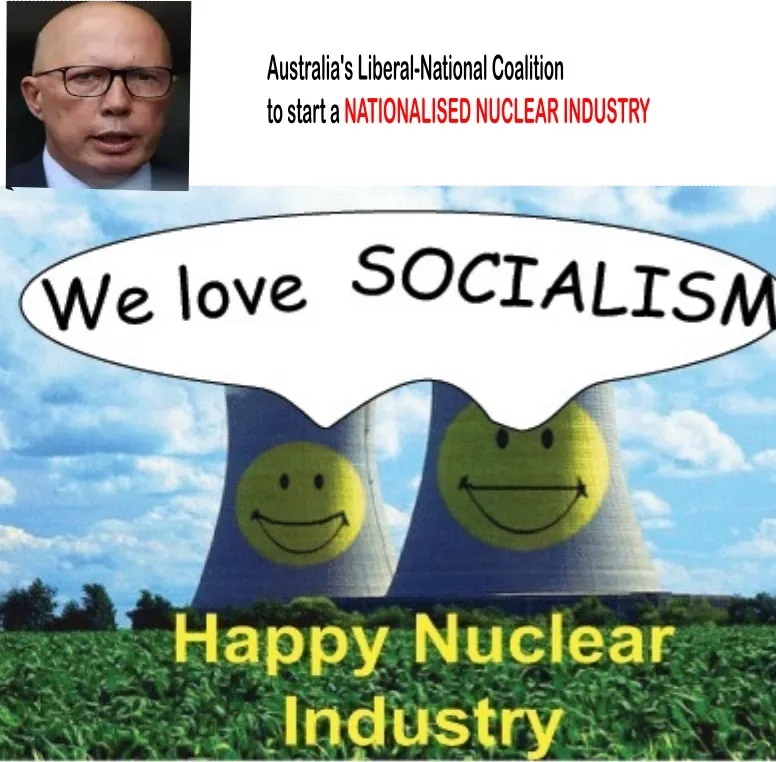
Dutton hints at privatising nuclear – one day
Phillip Coorey, 21 Feb 25
Peter Dutton has suggested his proposed nuclear power plants would one day be privatised, as he rejected the idea of the Albanese government taking an equity stake in the Whyalla steelworks.
With the $2.4 billion rescue plan for the steelworks in mid-north South Australia sparking a broader discussion about the re-nationalisation of business, the opposition leader said while he supported the plan, he derided the prospect of an equity stake in the Whyalla plant as “Whitlamesque”………………………….
Dutton said he was “completely opposed” to an equity stake.
“The prime minister can’t run a government – how can he run a steelworks? He’s now proposing to own an airline. I mean, this is Whitlamesque,” Dutton said.
Asked to explain why he opposed governments buying into troubled businesses but planned to spend $331 billion to build own and operate seven nuclear power plants, Dutton said there was a key difference in the nuclear energy would be a start-up industry.
“Nuclear power carries with it, from our country’s perspective, a zero-based knowledge, or a very low level of understanding, unlike in the United Kingdom or in Canada or in France or other parts of the world, including the United States,” he said.
“It’s obvious to me that there is greater reassurance in the public’s mind about the safety and the safe delivery of nuclear technology if it’s in government ownership.
“Now, it doesn’t need to be in government ownership forever.” https://www.afr.com/politics/federal/dutton-hints-at-privatising-nuclear-one-day-20250221-p5ldzj
1 This month

of the week – Australians for War Powers Reform (AWPR)
To see nuclear-related stories in greater depth and intensity
 Antinuclear