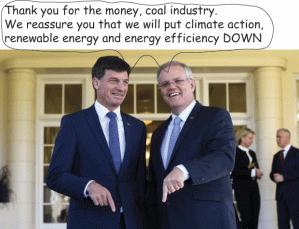
 Australian government brushes off UN’s urgent climate warning, SBS News 9 Aug 19 Humanity faces increasingly painful trade-offs between food security and rising temperatures within decades unless emissions are curbed and unsustainable farming and deforestation halted, according to a landmark climate assessment.
The federal emissions reduction minister has defended Australia’s land management practices after a new United Nations climate change report called for changes in the way the world produces and consumes food.
The UN’s Intergovernmental Panel on Climate Change warned efforts to limit global warming while feeding a booming population could be wrecked without swift and sweeping changes to how we use the land we live off.
The report on land use and climate change highlighted the need to protect remaining tropical forests as a bulkhead against future warming. It offered a sobering take on the hope that reforestation and bio-fuel schemes alone can offset mankind’s environmental damage, underlining that reducing emissions will be central to averting disaster.
“Land is a source of emissions as well as a sink,” IPCC chair Hoesung Lee told AFP.
“Obviously you want to reduce emissions from land as much as possible. But that has a lot to do with what’s happening to the other side of the equation: greenhouse gas emissions, mainly from the energy sector.”
But Emissions Reduction Minister Angus Taylor said Australia is already absorbing emissions from land management. “This is a very, very important success story in Australia. Farmers, in particular, haven’t been given the credit they deserve for the role, the enormous role, they’ve played on this front,” he told ABC News on Friday.
But the minister brushed off concerns about the role meat-heavy diets play in climate change, suggesting the report was “forcing” people to become vegan……..
Land is intimately linked to climate. With its forests, plants, and soil it sucks up and stores around one-third of all man-made emissions. Intensive exploitation of these resources also produces huge amounts of planet-warming CO2, methane and nitrous oxide, while agriculture guzzles up 70 percent of Earth’s freshwater supply.
National Farmers Federation president Fiona Simson said the food warning should send “a shiver down your spine”…….
As the global population balloons towards 10 billion by mid-century, how land is managed by governments, industry and farmers will play a key role in limiting or accelerating the worst excesses of climate change.
Farmers for Climate Action want the federal government to implement a national strategy on climate change and agriculture, and to speed up the transition to clean energy.
“With NSW marking one year since it was 100 per cent drought-declared … and farmers across the country hurting from droughts, heatwaves and other extreme weather events, it is clear that climate change is already hurting Australian agriculture,” the group said in a statement……https://www.sbs.com.au/news/australian-government-brushes-off-un-s-urgent-climate-warning
August 10, 2019
Posted by Christina Macpherson |
AUSTRALIA - NATIONAL, climate change - global warming, politics |
Leave a comment
Taylor presses nuclear button, as energy wars enter dangerous new phase, Giles Parkinson 5 August 2019 https://reneweconomy.com.au/taylor-presses-nuclear-button-as-energy-wars-enter-dangerous-new-phase-47854/
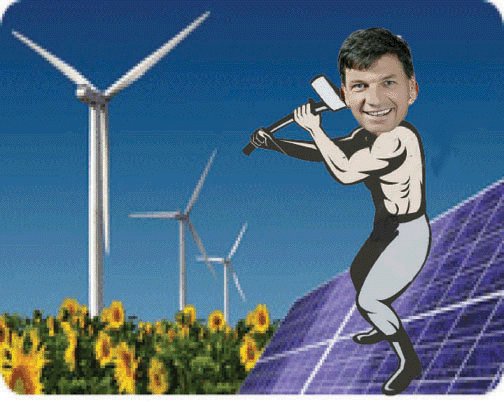
 Australia’s energy minister Angus Taylor has campaigned against renewables since before he entered parliament in 2013, appearing at anti-wind events organised by an anonymous and unpleasant website, and vowing on many occasions to scrap the renewable energy target.
He has been powerless to stop the build out of wind and solar, although he has complained about it often enough. But now Taylor and the Coalition government have taken their war against wind and solar to its next inevitable phase: They’ve pressed the nuclear button.
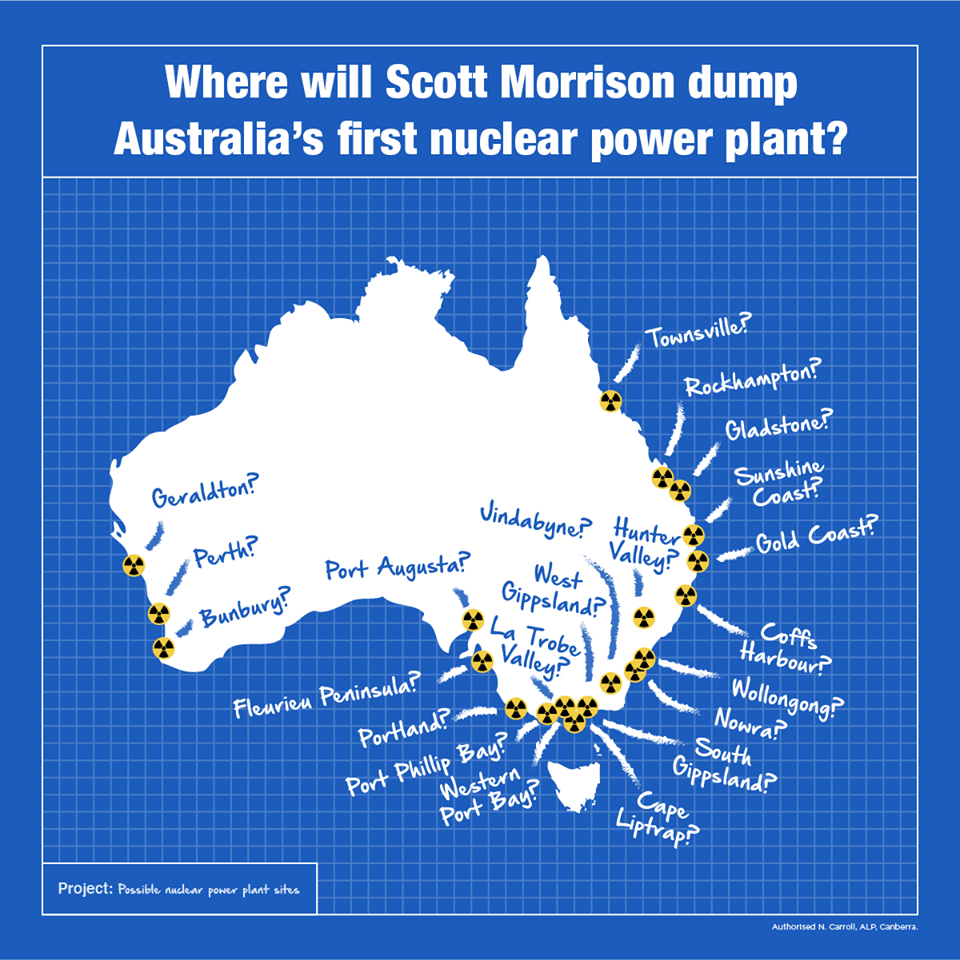
Taylor revealed late Friday that he had asked the Environment and Energy Standing Committee to launch a new inquiry into nuclear energy, including its costs and issues of waste etc. They’ve got four months to produce a report.
Taylor insists that there is no intention to repeal the laws that outlaw nuclear energy in Australia. But that beggars the question. Why have the inquiry in the first place?
The answer is simple. As Taylor revealed in an interview on ABC’s AM program, he simply doesn’t accept that renewables can power the electricity grid. A view that is loudly shared by many of his Coalition colleagues, the Murdoch media, and of course the coal industry.
The timing of the announcement is interesting. It comes just a couple of days after the end of the parliamentary sitting week (they won’t be back again until September) and just as the country’s far-right conservatives got ready to gather at the Australian Conservative Political Action Conference.
Tellingly, this is the first policy or initiative that Taylor has announced since the shock re-election of the coalition government in May, and comes after a major push by the far right ideologues of this conservative government to reconsider the ban on nuclear.
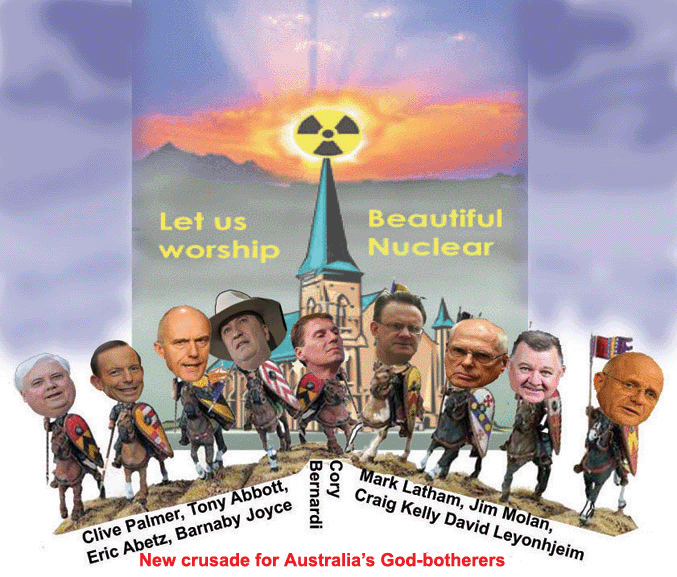
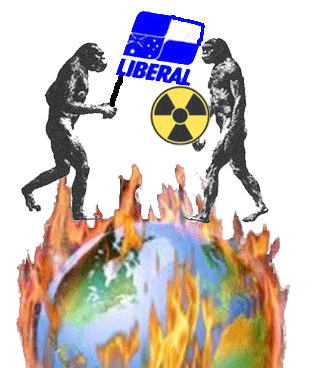
And as we have noted before, the same Coalition MPs that have been pushing for nuclear are the very same Coalition MPs pushing for new coal generation, and the very same Coalition MPs who reject the science of climate change, or make a mockery of the urgings of young people that they should take it seriously.
This is no co-incidence. This is not about carbon emissions, and it is certainly not about cheap energy. The common enemy of these people is wind and solar, and the shift from a centralised system based around “baseload” fossil fuel generators to a renewable system that is largely decentlralised (and democratised), and based around renewables, storage and demand management.
Australia is one of those regions – like Germany and California – that is at the forefront of this transition, and the fossil fuel industry view is that it cannot be allowed to succeed.
So it is no coincidence that the biggest industry supporter of nuclear is the coal lobby itself, in the guise of the Minerals Council of Australia, which is also pushing for new coal generators and urging the government to do as little as possible on climate.
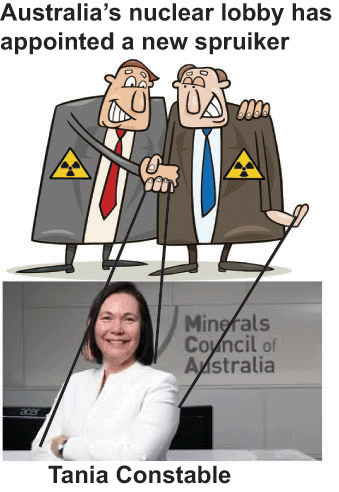
The MCA is cosy with the Coalition – its former CEO and deputy CEOs are now key advisors in Prime Minister Scott Morrison’s office, and its chair is the former Coalition minister Helen Coonan. Its current CEO, Tania Constable, was appointed by the Coalition government to the board of the ABC, over-riding independent recommendations.
A new dimension is also added.
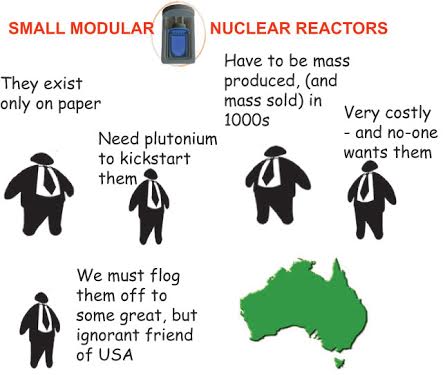
One of the noisiest opponents of renewable energy technologies is Trevor St Baker, pushing for new coal generators and whose Vales Point coal generator in NSW – currently in the queue to get federal government funding to remain open beyond its schedule closure date – is also the founder of a company SMR Nuclear that looking at new “modular” nuclear technologies that Taylor suggests could be a focus of this inquiry.
Like St Baker, the likes of Constable argue that only nuclear is able to deliver 24/7 emissions free power. They insist it is “cheap”, but that is nonsense.
The International Energy Agency desperately wants nuclear to succeed, but it concedes that costs have surged, as this graph (above) from a recent report illustrates. While the cost of solar has fallen 95 per cent over the past decade, and the cost of battery storage by some 70 per cent, the cost of nuclear has more than trebled upwards.
Even re-fitting existing stations was considered more expensive than wind and solar, although as BloombergNEF founder and now commentator Michael Liebreich has pointed out, the costs might be close enough to convince some countries to extend their life.
But there is no economic case for new nuclear. Liebreich says. Cost blowouts are occurring in the UK with Hinckley, and in France and in Finland with their versions of the latest technology, as it is in China (which has begun no new projects in the last three years), and in the US.
This graph[on original] from Le Monde in France illustrates how costs have surged in its next generation technology at its flagship project in Flamanville. It was begun in 20017 with promises it would be finished in 2012 at a cost of €3.5 billion.The latest delay and cost blowout have pushed the assumed finish date to 2022 and the new estimate of costs to €11.5 billion.
As France’s own National Infrastructure Commission said last year, a focus on renewables ‘looks like a safer bet than constructing multiple new nuclear plants’”.
Into this debate recently landed Industry Super Australia, the union fund research body with a report that is quite possibly one of the most inept analyses of the energy industry that has been produced in Australia. And that says something because it has had strong competition. The ISA, and the ISF that oversees it, should be embarrassed that it is published in its name.
To address the issue of costs, the ISA report produces a completely nonsensical “capital cost” assumption that confuses output with capacity factors, multiplies it by the cost of solar plants built more than 5 years ago.
It delivers a figure of $16 billion per gigawatt for the cost of solar. It is not a rough “back of the envelope” calculation as the authors try to claim, it is complete and utter garbage.
Among its other laughable claims are that Australia would need “one hundred” Snowy 2.0 pumped hydro schemes, or 72,000 Tesla big batteries were it to go 100 per cent renewables.
It’s a preposterous number that completely misunderstands the workings of the energy system, and the role of storage technologies, and fails to appreciate that if we do electrify everything, then we will be using less energy, not more.
Apart from now being expensive and polluting, burning fossil fuels is hugely inefficient – most of it disappears as heat, be it in a coal fired power station or in the internal combustion engine of a car – and it is two or three times more wasteful than electric motors and batteries.
But the authors of this report seek to mislead, either deliberately or through their ignorance. They make the patently false claim that fossil fuel plants “do not need back up.” Try running that past anyone who actually operates an electricity grid, and has to deal with large plants that need regular maintenance or which may trip for any number of reasons.
The study is so poorly researched it even claims that the Invanpah solar tower facility in California does not need back-up.
If the authors bothered to spend two minutes researching that project, rather than relying on the blogs of nuclear fantasists, they would have discovered that it has no storage, and needs gas plants to help fire it up in the morning. Yes, it was costly, but it turned out to be such a bad idea that no plant like it has or will be built again. All new solar towers do and will have storage.
But the authors’ minds were set. They even dismiss the reaction to the disasters at Chernobyl, Fukushima and Three Mile Island to “behavioural bias” and compares the lot of the nuclear industry with that of a baseball pitcher in 1930s, Chad Bradford, who had an unusual throwing action.
- “They just judged him on the way he looked. So they demoted him to the minor leagues for a time,” they plead.
- For heavens sake, nuclear is not judged by the way it looks, or its throwing action, but for its costs. And the CSIRO and the Australian Energy Market Operator – like the IEA – have made it clear that nuclear – like new coal – costs a multiple more than the cheapest alternatives, wind and solar backed by dispatchable capacity, be that pumped hydro, batteries, or demand management.
You won’t see baseload mentioned in AEMO’s Integrated System Plan, the 20-year blueprint for the future. Neither will you see it championed by the grid operators in the UK, or China. The world has moved on.
AEMO says Australia has the technology and know-how to move to 100 per cent renewables, although they would differ about the time frame from the most enthusiastic renewables supporters.
The problem is that like the ISA report, the nuclear boosters in the Coalition are prone to accept garbage as gospel.
The energy industry has largely dismissed nuclear as an option in Australia, knowing that it is absurdly expensive, and that if it were built in Australia it would take so long – possibly two decades at the very least – that the country would be powered almost exclusively by much cheap wind and solar and dispatchable storage by that time (if allowed to).
But Ted O’Brien, the chair of the committee reviewing the nuclear issue (it is stacked with four out of seven members from the Coalition) has already made up his mind.
Like his Coalition colleague Craig Kelly, lampooned in the cartoon above, he’s long been a big fan of nuclear – and given his analysis of Labor’s energy policy – he said it would be a tax on Tim Tams – he might have been about as thorough in his assessment of nuclear as Homer Simpson.
Don’t laugh.These people really are that stupid. They are not interested in the advice of experts – be it on climate science, energy technologies, or electric vehicles. But one thing they can’t admit is that the Greens – and now the rest of the energy industry – are right about wind and solar, and the focus on “dispatchable” power rather than “base-load”.
If Australia can demonstrate that a modern economy can be run on a predominantly renewables grid, it’s all over for the fossil fuel industry across the world. So expect this push to have some powerful friends, and not just in the media industry, and not just in Australia.
Giles Parkinson is founder and editor of Renew Economy, and is also the founder of One Step Off The Grid and founder/editor of The Driven. Giles has been a journalist for 35 years and is a former business and deputy editor of the Australian Financial Revie
August 5, 2019
Posted by Christina Macpherson |
AUSTRALIA - NATIONAL, politics |
Leave a comment
Australian parliament to launch nuclear energy inquiry. http://world-nuclear-news.org/Articles/Australian-parliament-to-launch-nuclear-energy-inq, 02 August 2019
Australia’s Energy Minister Angus Taylor has asked the House Standing Committee on the Environment and Energy to investigate the nuclear fuel cycle, Committee Chairman Ted O’Brien announced today
“This will be the first inquiry into the use of nuclear energy in Australia in more than a decade and I believe it’s the first time the Australian Parliament has ever undertaken such an inquiry,” O’Brien, who is Member of Parliament for Fairfax in Queensland, said. He will be tasked with leading the inquiry after the ministerial request is considered and adopted by the committee.
In a letter to O’Brien, Taylor said the inquiry will consider the economic, environmental and safety implications of nuclear power. The minister has specifically asked the committee to inquire into and report on “the circumstances and prerequisites necessary for any future government’s consideration of nuclear energy generation including small modular reactor technologies in Australia”.
The terms of reference for the inquiry include: waste management, transport and storage; health and safety; environmental impacts; energy affordability and reliability; economic feasibility; community engagement; workforce capability; security implications; national consensus; and “any other relevant matter”.
“Australia’s energy systems are changing with new technologies, changing consumer demand patterns and changes in demand load from major industries,” the context for the inquiry notes. “At the same time the National Electricity Market is seeing a significant increase in capacity in intermittent low emissions generation technologies.” The country’s bipartisan moratorium on nuclear electricity generation – which has been maintained by successive Labor and Coalition governments – will remain in place, it said.
The inquiry will have regard to previous inquiries into the nuclear fuel cycle, including South Australia’s 2016 Nuclear Fuel Cycle Royal Commission and the 2006 Review of Uranium Mining Processing and Nuclear Energy in Australia, which is also known as the Switkowski report after its lead author Ziggy Switkowski.
The minister has requested that the committee completes the inquiry and delivers its report by the end of this year.
August 3, 2019
Posted by Christina Macpherson |
AUSTRALIA - NATIONAL, media, politics |
Leave a comment






 Antinuclear