David Glynne Jones on the unwisdom of nuclear power for Australia in a heating climate
 Inquiry into the prerequisites for nuclear energy in Australia Submission 249 David Glynne Jones
…………4. Australia’s fresh water supplies are already under extreme pressure to meet 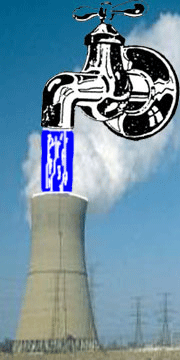 existing and future environmental flow, agricultural, urban and industrial requirements, and the use of very large quantities of fresh water for the cooling of nuclear power stations is unlikely to be either viable or acceptable.
- Consequently the only likely viable option will be to use seawater cooling, requiring nuclear power stations to be located close to the coastline, and with significant environmental impacts on affected coastal waters resulting from water heating and very large water flows.
- By comparison, solar photovoltaic and wind turbine generating systems do not require the use of any significant water resources for cooling……..
Energy affordability and reliability
 Recent European experience has shown that nuclear power generation is not reliable during extreme heatwave conditions, with nuclear power stations being required to operate at reduced power levels or shutdown completely.
- Given that the future climate outlook for Australia is longer hotter heatwaves during the summer, this must be given serious consideration in any decision to adopt nuclear power generation in Australia.
- There is no evidence that nuclear power generation using either LMR or SMR technology can compete with other emerging 21st century electricity generation technologies, which are evolving at an increasingly high rate and have gained broad market investor confidence.
- The AEMO/CSIRO GenCost 2018 report projects capital and operating costs for both LMR and SMR technology at uncompetitive levels for the foreseeable future.
- There is no evidence of market investor appetite for nuclear power generation investment in the absence of government subvention.
- The UK SMR program has a NOAK target of GBP 60/MWh (~ AUD 110/MWh), but this cannot be demonstrated until a significant number of reactors haved been built and operated for a significant period. The FOAK target is GBP 75/MWh (~ AUD 140/MWh).
-
- The report found that “Investing in a nuclear power plant is uneconomical. This This
holds for all plausible ranges of specific investment costs, weighted average cost of
capital, and wholesale electricity prices”.-
 Economic feasibility
 - A recent report published by the German Institute for Economic Research (known as DIW Berlin) reviewed the development of 674 nuclear power plants built since 1951, finding that none of the plants was built using ‘private capital under competitive conditions’. A full copy of the report is available at https://www.diw.de/documents/publikationen/73/diw_01.c.670581.de/dwr-19-30-
1.pdf. holds for all plausible ranges of specific investment costs, weighted average cost of capital, and wholesale electricity prices”.
-
-
- It would be sensible for the Committee to seek input from the energy investment
- It is highly unlikely that the commercial insurance industry would ever be prepared
- The cost of firmed renewable-generated electricity is already as low as AUD
- For a proposed Australian nuclear power generation industry capacity of 20 GWeThe report found that the expected economic loss for a 1000 MWe (1 GWe) nuclear power station would be in the range of Euro 1.5-8.9 billion – approximately AUD 2.4-14.4 billion).this would translate to a future economic loss in the range of approximately AUD50-300 billion………..
10.The biggest risk for potential market investors in nuclear power generation is the future uncertainty created by competing technologies, given that there is currently no operational evidence that nuclear power generation can ever compete directly with other electricity generation technologies. 70/MWh (https://reneweconomy.com.au/stunning-low-costs-inspire-alinta-to-rampup-renewables-push-flag-early-coal-exit-82836/), and is likely to reduce further over the next two decades.
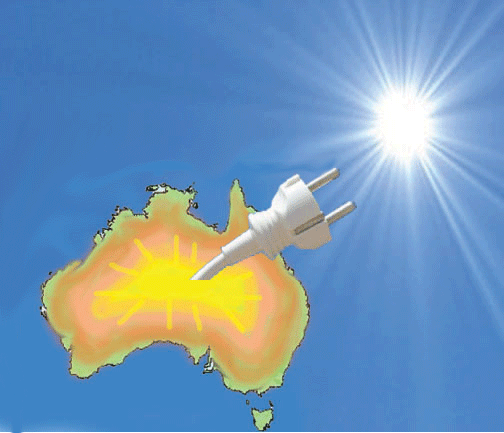
 12.Australia has a superabundance of solar energy resources – the largest of any nation state in the world. At current solar energy conversion efficiencies Australia has the potential to produce 30% of the world’s current electricity demand from just 1% of its land area (by comparison agriculture uses 53% of Australia’s land area).
13.The increasing technological and commercial viability of long distance HVDC transmission means that Australia will be able to export highly competitive low cost renewably generated electricity directly to the Asian market. to underwrite the risks of catastrophic failure, and consequently this will need to be underwritten by government (ie taxpayers), as is currently the case in other countries with nuclear power industries. and insurance industries.
- The cost of firmed renewable-generated electricity is already as low as AUD
- It is highly unlikely that the commercial insurance industry would ever be prepared
- It would be sensible for the Committee to seek input from the energy investment
- The report found that “Investing in a nuclear power plant is uneconomical. This This

Senator Sarah Hanson-Young defending the right to peacefully protest


The right to peacefully protest is at the core of our democracy. Home affairs Minister Peter Dutton threat to cancel welfare payments of climate protesters is an attempt to silence their views and is completely inappropriate.
Rather than resort to serious threats and attempt to shut down community views, the Government should come up with a national plan for dealing with the climate crisis that we’re in.
Article: Peter Dutton opens door to cancelling welfare of climate protesters, The Australian:
https://www.theaustralian.com.au/…/4907f2938e9099f2f7db1680…
Labor challenge to nuclear power fan MP Keith Pitt – where would you put nuclear reactors?
|
The LNP Party in Queensland is considering to open a nuclear plant
By SAHAR MOURAD FOR DAILY MAIL AUSTRALIA, 5 October 2019 A chilling warning has been issued of a ‘Fukushima-style’ disaster in Australia as the LNP continue to push to explore nuclear power. Nuclear power is currently a banned source of power in Australia despite the country having the world’s biggest uranium reserves, but the Queensland Government is looking to open a nuclear power plant in Maryborough. Bruce Saunders, the Labor member for Maryborough in Queensland’s Legislative Assembly, has slammed Keith Pitt – the LNP member for the federal seat of Hinkler – for his push to open the ‘Fukushima-style’ nuclear plant. ‘Mr Pitt – the man behind it all – owes it to our community to declare where he sits in the widening rift that is LNP energy policy,’ Mr Saunders told The Chronicle. …….. https://www.dailymail.co.uk/news/article-7540527/Chilling-warning-Fukushima-style-nuclear-disaster-Australia-government-pushes-forward.html |
|

Australia’s drought disaster a political disaster too, for its climate-sceptic Morrison govt?
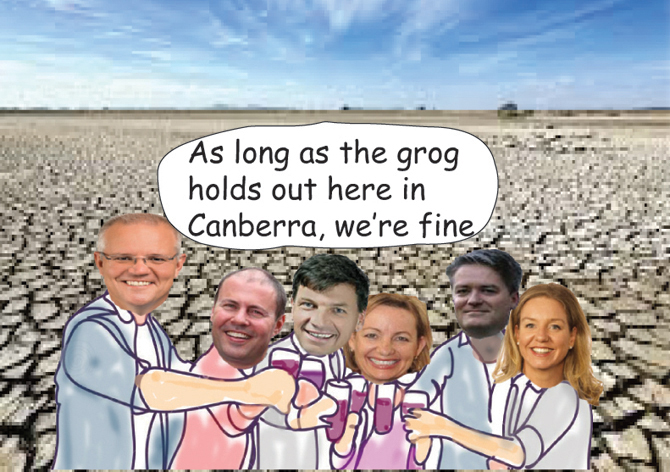
Inadequate drought preparation may prove to be political disaster too, Brisbane Times, Tony Walker 4 Oct 19
Panicky. That’s a word to describe the Morrison government’s response to a national drought emergency. Lack of rain, arid conditions, scorching winds and higher temperatures are contributing to an evolving disaster against the background of a contentious climate change debate.
This is a challenge that will become increasingly difficult for the governments, federal and state, to ignore as water supplies run down in New South Wales towns such as Dubbo and Queensland towns such as Stanthorpe. Risks of bushfire will be further elevated.Judging by Bureau of Meteorology forecasts, drought over much of eastern Australia is set to surpass all others in living memory going back to the beginning of record keeping. In other words, things may get a lot worse before they get better. What is left unspoken by government officials and farm representatives is this aridity will prove to be the new normal. Let’s repeat these words in capitals: NATIONAL DROUGHT EMERGENCY.
It might also be observed that no less than a drought emergency, this is a POLITICAL EMERGENCY for the Morrison government. Governmental responses, both federal and state, to a catastrophic dry across central and northern New South Wales and southern Queensland have been unfocused, according to farm representatives. Tony Mahar, chief executive of the National Farmers’ Federation, the peak body for Australian farmers, awards federal and state governments a “fail” when it comes to developing a national drought strategy to deal with emergencies. “No government, red or blue, has successfully nailed drought policy,” Mahar tells me.
Government inattention may well reflect agriculture’s diminishing share of the national economy at just three per cent of Gross Domestic Product. On the other hand, 1.6 million jobs reside in the complete agricultural supply chain. Prime Minister Scott Morrison’s dash – on his return to Australia from a state visit to the United States – to Dalby in the heart of drought-stricken southern Queensland to announce a $100-million relief package as part of an overall $7-billion allocation reflects government political concerns.
Morrison himself would not need reminding that the 2001-2010 millennium drought contributed to John Howard’s undoing, given he was perceived – rightly or wrongly – to be indifferent to climate change. At least six Coalition seats are at risk in the face of seething local anger over water mismanagement, or no management at all. In all of this, what tends to be overlooked is that the government has a wafer-thin majority of one after the Speaker is excluded……….
Finally, the latest Bureau of Meteorology bulletin provides little encouragement to believe that drought conditions will ease in the short term. The BOM reports the lowest rainfall on record extending from the Great Dividing Range as far as Dubbo and Walgett in central NSW. This is a huge swathe of the country under some of the most extreme drought conditions in the history of white settlement. Only the peak of the terrible 1900-02 “Federation Drought” was worse.
This is bad enough but meteorologists at the BOM are also reporting that a phenomenon known as sudden strategic warming above the South Pole risks contributing to a further deepening of the drought. The SSW effect would cause warmer westerly winds to track north, intensifying drought conditions in southern Queensland and northern New South Wales. If those forecasts prove correct, distinctions between a natural disaster and a national emergency will certainly become moot. Regardless, in a cloudless sky, these weather conditions will constitute an accelerating political emergency. https://www.brisbanetimes.com.au/national/governments-scandalously-little-drought-preparation-is-accelerating-disaster-20191004-p52xmv.html
Energy Efficiency the FIRST FUEL – a top Submission from Brenda Hugget
Submission to the Inquiry into the prerequisites for nuclear energy in Australia Brenda Huggett Submission 235
My submission will mainly focus on these two terms of reference:
- energy affordability and reliability
- Economic feasibility
The invitation to make a submission to this inquiry is headed by this statement:
The Australian Government supports an energy system which delivers affordable and reliable energy to consumers while fulfilling Australia’s international emissions reduction obligations.
I thoroughly endorse this aim, but would like to ensure that the Committee of Inquiry draws into this‘energy system’ a serious effort towards ENERGY EFFICIENCY – what the international Energy Agency and the G7 Ministers at their 2016 Japan meeting called the ‘first fuel’ – with its massive potential to power industry and homes cheaply, incrementally and with zero risks or cost blowouts.
At the same time the National Electricity Market is seeing a significant increase in capacity in intermittent low emissions generation technologies…
I believe this sentence should have been followed with “However the dramatic developments in a range of options to store PV and wind energy for ‘when the sun don’t shine and the wind don’t blow’ (the folksy way to refer to the ‘intermittency’ of renewables!) just may – over the coming decade or so – show Australia that it really can rely on renewables so we can truly phase out the last of our fossil fuel energy generation altogether, dodging nuclear power entirely.
Meanwhile our nuclear science academics and their grad students can keep a watching brief on nuclear developments overseas, in case we do find around 2030 that there is a real need for the nuclear option. A real need is totally different from a ‘niche’ where some industrialist (eg a Bill Gates, a Gina Rinehart or an Andrew Forrest) could build a nuclear power facility ‘just because they can’ (ie if there is no prohibition) because they have a passion to give it a go and a spare billion for the land, the plant, the phenomenally expensive insurance that presumably our Government would surely insist upon so that the venture can ‘stand on its own two feet’ (as PM Morrison wants!) and a workforce of eager nuclear engineering graduates.
The SA Nuclear Fuel Cycle Royal Commission
Although Commissioner Kevin Scarce recommended lifting the prohibition (which I strongly oppose at this time) the modelling for the Commission suggested that ‘a nuclear power plant would not be viable in South Australia even under carbon pricing policies consistent with achieving the ‘well below 2 °C’ target agreed in Paris because other low-carbon generation would be taken up before nuclear. p62
However Commissioner Scarce did recommend that the SA government collaborate with the Australian Government to ‘commission expert monitoring and reporting on the commercialisation of new nuclear reactor designs that may offer economic value for nuclear power generation.’ This sounds like a very sensible thing to do at this stage!
Small Modular Reactors
I appreciate that there must be no-one left in Australia who harbours a desire to see a huge ‘traditional’ nuclear power plant built anywhere. Rather the attention of nuclear enthusiasts has been diverted to SMR’s. There are many and varied types of Small Modular Reactors on drawing boards around the planet, reactors that can be factory-made, niftily deployed (only a couple of years, not decades, of work) and because they are small (producing only 300MW or less) the number of reactors at any plant can be scaled up or down according to demand. These drawing board SMR’s utilise a range of differing technologies some of which can be classified as ‘Generation IV’ initiatives and some which are just scaled down versions of earlier technology. Inquiry into the prerequisites for nuclear energy in Australia
These developments can and undoubtedly are all being monitored by Australian nuclear scientists, who can be presumed to also be monitoring ongoing developments in the quest for fusion pow
Tony Irwin of Sydney-based SMR Nuclear Technology complains (p. 14 of his submission)
that ‘serious consideration of the merits of N-power generation in Australia is precluded by our legislative prohibitions’. This is spurious at best! Nuclear Engineering is taught in Australian universities ANU and UNSW and probably more. Yes of course students and graduates will be champing at the bit to apply their learning on their home turf. But they can easily make themselves useful by either monitoring what is happening overseas and/or gaining experience elsewhere. With PhD scholarships, they can like their professors, even be paid by Australian taxpayers to watch and learn.
Mr Irwin goes on to complain ‘SMR vendors not treating Australia as a potential market while prohibitions remain.’ Of course these vendors would be fools to do so! We are not a market for any further nuclear technology (except for OPAL at Lucas Heights) while our legislative prohibitions remain in place – which will be until we as the Australian community have come to a conclusion that this new eg NuScale SMR technology has been truly proven up, has overcome all the safety concerns directed at previous nuclear technology, and that the costs are less than renewables+ batteries and moreover that it really is NEEDED!!! (not just ‘wanted/desired/wished for’)
The NuScale SMR project
Mr Irwin refers several times to the NuScale SMR project, based in Oregon. A little Googling shows that the 3 year review by the US Nuclear Regulatory Commissions of this 12000 page proposal should conclude by Sept 2020. One big – and controversial – ask by the company is that the normal requirement for a 32 km wide emergency evacuation zone be waived, because the company is so confident that their SMR will be safe and they would like to promote their technology as suitable for installing on the sites of decommissioned coal-fired power plants. NuScale has indeed lined up its first customer, Utah Associated Municipal Power Systems, for a plant at Idaho Falls, aiming to open it in 2027.
There is, predictably, local opposition with opponents arguing that it is more expensive than renewables with batteries, it will still produce nuclear waste (for which the US still has no real solution!) and local authorities don’t have the resources to adequately vet a nuclear plant. NuScale may live up to its (admittedly impressive) promise re safety, use of less water, etc. Australia can wait and see!
During these Watch and Learn years, there should absolutely be no lifting of our moratorium on the development of nuclear energy – a moratorium that has no doubt frustrated some, but has clearly satisfied an overwhelming majority of Australians as poll after poll has shown.
If… around 2030 Australia still has a demonstrable shortfall in energy production from renewables + storage AND cutting edge nuclear developments with concomitant waste elimination have been truly proved up then the Australian government would have a much more realistic chance of gaining much-needed ‘social licence’.
However, it may be just too late….
“Solar PV and onshore wind have won the race to be the cheapest sources of new ‘bulk generation’ in most countries. But the encroachment of clean technologies is now going well beyond that, threatening the balancing role that gas-fired plant operators, in particular, have been hoping to play.” Tifenn Brandily, Energy Economics Analyst at BloombergNEF. https://about.bnef.com/blog/battery-powers-latest-plunge-costs-threatens-coal-gas/#_ftnref1
ENERGY EFFICIENCY as the FIRST FUEL
The Energy Ministers of Canada, France, Germany, Italy, Japan, the UK, the USA, and the European Commissioner for Climate Action and Energy, met in Kitakyushu in May 2016, to discuss developments since the Hamburg meeting held in 2015, against the background of volatile energy prices and the COP21 Paris Agreement. They issued a joint statement for Leaders’ consideration including, under Improving Energy Efficiency:
- We affirm that improving energy efficiency is key to decarbonisation of our economies, enhancing energy security and fostering economic growth and should be regarded as the “first fuel.” We aim to strengthen our efforts to further improve energy efficiency and also call on other countries to follow suit.
We emphasize the importance of the strong interconnection between, and simultaneous improvement of, energy efficiency and resource efficiency
More to ‘Watch and Learn’ for Australia
In June this year, the International Energy Agency’s held its biggest ever Global Conference on Energy Efficiency in Dublin, attended by over 400 energy efficiency leaders from governments and corporations. The gathering aimed to identify how to unlock the vast potential of energy efficiency, bringing a wide range of important benefits, from greenhouse gas emissions reduction, to improved energy security and supporting economies to grow while delivering environmental and social benefits.
At this Conference a new Global Commission for Urgent Action on Energy Efficiency was launched, comprising government and industry leaders, chaired by Mr Richard Bruton, Ireland’s Minister of Communications, Climate Action and Environment.
It notes that energy efficiency policy implementation has slowed and progress is weakening. Global energy-related CO2 emissions increased last year at their highest rate sin The Commission will produce a concise list of clear, actionable recommendations next year.
“No meaningful energy transition can take place without energy efficiency,” the CEO of the IEA, Dr F. Birol said. More than any single fuel, energy efficiency has a central role to play in meeting global sustainable energy goals.
As a keen exponent and part-time worker in the field of energy efficiency education, I am dismayed but not surprised by Australia’s performance vis a vis the regard paid to this ‘first fuel.’
The AEEEC The American Council for an Energy-efficient Economy rates 20+ nations for their efforts towards energy efficiency. Australia is currently ranked at 18th, between Indonesia and the Ukraine. I BELIEVE WE CAN DO SO MUCH BETTER THAN THIS!!!!!!!
The point about Energy Efficiency, seen as a first fuel, and given commensurate support by Federal, state and local governments is that it could replace the 11% of world energy that is currently nucleargenerated and alongside renewables+storage can probably totally displace fossil-fuelled energy generation. I say probably because just maybe in 10 or 20 years we may have to consider whatever is then proved up to be the best nuclear option, to complement efficiency/renewables/storage in some locations in our wide brown land…
A nuclear industry for Australia would be a huge cost to taxpayers
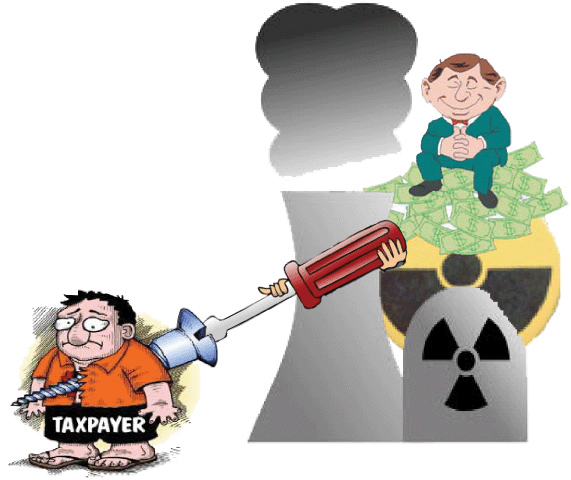
Nuclear inquiry hears cost, health h risks https://www.9news.com.au/national/environment-groups-front-nuclear-inquiry/79884d6e-f161-4624-9bac-b6f283d96598 By AAP Oct 1, 2019 Taxpayers would be bear the brunt of a potential nuclear energy industry in Australia, a parliamentary committee has been told.
Environment groups began the inquiry on Tuesday in Melbourne, a day after the committee was told the potential economic benefits of more uranium mining.Queensland Liberal National Party opposes nuclear power
Queensland LNP breaks with federal branch to oppose nuclear power, Amy Remeikis, 3 Oct 2019 Queensland LNP says it supports a greater focus on energy efficiency measures
One of the biggest detractors of the federal Queensland Liberal National party’s push to investigate nuclear energy as a potential power source for Australia has come from within its own house.
The state LNP opposition has publicly declared its opposition to making any changes to the current bipartisan ban on nuclear energy generation, declaring the government would be better served in its goals by focusing on renewable energy sources, in a marked split from their federal state colleagues.
Australia is once again looking at nuclear energy as a potential solution to its power woes, after a group of Coalition MPs, led by a cohort from Queensland, pushed the federal party room into investigating the prospect, through a parliamentary inquiry.
But in a move which has surprised their federal counterparts, the Queensland state LNP spokesman for energy, Michael Hart, made a written submission to the inquiry, announcing his arm of the party’s opposition to any attempt to allow nuclear energy generation, citing the risks to the communities and the environment.
Instead, Hart said the Queensland LNP supports “greater focus” on “energy efficiency measures, along with encouraging investment in renewable energy options like wind and solar, in combination with battery storage when it is technologically and economically feasible to do so”.
“It is considered that Australia’s rich renewable energy resources are more affordable and bring less risk than the elevated cost and risk associated with nuclear energy,” Hart submitted.
“The LNP encourages additional jobs and investment in Queensland’s renewable energy industry, while also supporting resource jobs and exploration which provides baseload power and employment for thousands of Queenslanders.
“In addition to the possibility of accidents and operational failure, nuclear facilities can be a potential target for terrorists. Securing insurance around such possibilities would be virtually impossible.
“In conclusion, the commercial, as well as the political risks, associated with nuclear energy are substantial. To this end, the LNP is strongly committed to an energy policy that delivers safe, affordable and reliable energy to consumers, while fulfilling Australia’s international emissions reduction obligations.
“We believe this can be achieved without lifting the moratorium on nuclear energy generation. Accordingly, we would encourage the committee to ensure an increased emphasis is placed on measures to encourage investment in renewable energy that creates green jobs and lowers electricity bills, for both consumers and industry, which does not (underlined) include nuclear energy”.
The state Labor government established a 50% renewable energy target by 2030 upon winning power in 2015.
The federal inquiry was established after a group of Coalition MPs, led by Hinkler LNP member Keith Pitt and Queensland LNP senator James McGrath, pushed for an investigation into whether nuclear power should be considered as part of the mix, as the government hunts for a long term solution to Australia’s surging energy prices.
Not wanting to reignite the war that led to the downfall of the national energy guarantee, and ultimately, Malcolm Turnbull’s leadership, the government acquiesced to calls for an investigation, which was established after a recommendation from Angus Taylor.
The state LNP position stands in stark contrast to their federal colleagues, including conservative senator Amanda Stoker, who said that “Australia must develop a nuclear energy industry”, as well as her Queensland colleague Gerard Rennick.
McGrath has publicly pushed for the nuclear discussion in numerous interviews and his own social media, as well as within the party room. Pitt, who describes himself as “technologically agnostic”, said the discussion had to be had.
“The first priority for the nations future energy needs will always be reliability and affordability,” he said. “As technology changes I expect our energy mix will also change over a period of time. I am completely technology agnostic in terms of the fuel types that might be utilised. Currently Queensland has the country’s youngest fleet of coal fired generators and I expect they will continue to be a critical part of Queensland’s energy mix into the future.”
He demurred from any questions on the split between state and federal lines, saying the state arm could “speak for themselves”, but attacked the state Labor government for its price management of the state owned power assets.
But the submission did give Queensland Labor senator, Murray Watt, a late week boost.
“This submission shows the LNP’s state MPs have had enough of their federal counterparts’ pointless culture war against renewable power,” he said. “Even the LNP’s state MPs acknowledge that renewables are a cheaper and safer way of meeting our future energy needs.
“They have also slammed their federal counterparts’ pursuit of nuclear power as a massive waste of time and resources.
“The Queensland LNP’s federal representatives should stop wasting everyone’s time by pursuing their obsession with nuclear power and get behind cheaper and safer means of meeting our energy needs.”
50+ groups sign joint civil society statement on domestic nuclear power
Friends of the Earth Australia is proud to be among the 50+ groups to sign the following statement calling for a clean, green, nuclear-free future.
The statement has been submitted to the federal inquiry into nuclear power (you can read the FoE submission about ‘small modular reactors’ here and our statement about nuclear power and climate change here).
The strong level of trade union support for a nuclear-free future is very welcome, with key national unions and peak union bodies including the ACTU endorsing the statement below.
*************************************************
Our nation faces urgent energy challenges. Against a backdrop of increasing climate impacts and scientific evidence the need for a clean and renewable energy transition is clear and irrefutable. All levels of government need to actively facilitate and manage Australia’s accelerated transition from reliance on fossil fuels to low carbon electricity generation.
The transition to clean, safe, renewable energy should also re-power the national economy. The development and commercialisation of manufacturing, infrastructure and new energy thinking is already generating employment and opportunity. This should be grown to provide skilled and sustainable jobs and economic activity, particularly in regional Australia.
There should be no debate about the need for this energy transition, or that it is already occurring. However, choices and decisions are needed to make sure that the transition best meets the interests of workers, affected communities and the broader Australian society.
Against this context the federal government has initiated an Inquiry into whether domestic nuclear power has a role in this necessary energy transition.
Our organisations, representing a diverse cross section of the Australian community, strongly maintain that nuclear power has no role to play in Australia’s energy future.
Nuclear power is a dangerous distraction from real movement on the pressing energy decisions and climate actions we need. We maintain this for a range of factors, including:
- Waste: Nuclear reactors produce long-lived radioactive wastes that pose a direct human and environmental threat for many thousands of years and impose a profound inter-generational burden. Radioactive waste management is costly, complex, contested and unresolved, globally and in the current Australian context. Nuclear power cannot be considered a clean source of energy given its intractable legacy of nuclear waste.
- Water: Nuclear power is a thirsty industry that consumes large volumes of water, from uranium mining and processing through to reactor cooling. Australia is a dry nation where water is an important resource and supply is often uncertain.
- Time: Nuclear power is a slow response to a pressing problem. Nuclear reactors are slow to build and license. Globally, reactors routinely take ten years or more to construct and time over-runs are common. Construction and commercialisation of nuclear reactors in Australia would be further delayed by the lack of nuclear engineers, a specialised workforce, and a licensing, regulatory and insurance framework.
- Cost: Nuclear power is highly capital intensive and a very expensive way to produce electricity. The 2016 South Australian Nuclear Fuel Cycle Royal Commission concluded nuclear power was not economically viable. The controversial Hinkley reactors being constructed in the UK will cost more than $35 billion and lock in high cost power for consumers for decades. Cost estimates of other reactors under construction in Europe and the US range from $17 billion upwards and all are many billions of dollars over-budget and many years behind schedule. Renewable energy is simply the cheapest form of new generation electricity as the CSIRO and the Australian Energy Market Operator concluded in their December 2018 report.
- Security: Nuclear power plants have been described as pre-deployed terrorist targets and pose a major security threat. This in turn would likely see an increase in policing and security operations and costs and a commensurate impact on civil liberties and public access to information. Other nations in our region may view Australian nuclear aspirations with suspicion and concern given that many aspects of the technology and knowledge base are the same as those required for nuclear weapons. On many levels nuclear is a power source that undermines confidence.
- Inflexible or unproven: Existing nuclear reactors are highly centralised and inflexible generators of electricity. They lack capacity to respond to changes in demand and usage, are slow to deploy and not well suited to modern energy grids or markets. Small Modular Reactors (SMRs) are not in commercial production or use and remain unproven and uncertain. This is no basis for a national energy policy.
- Safety: All human made systems fail. When nuclear power fails it does so on a massive scale. The human, environmental and economic costs of nuclear accidents like Chernobyl and Fukushima have been massive and continue. Decommissioning and cleaning up old reactors and nuclear sites, even in the absence of any accidents, is technically challenging and very costly.
- Unlawful and unpopular: Nuclear power and nuclear reactors are prohibited under existing federal, state and territory laws. The nuclear sector is highly contested and does not enjoy broad political, stakeholder or community support. A 2015 IPSOS poll found that support among Australians for solar power (78‒87%) and wind power (72%) is far higher than support for coal (23%) and nuclear (26%).
- Disproportionate impacts: The nuclear industry has a history of adverse impacts on Aboriginal communities, lands and waters. This began in the 1950s with British atomic testing and continues today with uranium mining and proposed nuclear waste dumps. These problems would be magnified if Australia ever advanced domestic nuclear power.
- Better alternatives: If Australia’s energy future was solely a choice between coal and nuclear then a nuclear debate would be needed. But it is not. Our nation has extensive renewable energy options and resources and Australians have shown clear support for increased use of renewable and genuinely clean energy sources.
The path ahead:
Australia can do better than fuel higher carbon emissions and unnecessary radioactive risk.
We need to embrace the fastest growing global energy sector and become a driver of clean energy thinking and technology and a world leader in renewable energy technology.
We can grow the jobs of the future here today. This will provide a just transition for energy sector workers, their families and communities and the certainty to ensure vibrant regional economies and secure sustainable and skilled jobs into the future.
Renewable energy is affordable, low risk, clean and popular. Nuclear is simply not.
Our shared energy future is renewable, not radioactive.
NSW Deputy Premier John Barilaro wants to “normalise”nuclear power
NSW Deputy Premier calls for nuclear vote within three years, AFR, Aaron Patrickn 30 Sept 19, NSW Deputy Premier John Barilaro suggested holding a non-binding vote at the next federal election to approve the introduction of nuclear power, a step that could help overcome entrenched opposition from the left to the low-emissions technology.
The leader of the state National Party is one of the leading political advocates for nuclear power, which is currently being investigated by parliamentary inquiries at the federal level and in NSW and Victoria.
“We could quite simply have a plebiscite at the 2022 election,” he told a conference run by the Australian Nuclear Association in Sydney. “We need to normalise [?] the conversation.
“Bit by bit it has become the norm. The negativity isn’t happening anymore. Australia is welcoming the conversation.”[?]
Supporters of nuclear power have been buoyed by the new political interest in nuclear, which received a boost when federal Energy Minister Angus Taylor initiated the federal inquiry last month.
At the University of Technology Sydney on Friday, several hundred engineers, regulators and policy experts gathered at the conference to discuss international developments and the Australian outlook.
“The conference is genuinely standing room only,” South Australian nuclear advocate Ben Heard said. “I have never seen it like this. Something is changing down under.”
The federal Coalition’s current policy is not to legalise nuclear power, but some federal and state Coalition MPs hope that developing community attitudes, and the pressure for action on global warming, could change the political environment.
The Labor Party and the Greens remain adamantly opposed. Labor climate change and energy spokesman Mark Butler has challenged the government to identify which cities, suburbs or towns would be the location for future nuclear reactors……..
Under a plan advocated by members of the Australia Nuclear Association, the federal government would build at least 20 nuclear power plants from 2030 to 2050.
At a cost of around $6 billion each, each plant would have a generating capacity of 1000 megawatts, which is about half AGL’s NSW Liddell power station, which is due to close in 2023…….
Nuclear critics, including former prime minister Malcolm Turnbull, have said that the cheapest way to reduce emissions is to combine wind and solar power with some form of storage.
Although batteries have very limited capacity at the moment, experts expect them to improve in coming years. https://www.afr.com/companies/energy/nsw-deputy-premier-calls-for-nuclear-vote-within-three-years-20190929-p52vz2
Nuclear submarines for Australia? Dangerous, would require costly taxpayer insurance
|
Nuclear subs idea worth floating It has been debated in some quarters for years that Australia should operate and maintain nuclear-propelled attack submarines. ……. This prospect raises two significant policy issues for Australia. The first is whether the commonwealth can operate and maintain nuclear submarines in a sovereign environment that has no civilian nuclear power industry to supply the nuclear-trained staffs, as well as build and maintain the infrastructure that is necessary. The second is whether Australia is prepared to establish an indemnification and regulatory environment that would be critical to safely and effectively operate and maintain nuclear vessels for 50 years. ……. A unique aspect of such submarines is the enormous amount of energy stored in their reactor cores. Built, operated, and maintained properly, this energy is released in a controlled manner over a long period. A sudden, uncontrolled release of this energy could be catastrophic, not only to the submarine, but to people and property nearby. Given that private insurance typically does not cover nuclear risks, an effective scheme to indemnify possible victims of a nuclear accident could be critical. Without such an indemnity scheme, companies might be unwilling to provide components and services to maintain and operate propulsion plants. As Australian policymakers and the public debate the nuclear submarine option for the Royal Australian Navy, it could be valuable for them to broaden their understanding of what it would take to establish: • A sovereign and robust industrial capability to operate and maintain submarines equipped with mobile nuclear power propulsion plants; • A rigorous regulatory scheme to ensure mobile power reactors are safely built, tested, operated, maintained and deactivated; • An indemnity scheme to cover third-party liabilities in the event of a “nuclear” incident; • Training and development paths for regulators, engineers, operators and maintainers; and • Facilities necessary to service nuclear-powered submarines……. https://www.theaustralian.com.au/commentary/nuclear-subs-idea-worth-floating/news-story/61c003a41e9303ca7883561983da90ac |
|
Scott Morrison on climate change: he just doesn’t “get it
 Morrison’s condescending response to kids and climate https://independentaustralia.net/politics/politics-display/morrison,13153 By Graeme McLeay | 29 September 2019 The best you can say about Prime Minister Scott Morrison is that he doesn’t get it.He and his conservative colleagues in the Coalition do not understand the science of climate change despite what our own scientists are telling them. The only way to explain his behaviour otherwise is to believe that he is deliberately setting out to deceive us.
First, there was the visit with U.S. President Donald Trump. No one would argue that good relations with the United States are not positive for Australia but his closeness to Trump tells us something about his mindset.
Trump is the President who vowed to revive coal, opened up federal parklands to oil and gas, attempted to reverse Obama’s plan to limit coal pollution and California’s vehicle pollution laws, decimated the U.S. Environmental Protection Agency, and withdrew from the Paris Agreement.
At least, French President Emmanuel Macron when visiting Trump raised climate change with him as Morrison surely would have if he understood the science.
Then it gets worse. Morrison continues his sojourn in the U.S. visiting an Australian owned cardboard factory while leaving Foreign Minister Marise Payne to attend the UN Climate Conference.
Had he himself gone he might have learned what the IPCC had to say: that in the last five years climate change has accelerated, a matter of some importance to Australia you might think, given the evidence from our own scientists. They tell us heat waves will increase, sea levels will rise, perennial droughts and a more severe bushfire seas. Continue reading
Lyn Allen and Richard Ledger’s nuclear submission – for the public good
Allen, Lyn and Ledgar, Richard Submission No 30
to the FEDERAL. Inquiry into the prerequisites for nuclear energy in Australia… Extracts “…..there are overwhelming economic, environmental and social reasons why nuclear energy is not an appropriate contributor to Australia’s energy mix.
If Australia is going to move to a sustainable future then we need to concentrate on producing energy from renewable resources. Uranium is not a renewable resource and even more so than coal, uranium mining produces waste that remains toxic for thousands of years.
Additionally, while nuclear power generation does not produce greenhouse gases, greenhouse gases are produced at every step in the process from mining to refinement and building nuclear power generation facilities. Like uranium mines, nuclear power stations expose the community and the environment in which they are built to significant risks ……
The future of Australia’s energy generation should to take advantage of our abundant natural resources such as sun, wind, tidal potential. Nuclear power station are massively expensive to build and take years to complete, whereas wind and solar generators and new storage technology (such as the batteries installed in South Australia) can be developed quickly and relatively inexpensively …
water. Generating nuclear power needs large quantities of water. Given Australia’s climatic conditions, the shortage of water in many of our major river systems,
Many countries around the world that currently use nuclear power are already starting to phase it out in favour of wind and solar generation. Australia can get in front of the energy production business by putting our skills, and efforts into an alternative energy grid that suits our climate, is safe for future generation and takes advantage of ‘free’ sources of energy.
Submission for the public good: to Federal Nuclear Inquiry – Noel Wauchope
Recommendation. There is no need to change Australia’s laws prohibiting nuclear activities. They were devised to protect Australians from the health, and safety risks of nuclear facilities, – far-sighted in that they have saved Australia from the unnecessary expense of a now collapsing industry. Meanwhile Australia is very well placed to put energy and funds into truly modern developments, and could become a world leader in energy efficiency and renewable energy.
To start with, the title of this Inquiry , featuring the word “prerequisite” really makes clear the major issue.
What is the major prerequisite?
Obviously the one important prerequisite is to repeal Australia’s laws banning nuclear activities.
First the Federal Law would have to be repealed. (a1)
Then – State Laws – Victoria’s NUCLEAR ACTIVITIES (PROHIBITIONS) ACT (a2) -and South Australia’s Nuclear Waste Storage Facility (Prohibition) Act 2000 (a3)
(a1) https://www.environment.gov.au/epbc/what-is-protected/nuclear-actions
(a2) http://www8.austlii.edu.au/cgi-bin/viewdb/au/legis/vic/consol_act/naa1983337/
Once these laws are repealed, then nuclear industry proponents will be free to spend much money on publicising the benefits of the industry. With helpful politicians and press, particularly from the predominant Murdoch media, this will give the industry huge boost. As Australia moves further into drought and water shortages, they will claim that nuclear power is essential to solve climate change. (Even if nuclear power could combat climate change, it would take decades to establish, and by then it would be too late.)
So – that is what the global nuclear industry needs, especially for South Australia, which has specific legislation against spending public money on promoting the nuclear industry .
While Australians have concerns about cost, safety, environment , health, wastes, Aboriginal rights, weapons proliferation etc, I am sure that the nuclear lobby will be able to overcome those hesitations, with an effective programme.
So, I have my doubts that the Terms of Reference matter all that much, but – here goes. I understand that the emphasis in this Inquiry is on Small Modular Nuclear Reactors (SMRs)
a . waste management, transport and storage. Continue reading
Controversial MP Barnaby Joyce on the pro nuclear campaign trail
 If there’s anyone really intelligent in Australia’s nuclear lobby, might they be wishing that Barnaby would just shut up? With friends like Barnaby, who needs enemies?
Barnaby Joyce finds a new cause in nuclear power, Australia’s best-known backbencher is hitching a ride to the nuclear debate and creating awkward moments. AFR, Aaron PatrickSenior Correspondent. Who knew? Barnaby Joyce loves nuclear energy as much as he detests abortions.
As a budding debate over splitting the atom fires up in three parliaments, the former deputy prime minister has decided that his new parliamentary vehicle, the House of Representatives Standing Committee on Industry, Innovation, Science and Resources, deserves a piece of the nuclear action.
On Friday morning, before a tour of Sydney’s own nuclear reactor, Joyce’s committee held a “nuclear industry roundtable” discussion that was broadcast live with about 30 energy industry experts, bureaucrats and lobbyists.
The purpose was, Joyce said, “to dispel some strongly held beliefs which may or may not be true”.
He couldn’t refer to the hearing as an inquiry, because one of those already exists – and helpfully covered much of the same information last month.
The House of Representatives Standing Committee on the Environment and Energy, which is reviewing nuclear energy at the government’s direction, held its hearing in Sydney three weeks ago.
Several of the same organisations turned up to Joyce’s event, which was held in a hotel within walking distance of Sydney Airport, making transport easier for the Member for New England.
To add to the double-dating awkwardness, Joyce’s star witness, businessman Ziggy Switkowski, read out the same opening statement he prepared for the other committee – by phone.
The real inquiry also visited the reactor, where it’s a wonder the distracted engineers haven’t inadvertently triggered a core meltdown.
Which raises an interesting question: would a nuclear accident that took out a parliamentary committee increase or lower public support for the power source?…… https://www.afr.com/companies/energy/barnaby-joyce-finds-a-new-cause-in-nuclear-power-20190919-p52t2y
Australian Labor Party standing firm on its climate policies
 Labor’s climate policies are ‘unshakeable’ despite
  election loss, Mark Butler says
Shadow climate minister says he believes Scott Morrison may shift on issue during the coming term, Guardian, Katharine Murphy Political editor @murpharoo, 21 Sep 2019 Mark Butler wants to make one thing clear: the shadow minister for climate change and energy is not for turning. It wasn’t a mistake to pursue an ambitious climate policy in the 2019 election and “we are not going to change our position to get to a level of profound irresponsibility [on policy], like the government”, he tells Guardian Australia’s politics podcast.
“Our position on climate is unshakeable.”……..
he also thinks it is possible Scott Morrison will shift on climate during the coming term, particularly if the Australian community remains vocal on the issue, and business also continues to demand policy certainty to allow it to deal with carbon risk. He says for people who want practical climate action, as opposed to rhetoric, bipartisanship remains “the holy grail”.
Butler says Morrison is not Malcolm Turnbull on climate, and not Tony Abbott, but somewhere in the middle. He suspects the prime minister has no “deep beliefs” on the issue, but that could enable him to pivot to a more plausible policy position in the event he makes a judgment that climate change is harming the electoral prospects of the Coalition. Perhaps Morrison, he says, can take “some baby steps to break down the culture war”.
…….. Butler says all the survey evidence he has seen indicates Australian voters are alarmed by the lack of policy action on climate change, and the issue rates second behind concerns about cost of living pressure. He says he is “utterly convinced” that public opinion in favour of action is “broad, deep and growing”.
Politicians, he says, need to be particularly aware that young people are hugely motivated on climate change. Butler has teenaged children and meets regularly with young activists.
“If we get to 2030 with the level of inertia we’ve had over the last decade, then we have profoundly let down our children and grandchildren”. https://www.theguardian.com/australia-news/2019/sep/21/labors-climate-policies-are-unshakeable-despite-election-loss-mark-butler-says?fbclid=IwAR0EPtILqei1clnBN_uRzHHflc-m2HBdcrvmQ3E9SUt0A3JkunlqKVc08Sk
1 This month
17 October, Free Public Talk on Nuclear Issues in South Australia
David Noonan will speak on public interest concerns over the new Roxby Downs Indenture Act 2026 on BHP copper-uranium mining and ore processing in SA, and on how AUKUS may face SA with a High-Level nuclear waste agenda.
Dr Jim Green will discuss international developments in the field of nuclear power including ‘small modular reactors’ and Generation 4 ‘advanced’ nuclear reactor concepts.


Help Aunty Sue Protect Her Land and Sacred Sites From Destructive Rocket Testing.
.

Australians deserve the truth
about
AUKUS – https://aukuspublicinquiry.com/

PETITION – To: Prime Minister Anthony Albanese and the Australian Labor Government

of the week – Australians for War Powers Reform (AWPR)
To see nuclear-related stories in greater depth and intensity

