GOLD Coast-based Federal MP Karen Andrews OK with nuclear power, but exactly where on the Gold Coast?
Gold Coast nuclear plant in the mix: but where would you put it on the tourist strip? , Gold Coast Bulletin, 19 June 19
GOLD Coast-based Federal MP Karen Andrews has been challenged on where she would want a nuclear plant on the Glitter Strip after not ruling out the energy option.
Ms Andrews, the Member for McPherson, was on Sky News today when asked about nuclear energy following the release of CSIRO’s Australian National Outlook report.
The report compares two versions of the Australia in 2060, and predicts the nation will enter a “slow decline” if challenges are not met head on.
The Industry, Science and Technology Minister was asked about the findings including that Australia could reach zero emissions by 2050.
But she admitted coal would be “part of the energy mix for some time in the future”.
Asked about nuclear energy, Ms Andrews replied: “I don’t have an issue with it being considered.”
Opposition climate change and energy spokesman Mark Butler seized on the comments saying it was another senior Liberal backing nuclear.
“We know nuclear power plants need to be built near water so would Minister Andrews, the Member for McPherson, like the nuclear power stations in her electorate, lining the Gold Coast,” he said.
“Would the Minister prefer the nuclear plant in Coolangatta, Robina, Burleigh Heads or Palm Beach? Scott Morrison needs to make his position clear.”
Mr Butler said the Prime Minister last year had indicated “where something can stack up and can actually bring the prices down, well I’m all for it.”
“Just last week, Energy Minister Angus Taylor told would not rule out nuclear power either saying, ‘If there is a clear business case there is a clear business case’,” Mr Butler said.
“The pressure is now on Scott Morrison to take real action to end the energy crisis that emerged under the Liberal Government. “So far, all the Liberals are promising in energy is expensive new coal-fired power stations and a growing pressure from Morrison’s backbench for Australia to pursue even more expensive nuclear power.”
Australians’ support for nuclear plants rising – but most don’t want to live near one
Essential poll finds 44% of Australians support nuclear power plants and 40% oppose them
Australians are slightly more inclined to support nuclear power plants than oppose them, but a clear majority of voters do not want to live near one, according to new polling.
With nuclear power making a return to the national political agenda, a new survey from Essential finds 44% of Australians support nuclear power plants, up four points since the question was last asked in November 2015, and 40% oppose them.
But asked whether respondents agreed or disagreed with the statement “I would be comfortable living close to a nuclear power plant”, only 28% agreed and 60% disagreed.
The new survey comes as some members of the Coalition are pushing for an inquiry into the viability of nuclear energy and the federal energy and environment ministers have left the door open to lifting Australia’s ban on nuclear power as part of a review of environmental regulations.
During the recent election campaign Scott Morrison insisted he had no plans to reverse the current ban on nuclear energy, after earlier suggesting he could be open to it if proposals stood on their own two feet.
While the internal positioning within the Coalition is nascent, influential industry groups such as the Minerals Council of Australia have been lobbying to overturn the ban. In the event the Morrison government ultimately proceeds with a legislative effort to end the prohibition, it is possible it could get the numbers in the new Senate even if Labor and the Greens oppose the shift.
The Australian Conservatives senator Cory Bernardi told Guardian Australia: “I’m all for it” – although he said he was not supportive of either a carbon price or government subsidies to make nuclear technology economically viable.
Bernardi said parliament should remove the ban and then let proponents determine whether power plants were viable or not.
The Centre Alliance senator Stirling Griff said it was possible the micro-party, which has two Senate votes, could support ending the nuclear ban. “We don’t have a closed mind on this, but we are a long way from having an open one,” he said. “I’m not there yet, but that’s not to say we won’t get there in the future.”
Griff said if any change was to be made it would need to be accompanied by appropriate safeguards and regulations to ensure safety and public confidence, and he said he was not sure Australian voters favoured the change.
The returning Tasmanian senator Jacqui Lambie is yet to flag her position publicly on a range of issues but in 2015 said: “Apart from hydro, the only way to decarbonise energy is to move very quickly to nuclear. And it’s about time we move to that option.”
The Switkowski review concluded that Australia could establish a nuclear industry, and nuclear power plants – which don’t emit carbon pollution – could make a useful contribution to Australia’s abatement task, but setting up the industry would take between 10 and 15 years. That review also concluded nuclear energy would not be viable without a carbon price.
A more recent inquiry in South Australia, while supportive of the industry, said a nuclear power plant would not be viable in the state even under carbon pricing policies consistent with achieving the well below 2C target agreed in Paris in December “because other low-carbon generation would be taken up before nuclear”.
Separate to the renewed nuclear debate, the mining giant BHP has submitted a plan to build a new tailings dam at South Australia’s Olympic Dam uranium mine within months.
Dave Sweeney, nuclear campaigner for the Australian Conservation Foundation, said: “Any increase in the footprint of Olympic Dam would mean an increase in the complexity and cost of future clean-up and rehabilitation.
“Cleaning up a uranium mine is never easy and always costly. BHP must be required to ensure there is the dedicated financial capacity to fund this clean-up work. It cannot be allowed to become a future burden to the SA community.”
The new survey from Essential says a majority of the sample 54% believe nuclear energy would be a reliable energy source for the future (28% disagree) and almost half the people in the survey, 47%, think nuclear would before better for the environment than coal-fired generation (30% disagree).
A majority, 63%, think having a nuclear industry in Australia would create skilled jobs, with 22% disagreeing. Even though nuclear energy is expensive, just over half the sample, 51%, think nuclear would help lower power prices (26% disagree).
John Howard established a review of nuclear power in the run-up to the 2007 election.
Victorian Liberal Democrat David Limbrick gets it wrong about nuclear power
Denmark: 1985 law passed by the Danish parliament, prohibiting power production from nuclear energy in Denmark.
Austria has no nuclear power plants. As a result of a public referendum in 1978,Austria follows a strictly non-nuclear energy policy.
Greece has no nuclear power plants
Iceland has no nuclear power plants
Victorian crossbenchers go nuclear, SBS 17 June 19, A couple of Victorian crossbenchers want to explore lifting the state’s bans around uranium and nuclear power in an effort to tackle climate change.
Two of Victoria’s crossbench want the parliament to explore lifting the state’s bans on nuclear activities in an effort to tackle climate change.
The Liberal Democrats this week in the upper house will table a motion to establish a parliamentary inquiry expand the nuclear industry including uranium mining, exploration and exports, power generation, waste management, industrial and medical applications.
“If we have these issues with climate change we need to look at all the options available to us and at the moment we’ve got laws prohibiting certain options and we think that those options should be on the table,” Liberal Democrats MP David Limbrick told AAP….The minor party is still working to garner support for their inquiry, but would hope if it gets up it would be completed in about 12 months. https://www.sbs.com.au/news/victorian-crossbenchers-go-nuclear
Australian government’s own data shows that its greenhouse gas emissions policy is failing
 Australia’s Emissions Reduction Fund is failing to deliver, government data shows, ABC News Australia’s Emissions Reduction Fund is failing to deliver, government data shows, ABC News
Key points:
The Emissions Reduction Fund also appears to be failing in its mission to lower emissions, Government data shows. In 2014, the Abbott government allocated $2.55 billion to the newly established Emissions Reduction Fund, mostly to pay polluters to emit less greenhouse gas. The Morrison Government has extended the program with an additional $2 billion and rebranded it the Climate Solutions Fund. Twice a year, the Clean Energy Regulator holds reverse auctions, where companies bid to win the emissions reduction work. The cheapest good-quality bids win and are awarded Emissions Reduction Fund contracts. Those contracts are for a range of projects, including planting trees, stopping tree-clearing and installing energy efficient appliances. Data shows flatlining of emissions reductionThe ABC examined figures from 10 different datasets published by the Government’s Clean Energy Regulator — a series of auction results published in separate PDFs, as well as two spreadsheets containing information about the status of Emissions Reduction Fund contracts and projects…….. https://www.abc.net.au/news/2019-06-17/australian-emissions-reduction-fund-data-analysis/11164476 |
|
Adani is not about jobs, and never really was,
|
Adani is not about jobs, and never really was, https://www.smh.com.au/national/adani-is-not-about-jobs-and-never-really-was-20190614-p51xu0.html, By Matt Holden June 16, 2019 So Adani gets its final environmental approval from the Queensland government, and central Queensland gets the jobs it voted for in the federal election: “an enormous win for regional jobs”, according to Queensland LNP Opposition Leader Deb Frecklington.What that amounts to is about 1500 jobs in the construction phase – which at two years won’t even get us to the next federal election – and maybe 100 when the mine is operating, at least according to University of Queensland economist Professor John Quiggin. It feels like you can believe whatever you want about Adani, or at least whatever suits your world view. But Adani was never really about jobs. “Adani” is a litmus test in Australian politics: you are either for Adani, which means you are for economic prosperity and development of Australia’s regions, or you are against Adani, in which case you are against prosperity, against people who need jobs, even against central Queensland itself. The simplistic dualism suits politicians whose business it is to squabble over political power and to mediate that squabble through culture wars (this one over coal, the next one over religious freedom, who knows what after that) rather than the work of making real policy. It also suits the interests that will benefit from Adani – mining companies, fossil-fuel investors, construction and mining unions. Adani has become more than a coal mine (although it’s not even that yet, and maybe never will be). It’s part of a narrative in Australian politics that poses a false choice between jobs and the environment, framed as the difference between living in the real world and living in the inner-city bubble, Continue reading |
Australia’s governments keen to frack up the land with coal, gas, nuclear
|
Coal, Gas, Nuclear – What A Fracked Up Week In Australia https://www.solarquotes.com.au/blog/fracking-nuclear-adani-mb1095/ June 14, 2019 by Adani’s coal mine another step closer, fracking to kick off in the NT (WA soon too?) and our energy minister hasn’t shut the door on nuclear power. Thank <insert choice of deity here> it’s Friday.Fossil fuel advocates will be punching the air and high-fiving each other with some recent news, while nuclear energy supporters in Australia may also see a glimmer of hope for their cause.
The Queensland Department of Environment and Science (DES) approved Adani’s Groundwater Dependent Ecosystem Management Plan (GDEMP) for its Carmichael coal mine in Queensland’s Galilee Basin yesterday. This means the company can now start some work on the mine. Federal Employment Minister Michaelia Cash reportedly stated it was a great win for Queenslanders and that “we need to take a long, hard look at red and green tape in Australia”. When I mentioned the approval to SQ’s Ronald, he said:
While the news will come as a major disappointment to many, the Greens say the fight sn’t over yet – not by a long shot.
Before the first chunks of coal can be pulled from the ground, Adani will still need to gain other federal environmental approvals and a royalties agreement is yet to be finalised. Among the hurdles remaining is the little detail of getting the coal out of the area, with a shadow still looming over the Carmichael Rail Network; intended to link the Carmichael mine with Abbot Point Port near Bowen. Questions also remain as to whether the mine is even financially viable, but Adani remains bullish on this. The Greens say it will use whatever means are available in parliament, the courts and on the streets to try to prevent the mine going ahead; including continuing to push for a climate trigger in Australia’s environmental laws.
Referred to as a “carbon bomb”, the Carmichael mine has approvals to rip out up to 60 million tonnes of thermal coal annually, but Adani is reportedly planning to produce about 27.5 million tonnes. More on the decision, the mine and some concerns aside from the massive amounts of carbon emissions and toxins that will be unleashed from burning what is pulled from it can be viewed here and here. New Code Enables Fracking Up The NT To BeginEarlier this week, the Northern Territory Labor Government finalised the Code of Practice for the NT’s onshore gas industry; i.e. fracking.
It’s now game on for fracking in the Territory. The fracking moratorium was lifted in April last year, but the Code needed to be completed before activities could begin – and it seems there’s a number of players not wanting to waste any time in getting started. While 49% of the Territory will be “frack-free”, it means there’s around 688,000 square kilometres that could potentially host fracking activity. An ABC report says exploration could begin in “days, if not weeks”. On a related note, across the border in Western Australia work is reportedly under way on what could be WA’s first fracking gasfield says Lock The Gate Alliance. However, regulations governing fracking in WA are yet to released or legislated. The WA Government has been clever in selling fracking, last year lifting the state’s moratorium but committing to using fracking royalties for funding new renewable energy projects. Angus Taylor On Nuclear Power – Willing To Consider It, But..Australia’s pro-nuclear lobby have also been thrown a bone; albeit a small, brittle one with sharp edges and very little meat left on it. The type you wouldn’t give to a dog as it would probably choke. Minister for Energy and Emissions Reduction Angus Taylor was quizzed by journalists in a doorstop interview on Wednesday about the potential for nuclear power in Australia. Here’s the relevant bits.
You can read the full exchange here. There’s little hope of a viable business case being presented. While Minister Taylor may not have closed the door on nuclear power in Australia himself, he doesn’t need to as it’s pretty much already shut. This is just a distraction – nuclear power is horribly expensive; meanwhile the costs of renewables such as wind and solar energy (and energy storage) continue to plummet. Minister Taylor also made some curious comments this week regarding LNG, stating Australia’s LNG boom is “ reducing our global carbon impact“. |
|
Silly talk from Sussan Ley, Australia’s new Minister Against the Environment
 She babbles on. You have to pause and try to figure out what she really means – the underlying messages. As Minister she wants “greater focus on INDIVIDUAL action” rather than government action. “I do want my approach to the portfolio to be about what YOU can do”. Wants ” approval times for major projects cut”. She doubts that ” land clearing is responsible for species loss”. Wants to simplify the EPBC Act, (too much green tape). She is “open to the review considering a removal of the nuclear ban”
Really, we were better off with Melissa Price. She was a straight out no nonsense advocate for coal. She was well informed in her subject (coal) , and we all knew where she stood. I forgot to mention this. I heard Sussan Ley on ABC radio, saying that on the subject of species extinctions in Australia “she knew better than the UN researchers, because she had lived in rural Australia” She said that “the UN had got it wrong”
I

Environment Minister floats ‘lending’ Murray Darling environmental water to farmers, Brisbane Times, By Nicole Hasham, June 15, 2019 New Environment Minister Sussan Ley says farmers in the Murray Darling Basin should be allowed to “borrow” water reserved for maintaining the river’s health, and federal approval for major developments must be streamlined to “give proponents more assurances” and reduce delays.
In an interview with The Sydney Morning Herald and The Age, Ms Ley also identified invasive starfish as the “most imminent” threat to the Great Barrier Reef as she flagged potential changes to the way Australia’s natural assets are managed.
The Liberal MP was returned with a 7 per cent swing against her in the rural NSW seat of Farrer, where concern about water allocations to farmers featured heavily in the federal election campaign.
Ms Ley’s new portfolio captures the Commonwealth Environmental Water Office, which manages the majority of water for the environment recovered under the Murray Darling Basin Plan.
She cited the need for “flexibility” to allow water storages intended for environmental use to be “borrowed” by struggling farmers.
Sometimes the environment doesn’t need all its water but farmers desperately do need water,” she said……
The Australia Institute senior water researcher Maryanne Slattery, a former director at the Murray-Darling Basin Authority, described Ms Ley’s depiction of the problem as “not very accurate”…….
Ms Ley re-entered the Coalition government’s cabinet last month, after a 2017 expenses scandalforced her resignation from the front bench.
The environment portfolio includes protection of the Great Barrier Reef, which is under grave threat from climate change.
The federal government’s Great Barrier Reef Marine Park Authority says climate change “is the greatest threat to the Great Barrier Reef and coral reefs worldwide”. …..
Australia’s key piece of environment legislation, the Environment Protection and Biodiversity Conservation Act, is due to be reviewed this year.
Ms Ley said it provided “real opportunity to remove some of the green tape around environmental approvals”…..
Australian Conservation Foundation nature campaign manager Basha Stasak said talk about cutting green tape was “code for making it easier for the loggers to cut down our forests, the diggers to rip up endangered animal habitat and corporate irrigators to suck more water out of our rivers”. https://www.brisbanetimes.com.au/politics/federal/environment-minister-floats-lending-murray-darling-environmental-water-to-farmers-20190614-p51xsf.html
Pick out the anti-environment statements in Sussan Ley’s spiel!
Sussan Ley: I’ll be an environmentalist as minister, Guardian 14 June 19, The new environment minister, Sussan Ley, has declared herself an “environmentalist”, saying she is prepared to fight for the environment around the cabinet table even when colleagues disagree with her.
Ley, who welcomed the Queensland government’s decision on Thursday to give the green light to the Adani coalmine, told Guardian Australia she wanted to see more action on recycling, threatened species and biodiversity protection, and a greater focus on individual action to achieve a better environment.
But in the lead-up to a 10-yearly review of the country’s Environment Protection and Biodiversity Conservation Act, Ley has also flagged that she wants approval times for major projects cut, has left the door open to lifting the country’s ban on nuclear power, and has questioned whether land clearing is responsible for species loss.
The former health minister, who was returned to cabinet by Scott Morrison after she quit over an expenses scandal in 2017, said she saw the role as an advocacy position……
Ley welcomed the review of the EPBC Act, due in the second half of this year, saying the country’s current environmental laws were “unnecessarily arduous, complex and not productive”.
….. Along with the approvals process, a clutch of Coalition MPs have indicated they will use the EPBC Act review to have Australia’s nuclear ban removed, a push that is being backed by the Minerals Council of Australia and industry groups.
Ley said the question of nuclear power in Australia was one “where you have to listen to all of the voices” but said she was open to the review considering a removal of the ban.
“To be honest, I am not strongly for or against nuclear power. I think there are good arguments for it, and there are good arguments against it.
“From the perspective of the environment it is important that it is considered, so I am not going to lead that discussion at any point of the review process. Plenty of other people will.”
Ley also made clear her views on the threat to biodiversity after a UN report warned that a million species across the world faced extinction. The minister said she was “concerned” about the problem, but questioned whether land clearing was to blame.
The Australian Conservation Foundation has estimated that there has been a loss of more than 7.4m hectares of threatened species habitat since the EPBC Act was introduced in 1999, with Australia singled out for its high rates of deforestation.
“Biodiversity and … our level of loss of species is of great concern to me,” she said.
“I really believe that the biggest threat to our threatened species is probably feral cats. Loss of habitat isn’t just land clearing, if it is land clearing at all, loss of habitat is often the wrong type of vegetation and that is often introduced weeds……
I do want my approach to the portfolio to be about what you can do, whether it be reducing plastic waste, whether it be about joining a local volunteer group, whether it be about agitating for better weeds and pest management in national parks that are near you, where you live – these are practical things that people can do and they do make a difference.”
On climate change, Ley said she was “interested” in the emissions reduction task of government which is included with the energy portfolio, under Angus Taylor, rather than environment, and said she believed the Coalition’s climate solutions fund is “where we need to be”.
“I am not going to discuss the emissions policy, that is Angus Taylor’s to discuss,”……..
Having argued during the campaign for the compliance and operational parts of the Murray-Darling Basin Authority to be split, Ley also said she would use her new role to push for changes being demanded by irrigators……..perhaps we need to work harder on that balance between environmental water and agriculture.” https://www.theguardian.com/australia-news/2019/jun/14/sussan-ley-ill-be-an-environmentalist-as-minister
Nuclear power exits Australia’s energy debate, enters culture wars
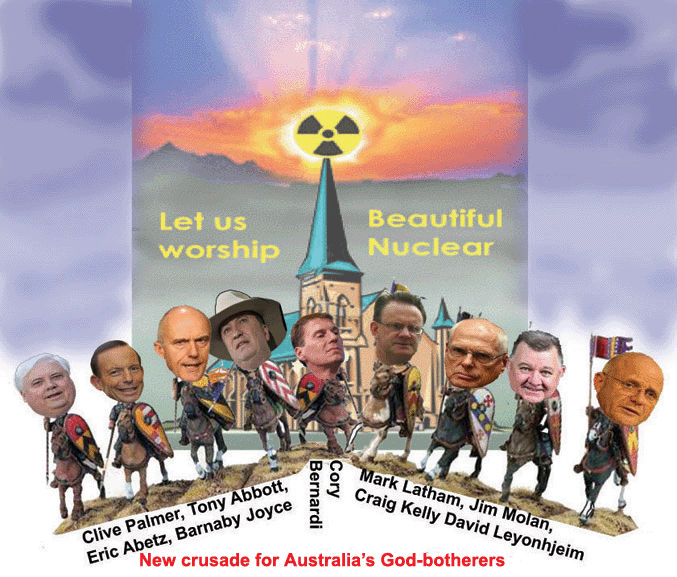
Nuclear power exits Australia’s energy debate, enters culture wars https://reneweconomy.com.au/nuclear-power-exits-australias-energy-debate-enters-culture-wars-47702/, 13 June 2019 What do these politicians and ex-politicians have in common: Clive Palmer, Tony Abbott, Cory Bernardi, Barnaby Joyce, Mark Latham, Jim Molan, Craig Kelly, Eric Abetz, and David Leyonhjelm?
Energy Minister Angus Taylor contemplates reversing Australia’s nuclear energy ban
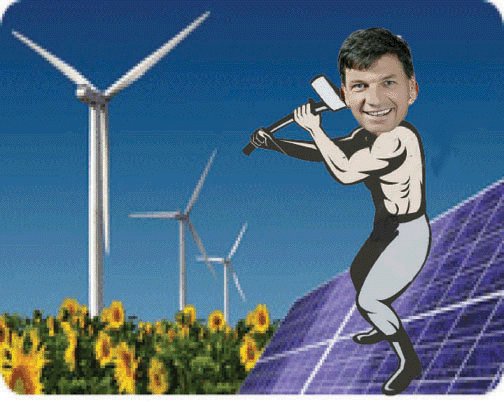 Angus Taylor won’t rule out reversing nuclear energy ban if business case stacks up Angus Taylor won’t rule out reversing nuclear energy ban if business case stacks up
Energy minister dodges questions about how Australia will meet its Paris emission reduction targets, Guardian, Amy Remeikis Angus Taylor has not ruled out reversing the nuclear energy ban and remains confident Australia will meet its Paris emission reduction targetsThe energy minister, Angus Taylor, has not ruled out the Morrison government reversing the nuclear energy ban, if a “clear business case” showed the economics were sound as he dodged questions about how Australia would meet its Paris agreement targets. The first energy battle of the new parliament comes from within the party room, with a group of Queensland MPs, emboldened by that state’s strong showing for the Coalition in the May election, leading a push to have nuclear energy reconsidered as part of Australia’s power plan. While a peak lobby group representing the sector says a carbon price would be needed for nuclear to be an economically viable alternative, Australia’s law against nuclear power is another impediment. But Taylor says the government would consider nuclear power if the economic case stacked up. I think, again, the prime minister has made many questions on this in the lead up to the election … right now it is illegal to build a nuclear power station and as he has said when there is a very clear business case which shows the economics of this can work, we are more than willing to consider it,” he said. Pushed on what that business case would look like, Taylor said he would not give “a lecture on business cases”. I mean it is pretty straight forward, I mean the prime minister answered this question on a number of occasions before the election, there needs to be a clear business case,” he said, before being asked directly if the government would change the law in the event a case presented itself. “As I say, let’s not put the cart before the horse, if there is a clear business case there is a clear business case,” he said. The nuclear question is not the only quandary facing the Morrison government in the energy space, as discussions over the rules for the Paris emissions reduction target continue within the international community. The main debate centres around whether countries which exceeded their Kyoto targets can use the excess abatement as credit towards their Paris targets. In Australia, that amounts to about 367 megatonnes, which Taylor has previously described as “relatively small” in terms of the nation’s carbon budget, but “apocalyptic” to the economy if not used. Repeatedly asked what the government’s plan was in the event it was decided carryover credits could not be used, Taylor did not have an answer and instead reiterated that Australia had met its past targets…….. https://www.theguardian.com/australia-news/2019/jun/12/angus-taylor-wont-rule-out-reversing-nuclear-energy-ban-if-business-case-stacks-up |
|
Home affairs minister Peter Dutton “knew nothing” about police raids on Australian media offices, and a home!!
 Peter Dutton denies prior knowledge of AFP raids on ABC and News Corp, Guardian, Sarah Martin and Kate Lyons 5 Jun 2019
Following two consecutive days of raids on journalists who had reported on defence matters, Dutton sought to distance himself from the police investigations, saying they were independent from government./////https://www.theguardian.com/australia-news/2019/jun/05/peter-dutton-denies-prior-knowledge-of-afp-raids-on-abc-and-news-corp?CMP=soc_567&fbclid=IwA
Energy and Emissions Reduction Minister Angus Taylor delayed releasing data that shows greenhouse gas levels continue to rise
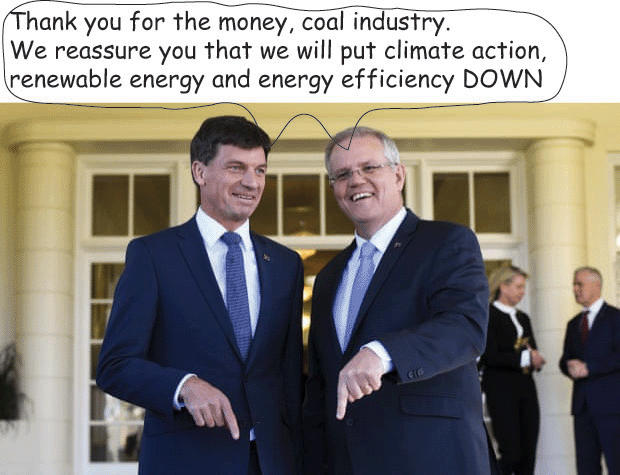 Delayed government data shows greenhouse gas levels continue to rise, Australia’s latest greenhouse gas data shows emissions are continuing to rise, with Labor saying it’s a “fantasy” that the nation will meet reduction targets. SBS, 7 June 19, Labor says it’s a government “fantasy” that Australia is on track to meet its emissions reduction targets, after delayed data showed greenhouse gas levels continue to rise.After missing a parliamentary deadline to report on greenhouse gas levels for the December quarter by last Friday, Energy and Emissions Reduction Minister Angus Taylor released the data on Thursday.
The December quarter figures show a 0.8 per cent increase compared to the previous quarter and a 0.7 per cent rise from the same time last year.
Despite the increase, Mr Taylor maintains Australia is on track to meet its Paris Agreement targets to reduce emissions by 26-28 per cent on 2005 levels by 2030.
“Our plan is laid out to the last tonne,” Mr Taylor told ABC radio on Friday. ……..
Mr Taylor took over responsibility for emissions reduction from former environment minister Melissa Price after the election.
He says Australia is now almost 12 per cent below its 2005 levels and emissions have decreased by 9.5 per cent in 30 years. However, government projections show more than half that target can be achieved through carryover credits from achieving goals of the Kyoto protocol.
Although Australia met its target in the first Kyoto agreement, it allowed for an increase of emissions.
Labor’s energy spokesman Mark Butler says it’s a government “fantasy” that Australia is on track to reach the Paris targets.
Mr Taylor’s announcement focused on the data per capita, while talking up the benefits of LNG.
“Today’s release shows once again that the Liberals will try every trick in the book to avoid scrutiny of their record on tackling climate change,” Mr Butler said.
Calls for a rethink on climate policy
Greens MP Adam Bandt has vowed to chase the government and department for answers over why the release of the data was delayed, and why it was given to select media before being made public.
Mr Taylor insists the government’s climate solutions plan will achieve the Paris target, primarily through paying companies and communities for projects to reduce pollution……..
Vivien Thomson from the Australian Firefighters Climate Alliance has warned that rising emissions are exposing communities to higher risks from more intense bushfires and other extreme weather events.
Ms Thomson says the climate-fuelled disasters stretch the mental and physical limits of firefighters, and cost billions in clean up and recovery costs.
The Climate Council says the government needs to rethink its approach to reducing emissions, as levels have increased over the past four years.
“The prime minister and his new cabinet have an opportunity for a fresh start. We cannot waste another three years,” Climate Council CEO Amanda McKenzie said. https://www.sbs.com.au/news/delayed-government-data-shows-greenhouse-gas-levels-continue-to-rise
Liberal National coalition’s “nuclear cowboys”

|
‘Crackpot stuff’: Coalition MPs’ call for nuclear power inquiry rejected by Greens, Guardian, Sarah Martin, 5
 June 19, Sarah Hanson-Young says the Nationals who have raised nuclear energy are ‘lunatic cowboys’ The Greens have labelled Coalition MPs pushing for an inquiry into nuclear power as “lunatic cowboys”, pledging to block any move to overturn Australia’s nuclear ban in the Senate. June 19, Sarah Hanson-Young says the Nationals who have raised nuclear energy are ‘lunatic cowboys’ The Greens have labelled Coalition MPs pushing for an inquiry into nuclear power as “lunatic cowboys”, pledging to block any move to overturn Australia’s nuclear ban in the Senate.As conservative MPs move to establish a Senate inquiry into nuclear power when parliament returns next month, the Greens senator Sarah Hanson-Young has invited the former Nationals leader Barnaby Joyce to debate her in the “town he thinks it should be built”. “Talk of overturning the ban on nuclear power in Australia is crackpot stuff,” Hanson-Young, who is the party’s environment spokesperson, said. “Aside from being a dangerous technology, nuclear power is wildly expensive and would take a decade or more to build. “It would be a funny joke if it wasn’t so embarrassing to have the Nationals, who are in government and who sit around the cabinet table, pushing for this. “These people are meant to be in charge, and they’re running around like a bunch of lunatic cowboys.” The comments from the Greens come after Queenslanders Keith Pitt and James McGrath indicated they would push for a select committee into nuclear power in the first week of parliamentary sittings in July, saying technology has changed since the country last reviewed its prospects in 2006……… The New South Wales deputy premier, John Barilaro, has also thrown his support behind the nuclear push, saying despite the debate over emissions reduction the nuclear “solution” was seen as too “politically risky”. “Now is the right time for Australia to begin a mature and fact-filled conversation on the benefits of nuclear energy,” Barilaro said. The Australian Nuclear Association has supported the new inquiry, saying deep cuts to emissions would be best achieved with nuclear power, with thetechnology cost competitive with coal and gas if carbon pollution is priced. The association’s Robert Parker said removing the ban on nuclear power that currently exists in the Environment Protection and Biodiversity Conservation Act would enable industry to start negotiations with suppliers about building a nuclear power plant at the lowest possible cost. But Hanson-Young said the Greens would be pushing to strengthen the EPBC Act and would fight any moves to water down the ban on nuclear. “We need stronger environment laws that continue the ban on nuclear energy,” Hanson-Young said. “Nuclear energy is an old technology that Australia doesn’t need and has outgrown. We are moving toward a renewable energy future. It’s happening, it’s here and the government should be enabling it, not trying to revisit a dangerous and outdated technology.” https://www.theguardian.com/australia-news/2019/jun/05/crackpot-stuff-coalition-mps-call-for-nuclear-power-inquiry-rejected-by-greens |
|
|
Australia heads for authoritarian rule, as Federal Police under government control, threatens press freedom
 The AFP media raids aim to suppress the truth. Without it we head into the darkness of oppression https://www.theguardian.com/australia-news/2019/jun/05/the-afp-media-raids-aim-to-suppress-the-truth-without-it-we-head-into-the-darkness-of-oppression
According to the Australian Federal Police Association’s president, Angela Smith, there was a widely shared feeling across the AFP that the body had “lost autonomy”. “It’s an embarrassing situation,” Smith was quoted as saying. “We look the least independent police force in Australia.”
In the wake of the AFP’s raids on a leading News Corp journalist Annika Smethurst on Tuesday and the ABC on Wednesday, the position of the AFP has gone from embarrassing to deeply disturbing.
Even Rupert Murdoch’s News Corp, the cheerleaders of the re-election of the Morrison government, seemed in no doubt as to the political purpose of the raid on Smethurst two weeks after a federal election. It was, News Corp said in an official statement, a “dangerous act of intimidation”.
Implicit in News Corp’s statement is that this is not an act of policing, but an act of politics.
What are we to make of two raids in two days as anything other than a symptom of deeply disturbing developments at the heart of our democracy?Smethurst’s story was over a year old. It was about a plan to allow the National Signals Directorate, for the first time, to directly spy on Australians by “hacking into critical infrastructure”.
In a statement the AFP attempted to justify its raid on Smethurst by arguing the disclosure of “these specific documents undermines Australia’s national security”. But how can our knowing about a possible major change to our freedoms as citizens in any way threaten our national security? The AFP doesn’t tell us because there is no argument they can make, only an unfounded assertion that they can repeat, mantra-like.
If mass surveillance is brought in, how will we know about it? Is national security best served by the inevitable abuses of such a scheme about which we are never told and which would go unpunished? Would national security be enhanced or weakened were Mr Dutton to use such powers for political advantage or to enable political persecution without our knowledge?
And if we cannot know the truth of such fundamental matters, what security as a democracy do we have?
If one raid was “a dangerous act of intimidation” what are we to make of two raids in two days – the second of our national broadcaster – as anything other than a symptom of deeply disturbing developments at the heart of our democracy?
The story in this case was not one but two years old, a major exposé of how Australian special forces soldiers had killed unarmed men and children in Afghanistan. On what possible grounds is it a good thing to not know atrocities have been committed by our nation?
How is our national security threatened by revealing crimes done in our name? Surely we are best served as a nation by a military that we can be confident acts within certain boundaries that are deemed acceptable in war and does not go beyond them?
In all this we cannot pretend to be surprised. The repression and culture of lying, deceit and evasion of public accountability that cloaked previous Liberal governments’ refugees policy is now coming home to haunt us all.
It was after all under Scott Morrison’s stewardship of the immigration portfolio that the notorious section 42 of the Border Force Act was enacted, allowing for the jailing for two years of any doctors or social workers who bore public witness to children beaten or sexually abused, to acts of rape or cruelty. The new crime was not crime, but the reporting of state-sanctioned violence on the innocent.
National security was invoked then to justify the enforcement of a national silence over what were no more or less than crimes.
And so it is again.
The consecutive timing of these acts represents not just a moment when a government crackdown on journalism began. The method may be to intimidate any whistleblower or journalist who would wish to reveal crimes committed by our government or in the name of our government.
But the aim is to suppress the truth.
And without the light of truth shining on what happens in public life we head into the darkness of oppression.
The Morrison government will soon seek to assume the high moral ground by diverting public discussion to the need for religious freedoms. But until I see Hillsong being raided by Dutton’s stooges, with the feds occupying their offices, accessing all their phone and computer records, I am not buying any of it.
This is a new government uninhibited, and it would now seem, unhinged. It does seem extraordinary that two cases, each of long standing, would immediately after an election, suddenly be activated to this level of public attention without ministerial knowledge. And yet, we have Dutton’s word it is not so. And were a news organisation subsequently to report, based on government documents, that the truth is otherwise, who knows who might come knocking on their door in the interest of national security?
Under his home affairs super ministry, Peter Dutton has more overt and covert power than any minister in our history. And this week officers of his ministry have been willing to use their powers recklessly against those practices that make us a democracy.
After the raids of the last two days, Australians would be justified in feeling fearful about their future. The politicians who might speak for us have long ceased to do so. And the journalists who still can, now risk everything if they publish political secrets that may be in our interests to know but are in our political masters’ to keep hidden.
The Morrison government could not have signalled its turn to the new authoritarianism that is poisoning so many other democracies with any clearer message. Get ready for the future, because it may already be here.
Extraordinary Federal Police action! Raiding ABC offices and home of a News Corps editor
Mr Dutton’s office yesterday referred all queries to the AFP and did not responded to a list of questions from news.com.au from early this morning.
“Minister Dutton must explain what he knew about these two raids … freedom of the press is an essential component of our democracy.”
|
Australian media is bracing for more “heavy-handed” Federal Police raids, after extraordinary searches of the ABC and a News Corp editor’s home. https://www.news.com.au/finance/business/media/federal-police-raid-abc-offices-in-sydney-over-a-2017-story-about-afghanistan/news-story/3bb1fbe51571d757ca05bb8da0b763d1 Shannon Molloy 5 June 19, Australia’s media industry is bracing for more “heavy-handed” raids by the Federal Police, following the extraordinary searches of the ABC today and a journalist’s home yesterday. Several officers remain inside the Sydney headquarters of the public broadcaster, trawling through more than 9200 items in relation to reports published two years ago regarding alleged unlawful killings and misconduct by Special Forces troops in Afghanistan. It comes just a day after the Canberra home of Annika Smethurst, political editor of News Corp Australia’s Sunday newspapers, was stormed by seven AFP officers who spent seven hours poking through her personal items, including her underwear drawer. Claire Harvey, deputy editor of The Sunday Telegraph, said she was concerned more journalists would be targeted in what was clearly an attempt to intimidate. “All media organisations should be concerned about who’s going to be next,” Harvey said on ABC News today. “There will be more raids. That’s inevitable. There are plenty of stories I can think of that the government might be targeting next.” The AFP raids, which News Corp Australia — publisher of news.com.au — has described as “outrageous and heavy-handed”, “aren’t about a genuine search for information”, Harvey said. “Seven Federal Police officers spent several hours going through every drawer in (Smethurst’s) home, the kitchen drawers and underwear drawer. Her cookbooks, they went through every page. “It’s interesting they haven’t searched Annika’s office. “This is a really chilling example of what happens when government thinks they aren’t going to be held to account.” The incredibly broad scope of the search warrant executed at the ABC’s offices today should be a concern for all media organisations, Harvey said. STORIES THAT SPARKED CRACKDOWN Continue reading |
1 This month

of the week – Australians for War Powers Reform (AWPR)
To see nuclear-related stories in greater depth and intensity
 Antinuclear