4 earthquakes in South Australia’s far North within the past week
 SPATE OF EARTHQUAKES HIT SOUTH AUSTRALIA’S FAR NORTH, Coober Pedy Regional Times, 24 March 12, A spate of earthquakes all within a week of each other have occurred in South Australia’s Far North with three strikes on the APY Lands. A significant 6.1 earthquake struck near Ernabella (Pukatja), Fregon and Indulkana on the APY Lands at 8.25pm South Australian Daylight Savings Time CDT Friday night 23 March 2012. ..
… Three further earthquakes have struck South Australia’s Far North in the past week.
16 March a 4.3 earthquake struck in the Musgrave Ranges near Ernabella at a depth of 15 km.
20 March a 3.8 earthquake struck in the Musgrave Ranges near Ernabella at a depth of 10 km.
21 March a 3.9 earthquake struck between Oodnadatta and William Creek in the Arckaringa Basin at a depth of 0.007km. http://cooberpedyregionaltimes.wordpress.com/2012/03/24/spate-of-earthquakes-hit-south-australias-far-north/
Lynas’ Mt Weld rare earths mines found to have out-dated safety permits
 Lynas’ Mt Weld Rare Earths Mines Safety Permits Outdated : http://community.nasdaq.com/News/2012-03/lynas-mt-weld-rare-earths-mines-safety-permits-outdated.aspx?storyid=125132#ixzz1oO63K2tj NASDAQ 3/5/2012 by Esther Tanquintic-Mis The controversy now has hit home. With Lynas Corp. still to fully arrest and win over the controversy surrounding its Lynas Advanced Materials Plant (LAMP) in Malaysia, here comes yet another information that could possibly whip up a storm right where its home base is.
In a statement released to media news agencies worldwide, the Anti-Nuclear Alliance of Western Australia (ANAWA) is set to file a motion today, Mar. 6, at the Environmental Protection Authority (EPA) to question the authenticity and effectiveness of the health and safety approvals issued to Lynas Corp. in reference to its Mt Weld rare earths mines in Western Australia.
According to the Free Malaysia Today, it was the Environmental Defenders Office of Australia that issued the media statement.
Marcus Atkinson, ANAWA spokesperson, alleged Lynas Corp. had made a number of alterations on the original health and safety approvals issued more than a decade ago for the operations of Mt Weld that did not undergo through the appropriate standard operating procedures relative to updating or modifying obsolete approvals.
“Lynas are currently operating under approvals issued to them 14 years ago,” Atkinson said, noting the terms and conditions contained in the original approvals could possibly no longer hold true to this day, specially “the amounts of radioactive materials being transported from Mt Weld through Fremantle Port.”
The Australian non-governmental organization urged the EPA to scrutinize the present operations at Mt Weld versus was what contained in the original health and safety approvals. “Health and safety issues need to be thoroughly examined to ensure the best protection of those involved in the handling of this material,” he said.
“The approvals given 14 years ago need to be re-examined by the EPA and stronger regulations need to be put in place to ease the fears of the community.” ANAWA also called for “extremely stringent” safeguards to protect Fremantle residents and other communities along the transport routes.
“We have made many mistakes in the past with the transport of lead and other materials, and we need to ensure that the same mistakes are not made with rare earth products,” Atkinson said.
Lynas Corp. is currently embroiled in a bitter battle against residents and political wannabes in Malaysia over its $200-million rare earths processing plant project in Gebeng, Kuantan.
Olympic Dam uranium mine at risk from earthquakes
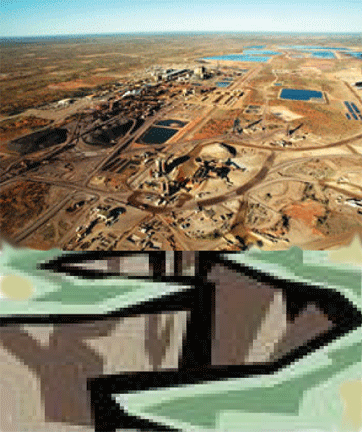 from our Seismology Watcher, 28 feb 12, Australian Yet another timely warning for Quarry Australia following seismologist, Edward Cranswick’s peer-reviewed paper on the 35-km-long, steeply dipping Mashers Fault which passes through the middle of the Olympic Dam ore body. The fault length implies an earthquake of maximum about 7.
An observation by Cranswick is that censoring of Australian lists of earthquakes and their corresponding source parameters, (i.e., time, location, depth, magnitude) has taken place.
Cranswick, who investigated earthquakes for the US Geological Survey for 22 years, suggests that the connection between mining and sesmicity (earthquakes) is obscured in Australia particularly the seismic hazard of the OD project in SA. Seemingly, BHP’s proposed expansion and potential radioactive fall-out at the Olympic Dam project in the event of a “natural” catastrophe reveals scant regard for public health and safety. However, there is nothing like an outraged Momma Nature (whose **se is being chewed by the mining industry) to make an ecocidal event, a grim reality.
Cranswick also makes reference to the Barrick/Newmont super pit and its connection to the unprecedented 5.2 magnitude earthquake that occurred in the stable continental region of Kalgoorlie/Boulder in April 2010. And what a pitiful mess that made of the historic buildings in the main street of Boulder which is about a kilometre from the super pit.
En garde my fellow Australians, asleep at the wheel.
Australian company involved in a nuclear power mess in Egypt
 As usual, trouble for Australian uranium, or nuclear-involved countries overseas, does not reach the Australian media. The troubles and losses of Paladin uranium company, over recent years, in Africa, have been ignored.
Likewise Australian company Worley Parsons has not suffered in the media, the embarrassment of its involvement with the fiasco that is Egypt’s new nuclear reactor
“WorleyParsons has the contract with the Egyptian Nuclear Power Plant Authority (NPPA) for a consultancy services contract to support the delivery of the first Egyptian Nuclear Power Plant…. a major milestone in the development of nuclear power generation in Egypt and WorleyParsons is very proud to be associated with the NPPA in this exciting project… It also demonstrates our leading position in the global nuclear new build arena.” – from Worley Parsons website
Soldiers and the demonstrators threw stones at each other and exchanged gunfire after the protesters demolished a wall surrounding the site, a security source and witnesses said…

 Radioactive material stolen from Egyptian power station: report Reuters Jan 19, 2012 CAIRO – Radioactive material has been stolen from a nuclear power station on Egypt’s Mediterranean coast that was the scene of violent protests last week, the state-run al-Ahram newspaper reported on Thursday.
A safe containing radioactive material at the Dabaa nuclear power plant, which is still under construction, was seized while another also containing radioactive material was broken open and part of its contents taken, the newspaper said. Continue reading
Northern Territory radioactive river spill causes wave of concern
Environment Centre NT calls for EPA investigation radioactive spill, 2 Jan 2012 The train derailment at Edith River spilling 1200 tonnes of copper concentrate into the flooded environment, which may have contained 0.01% of uranium, has urged the Environment Centre NT to call on the EPA for a full investigation.
“We have now learnt that the NT Government approved the transport of these toxic materials in substandard casing, covered only by a tarp. We want to know which department and which minister had signed off on this outrageous exemption” Said Cat Beaton, Nuclear Free NT Campaigner at the Environment Centre NT.
“This incident is a serious warning, that must trigger serious action. We will be writing to the EPA requesting a full investigation”.
“NT Government should not approve any increased transport of radioactive materials by rail until such an independent investigation has been undertaken,” continued Ms Beaton.
 The Northern Territory is at the dawn of increased transport of toxic and radioactive materials. The expansion of BHP’s Olympic Dam mine in SA is set to see 1.6 million tonnes a year of uranium infused copper concentrate transported daily by 1.8km long trainloads for the next 80-plus years.
The Territory could also face the reality of radioactive waste transport for a proposed nuclear waste dump at Muckaty, 120ks north of Tennant Creek.
“Right now the Territory Government cannot be trusted to ensure the safe transport of dangerous goods and we all need to think about the risks to our rivers, environment and the outdoors lifestyle that Territorians enjoy,” concluded Ms Beaton.
Northern Territory train derailment raises danger of uranium transport in tropical weather
 Audio Questions raised over toxic goods transport in the Northern Territory ABC Radio AM December 29, 2011 While government officials are investigating the cause and the environmental impact of a serious train derailment in the Northern Territory, a Territory Environment group has raised questions over the safety of transporting uranium in tropical weather conditions.
Michael Coggan MICHAEL COGGAN: Forty-eight hours after floodwaters swept part of a large freight train into the Edith River and cut off the Stuart Highway north of the Top End town of Katherine, several investigations are underway into the cause of the train derailment and the environmental impact of tonnes of copper concentrate spilled into the flooded Edith River from the freight train.
Jim Grant is the head of the Northern Territory Environment Department. JIM GRANT: Well it’s not a highly toxic substance but it’s not to be ingested or inhaled. We think it’s washed all over the place…..
MICHAEL COGGAN: Environment Centre director Stuart Blanch says the accident shows why dangerous goods including uranium oxide should not be carried on the Alice Springs to Darwin railway.
STUART BLANCH: A much bigger risk to Top End rivers would be derailment of trains carrying uranium oxide from the Roxby Uranium Mine in South Australia. The Territory Government should call a halt on approving the transport of more and more trains of uranium oxide up to Port Darwin until there are really adequate, safe measures in place to stop such a derailment ever happening with uranium on the track.
MICHAEL COGGAN: But Chief Minister Paul Henderson doesn’t want to speculate about the implications for the transport of uranium in the Northern Territory…. http://www.abc.net.au/news/2011-12-29/questions-raised-over-toxic-goods-transport-in-the/3750842?section=nt
The Nuclear Terrorism Legislation Amendment Bill – new law coming to Australia
Australian Lawmakers to Consider Nuclear Terror Bill, NTI Nov. 28, 2011 Lawmakers in Australia have received a bill intended to bolster the nation’s posture against nuclear terrorism, Australian Attorney General Robert McClelland announced on Wednesday (see GSN, May 8, 2009). The Nuclear Terrorism Legislation Amendment Bill 2011 would institute as national law the requirements set on member nations to the International Convention for the Suppression of Acts of Nuclear Terrorism.
“This bill sends a strong message to the international community demonstrating Australia’s continued commitment to addressing the threat of terrorism,” McClelland said in a press release. “It will also strengthen Australia’s case in encouraging our neighboring countries to ratify the 16 international counterterrorism instruments.”
The legislation increases the number of criminal offenses covered by the 1987 Nuclear Nonproliferation (Safeguards) Act that bans the illicit application of radioactive substances and nuclear plants. It sets a two-decade maximum punishment for crimes listed in the 24-year-old law.
“Acts of nuclear terrorism, including conduct relating to radiological and nuclear material, may result in grave consequences and pose a threat to international peace and security,” McClelland said. “We need to make sure that any act of nuclear terrorism is treated as a criminal offense” (Australian Attorney General Robert McClelland release, Nov. http://www.globalsecuritynewswire.org/gsn/nw_20111128_5611.php
Secrecy and security violations in Silex laser uranium enrichment technology
 NRC fines GE-Hitachi $45K over NC nuke test site, October 21, 2011 Bloomberg By EMERY P. DALESIO, RALEIGH, N.C. The U.S. Nuclear Regulatory Commission has fined GE-Hitachi Nuclear Energy $45,000 for multiple security violations at a North Carolina facility using classified technology to test whether lasers can be used to enrich uranium. Continue reading
Deep mining might increase Australia’s earthquake risks
about every five years there’s a potentially devastating quake of magnitude 6.0 or more.
some scientists have suggested that mining might have been to blame in that case [Earthquake in Newcastle 28 December 1989,] …..Some experts think this [ deep-core mining] might be enough to destabilise pre-existing faults in the Earth’s crust, and to trigger an earthquake. Certainly, human activity – like large dams being filled – has been linked to quakes overseas….
Earthquakes in Australia, AUSTRALIAN GEOGRAPHIC BY:EMMA YOUNG | OCTOBER-6-2011 Earthquakes don’t only occur near our neighbours Japan and New Zealand – they’re common in Australia too “……..Australia doesn’t sit on the edge of a tectonic plate. However, the Indo-Australian plate, at the centre of which our continent lies, is being pushed to the north-east at about 7cm per year. It’s colliding with the Eurasian, Philippine and Pacific plates, causing stress to build up in the 25km-thick upper crust. This build-up of pressure within the plate can cause earthquakes in Australia.
In fact, Australia has more quakes than other regions that sit in the middle of plates and are considered relatively stable, Continue reading
UN report on Nuclear Safety has implications for Australia
Today, 22 Sept 11, a special UN meeting will examine responses to Fukushima and the role/safety of nuclear power.
UN Secretary General Ban Ki Moon commissioned a multi-agency report to help guide this discussion.
It is available via http://www.reachingcriticalwill.org/political/energy/hlm/UN-system-wide-study.pdf
 Dave Sweeney Comments on the United Nations system-wide study on the implications of the accident at the Fukushima Daiichi nuclear power plant – September 2011
The report has been primarily drafted by the pro-nuclear International Atomic Energy Agency and is framed with the assumption that nuclear power is here to stay – Nuclear power has been and will remain a significant contributor to meeting global energy needs (16)
Within this flawed context there is much value and campaign utility in the report. Continue reading
Lucas Heights nuclear reactor safe? well, nearly!
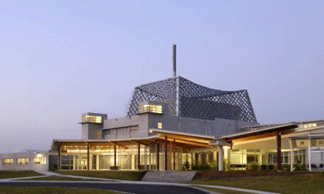 Despite the existence of maintenance plans, “staff argue that maintenance is only undertaken for the most urgent matters,” it said.
The report also recommended the organisation allow staff to report safety problems directly to the radiation safety watchdog and Comcare if managers failed to respond to their concerns….In 2009-10, ANSTO Health had one breach of its licence and 56 radiology “events or near misses.”..
Lucas Heights cleared of safety breaches: report | The Australian, Siobhain Ryan, May 31, 2011 AUSTRALIA’S nuclear research agency has been cleared of safety breaches and a culture of cover-ups in a report tabled in Canberra yesterday. But the Government-appointed panel that authored the report said the Lucas Heights reactor in Sydney’s south was ageing, staff were worried that maintenance occurred only for the most urgent matters, and an even more open approach to reporting health and safety problems should be adopted……. Continue reading
ANSTO making efforts to clean up its tarnished safety image
Nuclear agency safety culture ‘stuck in 70s’ | The Australian, Leigh Dayton, 25 May, 11,“……..Dr Paterson said he was instituting the “safety culture approach” adopted by the nuclear power industry. To assist what he called this “safety journey”, Sydney-based workplace resolutions company CoSolve has been hired. As well, recalcitrant staff are encouraged to move to another ANSTO job.Industry observers will be watching closely, following the Easter weekend incidents involving the handling of low-level laboratory waste and a batch of radioactive molybdenun-99. Dr Paterson disputed allegations they were not handled properly.ANSTO also disputed reports in The Australian last March that staff had been suspended after raising safety concerns and that others were bullied….”
Radioactive danger to Australia of Indonesian nuclear plants
 impacts on northern Australia of even a small release could potentially be devastating to agricultural production and tourism.”
 VIDEO Top End warning over nuclear reactor fallout | News | NT News | Darwin, Northern Territory, Australia | ntnews.com.au NT News | Darwin, 5 April 11, THE Top End is in danger of being devastated by a nuclear fallout cloud should Indonesian reactors melt down, computer modelling shows.The Australian National University’s Centre for Resource and Environmental Studies working paper shows there is “substantial risk” for the whole of northern Australia – particularly during the monsoon months. Continue reading
Questions over impartiality of Australia’s nuclear safety watchdog
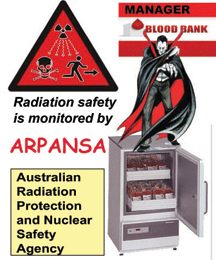 ARPANSA last year released two conflicting reports on the claims at Lucas Heights
Australian nuclear agency under review Australian Broadcasting Corporation, Lateline, 30/03/2011 Australia’s nuclear industry regulator, ARPANSA, is under review over its handling of safety breaches at the Lucas Heights nuclear reactor.
TONY JONES, PRESENTER: Australia’s nuclear industry regulator, ARPANSA, is under review over its handling of safety breaches at the nation’s only nuclear reactor. Continue reading
Canadian company to transport uranium through W.A.
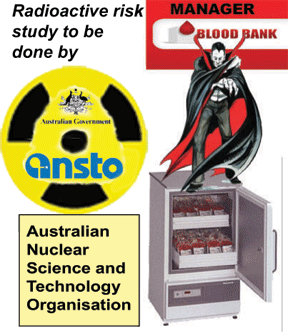 The transport risk study will be conducted by the Australian Nuclear Science and Technology Organisation…..The public comment period on the Cameco environmental scoping document closes on April 11
Cameco’s long uranium trek through WA | Perth Now, Nick Evans, March 28, 2011 CAMECO Corporation has pushed on with its plans to seek environmental approval for its WA uranium mine, despite turmoil on the international uranium stage after the recent disaster in Japan.The company released its environmental scoping document today, calling for public submissions on its plans to gain environmental approval for the proposed uranium mine, southeast of Port Hedland…… Continue reading
1 This month
17 October, Free Public Talk on Nuclear Issues in South Australia
David Noonan will speak on public interest concerns over the new Roxby Downs Indenture Act 2026 on BHP copper-uranium mining and ore processing in SA, and on how AUKUS may face SA with a High-Level nuclear waste agenda.
Dr Jim Green will discuss international developments in the field of nuclear power including ‘small modular reactors’ and Generation 4 ‘advanced’ nuclear reactor concepts.


Help Aunty Sue Protect Her Land and Sacred Sites From Destructive Rocket Testing.
.

Australians deserve the truth
about
AUKUS – https://aukuspublicinquiry.com/

PETITION – To: Prime Minister Anthony Albanese and the Australian Labor Government

of the week – Australians for War Powers Reform (AWPR)
To see nuclear-related stories in greater depth and intensity

