Unusually for a suburb, Lucas Heights does not contain a residential area. The residential area previously part of Lucas Heights was renamed Barden Ridge in 1996 to increase the real estate value of the area, as it would no longer be instantly associated with the HIFAR nuclear reactor. [and now the Opal nuclear reactor]
Residents warned not to leave, Sydney fire worsens SMH, By Jacob Saulwick,
Fire authorities have issued an emergency warning for some suburbs in south-west Sydney, telling residents to seek shelter.
At about midday on Sunday, residents in Voyager Point, Pleasure Point and Sandy Point were advised not to leave their properties and to protect themselves from the heat of an out-of-control fire.
Residents in Alfords Point, Menai and West Barden Ridge were advised to shelter in place as the bush fire approached.
“It is too late to leave,” the Rural Fire Service said in a statement.
“Firefighters are in these areas and are in place to undertake property protection as required,” the RFS said……
Electricity company Ausgrid, meanwhile, said there might be short interruptions to power supply.
Heat from the bushfires was affecting Transgrid’s high-voltage power lines, Ausgrid said, causing voltage dips. Rail services across Sydney were disrupted on Sunday morning……
Electricity company Ausgrid, meanwhile, said there might be short interruptions to power supply.
Tight security for shipment of nuclear waste from Lucas Heights to France, THE AUSTRALIAN, SIAN POWELL, 12 APR 18
A top-secret security operation to send spent radioactive fuel rods from Australia’s nuclear reactor to France for reprocessing is planned for the coming months.
Potentially involving hundreds of state and federal police, the details of the transport operation will remain confidential until after the shipment arrives at La Hague, in northwest France.
Unused uranium and plutonium will then be removed from the fuel rods, and the residual waste eventually returned to Australia for storage. About 500kg of unused low-enriched uranium and 4.5kg of unused plutonium will be recovered from the rods…
The Australian Nuclear Science and Technology Organisation at Lucas Heights in Sydney’s south has confirmed the shipment will be trucked to a port for transport to La Hague midway through this year.
The route, the port, the time and the ship, as well as the numbers of security personnel, will remain confidential until after the mission is completed.
The last shipment of spent rods was sent to the US in 2009, and both Port Kembla and Port Botany have been used as shipment ports in the past.
When reprocessed nuclear waste was returned to Australia in 2015 for storage at Lucas Heights, more than 500 police were deployed to guard the shipment, and it is expected at least that number will guard the radioactive cargo destined for France.
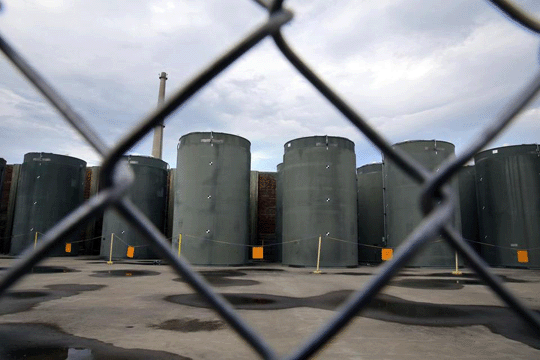
The radioactive spent fuel rods will be packed into an undisclosed number of immensely tough lead and stainless steel transport casks for the journey to France.
“These casks are purpose-engineered to safely transport this type of material without risk to people or the environment,” said the manager of the multipurpose OPAL Reactor at Lucas Heights, Dave Vittorio. “Even a jet plane strike could not penetrate them.”
The total cost of the project is $45 million, including the contract with France, equipment, staff costs, and incidentals.
Ten years worth of nuclear waste from Australia’s only reactor will be exported for reprocessing in a secretive high-security operation later this year.
Key points:
The spent fuel rods will be reprocessed in France, then returned to Australia
Australia’s only nuclear reactor is located at Lucas Heights in Sydney’s south
The timing and route of the operation are a closely guarded secret
Spent nuclear fuel waste from the Open-Pool Australian Lightwater (OPAL) reactor will be taken to a French facility, then return Down Under for storage.
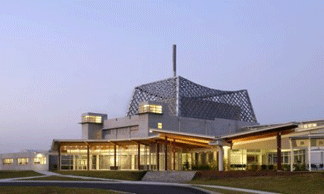
The OPAL reactor — located at Lucas Heights in Sydney’s south — has a radioactive “core” about the size of a bar fridge and produces radioisotopes for industrial and medical use, including cancer treatment.
It is operated by the Australian Nuclear Science and Technology Organisation (ANSTO).
Over the past decade, spent fuel rods have filled up a storage pond that sits aside the reactor, which is the size of a small swimming pool.
The rods are now due to be sent to France’s La Hague plant sometime in the middle of the year, but the date and route to the port remain confidential.
The La Hague plant deals with almost half of the spent fuel reprocessing from the world’s light water reactors.
It is the 10th time ANSTO will export nuclear waste and the first time for a decade.
The other nine times involved waste from ANSTO’s older High-Flux Australian Reactor, which was decomissioned in 2007 after 50 years of service.
Nuclear waste a controversial topic
There are approximately 100 nuclear waste storage sites around Australia.
Several Sydney councils have banned the transport of radioactive material within their boundaries.
The process has also been the subject of protest campaigns by organisations including Greenpeace and Friends of the Earth.
ANSTO Chief Nuclear Officer Hef Griffiths said spent fuel has been transported for reprocessing since the 1970s.
“In that time we estimate there’s been about 250,000 shipments like this worldwide,” he said.
“The safety record is pretty impeccable.”
Mr Griffiths said the casks used to hold the spent fuel assemblies are “designed to withstand the impact of a fully laden F-16 fighter jet crashing into it without any release”.
Jim Green, National Nuclear Campaigner for Friends of the Earth, said transporting spent nuclear fuel was not without incident.
“There are numerous documented examples of problems transporting spent fuel,” he said.
“In Germany and France in the 1990s there were serious contamination incidents which led German chancellor Angela Merkel to suspend the transport of nuclear fuel between the two countries.
“It’s dishonest for ANSTO to be claiming there’ve been no incidents of any consequence involving spent fuel transport,” Mr Green said.
Paul Waldon Fight To Stop Nuclear Waste Dump In Flinders Ranges SA Today the 18th of March is another red letter day in the nuclear arena with the 31st anniversary of a accident at Lucas Heights, but first lets jump forward 29 years to the Hawker nuclear community meeting on the 6th of May 2016, where a man named Bruce Wilson from the DIIS whom chaired such meeting, a man who could be a totally inept clairvoyant, a nuclear decision psychopath, a misinformed government payed nuclear spruiker, or just a sad ignorant man.
This is a man whom said “We will NOT have accidents” while the opposing dichotomy believes in the old dictum “Pray for the best, prepare for the worst” and the such dichotomy keeps giving a resounding NO to a deadly radioactive dump, which keeps falling on deaf ears of the liars who said they would walk away from a community that doesn’t want to accept it.
Now lets return to the anniversary of the 1987 accident where a fire at Lucas Heights nuclear research laboratory resulted in the contamination of two workers and the discharge of radioactive gas into the atmosphere over populated areas.
Yes, Bruce this was a accident, however there was an event two years prior to such accident that may be called a purpose when alleged vandals dodged security patrols and smashed a underground pipe, releasing radioactive effluent into river ways. (What was this pipe made of, maybe brittle 2mm plastic?).
Are we to believe Bruce that there wont be anymore accidents, maybe because accidents will be suppressed, or called a planed event, or re-classed as “Technically produced anomalies” just like the erroneous, magniloquent re-classing of high grade waste to intermediate waste in an attempt to try and push through a egregious program while attempting to insult the intelligence of the majority of informed South Australians who don’t want a risky radioactive dump here. https://www.facebook.com/groups/344452605899556/
Paul Waldon Fight To Stop Nuclear Waste Dump In Flinders Ranges SA, 16 Mar 18A successful safety test is one that shows the limitations or structural integrity of a product, just like car crash tests. Dry-casks have only had one successful safety test, where a cask was compromised with a less than 10 meter drop. However this had approximately 6 tonne of water which is a shortfall of the weight of nuclear fuel, plutonium being 1.8x heavier than lead, which shows heavy manipulated data can NOT always fuel the nuclear industries factoids.
71% of incidents was caused by human error, primarily in hospital based medical procedures. Radioactive waste had no statistically meaningful contribution within the Register.
Transporting radioactive waste across the country is bound to increase the probability of human error in previously unaffected environments nationwide; whilst placing a radioactive suppository in South Australia will not reduce human errors in hospitals.
The Advertiser can reveal the accident occurred on August 22 when a vial of the nuclear medicine product Molybdenum-99 was dropped when its cap was being removed during a quality-control test. The incident was rated “severe” by regulators and has led to changes in safety procedures.
Molybdenum-99 is produced by the Australian Nuclear Science and Technology Organisation at Lucas Heights, below, for use in cancer and heart disease scans.
ANSTO Health general manager Mark Moore said the analyst has a slightly elevated risk of developing skin cancer after the liquid spilt on their hands.
“The analyst was working in a shielded fume cupboard that, in normal operation, limits a dose received, but the dropping of the vial resulted in the radiation dose,’’ Mr Moore said.
“Our employee remains at work and is currently performing alternative quality assessment work in the nuclear medicine field.”
Mr Moore said the staff member had burn-like symptoms, including blistering and reddening of the skin.
“While ANSTO is still waiting to be advised on the final estimate dose by an independent clinical specialist, we know it was above the annual statutory dose limit of 500 millisieverts, and expect to be issued with a formal breach from the regulator,” Mr Moore said.
“At this stage, the dose is estimated to be more than 20 Sieverts, which is 40 times above the extremity dose limit.”
The incident was reported to the Australian Radiation Protection and Nuclear Safety Agency and the International Atomic Energy Agency.
An ARPANSA investigation criticised some safety practices in Lucas Heights’ radiopharmaceutical production facilities.
Liberal candidate raises safety concerns about Pirie’s former uranium plant site, Port Pirie Recorder, 25 Aug 17,Frome Liberal candidate Kendall Jackson is calling on the state government to restore the fence at the former Port Pirie Uranium and Rare Earth Treatment Plant and Tailings site.
She said the State Development Department was responsible for managing the area and was yet to release the Radiation and Environment Management Plan for the site.
This was expected to be released in the first half of this year.
“The government must publicly release its plans for the former uranium plant site,” Mrs Jackson said.
If Turnbull’s plan becomes law – and the prospects of the Opposition stopping anything to do with ‘fighting terrorism’ are remote – we can expect a terrorist attack to trigger an emergency response from the Special Operations Command, whose officers will have to be trained to shoot to kill other Australians.
As Australia becomes increasingly militarised, it is possible that the Tactical Assault Group could be called out for an anti-war demonstration, anti-mining protest, or industrial strike, and may be told that the people it confronts are enemies of the state and therefore terrorists. It makes me think of those signs you see on American suburban lawns: ‘Beware, Armed Response.’
Now that we have concrete bollards in Martin Place and Swanston Street and on Capital Hill, as well as fences to stop citizens strolling or rolling over the Parliament House grass, you’d think that in exchange for the aesthetic damage inflicted on us we must be safe. After all, Australia has had only five fatal terrorist attacks since the mysterious Hilton Hotel bombing in 1978. The risks we face from lightning strikes, sharks and crocodiles, or indeed bee-stings and falling furniture, are incomparably greater.
But terrorism is serious political business and once the threat of an attack is officially listed as ‘probable’, no government is brave enough to reduce it. Politicians have to be seen to be responding robustly to the danger. Continue reading →
The fireball, which was captured on CCTV by a business in Port Lincoln, was seen by hundreds of residents around midnight last Friday.
The Desert Fireball Network (DFN), which said in a statement it was tracking the fireball, said it was one of the brightest it had witnessed.
“It originated from within the solar system, having an orbit around the sun and that it went out almost as far as Mars,” DFN’s spokewoman Eleanor Sansom said.
The DFN said its Mount Ives observatory, which is located south of Lake Gairdner, captured an image of the fireball four minutes before midnight.
Hundreds of people took to social media after witnessing the bright light.
“What I can only guess was a meteor passed over Henley Beach,” one wrote on Reddit. “Saw it from the city, fast moving bright light, green trail, bright flash.”
Earlier this year, stargazers in Queensland were treated to the spectacular sight of a meteor blazing across the night sky from Bundaberg to the Gold Coast.
Experts said that meteor could have been travelling as fast as 10km per second.
Derek Abbott No High Level International Nuclear Waste Dump in South Australia Thought for the day: Nuke lobbyists love to state that more people die falling off roofs whist tinkering with their solar panels that people have died from nuclear power stations.
If we take the USA, for example, there are about 1 million (in 2016) domestic rooftops with panels. And yes, unqualified people do silly things on roofs when they shouldn’t be there.
By contrast there are about 60 commercial nuke power plants in the USA run under a strict set of guidelines. The waste from those plants is kept indefinitely above ground in dry casks that corrode and have a lifetime of ~50yrs. So when it comes time to start handling those dry casks and repackaging that fuel, on ever increasingly tight budgets, there is going to be a major safety problem.
The alpha particles emitted from the spent fuel in the casks create helium bubbles inside the fuel pellets. The fuel pellets crack. So repackaging the fuel is not simple, given one is dealing with fragments, dust, and particulate matter. This will lead to enormous escalating costs that have not been budgeted by governments. Repackaging runs into many tens of billions of dollars.
The dangers of falling off roofs are immediate, whereas the dangers of spent fuel management have been deferred into the future with dry cask storage that has not yet been taken to the next step. So the qualification of the danger of nuclear has not yet seen full practice.
Question to nuke advocates: given the choice would you ride a horse or a stroke a venomous spider? The statistics are zero deaths per year due to spiders, but 70-80 horse per year by horses. The facts are the raw statistics are not the whole story. Would you prefer to live in a world proliferated with horses, or would you prefer a proliferation of venomous spiders?
Peter Mahoney, Your Say site 17 Oct 2016 The Royal Commission report appears to be silent on the details of how these radioactive materials would be transported to South Australia, and what sort of defence force support would be required to ensure that they are not the subject of terrorist attack. Who would be responsible for ensuring that they are correctly and securely sealed in their containers in the country of origin, say India or Pakistan? How would an SA facility ensure that proper standards are being followed at every step. The consequences of undetected, small or slow leaks would be enormous if they occur all the way from the country of origin, across the oceans and then across the land to SA.
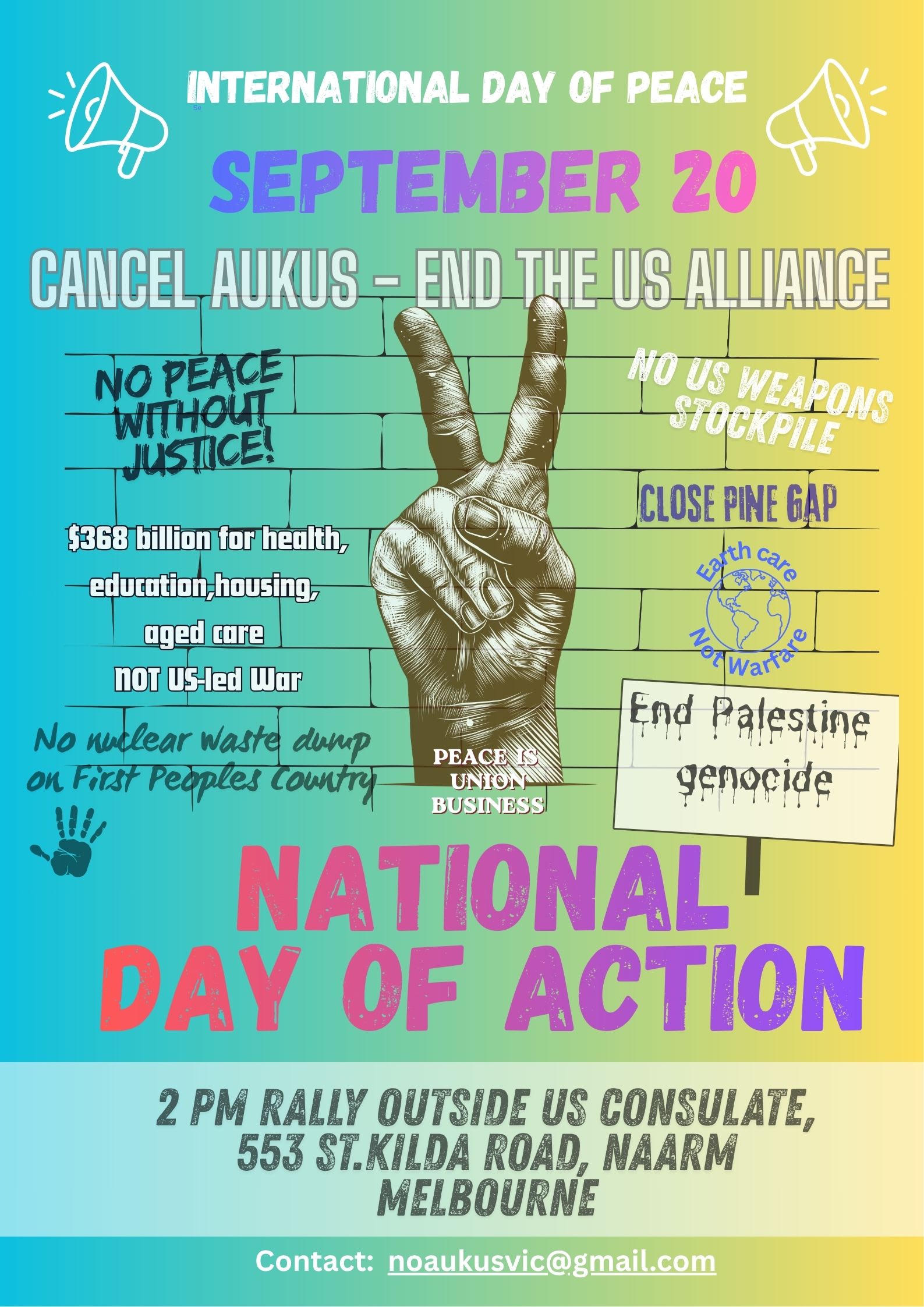
Officially called The Joint Defence Facility Pine Gap, the site is jointly run by the Australian and United States governments and is one of Australia’s most secret sites. The facility has been in operation since 1970 and is located half-an-hour’s drive south-west of Alice Springs.
Professor Richard Tanter, from the University of Melbourne, says Pine Gap contributes targeting data to American drone operations, including assassinations. “One of Pine Gap’s two key functions is as a control station and a downlink station for signal intelligence satellites 36,000 kilometres up in space,” he said. “They are picking up a very wide array of radio transmissions, including cell phones, satellite phones and so forth. “And that provides the data, both the contents and the geolocation data for targets of interest through the United States military.”
He said Pine Gap was also used for counter-terrorism and wider intelligence programs, as the site was able to contribute data “pretty directly — for example into drone targeting operations.”
Professor Tanter acknowledged that those type of programs were part of the alliance between the US and Australia, and Australia’s interest in the global fight against terrorism
But he said the question was whether it could be considered a good idea on a political level, seeing the potential for creating “further terrorism” if a strike were to go wrong.
“At a legal and moral level do we really want to be involved in operations which are frankly illegal under international law. In countries where we’re not at war, such as Pakistan or Somalia or Yemen, these are simply assassinations.”
“We won’t like it very much when it’s done back to us I suspect.”
Base also a likely target for nuclear missiles Professor Tanter said the site continued to be a “pretty high priority nuclear missile target” in the event of a major conflict between the United States and Russia or China.
“It would be, as they say in the military, a lucrative target of many benefits,” Professor Tanter said . “Secondly it is itself involved in nuclear war planning. I think that’s a totally awful thing for us to contemplate — you can’t use nuclear weapons except in a fairly genocidal way.”The Defence Department said that “the facility makes an important contribution to national security.”
A spokesperson said: “It provides intelligence on priorities such as terrorism, the proliferation of weapons of mass destruction, and foreign military capability and weapons developments. “It also supports monitoring of compliance with arms control and disarmament agreements, and provides ballistic missile early warning information.”
Paul Levai Interesting trip to ANSTO. A few concerns that I will post as some stage soon but the main one is that the intermediate waste that they propose to store here is our spent fuel rod waste from the old Lucas Heights HIFAR reactor that has been sent to France for reprocessing and must be returned to us as intermediate waste.
BUT the scary part is that rather than design and build a new container system for the ILW ( that would be easily identifiable) they decided to use an existing design container for HLW (high level waste) because its cheaper and easier and they think it will alleviate safety concerns (better and stronger).
BUT the problem is that NO ONE knows what the French could pack into these containers, we can’t open them and check…and the same container is used to store their high level waste from their Nuclear Power reactors…..so they could send us anything either deliberately or by mistake!
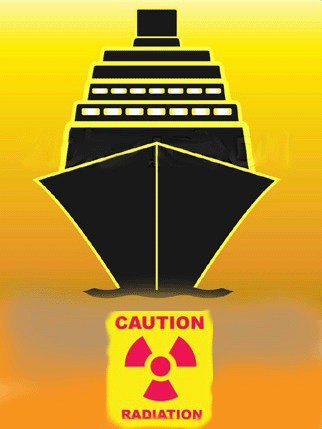
Australia completes first phase of its waste repatriation project ANSTO:The The shipment of repatriated waste left France on 15 October, arrived in Port Kembla on 5 December, and was safely transported to the interim storage facility at Lucas Heights the following day (6 December, 2015).
ANSTO thanks the State and Federal Government agenciesthat were involved in “Operation Cormorant”, particularly the NSW Police and Australian Federal Police who have worked tirelessly on the repatriation.









 Peter Mahoney, Your Say site 17 Oct 2016 The Royal Commission report appears to be silent on the details of how these radioactive materials would be transported to South Australia, and what sort of defence force support would be required to ensure that they are not the subject of terrorist attack. Who would be responsible for ensuring that they are correctly and securely sealed in their containers in the country of origin, say India or Pakistan? How would an SA facility ensure that proper standards are being followed at every step. The consequences of undetected, small or slow leaks would be enormous if they occur all the way from the country of origin, across the oceans and then across the land to SA.






 Antinuclear