Lyn BlumeFight To Stop Nuclear Waste Dump In Flinders Ranges SAHere is another good reason to not dump nuclear waste in SA as this is a seismic region in Australia, here is the most recent record. Earthquake Details
NW of Blinman, SA
Summary
Origin (UTC): 06/08/2018 22:35:45 Epicentral Time: 07/08/2018 08:05:45
Longitude: 138.511 Latitude: -31.000
Magnitude: 2.4 (ML) Depth: 10 km
Event Id: ga2018pkbnhd https://earthquakes.ga.gov.au/ Blinman is a town deep in the Flinders Ranges, in the mid-north of South Australia. It is very small but has the claim of being the highest surveyed town in South Australia. It serves as a base for large acre pastoralists and tourism. The town is just north of the Flinders Ranges National Park, is 60 kilometres(km) north of Wilpena Pound and 485 km north of Adelaide. https://www.whereis.com/search-results?query=Blinman%20SA….
Federal gov. names SA Ports to impose nuclear waste shipments Nuclear Brief (1st August 2018) by David Noonan, Independent Environment Campaigner
Amidst rising controversy, the Federal Industry Department (DIIS) has named proposed Ports in SA that may have to take shipments of irradiated nuclear fuel wastes to go on to a Federal dump site.
DIIS reports (p.179) two intended shipments of reprocessed nuclear fuel wastes into SA within the first 2 years of operations of a proposed National Radioactive Waste Management Facility (NRWMF).
A shipment of nuclear waste is due from Sellafield in UK and a shipment out of Port Kembla is planned from the ANSTO Lucas Heights reactor of nuclear waste received from France in 2015.
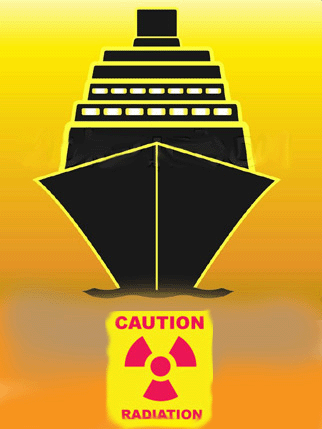
After years of secrecy over intended nuclear waste shipments to an SA Port, DIIS has now named Whyalla, Port Pirie, a new Eyre Peninsula commodities port (if built) and even Port Lincoln, as potential nuclear waste ports, in three “Site Characterisation, Technical Reports” released in July.
However, all of these ill-considered plans for nuclear waste ports face an array of serious obstacles
These targeted port communities are denied a say in Minister Canavan’s pending decision on siting a Federal dump in SA, they haven’t been consulted on use of their ports, and are excluded from ‘votes’ in the Hawker & Kimba districts over Aug-Sept on whether or not to locate a NRWMF in those areas.
The Federal gov. is in continued breach of advice of the Nuclear Safety Committee (NSC) to the nuclear regulator ARPANSA (Nov 2016) on the NRWMF, on transparency in decisions, and for:
“The ongoing requirement to clearly and effectively engage all stakeholders, including those along transport routes.” With the NSC stating that: “Such engagement is essential…”
Proposed indefinite above ground storage of nuclear fuel wastes compromises safety, is illegal in SA, and must not be allowed now. ARPANSA states these wastes require isolation for 10 000 years.
This was recognised by the previous SA State Liberal gov. that prohibited the import, transport, storage and disposal of nuclear fuel wastes under the Nuclear Waste Storage (Prohibition) Act 2000.
“The Objects of this Act are to protect the health, safety and welfare of the people of South Australia and to protect the environment in which they live by prohibiting the establishment of certain nuclear waste storage facilities in this State.”
The new SA State Liberal gov. under the leadership of Premier Marshall has a key responsibility to protect the public interest and to uphold the law in our State. These are fundamentally State issues.
The Howard Federal gov. targeted SA for nuclear dumping over 1998 – 2004 but had to abandon that “National Store Project” & associated shipping and transport of nuclear waste across SA.
This Federal dump plan poses reputational risks and material impacts to the Kimba & Eyre Peninsula agricultural region, to the iconic Flinders Ranges tourism region, and now to targeted Ports in SA.
Nuclear waste can pose serious Accident & Security Risks and Impacts:
“In the event of a major nuclear accident, adverse impacts on the tourism, agriculture and property sectors could potentially be profound.”
SA Nuclear Royal Commission: Tentative Findings, Risks and Challenges, Impacts on other Sectors (Feb 2016, p.28)
Key questions on safety & security in nuclear fuel waste transport and storage remain unanswered (see D Noonan submission to Senate Inquiry, p.10). Nuclear fuel wastes must not be allowed into SA
The UK Nuclear Free Local Authorities “Briefing: Nuclear security concerns – how secure is the UK civil nuclear sector?” (NFLA, May 2016) highlights key security threats including the risks from potential malicious attack on a nuclear waste transport or on a nuclear waste storage site.
NFLA (p.8) cites the views of nuclear engineer Dr John Large on safety as at the heart of its concerns:
“Movement of nuclear materials is inherently risky both in terms of severe accident and terrorist attack. Not all accident scenarios and accident severities can be foreseen; it is only possible to maintain a limited security cordon around the flask and its consignment; … terrorists are able to seek out and exploit vulnerabilities in the transport arrangements and localities on the route; and emergency planning is difficult to maintain over the entire route.”
NFLA Recommendations (p.15) call for real discussion on the aftermath of a nuclear security incident given the major emergency response issues that arise. SA is unprepared for any such consequences.
Any use of SA Ports for nuclear waste poses significant logistical & other constraints:
The DIIS “Site Characterisation, Technical Report – Wallerberdina” for a proposed Federal nuclear dump site near Hawker, Section 4.1 Transport (p.174-186), at “Proximity to Ports” (p.177) states:
“There is potential to have waste shipped from Port Kembla, NSW to key port locations such as Whyalla and Port Pirie. From here waste would either be shipped via road or rail to the site.”
Hundreds of Police were required for security at July nuclear waste shipment out of Port Kembla.
Use of Port Pirie to road would lock down the National Highway to Port Augusta with 130 tonne Nuclear Canisters on over dimension & over-mass special vehicles. To rail would require waste transfer onto national gauge alongside Port Pirie and a second transfer on to State gauge in Port Augusta, with rehabilitation of the disused Cotabena Railway (p.177 & 186), to go on to the Flinders.
Use of the Port of Whyalla to road would require upgrade of Yorkeys Crossing to bypass the Port Augusta Bridge and to try “to avoid occurrences of complete shutdown” (p.181) in Port Augusta.
The Iron Triangle cities of Whyalla, Port Augusta and Port Pirie are now openly targeted for nuclear fuel waste transport and should have a right to refuse these untenable Federal gov. nuclear plans.
Influential Port Lincoln may be able to defend itself: other Port communities shouldn’t have to do so.
The Marshall gov must protect all SA regional communities and reject a Federal nuclear dump in SA
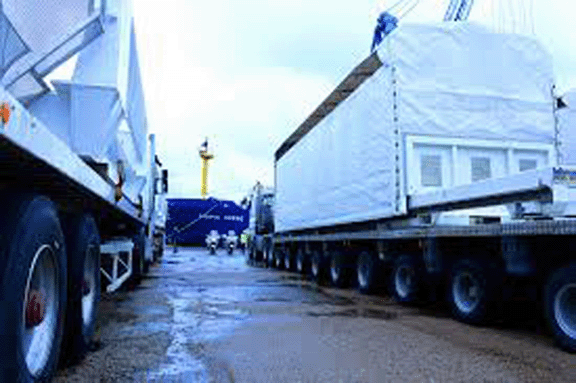
Radioactive nuclear fuel that was used for research and medicine began its voyage from Sydney to France on Saturday night, with the help of 200 NSW police officers.
The highly radioactive content will be recycled in France through extracting uranium and plutonium, and the leftover waste will be returned to Australia.
The fuel, used by the Australian Nuclear Science and Technology Organisation (ANTSO) for a decade’s worth of research and 5.5 million doses of nuclear medicine for Australian patients, was moved from a nuclear reactor in Lucas Heights, Sydney’s south, to Port Kembla for shipping to a French nuclear plant in La Hague, ANTSO said.
It is the tenth time this export has taken place.
Next month a Senate inquiry in Canberra will look into the Federal Government’s attempt to find another nuclear site in regional South Australia to dump and store low-level and intermediate level waste…….
the Australian Conservation Foundation’s Dave Sweeney said the material being shipped to France was “boomerang waste”, as the intermediate-level waste would be returned.
“There is no Federal Government process to identify the best place and method to manage this waste — some of which requires isolation for periods of up to 10,000 years,” Mr Sweeney said, adding that the Government was trying to buy time instead of solving “complex management issues”.
Nuclear radiation spills spur Lucas Heights review, THE AUSTRALIAN, SIAN POWELL, Higher Education & Science Writer, Sydney SEAN PARNELL-Health Editor, Brisbane @seanparnell
Australia’s nuclear safety agency has ordered a review of Sydney’s Lucas Heights nuclear medicine facility after two radiation spills, and a separate investigation is under way into a mechanical failure that has caused delays in diagnostic tests across the country.
The Australian Nuclear Science and Technology Organisation has had four safety breaches in 10 months and in recent weeks has had to call on US…….
Distribution of the replacement nuclear medicine supplies was also disrupted this month after airline delays from the US prevented the medicine reaching clinics and hospitals for some days……….
The supply problems caused by the mechanical failure have come as a review was ordered by the independent regulator, the Australian Radiation Protection and Nuclear Safety Agency and its chief executive Carl-Magnus Larsson, who issued the organisation with a direction under the Australian Radiation Protection and Nuclear Safety Act.
The agency said the independent review it had directed would focus on quality control of molybdenum-99 (Mo-99), the radioactive agent used in diagnostic imaging.
After the first safety breach when a staff member’s hands were contaminated on August 22 last year, ARPANSA found ANSTO to be noncompliant with its licence conditions, according to a statement from the safety agency.
“Three further events including the latest event on 7 June, 2018, indicate ongoing safety issues at ANSTO Health,” ARPANSA said………
An internal review is being conducted into the conveyor failure on June 22 while the separate independent safety review into the ageing ANSTO facility is undertaken.
ANSTO will appoint an independent reviewer. “This appointment is the next step on a path of continuous improvement.
“Using recommendations from the review, we’ll identify what more can be done to make that facility safer,” a spokesman for ANSTO said.
…….The conveyor has been fixed but compliance checks and a thorough audit will keep the production of nuclear medicine at a standstill for some time.
Michael Skeet KilowskyFight To Stop Nuclear Waste Dump In Flinders Ranges SAEyre Peninsula, SA, ML 4.5 1998 February 26, 14:13 UT
(Friday, February 27, 12:43 am CDST)
This earthquake occurred north of Cleve and south of Kimba on the Eyre Peninsula in South Australia, about 250km northwest of Adelaide. It was felt over northern Eyre Peninsula, and on Yorke Peninsula at a distance of about 110km from the epicentre. The maximum reported intensity was Modified Mercalli Intensity 4. Located by Sutton Earthquake Centre, PIRSA Adelaide. https://www.facebook.com/groups/344452605899556/?ref=bookmarks
Fault at Lucas Heights nuclear reactor halts production of medical isotope, Guardian, 28 June 18
Spokesman says no safety risk but there are fears patients could face delays in cancer diagnosis “….. production of the most commonly used isotope in nuclear medicine was halted at the Lucas Heights nuclear reactor in Sydney’s south.
The Australian Nuclear Science and Technology Organisation (Ansto) usually produces about 10,000 doses a week of Technetium-99m (Tc-99m), which is used to diagnose a variety of heart, lung and musculoskeletal conditions, as well as cancers.
This cooperation will address potential harm that could be caused by the higher concentrations of naturally occurring radioactive material (NORM) that can be the result of the processing and handling of raw materials.
The Practical Arrangements, signed on 24 May in Melbourne, Australia, builds on an earlier agreement under which work was conducted to create a publication on occupational radiation protection approaches in uranium mining and processing stages and techniques, as a part of the IAEA Safety Report Series. The report was developed during meetings in Australia, Canada and South Africa involving regulatory body and industry representatives.
The cooperation under the new three-year agreement is expected to provide practical tools for regulators, mine operators and workers through a training package that supports the use of the report’s recommendations.
Second radioactive spill in 10 months at ANSTO’s Lucas Heights facility, SMH, By Peter Hannam
A staff member at the Australian Nuclear Science and Technology Organisation facility at Lucas Heights has been involved in a spill of radioactive material, the second such incident in 10 months.
A quality control analyst working in medical production was involved in the spillage of about one millilitre of the radioactive isotope molybdenum-99 early on Thursday morning, an ANSTO spokesman said.
“The staff member was wearing full protective clothing. An occupational health physicist checked the analyst and confirmed no skin contamination,” the spokesman said.
The employee was then cleared to go home and returned to work on Friday.
A source told Fairfax Media, however, that employees at the site “are concerned with the most recent number of safety breaches and lack of management support”.
Medical production at the facility has ceased, pending a thorough investigation into the spill, the spokesman said. “ANSTO is working to minimise impacts on nuclear medicine production.”
ANSTO was keen to stress that Thursday’s incident was “very different” from one last August, when a staffer reportedly spilled a quantity of the MO-99 isotope, causing a “significant radiation dose”.
“Tests show the analyst involved in yesterday’s incident did not receive skin contamination. ANSTO continues to provide support for the employee involved in last year’s incident.”
The site has had other radiation events, such as one reportedly involving four staff in 2012….https://www.smh.com.
The Australian 1st June 2018,If you look out the window and glimpse a convoy winding through Sydney’s streets guarded by swarms of federal agents and state police, don’t be alarmed.
Any day now a decade’s worth of spent nuclear fuel assemblies weighing 24 tonnes will be moved out of Sydney’s Lucas Heights facility in a highly sensitive transport mission months in the making.
Guarded nuclear shipment to secretly depart SydneySBS News, 1 June 18 Any day now a decade’s worth of heavily guarded nuclear cargo will be secretly transported through Sydney’s streets and sent to France for reprocessing. ….. Any day now a decade’s worth of spent nuclear fuel assemblies weighing 24 tonnes will be moved out of Sydney’s Lucas Heights facility in a highly sensitive transport mission months in the making.
The radioactive cargo is set to be shipped to La Hague, in France, but details about the port, routes and specific timing of the operation remain classified with the Australian Nuclear Science and Technology Organisation (ANSTO) only disclosing it will happen mid-year.
An ANSTO spokesman has assured the public of the operation’s safety, saying the radioactive materials will be enclosed in specially-designed transport casks reinforced with lead and made to withstand almost anything, including a jet fighter crash.
“There is no credible chance of any accident or incident that could result in the cask being compromised,” an ANSTO spokesman said.
It will be the 10th transport mission of spent nuclear fuel assemblies, with the last shipment sent to the United States in 2009.
The spent fuel has come from Australia’s multi-purpose OPAL reactor…..The reprocessing project will cost $45 million, including the contract with France, equipment, staff and other costs.
Once the uranium and plutonium are extracted, they will be recycled into overseas civil power and research programs, with the remaining materials vitrified into a safer form for waste storage and sent back to Australia…..
The spent fuel assemblies, which would have been considered high-level waste, become transformed into an intermediate level waste, Hef Griffiths, ANSTO’s Chief Nuclear Officer told AAP.
But the question of where it will be stored remains.
The waste from this year’s transport mission will be returned from France in many years’ time and sent to the yet-to-be-built National Radioactive Waste Management Facility where it will be kept in storage for several decades.
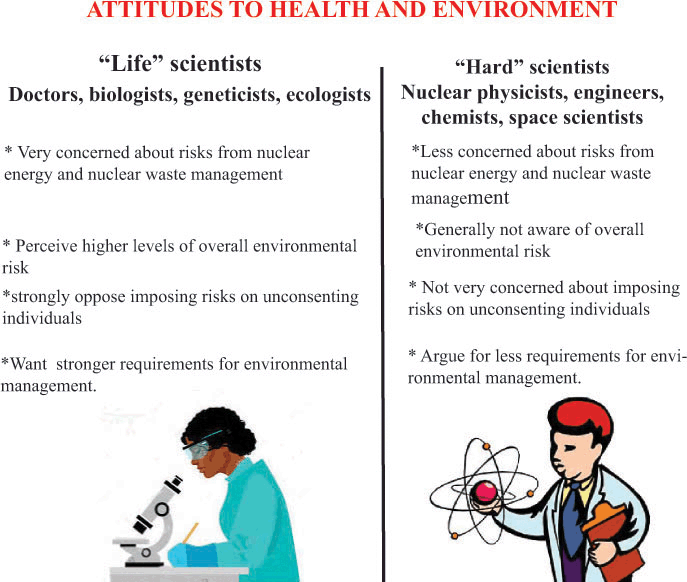
Research has found disturbing differences in the attitudes of scientists in different areas, to health and environmental risks of the nuclear industry.
It is even more disturbing that policy-makers and politicians prefer to support and value the opinions and work of the very scientists who are least informed and least interested in those risks.
Politics and Scientific Expertise: Scientists, Risk Perception, and Nuclear Waste Policy, Richard P. BarkeHank C. Jenkins‐Smith. – To study the homogeneity and influences on scientists’perspectives of environmental risks, we have examined similarities and differences in risk perceptions, particularly regarding nuclear wastes, and policy preferences among 1011 scientists and engineers. We found significant differences (p0.05)in the patterns of beliefs among scientists from different fields of research. In contrast to physicists, chemists, and engineers, life scientists tend to: (a)perceive the greatest risks from nuclear energy and nuclear waste management; (b)perceive higher levels of overall environmental risk; (c)strongly oppose imposing risks on unconsenting individuals; and (d)prefer stronger requirements for environmental management.
On some issues related to priorities among public problems and calls for government action, there are significant variations among life scientists or physical scientists. We also found that–independently of field of research–perceptions of risk and its correlates are significantly associated with the type of institution in which the scientist is employed. Scientists in universities or state and local governments tend to see the risks of nuclear energy and wastes as greater than scientists who work as business consultants, for federal organizations, or for private research laboratories. Significant differences also are found in priority given to environmental risks, the perceived proximity of environmental disaster, willingness to impose risks on an unconsenting population, and the necessity of accepting risks and sacrifices. more https://onlinelibrary.wiley.com/doi/abs/10.1111/j.1539-6924.1993.tb00743.x
Apocalyptic blaze surrounding nuclear reactor sets off emergency
AUSTRALIA is struggling to contain a growing bushfire that is racing towards a nuclear reactor, amid fears that the blaze could expand beyond their control. By OLI SMITH Apr 16, 2018
More than 500 Australia firefighters are struggling to tackle a massive bushfire, with several residents urged to seek shelters as evacuation is now “too late”.
Scenes of the blaze, which started yesterday, have been described as “apocalyptic” after the fire ripped through nearly 2,500 hectares of land close to the suburbs of Sydney.
Firefighters failed to stop the out-of-control blaze from burning through a major military base – and a nuclear reactor is the next at-risk location.
The New South Wales Rural Fire Service (RFS) said it was concerned that flying embers could spark even more blazes……
The unseasonably hot Autumn in south-eastern Australia has been blamed for worsening the bushfire after record temperatures for April.
Shane Fitzsimmons, of the RFS, warned that strong 60km per hour winds are expected to push towards residential homes.
He said that the country’s largest army barracks at Holsworthy, where stockpiles of fuel, ammunition and explosive materials are kept, had been hit by the fire.
Firefighters Warn NSW Is “Not Out Of The Woods” On Third Day Of Bushfires, Pedestrian. 16 Apr 18 More than 250 firefighters continue to battle bushfires in NSW’s southwest, which has spread more than 2,400 hectares since Saturday afternoon.
The blaze, which is believed to have originated in the vicinity of Casula, was fanned further by strong winds on Sunday.
More than 500 firefighters from the Rural Fire Service, Fire & Rescue NSW and the Australian Defence Force attempted to contain the blaze over the weekend with help from volunteers and 11 water-bombing helicopters.
The fire tore trough Holsworthy military range, and while approaching suburban areas, has been staved off. Several residents report fighting off embers with hoses and water buckets.
The fire was downgraded from “emergency level” to “watch and act” on 5.30pm Sunday, then again downgraded to “advice” around 2am Monday.
While lower wind conditions are expected to help with containing the fire, RFS Deputy Commissioner Rob Rogers warned that the high temperatures remain an issue.
“Still quite a difficult day ahead (on Monday),” Rogers told the Nine Network. “I think we’ve got a long way to go before we’re out of the woods.”
There’s also a risk that winds could also pick up to 35km/h later today.
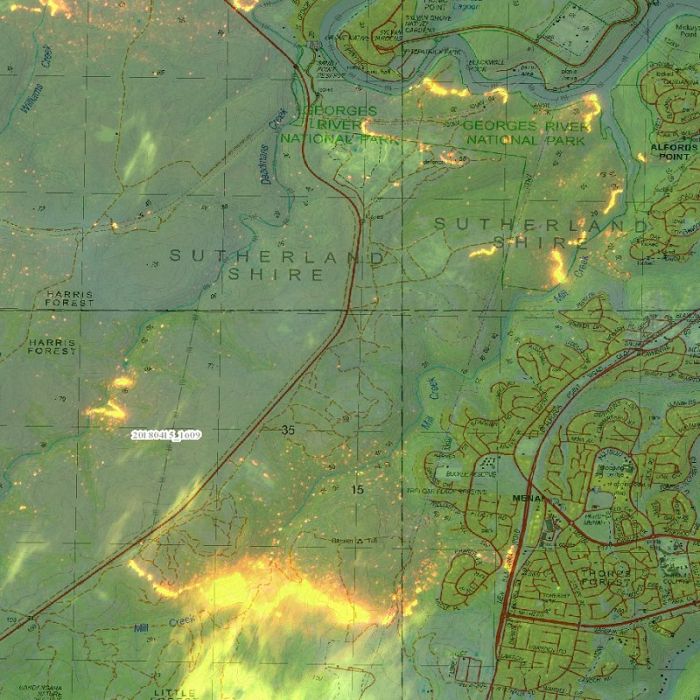
The RFS is currently advising residents in Pleasure Point, Sandy Point, Alfords Point, Barden Ridge [ie; Lucas Heights] , Voyager Point, Illawong, Menai & Bangor to “remain vigilant throughout the day and keep themselves up to date by checking the NSW RFS website“……..https://www.pedestrian.tv/news/firefighters-warning-nsw-bushfires/
Lucas Heights nuclear reactor: The untold threat of the Sydney bushfires.
Emergency warning issued as out-of-control bushfire rages across Sydney
As fires raged in Sydney, there has not been a peep out of the mainstream media about the fire hazard to Lucas Heights nuclear complex. Noel Wauchope reports.
THE LATEST news on the bushfires raging in Sydney’s south-west is that the firefighters are “cautiously optimistic” and that emergency warning advice has been downgraded to “watch and act”.
However, the fire continues to burn in an easterly direction towards Barden Ridge and weather conditions are still dodgy, as Sydney’s record-breaking heatwave looks like coming to an end.
It’s been an anxious time — the fire has burned over 2,400 hectares. On Sunday (15 April), more than 500 firefighters in almost 100 fire trucks, along with 15 aircraft, battled the blaze throughout the day. Residents were told that it was too late to leave their homes. Heat from the bushfires was impacting the high voltage lines. There is very little rain forecast over the next few days.
So, it has all been a worry. But you wouldn’t know, would you, that the fire is so close to the Lucas Heights nuclear complex? The latest maps shown on The Guardian and NSW Rural Fire Service websites don’t really show how close this fire is getting to Lucas Heights. I have previously written about the safety hazards of Lucas Heights, with its reactor, cooling pond and accumulation of nuclear wastes — the amount of which is not publicly available.
The fires have reached about four kilometres from Lucas Heights. Embers carried by wind can form spot fires well ahead of the firefront — even up to 20 kilometres away. In the dense and rugged bushland, with predicted west to north-west winds up to 30 kilometres per hour – not forgetting that bushfires create their own weather systems – is not that hazardous to the nuclear complex?
But we don’t hear a word about this. What makes the silence easier, is that the residential area previously part of Lucas Heights was renamed Barden Ridgein 1996 to increase the real estate value of the area, as it would no longer be instantly associated with the High Flux Australian Reactor (HIFAR) — and now the Opal nuclear reactor.
Of course, now, because of the name change, there’s no public awareness that Australia’s nuclear reactor is anywhere near the fires. You can bet that the government wants to keep us all in blissful ignorance.
What we do know, is that fires are certainly a hazard to nuclear sites and there is the possibility of radiation release across a wide area, if fire invades a nuclear complex, with the fuel rods in cooling pools at great risk. When fires do happen near a nuclear site, there may be a security panic going on but that is not communicated to the public.
Whenever there have been wildfires threatening nuclear sites – in Russia, Europe or the U.S. – the pattern is to downplay, to not mention, the nuclear danger. The publicity pattern is always to ignore the radiation hazard.
“It’s being fought by security site fire crews, with help from a helicopter able to detect any aerial release of radiation.”
As though any amount of monitoring is going to help or that any data would be publicly shared. Not a peep about the radiation numbers during the fires in and around Los Alamos, even though they were “monitoring” it.
And in the case of this fire in Russia, the emergency minister threatened to “deal with” those who spread radiation “rumours”:
For the current Sydney bushfires, it seems as though there will have been a lucky escape for the communities, despite the fact that two giant aircraft, the DC10 Nancybird and the C130 Hercules “Thor” — normally used for aerial water bombing — were not available to help fight the Sydney fire, having been sent back to the U.S., because by March, the fire risk is supposed to be over.
It will have been a much luckier escape that they realised if the nuclear complex remains unscathed — this time!
Lucas Heights nuclear organisation closed on Monday https://www.theleader.com.au/story/5343505/ansto-closed-to-all-non-essential-staff/
While there was no risk to ANSTO as a result of fires near the precinct, the organisation decided to close the campus to all non-essential staff tomorrow to help minimise traffic impacts in the area.
The Australian Nuclear Science and Technology Organisation (ANSTO) at Lucas Heights will be closed on Monday to all non-essential staff.
ANSTO released a statement late today saying there was no risk to ANSTO as a result of fires near the precinct but the organisation decided to help minimise traffic impacts in the area.
“ANSTO infrastructure including the OPAL reactor is protected by numerous fire safety systems, policies, plans and arrangements to ensure there is never any risk to operations or safety,” the statement said.
“The OPAL reactor is at power and operating normally.
“Some 1,200 people work at the Lucas Heights campus. Based on current advice, and to minimise local road and traffic impacts, we have advised ANSTO staff who are not performing essential services to work from home.
“All contractors, tenants and construction workers on our building projects are advised not to attend our campus tomorrow; and the childcare centre has been closed.
“As a precautionary measure, the ANSTO Operations Centre was activated yesterday, and continues to monitor the situation.
“ANSTO would like to take the opportunity to thank the emergency services and support staff who are continuing to assist on this matter.”
David Noonan will speak on public interest concerns over the new Roxby Downs Indenture Act 2026 on BHP copper-uranium mining and ore processing in SA, and on how AUKUS may face SA with a High-Level nuclear waste agenda.
Dr Jim Green will discuss international developments in the field of nuclear power including ‘small modular reactors’ and Generation 4 ‘advanced’ nuclear reactor concepts.