Australia’s collapsing reputation – way way down on Transparency International Corruption Index

The way ahead
This report from an influential global agency adds weight to increasingly urgent calls for an investigative commission with similar powers at the federal level to Victoria’s Independent Broad-based Anti-corruption Commission and the Independent Commission Against Corruption in NSW.
Australia should be able to do at least as well as Estonia.
Australia hits new low on Transparency International Corruption Index
MICHAEL WEST MEDIA, |By Alan Austin, January 27, 2022 The decline of political and corporate standards in Australia over recent years is not just in the imagination of some critics. Transparency International released its annual corruption report yesterday which gives Australia the lowest score and global ranking since the series began in 1995.
The Corruption Perceptions Index is widely regarded as the leading global measure of public sector corruption. It offers an annual snapshot of the relative extent of corruption by ranking 180 countries and territories. Its methodology allows for comparison of scores across nations and from one year to the next.
Australia’s severe decline
Australia ranked seventh in the world in 1995 with a creditable score equivalent to 88 out of 100. Only New Zealand, Denmark, Singapore, Finland, Canada and Sweden scored better, but not by much.
Through the late 1990s and early 2000s, Australia slipped significantly in both scores and ranking, falling as low as 13th in 2000. But by 2007, Australia had recovered to 11th, and thereafter advanced further. Australia ranked eighth from 2009 to 2011 and resumed seventh slot in 2012. For the seven years from 2014 to 2020, Australia ranked between 11th and 13th.
Then suddenly last year, in just the one year, Australia tumbled from 11th to 18th in the global ranking. Its score fell from 77 where it has stayed for the last four years to a lowly 73.
The seven countries which overtook Australia in combating corruption last year were the United Kingdom, Hong Kong, Austria, Canada, Estonia, Ireland and Iceland.
Worst decade collapse in the developed world
Over the last ten years, the deterioration in Australia’s standing is the deepest of all advanced nations. From a 2011 score of 88, Australia tumbled 15 points to just 73 in 2021.
No other developed member of the Organisation for Economic Development and Cooperation (OECD) has fallen that far in that period. Of those 38 countries, 15 increased their scores over that time, 21 saw a decline and two remained unchanged……………..
Corruption on the public record
The specific reasons for Australia’s decline are not spelled out in Transparency’s report. Regular readers of MWM will, however, be familiar with the likely causes. They include the “sports rorts” affair, the highly problematic sale of floodwater rights, international money laundering, pork barreling selected electorates, corrupt allocation of grant funds, allowing criminals to hide money in Australia’s property market, political fundraising, influence peddling, the East Timor electronic surveillance scandal and the outcomes of inquiries by state investigative commissions.
Some of these were identified in Transparency’s annual report last year, which reported:
“Australia faces several corruption challenges, including anonymous company ownership and money laundering. Following the FinCEN files, where thousands of leaked financial documents exposed a vast paper trail of money laundering across the globe, more than US$150 million were traced back to Australian banks.
“The country also shows severe deficiencies when it comes to corruption in international real estate. As a result of a 2006 law, properties can be bought and sold without due diligence and real estate agents, lawyers and accountants are not required to report suspicious activities. …………………………
“Despite multiple commitments, 131 countries have made no significant progress against corruption in the last decade. Two-thirds of countries score below 50, indicating that they have serious corruption problems, while 27 countries are at their lowest score ever.”
These include Australia.
The way ahead
This report from an influential global agency adds weight to increasingly urgent calls for an investigative commission with similar powers at the federal level to Victoria’s Independent Broad-based Anti-corruption Commission and the Independent Commission Against Corruption in NSW.
Australia should be able to do at least as well as Estonia. https://www.michaelwest.com.au/australia-hits-new-low-on-transparency-international-corruption-index/
The Australian government has breached the rights of both black and white people of Kimba in depriving them of access to independent information on nuclear wastes.

Nuclear waste is considered a highly toxic and dangerous material which it is acknowledged requires geological burial for long term storage and disposal which is not the case at Kimba
I wonder how our government so highly regarded overseas as a beacon for justice and democratic principles has not just allowed but actively participated in depriving the Barngarla as well as the general community of their rights to properly ventilate their concerns
It is quite clear from the settled overseas requirements that the federal government as the proponent of the nuclear waste facility at Kimba must enable the Kimba community including the Barngarla to seek their own independent assessment and advice as to the government’s proposals with the government providing all the necessary funding and access to all information for that purpose
It should be relatively straightforward for the community generally which includes the Barngarla to establish that the government has failed to assist them in getting the independent assessment and refusing the funds for that purpose when requested on several previous occasions
In addition to obviously being a major ground for the judicial review the government’s conduct is tantamount to a seemingly serious deprivation of the human rights of the Barngarla and the Kimba community .
While this breach of human rights applies to the whole community the Barngarla can additionally claim that their human rights were breached and that the mandate created to overcome the discriminatory conduct towards them covering
- implementing international standards concerning the rights of indigenous peoples;
- making recommendations and proposals on appropriate measures to prevent and remedy violations of the rights of indigenous peoples;
- reporting on the human rights situations of indigenous peoples around the world; and
- addressing specific cases of alleged violations of indigenous peoples’ rights.
Francisco Cali Tzay is the current mandate holder as Special Rapporteur on the rights of indigenous peoples
The mandate on hazardous substances and wastes
relates to the exposure of people to a myriad of harmful substances without their prior informed consent which is a human right that can be satisfactorily solved if identified in its early stages
Dr Marcos A. Orellana is the current mandate holder as Special Rapporteur on toxics and wastes as human rights
Nuclear waste is considered a highly toxic and dangerous material which it is acknowledged requires geological burial for long term storage and disposal which is not the case at Kimba
Australian government and Labor opposition ignore the suffering of Julian Assange. Can they afford to, as election looms?
If he dies, his death will have been caused by, among others, politicians in Australia who have the diplomatic power to bring him home,” Pilger said.“Scott Morrison, in particular, will have Julian’s life and suffering on his hands, along with those in the Labor opposition who have kept a cowardly silence.
Independent MP Andrew Wilkie, among others, has said that Scott Morrison must urge the US and Britain to release Assange and let him return to Australia.
the “noise” in parliament combined with more public awareness of Assange’s dire state may present a headache for the government as polls loom.
Saving Julian Assange, Last week, the British High Court ruled that Julian Assange can be extradited to face charges in the United States. His fiancée, Stella Moris, vows to continue the fight alongside his network of supporters. By Amy Fallon. https://www.thesaturdaypaper.com.au/news/politics/2021/12/18/saving-julian-assange/163974600013099?fbclid=IwAR2dLaNxKG0FTyBvywjYpL_HpxPb8RWA6rF0mQwIE-X8Pnd8TMbAzkWed2Y#mt This week, Stella Moris said she and Julian Assange still intended to marry in the new year, although they have not set a date. She is currently speaking to the prison about arrangements. Moris hopes it will be a ceremony attended by close family and friends, with their children, Gabriel, 4, and Max, 2, taking part.
“The High Court ruling has made things even more precarious than before,” she tells The Saturday Paper.
“But that has only strengthened our determination to celebrate what is constant and certain in our lives – our love and support for each other.”
Moris is a South-African born lawyer and an activist in her own right. Her family were involved in the anti-apartheid battle. After the British High Court ruled that her fiancé could be extradited to the United States, her response was simple: “We will fight.”
“History will not spare them if we lose a man who is not only innocent of any crime but a genuine hero in the extraordinary public service he has performed for millions of people.”
She sees the case in these terms: “Every generation has an epic fight to fight, and this is ours, because Julian represents the fundamentals of what it means to live in a free society.”Last week’s decision was made after two of Britain’s most senior judges ruled Assange, earlier deemed a suicide risk, had received assurances from the US that he would not face the strictest measures before a trial or once convicted. They found a lower court had erred in offering him protection.
“That risk is in our judgement excluded by the assurances which are offered,” one of the judges, Lord Burnett, said. “It follows that we are satisfied that, if the assurances had been before the judge, she would have answered the relevant question differently.”
British Home Secretary Priti Patel must now approve Assange’s extradition. Lawyers for the 50-year-old are appealing the decision. Subsequent hearings are likely to raise the issue of free speech, which campaigners say is at the heart of the case involving the Walkley Award-winning journalist.Many around the world are now calling on the Australian government to intervene and save Assange’s life before it’s too late.
“There seem to be no limits to the savagery of the Anglosphere – US, UK, Australia – in exacting revenge for the crime of informing the population of what the powerful want to conceal,” the intellectual and activist Noam Chomsky later told The Saturday Paper.
He urged followers of Julian Assange, wanted by the US for breaking espionage laws after publishing hundreds of thousands of Afghanistan and Iraq war logs and diplomatic cables, to “get organised”.
“And act,” added Chomsky, because there was “not much time”.
Another two to three years may drag on before the extradition is resolved. Australian journalist John Pilger, who described Assange as “frail and skeletal” the last time he hugged his friend in 2020, said the fact he was still alive was remarkable.
Last weekend’s revelation, that Assange had suffered a stroke in October, didn’t shock the veteran reporter. A month earlier, a Yahoo News report revealed that the CIA allegedly planned to assassinate Assange.
“If he dies, his death will have been caused by, among others, politicians in Australia who have the diplomatic power to bring him home,” Pilger said.“Scott Morrison, in particular, will have Julian’s life and suffering on his hands, along with those in the Labor opposition who have kept a cowardly silence. History will not spare them if we lose a man who is not only innocent of any crime but a genuine hero in the extraordinary public service he has performed for millions of people.”
To Gabriel Shipton, Assange’s brother, Julian, is a “bad dancer” with a “dorky sense of humour”. But, he says, “he is very sweet with his children, very good with kids, and a very principled man”.
Shipton produced the recent documentary Ithaka, which tells the story of Gabriel and Julian’s father’s struggle to have Assange freed.“Often people lose sight that these are actual real people involved, not just a head on a screen, or a headline, that this is a person’s father, brother, partner,” Shipton says. “Once people find out about how tragic the actual injustice that Julian suffered [is], and through no fault of their own his family are suffering, they’re quite confronted that they’ve allowed it to carry on for as long as it has.”
Shipton concedes the fight is just as much or even more political than legal, and others echo this. “There is no doubt that [this] aggressive and relentless pursuit is driven by the US security and defence state,” said Greg Barns, a barrister and adviser to the Australian Assange campaign.
A bipartisan Australian Parliamentary Friends of the Bring Julian Assange Home group comprises 25 senators and MPs, but was adding “about one member or so monthly”, says Shipton. In the past week, Deputy Prime Minister Barnaby Joyce has spoken out against Assange being sent to the US. Independent MP Andrew Wilkie, among others, has said that Scott Morrison must urge the US and Britain to release Assange and let him return to Australia. The opposition has urged the government to encourage the US to close the matter, although it has not elaborated on what it means by this.According to Kellie Tranter, a Maitland-based lawyer, human rights activist, researcher and former WikiLeaks Party candidate, the “noise” in parliament combined with more public awareness of Assange’s dire state may present a headache for the government as polls loom.
“If the level of interest keeps increasing, the government may feel obliged to act as the Howard government did in the case of David Hicks,” she says, referring to the former Guantánamo Bay detainee. “The last thing the government wants is this case soaking up oxygen in place of its policies. It’s public criticism, which is exactly what they wanted to avoid in the case of Hicks.”Tranter points out that progressive campaign group GetUp! played a critical role in Hicks’s repatriation by making his detention by the US an election issue, mobilising public opinion against his mistreatment. They may be the only organisation capable of doing the same in this case, she said. GetUp! said they had no comment on Assange.
In Britain, Assange has admirers from all walks of life. Sadia Kokni, 40, is British-born with African, Indian and Middle Eastern heritage and the managing director of a cosmetics company. Despite having a disability, she attends twice-weekly protest vigils at the Australian high commission with “Team Assange”, comprising about 50 people, including bus drivers, graphic designers, nurses and artists.
“I campaign for nothing, I only campaign for Julian,” Kokni says. “Unlike when people campaign against a war – it’s a nation against a nation – when it comes to Julian it’s the most powerful nation in the world against one man and he’s exposing the atrocities of global governance and things that every living person should be aware of.”
Although Kokni acknowledges Assange’s predicament could be treated with greater urgency by the British parliament, she also feels disbelief over Australia’s inaction.“They could be doing a lot more, Australia. I find it ridiculous,” she said, singling out the high commissioner, George Brandis. “Brandis – what is he actually doing? Has he written any letters?”
The Australian high commission in Britain did not respond to requests for comment.
A free press, a free Julian Assange – would be the best gift for the world

The disgraceful case mounted against Assange by a corrupt U.S. Department of Justice and their hired guns in Britain.

It is this institutional lying and duplicity that Julian Assange brought into the open and in so doing performed perhaps the greatest public service of any journalist in modern times.
JOHN PILGER: U.S. wins extradition appeal against Julian Assange, Independent Australia, By John Pilger | 11 December 2021, ”…….. Miscarriage of justice is an inadequate term in these circumstances. It took the bewigged courtiers of Britain’s ancien regime just nine minutes on Friday to uphold an American appeal against a District Court judge’s acceptance in January of a cataract of evidence that hell on Earth awaited Assange across the Atlantic: a hell in which, it was expertly predicted, he would find a way to take his own life.
Volumes of witness by people of distinction, who examined and studied Julian and diagnosed his autism and his Asperger’s Syndrome and revealed that he had already come within an ace of killing himself at Belmarsh Prison, Britain’s very own hell, were ignored.
The recent confession of a crucial FBI informant and prosecution stooge, a fraudster and serial liar, that he had fabricated his evidence against Julian was ignored. The revelation that the Spanish-run security firm at the Ecuadorean embassy in London, where Julian had been granted political refuge, was a CIA front that spied on Julian’s lawyers and doctors and confidants (myself included) — that, too, was ignored.
The recent journalistic disclosure, repeated graphically by defence counsel before the High Court in October, that the CIA had planned to murder Julian in London — even that was ignored.
Each of these “matters”, as lawyers like to say, was enough on its own for a judge upholding the law to throw out the disgraceful case mounted against Assange by a corrupt U.S. Department of Justice and their hired guns in Britain. Julian’s state of mind, bellowed James Lewis, QC, America’s man at the Old Bailey last year, was no more than “malingering” — an archaic Victorian term used to deny the very existence of mental illness.
To Lewis, almost every defence witness, including those who described from the depth of their experience and knowledge the barbaric American prison system, was to be interrupted, abused, discredited. Sitting behind him, passing him notes, was his American conductor: young, short-haired, clearly an Ivy League man on the rise.
In their nine minutes of dismissal of the fate of journalist Assange, two of the most senior judges in Britain, including the Lord Chief Justice, Lord Burnett (a lifelong buddy of Sir Alan Duncan, Boris Johnson’s former Foreign Minister who arranged the brutal police kidnapping of Assange from the Ecuadorean embassy) referred to not one of a litany of truths aired at previous hearings in the District Court.
These were truths that had struggled to be heard in a lower court presided over by a weirdly hostile judge, Vanessa Baraitser. Her insulting behaviour towards a clearly stricken Assange, struggling through a fog of prison-dispensed medication to remember his name, is unforgettable.
What was truly shocking on Friday was that the High Court Judges – Lord Burnett and Lord Justice Timothy Holroyde, who read out their words – showed no hesitation in sending Julian to his death, living or otherwise. They offered no mitigation, no suggestion that they had agonised over legalities or even basic morality.
Their ruling in favour, if not on behalf of the United States, is based squarely on transparently fraudulent “assurances” scrabbled together by the Biden Administration when it looked in January like justice might prevail.
These “assurances” are that once in American custody, Assange will not be subject to the Orwellian SAMs – Special Administrative Measures – which would make him an un-person; that he will not be imprisoned at ADX Florence, a prison in Colorado long condemned by jurists and human rights groups as illegal: “a pit of punishment and disappearance”; that he can be transferred to an Australian prison to finish his sentence there.
The absurdity lies in what the Judges omitted to say. In offering its “assurances”, the U.S. reserves the right not to guarantee anything should Assange do something that displeases his gaolers. In other words, as Amnesty International has pointed out, it reserves the right to break any promise.
There are abundant examples of the U.S. doing just that. As investigative journalist Richard Medhurst revealed last month, David Mendoza Herrarte was extradited from Spain to the U.S. on the “promise” that he would serve his sentence in Spain. The Spanish courts regarded this as a binding condition.
Medhurst wrote:
‘Classified documents reveal the diplomatic assurances given by the U.S. Embassy in Madrid and how the U.S. violated the conditions of the extradition. Mendoza spent over six years in the U.S. trying to return to Spain. Court documents show the United States denied his transfer application multiple times.’
The High Court Judges – who were aware of the Mendoza case and of Washington’s habitual duplicity – describe the “assurances” not to be beastly to Julian Assange as a “solemn undertaking offered by one government to another”. This article would stretch into infinity if I listed the times the rapacious United States has broken “solemn undertakings” to governments, such as treaties that are summarily torn up and civil wars that are fuelled. It is the way Washington has ruled the world, and before it Britain — the way of imperial power, as history teaches us.
It is this institutional lying and duplicity that Julian Assange brought into the open and in so doing performed perhaps the greatest public service of any journalist in modern times.
Julian himself has been a prisoner of lying governments for more than a decade now. During these long years, I have sat in many courts as the United States has sought to manipulate the law to silence him and WikiLeaks………….. https://independentaustralia.net/life/life-display/john-pilger-us-wins-extradition-appeal-against-julian-assange,15842
Classified Documents Invalidate United States’ Appeal Against Assange — Richard Medhurst
‘‘I’m scared that will be Assange. They will make him go nuts.”
“I’m a nobody. If they’re capable of doing this to me, just imagine what they can do to Assange.”
The United States Broke Diplomatic Assurances for David Mendoza, It Will Do the Same with Julian Assange Richard Medhurst’s Newsletter
| Richard MedhurstNov 29 |
| Richard Medhurst Nov 29 In 2009, David Mendoza Herrarte was extradited from Spain to the United States, on condition he be allowed to serve his sentence in SpainClassified documents reveal the diplomatic assurances given by the U.S. Embassy in Madrid and how the U.S. violated the conditions of his extraditionMendoza spent over 6 years in the United States trying to return to Spain. Court documents show how the United States denied his transfer application multiple timesWhile in prison, Mendoza sued the United States, and Spain for failing to uphold the conditions of his extradition and violating his human rights. His case was recently taken up by the United Nations |
- Mendoza’s case was raised last month in the English High Court, where the United States is attempting to extradite Julian Assange to the U.S.
- The United States has offered similar diplomatic assurances that Assange could serve a sentence in Australia
- Assange’s lawyers cite Mendoza’s case as evidence that these assurances cannot be trusted
- James Lewis, the lead U.S. prosecutor, said that these assurances are bulletproof. He told the High Court that, “The United States have never broken a diplomatic assurance, ever”. Court documents and diplomatic assurances obtained by Richard Medhurst show this to be untrue
- David Mendoza Herrarte was born and raised in the United States. His mother being from Spain, he would go there every summer, describing it to me as his second home. He is both an American and Spanish national.
Mendoza was wanted by the United States for drug trafficking. In the early 2000s, he used helicopters to transport marijuana, known commonly as BC Bud, from Canada across the U.S. border into Seattle. Today, marijuana is legal in Seattle……………………………………………… - The diplomatic assurance did not specifically state that Mendoza would be sent to Spain to serve his sentence. It only said that the United States “does not object to Mendoza making an application to serve his sentence in Spain”– something the United States cannot object to anyway, as it is every prisoner’s right to apply for a treaty transfer.
Mendoza tells me, “This shows the deviance of these people. They use this ambiguous language on purpose. There’s precedent in federal court that if they don’t specifically agree to the transfer, it’s not valid”.
Recently, the United States offered similar diplomatic assurances to the United Kingdom, namely that Assange could could serve a sentence in his home country of Australia.
Mendoza says for this to be valid, the diplomatic assurances from the U.S. must explicitly state in advance that the U.S. Department of Justice and Australia accept Assange’s transfer— otherwise it’s meaningless.
“With the Assange thing, I can see it black and white. They [Australia] are not going to do a thing. Under the treaty, all three parties must agree: Julian, Australia, and the United States. But the U.S. can tell Australia behind the scenes: ‘screw this guy, don’t do anything’.”
- The Convention on the Transfer of Sentenced Persons specifically states under Article 3 (f) that a sentenced person may be transferred “if the sentencing and administering States agree to the transfer.” (The administering state meaning Australia)Being one of the few journalists to cover Assange’s extradition, I can confirm that as of now Australia has not given any indication that it would accept Julian Assange’s request to serve a sentence there, should he apply……….
- April 2009: David Mendoza Herrarte is extradited to the United States
After signing the Acta de Entrega, Mendoza was officially under U.S. jurisdiction. He recalls being handed over to U.S. authorities: “The first thing they do when they get you, is they strip you naked. The marshals look in your mouth, your ass, your ears, every orifice. They attempt to humiliate you in every fashion: ‘Squat! Now do this…’. They tell you: you’re under US jurisdiction now, and our law is what is going to apply to you.”
June 2009: Once in the United States, Mendoza took part in what is known as an arbitration hearing or settlement conference. This is where plea bargains are hashed out in the presence of the judge, between prosecutors and defendant……………………………………………
- It now became clear that the United States never intended to send Mendoza back to Spain. They had squeezed him for every last penny, then violated the diplomatic assurances given to Spain………….
- Mendoza expects the United States government will play the same trick on Assange if they refuse to send him to Australia and he contests it in court.“Within that note, it must specifically state that Julian has a right to contest non-compliance of the United States, even as a non-signatory to the treaty. Because the US will start playing games.”…………….
- Instead of being sent to Spain immediately to carry out his sentence, Mendoza was told to apply for a treaty transfer. He applied, and the answer from the United States was ‘no’……………
In total, Mendoza applied three times for treaty transfer to Spain. All three applications were denied, violating the conditions of his extradition. Each time he applied, he had to wait 8 months for a decision, and even longer to apply again. The denial states: “There is no administrative appeal from this decision. Unless otherwise noted above, the prisoner may reapply two years after this denial.”
Mendoza told me: “That’s when I realized I’m in the wrong court. I’m going to get nothing here. ……………………..
The other assurance offered by the United States appears to state that Assange would not be jailed at ADX Florence or placed under oppressive prison conditions known as Special Administrative Measures (SAMs).
Similiar to those offered for Mendoza, the assurances for Assange are ambiguous and vaguely-worded. The United States says he will not be subject to SAMs or imprisoned at ADX unless “in the event that, after entry of this assurance, he was to commit any future act that met the test for the imposition of a SAM pursuant to 28 C.F.R. § 501.2 or § 501.3”
Once in U.S. custody, the United States could simply allege that Assange did something that “met the test for the imposition of a SAM”, place him in isolation, and then claim that it never violated its assurances, because it already gave itself a backdoor to do so.
This is why Mendoza told me that assurances must be explicitly spelled out, with no room for derogation.
Assange’s extradition was blocked by a UK judge in January 2021, on grounds that U.S. prison conditions would be too oppressive, leading him to commit suicide.
While in the U.S., Mendoza was imprisoned at a medium-high security facility in Englewood, Colorado. This is near ADX Florence, where Assange is likely to be sent.
“Believe me, European prisons aren’t nice. But U.S. prisons are much worse. I was in Colorado, one of the biggest s–tholes I’ve ever been to. It was dirty; they let you out of your cell one hour a day– when they decided, not when I wanted.”…….. It’s 3am, for example, they would buzz you and say: do you want your hour of recreation?”. Prisoners who declined would not be able to leave their cell until the next day.
Mendoza explained to me the process of dehumanization and sleep deprivation in prison: “You don’t have a name; you have a number, and you have to repeat it during every count. Counts are every three hours in higher security federal prisons. Another thing guards would do is instead of pointing their flashlight up to the ceiling, they would flash it right in your face.”
“I’m scared that will be Assange. They will make him go nuts. The only thing that kept me sane is this legal work; writing to the judges and the press, going after the United States in civil court.”
What Mendoza went through is a step down from what Assange would be in. Not only is ADX Florence a federal super-maximum prison, but Assange would also be placed under Special Administrative Measures (SAMs), in extreme isolation.
Mendoza tells me that visitation had to be approved by specific people. ……………………
Mendoza’s case is an incredible story on its own merits.
Nevertheless, it must be examined in the context of Assange’s extradition. When James Lewis told High Court judges that “the United States have never broken a diplomatic assurance, ever”— this is simply untrue.
The above documents [on original] make it clear that the United States violated its agreement and broke diplomatic assurances to Spain. Mendoza was to be returned to Spain to carry out his sentence, instead he spent six years and nine months in various U.S. prisons. Only after suing both the United States and Spain— his own countries— for failing to enforce the conditions of his extradition, was he allowed to return. Only after the Spanish Supreme Court ruled in his favor, threatening the U.S.-Spain Extradition Treaty itself, could he compel the United States to enforce the conditions of his extradition and return him to Spain.
Mendoza was fortunate enough to have the Spanish Supreme Court, senior judges and public on his side. Were the United States to violate the assurances of Assange’s extradition, it is extremely unlikely given the “Special Relationship” between the U.K. and U.S., that Assange would be able to successfully lobby the British government into compelling the U.S. to uphold the conditions of his extradition.
James Lewis told the English High Court that diplomatic assurances are “solemn undertakings, given out at the highest order; they are not dished out like smarties”. He is correct. It is therefore incumbent on the Court to consider what happened to Mendoza, for whom the United States did offer diplomatic assurances, and assess whether those offered for Assange are adequate, but more importantly, whether they can be enforced once he is no longer under British jurisdiction.
Mendoza’s experience shows that for Assange, any diplomatic assurances or agreements must be written in explicit language and signed by all parties, including Assange, so that in the eventuality of non-compliance, he may be afforded the opportunity to contest this in court, despite his status as a non-signatory of the United Kingdom-United States Extradition Treaty.
Mendoza’s case offers the Court extraordinary insight into the innerworkings of American diplomacy, legal proceedings, and extradition to the United States. It is a serious warning which High Court Justices should heed, who at their discretion, have the power to prevent gross miscarriages of justice which gravely imperil the respondent, before they arise.
“I’m a nobody. If they’re capable of doing this to me, just imagine what they can do to Assange.” https://richardmedhurst.substack.com/p/mendoza
Julian Assange trial is political hypocrisy
WikiLeaks founder Julian Assange attended the conference. Assange has become one of the main targets. Many of the themes discussed at the conference are what Assange has come to represent.
Freedom of information rather than freedom from information. The prosecution of wrongdoers, not the prosecution of whistleblowers. An open society, not a closed society.
“Freedom to think as you will and speak as you think are indispensable to the discovery and spread of political truth; the greatest menace to freedom is an inert people.”
The Australian Government must speak up for Julian Assange.
Julian Assange trial is political hypocrisy, Independent Australia, By Kim Sawyer | 13 December 2021 Given that governments in the past have encouraged whistleblowing, the punishment of Julian Assange is a great hypocrisy, writes Dr Kim Sawyer.
Continue readingHow the military-industrial complex has captured Australia’s top strategic advisory body

AUSTRALIA CAPTURED – How the military-industrial complex has captured Australia’s top strategic advisory body, MICHELLE FAHY, DECLASSIFIED AUSTRALIA 9 DECEMBER 2021
The Australian Strategic Policy Institute has veered away from its founding vision of providing an array of independent diverse views, to now promote an aggressive militaristic solution to the heightened tensions in Australia’s region.
The Australian Strategic Policy Institute (ASPI) in Canberra is the government’s primary source of outside-government advice, research and analysis on military and strategic affairs. Since its establishment in mid-2001, it has veered away from its founding vision.
There is a jarring disconnect between the lofty goals of independence expressed in ASPI’s charter, and the infiltration of ASPI by tentacles of the military-industrial complex. This has been barely mentioned in Australia’s mainstream media.
A Declassified Australia investigation has uncovered a casebook example of ‘state-capture’, with the development of deep connections between ASPI, and the world’s largest and most powerful military weapons manufacturers.
Australia is a significant participant in the global arms trade at present. Its $270-billion decade-long spending spree upgrading weapons and war machines is large by international standards, and Australia is increasingly becoming an arms seller too. As Australia moves militarily ever closer to the US, even defence insiders say the defence industry is ‘awash with money’.
The wars in Iraq, Afghanistan, Syria and Yemen have made the world’s biggest weapons manufacturers richer, larger, and more influential. At the lesser-known end of the spectrum, the Yemen war is notable for its extensive human rights abuses and war crimes: it has created the world’s largest humanitarian crisis. Despite pleas from the UN, the arms still flow and the war continues. The weaponry for this war has been supplied by the world’s top arms manufacturers, including Lockheed Martin, BAE Systems, Boeing, and missile-maker Raytheon.
ASPI and the Weapons Lobby
The Australian subsidiaries of these and other global weapon-makers have been regular ASPI sponsors for years. Some of them have successfully used the back door to gain access to ASPI’s top table, its governing council. ASPI council members have included former senior military officers, defence ministers, and federal MPs who are also on arms and cyber company boards. It has also included former and current arms industry executives. The challenge to ASPI’s independence is large and real.
ASPI’s founding charter, since it was established in 2001 by then prime minister John Howard with bipartisan support from Labor leader Kim Beazley, declares it must ‘operate independently of Government and of the Defence Organisation’.
Further, it states that ‘the perception, as well as the reality, of that independence would need to be carefully maintained’. Thus, from the outset, the government was acknowledging how such an important think tank would be vulnerable to capture by vested interests, both ideological and commercial………..
Our investigation shows that the ASPI council has numerous members who represent or have close links to the military-industrial complex. Of the 11 non-executive directors on ASPI’s governing council, five sit on the boards or advisory boards of weapons or cybersecurity corporations, while numerous past council members have had similar connections.
The current council includes former Howard defence minister Robert Hill. He’s on the supervisory board of German weapon-maker Rheinmetall’s Australian subsidiary, which is supplying Defence’s $5 billion of Boxer combat reconnaissance vehicles, and will soon also produce and export ammunition for the US Joint Strike Fighter program. Hill is also chair of Viva Energy Group, a major supplier of fuel to the Australian Defence Force (ADF)…………………….
Declassified Australia put questions to ASPI and the current council members. Dr Nelson declined to comment. No other council member responded by deadline. ASPI replied saying it manages conflict of interest matters in line with other Australian proprietary limited companies, and that ‘Council members will recuse themselves from discussions which may give rise to the perception of a conflict of interest matter’.
ASPI has a history of council members with interests in the defence industry. Jim McDowell was chief executive of BAE Systems in Australia for a decade, and then ran BAE in Saudi Arabia, where the Saudi military has since used BAE arms in the catastrophic war in Yemen. Returning to Australia, he was engaged by Liberal defence industry minister Christopher Pyne, and Defence, on numerous sensitive defence projects while also on ASPI’s Council. BAE Systems is in the running to provide Australia’s planned nuclear-powered submarines under the AUKUS pact.
Former Labor senator Stephen Loosley’s Council membership, including seven years as chair, coincided with board roles at French arms multinational Thales Australia, manufacturer of the Austeyr, the service rifle for all the Australian military, as well as armoured vehicles, submarine sonars and munitions. The Thales group has been accused of selling weapons to the Indonesian military who are running a war in West Papua against the independence movement.
Former Labor defence minister Kim Beazley was an ASPI distinguished fellow for two years in 2016-2018. For the majority of that time he was on the board of Lockheed Martin Australia while writing regularly for ASPI, without ASPI disclosing his board position at Lockheed.
………..ASPI’s independence is drawn into question not just by its board appointees but also by some research fellows. One recent example is the former director of cyber, intelligence and security at BAE Systems Applied Intelligence, Rajiv Shah, who cowrote a report on collaboration within the intelligence community that was sponsored by BAE Systems. Shah is now an ASPI fellow and a consultant to government and industry. ASPI does not disclose either in the report nor in his website bio Shah’s previous employment with BAE Systems, one of the world’s top 10 arms companies. Dr Shah did not respond to questions.
Declassified Australia does not imply any illegality by any past or present ASPI council members, fellows, or staff. The issue is the deep involvement of people associated with global weapons manufacturers, and the potential for, and perception of, conflicts with ASPI’s charter of independence.
The Reshaping of ASPI
At its foundation, the ASPI Council was instructed by the government to ensure its independence. As set down by the defence minister, it is required not only to be ‘politically non-partisan’ but also, most crucially, to ‘reflect the priority given to both the perception and substance of the Institute’s independence’.
The Howard government had envisaged that ASPI would do this by maintaining a ‘very small’ permanent staff while relying mostly on short-term contracts, secondments and similar arrangements for its research work. It would not publish views in its own name but would provide a forum for the views of a wide variety of outside experts.
20 years on, ASPI has morphed into a very different organisation.
A decision by Labor prime minister Kevin Rudd to make Stephen Loosley the ASPI Council chair in 2009, while Loosley was on the Thales Australia board, tested perceptions of independence. Then, in 2012, the Gillard Labor government appointed the current executive director directly from the senior position of Deputy Secretary of Strategy in the Defence Department. In the late 90s, Peter Jennings had been chief of staff to Liberal defence minister Ian McLachlan when the Howard Government first mooted the idea of creating ASPI.
Under this new leadership, ASPI set about expanding. Staff numbers have quadrupled in nine years from 14 to 60, plus there are now 29 research fellows and nine interns.
ASPI receives its core funding via a grant from the Defence Department. In 2018, the Morrison government approved a $20 million grant to cover five years’ of ASPI operations. In May 2021, this grant was increased by $5 million to cover two years of operations of a new Washington DC office.
Since 2012, ASPI has vigorously pursued additional funding. Within two years, annual income from commissioned research jumped from $37,000 to $1.1 million, and sponsorships were up 235% to $746,000. ASPI’s own-sourced revenue has continued to grow dramatically. In 2011-12, ASPI received less than $500,000 above its base funding, by 2020-21 it had exploded to $6.7 million.
The single largest source of ASPI’s funding in 2020-21, beyond its core funding, was from the US Government’s Departments of Defense and State ($1.58m), followed by additional funding from Defence ($1.44m) and other federal government agencies ($1.18m). The NSW and Northern Territory governments provided $445,000. In the private sector, the largest source was social media, tech and cybersecurity companies ($737,362), with Facebook ($269,574), Amazon ($100,000) and Microsoft ($89,500) being the largest. From the arms industry, ASPI received $316,636, with more than two-thirds of that coming from two of Australia’s largest defence contractors, Thales ($130,000) and BAE Systems ($90,000).
In 2019-20, Twitter gave ASPI $147,319 for its cyber research. Significantly, Twitter last week announced a partnership with ASPI said to be dealing with misinformation from the Chinese communist party that was seeking to counter evidence of human rights abuses in Xinjiang. As a result of ASPI’s research, thousands of “state-linked accounts” were shut down by Twitter.
While the cash from the arms industry may not appear substantial, as we have seen, the arms industry wields its major influence via its representatives finding their way on to seats at the top table.
The substantial extra funding from the US government, Defence and other Australian government departments, as well as corporate interests, provides a real challenge to ASPI’s responsibility to remain independent. It raises serious questions about undue influence, including foreign influence, at ASPI.
ASPI responded to our questions about protecting the perception of its independence by saying it retains ‘complete editorial independence on the material we choose to research’. It said it would not accept funding from parties attempting to constrain its editorial independence.
But just what does the US government get in return for its $1.57 million funding of ASPI, beyond its research projects on human rights violations, disinformation, and cybersecurity in China?
And what might BAE Systems get for its $90,000 grant to ASPI, other than a new report on the need for a ‘collaborative and agile’ intelligence community?
And what about Thales Australia, in return for its $130,000 grant to ASPI, beyond just being lead sponsor of the 2020 ASPI Conference?
The answer for them all, is ‘influence’.
ASPI’s role in advising the Australian government on defence strategy and procurements and cybersecurity would better serve the Australian people if it was to return to its original charter of researching and publishing a diversity of views from a position of uncompromised independence.
MICHELLE FAHY is an independent writer and researcher, specialising in the examination of connections between the weapons industry and government, and has written in various independent publications. She is on twitter @FahyMichelle, and on Substack at undueinfluence.substack.com https://declassifiedaus.org/2021/12/09/australia-captured/?fbclid=IwAR0_MMo3hIrY7uDHK4d2l5M-nxdsGBFyA_6Xtim8jxjotqPkMXmFheeGNWM
Appeal to UK’s Supreme Court will just lengthen Julian Assange’s legal torment – of course Australia doesn’t care.
Edward Fitzgerald QC, for Assange, previously told the High Court that Australia had not indicated whether it would accept Assange, who “will most likely be dead before it can have any purchase, if it ever could”……..
Assange lawyers eye UK Supreme Court, The North West Star.Jess Glass and Tom Pilgrim, PA
11 Dec 21, Julian Assange’s lawyers intend to take his case to the Supreme Court, his fiancee says, after the High Court allowed the WikiLeaks founder’s extradition to the United States.
Assange, 50, is wanted in the US over an alleged conspiracy to obtain and disclose classified information following WikiLeaks’ publication of hundreds of thousands of leaked documents relating to the Afghanistan and Iraq wars
US authorities brought a High Court challenge against a January ruling by then-district judge Vanessa Baraitser that Assange should not be sent to the US, in which she cited a real and “oppressive” risk of suicide.
After a two-day hearing in October, the Lord Chief Justice Lord Burnett, sitting with Lord Justice Holroyde, ruled in favour of the US on Friday………..
The judges ordered that the case must return to Westminster Magistrates’ Court for a district judge to formally send it to UK Home Secretary Priti Patel.
Assange’s fiancee Stella Moris called the ruling “dangerous and misguided” and said his lawyers intended to seek an appeal at the Supreme Court……..
The legal wrangling will go to the Supreme Court, the United Kingdom’s final court of appeal.
“It is highly disturbing that a UK court has overturned a decision not to extradite Julian Assange, accepting vague assurances by the United States government,” Assange’s lawyer Barry Pollack said.
“Mr Assange will seek review of this decision by the UK Supreme Court.”
Supporters of Assange gathered outside of the court after the ruling, chanting “free Julian Assange” and “no extradition”.
They tied hundreds of yellow ribbons to the court’s gates and held up placards saying “journalism is not a crime”.
If Assange’s lawyers do take his case to the Supreme Court, justices will first decide whether to hear the case before any appeal is heard.
During October’s hearing, James Lewis QC for the US said that the “binding” diplomatic assurances made were a “solemn matter” and “are not dished out like Smarties”.
The assurances included that Assange would not be held in a so-called “ADX” maximum security prison in Colorado or submitted to special administrative measures (SAMs) and that he could be transferred to Australia to serve his sentence if convicted.
But lawyers representing Assange had argued that the assurances over the WikiLeaks founder’s potential treatment were “meaningless” and “vague”.
Edward Fitzgerald QC, for Assange, previously told the High Court that Australia had not indicated whether it would accept Assange, who “will most likely be dead before it can have any purchase, if it ever could”……..
The United Nations’ special rapporteur on torture Nils Melzer sharply criticised the verdict.
“This is a shortcoming for the British judiciary,” Melzer told the DPA news agency on Friday.
“You can think what you want about Assange but he is not in a condition to be extradited,” he said, referring to a “politically motivated verdict”.
with reporting from Reuters and DPA https://www.northweststar.com.au/story/7547237/assange-lawyers-eye-uk-supreme-court/?cs=13136
The latest court case for Australian Julian Assange – and the death of democracy
Assange is too important to the establishment to let get away. No matter that the C.I.A. wanted to kill him; no matter that the C.I.A. spied on his privileged conversations with his lawyers; no matter that the chief witness in the computer conspiracy charge admitted he made it all up.
The Old Boy Network of trust between the rulers of the Anglo-Saxon powers was enough.
To save their hides from more exposure about how they try to violently and deceptively dominate the world, they are willing to sacrifice the last vestiges of their pretend democracy.
Julian Assange is that important to them.
Democracy Dying in the Darkness of the Assange Case https://consortiumnews.com/2021/12/10/democracy-dying-in-the-darkness-of-the-assange-case/ December 10, 2021 The establishment figures on the bench took American promises as “solemn undertakings from one government to another” because Assange is too important to let go, By Joe Lauria.
It is a very dark day indeed for the future of press freedom. If Julian Assange does not find relief at the U.K. Supreme Court, it won’t be an exaggeration to say that democracy, already on life support, is done for. The U.S., and its best ally Britain, have behaved in this affair no better than any tinpot dictator tossing a critical reporter into a dungeon.
This judgement by the High Court today to allow Assange’s extradition to the U.S. comes on U.N. Human Rights Day; the day that Washington concluded its so-called Democracy Summit and the day when the Nobel Prize was awarded to two journalists, one of whom dismissed Julian Assange and said the purpose of journalism is to support national security.
That’s exactly what the national security state wants from its journalists. And they reward them with the highest honors. Assange did the opposite. He fulfilled journalism’s supreme purpose and he may be about to pay for it with his life.
The Choices Available
The High Court could have denied extradition to a country whose intelligence service plotted to kill or kidnap him. It could have sent the case back to magistrate’s court to be reheard.
Instead Lord Chief Justice Ian Burnett and Lord Justice Timothy Holroyde found an extremely narrow way to overturn the lower court’s decision not to extradite Assange.
Continue readingThe Institute of Public Affairs is seeking to harm the ABC’s reputation

helen caldicott @DrHCaldicott19mReplying to @Anthony_Klan
the IPA is closely affiliated with the Heritage Foundation in the US, which is funded by Hertz, Ocean Spray cranberries, Holiday Inns, Readers Digest, Coors Beer, Bechtel, Gulf Oil, Vicks, Amway, Hunt Oil, the Chicago Tribune Company
The IPA rolls out ugly campaign against the ABC, Independent Australia, By Anthony Klan | 9 December 2021 The Institute of Public Affairs is seeking to harm the ABC’s reputation, while questions linger over its own operations and purpose, writes Anthony Klan.
WELL-HEELED secretive lobby group the Institute of Public Affairs (IPA), which seeks to influence Australia’s public debate, sway government policy – and is running an aggressive campaign against the nation’s most trusted news outlet – is refusing to say who actually funds it.
The IPA is spending substantial sums of money – funds it is refusing to disclose the source of – in a long-standing, clinical and systematic campaign attacking Australia’s public broadcaster, the ABC.
Yet the IPA and its Executive Director John Roskam – who is due to appear on ABC Q&A program – are steadfastly refusing to even disclose who actually funds the highly vocal operation.
That is, who is ultimately calling the shots against Australia’s most trusted news source.
The IPA’s anti-ABC campaign includes outlandish claims, such as the ABC is “structurally and geographically biased against mainstream Australia”, is an “echo chamber disconnected from the mainstream” and has “obsessions” such as around climate change.
It produces anti-ABC “news” style articles and videos – and most recently has produced a five-part “documentary podcast” – all attacking the ABC’s procedures and its ethics.
Yet the IPA has refused to say whether it, as publisher of all the material, considers itself an adherent – in any way – to the basic ethical frameworks that underpin Australian journalism.
Further, Roskam has failed to provide the name of a single employee or contributor, behind the barrage of anti-ABC “news” items, who considers themselves to be an adherent to Australian journalism’s ethical guidelines.
Yet when we approached Mulholland asking if he – the person savagely attacking Australia’s most trusted media outlet – considered himself a “journalist”, or adherent to the Australian Journalist Code of Ethics, he steadfastly refused to comment.
The IPA’s attacks on the ABC are particularly remarkable given polls consistently show that the ABC is the most trusted news source in the country.
A poll in March last year found 72% of Australians agreed the ABC was ‘Australia’s most trusted news source’ and a massive 84% agreed the ABC ‘is a valuable source of news to the Australian community’.
ABC newsrooms are widely known among professional journalists to be some of, if not the most, ethical in the country…………..
ASX-listed companies, even though influencing public debate and government policy is not their primary business – unlike the IPA – are required to disclose their 20 biggest investors.
That’s so market participants know who they’re dealing with. The IPA discloses none of this……………… https://independentaustralia.net/politics/politics-display/the-ipa-rolls-out-ugly-campaign-against-the-abc,15830
Complicity of the corporate media in the defamation of Julian Assange’s character
Assange / December 2021 issue / Human Rights
New FOI responses confirm the British government’s media campaign against Julian Assangeby The Indicteron December 5, 2021 By Nina Cross, Acting chief-editor of The Indicter.
This article revisits the ‘The role of the BBC in the state-sponsored persecution of Julian Assange. Part 1’ in light of relevant FOI responses we have received from the British government (linked to below). They confirm that Jeremy Hunt’s BBC interview on 11th April 2019 was specifically arranged in the Foreign Office for the purpose of commenting on Assange’s arrest. Assange was arrested for the minor offence of breaching a police bail in 2012 as the result of seeking political asylum in the Ecuadorian embassy. He feared persecution by the US government for Wikileaks’ publication of evidence showing US war crimes.
In order to recognise the significance of Hunt’s statement and its impact on Assange, we can measure it against the ECHR’s understanding of how the right to freedom of expression (Article 10 of the European Convention of Human Rights) can impact on the right to a fair trial (Article 6 of the same Convention):
“Article 10 of the Convention, includes the freedom to receive and impart information. Article 6 § 2 cannot therefore prevent the authorities from informing the public about criminal investigations in progress, but it requires that they do so with all the discretion and circumspection necessary if the presumption of innocence is to be respected…The Court has emphasised the importance of the choice of words by public officials in their statements before a person has been tried and found guilty of a particular criminal offence …As to press campaigns against an accused or publications which contain accusatory aspects, the Court has noted that these may prejudice the fairness of a trial by influencing public opinion and, consequently, the jurors called upon to decide on the guilt of an accused…”
With this clarification by the ECHR in mind, Hunt’s comments on Assange can be examined:
No one is above the law. Julian Assange is no hero. He has hidden from the truth for years and years and it is right that his future should be decided in the British judicial system. What has happened today is the result of years of careful diplomacy by the foreign office and I commend particularly our ambassador in Ecuador, and Alan Duncan and his team here in London for their work but also the very courageous decision by President Moreno in Ecuador to resolve the situation that has been going on for nearly seven years I mean it’s not so much Julian Assange being held hostage in the Ecuadorian Embassy, it’s actually Julian Assange holding the Ecuadorian embassy hostage in a situation that was absolutely intolerable for them so this will now be decided properly, independently by the British legal system respected throughout the world for its independent and integrity and that is the right outcome.”
There are no specific facts in Hunt’s statement regarding any charges, crimes or convictions. His comments “no hero” “hidden from the truth” “holding the Ecuadorian embassy hostage” “absolutely intolerable” are speculative opinion. His statement is designed to provoke disgust.
As we asked in Part 1 regarding the government’s statements the day Assange was arrested, what possible proportionate and legitimate reason could exist allowing senior ministers to make multiple public statements across government and which infer guilt: “It is only right he is facing justice.” “No one is above the law”. The issue of public interest could have been addressed with a single objective statement of fact on Assange’s arrest. But this was not about public interest; it was a strategy to protect the actions of the Ecuadorian government which had unlawfully stripped Assange of asylum. It was a coordinated campaign by the senior Cabinet ministers to paint Assange as a serious criminal who should “face justice” thereby setting the scene for the US Department of Justice to launch its attack on Assange and set in motion the process to criminalise investigative journalism…………..
Should Assange’s case ever go to the European Court of Human Rights, the malevolent manipulation by politicians should be laid bare. The extent to which senior politicians have abused their office to interfere with and frame public opinion of Assange should be set out in the Court, as should the role of the British corporate media. The connivance of politicians through the use of the media is further evidence that the persecution of Assange is state-sponsored and has relied on networks and relationships between powerful individuals in public office and powerful media figures and institutions.
The defamation of Assange’s character by the British government is institutional; to this day, over two and a half years after he was rendered by hostile states and placed in high security Belmarsh prison, treated as a terrorist, the government continues its disinformation and smearing campaign against him, as seen on the government website:……….
But only through the complicity of the corporate media has this abuse been possible. Without its sustained collusion and servility, the powerful would not have impunity; they would not dare attempt what appears to be the slow assassination of a journalist in full public view for exposing their crimes. https://theindicter.com/new-foi-responses-confirm-the-british-governments-media-campaign-against-julian-assange/?fbclid=IwAR3_g27G5_2LIGeWfWtD-CU4-nuYKQTC9RfseI2GEV-qnzvB2JGpBELEE04
Liberal MP Rowan Ramsey has misled South Australia, in greatly minimising the amount of Intermediate Level nuclear waste intended for Napandee farm site.

So on the basis of the above figures the amount of ILW contained in the big canister that Rowan mentioned is actually only 0.1 per cent by volume of the ILW intended for Napandee. (In other words the documented volume of ILW intended for Napandee is about 1000 times more than what he stated).
Andrew Williams, Fight to stop sa nuclear waste dump in South Australia, 1 Dec 21, Rowan Ramsey stated that the TN-81 canister in the Interim Waste Store at Lucas Heights is the only Intermediate Level Waste intended for Napandee. This is not correct.
The large canister that he mentioned contains reprocessed used nuclear fuel from the old decommissioned HIFAR reactor, which ARPANSA notes as having radioactivity at the higher end of the ILW range.
That means it must remain safe from people and the environment for 10,000 years according to International guidelines followed by the Australian regulator. Another load of reprocessed used nuclear fuel from the old HIFAR reactor is due back next year and is intended to end up at Napandee, in the same type of TN-81 container.
Of the waste intended for Napandee, this highly hazardous reprocessed nuclear fuel is the most radioactive. However there is a lot more intermediate level waste (ILW) than what is in these two big containers intended for Napandee. All of the reprocessed highly hazardous used nuclear fuel produced by the existing OPAL reactor over its operating life is intended for Napandee in years to come.
However during the production of radioactive isotopes (some of which are used in nuclear medicine) ILW is produced. The Australian Radioactive Waste Management Framework (2018) reports total ILW at 1770 cubic metres, with 95% by volume as federal gov. wastes. It is intended to produce a further 1,960 cubic metres over the next 40 years (all intended for Napandee), most of which will be produced at Lucas Heights. (This is documented and can be checked).
All of this ILW is intended to go to Napandee for up to 100 years of above ground storage. A TN-81 container can hold up to 28 canisters, each containing 150 litres of vitrified reprocessed fuel waste. 28×150 litres = 4,200 litres = 4.2 cubic metres. So on the basis of the above figures the amount of ILW contained in the big canister that Rowan mentioned is actually only 0.1 per cent by volume of the ILW intended for Napandee. (In other words the documented volume of ILW intended for Napandee is about 1000 times more than what he stated).
New files expose Australian govt’s betrayal of Julian Assange and detail his prison torment
The documents obtained by Tranter and provided to The Grayzone provide an unobstructed view of the Australian junior ally’s betrayal of one of its citizens to the imperial power that has hunted him for years. As Julian Assange’s rights were violated at every turn, Canberra appears to have been complicit.
New files expose Australian govt’s betrayal of Julian Assange and detail his prison torment https://thegrayzone.com/2021/11/17/files-australian-julian-assange-prison/ KIT KLARENBERG· NOVEMBER 17, 2021
Documents provided exclusively to The Grayzone detail Canberra’s abandonment of Julian Assange, an Australian citizen, and provide shocking details of his prison suffering
Was the government of Australia aware of the US Central Intelligence Agency plot to assassinate Julian Assange, an Australian citizen and journalist arrested and now imprisoned under unrelentingly bleak, harsh conditions in the UK?
Why have the country’s elected leaders refused to publicly advocate for one of its citizens, who has been held on dubious charges and subjected to torture by a foreign power, according to UN Special Rapporteur on Torture Nils Melzer? What does Canberra know about Julian’s fate and when did it know it?
The Grayzone has obtained documents revealing that the Australian government has since day one been well-aware of Julian’s cruel treatment inside London’s maximum security Belmarsh Prison, and has done little to nothing about it. It has, in fact, turned a cold shoulder to the jailed journalist despite hearing his testimony of conditions “so bad that his mind was shutting down.”
Not only has Canberra failed to effectively challenge the US and UK governments overseeing Assange’s imprisonment and prosecution; as these documents expose in stark detail, it appears to have colluded with them in the flagrant violation of an Australian citizen’s human rights, while doing its best to obscure the reality of his situation from the public.
Continue readingIssue for The Australian Radiation Protection and Nuclear Safety Agency (ARPANSA): IS ANSTO’s NUCLEAR REACTOR VIABLE?
ISSUES FOR URGENT RESOLUTION BY ARPANSA
The Australian Radiation Protection and Nuclear Safety Agency (ARPANSA) is the national regulator of all federal government aspects of nuclear and radiation sources and activities with the prime objective of protecting and keeping safe the nation’s population and environment from the harmful effects of radiation and other nuclear pursuits.
In its regulatory role ARPANSA will shortly have to address issues linked to nuclear waste and collectively are probably the most important and significant situation that has had to be dealt with by ARPANSA since its foundation over twenty years ago
ANSTO VIABILITY
The first is the need for ARPANSA to obtain an independent andcomprehensive assessment and report on the proposed increased
production of nuclear medicine by reactor generation by the AustralianmNuclear Science and Technology Organisation (ANSTO) at its Lucas Heights precinct
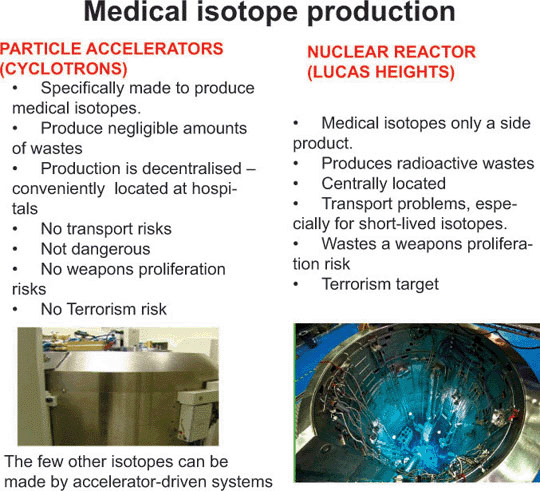
The reason behind this is that ANSTO is relying on its production of nuclear medicine as the mainstay of its activities and intends to become a major international producer and exporter of reactor generated nuclear medicine.
However this appears to be a misconceived and purposeless intention since nuclear medicine generated by reactor isotopes is in significant decline throughout the world due to its dangerous inherent state in being used in medical diagnosis and treatment
There is a world wide turning away by the medical profession from using reactor generated nuclear medicine because of its sever danger to patients coupled with its extremely high production costs.
More alternatives to this form of nuclear medicine are already extensively used as they are far safer and pose little risk to patients and additionally are much cheaper to produce with the involvement of major international drug companies
ARPANSA should seek the independent and expert assessment and review of the proposal and intentions by ANSTO as part of the licensing process for the increased storage facility for nuclear waste at Lucas Heights recently proposed by ANSTO
The assessment and review must include a financial examination to determine commercial and economic viability of the activities and proposals by ANSTO as this is an essential ingredient of the qualifications for the licence for the increased storage capacity
Since the suitably qualified experts for the assessment are not in Australia (as in any case this could create a conflict situation) ARPANSA will need to rely on and engage the highly qualified experts in this field available
from overseas
From the general tenor and prescriptions of the Australian Radiation Protection and Nuclear Safety Act 1998 and applicable regulations – which are referred to as the enabling legislation – it seems quite certain that the commercial and financial aspects must be included by ARPANSAin considering an application for a licence
This should be even more imperative since the funds sought by ANSTO for the increased storage capability at Lucas Heights are being provided by the federal government which is in direct and colloquial terms taxpayers’ money and it is an obligation of the government to protect public revenue and expenditure
There has never been any publicly released information by ANSTO on the financial aspects of the production and sale of its nuclear medicine but as justification for the production ANSTO has relied on the emotivearguments that in their lifetime everyone has or will have a need for nuclear medicine.
ANSTO claims that it has given to the government a recently commissioned independent study into future nuclear medicine supply in Australia and this study should be given to ARPANSA with all supporting information for assistance for its assessment and review as part of the licensing process.
1 This month
17 October, Free Public Talk on Nuclear Issues in South Australia
David Noonan will speak on public interest concerns over the new Roxby Downs Indenture Act 2026 on BHP copper-uranium mining and ore processing in SA, and on how AUKUS may face SA with a High-Level nuclear waste agenda.
Dr Jim Green will discuss international developments in the field of nuclear power including ‘small modular reactors’ and Generation 4 ‘advanced’ nuclear reactor concepts.


Help Aunty Sue Protect Her Land and Sacred Sites From Destructive Rocket Testing.
.

Australians deserve the truth
about
AUKUS – https://aukuspublicinquiry.com/

PETITION – To: Prime Minister Anthony Albanese and the Australian Labor Government

of the week – Australians for War Powers Reform (AWPR)
To see nuclear-related stories in greater depth and intensity

