Australia’s environmental scientists are being gagged
|
Research reveals shocking detail on how Australia’s environmental scientists are being silenced The Conversation Don Driscoll -Professor in Terrestrial Ecology, Deakin University, Bob Pressey, Professor and Program Leader, Conservation Planning, ARC Centre of Excellence for Coral Reef Studies, James Cook University, Euan Ritchie, Associate Professor in Wildlife Ecology and Conservation, Centre for Integrative Ecology, School of Life & Environmental Sciences, Deakin University, Noel D Preece, Adjunct Asssociate Professor, James Cook University, September 9, 2020 Ecologists and conservation experts in government, industry and universities are routinely constrained in communicating scientific evidence on threatened species, mining, logging and other threats to the environment, our new research has found.
Our study, just published, shows how important scientific information about environmental threats often does not reach the public or decision-makers, including government ministers. In some cases, scientists self-censor information for fear of damaging their careers, losing funding or being misrepresented in the media. In others, senior managers or ministers’ officers prevented researchers from speaking truthfully on scientific matters. This information blackout, termed “science suppression”, can hide environmentally damaging practices and policies from public scrutiny. The practice is detrimental to both nature and democracy.
Code of silenceOur online survey ran from October 25, 2018, to February 11, 2019. Through advertising and other means, we targeted Australian ecologists, conservation scientists, conservation policy makers and environmental consultants. This included academics, government employees and scientists working for industry such as consultants and non-government organisations. Some 220 people responded to the survey, comprising:
In a series of multiple-choice and open-ended questions, we asked respondents about the prevalence and consequences of suppressing science communication.
About half (52%) of government respondents, 38% from industry and 9% from universities had been prohibited from communicating scientific information. Communications via traditional (40%) and social (25%) media were most commonly prohibited across all workplaces. There were also instances of internal communications (15%), conference presentations (11%) and journal papers (5%) being prohibited.
Ministers are not receiving full information’Some 75% of respondents reported having refrained from making a contribution to public discussion when given the opportunity – most commonly in traditional media or social media. A small number of respondents self-censored conference presentations (9%) and peer-reviewed papers (7%). Factors constraining commentary from government respondents included senior management (82%), workplace policy (72%), a minister’s office (63%) and middle management (62%). Fear of barriers to advancement (49%) and concern about media misrepresentation (49%) also discouraged public communication by government respondents. Almost 60% of government respondents and 36% of industry respondents reported unduly modified internal communications.
One government respondent said:
University respondents, more than other workplaces, avoided public commentary out of fear of how they would be represented by the media (76%), fear of being drawn beyond their expertise (73%), stress (55%), fear that funding might be affected (53%) and uncertainty about their area of expertise (52%). One university respondent said: I proposed an article in The Conversation about the impacts of mining […] The uni I worked at didn’t like the idea as they received funding from (the mining company)……….
The system is brokenOf those respondents who had communicated information publicly, 42% had been harassed or criticised for doing so. Of those, 83% believed the harassers were motivated by political or economic interests………… https://theconversation.com/research-reveals-shocking-detail-on-how-australias-environmental-scientists-are-being-silenced-140026 |
–
|
Indecent haste in Australian government’s push for law making Napandee the nuclear waste dump. What’s going on?
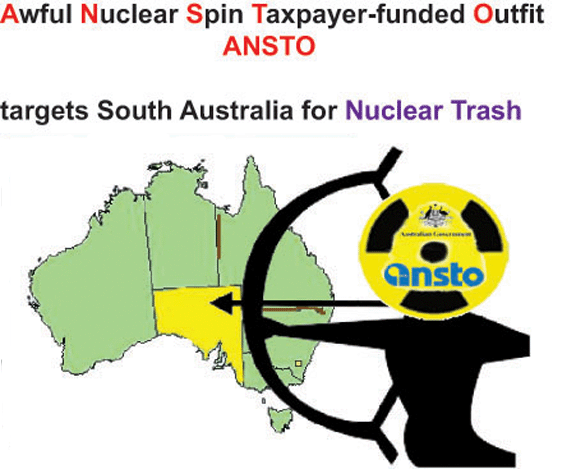
New nuclear legislation set to provide toxic dumping ground in South Australia, Independent Australia, By Noel Wauchope |
UNDER THE PRESSURE of The Australian Nuclear Science and Technology Organisation (ANSTO), The Australian Government is in a hurry to get a new bill passed. It’s not really a new bill, it’s actually a new bit tacked on to an existing one. It’s called the National Radioactive Waste Management Amendment (Site Specification, Community Fund and Other Measures) Bill 2020.
The amendment does two important things: it selects a definite place in South Australia, a farmer’s property called Napandee, as a radioactive waste dump and it removes the possibility of a judicial review of that selection.
The proposed dump is an “interim” radioactive waste facility.
It would consist of two parts:
- Temporary above-ground storage for what is known as low-level waste (LLW). LLW is a general term for a range of objects that are radioactively contaminated, but not considered to be highly radioactive nor toxic for thousands of years.
- A “temporary” above-ground storage for intermediate-level waste (ILW). ILW is a term for a mix of wastes that contains some very long-lived highly toxic radioactive matter, that does require isolation for thousands of years. While this amount would be smaller in volume, it would be far more significant. 95 per cent of this radioactive content would be spent nuclear fuel rods from ANSTO’s nuclear reactor at Lucas Heights, Sydney.
At present, these highly radioactive wastes are stored in giant canisters at Lucas Heights, where there is ample space for further canisters and experienced and skilled staff to monitor them and provide security.
ANSTO has plans to expand its operation and CEO Dr Adi Paterson’s dream of a world-leading business in exporting radionuclides for medicine and industry. Meanwhile, international nuclear security obligations demand that Australia develop a plan for the permanent disposal of nuclear wastes.
Unfortunately, this Napandee plan does nothing towards meeting these obligations. ……….
There is no plan whatsoever for the permanent disposal of this highly radioactive trash.
There’s a vague story that these wastes will later be moved from Napandee to a permanent disposal — anything from 40 to 300 years. They are most likely to suffer the fate of other such facilities in the USA and other countries and become stranded wastes…….
There was a heavy emphasis on “medical” wastes. But the reality is that the vast majority of wastes from nuclear medicine are very short-lived radioisotopes, that have no need to be transported thousands of miles and are routinely disposed of close to places such as hospitals where they are used.
A ballot was held in the area, of ratepayers only, on whether or not to support the project. Some residents close to the property were excluded, as were the Native Title holders, the Barngarla Aboriginal community. The vote result, from 824 voters, was 452 “yes”. The Barngarla held their own vote — 80 Barngarla voted, with the unanimous result of “no”.
The whole issue of the transport of the nuclear wastes and their “temporary” dumping does concern also the region, the state of South Australia and the nation. The decision should not be made solely by 452 ratepayers in one small rural area………
Non-ratepayers did not get a look-in. In this modern, almost Trumpian paradigm, outsiders such as economists, environmentalists, medical experts, sociologists and independent radiation experts are seen as “the elites” that can’t be trusted. Unfortunately, independent overseas experts on nuclear waste management have been excluded, too. Apart from the problems raised for the town and region of Kimba itself, there are serious questions about the appropriateness of the planned system, the area environmentally and geologically……..
Of course, this plan is confined to nuclear wastes produced in Australia. For now.
The plan is obviously helpful to ANSTO. They can pass this uncomfortable buck of 10,000 year-lasting radioactive wastes on to a distant South Australian rural community. It will then be managed and funded by whom? The South Australian and Australian tax-payers.
This will take the pressure of ANSTO, make it look as if they’re doing something about their radioactive trash and avoid any Lucas Heights, or rather Barden Ridge fuss, as they expand their operations. (The residential area previously part of Lucas Heights was renamed Barden Ridge to increase the real estate value of the area, as it would no longer be instantly associated with the nuclear reactor.)
It’s not so helpful to South Australia, or to Australia. The best solution is to leave those nuclear reactor wastes safely stored at Lucas Heights for the time being and to develop a national discussion and plan for what to do with those wastes for permanent disposal. Under this present, rather rushed scheme, Resources Minister Keith Pitt, Dr Paterson and the whole crew of the NRWMF will be dead and gone, long before the stranded wastes at Napandee will be properly dealt with.
A solution for the common good is what’s needed, not just a solution that suits ANSTO. ANSTO is a statutory body — a case of the tail wagging the dog, perhaps?
The National Radioactive Waste Management Amendment (Site Specification, Community Fund and Other Measures) Bill 2020 has been passed by the House of Representatives. It will be debated in the Senate later this year.
Meanwhile the Senate Economics Legislation Committee is holding an Inquiry into this bill…….
it gets interesting. Suddenly, a public hearing becomes private. The topic for this new secrecy was the discussion of some documents from the NRWMFT that had been requested by the Committee and received only a very short time before the hearing. The documents were heavily redacted. They relate to the process by which the Napandee site was selected. How spontaneous was the farmer’s offer of his land? What roles did the NRWMFT, ANSTO and the Industry Department, play in instigating this offer?
So many questions surround this plan:
- Is the new amendment being pushed because Minister Keith Pitt fears the opposition of Aboriginals, or indeed of the public in general?
- The exclusion of the Barngarla from the decision — how does this square with Indigenous rights?
- Why did the Government not provide any independent advice to the Kimba community?
- Why are the South Australian and Australian public excluded from decision-making?
- Why is this Senate Committee public hearing to be held in secret?
- Why is this all happening in such a hurry? https://independentaustralia.net/politics/politics-display/new-nuclear-legislation-set-to-provide-toxic-dumping-ground-in-south-australia,14256
Australia’s Dept of Industry hiding the facts on choice of Kimba nuclear waste site
 Kazzi Jai No Nuclear Waste Dump Anywhere in South Australia, 22 Aug 20,
 FRIDAY NIGHT QUIZ QUESTION: How many times did the DIIS quote this EXACT SAME STATEMENT in their “Answers to Questions Notices” tabled recently for the Senate Inquiry?….more https://www.facebook.com/groups/1314655315214929/
Military to Weapons Sales – Professor Peter Leahy and the revolving door
Professor Peter Leahy AC Australian Defence Force | Military | Revolving Doors, Michael West Media, 19 Aug, 20
Lieutenant-General Peter Leahy retired from the Australian army in July 2008 having concluded his 37 year military career with six years as Chief of Army. Within a year he was on the boards of Codan and Electro Optic Systems (EOS). More recently, EOS has been exporting its weapon systems to Saudi Arabia and the United Arab Emirates while the Yemen war has raged despite multiple reports of war crimes by these countries and a situation in Yemen which the UN has called the world’s worst humanitarian catastrophe.
Current Positions
Public
Professor and foundation director, National Security Institute, University of Canberra (7.10.08–present^)
^ Website accessed 10.08.20
Corporate
Member, Advisory Board, WarpForge Limited ([??]–present^)
Director, Citadel Group (28.6.14*–present^; including as Chair from 12.11.19)
Director, Electro Optic Systems (4.5.09*–present^)
Director, Codan Limited (19.9.08*–present^)………. https://www.michaelwest.com.au/peter-leahy/
Australian govt trying to keep its $1.3bn arms purchase a secret, a dangerous precedent
Coalition says making public parts of $1.3bn Thales arms deal audit would penalise weapons company
Australian government claims disclosure would damage chances of multinational Thales to sell Hawkei combat vehicle to other countries, Guardian Christopher Knaus, The Australian government is arguing parts of an audit of a $1.3bn arms purchase must be kept secret because a multinational weapons company Thales would have trouble selling its product if they were disclosed.But the administrative appeals tribunal has heard that such an argument if allowed to stand would have a “devastating effect” on the auditor general’s ability to transparently and publicly criticise other government purchases.
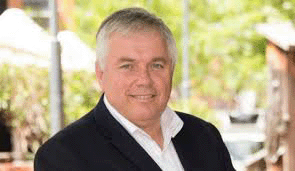 The tribunal is hearing a case between the Department of Prime Minister and Cabinet and crossbench senator Rex Patrick, who is fighting through freedom of information for full release of a 2018 audit report examining the government’s acquisition of the $1.3bn Hawkei combat vehicle fleet from French-based manufacturer Thales.
After representations from Thales, the attorney general, Christian Porter, made an extraordinary and largely unprecedented intervention to redact sections of the audit on the grounds they unfairly prejudiced Thales’s commercial interests and threatened Australia’s national security and defence.
The Guardian has since revealed the redacted material included a cost-comparison suggesting that Australia could have saved money by purchasing a different vehicle – the joint light tactical vehicle – from the United States……. https://www.theguardian.com/world/2020/jul/23/coalition-says-making-public-parts-of-13bn-thales-arms-deal-audit-would-penalise-weapons-company
(Video) Pine Gap – USA’s secret spy base in Australia
This post goes back 10 years. It is now updated, due to public interest. The video previously linked to this post, has now disappeared from the Internet. So, it is now replaced here with another video.
Pine Gap was built on traditional Aboriginal land, forcing removal of Aborigines from it


(Video) Mother of All DUMBs and Ops in Oz Red Center April 3, Human Rights Examiner Deborah Dupre’ Australia has over 63 U.S. military bases. Locals say that at Pine Gap secret deep underground military base (DUMB) in Australia’s “Red Center,” not far from the “Town Called Alice,” there are more CIA employees than there are in the entire U.S. It is officially reported to have 1000 CIA employees. more at
USA adds a new indictment to its charges against Julian Assange
 WikiLeaks founder Assange faces new indictment in US, By ERIC TUCKER, 29 June 20, WASHINGTON (AP) — WikiLeaks founder Julian Assange sought to recruit hackers at conferences in Europe and Asia who could provide his anti-secrecy website with classified information, and conspired with members of hacking organizations, according to a new Justice Department indictment announced Wednesday.
The superseding indictment does not contain additional charges beyond the 18 counts the Justice Department unsealed last year. But prosecutors say it underscores Assange’s efforts to procure and release classified information, allegations that form the basis of criminal charges he already faces.
Beyond recruiting hackers at conferences, the indictment accuses Assange of conspiring with members of hacking groups known as LulzSec and Anonymous. He also worked with a 17-year-old hacker who gave him information stolen from a bank and directed the teenager to steal additional material, including audio recordings of high-ranking government officials, prosecutors say.
Assange’s lawyer, Barry Pollack, said in a statement that “the government’s relentless pursuit of Julian Assange poses a grave threat to journalists everywhere and to the public’s right to know.”
“While today’s superseding indictment is yet another chapter in the U.S. Government’s effort to persuade the public that its pursuit of Julian Assange is based on something other than his publication of newsworthy truthful information,” he added, “the indictment continues to charge him with violating the Espionage Act based on WikiLeaks publications exposing war crimes committed by the U.S. Government.”
Assange was arrested last year after being evicted from the Ecuadorian Embassy in London, where he had sought refuge to avoid being sent to Sweden over allegations of rape and sexual assault, and is at the center of an extradition tussle over whether he should be sent to the United States.
The Justice Department has already charged him with conspiring with former U.S. Army intelligence analyst Chelsea Manning in one of the largest compromises of classified information in U.S. history by working together to crack a password to a government computer.
Prosecutors say the WikiLeaks founder damaged national security by publishing hundreds of thousands of classified documents, including diplomatic cables and military files on the wars in Iraq and Afghanistan, that harmed the U.S. and its allies and aided its adversaries.
Assange maintains he was acting as a journalist entitled to First Amendment protection. His lawyers have argued the U.S. charges of espionage and computer misuse were politically motivated and an abuse of power.
Assange generated substantial attention during the 2016 presidential election, and in investigations that followed, after WikiLeaks published stolen Democratic emails that U.S. authorities say were hacked by Russian military intelligence officials. An investigation by special counsel Robert Mueller revealed how Trump campaign associates eagerly anticipated the email disclosures. One Trump ally, Roger Stone, was found guilty last year of lying about his efforts to gain inside information about the emails. Assange, however, was never charged in Mueller’s Russia investigation.
The allegations in the new indictment center on conferences, in locations including the Netherlands and Malaysia in 2009, at which prosecutors say he and a WikiLeaks associate sought to recruit hackers who could locate classified information, including material on a “Most Wanted Leaks” list posted on WikiLeaks’ website.
According to the new indictment, he told would-be recruits that unless they were a member of the U.S. military, they faced no legal liability for stealing classified information and giving it to WikiLeaks “because ‘TOP SECRET’ meant nothing as a matter of law.”
At one conference in Malaysia, called the “Hack in the Box Security Conference,” Assange told the audience, “I was a famous teenage hacker in Australia, and I’ve been reading generals’ emails since I was 17.”
Trump’s Justice department doubles down on USA allegations against Julian Assange
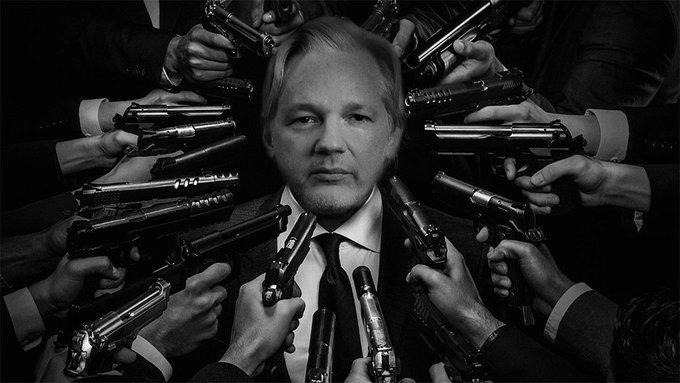 ASSANGE EXTRADITION: Assange Hit With New Superseding Indictment, Reflecting Possible FBI Sting Operation The U.S. Justice Department on Wednesday unveiled the new superseding indictment against the WikiLeaks publisher, adding to existing computer intrusion charges. By Joe Lauria, Consortium News June 24, 2020 The Justice Department on Wednesday said it had filed a second superseding indictment against imprisoned WikiLeaks publisher Julian Assange, adding to existing computer intrusion charges.“The new indictment does not add additional counts to the prior 18-count superseding indictment returned against Assange in May 2019,” the DOJ said in a press release.
“It does, however, broaden the scope of the conspiracy surrounding alleged computer intrusions with which Assange was previously charged,” the release said. “According to the charging document, Assange and others at WikiLeaks recruited and agreed with hackers to commit computer intrusions to benefit WikiLeaks.”…….
The indictment quotes Assange at hacking conferences encouraging hackers to obtain a “Most Wanted Leaks” list of classified materials that WikiLeaks sought to publish.
It provides new allegations that Assange instructed a “teenager” from an unnamed NATO country to conduct various hacks “including audio recordings of phone conversations between high-ranking officials” of the NATO nation as well as members of parliament from that country. The indictment claims Manning “downloaded classified State Department materials” about this country.
WikiLeaks has identified the “teenager” as Sigurdur Thordarson, “a diagnosed sociopath, a convicted conman, and sex criminal” who had impersonated Assange to embezzle money from WikiLeaks………..
Thordarson, an Icelander, became an FBI informant, and was flown to Washington in May 2019 for an interview with the FBI.
The superseding indictment says Assange was allegedly able to learn from “unauthorized access” to a website of this government that police from that country were monitoring him. The indictment says the source of this information was a former member of Anonymous who worked with WikiLeaks named Sabu, identified in the press as Hector Monsegur, who became an FBI informant after being arrested in June 2011.
In the same month, Iceland’s Interior Minister Ögmundur Jonasson prevented FBI agents from entering Iceland, testifying that “FBI dirty-tricks operations were afoot against WikiLeaks.” He said the agents had been sent to seek “our cooperation in what I understood as an operation to set up, to frame Julian Assange and WikiLeaks.” The possibility remains that the new evidence against Assange was obtained in an FBI sting operation.
Jeremy Hammond, a hacker arrested for obtaining the Stratfor files, is named in the new indictment has having revealed information about his activities with Assange to Sabu in December 2011. Last September, Hammond, who was serving a 10-year sentence in Memphis, TN, was brought by prosecutors investigating Assange to Alexandria, VA to compel him to give testimony against Assange. Hammond has refused.
Reiterates Original Charges
The new indictment repeats the existing espionage and computer intrusion charges………
In 2010, Robert Parry, one of the best investigative reporters of his era, and the founder of this website, wrote that the then pending plans of the Obama administration to indict Assange “for conspiring with Army Pvt. Bradley Manning to obtain U.S. secrets strikes at the heart of investigative journalism on national security scandals.”
Parry added:
“That’s because the process for reporters obtaining classified information about crimes of state most often involves a journalist persuading some government official to break the law either by turning over classified documents or at least by talking about the secret information. There is almost always some level of ‘conspiracy’ between reporter and source.” [Emphasis added.]
Parry thus admitted to encouraging his sources to turn over classified information even if it meant committing the lesser crime of leaking classified information if it could help prevent a larger crime from being committed. In this way Assange encouraged Manning to turn over material such as the “Collateral Murder” video in the hope that it could end the illegal war in Iraq…….
The New York Times reported at the time that “federal prosecutors were reviewing the possibility of indicting Assange on conspiracy charges for allegedly encouraging or assisting Manning in extracting ‘classified military and State Department files from a government computer system,’” Parry wrote.
“The Times article by Charlie Savage notes that if prosecutors determine that Assange provided some help in the process, ‘they believe they could charge him as a conspirator in the leak, not just as a passive recipient of the documents who then published them,” wrote Parry.
This is precisely what the Trump Justice Department has done in the first computer intrusion indictment against Assange and now with this superseding one. https://consortiumnews.com/2020/06/24/assange-extradition-assange-hit-with-new-superseding-indictment-broadening-computer-intrusion-charges/?fbclid=IwAR3uZdqQkMLxeheGyUVLpkUYPIo0ywUZwFiQcu6pD9woYSYyPhZtyh3kiw4
Julian Assange’s fiancé calls on the Australian government to secure his freedom
|
Julian Assange’s fiancé calls on the Australian government to secure his freedom, https://www.wsws.org/en/articles/2020/06/22/assa-j22.html, By Oscar Grenfell, 22 June 2020Stella Morris, the fiancé of Julian Assange and mother of his two young children, issued a powerful call last night for the Australian government to secure the WikiLeaks founder’s freedom and prevent his extradition to the US, where he faces life imprisonment for exposing American war crimes.
Morris was featured on Channel Nine’s “60 Minutes” program. The 24-minute segment provided an objective account of Assange’s decade-long arbitrary detention, first in Ecuador’s London embassy where he was a political refugee, and since April 2019 in the maximum-security Belmarsh Prison. The program, presented by Tara Brown, was the first substantive examination of Assange’s plight by the Australian media since the coronavirus pandemic began. Despite the fact that he is an Australian journalist being persecuted by the most powerful governments in the world for his publishing activities, corporate media outlets have maintained an effective D-notice on Assange for more than three months. This has dovetailed with the refusal of the Australian government, the Labor opposition and all of the official parties to defend the WikiLeaks founder. Morris warned that Assange’s incarceration in Belmarsh, which she noted has been dubbed the “UK’s Guantanamo Bay,” is exacerbating physical and psychological health issues stemming from his protracted persecution. “He’s very unwell and I’m very concerned for his ability to survive this,” she said. “Now he’s in the UK’s worst prison. It’s a high-security prison. One in five prisoners are murderers. He shouldn’t be there. He’s not a criminal, he’s not a dangerous person, he’s a gentle intellectual thinker and a journalist. Those people are not the people who belong in prison.” Morris stated that she was “very worried” about Assange’s circumstances. She has been unable to visit him since February, as a result of coronavirus lockdown measures. Despite widespread infections throughout the British penitentiary system, including in Belmarsh, and Assange’s vulnerability to the virus as a result of a chronic lung condition, he has been refused bail. “If you’re separated from your family and you’re alone in a tiny, dark room for 23-hours a day, with no control over your surroundings, I think people can imagine what that is like,” Morris said. Brown stated that in such circumstances, “most people would probably go mad.” Morris responded: “I think any person would get very severely depressed and he is very depressed.” “60 Minutes” showed Morris and her two young children speaking with Assange on the phone. The older of the two asked Assange when he was coming home. Morris, a 37-year-old lawyer, recounted the circumstances of her relationship with Assange. They had grown close when she was working on his legal cases after he had successfully sought political asylum in the Ecuadorian embassy. When the couple’s two children were born in 2017 and 2018, the new Ecuadorian government had initiated closer relations with the US and was increasingly hostile to Assange. UC Global, a Spanish firm contracted to manage the embassy’s security, was surveilling every aspect of Assange’s life and was passing the the material gathered to the US Central Intelligence Agency. When she fell pregnant, Morris informed Assange by writing the news on a piece of paper. They were fearful that any conversation about their personal life would be picked up by the audio recording devices placed throughout the embassy by UC Global. Morris sought to hide her pregnancies from the embassy staff and after the children were born, a friend of Assange pretended to be their father and brought them to the embassy. “The real issue was I thought that our family would be targeted by the same people that were trying to harm Julian,” Morris stated. The program featured news clips of senior US government figures denouncing Assange in hysterical terms and calling for him to be silenced. Morris noted that UC Global had considered stealing the diaper of one of her children to confirm his paternity, and had even discussed plans to kill Assange or allow American agents to kidnap him. Morris commented that it would be difficult for many people to appreciate the lawlessness that had characterised Assange’s persecution. “There’s incredible criminality that has been going on in order to gather information about Julian’s lawyers, and his family, and journalists who were visiting him,” she said. “I’ve been in a permanent state of fear for years and now it’s slowly playing out.” Significantly, the politically-motivated character of Swedish sexual misconduct allegations against Assange was made clear in the program. The allegations were concocted by that country’s police and judiciary, in the midst of a frenzied US campaign against WikiLeaks’ exposure of war crimes in Iraq and Afghanistan. Brown noted that Assange had never been charged with a crime in Sweden, and that the Swedish investigation had been dropped. Australian independent parliamentarian Andrew Wilkie pointed out that documents had shown that the British government used the allegations to enforce Assange’s arbitrary detention in the Ecuadorian embassy. The British authorities had been aware that the Swedish claims were a smokescreen for plans to dispatch Assange to his US persecutors. The program concluded with an appeal from Morris to the Australian government. She said: “I want people to understand that we’re being punished as a family. It’s not just Julian in the prison. The kids are being deprived of their father. I need Julian and he needs me.” Morris declared: “I’d like to ask [Australian Prime Minister] Scott Morrison to do everything he can to get Julian back to his family. If Australia doesn’t step in I’m very fearful this wrong won’t be righted. It’s a nightmare.” Tellingly, Brown stated that Morrison, Foreign Minister Marise Payne and Christian Porter refused to be interviewed. This was in line with the ten-year collaboration of Australian governments in the US-led vendetta against Assange. Beginning with the Greens-backed Labor government of Julia Gillard, they have rejected calls to defend the WikiLeaks’ founder, instead participating in the campaign against him. The official hostility to Assange is bound up with the Australian ruling elite’s unconditional support for the US military alliance and all of American imperialism’s illegal wars and military preparations and dovetails with a domestic assault on democratic rights, including attacks on press freedom and laws increasing punishments for whistleblowers. It is facilitated by the refusal of the Greens, the pseudo-left groups and the unions to mount any campaign for Assange’s rights. This underscores the fact that the fight for Assange’s freedom and for the defence of all civil liberties requires the mobilisation of the working class. The international protests over recent weeks against police violence have demonstrated the objective basis for building such a movement. |
|
Mysterious, manipulative and corrupt process whereby Napandee was selected for nuclear dump site

Name Withheld, National Radioactive Waste Management Amendment (Site Specification, Community Fund and Other Measures) Bill 2020 [Provisions] Submission 39 [Excerpt] “…..So we examine briefly the nomination process in Kimba. When the 28 nominations were received in 2015, the number were then by a mysterious and yet to be released process whereby 6 sites were ultimately deemed suitable by the Federal Government. This announcement occurred in early 2016 and after another round of processes which were just as mysterious, the two sites in Kimba and one site in Hawker were selected to go to the the next round.
But just as quickly as they were announced – Cortlinye (Current MP at that time and now Rowan Ramsey’s land) and Pinkawillinie (Jeff Baldock’s
land) in Kimba, and Barndioota (former senator Grant Chapman and Philip Speakman pastoral lease), suddenly it was noted that Rowan Ramsey’s nomination of Cortlinye was in direct conflict with Section 44 of the Constitution, so his land nomination was withdrawn. Pinkawillinie, which was Jeff Baldock’s nomination was not accepted as suitable because of lack of community support.
So that left Barndioota as the only candidate. That meant Kimba was taken completely off the list as a possible site announced April 29th 2016. And that should have been the end of it.
https://www.eyretribune.com.au/story/3878053/kimba-not-going-nuclear/
Then following the Federal Election in July 2016, just a few months later, the portfolio of Minster of Resources was shifted from Josh Frydenberg and given to Matt Canavan. And then the goalposts for nomination were changed…. and suddenly Kimba was on the list again, with three different nominations – Napandee (Jeff Baldock’s land), Tola Park (Jeff Baldock’s land) and Lyndhurst (Brett and Michelle Rayner).
So effectively Jeff Baldock seemingly pursued this dump and the nomination process if you look at how many sites he submitted! And he became proactive by being an active member of the newly formed Working for Kimba’s Future (in 2016) AND one of the members of the Kimba Consultative Committee!
There was no apparent submissions required for these nominations in this “second intake” or at least it was not advertised! Many people in Kimba assumed that the previous ones submitted when Cortlinye and Pinkawillinie were nominated would be used for these two new sites of Napandee and Lyndhurst. Tola Park was not taken any further after the nominations were announced possibly because it had too many neighbours to deal with.
To bring the point absolutely to point – Jeff Baldock was intent on making this happen, by submitting his land, not once, not twice but three times! And inserting himself into the Working for Kimba’s Future Committee AND an active member of the Kimba Consultative Committee! Rowan Ramsey did not do this when nominating his land. Brett and Michelle Rayner did not do this when nominating their land. (And go to Hawker – Grant Chapman and peter Speakman did not do this when nominating their land – although granted they do not actually live in the area either!)
Why would you allow an OBVIOUS INVESTED PERSONAL INTEREST be on the Kimba Consultative Committee – where the members WERE SELECTED BY THE GOVERNMENT! And it gets worse than that – the required NUMBERS OF PEOPLE REQUIRED – 6 FOR, 6 AGAINST and 6 NEITHER – were not achieved for the committee when the selected names came back, and when questioned why this is so, were told that it didn’t matter because they were a non voting body. However that is not true as the Committee was used to decide the boundaries for the voting.
“5.20 Mrs Toni Scott outlined her concerns with the allocation of places to the Kimba Consultative Committee: Bruce McCleary…informed people at the meeting that the committee would consist of six people opposed, six people supportive and six people who are neutral. That was also again given to members of our group by the Minister—that that’s how the makeup of the committee would be. On the day that the committee was announced, we were extremely concerned that there were only four people who had expressed opposition who were actually on that committee…
Bruce Wilson took my concerns on board and told me that the makeup of the committee didn’t really matter because it’s a non-voting body.15 5.21 However, it does appear that the Kimba Consultative Committee (KCC) has
been asked to make at least on significant decision: We were told by Bruce McCleary that the KCC would be a non-decision making body. However, our concerns probably came to light a bit in the May meeting, when the KCC was asked to vote on whether we should request that the Minister consider altering the boundaries for the ballot.”
https://www.aph.gov.au/Parliamentary_Business/Committees/Senate/Economics/Wastemanageme
ntfacility/~/media/Committees/economics_ctte/Wastemanagementfacility/report.pdf
Which leads to the use of the Local Government Act in the ballot process. It was not an accident of fortune that it was used to conduct the community ballot – as this meant that it could be used also to exclude Traditional Owners as well – particularly the Barngarla people in the case of Kimba.
“5.21 However, it does appear that the Kimba Consultative Committee (KCC) has been asked to make at least on significant decision: We were told by Bruce McCleary that the KCC would be a non decision making body. However, our concerns probably came to light a bit in the May meeting, when the KCC was asked to vote on whether we should request that the Minister consider altering the boundaries for the ballot.16 5.22 By contrast, Dr Susan Andersson explained how the Barndioota Consultative Committee had effectively been sidelined by DIIS and the Minister in relation to defining the boundaries of the community vote: …we spent hours deciding what community is and who will get the vote and whether that includes Quorn, whether outback areas get in and how broad this should be. We had an expert there to help us define community for two sessions. Plus it was on the agenda two or three times: you will get a vote; BCC will be inputting into what area gets a vote.
Then Minister Canavan arrived on his surprise visit and said, ‘The area will be this.’ At a BCC meeting we said, ‘Hang on, we haven’t had our vote yet.’ ‘Oh, haven’t you? You can still have your vote; we’ll listen to it.’ But he’d already made media and public announcements as to what the area was. The BCC had been working towards contributing to what defined the community.17”
https://www.aph.gov.au/Parliamentary_Business/Committees/Senate/Economics/Wastemanageme
ntfacility/~/media/Committees/economics_ctte/Wastemanagementfacility/report.pdf
Although the Act as it stands requires consultation with Traditional Owners, freezing them deliberately out of the community ballot should not the intention of what is considered a right and Australian way of doing things in this day and age – given the scope and timeline of the nuclear waste being considered! Especially when the Local Government Act is only primarily used for Roads, Rates and Rubbish…and electing new council members!
Although the Barngarla people’s Native Title claim was determined on January 22nd 2015, their formal ownership occurred in June 2018, after first being lodged in 1996! Now when was the community ballot originally meant to be conducted for this dump? August 2018. This again is a reason why the Barngarla people are angry. When they conducted their very own ballot in 2019, through an independent ballot agent Australian Election
Company, after being denied one through the Council ballot with boundaries determined by the Minister, their results showed NO VOTES IN FAVOUR OF THE DUMP ON THEIR LAND – 209 eligible to vote, 83 voted NO 0 voted yes! So under Matt Canavan’s loose usage of figures, 100% NO and
0%YES.
But the real kicker are two other points. One that the Baldocks are now actively selling land with three neighbouring famers in Kimba in a large lot called the “Cunyarie Collection”, 9000ha as
advertised February 14, 2020 https://www.adelaidenow.com.au/business/sa-businessjournal/
large-parcel-of-eyre-peninsula-cropping-land-on-the-market/newsstory/
74188105d449d5920685cdd74637780c
So much for all the media gab about it being good for the community! Actions speak louder than words!
And that the historical information about the announced site, as under the AECOM site study used some historical information from Jeff Baldock himself, who had had the land only for less than 10 years! “The soils at the site are a sandy loam on a relatively impermeable calcrete/silcrete layer at a depth of approximately 0.3m with no known localised flooding or water logging issues (source Jeff Baldock 22 Feb 2018). This is based on approximately 6 years on the property.” Page 72
https://www.industry.gov.au/sites/default/files/2019-
04/nrwmf_site_characterisation_technical_report_napandee.pdf
This is a flawed proposal from start to end. Having ONE person nominate their land is not the best way of dealing with nuclear waste. This is not considering the very best geological site for this waste.Nor the very safest site for this waste. Just a lottery for the landowner who would “win” the
nomination!
And the goal posts were forever changing. The neighbouring areas were farcical as the diameter of the inclusion zone became smaller and smaller…until it was only the immediate fence lines and have a road in-between and you’re not a neighbour! That is how the 100% neighbour figure was achieved. There were four immediate or direct neighbours to Napandee, but that became 3 after this ruling was used. And those 3 neighbours agreed with the site. The neighbour with the road in-between did not! https://www.aph.gov.au/DocumentStore.ashx?id=4211af77-bacf-4cb7-b03c-
98ba573b179b&subId=565156
The Conservation Parks nearby Napandee (Pinkawillinie Conservation Park and also the Gawler Ranges National Park) were not allowed a say as “neighbours” as they are State owned…. as determined by the guidelines set up Department of Industry, Innovation and Science, with advice from Geoscience Australia, independent market research company ORIMA Research the Kimba Consultative Committee… “A neighbour cannot be the Crown in any capacity, a district council or any
other State or Commonwealth government body”
https://www.industry.gov.au/sites/default/files/2019-11/nrwmf-neighbour-sentiment-surveyguidelines.
pdf
Gabrielle Costigan- another one revolving from tax-paid jobs to weapons industry!
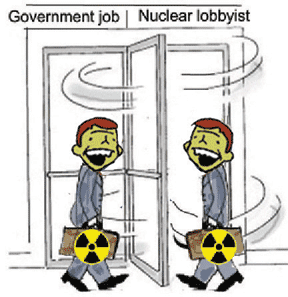 Gabrielle Costigan MBE https://www.michaelwest.com.au/gabrielle-costigan-mbe/
MILITARY INDUSTRY REVOLVING DOOR
A former Colonel in the Australian Army who led logistic operations for the Australian and US governments. Left the military to move into a US-based military industry company. Currently, CEO of BAE Systems Australia.
Current Positions
Corporate
CEO, BAE Systems Australia (1.1.18-present)
Publicly funded
Chair, Council for Women and Families United by Defence Service (term: 17.5.19–14.5.2021)
Previous Positions
Corporate positions
CEO (designate), BAE Systems Australia (2.10.17-31.12.17)
CEO, Linfox International Group (May 2014-June 2017)
Vice President, Military Programs and Business Development Commercial Aircraft, VAS Aero Services, LLC (USA) (July 2013-Mar 2014)
Vice President, Military Programs, VAS Aero Services, LLC (USA) (July 2012-June 2013)
Publicly funded positions
Board member, Australia-ASEAN Council [Joined board while at Linfox; no longer listed on board. Emailed DFAT-AAC for dates 15.2.20; no reply]
Military positions
Director, Multi-National Logistics Division, United States Central Command (Jan 2010-July 2012)
Military Assistant to the Chief of Joint Operations Command, Australian Defence Force (Jan 2008-Dec 2009)
Australian Command and Staff College, Australian Defence Force (Jan 2007-Dec 2007)
Australian Army, various positions (Jan 2002-Dec 2006)
Defence departmental positions
Project Manager–Simulation, Defence Department (1999-2002)
Related Items
June 2019: Awarded MBE by the United Kingdom, Queen’s Birthday honours list, “for services to UK/Australia relations.”
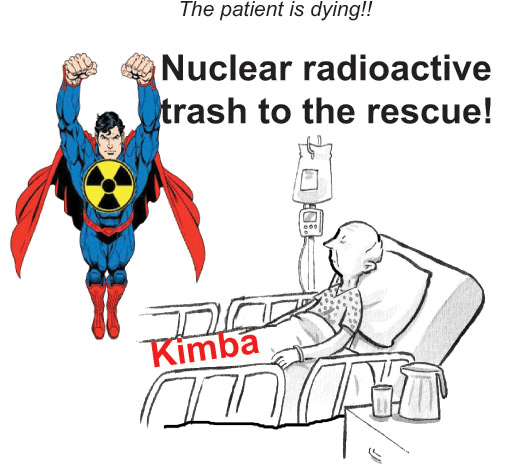
Town of Kimba depicted as failing, desperate to have nuclear waste dump for its survival
|
Waste dump gives bush town ‘secure future’ https://www.theleader.com.au/story/6789645/waste-dump-gives-bush-town-secure-future/?cs=9397 Finbar O’Mallon 11 June 20
A South Australian regional town desperately needs to become the site of a nuclear waste dump to stop the town’s decline, its federal MP says.
Government chief whip Rowan Ramsey’s dreams for his hometown on the Eyre Peninsula are one step closer to reality as the bill cementing the site passed the House of Representatives. “The project will be a game changer for Kimba. It will offer a secure future,” the Liberal MP told parliament on Thursday.
Native title holders have unsuccessfully gone to the courts to block the facility. Environmental advocates are concerned the bill has major holes, while Labor wanted the government to let a Senate committee review the proposal.
Government chief whip Rowan Ramsey’s dreams for his hometown on the Eyre Peninsula are one step closer to reality as the bill cementing the site passed the House of Representatives. “The project will be a game changer for Kimba. It will offer a secure future,” the Liberal MP told parliament on Thursday.
Native title holders have unsuccessfully gone to the courts to block the facility. Environmental advocates are concerned the bill has major holes, while Labor wanted the government to let a Senate committee review the proposal.
The local native title holders tried to have the proposal thrown out by the courts in March. Barngarla Determination Aboriginal Corporation claimed some votes on whether to support the facility had been excluded. The ballot returned about 62 per cent support for the dump. While native title rights don’t exist at the Napandee property site, the bill allows the government to override nearby rights holders and not seek permission to build access roads on their land. Under the bill, the Kimba farm would become Australia’s number one nuclear waste dump, with the facility expected to store radioactive refuse for 100 years. A one-off $20 million community fund would help establish and maintain the site. Mr Ramsey said it would create 33 local permanent jobs. He painted a picture of a town in decline, with a shrinking population, no permanent doctor and even the loss of three of its four footy clubs. “Survival of our towns will require something new, something outside the square,” Mr Ramsey said. “I’m convinced 100 other communities around Australia will look at Kimba and ask, ‘Why didn’t we put our hand up?'” |
|
Former weapons chief executive now South Australian Premier’s top advisor

This could shed some light on the South Australian government’s silence on the Federal plan for a nuclear waste dump in South Australia. We can expect the South Australian government to now support the nuclear waste dump at Napandee, and to promote schemes to make south Australia a nuclear hub, especially with nuclear submarines production.
|
Weapons of Influence: BAE arms boss turns Premier’s right-hand man https://www.michaelwest.com.au/weapons-of-influence-bae-arms-boss-turns-premiers-right-hand-man/ Michael West Media, by Michelle Fahy | Jun 12, 2020 As part of her series of investigations into the close links between the military industry and politics, Michelle Fahy reports on former weapons chief executive for BAE, Jim McDowell, who is now at the centre of government in the Defence State, South Australia. Jim McDowell was employed in the weapons industry for 37 years. Born in Belfast, he studied law then spent 18 years with Northern Ireland firm Bombardier Shorts. After that, he joined British Aerospace (now BAE Systems) in Singapore and worked his way up through various positions in Asia. In 2001, McDowell was appointed CEO of BAE Systems Australia. During a decade in that role he oversaw BAE’s 2008 acquisition of Tenix Defence, a deal that doubled the size of the company and resulted in BAE becoming Australia’s largest weapons-maker at the time. It remains one of the largest today, mostly for building Australia’s warships, among other projects. In September 2011, Jim McDowell left Adelaide for Riyadh, where he ran BAE’s Saudi Arabian operation for a little over two years. Saudi Arabia is crucial to BAE’s business, its third largest market after the US and the UK (Australia is fourth). The company has been supplying combat aircraft to the Saudis since the 1960s. Several of its arms deals have been dogged by controversy (and continue to be due to the Saudi role in the humanitarian catastrophe in Yemen), and some by corruption. In the UK, a Serious Fraud Office investigation into BAE’s relationship with the Saudis was notoriously shut down in December 2006 following intense pressure from the Saudi government and the UK’s then prime minister Tony Blair, citing national security reasons. The capitulation of the Serious Fraud Office was later deemed “unlawful, an “abject surrender” and a “threat to the reputation of British justice” by the British High Court. By the time McDowell arrived, all that was in the past and it was back to business. In a media release describing a visit of the BAE Board to Saudi Arabia in March 2012, McDowell said, “Saudi Arabia is a key market for the company. We want to be considered as an industrial and a strategic partner for the Kingdom… The meeting was a wonderful way to strengthen relations.” Several multi-billion pound arms deals were concluded during the period McDowell was BAE’s chief executive in Saudi Arabia. Back to Australia with ANSTOIn December 2013, McDowell resigned from BAE and returned to Australia. He was immediately appointed to the board of the Australian Nuclear Science and Technology Organisation, as deputy chair. Then Industry Minister Ian Macfarlane said, “Mr McDowell’s business background coupled with his knowledge of international marketing and joint ventures will support the development of emerging business opportunities…” ANSTO’s chair, Dr Paul Greenfield, said, “This is a dynamic and exciting time for ANSTO and this is reflected in the overall contribution nuclear science and technology is now making across a range of key areas.” Earlier that year (in February 2013), ANSTO had signed a formal research cooperation agreement with the Defence Science and Technology (DST) Organisation. This was a period when DST, under Chief Defence Scientist Alex Zelinsky, signed a number of collaborative agreements with military industrial companies, including BAE in October 2013 and, as we have covered previously, Lockheed Martin in March 2014, among others. At the completion of Dr Greenfield’s term, in August 2014, McDowell was appointed chair of the ANSTO board, a position he held for the next four years. McDowell’s timely departure from the military industry created an influx of new opportunities for him from a government with a policy of recognising industry as a “fundamental input to capability”. Following his rapid appointment to the ANSTO board, over the next four years, McDowell was awarded lucrative contracts across six major areas by Defence (see table), which together totalled almost $1.5 million in consultancy fees. To supplement the government’s largesse, in the same four-year period, McDowell accepted appointments as Chancellor of the University of South Australia and to the Council of the Australian Strategic Policy Institute. He also joined the boards of eight public companies, most of which operate in the military industrial sector. In addition to those in the chart, McDowell was made chair of another two private companies, duMonde Group Pty Ltd and Total Construction Pty Ltd (dates of those appointments are not publicly available). In 2017, it appears McDowell was engaged simultaneously in at least 12 different roles. Continue reading |
Australian Government’s Covid-19 advisory body – stacked with fossil fuel big-wigs, but their conflicts of interest kept secret
 Just one of six Covid commission members volunteers to release conflict-of-interest declaration Just one of six Covid commission members volunteers to release conflict-of-interest declaration
Federal government refuses to release disclosures, saying they were made ‘in confidence’, amid calls for greater transparency, Guardian, Christopher Knaus @knausc Fri 12 Jun 2020 Only one of the six commissioners on Scott Morrison’s Covid-19 commission has volunteered to release their conflicts of interest, prompting calls for greater transparency from the publicly funded body.The government has refused to release the conflict-of-interest declarations for members of its National Covid-19 Coordination Commission (NCCC), a prominent advisory body shaping non-health aspects of Australia’s Covid-19 strategy. There have been increasing concerns about a lack of proper governance structures around the taxpayer-funded commission, which operates with a broad remit and a budget of more than $5m. The commission is headed by Nev Power, the former head of Fortescue Metals, and other commissioners include the Industry Super chair Greg Combet, former health department secretary Jane Halton, rich-lister Paul Little, EnergyAustralia chair Catherine Tanna and CSIRO chair David Thodey Officials from the Department of Prime Minister and Cabinet said it could not release their conflict-of-interest declarations because they were provided “in confidence”. The Guardian approached each of the commissioners and asked whether they would release their interests of their own volition. Only Combet agreed to do so. A spokesman told the Guardian Combet’s “interests are already publicly available and widely known”, and provided a list including his chairmanship of Industry Super Australia and IFM Investors, as well as his membership of the Invest Victoria advisory board and occasional consulting roles. The interests he declared had already been published on the NCCC’s website, where others had also published their public directorships……. The Australia Institute’s climate and energy program director, Richie Merzian, said publicly disclosing conflicts was “the least the government commissioners” could do, given they had been handpicked to advise the government on spending billions of dollars taxpayer funds. “The roles of the NCCC commissioners are, by design, intended to influence government,” Merzian said. “It is clearly in the public interest for any conflicts of interest to be publicly declared. There is no excuse for any potential conflicts of interest to remain secret.” Crossbench senator Rex Patrick also urged “full disclosure” of the commissioners’ interests. “The commissioners are being paid from the public purse, are performing public activities and their output may have significant influence over the future expenditure of public money,” he said…….. https://www.theguardian.com/australia-news/2020/jun/12/just-one-of-six-covid-commission-members-volunteers-to-release-conflict-of-interest-declaration |
|
Another Australian former Senator glides easily into the weapons industry
Stephen Loosley AM, MILITARY INDUSTRY REVOLVING DOOR
Stephen Loosley was a NSW ALP Senator from 1990 to 1995. From November 2012 to September 2016 he was Chair of the Woomera Prohibited Area Advisory Board, a role required to be independent, yet he concurrently sat on the Thales Australia Advisory Board. Thales is one of the world’s top 10 weapons-makers….. https://www.michaelwest.com.au/stephen-loosley-am/
1 This month
Chernobyl: The Lost Tapes – A good documentary on Chernobyl on SBS available On Demand for the next 3 weeks– https://www.sbs.com.au/ondemand/tv-program/chernobyl-the-lost-tapes/2352741955560
15 April – Zoom –Nuclear Power is Not the Solution
Apr 15, 2026 01:00 AM in Canberra, Melbourne, Sydney

Join the International Physicians for the Prevention of Nuclear War (IPPNW) on Tuesday, April 14th for a timely webinar exploring the risks associated with nuclear power and challenging the myth that it offers a simple, safe, carbon-free solution to the climate crisis

21 April Webinar: No Nuclear Weapons in Australia
Start: 2026-04-21 18:00:00 UTC Canberra, Melbourne, Sydney (GMT+10:00)
End: 2026-04-21 19:30:00 UTC Canberra, Melbourne, Sydney (GMT+10:00)
Event Type: Virtual
A virtual link will be communicated before the event.
Host Contact Info: australia@icanw.org

of the week – Australians for War Powers Reform (AWPR)
To see nuclear-related stories in greater depth and intensity
 Antinuclear