Persecuting Assange Is a Real Blow to Reporting and Human Rights Advocacy’
Persecuting Assange Is a Real Blow to Reporting and Human Rights Advocacy’
CounterSpin interview with Chip Gibbons on Assange extradition Fair, 15 Oct 20,
Assange’s case, the unprecedented use of the Espionage Act to go after a journalist, has dire implications for all reporters. But this country’s elite press corps have evidently decided they can simply whistle past it, perhaps hoping that if and when the state comes after them, they’ll make a more sympathetic victim.
Joining us now to discuss the case is Chip Gibbons. He’s policy director at Defending Rights & Dissent. He joins us now by phone from Washington, DC………..
CG: Sure. So the US has indicted Julian Assange with 17 counts under the Espionage Act, as well as a count under the Computer Fraud and Abuse Act.
Assange is not a US person; he’s an Australian national. He was inside the Ecuadorian embassy for a number of years, as Ecuador had granted him asylum, and the UK had refused to basically recognize that and let him leave the country, so he was de facto imprisoned inside the embassy. And after the indictment the US issued, the new government of Ecuador—which is much less sympathetic to Assange than the previous Correa government—let the US come in the embassy and seize him.
And the US is seeking Assange’s extradition to the US from the UK. I guess it’s, probably, technically a hearing, but Kevin’s point was that it’s more like what we would think of as a trial, in that there’s different witnesses, there’s expert testimony, there’s different legal arguments at stake.
The defense, the witness portion of it, has closed; it ended last week. And there’s going to be closing arguments submitted in writing, and then the judge will render a decision, and that decision will be appealable by either side. So regardless of the outcome, we can expect appeals. So it does very closely mirror what we would think of more like a trial than a hearing in the US court context.
It’s important to really understand what’s at stake with Assange’s extradition. He is the first person ever indicted by the US government under the Espionage Act for publishing truthful information.
The US government has considered indicting journalists before: They considered indicting Seymour Hersh, a very famous investigative reporter. They considered indicting James Bamford, because he had the audacity to try to write a book on the National Security Agency. But they’ve never done that.
And Obama’s administration looked at the idea of indicting Assange and said, “No, this would violate the First Amendment, and it would open the door to all kinds of other bad things.” But the Trump administration clearly doesn’t have those qualms……..
It is very interesting to see how this plays out in a US court in the current environment. If whoever—Trump or Biden, whoever is president, when this finally comes to the US—actually pursues this, and they actually are allowing the persecution of journalists, that’s going to be a really dark, dark assault on free expression rights.
And it’s worth remembering—and Julian Assange is clearly very reviled in the corporate media and the political establishment right now—but the information he leaked came from Chelsea Manning, it dealt with US war crimes; and he worked with the New York Times, the Guardian, Der Spiegel, Le Monde, Al Jazeera, to publish this information. So if he can go to jail for publishing this, why can’t the New York Times? And is that a door anyone wants to open? There is a big press freedom angle here.
I also want to talk about the facts, though: What did Julian Assange publish, and why did it matter? ………..
Julian Assange is accused of publishing information about war crimes, about human rights abuses and about abuses of power, that have been tremendously important, not just for the public’s right to know, but also have made a real difference in advocacy around those issues. People were able to go and get justice for victims of rendition, or able to go and get court rulings in other countries about US drone strikes, because of this information being in the public domain. So attacking Assange, persecuting Assange, disappearing him into a supermax prison, this is a real blow to reporting and human rights advocacy. ………
JJ: Right. And, finally, the journalists who are holding their nose right now on covering it aren’t offering to give back the awards that they won based on reporting relying on WikiLeaks revelations. And James Risen had an op-ed in the New York Times a while back, in which he was talking about Glenn Greenwald, but also about Julian Assange, and he said that he thought that governments—he was talking about Bolsonaro in Brazil, as well as Donald Trump—that they’re trying out these anti-press measures and, he said, they “seem to have decided to experiment with such draconian anti- press tactics by trying them out first on aggressive and disagreeable figures.”………. https://fair.org/home/persecuting-assange-is-a-real-blow-to-reporting-and-human-rights-advocacy/
Michelle Fahy blows open the disgraceful collusion between Australian politicians and weapons industries
|
Sweeping policy changes by the Coalition, including bringing the military industry into the centre of defence planning and a 2018 strategy to catapult Australia into the world’s top 10 of weapons exporting nations, created a business bonanza in the military industry. The Turnbull government allocated $195 billion towards upgrading Australia’s military capability (since increased to $270 billion). Extraordinary amounts of money. When combined with the fundamental undeclared, and undealt with, conflicts of interest that have now become routine in Australia’s defence sector, the potential for corruption has increased markedly. Conflicts of interest have become entrenched because of the close integration of military industry interests with government policy. Corporate influence on government policy has been cultivated for years by a phenomenon at which the arms trade excels: the revolving door. This is how the revolving door works. Defence-related politicians and public officials and military personnel are regularly offered high-level, high-paying positions with weapons companies upon retirement. This provides a strong incentive for those in public service, with an eye to their future, to seek the best interests of these companies. Military industry executives in turn are welcomed into government as experts, consultants and employees. Legalised corruption of democracy? Corruption is defined as “the abuse of entrusted power for private gain, be it grand, petty, or political corruption” in the 2019 Australian research report, Governing for Integrity. The report says ‘undue influence’ is a marker for corruption, and that undue influence and the ‘revolving door’ are two key problems “eroding public confidence in parliamentarians and ministers, and weakening the fundamentals of democracy”. Take the case of former defence minister Christopher Pyne, who discussed his future with EY Defence while still in parliament, then nine days after leaving politics accepted a position with them. Pyne now also runs his own lobbying firm, lectures as an ‘industry professor’ at the University of South Australia, and is chair of the advisory board and investment committee of a new investment fund promoting high returns via investment in selected defence and cyber stocks. Pyne’s post-politics career made a mockery of the ministerial standards and lobbying rules and led to a senate inquiry, which included former foreign minister Julie Bishop, who only months after leaving parliament joined the board of multinational aid contractor Palladium. The revolving door yet again exposed the parliament’s unwillingness to manage risk factors for corruption, further eroding public confidence in the integrity of our political system. As noted by Transparency International Australia in its submission to the senate inquiry, it is quite the “culture of cosiness”. Although a particularly egregious case, Pyne isn’t the only former defence minister to have used the revolving door. The Liberals’ Peter Reith left his ministerial desk and popped up a few days later at Tenix, then Australia’s largest defence contractor. EY also secured the services of Labor’s Kim Beazley within a year of his political departure, along with former Labor defence minister Stephen Smith. Beazley joined the board of Lockheed Martin in between his public roles as US Ambassador and WA Governor. (The job description and the budget of the WA Governor has been expanded to enable Beazley to advocate for defence industry.) After a three-year association with EY, Smith has recently accepted directorships with cyber security companies ArchTIS and Sapien Cyber. Meanwhile, former Liberal David Johnston is being paid $3,000 a day for up to 180 days a year as the federal government’s chief weapons industry advocate, while sitting on the board of Saab Technologies (a significant contractor to the Defence Department). Brendan Nelson, a former Liberal party leader, defence minister and director of the Australian War Memorial, is now with Boeing (a multibillion-dollar contractor to Defence). Nelson’s move to Boeing was announced in January 2020, just a few weeks after his departure from the war memorial, a tenure that caused controversy given Nelson’s pursuit of sponsorship from arms manufacturers. (In Nelson’s final appearance at senate estimates in October 2019 he highlighted Boeing’s $1 million sponsorship of the memorial.) Nelson also raised eyebrows in March 2019 when his entry on the foreign influence transparency register revealed he had been on Thales Australia’s “advisory board” since March 2015. Thales is a global top 10 arms manufacturer, a multibillion-dollar contractor to Defence, and a sponsor of the war memorial. Then veterans affairs minister Michael Ronaldson approved Nelson’s extracurricular activity while noting the potential for conflict of interest. Nelson countered public concerns by saying he donated the fees he received to the war memorial. Current minister Linda Reynolds was briefly employed by missile-maker Raytheon in between military and political jobs in her pre-senate career. Politicians attract almost all the attention for using revolving door, but they aren’t the only ones using it. Privileged accessConsider the appointment to the Thales Australia board of former ASIO boss Duncan Lewis in February 2020, just five months after he left ASIO. The appointment attracted almost no attention. While the Sydney Morning Herald noted the appointment, no hard questions were asked and no analysis provided of Lewis’s swift move into an industry over which he had had oversight. Lewis had spent five years as ASIO’s Director-General, his final public role in a long career of public service that spanned the military (commander of special forces), the departments of the prime minister and cabinet and defence, as well as diplomatic roles (including as Australia’s ambassador to NATO)……… Weapons CEO moves into public serviceThe revolving door also ushers former weapons industry executives into public sector roles. Jim McDowell is a good example. After 17 years with BAE, the world’s sixth largest weapons-maker, including 10 years as chief executive of BAE Systems Australia, McDowell returned to Australia in December 2013 from his post in Saudia Arabia as the company’s chief executive and was immediately appointed to the board of the Australian Nuclear Science and Technology Organisation. He became ANSTO’s chair in August 2014. For the next four years while with ANSTO he also undertook numerous influential consulting roles with the Defence Department. (More details here.)…….. McDowell was chancellor of the University of South Australia (which has close links with military industry) and was on the board of numerous companies in the military industrial sector …… Part 2: There’s been plenty of talk about enhancing military capability but nothing about enhancing defence’s anti-corruption practices . https://www.michaelwest.com.au/culture-of-cosiness-colossal-conflicts-of-interest-in-defence-spending-blitz/ |
|

Medical experts testify to court on Julian Assange’s precarious mental health
 Assange faces “very high risk of suicide,” medical expert tells court, WSWS, By Thomas Scripps and Laura Tiernan, 23 September 2020
Medical evidence was produced in Julian Assange’s extradition hearing yesterday detailing the terrible harm done to the heroic journalist by a decade of state-orchestrated persecution.
The day was given over to the examination of Professor Michael Kopelman who testified to Assange’s mental health. Kopelman is a psychiatrist and Emeritus Professor of Neuropsychiatry at Kings College London. He has given expert evidence in multiple extradition cases on behalf of both the defence and the prosecution. In assessing Assange, he conducted seventeen visits in 2019 and additional visits in 2020, constructed a “full family history” and a “full personal psychiatric history,” and carried out “interviews with his family and lifelong friends.”
His findings constitute a clear bar to Assange’s extradition to the United States. Under Section 91 of the UK Extradition Act (2003), extradition is prohibited if “the physical or mental condition of the person is such that it would be unjust or oppressive to extradite him.”
Under Section 87, extradition is prohibited if it is incompatible with the European Convention on Human Rights (ECHR). Article 3 of the ECHR states, “No one shall be subjected to torture or to inhuman or degrading treatment or punishment.”
Medical evidence speaking to these bars has played a critical role in previous US-UK extradition hearings, for example in the case of Lauri Love. The risk of notoriously poor conditions in US prisons exacerbating mental illness is an important factor.
Assange’s case meets these criteria. The details in today’s WSWS coverage are being reported consistent with the “sensitivity” called for by defence lawyer Edward Fitzgerald QC, on behalf of his client. Nonetheless they make overwhelmingly clear the “unjust and oppressive” treatment to which Assange has already been subjected.
Assange, Kopelman told the court, has experienced periods of serious mental illness in his earlier life. Since being confined to the Ecuadorian Embassy and then Belmarsh maximum security prison, these issues have resurfaced and worsened. Assange has suffered symptoms of severe and recurrent depression. Those symptoms have included “loss of sleep, loss of weight, a sense of pre-occupation and helplessness” and auditory hallucinations which Kopelman summarised as “derogatory and persecutory.”
They have also included “suicidal preoccupations.” Kopelman told the court, “There are… an abundance of known risk factors in Mr Assange’s case” and that Assange has “made various plans and undergone various preparations.” He gave his opinion that there was a “very high risk of suicide.”
These symptoms and risks, Kopelman explained, are exacerbated by an anxiety disorder and Post Traumatic Stress Disorder (PTSD) and by a diagnosis of Asperger’s syndrome. Kopelman cited a paper by world-leading autism expert Dr Simon Baron-Cohen which found that the lifetime experience of suicidal thoughts in those with Asperger’s “was more than nine times higher than in the general population in England.”
Explaining the impact of the US government’s persecution, Kopelman said, “The risk of suicide arises out of the clinical factors of depression and the other diagnoses, but it is the imminence of extradition and/or an actual extradition that will trigger the attempt, in my opinion.”
If Assange were to be incarcerated in the US and segregated from other prisoners, Kopelman gave his opinion that the WikiLeaks founder would “deteriorate substantially” and see an “exacerbation” of his “suicidal ideas.” This would “amount to psychological harm and severe psychological suffering.”
Kopelman’s evidence confirms the warnings made since November 2019 by Doctors for Assange, representing hundreds of medical professionals from around the world, that Assange is suffering “psychological torture” and “could die in prison.” It underlines in distressing detail UN Special Rapporteur on Torture Nils Melzer’s comment regarding Assange’s treatment that “psychological torture is not torture-lite. Psychological torture aims to wreck and destroy the person’s personality and identity… to make them break.”
Assange’s year-and-a-half long incarceration at Belmarsh has been designed to achieve this objective. It has profoundly undermined, in numerous ways, his legal right to prepare his defence against extradition. Kopelman reported yesterday that Assange has repeatedly complained that the medication taken for his mental health has caused him “difficulty in thinking, in memorising [and] in concentration.”
During the morning’s cross examination, Kopelman forcefully rebuffed prosecution lawyer James Lewis QC’s challenge to his credentials. He said solicitors had called him several times in recent years saying that Lewis himself was “keen to have your services” in an extradition case.
In the afternoon, cross-examination continued, with Lewis challenging the veracity of Kopelman’s diagnosis, and claiming that Assange’s appearance was “wholly inconsistent with someone who is severely or moderately-severely depressed and with psychotic symptoms.”
Kopelman replied, “Could we go back a step?” Having seen Assange between May 30 and December [2019], “I thought he was severely depressed, suicidal and was experiencing hallucinations.”………….. https://www.wsws.org/en/articles/2020/09/23/assa-s23.html
Australian scientists censored on speaking about climate change

 Censored: Australian scientists say suppression of environment research is getting worse
Survey finds that many researchers are banned from speaking about their work or have had their research altered to downplay risks. Nature , Dyani Lewis, 22 Sept 20, Environmental scientists in Australia say that they are under increasing pressure from their employers to downplay research findings or avoid communicating them at all. More than half of the respondents to an online survey thought that constraints on speaking publicly on issues such as threatened species, urban development, mining, logging and climate change had become worse in recent years1.
The findings, published this month in Conservation Letters, reflect how politicized debates about environmental policy in Australia have become, says Saul Cunningham, an environmental scientist at the Australian National University in Canberra. “We need our publicly funded institutions to be more vocal in defending the importance of an independent voice based on research,” he says.
Australian scientists aren’t the only ones who have reported interference in science or pressure — particularly from government employers — to downplay research findings. Scientists in the United States, Canada and Brazil have also
Scale of the problem
Two hundred and twenty scientists in Australia responded to the survey, which was organized by the Ecological Society of Australia and ran from October 2018 until February 2019. Some of the respondents worked in government; others worked in universities or in industry, such as environmental consultancies or non-governmental organizations.
The results show that government and industry scientists experienced greater constraints from their employers than did university staff. Among government employees, about half were prohibited from speaking publicly about their research, compared with 38% employed in industry and 9% of university staff. Three-quarters of those surveyed also reported self-censoring their work (see ‘Scientists silenced’)……….
One-third of government respondents and 30% of industry employees also reported that their employers or managers had modified their work to downplay or mislead the public on the environmental impacts of activities such as logging and mining. ………. https://www.nature.com/articles/d41586-020-02669-8
Australia is to build new nuclear reactors, in partnership with China (does Parliament know?)


Republishing again, in view of Dr Adi Paterson’s departure from Ansto.
Republishing this one, in view of news from the UK, that a British-China nuclear research programme may be siphoning UK tax-payers’ funds off into China’s military projects.
Australia is back in the nuclear game, Independent Australia, By Noel Wauchope | 24 March 2019, One of Australia’s chief advocates for nuclear power Dr Adi Paterson, CEO of Australian Nuclear Science and Technology Organisation, (ANSTO), has done it again.
This time, he quietly signed Australia up to spend taxpayers’ money on developing a new nuclear gimmick — the Thorium Molten Salt Reactor (TMSR).
This new nuclear reactor does not physically exist and there is no market for it. So its development depends on government funding.
Proponents claim that this nuclear reactor would be better and cheaper than the existing (very expensive) pressurised water reactors, but this claim has been refuted. The TMSR has been described by analyst Oliver Tickell as not “green”, not “viable” and not likely. More recently, the plan has been criticised as, among other things, just too expensive — not feasible as a profitable commercial energy source.
Paterson’s signing up to this agreement received no Parliamentary discussion and no public information. The news just appeared in a relatively obscure engineering journal.
The public remains unaware of this.
In 2017, we learned through the Senate Committee process that Dr Paterson had, in June 2016, signed Australia up to the Framework Agreement for International Collaboration on Research and Development of Generation IV Nuclear Energy Systems (also accessible by Parliament Hansard Economics Legislation Committee 30/05/2017).
This was in advance of any Parliamentary discussion and despite Australia’s law prohibiting nuclear power development. Paterson’s decision was later rubber-stamped by a Senate Committee……..
Dr Paterson was then obviously supremely confident in his ability to make pro-nuclear decisions for Australia.
Nothing seems to have changed in Paterson’s confidence levels about making decisions on behalf of Australia.
Interestingly, Bill Gates has abandoned his nuclear co-operation with China. His company TerraPower was to develop Generation IV nuclear reactors. Gates decided to pull out of this because the Trump Administration, led by the Energy Department, announced in October that it was implementing measures to prevent China’s illegal diversion of U.S. civil nuclear technology for military or other unauthorised purposes.
Apparently, these considerations have not weighed heavily on the Australian Parliament.
Is this because the Parliament doesn’t know anything about Dr Paterson’s agreement for Australia to partner with the Shanghai Institute of Applied Physics (SINAP) in developing Thorium Molten Salt Reactors? https://independentaustralia.net/environment/environment-display/australia-is-back-in-the-nuclear-game,12488#.XJWdhxDqitc.twitter
Julian Assange case: Witnesses recall Collateral Murder attack: “Look at those dead bastards,” shooters said
|
Witnesses recall Collateral Murder attack: “Look at those dead bastards,” shooters said, WSWS, By Thomas Scripps and Laura Tiernan, 19 September 2020New Zealand investigative journalist Nicky Hager testified in Julian Assange’s extradition hearing yesterday morning. Hager has extensive experience in reporting imperialist violence and intrigue. In 2017, he released the book Hit and Run with co-author Jon Stephenson exposing the killing of civilians by New Zealand and United States forces in Afghanistan. He worked with WikiLeaks in the release of US diplomatic cables from November 2010 and made use of other releases in his writing.
Hager explained that serious journalists routinely make use of classified materials when reporting on conflicts and potential state crimes. This, he said, was “generally impossible … without access to sources that the authorities concerned regard as sensitive and out of bounds. Consequently, information marked as classified is essential to allow journalism to perform its role in informing people about war, enabling democratic decision making and deterring wrongdoing.” The Iraq and Afghanistan war logs and US embassy cables obtained by WikiLeaks, Hager said, were documents “of the highest public interest—some of the most important material I have ever used in my life.” Referring to the “Collateral Murder” video, which District Judge Vanessa Baraitser intervened to stop him describing in full, he said, “After the shooting, the pilot and the co-pilot were heard saying ‘Look at those dead bastards,’ with the other replying ‘Nice’ … My belief is … the publication of that video and those words was the equivalent of the death of George Floyd and his words ‘I can’t breathe.’ They had a profound effect on public opinion in the world.” The Iraq and Afghanistan war logs and US embassy cables obtained by WikiLeaks, Hager said, were documents “of the highest public interest—some of the most important material I have ever used in my life.” Referring to the “Collateral Murder” video, which District Judge Vanessa Baraitser intervened to stop him describing in full, he said, “After the shooting, the pilot and the co-pilot were heard saying ‘Look at those dead bastards,’ with the other replying ‘Nice’ … My belief is … the publication of that video and those words was the equivalent of the death of George Floyd and his words ‘I can’t breathe.’ They had a profound effect on public opinion in the world.”……………. Yesterday’s cross-examination centred on the scope of the Espionage Act, with US prosecutors making clear that journalists and media outlets are now a legitimate target—especially those which are deemed “non-conventional.” …….. Throughout the hearing, US prosecutors have claimed the “Collateral Murder” video is not part of their case against Assange. But as Fitzgerald argued, after taking instruction from his client, the “Collateral Murder” video is connected “indivisibly” from the Iraq Rules of Engagement published by WikiLeaks and named in the US indictment. It was on the basis of these Rules of Engagement that Apache’s crew member “Crazy Horse 1-8” fired on civilians, leaving 18 dead and horrifically injuring two children. The hearing continues on Monday. https://www.wsws.org/en/articles/2020/09/19/assa-s19.html |
|
Julian Assange was offered a pardon, if he would name a source
Trump ‘associates’ offered Assange pardon in return for emails source, court hears
WikiLeaks founder was asked to reveal source of leak damaging to Hillary Clinton, hearing told, Guardian, Peter Beaumont in London, Sat 19 Sep 2020 Two political figures claiming to represent Donald Trump offered Julian Assange a “win-win” deal to avoid extradition to the US and indictment, a London court has heard.
Under the proposed deal, outlined by Assange’s barrister Jennifer Robinson, the WikiLeaks founder would be offered a pardon if he disclosed who leaked Democratic party emails to his site, in order to help clear up allegations they had been supplied by Russian hackers to help Trump’s election in 2016.
According to a statement from Robinson read out to the court, the offer was made by the then Republican congressman Dana Rohrabacher and Trump associate Charles Johnson at a meeting on 15 August 2017 at the Ecuadorian embassy in London where Assange was then sheltering. At the time he was under secret investigation by a US grand jury.
Robinson added: “The proposal put forward by Congressman Rohrabacher was that Mr Assange identify the source for the 2016 election publications in return for some kind of pardon, assurance or agreement which would both benefit President Trump politically and prevent US indictment and extradition.”
……….. The barrister added that Assange did not name the source of the emails.While Assange’s legal team first made the claim in February detailing a deal for a pardon in exchange for denying the source of the emails was Russia, Robinson’s statement – admitted as evidence by the court – provides substantial details of the meeting………
Robinson’s description of the offer suggests Trump was prepared to consider a pardon for Assange in exchange for information almost a year before a federal grand jury issued a sealed indictment against the WikiLeaks founder.
If it is confirmed that the approach did indeed have the approval of Trump, it would mark the latest in a number of interventions by the US president in relation to the investigation into Russian election interference.
In her statement, Robinson said Rohrabacher and Johnson “wanted us to believe they were acting on behalf of the president”.
“They stated that President Trump was aware of and had approved of them coming to meet with Mr Assange to discuss a proposal – and that they would have an audience with the president to discuss the matter on their return to Washington DC,” she said……
Appearing to confirm that the approach had been made, James Lewis QC, for the US government, said: “The position of the government is we don’t contest these things were said,” adding: We obviously do not accept the truth of what was said by others.” ……. https://www.theguardian.com/media/2020/sep/18/trump-offered-julian-assange-pardon-in-return-for-democrat-hacking-source-court-told
Julian Assange exposed “a very serious pattern of actual war crimes”
Speaking on the significance of the WikiLeaks releases, Ellsberg said, “It was clear to me that these revelations, like the Pentagon papers, had the capability of informing the public that they had been seriously misled about the nature of the [Iraq and Afghan] war[s], the progress of the war, the likelihood that it would be ended successfully or at all, and that this was information of the highest importance to the American public.”
Characterising the wars that WikiLeaks exposed, Ellsberg explained, “The Iraq war was clearly recognisable, even to a layman, as a crime against the peace, as an aggressive war.”
|
Assange exposed “a very serious pattern of actual war crimes,” Daniel Ellsberg tells extradition hearing https://www.wsws.org/en/articles/2020/09/17/ells-s17.html, By Thomas Scripps, 17 September 2020Daniel Ellsberg gave powerful testimony to the Julian Assange extradition hearing yesterday, speaking via videolink to London’s Old Bailey. Ellsberg’s release of the top-secret Pentagon Papers in 1971 exposed the US government’s lies and criminality in the Vietnam War. “[T]he Afghan war was immediately recognisable as what might be called ‘Vietnam-istan.’ It was a rerun of the Vietnam war despite the great differences in terrain, in religion, in language … [T]he basic nature of the war, as basically an invasion and occupation of a foreign country against the wishes of most of its inhabitants, was the same. And that meant the prospects were essentially the same, which were for an endless stalemate which we’ve now experienced in Afghanistan for 19 years. And it might have gone on that long in Vietnam had not truths that the government was trying to withhold been made public.” Referring to the brutality of these occupations which the WikiLeaks releases uncovered, Ellsberg said, “I saw for the first time in virtually forty years … since the Pentagon papers, the release of a sufficient quantity of documentation to make patterns of decision making [in the war] very evident, to show that there were policies at work and not merely aberrant incidents.” He drew special attention to how the documents had exposed “a very serious pattern of actual war crimes. … In the Afghan case the reports of torture and of assassination and death squads were clearly describing war crimes. I would have, by the way, been astonished to see such reports in Secret level communications [as opposed to Top Secret] in 1971 or 1964 in the Pentagon. They would have been much higher in classification. What these reports revealed was that in the intervening years, in the Iraq War and the Afghan War, torture had become so normalised, and death squads and assassination, that reports of them could be trusted to a network at the Secret level available to … people with low-level clearances.” Ellsberg said of the Iraq “Collateral Murder” video, “We were watching somebody pursue with his machine gun an unarmed man, wounded, crawling for safety. … I was very glad that the American public was confronted with this reality of our war.” Speaking on the significance of the WikiLeaks releases, Ellsberg said, “It was clear to me that these revelations, like the Pentagon papers, had the capability of informing the public that they had been seriously misled about the nature of the [Iraq and Afghan] war[s], the progress of the war, the likelihood that it would be ended successfully or at all, and that this was information of the highest importance to the American public.” Characterising the wars that WikiLeaks exposed, Ellsberg explained, “The Iraq war was clearly recognisable, even to a layman, as a crime against the peace, as an aggressive war.” Continue reading |
Julian Assange’s extradition hearing in London. What can we expect?
 What’s at stake at Julian Assange’s long-awaited extradition hearing?, ABC 8 Sept 20, Julian Assange is fighting an attempt by the United States to extradite him to face charges on what it says was “one of the largest compromises of classified information in the history of the United States”.
It marks the culmination of a nearly decade-long pursuit by US authorities of the Australian-born WikiLeaks founder over the publication of secret documents and files in 2010 and 2011.
Assange’s extradition hearing had initially begun in February but was delayed for several months, and the coronavirus pandemic added additional delays, meaning Assange has been kept on remand in Belmarsh prison in south-east London since last September.
As reported by Background Briefing, Assange’s defence team will attempt to persuade the court he is unfit to travel to the US to face trial, and that the attempt to send him there is essentially an abuse of process.
How did he get to this point?
WikiLeaks made international headlines in April 2010 when it published a classified US military video showing an Apache attack helicopter gunning down 11 civilians, including two Reuters journalists, on a street in Baghdad in 2007.
Later that year, WikiLeaks released hundreds of thousands of US military messages and cables, a leak that saw former US Army intelligence analyst Chelsea Manning jailed……..
Assange, 49, has always denied the allegations, saying they were part of a US plot to discredit him and eventually extradite him to the US, and the investigation was eventually dropped in 2017.
He remained holed up in the embassy for seven years until April 2019, when the Ecuadorian government withdrew his asylum and Metropolitan Police officers arrested him for failing to surrender to the court over an arrest warrant issued in 2012……..
In May 2019, Assange was sentenced to 50 weeks in jail for breaching bail conditions, and during that time the US Justice Department brought 18 charges against him.
What is Assange accused of?
Assange is facing 17 charges relating to obtaining and disclosing classified information, and one charge concerning an alleged conspiracy to crack passwords on government servers.
The US alleges he conspired with Chelsea Manning to hack into US military computers to acquire the classified information published by WikiLeaks.
What can we expect from this hearing?
The court must examine a series of factors before any extradition can be granted, such as if the alleged crimes have equivalent offences in the UK and could lead to trial.
“It’s what’s called double criminality, in other words, whether the offences for which Assange is being sought in under US law are broadly being recognised under UK law,” Professor Don Rothwell, from the Australian National University, told Background Briefing.
Prosecutors have argued there is no doubt his actions would amount to offences under the UK’s Official Secrets Act.
If the court agrees, it must then consider how extradition would affect Assange’s health.
Previous court appearances this year have been delayed due to health issues, and his lawyers say his efforts to protect himself from US extradition and being stuck inside the Ecuadorian embassy for seven years had taken its toll.
If the court accepted it would be detrimental to his health, it could open up the possibility of protecting Assange in the UK under European human rights law.
The magistrate may also take issue with how the prosecutors are seeking to impose American law on what Mr Assange is alleged to have done outside of US territory.
“In this matter, US law is seeking to extend all the way, not only from the United States, but into the United Kingdom and into parts of Europe and basically impact upon the activities that Assange has undertaken associated with WikiLeaks over 10 years ago,” Professor Rothwell said…….
Assange’s legal team contends the US is seeking to prosecute Assange for political offences and that he is thereby exempt from extradition under the terms of the UK-US extradition treaty…….
What happens next?
The hearing is expected to last between three and four weeks, with any decision made likely to be appealed and go to a higher court, meaning the legal battle would likely drag into next year and possibly beyond that.
If Assange is eventually extradited to the United States and found guilty, he faces a maximum 175 years imprisonment for the 18 offences listed in the indictment. https://www.abc.net.au/news/2020-09-09/julian-assange-what-does-extradition-hearing-mean/12642972
Australia’s environmental scientists are being gagged
|
Research reveals shocking detail on how Australia’s environmental scientists are being silenced The Conversation Don Driscoll -Professor in Terrestrial Ecology, Deakin University, Bob Pressey, Professor and Program Leader, Conservation Planning, ARC Centre of Excellence for Coral Reef Studies, James Cook University, Euan Ritchie, Associate Professor in Wildlife Ecology and Conservation, Centre for Integrative Ecology, School of Life & Environmental Sciences, Deakin University, Noel D Preece, Adjunct Asssociate Professor, James Cook University, September 9, 2020 Ecologists and conservation experts in government, industry and universities are routinely constrained in communicating scientific evidence on threatened species, mining, logging and other threats to the environment, our new research has found.
Our study, just published, shows how important scientific information about environmental threats often does not reach the public or decision-makers, including government ministers. In some cases, scientists self-censor information for fear of damaging their careers, losing funding or being misrepresented in the media. In others, senior managers or ministers’ officers prevented researchers from speaking truthfully on scientific matters. This information blackout, termed “science suppression”, can hide environmentally damaging practices and policies from public scrutiny. The practice is detrimental to both nature and democracy.
Code of silenceOur online survey ran from October 25, 2018, to February 11, 2019. Through advertising and other means, we targeted Australian ecologists, conservation scientists, conservation policy makers and environmental consultants. This included academics, government employees and scientists working for industry such as consultants and non-government organisations. Some 220 people responded to the survey, comprising:
In a series of multiple-choice and open-ended questions, we asked respondents about the prevalence and consequences of suppressing science communication.
About half (52%) of government respondents, 38% from industry and 9% from universities had been prohibited from communicating scientific information. Communications via traditional (40%) and social (25%) media were most commonly prohibited across all workplaces. There were also instances of internal communications (15%), conference presentations (11%) and journal papers (5%) being prohibited.
Ministers are not receiving full information’Some 75% of respondents reported having refrained from making a contribution to public discussion when given the opportunity – most commonly in traditional media or social media. A small number of respondents self-censored conference presentations (9%) and peer-reviewed papers (7%). Factors constraining commentary from government respondents included senior management (82%), workplace policy (72%), a minister’s office (63%) and middle management (62%). Fear of barriers to advancement (49%) and concern about media misrepresentation (49%) also discouraged public communication by government respondents. Almost 60% of government respondents and 36% of industry respondents reported unduly modified internal communications.
One government respondent said:
University respondents, more than other workplaces, avoided public commentary out of fear of how they would be represented by the media (76%), fear of being drawn beyond their expertise (73%), stress (55%), fear that funding might be affected (53%) and uncertainty about their area of expertise (52%). One university respondent said: I proposed an article in The Conversation about the impacts of mining […] The uni I worked at didn’t like the idea as they received funding from (the mining company)……….
The system is brokenOf those respondents who had communicated information publicly, 42% had been harassed or criticised for doing so. Of those, 83% believed the harassers were motivated by political or economic interests………… https://theconversation.com/research-reveals-shocking-detail-on-how-australias-environmental-scientists-are-being-silenced-140026 |
–
|
Indecent haste in Australian government’s push for law making Napandee the nuclear waste dump. What’s going on?
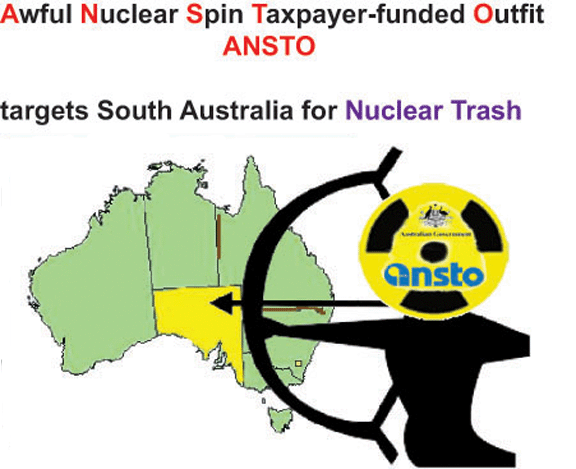
New nuclear legislation set to provide toxic dumping ground in South Australia, Independent Australia, By Noel Wauchope |
UNDER THE PRESSURE of The Australian Nuclear Science and Technology Organisation (ANSTO), The Australian Government is in a hurry to get a new bill passed. It’s not really a new bill, it’s actually a new bit tacked on to an existing one. It’s called the National Radioactive Waste Management Amendment (Site Specification, Community Fund and Other Measures) Bill 2020.
The amendment does two important things: it selects a definite place in South Australia, a farmer’s property called Napandee, as a radioactive waste dump and it removes the possibility of a judicial review of that selection.
The proposed dump is an “interim” radioactive waste facility.
It would consist of two parts:
- Temporary above-ground storage for what is known as low-level waste (LLW). LLW is a general term for a range of objects that are radioactively contaminated, but not considered to be highly radioactive nor toxic for thousands of years.
- A “temporary” above-ground storage for intermediate-level waste (ILW). ILW is a term for a mix of wastes that contains some very long-lived highly toxic radioactive matter, that does require isolation for thousands of years. While this amount would be smaller in volume, it would be far more significant. 95 per cent of this radioactive content would be spent nuclear fuel rods from ANSTO’s nuclear reactor at Lucas Heights, Sydney.
At present, these highly radioactive wastes are stored in giant canisters at Lucas Heights, where there is ample space for further canisters and experienced and skilled staff to monitor them and provide security.
ANSTO has plans to expand its operation and CEO Dr Adi Paterson’s dream of a world-leading business in exporting radionuclides for medicine and industry. Meanwhile, international nuclear security obligations demand that Australia develop a plan for the permanent disposal of nuclear wastes.
Unfortunately, this Napandee plan does nothing towards meeting these obligations. ……….
There is no plan whatsoever for the permanent disposal of this highly radioactive trash.
There’s a vague story that these wastes will later be moved from Napandee to a permanent disposal — anything from 40 to 300 years. They are most likely to suffer the fate of other such facilities in the USA and other countries and become stranded wastes…….
There was a heavy emphasis on “medical” wastes. But the reality is that the vast majority of wastes from nuclear medicine are very short-lived radioisotopes, that have no need to be transported thousands of miles and are routinely disposed of close to places such as hospitals where they are used.
A ballot was held in the area, of ratepayers only, on whether or not to support the project. Some residents close to the property were excluded, as were the Native Title holders, the Barngarla Aboriginal community. The vote result, from 824 voters, was 452 “yes”. The Barngarla held their own vote — 80 Barngarla voted, with the unanimous result of “no”.
The whole issue of the transport of the nuclear wastes and their “temporary” dumping does concern also the region, the state of South Australia and the nation. The decision should not be made solely by 452 ratepayers in one small rural area………
Non-ratepayers did not get a look-in. In this modern, almost Trumpian paradigm, outsiders such as economists, environmentalists, medical experts, sociologists and independent radiation experts are seen as “the elites” that can’t be trusted. Unfortunately, independent overseas experts on nuclear waste management have been excluded, too. Apart from the problems raised for the town and region of Kimba itself, there are serious questions about the appropriateness of the planned system, the area environmentally and geologically……..
Of course, this plan is confined to nuclear wastes produced in Australia. For now.
The plan is obviously helpful to ANSTO. They can pass this uncomfortable buck of 10,000 year-lasting radioactive wastes on to a distant South Australian rural community. It will then be managed and funded by whom? The South Australian and Australian tax-payers.
This will take the pressure of ANSTO, make it look as if they’re doing something about their radioactive trash and avoid any Lucas Heights, or rather Barden Ridge fuss, as they expand their operations. (The residential area previously part of Lucas Heights was renamed Barden Ridge to increase the real estate value of the area, as it would no longer be instantly associated with the nuclear reactor.)
It’s not so helpful to South Australia, or to Australia. The best solution is to leave those nuclear reactor wastes safely stored at Lucas Heights for the time being and to develop a national discussion and plan for what to do with those wastes for permanent disposal. Under this present, rather rushed scheme, Resources Minister Keith Pitt, Dr Paterson and the whole crew of the NRWMF will be dead and gone, long before the stranded wastes at Napandee will be properly dealt with.
A solution for the common good is what’s needed, not just a solution that suits ANSTO. ANSTO is a statutory body — a case of the tail wagging the dog, perhaps?
The National Radioactive Waste Management Amendment (Site Specification, Community Fund and Other Measures) Bill 2020 has been passed by the House of Representatives. It will be debated in the Senate later this year.
Meanwhile the Senate Economics Legislation Committee is holding an Inquiry into this bill…….
it gets interesting. Suddenly, a public hearing becomes private. The topic for this new secrecy was the discussion of some documents from the NRWMFT that had been requested by the Committee and received only a very short time before the hearing. The documents were heavily redacted. They relate to the process by which the Napandee site was selected. How spontaneous was the farmer’s offer of his land? What roles did the NRWMFT, ANSTO and the Industry Department, play in instigating this offer?
So many questions surround this plan:
- Is the new amendment being pushed because Minister Keith Pitt fears the opposition of Aboriginals, or indeed of the public in general?
- The exclusion of the Barngarla from the decision — how does this square with Indigenous rights?
- Why did the Government not provide any independent advice to the Kimba community?
- Why are the South Australian and Australian public excluded from decision-making?
- Why is this Senate Committee public hearing to be held in secret?
- Why is this all happening in such a hurry? https://independentaustralia.net/politics/politics-display/new-nuclear-legislation-set-to-provide-toxic-dumping-ground-in-south-australia,14256
Australia’s Dept of Industry hiding the facts on choice of Kimba nuclear waste site
 Kazzi Jai No Nuclear Waste Dump Anywhere in South Australia, 22 Aug 20,
 FRIDAY NIGHT QUIZ QUESTION: How many times did the DIIS quote this EXACT SAME STATEMENT in their “Answers to Questions Notices” tabled recently for the Senate Inquiry?….more https://www.facebook.com/groups/1314655315214929/
Military to Weapons Sales – Professor Peter Leahy and the revolving door
Professor Peter Leahy AC Australian Defence Force | Military | Revolving Doors, Michael West Media, 19 Aug, 20
Lieutenant-General Peter Leahy retired from the Australian army in July 2008 having concluded his 37 year military career with six years as Chief of Army. Within a year he was on the boards of Codan and Electro Optic Systems (EOS). More recently, EOS has been exporting its weapon systems to Saudi Arabia and the United Arab Emirates while the Yemen war has raged despite multiple reports of war crimes by these countries and a situation in Yemen which the UN has called the world’s worst humanitarian catastrophe.
Current Positions
Public
Professor and foundation director, National Security Institute, University of Canberra (7.10.08–present^)
^ Website accessed 10.08.20
Corporate
Member, Advisory Board, WarpForge Limited ([??]–present^)
Director, Citadel Group (28.6.14*–present^; including as Chair from 12.11.19)
Director, Electro Optic Systems (4.5.09*–present^)
Director, Codan Limited (19.9.08*–present^)………. https://www.michaelwest.com.au/peter-leahy/
Australian govt trying to keep its $1.3bn arms purchase a secret, a dangerous precedent
Coalition says making public parts of $1.3bn Thales arms deal audit would penalise weapons company
Australian government claims disclosure would damage chances of multinational Thales to sell Hawkei combat vehicle to other countries, Guardian Christopher Knaus, The Australian government is arguing parts of an audit of a $1.3bn arms purchase must be kept secret because a multinational weapons company Thales would have trouble selling its product if they were disclosed.But the administrative appeals tribunal has heard that such an argument if allowed to stand would have a “devastating effect” on the auditor general’s ability to transparently and publicly criticise other government purchases.
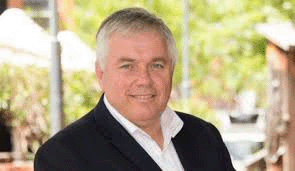 The tribunal is hearing a case between the Department of Prime Minister and Cabinet and crossbench senator Rex Patrick, who is fighting through freedom of information for full release of a 2018 audit report examining the government’s acquisition of the $1.3bn Hawkei combat vehicle fleet from French-based manufacturer Thales.
After representations from Thales, the attorney general, Christian Porter, made an extraordinary and largely unprecedented intervention to redact sections of the audit on the grounds they unfairly prejudiced Thales’s commercial interests and threatened Australia’s national security and defence.
The Guardian has since revealed the redacted material included a cost-comparison suggesting that Australia could have saved money by purchasing a different vehicle – the joint light tactical vehicle – from the United States……. https://www.theguardian.com/world/2020/jul/23/coalition-says-making-public-parts-of-13bn-thales-arms-deal-audit-would-penalise-weapons-company
(Video) Pine Gap – USA’s secret spy base in Australia
This post goes back 10 years. It is now updated, due to public interest. The video previously linked to this post, has now disappeared from the Internet. So, it is now replaced here with another video.
Pine Gap was built on traditional Aboriginal land, forcing removal of Aborigines from it


(Video) Mother of All DUMBs and Ops in Oz Red Center April 3, Human Rights Examiner Deborah Dupre’ Australia has over 63 U.S. military bases. Locals say that at Pine Gap secret deep underground military base (DUMB) in Australia’s “Red Center,” not far from the “Town Called Alice,” there are more CIA employees than there are in the entire U.S. It is officially reported to have 1000 CIA employees. more at
1 This month
17 October, Free Public Talk on Nuclear Issues in South Australia
David Noonan will speak on public interest concerns over the new Roxby Downs Indenture Act 2026 on BHP copper-uranium mining and ore processing in SA, and on how AUKUS may face SA with a High-Level nuclear waste agenda.
Dr Jim Green will discuss international developments in the field of nuclear power including ‘small modular reactors’ and Generation 4 ‘advanced’ nuclear reactor concepts.


Help Aunty Sue Protect Her Land and Sacred Sites From Destructive Rocket Testing.
.

Australians deserve the truth
about
AUKUS – https://aukuspublicinquiry.com/

PETITION – To: Prime Minister Anthony Albanese and the Australian Labor Government

of the week – Australians for War Powers Reform (AWPR)
To see nuclear-related stories in greater depth and intensity

