Journalists beware! Australia now a surveillance state
 Australia now a surveillance state with journalists as POIs under ASIO Act, Michael West.com, by John Stapleton — 21 November 2019 Will future historians see the Abbott/Turnbull/Morrison era as the period of governance when totalitarian instincts were unleashed? The targeting of journalists is just the beginning of a much greater disaster, writes journalist and author, John Stapleton. Australia now a surveillance state with journalists as POIs under ASIO Act, Michael West.com, by John Stapleton — 21 November 2019 Will future historians see the Abbott/Turnbull/Morrison era as the period of governance when totalitarian instincts were unleashed? The targeting of journalists is just the beginning of a much greater disaster, writes journalist and author, John Stapleton.
The #RighttoKnow movement barely touches on the intensity of media manipulation by the conservatives since they regained power in 2013; from blocking popular Facebook sites to harassing little-read authors like me. Imagine you’re writing something critical of the government. You know there are cameras in your home, a keylogger on your computer – every keystroke is observed or recorded. And then you hear cries of derision from a neighbouring house. I experienced this while completing the third and final book in a series on Australian life, Dark Dark Policing. The first two, Terror in Australia: Workers’ Paradise Lost and Hideout in the Apocalypse, may not have set the bestseller lists alight, but that is not the point. My lifetime in journalism never prepared me for so much abusive surveillance. My epiphany came post-retirement. Returning from years in Asia, I was jarred by the dilapidated state of Australia in contrast to the dynamic societies I had been in. And so began my work on a book initially titled Workers’ Paradise Lost. But it was impossible to ignore the biggest story of the day, terror, with the then Prime Minister, Tony Abbott, abandoning good government in favour of terrifying the population, pounding on about “the death cult” at every opportunity. This was despite repeated warnings from terror-messaging experts that his terminology was counterproductive, actually attracting recruits to Islamic State……. Among the most egregious laws passed by the Abbott and Turnbull governments were Journalist Information Warrants, issued entirely in secret. Journalists are not informed if a warrant is taken out against them and face jail if they publicise the fact. The laws have become so strict that journalists cannot write about security operations, or even surveillance of their reporting, without the risk of prison. I chose to use novelistic techniques. …….. The tranches of anti-journalist legislation introduced jail terms of up to ten years for journalists who disclose what are known as SIOs, Secret Intelligence Operations. Who decides what an SIO is? ASIO does…… The point is, the public narrative – thereby, the nation’s culture – is being controlled: from barely read authors like me, to the mainstream media, to Facebook warriors. Suppress dissent and you foment revolution. Thanks to the blizzard of poorly drafted legislation that the Liberals introduced to exploit the fear of terror, we now live in a country where, as the Inspector-General of Intelligence and Security recently pointed out, you can be jailed for five years for breaching orders you didn’t know existed; where children as young as ten can be incarcerated without charge. It doesn’t take the gift of prophecy to know that future historians will see the Abbott/Turnbull/Morrison era as the worst period of governance in Australia’s history, when totalitarian instincts were unleashed. The targeting of journalists is just the beginning of a much greater disaster. https://www.michaelwest.com.au/australia-the-surveillance-state-with-journalists-now-pois-under-the-asio-act/ |
|
How does the climate denialist Institute of Public Affairs (IPA) get away with being a “charity”?
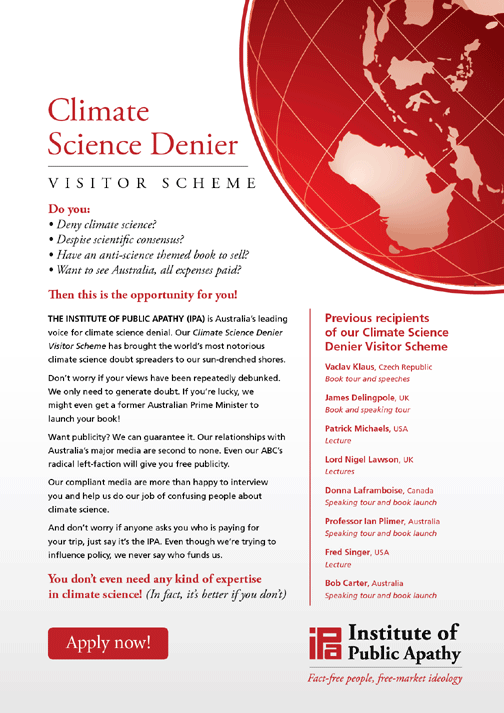
The climate denialist IPA and its ‘public interest’ charity status, Independent Australia, By David Paull | 19 November 2019, Since the IPA and CIS organisations argue against the scientific consensus on the climate change emergency isn’t that against the public interest? Why, then, are they classified as ‘charities’? David Paull reports.
The Prime Minister’s recent comments on the rights of individuals to undertake actions, such as boycotts, that may adversely affect “secondary” company interests raises questions of free speech and public interest.
But the increasingly shrill advocacy for climate denial in the public sphere in this country has reached a stage where it seems that substantive scientific arguments regarding future Earth scenarios are being drowned out.
The debate has descended – thanks in no small part to Murdoch media and political pundits – so that now it’s a “conspiracy” by the Bureau of Meteorology and NASA, or it’s “sun-spots”, which will initiate a new “ice-age”. Even the line, “We must take a balanced view” provides anti-science advocates with a platform.
Which raises the clear question: Is climate change denial of benefit to our community? Or, to put it another way, if some are still arguing against the scientific consensus on the climate change emergency we are confronting, isn’t that against the public interest?
What does it take to be a charity?
As it turns out, not if you are a “charity” registered with the Australian Charities and Not-for-profit Commission (ACNC). When talking about climate denialist organisations, key among those in Australia is the Institute of Public Affairs (IPA) and the Centre for Independent Studies (CIS). Both have generated substantial public communication, which is “climate sceptical” in nature and at deviance from the consensus scientific view. Yet both organisations – particularly the IPA – and through their front groups such as the Australian Environment Foundation, have been at the forefront of promoting the idea that global warming is a conspiracy. Examples are the recent book published by the IPA and edited by Dr Jennifer Marohasy who is working on releasing a new edition next year.
The CIS, while not being a loud advocate of climate scepticism, has certainly hosted talkfests which have articulated these views. Both organisations are also within the international Atlas Network, which channels money into groups around the world that seek to further the climate denialist and libertarian agendas. And both have registered charities with the Australian Charities and Not-For-Profits Commission (ACNC).
The IPA’s registered charity is called Trustee For Institute Of Public Affairs Research Trust, while the CIS has registered a charity under the name of, The Centre For Independent Studies Ltd……
Follow the money
The IPA receives only about ten to 20 per cent of its annual income through its charity, most of which is spent each year, amounting to some $800,000 in 2017-18. These are nearly all classed as “donations” under the ACNC disclosure requirements — though of course “donors” are not required to be identified…….
Both charities claim they are benefiting the “general community of Australia”. However, given the difficulty in matching a climate denialist agenda with a supposed community benefit, this simply does not stack up anymore.
The reviews by the ACNC in January 2014 of the charitable status of these two registered charities, in this light, needs to be reviewed again. This is particularly so of the IPA with its increasing focus on spreading misinformation (none of which stands up to proper scientific scrutiny) since 2014.
But there are also other issues which need clarification in order that better transparency occurs, such as better definitions of income and expenditure, the question of influence by foreign entities and perhaps what is key: whether charity funds being used by these organisations is for a purpose that may be deemed as being of detriment to the community. Charitable status should be relinquished under these circumstances.
I have written to the Australian Charities and Not-for-profit Commission (ACNC) to undertake a fresh review of these charities and await a response in anticipation. You can make a complaint to the ACNC HERE. David Paull is an Australian ecologist . You can follow David on Twitter @davesgas. https://independentaustralia.net/politics/politics-display/the-climate-denialist-ipa-and-its-public-interest-charity-status,13325
A duplicitous letter from Sam Chard, General Manager, Radioactive Waste Taskforce
 What a duplicitous letter from Sam Chard!
Nuclear assurance, by SAM CHARD, NRWMF taskforce general manager
I WRITE in response to the letter from Michele Madigan (“Nuclear vote”, The Advertiser, 11/11/19).
The National Radioactive Waste Management Facility will be for the permanent disposal of low-level waste, and temporary storage of intermediate-level waste.
A separate facility, likely a deeply geological one, will be found for the permanent disposal of the intermediate-level waste, but that’s a few decades off.
The transport of waste will be conducted safely, and examples in France and the UK demonstrate such a facility can coexist with a clean, green image and a successful export industry.
In the recent Kimba community ballot, more than 61 per cent of local residents supported hosting the facility, and now a ballot is under way for residents near Wallerberdina Station.
Traditional owner, neighbour, and business consultation is also being undertaken, and anyone else with an interest can make a submission
Australia’s National Radioactive Waste Management Taskforce disingenuous about medical nuclear wastes
Tim Bickmore No Nuclear Waste Dump Anywhere in South Australia 11 Nov 19, The Taskforce broadcasts minimal information about the type, amount, & location of facility bound radioactive wastes; including that % which SPECIFICALLY RESULTS FROM ACTUAL AUSTRALIAN MEDICAL USAGE.According to ANSTO Waste Projects & Strategic Planning Manager Kapila Fernando in 2017:
“ANSTO holds about 50 per cent of the radioactive waste in Australia, and 85 per cent of the waste ‘stream’ is directly associated with this nuclear medicine manufacturing program – including the fuel used to power the reactor, the machines used in medicine production, and the gloves and gowns used in the manufacture or administration processes – the cycle to produce radionuclides produces nuclear medical waste.”When questioned by (then) Senator Scott Ludlam (Senate Economics Legislation Committee Session May 2017); ANSTO CEO Adi Paterson informed us that in the 2016 financial year 80% of ANSTO’s diagnostic medical isotope production consisted of Molybdenum 99. Of which only 28% was used in Australia whilst 72% was exported.
.
Let’s do the medical waste maths: – (50% x 85%) = 42.5 % of the national radioactive waste inventory results from medical isotope production. Currently (72% x 80%) = 57.6% of that results from Mo99 exports: which in future will triple, but at 2016 stood at (57.6% x 42.5%) = 24.5% of the total.
Therefore, only 18% (42.5%-24.5%) results from actual national use of medical isotopes: & not all of the 18% requires containment in the proposed facility.
PS ANSTO will not tell us the cost for producing OS exports vs economic return ~ but there is a very high probability (bordering on certainty) that the taxpayer is heavily subsidising OS usage…more https://www.facebook.com/groups/1314655315214929/
Australia’s media fights for freedom of press – BUT NOT FOR JULIAN ASSANGE
 Mainstream Media Fights for Own Freedom, But Not for Assange’s, Sydney Criminal Lawyers, 02/11/2019 BY PAUL GREGOIRE Major Australian mainstream media outlets joined forces a fortnight ago to launched the Right to Know campaign. It aims to see public interest journalism decriminalised, and safeguards for whistleblowers enhanced.This unprecedented display of unity has seen The Guardian, the ABC, Nine, News Corp, SBS and the MEAA join forces in calling on the government to enact reforms. And this is rather significant, considering some of these organisations have been much criticised for towing the party line.
The Right to Know has six demands: exceptions so journalists can’t be prosecuted under national security laws, freedom of information reform, defamation law reform, a narrowing of the information classified as secret, protections for whistleblowers and the right to contest warrants.
Of course, the campaign was sparked by the June AFP press raids, which saw agents rifle through the house of a News Corp journalist, as well as the offices of the national broadcaster, in what was understood by many to be a warning to the media and whistleblowers to keep quiet.
However, a glaring campaign omission is the case of an Australian publisher who’s currently being remanded in the UK over charges that apply in the US, which relate precisely to public interest journalism. Yet, the Australian media has all but forgotten their colleague, Julian Assange.
Silenced by association
“The Right to Know campaign drives to the heart of the matter more than many journalists realise,” remarked Ian Rose, a member of the Support Assange and Wikileaks Coalition.
“While on the one hand, they’re right to finally be calling out the creeping incursions and restrictions into media freedoms,” he told Sydney Criminal Lawyers. “On the other, they don’t have the inner fortitude to stand up for Assange.”
According to Rose, there are two reasons that the Australian media has abandoned the Walkley award-winning journalist. One is that he’s “an egalitarian”, which “frightens the hell out of the ruling class”, as most of the work of WikiLeaks has been all about exposing their lies.
The second reason behind the silence is that the “oligarchs” are the “journalists’ paymasters”. And for this reason – which is underscored by the justifiable fear of losing their lives – journalists have refrained from “calling these people out”.
An excuse for silencing
Attorney general Christian Porter spoke out against the Right to Know campaign, claiming that by providing the media with the right to contest warrants could hinder criminal investigations. And he also asserted that the campaign demands could lead to national security threats.
As an example of how the media could become such a threat, Porter pointed to Assange having published leaked classified documents on WikiLeaks. The top lawmaker further set out that while this act of publication was widely condemned, the local industry still awarded Assange a Walkley……..
Neglecting an ally
And as for what the Australian media should be doing about one of its own locked away in isolation in circumstances that undermine the rule of law, Mr Rose says that it “ought to get over its jealousy and unite to support Assange”.
Indeed, the Right to Know campaign should embrace Assange’s cause, as it’s the quintessential example of the concerted crackdown on journalists that’s currently taking place across the western world. And there’s a clear correlation between his silencing and the local AFP raids.
“The way Assange is being treated is the way journalists are starting to be treated, and the way all of society will be treated if we don’t collectively call for a stop to the new dictatorial world order,” Rose warned.
And as an example of how this silencing of dissent is spreading beyond the media, Rose pointed to the recent assault on nonviolent climate activists, which has seen the application of ongoing arrests, draconian bail conditions, intimidatory procedures and the passing of restrictive laws……..https://www.sydneycriminallawyers.com.au/blog/mainstream-media-fights-for-own-freedom-but-not-for-assanges/
Matt Canavan and ANSTO lying to Kimba community about true level of planned nuclear waste
|
Susan Craig Fight To Stop Nuclear Waste Dump In Flinders Ranges SA
Visual Storyteller 9 Nov 19
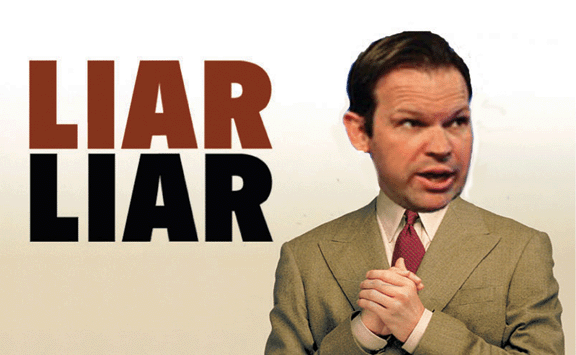
Resources Minister Matt Canavan refers to Intermediate Level Waste as “medial waste.” This is a lie. How can communities make informed decisions based on misinformation? (Extract from The Advertiser November 8. Page 5) Zac Eagle The reprocessed, vitrified waste returned from Europe is classified High Level in every country except Australia. Kazzi Jai Honestly, if it is so safe, safe, safe…..then why are they treking it over 1500 kms plus away from Lucas Heights which produces over 90% of Australias nuclear waste? And the determination of the best place for this waste is by an individual nominating their own land? For an all-above-ground dump? The cheapest way to deal with all of this waste! Not the best….but the cheapest! This is how desperate the Feds are to rid themselves of this waste! Not the most scientific and geological stable site, not the least flood prone or least earthquake prone site…..but by a landowner nomination….. And then dividing a small rural community – whether Kimba or Hawker – and feeding them half -truths and bribing these little struggling communities with bribe money into accepting this waste which remains dangerous for hundreds of years, and the compulsory tag-a-long intermediate level waste for thousands of years! And saying that it is an industry! When is radioactive landfill for Lucas Heights an industry? It is simply a licence for Lucas Heights to generate as much waste as they like, and have no responsibility for it, since it is shafted over onto South Australia and becomes SOLELY South Australia’s liability and problem! Disgraceful! Anton Thony since when is medical waste intermediate level waste? https://www.facebook.com/groups/941313402573199/ |
|
A travesty of justice- extradition process of Julian Assange
|
Julian Assange’s Extradition Process Is ‘A Charade’, The Real News Network, November 5, 2019
Interview Transcript
GREG WILPERT: Julian Assange recently lost a court bid to have his upcoming February 2020 extradition hearing postponed. The hearing about the postponement took place on October 21, and according to observers who were present, he could barely speak in coherent sentences. Reacting to the hearing, UN Human Rights Rapporteur Nils Melzer warned last Friday that Assange continues to show symptoms of psychological torture. Melzer had visited Assange in May when he conducted an extensive review of his physical and psychological condition. In his statement on Friday, Melzer said, “Despite the medical urgency of my first appeal, and the seriousness of the alleged violations, the U.K. has not undertaken any measures of investigation, prevention, and redress required under international law.” In addition to the concerns about Assange’s treatment at Belmarsh Prison outside of London, many have also raised concerns about the impartiality of the proceedings against him. Assange was jailed last April when the Ecuadorian Embassy, where he had been given political asylum, allowed the police to arrest him. He then received a 50-week sentence for having skipped jail in 2012. The Trump Administration has since then requested Assange’s extradition on 17 charges of espionage for which he could receive a 170-year prison sentence in the United States. Joining me now to discuss the latest developments in the case of Julian Assange is John Pilger. He has been observing the Assange case very closely and was present at the October 21 court hearing…… John Pilger – “…..His physical condition has changed dramatically. He’s lost about 15 kilos in weight. To see him in court struggling to say his name, and his date of birth, was really very moving. I’ve seen that when I visited Julian in Belmarsh Prison where he struggles at first, and then collects himself. I’m always impressed by the sheer resilience of the man, because as Melzer says, absolutely nothing has been done to change the conditions imposed on him by the prison regime. Nothing has been done by the British authorities.
This was almost underlined by the contemptuous way that this court hearing recently was conducted by this judge, by this magistrate. There was a sense among all of us who were there that the whole charade, and it seemed a charade, was preordained. You had sitting in front of us, on a long table, four Americans who were from the U.S. Embassy here in London, and one of the prosecution team was scurrying backwards and forwards to get instructions from them. The judge could see this, and she allowed it. It was just absolutely outrageous.
When Julian did try to speak, and to say that basically he was being denied the very tools with which to prepare his case, he was denied the right to call his American lawyer. He was denied the right to have any kind of word process or laptop. He was denied certain documents. As he said, “I’m even denied my own writings,” as he called it. That is, his own notes and manuscripts. This hasn’t changed at all, and of course the effect of that on his morale, to say the least, has been very significant, and that showed in the court.
Greg Wilpert – ” ….district judge, Vanessa Baraitser, and one of the things that she did was completely dismiss Assange’s request for determination whether the extradition proceedings are even legal. That is, he cites according to U.K. law, “Extradition shall not be granted if the offense for which extradition is requested is a political offense”
JOHN PILGER quotes Julian’s lawyer Gareth Peirce – “….under law, it’s not a matter of opinion. They are political. All but one of the charges concocted in Virginia are based on the 1917 Espionage Act, which was a political piece of legislation used to chase off the conscientious objectors during the first World War.
It’s political. There is no charge. There is no basis, no foundation, for allowing these extradition proceedings to go forward, and almost perversely the judge seemed to, if not acknowledged that in her contempt for the proceedings. Whenever Julian Assange spoke, she feigned a disinterest, a boredom, and whenever his lawyers spoke, the same thing. Whenever the prosecutor spoke, she was attentive. The theatrics of this hearing were quite remarkable. I’ve never seen anything like it. Then very hurriedly, when Julian Assange’s lawyer requested a delay in when the case actually starts from February, they said, “We’re not going to be ready in February,” and she dismissed that out of hand.Not only that, she said that the extradition case would be held in a court that is in fact adjoining Belmarsh prison. It’s almost part of the prison. It’s a long way out of London.
So you have, if not a secret trial, but a trial in which, or an extradition hearing in which very few seats are available to the public. It’s a very difficult place to get to. So every obstacle has been put in the way of Assange getting a fair hearing. And I can only repeat, this is a publisher and a journalist convicted of nothing, charged with nothing in Britain, whose only crime is journalism. That may sound like a slogan, but it’s true. They want him for exposing the kind of outrageous war crimes, Iraq, Afghanistan, that journalists are supposed to do. “
GREG WILPERT: “…….How do you explain this lack of concern among the media and human rights groups for Assange’s situation?
JOHN PILGER: Because so many human rights groups are deeply political, Amnesty International never made Chelsea Manning a prisoner of conscience. A really disgraceful thing. Chelsea Manning, who was effectively tortured in prison, and they haven’t, as you say, they haven’t elevated Julian’s case. Why? Well, they’re an extension. They’re an extension of an establishment that is now almost systematically coming down on any form of real dissent. In the last five, six years, the last gaps, the last bolt holes, the last spaces in the mainstream media for journalists, from average journalists for the likes Assange, not only Assange, for the likes of people like even myself and others, have closed. The mainstream media, certainly in Britain, always held open those spaces. They’ve closed, and there is generally I would think a fear, right throughout the media, a fear about opposing the state on something like the Assange case. You see the way the whole obsession with Russia has consumed the media with so many nonsensical stories. The hostility, the animosity towards Julian. My own theory is that his work shamed so many journalists. He does what journalists ought to have done, and don’t do any more. He’s done the job of a journalist. That can only explain it. I mean when you take a newspaper like The Guardian, which published originally the WikiLeaks revelations about Iraq and Afghanistan, they turned on Julian Assange in the most vicious way.
They exploited him for one thing. A number of their journalists did extremely well with their books, and Hollywood scripts, and so on, but they turned on him personally. It was one of the most unedifying sights I think I’ve ever seen in journalism. The same thing happened in the New York Times. Again, I can only surmise the reason for that. It’s that he shames them. We have a desert of journalism at the moment. There are a few who still do their jobs; who still stand up against establishment power; who still are not frightened. But there’re so few now, and Julian Assange is totally fearless in that. He knew that he was going to run into a great deal of trouble with the state in Britain, the state in the United States–but he went ahead anyway. That’s a true journalist…… https://therealnews.com/stories/julian-assange-extradition-process-charade
|
|
The Morrison governments hypocrisy: double standards on “unacceptable” protests
 Protesting and boycotting the Morrison Government way, Independent Australia, By Michelle Pini | 7 November 2019 Ahead of the Coalition’s signalled changes to protests, boycotts and freedom of speech, executive editor Michelle Pini decodes who may and may not protest and what they may protest about.
THE MINISTER FOR RESOURCES and Northern Australia – who, like his coal-loving PM, has openly spruiked coal and practically kissed the feet of his environment-pillaging hero, Gautam Adani – is on TV discussing climate protests and talking about “groups abusing the law”.
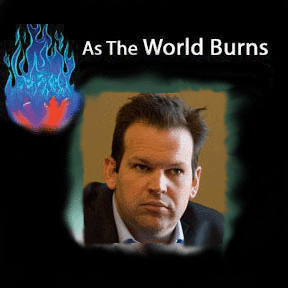 Scarcely able to string two words together to form a coherent sentence, Matt Canavan is umming and ahhing on The Project, whining about protesters “stopping average Australians, particularly small businesses, going about their day.”
A few days prior, Scott Morrison labelled environmental protesters “anarchists” and flagged a crackdown on the right to protest, indicating his Government would seek to apply penalties to those boycotting businesses. Such “anarchists” seek to “deny the liberties of Australians”, according to the PM………
Canavan ends by summarising the Coalition’s latest position on democratic protests and public boycotts thus:
“What I wanna do, what I wanna do is support Australian jobs… I do think the problem’s gotten worse, though, since that review — protests holding up traffic, putting lives at risk, ah, ah, just with a few people.”
Thanks for clearing that up, Matt.
Let’s try and clear at least one thing up. This latest tirade from “free speech warriors” the Morrison Government, is about one thing and one thing only — only those who agree with this Government are permitted the right to protest, boycott, or spew forth with angry tirades against others. Once again, free speech, in the world according to the Coalition, is only a right for the Right.
THE RIGHT AND LEFT OF POLITICAL PROTEST
To assist in our understanding of the Right and proper application of our democratic rights, listed below are a few examples of who can and can’t, according to the Morrison Government’s free speech rules, protest, enact a boycott or, generally, speak out about perceived injustice:
1. Racing parade v animal activists…
2. Westpac v Canavan
Only two short years ago, Matt “Minister for Coal” Canavan encouraged everyone to boycott Westpac because the bank had decided to drop on-the-nose mining companies from its investment list.
Right Matty boycotting Westpac in this scenario is okay, because – pay attention here – it is about our democratic Right to protect the “small business” of coal mining and fossil fuels in general.
Wrong It would not be okay for anyone to protest against the democratic Right of the Minister for Coal to boycott any business that got in the way of coal. This would include outside any mining conferences, obviously.
3. Mining tax v climate change action
Gina Rinehart and Andrew “Twiggy” Forrest protested in the streets of Perth when the Labor Government instigated the so-called “mining tax.” Gina jangled her bangles standing atop a flat-topped truck, and led the chant alongside fellow protesters to demand Kevin Rudd “axe the tax”.
Fellow billionaire Forrest, whose “small business” Fortescue Metals had never paid tax, was Rightly aghast at the prospect of breaking that record and took it all the way to the High Court.
Right Once again, this is perfectly acceptable. Gina and Twiggy were simply exercising their democratic Right – aided by the mainstream media – to topple any government that stood in the way of their billions.
Wrong, It is not okay for anyone to protest against the Adani mine, however, or boycott any of the companies owned by the aforementioned billionaires. This would be “abusing the law” and would not be tolerated. It would likely also be “putting lives at risk”…… https://independentaustralia.net/politics/politics-display/protesting-and-boycotting-the-morrison-government-way,13287
A new court order is being abused in order to harass a journalist
YOU CAN’T HANDLE THE TRUTH! Media’s dwindling role in Democracy Panel
 Toxic “Safety” orders the latest tool to shut down free speech https://www.michaelwest.com.au/toxic-safety-orders-the-latest-tool-to-shut-down-free-speech/, by Michael West — 25 October 2019 It’s #YourRightToKnow. There are many ways to silence the media: persecution of whistleblowers, defamation threats, contempt of court claims, lobbying of media bosses by powerful interests, injurious falsehood claims, the government’s draconian secrecy laws and police raids on journalists. Michael West reports on the latest abuse against free speech.
Today we can unveil yet another threat to freedom of speech: the Personal Safety Intervention Order (PSIO), a court order which is intended to help victims of domestic violence but instead is being abused as a tool to harass journalists, namely Sandi Keane, Editor of this publication.
It’s #YourRightToKnow. There are many ways to silence the media: persecution of whistleblowers, defamation threats, contempt of court claims, lobbying of media bosses by powerful interests, injurious falsehood claims, the government’s draconian secrecy laws and police raids on journalists. Michael West reports on the latest abuse against free speech.
Today we can unveil yet another threat to freedom of speech: the Personal Safety Intervention Order (PSIO), a court order which is intended to help victims of domestic violence but instead is being abused as a tool to harass journalists, namely Sandi Keane, Editor of this publication.
There have been some reports about the abuse of Personal Safety Intervention Orders in Victoria by those seeking malicious revenge. The editor of this journal, Sandi Keane, is believed to be the first journalist to be silenced in this way. She’s attended court seven times after receiving two Orders and has been threatened with a third. “An Intervention Order is now a sure fire way to shut down a story,” says Keane. “Getting an Intervention Order in Victoria is instant and cost-free (no lawyer required).”
The two essential criteria are for applicants to claim they have been threatened and are suffering mental stress as result.
An Interim Order will be issued immediately against anyone in Australia.
Sandi Keane says the applicants lied about the threats but no evidence was needed until the Final Contested Hearing some 12-18 months later.
The effect on public interest reporting therefore is chilling as most news is time-critical, so by the time the story might eventually be published, its news value might have evaporated.
There are no consequences for abusing the legal system and costs cannot be claimed by the Respondent in the proceedings.
The Applicant can also manipulate the date of the final hearing as a magistrate will only set a date for the Final Hearing if both sides have had a chance to get a lawyer; are ready for the hearing; or agree to the date.
Furthermore, court reporters cannot report on an Intervention Order unless they withhold the name of the court and names of the relevant parties.
So, not only does an Intervention Order trump an Injunction in the High Court with all its attendant costs and adverse publicity, it also ticks the Suppression Order box.
Yet the sting in the tail is that, from the date of the Interim Order, all references to the “protected person” must be deleted from any media site including social media (Condition 10).
Journalists can forget about getting another colleague to publish the story as this is prohibited under Condition 8.
Breaching the order risks a criminal conviction or prison sentence.
Journalists union, the Media Arts and Entertainment Alliance (MEAA), has met with the Victorian Attorney General with the hope of amending the Personal Safety Intervention Order Act to protect freedom of the press. In a letter to the Chief Magistrate, the MEAA wrote:
“This is a dangerous assault on press freedom, has a chilling effect on legitimate journalism in the public interest and undermines the public’s right to know.”
Editor’s Note:
Sandi Keane’s investigation was into the fraudsters operating in the pedigree dog industry. She was successful in contesting one of these orders. The unsuccessful Applicant in this case had served a jail sentence for fraud and was also found guilty of arson. The other applicant also has a conviction for fraud. These two people have taken out five PSIOs of which we know. The others were granted against people who had taken legal action against them, made an official complaint or given evidence against them.
The rise of PSIOs, and their abuse, coincides with the rise in other forms of suppression of free speech in Australia, by all three branches of government: the judiciary, the executive and the legislature.
It’s time to enshrine free speech in the constitution such as is the case in the US. You can take action to stand up for your right to know. Check out MEAA’s Take Action site here.
Australia’s environment department is unlawfully withholding documents from the public
The Transparency Project Freedom of information Environment department illegally withholds thousands of FOI pages
More than 10,000 pages of documents have not been made public, including records on Adani and the Angus Taylor grasslands saga , Guardian, Christopher Knaus @knausc Wed 16 Oct 2019
Australia’s environment department is unlawfully withholding more than 10,000 pages of freedom of information documents from the public, including internal records on Adani and the Angus Taylor grasslands affair.
The department has failed to place documents on its FOI disclosure log for the past 10 months, meaning material it has released to individual applicants is not visible to the wider public.
The failings, first reported by the Mandarin, are a breach of FOI law, which compels government agencies to publish documents online within 10 working days of giving them to the initial applicant.
It means more than 10,000 pages have not been published on the log, including internal records on its decision to approve the controversial groundwater plan for the Adani coalmine and on Taylor’s interactions with an investigation into land-clearing by a company he and his family part-owned.
Guardian Australia understands the department’s conduct has been the subject of an official complaint to the information watchdog, the office of the Australian information commissioner (OAIC). The OAIC typically does not comment on ongoing investigations………
Peter Timmins, a lawyer and highly-regarded FOI expert, said it showed a broader problem with the federal government’s attitude toward FOI.
“It shows a broader problem really about the state of FOI if we have agencies that can disregard quite clear obligations to make documents released publicly available on their disclosure log,” Timmins said. “The broader problem is that I think without appropriate leadership – and that really is at the highest level of government – about the importance of transparency and integrity, we see these breaches occur.”…….. https://www.theguardian.com/australia-news/2019/oct/16/environment-department-illegally-withholding-thousands-of-foi-pages
Federal govt open door to international high level nuclear waste dump
Nuclear Shipment Truth Exposed
If the Fed Govnt establish proposed nuclear waste dumps in SA and they get away with reclassifying reprocessed vitrified High Level Nuclear Waste from France as Intermediate Level Nuclear Waste, on arrival back in Australia (like they plan to do) – then it opens the door for importing International High Level Nuclear Waste into Australia, and dumping in SA as reclassified Intermediate Level Nuclear Waste. Reprocessed vitrified High Level Nuclear Waste is highly radioactive and contains 95% of the total radioactivity (the worst elements) from Nuclear reactor spent nuclear fuel – is long lived – and is classified High Level Nuclear Waste everywhere in the world except Australia.
Australian media push for press freedom (pity they’re not helping Julian Assange, though)

|
‘A culture of secrecy’: what is the Right to Know campaign about? Media companies say their journalists are being stopped from holding the powerful to account. What’s stopping them? What do they want government to do about it? Why should you care? The Age By Fergus Hunter, OCTOBER 20, 2019 All of Australia’s major media organisations have joined forces to call for reforms to protect public interest journalism in Australia. Australia’s Right to Know coalition includes Nine, News Corp, the ABC, SBS, The Guardian, and journalists’ union the Media, Entertainment and Arts Alliance. The campaign, an unprecedented show of unity between competitors, is pushing for stronger protections for media freedom after years of perceived deterioration. The outlets are seeking to combat a growing culture of secrecy that restricts journalists’ ability to hold the powerful to account.
Did anything, in particular, spark this?Media organisations in Australia have long been concerned about threats to journalism, but the issue exploded into the public consciousness following two consecutive police raids earlier this year. On June 4, police conducted a six-hour raid on the home of News Corp political journalist Annika Smethurst over an April 2018 story. The story had revealed a proposal for electronic intelligence agency the Australian Signals Directorate to take on an expanded domestic role and that figures inside government were concerned about the idea.
Did anything, in particular, spark this?Media organisations in Australia have long been concerned about threats to journalism, but the issue exploded into the public consciousness following two consecutive police raids earlier this year. On June 4, police conducted a six-hour raid on the home of News Corp political journalist Annika Smethurst over an April 2018 story. The story had revealed a proposal for electronic intelligence agency the Australian Signals Directorate to take on an expanded domestic role and that figures inside government were concerned about the idea.
What was the government’s response?Prime Minister Scott Morrison and senior colleagues defended the police raids as the independent actions of an agency doing its job to protect national security. They have responded to the broader furore over press freedom by calling a parliamentary inquiry and issuing directives to agencies emphasising the importance of a free press. The inquiry, conducted by the intelligence and security committee, is examining the impact of national security laws on press freedom. This inquiry has heard from media outlets, government officials and independent experts. It is being conducted alongside a more wide-ranging press freedom inquiry by a Senate committee. Officials, including senior figures at the Australian Security Intelligence Organisation and the Department of Home Affairs, have defended the need for a high level of secrecy, criticised media coverage and argued that some of the recommendations put forward by media organisations would threaten national security. Ministers and officials have declined to rule out pursuing charges against the News Corp and ABC journalists targeted in the raids.
Home Affairs Minister Peter Dutton has issued a directive to the federal police stating they should consider the “importance of a free and open press” and broader public-interest implications before involving media outlets in investigations. Attorney-General Christian Porter also instructed Commonwealth prosecutors not to charge journalists under certain secrecy laws without his approval. Porter has said he would be “seriously disinclined” to authorise the prosecutions. Privately, the Morrison government has indicated a scepticism that media freedom is something that grabs the public’s attention. There is also hostility within the Coalition towards any changes seen as weakening national security. With these political and policy factors in mind, the government does not yet seem convinced of the need for sweeping law reform. What do the media companies want to achieve?Australia’s Right to Know coalition has six key proposals for “necessary and urgent” reform. The changes would strengthen rights and protections for public-interest journalism.
|
|
Julian Assange and Wikileaks have exposed nuclear scandals
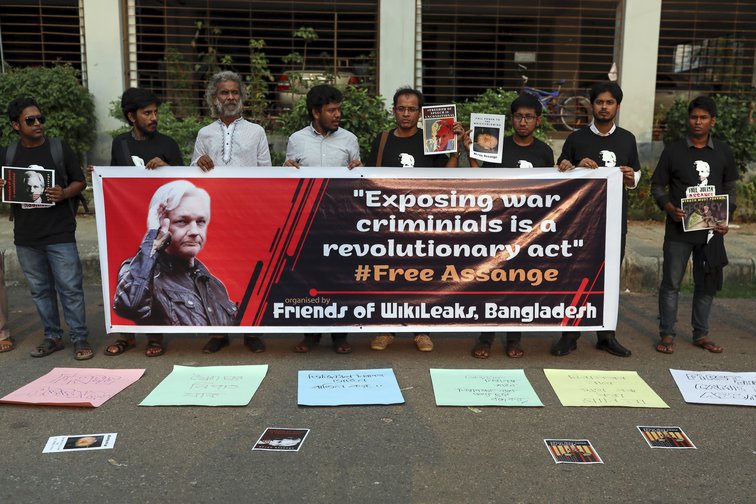
What we know about nuclear weapons and the nuclear industry thanks to WikiLeaks
“The Nobel Peace Prize will be awarded on 11 October. Why I support the nomination of Julian Assange and WikiLeaks.” Open Democracy, Felicity Ruby, 7 October 2019 The Nobel Peace Prize will be awarded on 11 October. Julian Assange and WikiLeaks have been nominated for the prize again this year, as they have since 2010. As the first staffer of the campaign that won the Peace Prize in 2017, the International Campaign to Abolish Nuclear Weapons (ICAN), I support this nomination for a number of reasons.
Below are just ten examples of where WikiLeaks exposed wrongdoing on the part of governments and corporations that meant citizens could take action to protect themselves from harm, or governments were held to account:
After the Chalk River nuclear reactor was shut down for routine maintenance on 18 November 2007, inspectors verified the reactor’s cooling systems had not been modified as required by an August 2006 licensing review. Atomic Energy of Canada Limited (AECL) did not start the reactor but said upgrades could be done as part of maintenance while still operating safely. This impasse lasted a month, with the government intervening to grant an exemption to the reactor to allow its restart. The responsible Minister for Natural Resources, Gary Lunn MP, fired Linda Keen, the President of the Nuclear Safety Commission. Their exchange of letters revealed much about the safety standards and routine practices of the Canadian nuclear regulatory system, and particular problems with the ageing Chalk River reactor previously unknown to the public.
– Footage of the 1995 disaster at the Japanese Monju nuclear reactor – released 25 January 2008
Following the 2008 announcement that the Japanese Monju fast breeder nuclear reactor would be reopened, activists leaked the suppressed video footage of the sodium spill disaster that led to its closure in 1995. Named after the Buddhist divinity of wisdom, Monju, located in Japan’s Fukui prefecture, is Japan’s only fast-breeder reactor. Unlike conventional reactors, fast-breeder reactors, which “breed” plutonium, use sodium rather than water as a coolant. This type of coolant creates a potentially hazardous situation as sodium is highly corrosive and reacts violently with both water and air. On December 8, 1995, 700 kg of molten sodium leaked from the secondary cooling circuit of the Monju reactor, resulting in a fire that did not result in a radiation leak, but the potential for catastrophe was played down the extent of damage at the reactor and denied the existence of a videotape showing the sodium spill. Further complicating the story, the deputy general manager of the general affairs department at the PNC, Shigeo Nishimura, 49, jumped to his death the day after a news conference where he and other officials revealed the extent of the cover-up.
– Serious nuclear accident lay behind Iranian nuke chief’s mystery resignation – released 16 July 2009 WikiLeaks revealed that a source associated with Iran’s nuclear program confidentially told the organisation of a serious, recent, nuclear accident at Natanz. Natanz is the primary location of Iran’s nuclear enrichment program and the site targeted with the Stuxnet worm that contained 4 zero days and was designed to slow down and speed up centrifuges enriching uranium. WikiLeaks had reason to believe the source was credible, however contact with this source was lost. …………..
WikiLeaks and Assange have brought forward many truths that are hard to face, publishing well over 10 million documents since 2006. Often forgotten is that each one was provided by a whistleblower who trusted this platform to publish, and who sought reform of how political, corporate and media power elites operate. Each release has shared genuine official information about how governments, companies, banks, the UN, political parties, jailers, cults, private security firms, war planners and the media actually operate when they think no one is looking.
Assange is nominated for the Nobel Peace Prize because of these many releases of information, used as evidence in court cases, freeing prisoners and exposing scandals, torture, murder and surveillance for which redress is only possible when the wrongdoing is dragged into the light. For publishing this true information, Assange, an Australian based in the UK at the time of publication, is on the health ward of Belmarsh Prison, facing extradition and charges attracting 175 years in a US jail, an effective death sentence….. https://www.opendemocracy.net/en/can-europe-make-it/what-we-know-about-nuclear-weapons-and-nuclear-industry-thanks-wikileaks/
Exposing misleading evidence to the federal nuclear inquiry
Big claims and corporate spin about small nuclear reactor costs, Jim Green, 19 September 2019, RenewEconomy https://reneweconomy.com.au/big-claims-and-corporate-spin-about-small-nuclear-reactor-costs-65726/
The ‘inquiry into the prerequisites for nuclear energy in Australia’ being run by Federal Parliament’s Environment and Energy Committee has finished receiving submissions and is gradually making them publicly available.
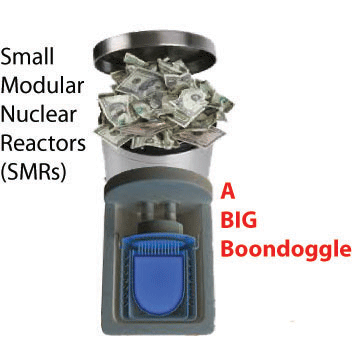 The inquiry is particularly interested in ‘small modular reactors’ (SMRs) and thus one point of interest is how enthusiasts spin the economic debate given that previous history with small reactors has shown them to be expensive; the cost of the handful of SMRs under construction is exorbitant; and both the private sector and governments around the world have been unwilling to invest the billions of dollars required to get high-risk SMR demonstration reactors built.
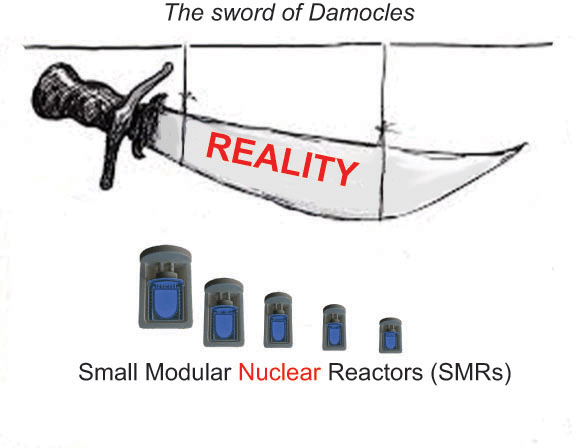 To provide a reality-check before we get to the corporate spin, a submission to the inquiry by the Institute for Energy Economics and Financial Analysis notes that SMRs have been as successful as cold fusion – i.e., not at all. The submission states:
“The construction of nuclear power plants globally has proven to be an ongoing financial disaster for private industry and governments alike, with extraordinary cost and construction time blow-outs, while being a massive waste of public monies due to the ongoing reliance on government financial subsidies. … Governments have repeatedly failed to comprehend that nuclear construction timelines and cost estimates put forward by many corporates (with vested interests) have proven disastrously flawed and wrong.”
The Institute is equally scathing about SMRs:
“For all the hype in certain quarters, commercial deployment of small modular reactors (SMRs) have to-date been as successful as hypothesized cold fusion – that is, not at all. Even assuming massive ongoing taxpayer subsidies, SMR proponents do not expect to make a commercial deployment at scale any time soon, if at all, and more likely in a decade from now if historic delays to proposed timetables are acknowledged.”
Thus the Institute adds its voice to the chorus of informed scepticism about SMRs, such as the 2017 Lloyd’s Register survey of 600 industry professionals and experts who predicted that SMRs have a “low likelihood of eventual take-up, and will have a minimal impact when they do arrive“.
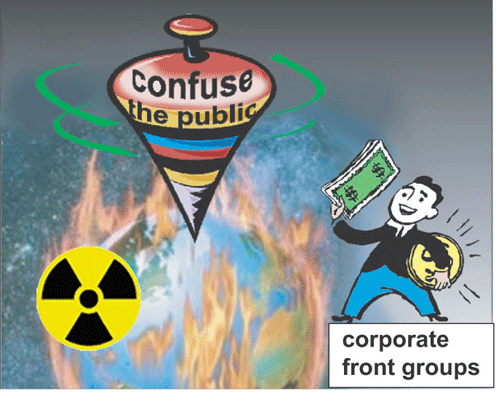 Corporate spin #1: Minerals Council of Australia
The Minerals Council of Australia claims in its submission to the federal inquiry that SMRs could generate electricity for as little as $60 per megawatt-hour (MWh). That claim is based on a report by the Economic and Finance Working Group (EFWG) of the Canadian government-industry ‘SMR Roadmap’ initiative.
The Canadian EFWG gives lots of possible SMR costs and the Minerals Council’s use of its lowest figure is nothing if not selective. The figure cited by the Minerals Council assumes near-term deployment from a standing start (with no-one offering to risk billions of dollars to build demonstration reactors), plus extraordinary learning rates in an industry notorious for its negative learning rates.
Dr. Ziggy Switkowski noted in his evidence to the federal inquiry that “nuclear power has got more expensive, rather than less expensive”. Yet the EFWG  paper takes a made-up, ridiculously-high learning rate and subjects SMR cost estimates to eight ‘cumulative doublings’ based on the learning rate. That’s creative accounting and one can only wonder why the Minerals Council would present it as a credible estimate.
Here are the first-of-a-kind SMR cost estimates from the EFWG paper, all of them far higher than the figure cited by the Minerals Council:
- 300-megawatt (MW) on-grid SMR: C$162.67 (A$179) / MWh
- 125-MW off-grid heavy industry: C$178.01 (A$196) / MWh
- 20-MW off-grid remote mining: C$344.62 (A$380) / MWh
- 3-MW off-grid remote community: C$894.05 (A$986) / MWh
The government and industry members on the Canadian EFWG are in no doubt that SMRs won’t be built without public subsidies:
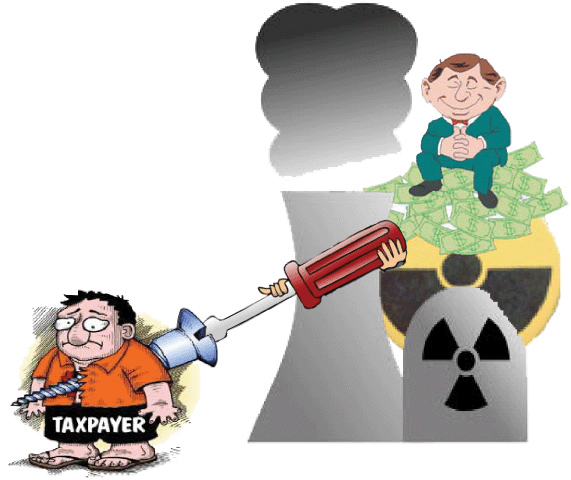 “The federal and provincial governments should, in partnership with industry, investigate ways to best risk-share through policy mechanisms to reduce the cost of capital. This is especially true for the first units deployed, which would likely have a substantially higher cost of capital than a commercially mature SMR.”
The EFWG paper used a range of estimates from the literature and vendors. It notes problems with its inputs, such as the fact that many of the vendor estimates have not been independently vetted, and “the wide variation in costs provided by expert analysts”. Thus, the EFWG qualifies its findings by noting that “actual costs could be higher or lower depending on a number of eventualities”.
Corporate spin #2: NuScale Power
US company NuScale Power has put in a submission to the federal nuclear inquiry, estimating a first-of-a-kind cost for its SMR design of US$4.35 billion / gigawatt (GW) and an nth-of-a-kind cost of US$3.6 billion / GW.
NuScale doesn’t provide a $/MWh estimate in its submission, but the company has previously said it is targeting a cost of US$65/MWh for its first SMR plant. That is 2.4 lower than the US$155/MWh (A$225/MWh) estimate based on the NuScale design in a report by WSP / Parsons Brinckerhoff prepared for the SA Nuclear Fuel Cycle Royal Commission.
 NuScale’s cost estimates should be regarded as promotional and will continue to drop – unless and until the company actually builds an SMR. The estimated cost of power from NuScale’s non-existent SMRs fell from US$98-$108/MWh in 2015 to US$65/MWh by mid-2018. The company announced with some fanfare in 2018 that it had worked out how to make its SMRs almost 20% cheaper – by making them almost 20% bigger!
Lazard estimates costs of US$112-189/MWh for electricity from large nuclear plants. NuScale’s claim that its electricity will be 2-3 times cheaper than that from large nuclear plants is implausible. And even if NuScale achieved costs of US$65/MWh, that would still be higher than Lazard’s figures for wind power (US$29-56) and utility-scale solar (US$36-46).
Likewise, NuScale’s construction construction cost estimate of US$4.35 billion / GW is implausible. The latest cost estimate for the two AP1000 reactors under construction in the US state of Georgia (the only reactors under construction in the US) is US$12.3-13.6 billion / GW. NuScale’s target is just one-third of that cost – despite the unavoidable diseconomies of scale and despite the fact that every independent assessment concludes that SMRs will be more expensive to build (per GW) than large reactors.
Further, the modular factory-line production techniques now being championed by NuScale were trialled with the AP1000 reactor project in South Carolina – a project that was abandoned in 2017 after the expenditure of at least US$9 billion.
Corporate spin #3: Australian company SMR Nuclear Technology
In support of its claim that “it is likely that SMRs will be Australia’s lowest-cost generation source”, Australian company SMR Nuclear Technology Pty Ltd cites in its submission to the federal nuclear inquiry a 2017 report by the US Energy Innovation Reform Project (EIRP).
According to SMR Nuclear Technology, the EIRP study “found that the average levelised cost of electricity (LCOE) from advanced reactors was US$60/MWh.”
However the cost figures used in the EIRP report are nothing more than the optimistic estimates of companies hoping to get ‘advanced’ reactor designs off the ground. Therefore the EIRP authors heavily qualified the report’s findings:
“There is inherent and significant uncertainty in projecting NOAK [nth-of-a-kind] costs from a group of companies that have not yet built a single commercial-scale demonstration reactor, let alone a first commercial plant. Without a commercial-scale plant as a reference, it is difficult to reliably estimate the costs of building out the manufacturing capacity needed to achieve the NOAK costs being reported; many questions still remain unanswered – what scale of investments will be needed to launch the supply chain; what type of capacity building will be needed for the supply chain, and so forth.”
SMR Nuclear Technology’s conclusions – that “it is likely that SMRs will be Australia’s lowest-cost generation source” and that low costs are “likely to make them a game-changer in Australia” – have no more credibility than the company estimates used in the EIRP paper.
SMR Nuclear Technology’s submission does not note that the EIRP inputs were merely company estimates and that the EIRP authors heavily qualified the report’s findings.
The US$60/MWh figure cited by SMR Nuclear Technology is far lower than all independent estimates for SMRs:
- The 2015/16 South Australian Nuclear Fuel Cycle Royal Commission estimated costs of A$180-184/MWh for large light-water reactors, compared to A$225 for an SMR based on the NuScale design (and a slightly lower figure for the ‘mPower’ SMR design that was abandoned in 2017 by Bechtel and Babcock & Wilcox).
- A December 2018 report by CSIRO and the Australian Energy Market Operator found that electricity from SMRs would be more than twice as expensive as that from wind or solar power with storage costs included (two hours of battery storage or six hours of pumped hydro storage).
- A report by the consultancy firm Atkins for the UK Department for Business, Energy and Industrial Strategy found that electricity from the first SMR in the UK would be 30% more expensive than that from large reactors, because of diseconomies of scale and the costs of deploying first-of-a-kind technology. Its optimistic SMR cost estimate is US$107-155 (A$157-226) / MWh.
- A 2015 report by the International Energy Agency and the OECD Nuclear Energy Agency predicted that electricity from SMRs will be 50−100% more expensive than that from large reactors, although it holds out some hope that large-volume factory production could reduce costs.
- An article by four pro-nuclear researchers from Carnegie Mellon University’s Department of Engineering and Public Policy, published in 2018 in the Proceedings of the National Academy of Science, concluded than an SMR industry would only be viable in the US if it received “several hundred billion dollars of direct and indirect subsidies” over the next several decades.
SMR Nuclear Technology’s assertion that “nuclear costs are coming down due to simpler and standardised design; factory-based manufacturing; modularisation; shorter construction time and enhanced financing techniques” is at odds with all available evidence and it is at odds with Dr. Ziggy Switkowski’s observation in a public hearing of the federal inquiry that nuclear “costs per kilowatt hour appear to grow with each new generation of technology”.
SMR Nuclear Technology claims that failing to repeal federal legislative bans against nuclear power would come at “great cost to the economy”. However the introduction of nuclear power to Australia would most likely have resulted in the extraordinary cost overruns and delays that have crippled every reactor construction project in the US and western Europe over the past decade – blowouts amounting to A$10 billion or more per reactor.
Nor would the outcome have been positive if Australia had instead pursued non-existent SMR ‘vaporware‘.
Dr Jim Green is lead author of a Nuclear Monitor report on SMRs and national nuclear campaigner with Friends of the Earth Australia.
Revealed: Josh Frydenberg was behind the strange Environment Department decision to block wind turbines on Lord Howe Island.
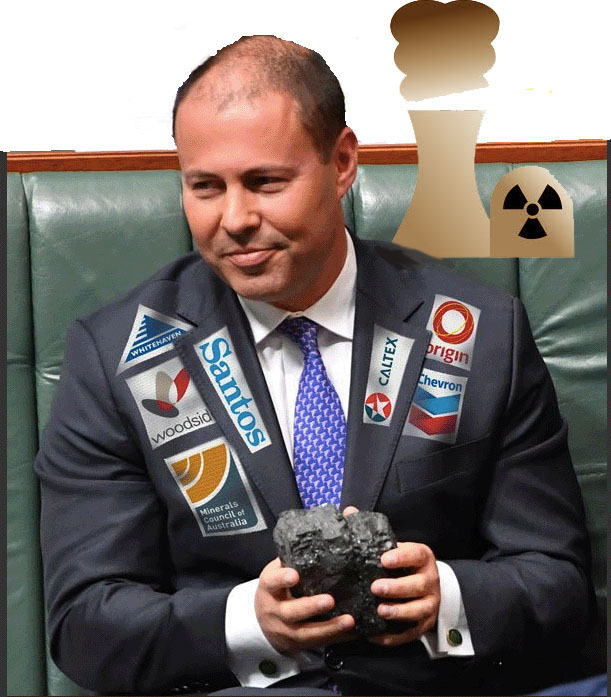 Josh Frydenberg overruled department to block Lord Howe Island wind turbines, FOI documents reveal former environment minister took action despite support from islanders, Guardian, Anne Davies, 18 Sept 19 The former environment minister Josh Frydenberg went against the advice of his departmental experts when he blocked two wind turbines on Lord Howe Island in 2017, consigning the world heritage-listed island to relying on diesel fuel for the bulk of its electricity. Josh Frydenberg overruled department to block Lord Howe Island wind turbines, FOI documents reveal former environment minister took action despite support from islanders, Guardian, Anne Davies, 18 Sept 19 The former environment minister Josh Frydenberg went against the advice of his departmental experts when he blocked two wind turbines on Lord Howe Island in 2017, consigning the world heritage-listed island to relying on diesel fuel for the bulk of its electricity.A freedom of information request by the Guardian has uncovered that the minister took the unusual action of blocking the project under the Environmental Protection and Biodiversity Conservation Act, deeming it “unacceptable”…… Projects are rarely ruled “unacceptable” under federal environmental laws but are often approved with modifications or strict conditions. For instance, the Adani coal project’s groundwater plan was approved in 2019 with conditions; the Abbot Point coal terminal was judged not to have unacceptable impacts on the Great Barrier Reef; and the Watermark coal project near Tamworth was waved through in 2015. But two medium-sized wind turbines on Lord Howe Island proved a bridge too far for Frydenberg as environment minister. Now the Guardian can reveal that his decision was taken despite the advice of his own department, strong support from the majority of residents on Lord Howe Island, the governing board of the island, and even another federal government agency – the Australian Renewable Energy Agency – which had offered $4.6m in funding towards the renewable energy project. The department’s natural heritage section 23 November 2016 advice was that “the proposed action is unlikely to significantly impact the Island Group’s world heritage values” and that moving the island away from reliance on weekly deliveries of diesel would help secure its Unesco world heritage status……… The case raises questions about political influence in environmental decision making. “Former environment minister Josh Frydenberg’s rejection of the Lord Howe Island windfarm is inconsistent with many other environmental approvals where there was strong departmental advice about unavoidable risks to internationally protected places and wildlife,” Basha Stasak, the Australian Conservation Foundation’s nature campaign manager, said.
“For example, Frydenberg ignored clear departmental advice urging a rejection of the Toondah Harbour property development because it would destroy part of an internationally protected wetland. “These inconsistencies go to the heart of the environmental law reform Australia needs. We need strong laws and decisions made under them by an independent national Environment Protection Authority,” she said…….. Lord Howe Island resident Craig Thompson – “Sustainable clean energy for a world heritage site like Lord Howe should be mandatory. We should be setting an example to the whole world, not being held back by a minister’s political ideology or personal opinion.” …….. Lord Howe Island is now exploring what can be done with solar and batteries to meet the island’s needs. New South Wales spends $750,000 a year on shipping diesel to the island to provide power for its 350 residents. https://www.theguardian.com/australia-news/2019/sep/18/josh-frydenberg-overruled-department-to-block-lord-howe-island-wind-turbines |
|
1 This month

of the week – Australians for War Powers Reform (AWPR)
To see nuclear-related stories in greater depth and intensity
 Antinuclear