The Australian 1st June 2018,If you look out the window and glimpse a convoy winding through Sydney’s streets guarded by swarms of federal agents and state police, don’t be alarmed.
Any day now a decade’s worth of spent nuclear fuel assemblies weighing 24 tonnes will be moved out of Sydney’s Lucas Heights facility in a highly sensitive transport mission months in the making.
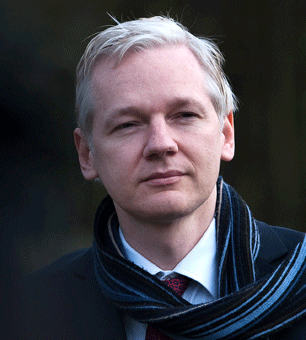
The rejection by ‘Russiagate’ investigators in the US to interview WikiLeaks founder Julian Assange shows that they are not interested in hearing him out, journalist Max Blumenthal told RT.
Assange, who is currently incommunicado in the Ecuadorean embassy in London, reportedly offered – through an intermediary – to talk to US investigators about the release of DNC documents by WikiLeaks during the 2016 US election campaign. Continue reading →
Adani to pay for Isaac council staff working on Carmichael mine activities, ABC News 28 May 18 , ByJosh RobertsonandEmilia Terzon
Adani will bankroll the jobs of local government staff tasked with assessing activities around its Queensland mine proposal — a deal anti-corruption campaigners say raises “serious questions” about independent oversight.
The Indian mining giant has struck an unusual deal to pay up to $1.15 million in wages, housing and vehicle costs for four Isaac Regional Council employees to deal with the “extraordinary workload” created by the Carmichael coal project.
Anti-corruption think tank Transparency International Australia called the scenario unprecedented, saying it would raise questions about the independence of council decisions and perceptions of conflict of interest.
But the council said the staff were under its direction and not controlled by Adani.
It said it was protecting ratepayers from bearing costs for a transnational corporation.
A council resolution last October stated that negotiations with Adani led to the company committing to “fund certain positions within council … to address the extraordinary workloads generated for council by the Adani projects”.
According to council minutes, jobs for an executive and legal support officer, a senior engineering manager and two field officers would be “fully funded (including labour and other on-costs, housing and vehicle costs) by Adani”.
‘Potential for conflict of interest’
Transparency International chief executive Serena Lillywhite said the arrangement raised “real questions around the perception or the potential for a conflict of interest, and for undue industry influence, and certainly questions around the independence of decisions being made by the council”.
She said it took the risk of regulatory capture to “a whole new level”.
“When you have a situation whereby people who are employed by the council but are in fact being paid for by Adani to undertake responsibilities and tasks — such as legal support and compliance with contractual arrangements, engineering support to check whether or not there is compliance with standards regarding engineering or environmental aspects — it does create some real concerns.
“You can understand how at best there would be a perception that there is not an arm’s-length arrangement between the council and the company.”
………No other council has similar arrangement
However, a spokeswoman for the Local Government Association of Queensland (LGAQ) said it was not aware of any other such arrangement between a council and a company where funding was tied to jobs involving oversight of the company’s activities.
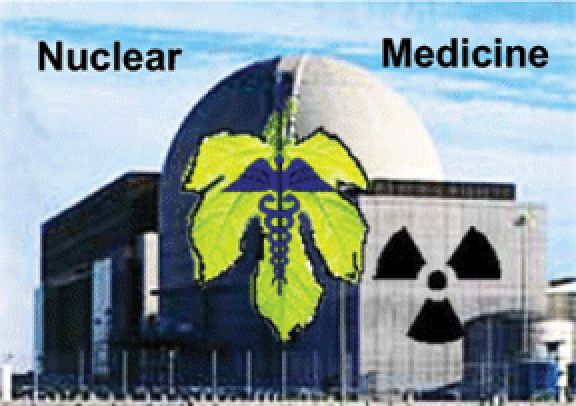
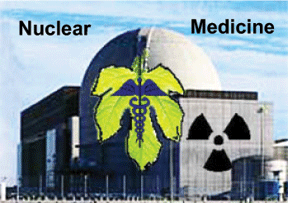
Small rural communities in South Australia are being told that it’s their patriotic duty to save Australia’s nuclear medicine – by allowing a nuclear waste dump in their area.
This is the patently lying propaganda of the Australian Government ‘s Department of Industry, Innovation and Science now busily involve spending tax-payers’ money on pro nuclear spin.
The real purpose of the radioactive trash dump is to host nuclear waste – euphemistically called “intermediate level” waste – currently stored in of 9,8000 leaking rusty barrels at Woomera, and also the wastes produced by the Lucas Heights nuclear reactor. These also so-called “intermediate ” wastes are the reprocessed wastes returned from France, with more to come in the future.
The Australian nation is being conned by the government and its well-funded nuclear promotion organisation Australian National Science and Technology Organisation (ANSTO), with the furphy that the whole purpose of the reactor is medical.
(a) the “medical isotope” function was tacked on – the original purpose was to lead to nuclear weapons. The current purpose is just a foot in the door for the whole nuclear fuel chain.
(b) Nuclear reactors are now going out of fashion, as the cheaper, more flexible, local, cyclotrons can produce medical isotopes safely – with no radioactive waste created.
Tight security for shipment of nuclear waste from Lucas Heights to France, THE AUSTRALIAN, SIAN POWELL, 12 APR 18
A top-secret security operation to send spent radioactive fuel rods from Australia’s nuclear reactor to France for reprocessing is planned for the coming months.
Potentially involving hundreds of state and federal police, the details of the transport operation will remain confidential until after the shipment arrives at La Hague, in northwest France.
Unused uranium and plutonium will then be removed from the fuel rods, and the residual waste eventually returned to Australia for storage. About 500kg of unused low-enriched uranium and 4.5kg of unused plutonium will be recovered from the rods…
The Australian Nuclear Science and Technology Organisation at Lucas Heights in Sydney’s south has confirmed the shipment will be trucked to a port for transport to La Hague midway through this year.
The route, the port, the time and the ship, as well as the numbers of security personnel, will remain confidential until after the mission is completed.
The last shipment of spent rods was sent to the US in 2009, and both Port Kembla and Port Botany have been used as shipment ports in the past.
When reprocessed nuclear waste was returned to Australia in 2015 for storage at Lucas Heights, more than 500 police were deployed to guard the shipment, and it is expected at least that number will guard the radioactive cargo destined for France.
The radioactive spent fuel rods will be packed into an undisclosed number of immensely tough lead and stainless steel transport casks for the journey to France.
“These casks are purpose-engineered to safely transport this type of material without risk to people or the environment,” said the manager of the multipurpose OPAL Reactor at Lucas Heights, Dave Vittorio. “Even a jet plane strike could not penetrate them.”
The total cost of the project is $45 million, including the contract with France, equipment, staff costs, and incidentals.
Paul Waldon No Nuclear Waste Dump Anywhere in South Australia, 18 Mar 18
Today the 18th of March is another red letter day in the nuclear arena with the 31st anniversary of a accident at Lucas Heights.
But first lets jump forward 29 years to the Hawker nuclear community meeting on the 6th of May 2016, where a man named Bruce Wilson from the DIIS who chaired such meeting, a man who could be a totally inept clairvoyant, a nuclear decision psychopath, a misinformed government payed nuclear spruiker, or just a sad ignorant man, this is a man whom said “We will NOT have accidents” .
The opposing dichotomy believes in the old dictum “Pray for the best, prepare for the worst” and the such dichotomy keeps giving a resounding NO to a deadly radioactive dump, which keeps falling on deaf ears of the liars who said they would walk away from a community that doesn’t want to accept it.
Now lets return to the anniversary of the 1987 accident where a fire at Lucas Heights nuclear research laboratory resulted in the contamination of two workers and the discharge of radioactive gas into the atmosphere over populated areas. Yes, Bruce this was a accident, however there was an event two years prior to such accident that may be called a purpose when alleged vandals dodged security patrols and smashed a underground pipe, releasing radioactive effluent into river ways. (What was this pipe made of, maybe brittle 2mm plastic?).
Are we to believe, Bruce, that there wont be anymore accidents, maybe because accidents will be suppressed, or called a planed event, or re-classed as “Technically produced anomalies” just like the erroneous, magniloquent re-classing of high grade waste to intermediate waste in an attempt to try and push through a egregious program while attempting to insult the intelligence of the majority of informed South Australians who don’t want a risky radioactive dump here? https://www.facebook.com/groups/1314655315214929/
Spoils of war? Weapons industry heavyweights wine and dine Defence top brass, Canberra Times Michael Inman, Steven Trask, Markus Mannheim , 9 Mar 18
Weapons industry heavyweights were among companies that lavished almost half a million dollars’ worth of hospitality and gifts on Australian Defence executives and top military personnel.
Government records show sovereign nations, arms manufacturers and private businesses furnished Defence staff with about $490,000 worth of gifts, sponsorships and hospitality in the past four years.
Defence staff are required to register the acceptance or soliciting of gifts, hospitality and sponsorship. The information is kept in a central ledger, which is not published publicly but was made available under freedom of information law.
Six of the world’s largest weapons manufacturers are listed on the register: Lockheed Martin, Boeing, Northrop Grumman, Airbus, Thales and BAE Systems.
Paul Waldon Fight To Stop Nuclear Waste Dump In Flinders Ranges SA 29 Jan 18 “People lie when they want something, because they think the truth wont get it for them.” (Cary Grant, Charade).
DIIS failure to catalogue the known risks of a radioactive waste dump in Hawker or Kimba may be testimony of burying the truth, in a attempt to jump-start the progress of waste abandonment, while knowing they can’t tick all the boxes.
We must remain resolute in our fight to preserve a clean, safe environment for future generations.
Paul Waldon, Fight To Stop Nuclear Waste Dump In Flinders Ranges SA https://www.facebook.com/groups/344452605899556/6 Jan 18 Dr Carl Magnus Larsson is the CEO of ARPANSA, and the man that signs off on a nuclear waste dump, but has he a vested interest in the proposal to abandon such waste?
Is ARPANSA wrongfully regulating and promoting the project? Why did ARPANSA fail to address the safety issues at Lucas Heights that Comcare bought to their attention?
Why does ARPANSA have trouble dealing with people in group discussions?
Is ARPANSA being strong-armed by DIIS, and ANSTO to push a radioactive dump on a community of unwilling people?
Is ARPANSA listening to the majority that are saying “NO”?
Is ARPANSA insensitive to native heritage.? Is ARPANSA ignoring the science of nuclear waste being abandonment in a environment that fails on all the criteria put forward by DIIS?
Is ARPANSA honest and forthcoming with all the issues pertaining to the toxic proposal?
POTENTIALLY dangerous radioactive gases have been secretly pumped into the atmosphere from Lucas Heights and have spread hundreds of kilometres from the nuclear reactor – but the public have never been told.
The release of the highly volatile radioxenon over several months last year was so concentrated that the plumes were detected in Melbourne up to two days later. Other plumes were dragged out to sea by winds before drifting back over Sydney.
The Sunday Telegraph understands the Australian Nuclear Science and Technology Organisation (ANSTO) decided against releasing a public statement at the time to avoid causing alarm.
Scientists at a nuclear testing station in Melbourne traced the source of the radioactive gases to Sydney after the The Comprehensive Test Ban Treaty Organisation International Monitoring System site in Melbourne contacted Lucas Heights after detecting the radioxenon isotope Xe-133.
They were told that 36 hours earlier the first “hot commissioning trials” at ANSTO’s Lucas Heights radioisotope facility for Molybdenum-99 had taken place.
Molybdenum-99 is produced by the fission technique – the intense neutron-bombardment of a highly purified uranium-235 – and is used in nuclear medicine.
While the nuclear reactor – and the government body that oversees it – insists the release of the radioxenon by-product were no threat to public safety, no one, including neighbours of the suburban Sydney plant, were informed.
“Xenon gases are highly volatile and, being inert, they are not susceptible to wet or dry atmospheric removal mechanisms,” a scientific report obtained by The Sunday Telegraph says.
“Consequently, once released to the atmosphere they are simply transported down-wind while radioactively decaying away.”
A Wangan and Jagalingou (W&J) representative said he was paid $2,000 by Adani to boost numbers at the meeting, where he said many who were “not part of my mob” voted on the compensation deal.
Another W&J woman said her family of eight voted against the deal but the official vote recorded just one person against and 294 people in favour.
What’s the deal with the Adani deal?
Traditional owners need to sign off on a deal for compensation
Adani can’t get finance until the deal is done
The deal’s divided the W&J group
Last year’s meeting was to sign off on the deal
A trial next year will decide whether the meeting was legitimate
The claims are made in sworn statements filed in the Federal Court, ahead of a trial in March to decide whether the meeting legitimately endorsed the Adani deal, which has bitterly divided the W&J Continue reading →
URANIUM. From 1944 the purpose of Australia’s uranium industry was to supply nuclear weapons. Up until 1962 Australia supplied 7,730 tonnes of uranium to the USA and UK for their nuclear weapons programs.
More recently, Australia’s uranium is supposed to go only to “peaceful” nuclear power. So – it can go to India, for example, where there’s dubious supervision anyway, and where it frees up other uranium supplies for India’s burgeoning nuclear weapons.
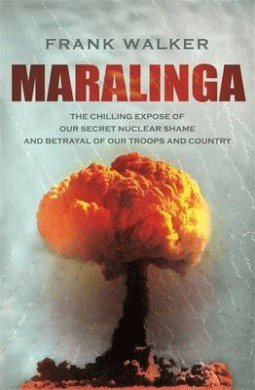
NUCLEAR BOMBS. The Menzies government allowed Britain to explode its nuclear bombs in South Australia, and also at Monte Bello Island, in the 1950s and 60s. So the nuclear weapons industry has had its dirty foot well into Australia.
NUCLEAR REACTOR. Lucas Heights nuclear reactor was always intended as a step towards nuclear weapons, AND IT STILL IS. In the early 1950s, politicians, scientists and Defence Department enthusiasm for Australia to get a nuclear weapon led to the building, in 1957, of a nuclear reactor at Lucas Heights. A plan to build a nuclear reactor at Jervis Bay was pitched to the public as a commercial venture, but was always intended to provide enriched uranium for Australia’s own nuclear weapons.
Others favoured getting nuclear bombs supplied by Britain. The pro nuclear lobby always had nuclear weapons in mind, and campaigned for them strongly through the 1960s, to 1972, when Prime Minister Whitlam ended these ambitions. The campaign continued, more quietly.
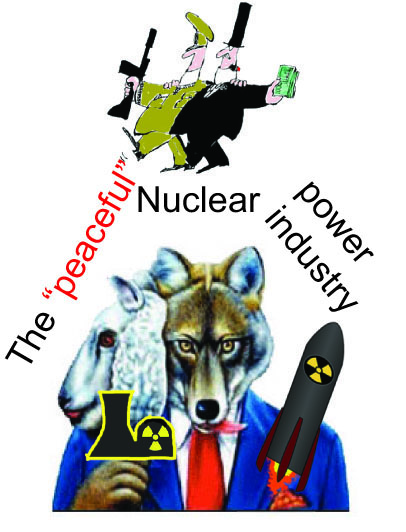
ANSTO. In 1987 the Australian Atomic Energy Commission was abolished, and the Australian Nuclear Science and Technology Organisation (ANSTO) was set up. ANSTO is very secretive about its operations, but does pursue the advanced technology that would make nuclear weapons development possible. Today’s nuclear weapons advocates talk incessantly about “medical research”, and foster the myth of the “peaceful atom”.
As the nuclear weapons establishment in UK and USA now make clear – “peaceful” nuclear power is essential for nuclear weapons – as an industry supplying resources and trained operatives for the weapons industry.
The push for Australia to house nuclear wastes, and the whole nuclear fuel chain is an intrinsic part of the global nuclear weapons industry.
no amount of corporate black washing – including Indigenous participation plans that champion strong and effective relationships between Adani and W&J, alongside jobs and traineeships – can hide Adani’s direct and immediate part in walking over the rights of Traditional Owners.
Traditional Owners Expose Adani’s Relentless Pursuit of W&J Country, New Matilda By Kristen Lyonson
In the third in a five part series on the proposed Adani Carmichael coal mine, Kristen Lyons looks at a deal struck between the miners and the local traditional owners, and why it just adds to the smell that pervades the entire project.
Introduction
The Indian industrial conglomerate, Adani Enterprises – well known for environmental damage and human rights abuses at its project sites around the world, and built upon a complex business structure with tax havens in the Cayman Islands – entered Australia in 2010 with the purchase of coal tenements in the Galilee Basin, in Central Queensland.
Despite its controversial back story, some of which has only come to light since approvals were granted for its Australian project, Adani quickly rose to become a poster child for the State Government, based on promises its Carmichael mine project would deliver jobs and economic growth for regional Queensland.
Managed by its domestic arm, Adani Mining Pty Ltd, over the following years it developed a project proposal that included a coalmine, as well as rail and port infrastructure, thereby opening up the massive Galilee Basin for coal exports.
With seven years gone since acquisition of the coal tenements, and marred by substantial project downsizing, Adani is yet to start construction of its mega mine. Wangan and Jagalingou Traditional Owners Family Councils’ (W&J) defiant opposition to Adani’s proposed Carmichael mine has been central to this delay; opposition that has, in itself, exposed the dirty deeds Adani is willing to perpetrate against Traditional Owners who seek to defend their right to say no to a mine that would destroy their country.
This article exposes some of Adani’s deeds, including its nefarious actions in reaching an ‘agreement’ with Traditional Owners, Continue reading →
This is not an entirely new approach. Before the government decided to abandon the proposed Clean Energy Target it put a lot of effort into redefining coal as “clean”.
Those political objectives are: to provide a point of policy difference with the Labor Party; to meet the demands of the government’s backbench to provide support for coal-fired electricity; and to be seen to be acting to hold power prices down.
Meeting these objectives solves Prime Minister Malcolm Turnbull’s immediate political problems. But it comes at the cost of producing a policy that can only produce further confusion and delay.
The government’s central problem is that, as well as being polluting, coal-fired power is not well suited to the problem of increasingly high peaks in power demand, combined with slow growth in total demand.
Coal-fired power plants are expensive to start up and shut down, and are therefore best suited to meeting “baseload demand” – that is, the base level of electricity demand that never goes away. Until recently, this characteristic of coal was pushed by the government as the main reason we needed to maintain coal-fired power.
The opposite of baseload power is “dispatchable” power, which can be turned on and off as needed.
Adani Australia: Investigation uncovers tax haven ties to British Virgin Islands, Four Corners ,By Stephen Long, Wayne Harley and Mary Fallon , ABC News, 3 Oct 17 An investigation by the ABC’s Four Corners program has uncovered previously unknown tax haven ties for Adani Group’s Australian operations, with key assets ultimately owned in the British Virgin Islands.
Key points:
Adani Group’s filings with ASIC fail to mention a company registered in the British Virgin Islands
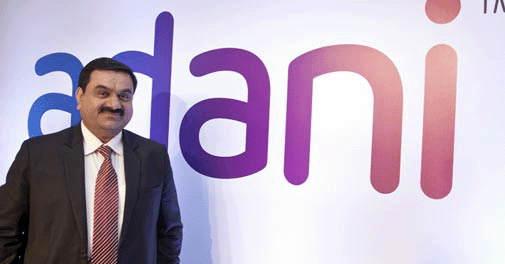
Vinod Adani, older brother of Adani Group chairman Gautam Adani, has been under investigation in India
Vinod Adani also a substantial shareholder in Adani Enterprises Limited
Adani Group has promised a $22 billion windfall in taxes and mining royalty payments for Australia over the life of the giant Carmichael coal mine it has been given approval to build in outback Queensland.
But experts say an opaque web of companies and trusts behind its Australian assets gives it ample opportunity to minimise the tax it pays.
Adani Group’s assets in Australia include the Abbot Point Coal Terminal near Mackay in Queensland, a terminal expansion project it has approval to undertake at Abbot Point, and a planned railway line of nearly 400 kilometres from the port to the giant mine it wants to build in the Galilee Basin — aided by a subsidised loan of up to a $1 billion it is seeking from the Federal Government’s Northern Australia Infrastructure Facility.
It was previously thought that Atulya Resources, a Cayman Islands domiciled company controlled by members of the Adani family, was the ultimate holding company for Abbot Point, the expansion project, and the railway.
However, filings in Singapore by privately-owned Adani companies show that a company registered in another notorious tax haven, the British Virgin Islands, sits behind Atulya Resources.
Vinod Adani investigated over alleged scam
It is variously described in the offshore company filings as ARFT Holding Limited, AFRT Holding Limited and Atulya Resources Family Trust.
Adani Group’s filings with Australia’s corporate watchdog, ASIC, fail to mention this company, instead continuing to list Atulya Resources as the owner.
The British Virgin Islands’ company’s apparent position at the apex of the structure is disclosed in the financial reports of a series of Adani companies controlled by Vinod Adani, also known as Vinod Shantilal Adani or Vinod Shah.
Apr 15, 2026 01:00 AM in Canberra, Melbourne, Sydney
Join the International Physicians for the Prevention of Nuclear War (IPPNW) on Tuesday, April 14th for a timely webinar exploring the risks associated with nuclear power and challenging the myth that it offers a simple, safe, carbon-free solution to the climate crisis
21 April Webinar: No Nuclear Weapons in Australia
Start: 2026-04-21 18:00:00 UTC Canberra, Melbourne, Sydney (GMT+10:00)
End: 2026-04-21 19:30:00 UTC Canberra, Melbourne, Sydney (GMT+10:00)
Event Type: Virtual A virtual link will be communicated before the event.















 Antinuclear