Roundup of news on the Panama global financial corruption scandal
 Panama Papers: Mossack Fonseca labels leak a ‘crime and attack’The revelation of the Panama Papers detailing the off-shore structures of many wealthy clients is a “crime” and an “attack” on Panama, the law firm at the heart of the scandal has said.http://www.abc.net.au/news/2016-04-04/mossack-foncesa-says-panama-papers-a-crime-and-attack/7296858
Panama Papers: FIFA officials, Lionel Messi, Michel Platini named in secret offshore files Disgraced FIFA officials, suspended UEFA chief Michel Platini and Barcelona superstar Lionel Messi were amongst the names found the Panama Papers — leaked documents which reveal offshore financial dealings of the world’s rich and famous.http://www.abc.net.au/news/2016-04-04/fifa-officials-and-lionel-messi-named-in-offshore-files/7296140
Panama Papers leak: Australian security company Wilson linked to Hong Kong corruption scandalLeaked documents have revealed that two brothers embroiled in a massive Hong Kong corruption scandal were ultimately in control of an Australian security company that earned roughly half a billion dollars in lucrative government contracts.http://www.abc.net.au/news/2016-04-04/australian-company-wilson-linked-to-hong-kong-corruption-scandal/7291178
Panama Papers: Tax office investigating 800 Australians identified in financial record leak The Australian Tax Office (ATO) is investigating 800 Australian residents named in a massive leak of tax and financial records known as the Panama Papers. http://www.abc.net.au/news/2016-04-04/tax-office-investigating-800-australians-in-panama-papers-leak/7296512
Panama Papers: Iceland PM Gunnlaugsson urged to resign amid Mossack Fonseca data leak By International Consortium of Investigative Journalists and ABC staffPressure is mounting for Iceland’s Prime Minister to resign after an unprecedented leak of data revealed accusations he used an offshore company to hide millions of dollars in investments in Iceland’s major banks.http://www.abc.net.au/news/2016-04-04/iceland-pm-urged-to-resign-amid-panama-papers-scandal/7295742
Panama Papers: Vladimir Putin associates, Jackie Chan identified in unprecedented leak of offshore financial records An unprecedented leak of more than 11 million documents has revealed the hidden financial dealings of some of the world’s wealthiest people, as well as 12 current and former world leaders and 128 more politicians and public officials around the world.http://www.abc.net.au/news/2016-04-04/unprecedented-leak-of-offshore-financial-records-exposes-secrets/7293524
The International Consortium of Investigative Journalists (ICIJ): The Panama Papers: Exposing the Rogue Offshore Finance Industry Leak of more than 11 million documents show heads of state, criminals and celebrities using secret hideaways in tax havens.https://panamapapers.icij.org/
Panama Papers: Greens call for Wilson Security to be stripped of contracts after corruption scandal links exposedThe Greens have called on the Federal Government to strip Wilson Security of its contracts for offshore immigration detention centres after revelations the company has links to a Hong Kong corruption scandal. http://www.abc.net.au/news/2016-04-05/greens-call-for-wilson-security-sacking/7299736
Panama Papers: Here’s who has been caught in the fallout of the Mossack Fonseca leak The unprecedented leak of more than 11 million documents from Panamanian law firm Mossack Fonseca has revealed some of the hidden financial dealings of the world’s rich and powerful.
Here’s a look at some of the more high-profile people feeling the heat after the scandal broke.http://www.abc.net.au/news/2016-04-05/who-has-been-caught-in-the-panama-papers-fallout/7299666
Panama Papers: Iceland PM Gunnlaugsson refuses to resign over tax leaks; protesters take to streets Iceland’s Prime Minister is refusing to resign after leaked tax documents known as the Panama Papers revealed accusations he and his wife used an offshore firm to allegedly hide million-dollar investments. http://www.abc.net.au/news/2016-04-05/icelandic-pm-refuses-to-resign-over-panama-papers-leak/7298944 (Actually I think that he has now resigned)
Panama Papers: Fraudsters, former tax officials among Australians identified in Mossack Fonseca leak Convicted fraudsters, directors banned by the corporate regulator and former Australian Tax Office (ATO) officials are among hundreds of Australians linked to companies incorporated by Panamanian law firm Mossack Fonseca. http://www.abc.net.au/news/2016-04-05/australians-identified-in-mossack-fonseca-panama-papers-leak/7297964
(Read more about this investigation by ICIJ journalists and more than a hundred other media partners at:https://panamapapers.icij.org/about.html – and check out the videos and reading list.)
The global oil corruption scandal and Australia’s role in it
UNAOIL Why we Must Act , The Age, Nick McKenzie, 2 Apr 16 Australia is leagues behind the US when it comes to investigating corrupt multinational companies who bribe their way to success in third world countries.
This fact is even more concerning given that US prosecutors acknowledge that even they aren’t getting it right, and need to do more to send US corporate crooks to jail. If the US regime needs a jolt, Australia’s system needs a triple bypass.
Recently, when the CEO of the Australian Securities Exchange, Elmer Funke Kupper, stood down to deal with a police investigation over an alleged international bribery case, we even had the corporate cop saying what a “sad loss” it was.
Not a single Australian executive has been jailed for paying a bribe overseas, despite the introduction in 1999 of specific laws banning this practice…….
Unaoil is a Robin Hood in reverse. On steroids. It robs the poor of oil-rich nations such as Iraq, Libya, Angola and Iran. The citizens own the resources beneath their feet, but the money from exploiting them ends up lining the pockets of executives and crooked officials.
Among the Australian firms exposed in the leaked trove of documents is Leighton Offshore, the overseas arm of construction giant Leighton Holdings (since renamed CIMIC).
The emails show that Leighton Offshore promised to pay tens of millions of dollars in bribes in 2010 and 2011. These kickbacks were allocated by Unaoil to high-ranking Iraqi officials and politicians. In return, Leighton Offshore wanted these corrupt officials to help them win pipeline construction projects worth more than $1 billion.
This Australian-funded bribery is precisely the sort of illegal conduct the FBI’s McEachern says fuels inequality, anger and extremism…….
Both the US and UK have comprehensive anti-foreign bribery frameworks. Companies and whistle blowers have strong incentives to self-report corruption and co-operate with authorities – in the US, volunteering information can mean payments of millions of dollars to individual informers. High-quality inside knowledge makes it easier for authorities to hold the corrupt to account.
None of this applies in Australia. ra rahttp://www.theage.com.au/interactive/2016/the-bribe-factory/day-3/why-we-must-act.html
LET’S NOT LEAVE THE OIL INDUSTRY OUT OF OUR SCRUTINY
UNAOIL – The Company That Bribed The World The Age, HuffPost http://www.theage.com.au/interactive/2016/the-bribe-factory/day-1/the-company-that-bribed-the-world.html 31 Mar 16
 In the list of the world’s great companies, Unaoil is nowhere to be seen. But for the best part of the past two decades, the family business from Monaco has systematically corrupted the global oil industry, distributing many millions of dollars worth of bribes on behalf of corporate behemoths including Samsung, Rolls-Royce, Halliburton and Australia’s own Leighton Holdings.
Now a vast cache of leaked emails and documents has confirmed what many suspected about the oil industry, and has laid bare the activities of the world’s super-bagman as it has bought off officials and rigged contracts around the world.
A massive leak of confidential documents has for the first time exposed the true extent of corruption within the oil industry, implicating dozens of leading companies, bureaucrats and politicians in a sophisticated global web of bribery and graft.
After a six-month investigation across two continents, Fairfax Media andThe Huffington Post can reveal that billions of dollars of government contracts were awarded as the direct result of bribes paid on behalf of firms including British icon Rolls-Royce, US giant Halliburton, Australia’s Leighton Holdings and Korean heavyweights Samsung and Hyundai.
The investigation centres on a Monaco company called Unaoil, run by the jet-setting Ahsani clan. Following a coded ad in a French newspaper, a series of clandestine meetings and midnight phone calls led to our reporters obtaining hundreds of thousands of the Ahsanis’ leaked emails and documents.
The trove reveals how they rub shoulders with royalty, party in style, mock anti-corruption agencies and operate a secret network of fixers and middlemen throughout the world’s oil producing nations.
Corruption in oil production – one of the world’s richest industries and one that touches us all through our reliance on petrol – fuels inequality, robs people of their basic needs and causes social unrest in some of the world’s poorest countries. It was among the factors that prompted the Arab Spring.
Fairfax Media and The Huffington Post today reveal how Unaoil carved up portions of the Middle East oil industry for the benefit of Western companies between 2002 and 2012.
In part two we will turn to the impoverished former Russian states to reveal the extent of misbehaviour by multinational companiesincluding Halliburton. We will conclude the three-part investigation by showing how corrupt practices have extended deep into Asia and Africa……….
In continuing fallout from the joint Fairfax Media-Huffington Post investigation into corruption in the oil industry, the Monaco government revealed that it had raided the homes and offices of Unaoil’s principals, who ran the company exposed as the global bagman for the oil industry.
Advertisement
Unaoil executives “were also interviewed… in the presence of British officers in connection with a case of vast corruption with international ramifications that involves many foreign companies active in the petroleum sector,” the Monaco government’s statement said.
Fairfax Media revealed on Thursday that the British police had teamed up with the Australian Federal Police, the US Department of Justice and the FBI to investigate the vast cache of leaked Unaoil emails on which our stories have been based.
Unaoil was hired over almost two decades by large multinational firms, including the offshore arm of Australia’s Leighton Holdings, to pay bribes to top overseas officials in return for winning government funded contracts in oil-rich nations.
Police raids and more revelations: the fallout of the Unaoil scandal The Age, April 1, 2016 Nick McKenzie, Richard Baker, Michael Bachelard, Daniel Quinlan “……. In continuing fallout from the joint Fairfax Media-Huffington Post investigation into corruption in the oil industry, the Monaco government revealed that it had raided the homes and offices of Unaoil’s principals, who ran the company exposed as the global bagman for the oil industry.
Unaoil executives “were also interviewed… in the presence of British officers in connection with a case of vast corruption with international ramifications that involves many foreign companies active in the petroleum sector,” the Monaco government’s statement said.
Fairfax Media revealed on Thursday that the British police had teamed up with the Australian Federal Police, the US Department of Justice and the FBI to investigate the vast cache of leaked Unaoil emails on which our stories have been based.
Unaoil was hired over almost two decades by large multinational firms, including the offshore arm of Australia’s Leighton Holdings, to pay bribes to top overseas officials in return for winning government funded contracts in oil-rich nations……… http://www.theage.com.au/business/police-raids-and-more-revelations-the-fallout-of-the-unaoil-scandal-20160401-gnw9mx.html#ixzz44ZNjGbWg
Follow us: @theage on Twitter | theageAustralia on Facebook
We are becoming a dumping ground for dirty money
The Age, Nick McKenzie, 1 Apr 16
- Read the full day two expose here
- The dirty western executives
- Australia’s Leighton Offshore: dirty dealing in Iraq
- Big Oil’s bribe factory
Anti-corruption experts in the US and Europe have urged Australia to properly resource and empower its anti-bribery regime as Australia emerges as the “dumping ground” for dirty money from Asia.
Officials believe that under-resourcing, ineffective laws and competing priorities between the federal police and corporate watchdog ASIC are a factor in the failure to resolve many cases.
The call comes after Fairfax Media revealed Australian involvement in one of the biggest bribery scandals to ever hit – a scandal that has implicated a number of Australian firms and executives including the offshore arm of Leighton Holdings and WorleyParsons…….
The Coalition government has focused on fighting union corruption, but has been all but silent on the major gaps in Australia’s anti-corporate corruption regime.
From politician to mining executive and back again: how miners control Australian government policy
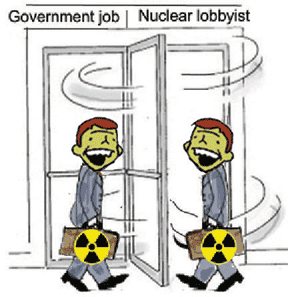 Larissa Waters: Ban donations from mining companies and stop ministers working for them, Larissa Waters, Guardian, 1 Mar 16 “……….The revolving door
Former politicians:
- Former Nationals leader and deputy prime minister John Anderson became chairman of Eastern Star Gas, the company behind the Narrabri Gas Project (which is now owned by Santos) about two years after leaving politics.
- Former Nationals leader and deputy prime minister Mark Vaile became a director and then chairman of Whitehaven coal.
- Former Labor resources minister Martin Ferguson became chairman of the APPEA Advisory Board – in October 2013 – just six months after he stopped being the minister. (The lobbying code of conduct requires an 18-month cooling-off period for ex-ministers).
- Craig Emerson, a former federal Labor trade minister went on to be a consultant for AGL Energy and Santos.
- Former foreign minister Alexander Downer was at one point a registeredlobbyist with Bespoke Approach, which included the likes of Woodside Petroleum, Xstrata, Petrochina and Yancoal among its clients.
- Greg Combet, the federal Labor climate change minister, went on to be a consultant to AGL Energy and Santos.
Political staffers:
- Bill Shorten’s current chief of staff, former Queensland Labor state secretaryCameron Milner, has also worked with Adani. He was director of Milner Strategic Services & Next Level Holdings, which is co-owned by former Liberal staffer David Moore and was reportedly providing advice to Adani on the controversial Adani Carmichael coal project.
- Ben Myers worked for Queensland Gas Company, and went on be Queensland LNP premier Campbell Newman’s chief of staff.
- Mitch Grayson worked as a staffer for Queensland LNP premier Campbell Newman in 2012 and, by early 2013, had joined Santos. Later, he re-joined Premier Newman’s office.
- Stephen Galilee, who worked as chief of staff to Ian Macfarlane as Liberal federal resources minister for three years, and chief of staff to Mike Baird as NSW treasurer and shadow treasurer, went on to be CEO of the NSW Minerals Council.
- Geoff Walsh, former adviser to Labor prime ministers Paul Keating and Bob Hawke, and a former national secretary of the Labor party, was made director of public affairs at BHP in 2007.
- Claire Wilkinson, spent a year as a senior media adviser for Labor resources minister Martin Ferguson before getting a job as a senior external affairs adviser for Royal Dutch Shell. She is now at Total E&P.
- Brad Williams, who spent four years as Mark Vaile’s chief of staff, went on to become the manager for government affairs at Inpex – an oil and gas company that has approval for a $34bn LNG project near Darwin. He is now working in government relations at another mining company, South32.
- Shaughn Morgan worked as adviser to Jeff Shaw, NSW Labor’s attorney general, before becoming the manager of government and external relations at AGL.
- Lisa Harrington was a senior adviser to Mike Baird before becoming the head of government relations at AGL Energy.
- Sarah Macnamara worked at AGL before becoming chief of staff to federal Liberal resources minister Ian Macfarlane, and was resource policy adviser to Liberal PM Tony Abbott.
- Robert Underdown was senior adviser to Liberal resources minister Ian Macfarlane before becoming the manager of the government and public policy group at Santos.
-
- Caroline Hutcherson was senior media adviser to the then Liberal NSW resources minister Chris Hartcher before working as a senior adviser to Santos, and going on to work as a senior adviser to NSW Liberal premier Mike Baird.
- Alexandra Gibson was an adviser to Christopher Pyne, before becoming a policy adviser to APPEA, the oil and gas lobby group.
- Paul Fennelly was the director of the Queensland Department of State Development, Trade and Innovation before becoming the CEO of APPEA.
- Chris Ward was an adviser to the Queensland treasurer and to the consumer affairs minister in the federal Labor government under Kevin Rudd and Julia Gillard, before taking a job as media manager at APPEA.
- Charles Perrottet was senior media adviser to the then Liberal NSW resources minister Chris Hartcher, then an executive of the NSW Liberal party before becoming a government affairs analyst at BP Australia.
- Andrew Humpherson was chief of staff to the then Liberal NSW resources minister Chris Hartcher before working as a consultant to the NSW Minerals Council.
- Emma Browning was a media adviser for the then Liberal NSW resources minister Chris Hartcher before becoming director of government relations at the NSW Minerals Council.
- Brad Emery was a media adviser to federal Liberal minister Peter Dutton before working as director of media and public affairs at the NSW Minerals Council.
- Chris Rath was media and public affairs manager at the NSW Minerals Council before working as an adviser to NSW Liberal resources minister Anthony Roberts.
- Lindsay Hermes was media and communications manager at the NSW Minerals Council before working as an adviser to federal Liberal resources minister Ian Macfarlane. http://www.theguardian.com/commentisfree/2016/mar/01/larissa-waters-ban-donations-from-mining-companies-and-stop-ministers-working-for-them
Exposing the vested interests of pro nuclear publicists like Oscar Archer
 Dennis Matthews, 26 Feb 16 The Advertiser newspaper has been printing lots of Letters to the Editor on the nuclear issue.
Two pro-nuclear letters caught my attention.
One was by a writer (Oscar Archer) who is regular contributor to a pro-nuclear website, and who prides himself on having a PhD in Chemistry. The PhD, however, is in an area of chemistry not evenly faintly related to nuclear issues and is no basis for claiming any special insight. What is highly relevant however is that the supervisor of his thesis was Stephen Lincoln who, as a member of the board of SA Nuclear Energy Systems, has a vested interest in promoting the nuclear industry.
Another letter was written by a geologist (Sean Kennedy) who was one of the people acknowledged by Senator Edwards as contributing to his submission calling for an integrated nuclear industry in SA.
Noel Wauchope – Oscar Archer is a star publicist for the nuclear lobby. And – he really gave the game away in a talk on ABC Radio National “Ockham’s Razor” – in which he elaborated the plan of USA nuclear industry “new nukes” – their idea to set up a suite of experimental SMRs -Small Modular Reactors in Australia at their own expense. All Australia has to do to get these is to invite in the world’s radioactive trash. They don’t mention that SMRs need plutonium or enriched uranium to start the reaction – so Australia would have to import those, to get these reactors working.
Interesting that they just call them “SMRs” – leaving out that unpopular word “Nuclear”. As USA govt has difficult safety regulations for setting up new nuclear reactors, why not have Australia be the guinea pig?
Australian govt lies about medicine and nuclear waste
Government information on nuclear waste is misleading and omits important facts. Failure of informed consent? Medical Association for Prevention of War – health professionals promoting peace 22 February 2016 – MELBOURNE:
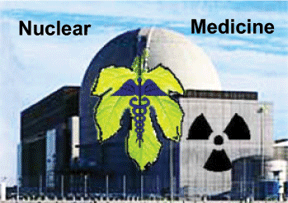 Nuclear medicine has been highlighted as a key reason to have a nuclear waste repository. MAPW President, Dr Margaret Beavis observes that ‘The Commonwealth government fact sheet: Information for communities- Key questions answered’ is a gross misrepresentation and reads more like a puff-piece for the nuclear industry. The recently released brochure states “One in two Australians – everyone who has ever had a broken bone, heart scan or cancer diagnosis – will need nuclear medicine at some point in their lifetime.”
“This is very clearly misleading in all three areas” said Dr Beavis . “X Rays for a broken bone rarely require nuclear medicine, the vast majority of heart scans are done by ultrasound, and most cancers are treated by surgery, chemotherapy or radiotherapy, none of which use radioisotopes. Even the assertion the half the population needs nuclear medicine is not credible.”
In addition ANSTO continues to insist that using reactors to produce radioisotopes is the only option. In January 2015 Canada – the world leader in radioisotope commerce – had a successful pilot project for commercial cyclotron production. Current regulatory testing and expansion will likely make Canada self-sufficient through cyclotron generation in 3-5 years. “Cyclotrons are a more reliable, safer and cheaper source of radioisotopes than nuclear reactors, and produce no long term waste, but ANSTO has not mentioned this” said Dr Beavis
Nor is mention made of ANSTO’s plans to increase reactor production (from previously 1%) to supply 25-30% of world markets, vastly increasing Australia’s waste from the generation of medical radioisotopes for international sales. “We already have more waste than we know what to do with” said Dr Beavis “We need community debate before massively increasing radioactive waste production.”
Earlier this month it was reported that ANSTO would stop making radioisotopes next year if a waste repository site was not found. Subsequently in Senate Estimates hearings it emerged this was sourced from a previous document and was not the case. These alarming claims have yet to be widely rebuffed by ANSTO, despite requests to do so.
Finally, the telephone information hotline for communities has been very poor. “Comments such as suggesting televisions and microwaves are radioactive when used are clearly wrong.” said Dr Beavis.
If the government is sincere about informed consent it needs to do much better than this.
ARPANSA: a not so independent radiation regulator
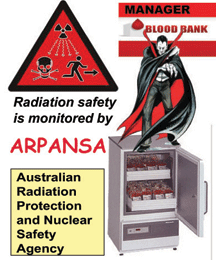 Jim Green 21 Feb 16 Bruce Wilson (from the federal government’s Department of Industry, Innovation and Science) and other governments reps were keen to talk up the role of the ‘independent’ regulator, the Australian Radiation Protection and Nuclear Safety Agency (ARPANSA). But ARPANSA has a troubled history. Its troubles began immediately: the government allowed ANSTO a direct role in selecting the founding CEO of ARPANSA, so ARPANSA’s independence was undermined from the start.
Here’s a more recent example of problems with ARPANSA, summarised in a 2011 ABC article:
“A review of Australia’s nuclear industry regulator, ARPANSA, has found an improper relationship with the main agency it monitors [ANSTO]. The Health Department’s audit and fraud control branch has been investigating how ARPANSA handled allegations of safety breaches and bullying at the nation’s only nuclear reactor in Sydney. Whistleblowers had alleged ARPANSA was too close to the Australian Nuclear Science and Technology Organisation (ANSTO), which runs the Lucas Heights research facility.”
ABC, 8 July 2011, Nuclear regulator ‘too close’ to ANSTO, www.abc.net.au/news/stories/2011/07/07/3264086.htm
An independent regulator could provide some confidence. But a not-so-independent regulator with a poor track record …
More information about ARPANSA:
- www.foe.org.au/anti-nuclear/issues/oz/arpansa
- ANSTO / ARPANSA whistleblower saga: www.foe.org.au/ansto-whistleblower-saga-2007-ongoing
Barry Brook, Pinchy Lobster and Clive Palmer: Three ‘Outstanding Scientists/Intellectuals’
 Jim Green, 19 Feb 16 Tas Uni academic Barry Brook’s university webpage says that in 2005 he was listed as one of the “2000 Outstanding Scientists of the 21st Century” by the International Biographical Centre (IBC). But the IBC is a zero-credibility money making operation.
The WA Government’s Dept of Commerce ‘ScamNet’ website states: “The material promoting the International Biographical Centre creates a false impression about the credentials of the organisation. It also wrongly implies that the receiver of the letter has been picked through a special research process considering their work and qualifications.”
If there was any doubt about the IBC’s illegitimacy, one of Brook’s academic colleagues nominated a squeaky toy lobster and Prof. Lobster was accepted for inclusion as one of the ‘2000 Outstanding Scientists of the 21st Century’. And the IBC has accepted a nomination for Clive Palmer to be listed as one of the ‘2000 Outstanding Intellectuals of the 21st Century’. A ‘Medal of Intellect’ will be sent to Palmer on payment of a $240 fee.
Feel free to test the IBC’s credibility yourself … you’ll have no trouble getting the Wiggles or the Bananas in Pyjamas or Thomas the Tank Engine accepted as Outstanding Scientists or Outstanding Intellectuals.
Given that the illegitimacy of the IBC is beyond doubt, why does the IBC accolade remain on Brook’s university webpage?
Sources:
- Brook’s Tas Uni website (see the Career tab, under “Awards and Prizes”): https://secure.utas.edu.au/profiles/staff/plant-science/barry-brook
- IBC: www.internationalbiographicalcentre.com/2000_outstanding_scientists_of_the_21st_c.php
- WA Government ‘scamnet’ website: http://www.scamnet.wa.gov.au/scamnet/Scam_Types-Directory_Listings_and_registry_schemes-International_Biographical_Centre.htm
- Wikipedia IBC entry: https://en.wikipedia.org/wiki/International_Biographical_Centre
- Critique of Brook’s nuclear propaganda: www.foe.org.au/anti-nuclear/issues/oz/barry-brook-bravenewclimate
Northern Territory Mine Regulator gives a free pass for uranium mining companies to pollute
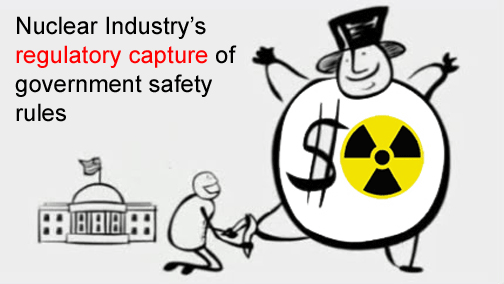 What is a regulator for again? http://linkis.com/greensmps.org.au/1cNkL 12 Feb 2016 The Northern Territory mine regulator is inviting uranium companies to ignore any environmental safeguards with their refusal to prosecute Energy Resources Australia, the Australian Greens said today.
“After more than two years, the NT regulator has given ERA a pass. The Ranger mine leaked nearly 1.5 million litres of radioactive acidic sludge into the plant area, and could have got people killed,” Australian Greens Deputy Leader Senator Scott Ludlam said today.
“Under estimates questioning we were told that the report into the leach tank spill was kept from the public while a decision was made about whether or not to prosecute. It’s hard to envisage a scenario that warranted the application of the full force of the law more than this one.
“The regulator failed to prevent the spill, they took years to deliberate, and came up with nothing. They’ve essentially announced to mining companies in the NT that there are no legal consequences for catastrophic negligence,” Senator Ludlam said.
“We urge the NT government to reverse this decision immediately and force ERA to be accountable.”
Australian Nuclear science and Technology Organisation (ANSTO) not honest about cyclotrons
 Medical isotope production in Australia: Should we be using reactor based or cyclotron technology? 15th January 2016 Dr Margaret Beavis MBBS FRACGP MPH Medical Association for Prevention of War, Australia Health Professionals Promoting Peace
 Mongolia secret [but failed] nuclear waste deal – a model for Australia?
This article relates to Mongolia, but the principles would also apply to Australia, on the basis that anywhere will do. The waste in question is not only Japanese waste, but also waste produced in nuclear power plants exported by Toshiba/Westinghouse
 while ostensibly the negotiations were between the three governments, the plans for the deal were drawn up by the U.S. and Toshiba with the aim of selling nuclear power plants to emerging economies under a scheme called Comprehensive Fuel Service.
According to this scheme, vendors assure potential customers that they will handle any future nuclear  waste produced by power plants the customers buy, which is why Mongolia’s acceptance of such waste is so important. Due to local resistance, neither the U.S. nor Japan has anywhere to dump spent fuel, even their own.
The reason Yamada became so interested in this topic years after the fact is that in the meantime, Toshiba has been caught up in financial scandals that have brought the company to its knees, and he wanted to explore the connection between Toshiba’s nuclear energy business and its fiscal woes.
the U.S., desperate to find a friendly country to accept nuclear waste, was pushing Japan to make a deal with Mongolia.
The elephant in the room for Toshiba is nuclear http://www.japantimes.co.jp/news/2016/01/16/national/media-national/elephant-room-toshiba-nuclear/
BY PHILIP BRASOR THE JAPAN TIMES, JAN 16, 2016
Japanese press outlets often cover scoops from competing outlets, but it’s rare to build on a competitor’s story with original reporting, especially when the scoop is a few years old. In December, the weekly magazine Aera, which is affiliated with the Asahi Shimbun, ran an article about a secret meeting that took place between representatives of Japan, Mongolia and the United States almost five years ago. This meeting was first reported by Haruyuki Aikawa in the May 9, 2011, issue of the Mainichi Shimbun.
What interested Aera reporter Atsushi Yamada about the article was Aikawa’s assertion that Toshiba Corp. was on hand for the negotiations. Continue reading
National waste dump is NOT NEEDED for medical nuclear wastes
Is Australia becoming the world’s nuclear waste dump by stealth? http://www.smh.com.au/comment/is-australia-becoming-the-worlds-nuclear-waste-dump-by-stealth-20151122-gl4v04.html December 2, 2015 -Dr Margaret Beavis
When it comes to justifying new nuclear waste storage, a lot has been said about it being essential for medical diagnostics and cancer treatment. This is misleading. It blurs two distinct components of nuclear medicine – the production of isotopes and the use of isotopes.
Australia’s medical use of isotopes creates very little waste. In contrast, reactor production of isotopes generates considerable amounts, and ANSTO (the Australian national nuclear research and development organisation) is very quietly proposing to dramatically increase production to supply 30 per cent of the world market. This will significantly increase Australia’s nuclear waste problems.
On the “use” side, the vast majority of isotopes used for medical tests are very short-lived. They decay on the medical facilities’ premises until their radioactivity is negligible. They can then be disposed of in the normal waste stream (sewers, landfill etc) according to set standards. There is no need for a new nuclear waste facility for these isotopes. Most cancer radiotherapy uses X-rays, which does not produce any waste at all. A very small proportion of cancer treatments need radioactive materials, which also are too short-lived to require a remote repository, or are legally required to be sent back to the (overseas) supplier once used up. There is a very small amount of legacy radium relating to cancer therapy in the past, however, this has not been used in Australia since 1975.
On the other hand, using a nuclear reactor to manufacture radio isotopes creates a significant amount of intermediate and low-level waste. ANSTO has recently unilaterally decided it will dramatically increase its production of medical isotopes at the Lucas Heights reactor to supply 30 per cent of the world’s needs. This business decision assumes it will not have to pay for the disposal of the waste produced, even though it will need securing for many thousands of years.
This decision ignores the reality of technology that enables isotopes to now be produced using accelerators and cyclotrons; i.e. without using a reactor and without generating large quantities of radioactive waste. This is fast approaching commercial scale and economic viability. ANSTO’s decision contrasts with that of the Canadian nuclear authorities, who have for some years been actively phasing out reactor production, and pouring money into developing non-reactor technologies.
Canada, the world’s single largest producer of medical isotopes, independently reviewed its nuclear industry in 2009 and decided not to build a new reactor. Several reasons stood out: investment in reactor production of medical isotopes would crowd out investment in innovative alternative production technologies both domestically and internationally, Canada did not want to continue being the radioactive waste site for other countries’ nuclear medicine industries, it created supply vulnerabilities, and at no stage was it commercially viable without massive taxpayer subsidies.
The ANSTO decision represents vested interests entrenching a reactor-based model and crowding out development of other options. In many ways it is like the coal industry boosting production to stop wind and solar development. Like coal, the business model relies on not being responsible (financially or socially) for the waste it leaves behind.
We urgently need an open conversation about whether we want to pick up the world’s waste tab when it comes to producing medical isotopes. This is a policy choice that will leave Australia storing waste from isotopes produced for international markets. The market price for these isotopes does not factor in the price of storing this waste, which falls to the taxpayer and the community unlucky enough to be landed with it. It is taking Australia down a path that Canada has rejected.
The bottom line is that storage of nuclear waste from reactors is difficult, requiring long-term isolation and security.
We need transparent, informed and clear discussion of what our choices are. We have an obligation to future generations to minimise the waste we produce. There needs to be a considered and open debate about where existing waste is most safely stored in Australia. And it needs to be absolutely clear to ANSTO that we do not want to be left holding the world’s radioactive waste by default.
The Australian community is far from convinced about taking on more radioactive material on behalf of the international community. ANSTO needs to be much more explicit about what it is planning. As a government-owned entity it has a responsibility to be upfront and consult with the community.
When it comes to such long-term decisions about radioactive materials, sleight of hand is not good enough.
Margaret Beavis is a GP and national president of the Medical Association for Prevention of War.
GREENPEACE FINDS NUCLEAR WASTE HEADED TO AUSTRALIA CLASSIFIED AS DANGEROUS HIGH-LEVEL WASTE BY FRANCE
The French Nuclear Safety Authority (ASN) has revealed to Greenpeace that the waste has been classified as high-level (long-life) waste according to standards set by ANDRA, the French national radioactive waste management agency. High-level waste is ANDRA’s most severe nuclear waste classification.
Areva documents have also confirmed that the waste still contains low quantities of plutonium.
The nuclear waste is due to be unloaded off the BBC Shanghai at Port Kembla in southernSydney in the early hours of Sunday, 6 December. It will then be transported to Lucas Heights by road for interim storage.
Sydney, 2 December 2015 – Nuclear waste returning to Australia this weekend by ship from France has been classified as high-level waste by French authorities, contradicting Australia’s claims over its radioactivity, a Greenpeace report has found.
Greenpeace’s investigation also found the waste still contains quantities of plutonium – highly toxic even in small quantities – despite reprocessing by French state-owned nuclear company, Areva.“The Australian government is downplaying the danger of this shipment, saying it is
intermediate-level waste that isn’t harmful unless mismanaged. But we know it contains plutonium and is classified as high-level waste by the French authorities,” said Emma Gibson, Greenpeace Australia Pacific’s Head of Programs. Continue reading



Australian govt to pay 4 times land value for nuclear dump site, plus #10 million to local community

Sallys Flat should be removed from nuclear waste shortlist, residents say, ABC News 13 Nov 15 By Joanna Woodburn, “……The Government says it needs to build a facility to store the low and intermediate nuclear waste that’s been accumulating in at hospitals, universities and at the Lucas Heights nuclear reactor in Sydney.
Landowners were asked to volunteer their land, with the government offering to buy it at four times the market value. Local communities are being offered $10 million for local projects.”… http://www.abc.net.au/news/2015-11-13/take-sallys-flat-off-nuclear-waste-shortlist-residents-say/6937442
Exposing Michels Warren and Nuclear Waste Dumping in South Australia
 Nuclear Fuel Chain Royal Commission WEEK 11 – MANAGEMENT,
  STORAGE AND DISPOSAL OF NUCLEAR AND RADIOACTIVE WASTE, Jim3 17 Sept 11115
Michels Warren is a PR company working for the Nuclear Fuel Cycle Royal Commission. The company was involved in the Howard government’s failed 6-year attempt to impose a national nuclear waste dump in South Australia. A great deal of information is available about the role of Michels Warren in this controversy thanks to documents released under Freedom of Information (FoI) legislation.
A September 27, 2000 email written by Stephen Middleton from Michels Warren talked about the need  to “soften up the community” and “sell” the repository: “We will lose ground once again unless we can soften up the community on the need for the repository and the reasons why SA has been identified as the best location. The prospect of the Minister announcing the preferred site before we can get to the community with something that explains what it all means makes my head spin. The wider research into issues such as Lucas Heights, uranium mining, the nuclear fuel cycle etc etc can be tackled as a separate issue. It should not hold up anything we are doing in terms of selling the repository to South Australians. The rest of the country probably doesn’t care less about the repository, but it is a big issue in SA. Further delays could be potentially disastrous.”
Why was a South Australian company willingly involving itself in the federal government’s nuclear dump plans? After all, Michels Warren itself acknowledges that the dump is an unwanted imposition on SA.
A 2003 Michels Warren document released under FoI legislation stated: “The National Repository could never be sold as “good news” to South Australians. There are few, if any, tangible benefits such as jobs, investment or improved infrastructure. Its merits to South Australians, at the most, are intangible and the range and complexity of issues make them difficult to communicate.”
So why was Michels Warren dumping on its home state? Money, of course. In total, Michels Warren was paid at least $487,000 to dump on SA … and possibly much more. Michels Warren staff were paid at rates up to $192.50 per hour for their work on the nuclear dump campaign.

An August 16, 2000 “high priority” email reveals that Caroline Perkins, a senior official in the  Department of Industry, Science and Resources – at that time under the direction of Senator Nick Minchin – was asked to compile information on protesters. “[T[he minister wants a short biography of our main opponents in the Ivy campaign by about 11am our time (pre-rally)”, the email said. The rest of the email is blacked out under FoI provisions. The email refers to a Michels Warren employee – no doubt Michels Warren helped compile the biographies. Continue reading
Australian mining companies’ shameful record in Africa
Australia sells itself as a nation that can teach the world about responsible mining – Afghanistan is one willing student – but the record suggests our corporations have a callous disregard for the rights of civilians.
Why is it left to US NGOs to expose Australian mining’s wrongdoing in Africa? Antony Loewenstein, Guardian , 27 july 15
There are hundreds of Australian mining companies working in Africa, but just one full-time Australian journalist. What does that mean for accountability? Australian miners are making a killing overseas. With little regulation or oversight, billions of dollars are being made in some of the most remote places on Earth.
The necessity of partnering with autocratic regimes has proved no impediment to investment. Human rights have been breached. Victims are largely invisible.
None of this should be surprising. If Australian companies operating internationally are mentioned in the media, it appears in the business pages and discusses the strengths of a CEO or share price. Rio Tinto, for example, receives largely uncritical coverage despite in the 1980s the corporation facing serious allegations of human rights abuses around the world, including in Papua New Guinea.
Two American non-profit media organisations, the Centre for Public Integrity and the International Consortium of Investigative Journalists, recently bucked the trend and released a stunning report, Fatal Extraction, on Australian mining companies working in Africa (in which no allegations were made against Rio Tinto). How revealing that this research was led from America and not Australia itself.
The findings of the report, produced in collaboration with African journalists on the ground, were shocking.
From the Democratic Republic of the Congo to Malawi, grim details of death, maiming and police and army brutality were revealed. Continue reading
1 This month
Chernobyl: The Lost Tapes – A good documentary on Chernobyl on SBS available On Demand for the next 3 weeks– https://www.sbs.com.au/ondemand/tv-program/chernobyl-the-lost-tapes/2352741955560
15 April – Zoom –Nuclear Power is Not the Solution
Apr 15, 2026 01:00 AM in Canberra, Melbourne, Sydney

Join the International Physicians for the Prevention of Nuclear War (IPPNW) on Tuesday, April 14th for a timely webinar exploring the risks associated with nuclear power and challenging the myth that it offers a simple, safe, carbon-free solution to the climate crisis

21 April Webinar: No Nuclear Weapons in Australia
Start: 2026-04-21 18:00:00 UTC Canberra, Melbourne, Sydney (GMT+10:00)
End: 2026-04-21 19:30:00 UTC Canberra, Melbourne, Sydney (GMT+10:00)
Event Type: Virtual
A virtual link will be communicated before the event.
Host Contact Info: australia@icanw.org

of the week – Australians for War Powers Reform (AWPR)
To see nuclear-related stories in greater depth and intensity
 Antinuclear