Australia further in the grip of the USA, with the Amazon data spy hub – paid for by Aussie tax-payers!
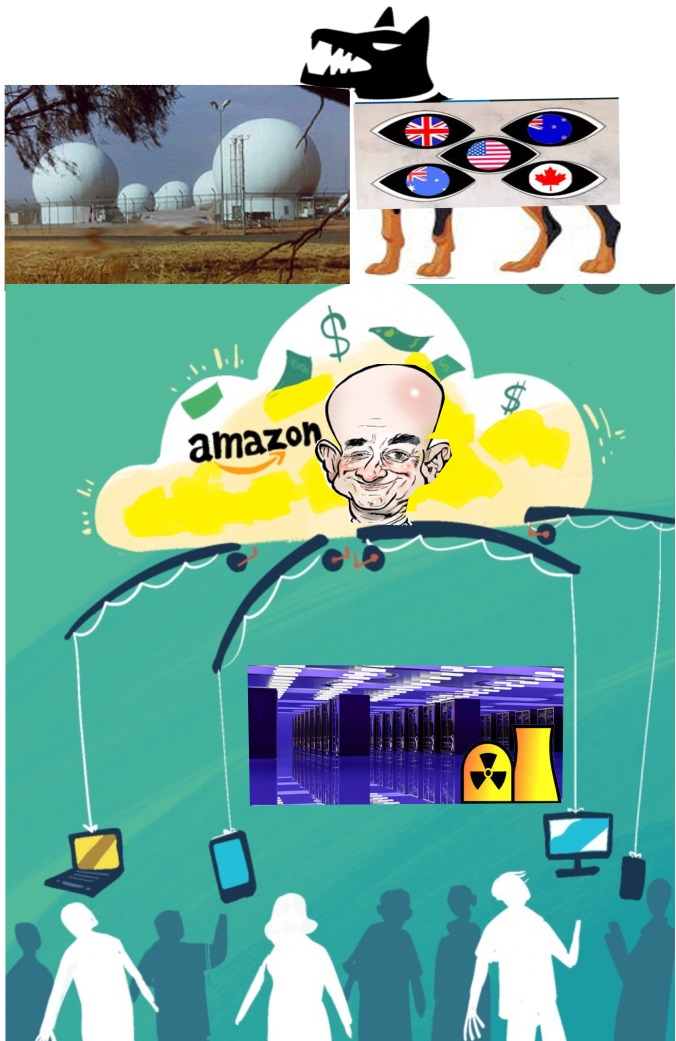
Australia’s Defence Minister Richard Marles was ecstatic as he announced the secret deal now organised for Australia to pay for Amazon to set up secret spy databanks, just as he was ecstatic about the government’s AUKUS deal for buying nuclear submarines from USA and UK
It’s not as if the public knew about either of these decisions beforehand, (the AUKUS one being largely arranged with scandal-ridden consultancy PWC). It’s not as if these matters were discussed in Parliament. On both occasions, the government just did it.
Points that haven’t been addressed:
Australian taxpayers again foot the bill to an America private company
Amazon private staff will be running the operation – with access to the data?
The whole thing perpetrates the lie about the data being “in the cloud” – but there is no “cloud”. The data will be in gigantic steel containers, set out on a large area.
The data containers will require massive amounts of electricity. ? supplied by nuclear power
The data containers will require massive amounts of cooling water, in this dry, water-short country..
The whole set up, just like the now-being expanded Pine Gap. will form a dangerous target for terrorists, or for enemies of the USA.
Like Pine Gap, it is probable that Australian authorities will have limited access to the information. And as artificial intelligence is involved – who IS going to be in control?
And what’s to stop the USA officials and the Australian government spying on Australian individuals via the Five Eyes?
The whole set-up will be the servant of the Five Eyes, secret intelligence of five English-speaking countries, ( no trust in Europe, or any non-anglophone nation) but controlled by the USA.
The vast amount of tax-payer money going to all this means the money is not going to Australians’ health, welfare, education, environment, climate action – in other words to the common good.
As the USA Supreme Court has just made the U.S. president effectively above the law – this secret deal with Amazon and the USA puts Australia more firmly in the grip of the USA – (and God help us if Trump wins).
Amazon wins contract to store ‘top-secret’ Australian military intelligence

Please note – this article uses the word “cloud” – but this isa a lie
There is no cloud.
What they mean is -acres and acres of dirty great steel canisters, guzzling electricity and water
By defence correspondent Andrew Greene, Thu 4 Jul 2024 https://www.abc.net.au/news/2024-07-04/amazon-contract-top-secret-australian-military-intelligence/104057196
In short:
Three data centres will be built in secret locations to host Australia’s military secrets.
Amazon has won the $2 billion contract to store the classified intelligence.
What’s next?
The massive project will roll out over several years, and is expected to create more than 2,000 jobs
American technology giant Amazon will establish a “top-secret” data cloud to store classified Australian military and intelligence information under a $2 billion partnership with the federal government.
Three highly secure data centres will be built in secret locations across the country to support the purpose-built Top Secret (TS) Cloud which will be run by a local subsidiary of Amazon Web Services (AWS).
The massive new project is expected to harness cutting-edge artificial intelligence (AI) technology and scheduled to be in operation by 2027, with the government insisting Australia will have complete sovereignty over the cloud.
Similar data clouds have already been established in the US and UK allowing the sharing of “vast amounts of information”, with intelligence figures highlighting that potential adversaries were also investing heavily in similar technology.
Initially, the government will invest at least $2 billion into the project being run by the Australian Signals Directorate (ASD) and AWS, but it’s expected to cost billions more in operating costs over the coming years.
Details of the massive project were first revealed in a speech to an American audience last year by the director-general of national intelligence Andrew Shearer, who emphasised the benefits it presented for collaboration for partner nations.
Prime Minister Anthony Albanese says the project will create 2,000 jobs and “bolster our defence and national intelligence community to ensure they can deliver world-leading protection for our nation”.
“We face a range of complex and serious security challenges and I am incredibly proud of the work our national security agencies undertake on a daily basis to keep Australians safe,” Mr Albanese said
ASD director-general Rachel Noble said the project would provide a “state-of-the-art collaborative space for our intelligence and defence community to store and access top secret data”.
“For ASD, this capability is a vital part of our REDSPICE program which is lifting our intelligence and offensive and defensive cyber capabilities.”
AWS’ managing director in Australia, Iain Rouse, says his company is “uniquely positioned, as a trusted, long-term partner to the Australian government to deliver on this important partnership”.
“This critical national security initiative allows AWS to demonstrate our commitment to not just deliver a fixed set of requirements, but to continuously adapt, enhance and innovate together over the years to come.”
The Coalition says the rest of the G20 is powering ahead with nuclear – it’s just not true

Adam Morton Tue 25 Jun 2024, Guardian,
The opposition claims Australia is an outlier in the developed world in not having nuclear, yet Germany and Italy have closed their plants.
So much has been said by the Coalition about what nuclear energy could do for Australia, with so little evidence to back it up, that it can be hard to keep up with the claims.
The key assertion by Peter Dutton and Ted O’Brien is that nuclear would lead to a “cheaper, cleaner and consistent” electricity supply. None of this has been supported.
Not cheaper: the available evidence suggests both nuclear and gas-fired electricity – which Dutton says we would need a lot more of – would be more expensive for Australian consumers than the currently proposed mix of renewable energy, batteries, hydro, new transmission lines and limited amounts of gas.
Not cleaner: stringing out the life of old coal plants and adding gas would increase heat-trapping greenhouse gas emissions.
Not more consistent: the Coalition is proposing a small post-2040 nuclear industry that, even in a best-case scenario, is likely to provide only a fraction of Australia’s electricity. It wants less solar and wind but has not explained how this would help keep the lights on as coal plants shut.
There has been less attention on the Coalition’s repeated suggestion that Australia is the only one of the world’s top 20 economies that either doesn’t have or hasn’t signed up to nuclear energy.
It’s a point that has been raised to imply a bigger point: that nuclear energy is flourishing elsewhere and Australia is out on a limb by not having it.
Let’s test that.
Germany, the world’s third biggest economy, shut its remaining nuclear plants in April last year, following through on a commitment after the 2011 Fukushima disaster in Japan to accelerate its shift away from atomic power. It was the end of a nuclear power industry that had operated since the 1960s.
Germany is also using less coal power – it is at its lowest level in decades – and instead backing renewable energy. It has an 80% renewables target for 2030.
Italy, Europe’s third biggest economy, also had a nuclear industry from the 60s, but shut its plants in 1990 after a referendum. Its rightwing government has suggested it would like to reopen the industry. It hasn’t yet.
Germany and Italy are connected to the European power grid, which gets about 20% of its electricity from nuclear energy, mostly from France’s decades-old plants. But to suggest either is a “nuclear country” is to stretch the truth to breaking point.
Indonesia has toyed with the idea of nuclear energy since opening an experimental reactor in 1965 but nothing has been developed. A US company has signed an MoU to study “developing a thorium molten salt reactor for either power generation or marine vehicle propulsion”, and Indonesian officials say they expect nuclear to play a small role in a future grid dominated by renewable energy. But no plants are under construction and the regulatory work to establish an industry has not been done.
Saudi Arabia also has no nuclear plants. It has been considering developing an industry for about 15 years and invited bids to build two large nuclear plants to help replace fossil fuels. But it is mostly backing renewables and has set a goal of 50% of electricity coming from solar by 2030.
Counting Australia, that means five of the G20 has no nuclear industry and attempts to change that are, at best, at an early stage.
That’s not necessarily a good thing. The evidence suggests nuclear energy will be needed for the world to eradicate fossil fuels, especially in places that do not have Australia’s extraordinary access to renewable energy resources. Every country will have to find its own way.
But it is evidence that the Coalition’s claim that nuclear energy is “used by 19 of the 20 biggest economies”, as Dutton put it last week, is misleading.
The data from an annual statistical review by the Energy Institute tells us there is no global wave of nuclear energy investment or construction. Global generation peaked in 2006, dipped after the catastrophe in Japan and has more or less flatlined since.
Electricity generated from solar and wind, on the other hand, has soared from a near zero base at the turn of the millennium to now be more than 50% greater than the output from nuclear…………………………………………… more https://www.theguardian.com/environment/commentisfree/article/2024/jun/25/the-coalition-talks-so-much-about-its-nuclear-energy-plan-but-provides-so-little-evidence
—
Coalition won’t say how much nuclear power its plan will generate until after an election
By political reporter Tom Crowley, 2024, ABC
https://www.abc.net.au/news/2024-06-23/coalition-wont-reveal-nuclear-power-generation-before-election/104012212
- In short: The Coalition is unable to provide details about the amount of power to be generated by its proposed nuclear reactors.
- Coalition energy spokesperson Ted O’Brien told the ABC’s Insiders that would be determined after the election, despite industry groups calling for more information to inform investments.
- What’s next? The Coalition says it will release information about the cost of its plans in future.
The Coalition is unable to say how much nuclear energy it plans to generate, its energy spokesperson says.
The amount of power is one of many details the opposition did not provide on Wednesday when it said it wanted to build seven nuclear plants across five states between 2035 and 2050. Other details include cost and precise timing.
But business and experts say the power generation figure is essential for energy investors to understand what balance of nuclear, renewables and gas the Coalition proposes for Australia, and plan their investments accordingly.
Energy spokesperson Ted O’Brien, who designed the plan, told the ABC’s Insiders the amount of energy generated would depend on the type and number of reactors built at each site, and that neither of those things could be known until a Coalition government could establish a nuclear expert agency to undertake studies.
“We would be leaving that to the nuclear energy co-ordinating authority,” he said.
“That independent body is to work out at each site what is the feasibility of certain technologies and only from there can you come down to a specific number of gigawatts.”
That is unlikely to satisfy the concerns of industry groups who point to Labor’s annually updated Integrated System Plan, which lays out its proposed energy mix in gigawatts.
Australian Industry Group chief Innes Willox said this was important for “certainty” and investor confidence.
But Mr O’Brien said gigawatts were “very specific” and the Coalition would instead offer its “assumptions” and provide a broad figure for “how much we believe there will be come 2050”.
“I’m a Liberal and I appreciate and respect that investors want to make money, but to be really clear our focus is on the Australian people that want to save money,” he said.
Mr O’Brien also revealed the Coalition planned to have multiple reactors on some sites, which would increase the amount of energy produced.
Estimates from experts have put the amount of power able to be generated by seven nuclear sites at about 10 gigawatts, or less than 4 per cent of Australia’s energy needs.
Mixed signals on renewables
The proposed energy contribution of nuclear is also relevant to the status of the renewables rollout and the extent to which the Coalition would seek to continue it in government.
Nationals leader David Littleproud has consistently framed the nuclear policy as an alternative to renewables and even suggested there would be a renewables “cap”.
But Mr O’Brien said on Sunday that was not the Coalition’s policy and the Coalition was “united around the idea by 2050 of a net zero power grid”.
Mr O’Brien added he did not believe renewable energy could be used as Australia’s “baseload” power source, labelling the government’s 85 per cent renewables target as unrealistic.
Asked what the Coalition would do about the looming short-term energy shortfall, given 90 per cent of coal power is set to exit the National Electricity Market within the next decade and before the first proposed nuclear plant would be built, Mr O’Brien said the answer was to “pour more gas into the market” but also said he would “welcome all renewables”.
“The government believes the aim of the game is to maximise the amount of renewables. We want the optimum amount.”
The government supports renewables through its Capacity Investment Scheme, which underwrites approved renewables projects to give investors a “revenue safety net”. The Coalition’s plans for that scheme in government are not clear, but Mr O’Brien promised renewable and gas projects would be forthcoming.
Environment Minister Tanya Plibersek said the Coalition’s plan threatened the progress of renewables in the short-term.
“You’re not going to see [a nuclear plant] for a decade at least. Australians want relief from their energy bills now,” she told Sky News on Sunday.
“We’re seeing renewables entering our energy market, bringing down the cost of energy. It’s already happening, and instead Peter Dutton’s got some plan he won’t tell you the cost of that might help in a decade’s time.
“We can be a renewable energy superpower and instead Peter Dutton wants to slam the breaks on, instead of us leading the world with renewable energy he wants to put us on the slow lane. It’s just mad.”
John Grimes, chief executive of the Smart Energy Council, said the Coalition policy was “a spoke in the wheel of progress” and was actively undermining renewables.
Mr Littleproud again on Sunday morning said the explicit intention of the nuclear policy was less renewables.
“That’s just math,” he told Sky News, saying there would be fewer transmission lines and less “tearing up [of] prime agricultural ground” under the Coalition.
While the Coalition has not yet revealed the cost, Mr Littleproud said the construction costs were “in the ballpark” of $8 billion per unit.
Asked about the higher cost of nuclear in most expert analysis, he said the government would “control” the plants and could run them in a way that would “drive down the cost”.
Mr O’Brien also flagged a plan for “market reform” to reduce prices, but did not elaborate.
Two years of community consultation to ‘make sure they understand’
Mr Littleproud and Mr O’Brien both flagged two and a half years of local community consultation would be needed before site details could be finalised, but that communities would not be given the opportunity to veto.
“That is not international best practice,” Mr O’Brien said.
“We are taking this to the Australian people, we are seeking a mandate.”
He added he did not expect that communities were likely to oppose the plants.
Mr Littleproud said he planned to “take the Australian people on a journey … [we would] start the two and a half year consultation process with those communities to make sure they understood”.
Ziggy Switkowski- Senior Nuclear Sales Executive – a Trojan horse for the nuclear industry

• waste
• weaponsBy the time Switkowski had rolled out the TELSTRA privatisation, we knew we had been conned.Switkowski will roll out the same business plan for implementing another energy monopoly ensuring there is no democratisation of the Australian national grid.Because what he did with TELSTRA, Switkowski did with NBN Co.
By the time Switowski had got hold of this, then rolled it out, we lost FTTP^
The NBN modified outcome lost emerging generations post-2013, their direct engagement with the global business world and any technological advantage was rapidly lost for SME.
On The Plus Side
Any NBN advantage was handed off to do what Switowski specialises in;
• making money for the corporate state of listed companies
• Boards, CEO, CFOs, EOs, stakeholders and corporate couturiers.
It takes 40 years to achieve ‘proof of concept’ for any bespoke reactor, none have proved economically viable.
Switkowski, is claiming to reach innovation efficiencies just not possible in the engineering world regarding any product.
Let alone one as complex as a nuclear fission reactor, whose economies of scale have never been tested anywhere.
He is a Senior Nuclear Sales Executive, flogging advantage for his friends with benefits, in government, and the corporate sector, including the US Military-Industrial Complex.
As if Australia was a nation of over 80 million people!
Lockheed Martin, Australian Government: joined at the hip
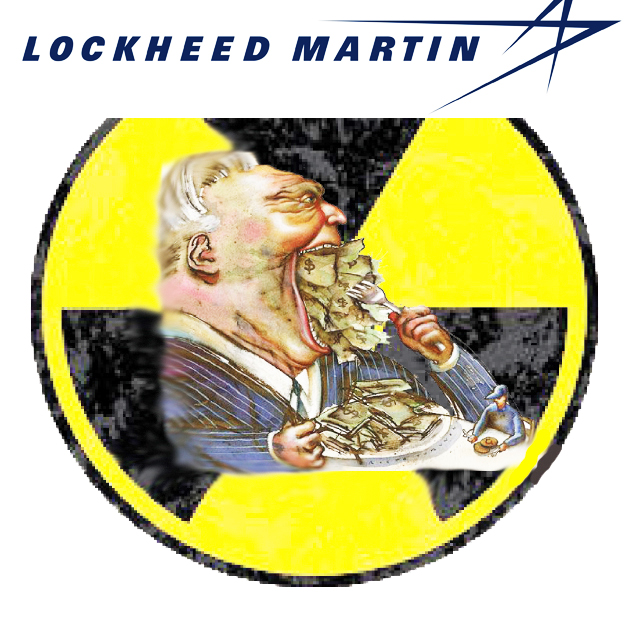
There is a remarkable “revolving door” of top people between Australian government and Defence Department roles and the world’s no 1 weapons-maker
MICHELLE FAHY, JUN 19, 2024
Global weapons giant Lockheed Martin – which has deleted from its website details about Australia’s key role in building F-35 fighter jets – has long had deep ties to the Australian government, investigations show.
Analysis shows a remarkable “revolving door” of people between top government and Defence Department roles and the world’s largest weapons-maker, whose F-35 fighter jets Israel is using to bomb Gaza.
The revolving door between government and corporations is well documented as a factor helping to undermine democracy.
In 2022, Lockheed Martin’s total global revenue was US$66 billion, with 90 per cent of it (US$59.4 billion) from the sale of arms.
Some of Australia’s most senior government officials, military officers, and Defence Department staff have been appointed to Lockheed Martin Australia’s board or have served as its chief executive or in other positions in recent years.
Constantly revolving door
Lockheed’s current CEO for Australia and New Zealand, retired Air Marshal Warren McDonald, officially joined the weapons maker’s ANZ leadership team as chief executive elect on July 1, 2021 having exited his 41-year career in the Royal Australian Air Force (RAAF) just seven months earlier. McDonald formally commenced as Lockheed’s local CEO in November 2021.
McDonald was deputy chief of the RAAF until mid-2017 when he was promoted into a new role as the Defence Force’s inaugural Chief of Joint Capabilities, a group comprising space, cyber and the defence networks tasked with preparing space and cyber power, and logistics capabilities, to serve the modern integrated defence force.
When later asked what had interested him about joining Lockheed Martin, McDonald said: “From all domains – space to the sea floor – Lockheed Martin has in its hands the combat capability of the Defence Force”…………………………………………………………………………more https://undueinfluence.substack.com/p/lockheed-martin-australian-government?utm_source=post-email-title&publication_id=297295&post_id=145632377&utm_campaign=email-post-title&isFreemail=true&r=ln98x&triedRedirect=true&utm_medium=email
Nuclear misinformation in Australia is Hail Mary policy by the Opposition
The Fifth Estate, DARRIN DURANT, Dr Darrin Durant is Senior Lecturer in Science and Technology Studies at the University of Melbourne.17 JUNE 2024
Having promised a nuclear power policy for several years, the Australian Liberal-National Party finally announced one: no reactors before 2040 and approving new gas and coal projects instead. At the same time, it is abandoning the emissions reduction target for 2030 (a 43 per cent cut compared with 2005 levels) and refusing to commit to details about nuclear projects until after the May 2025 election.
This is a Nuclear Hail Mary Policy: reduce emissions aspirations and hope a final play two decades from now will work out.
Most commentary has focused on what this nuclear Hail Mary implies for Australia’s commitment to the Paris Agreement. Some suggest the LNP plans to “rip up” the agreement. Others that the LNP plans to “breach the text and spirit” of the agreement.
Closest to the mark, I suggest, is that LNP is internally fractured and confused about both what its nuclear and emissions policy should be and how it should conduct itself regarding international agreements.
Opposition Leader Peter Dutton’s climate backtracking on Saturday, 8 May 2024, pushed from the news cycle a clear marker of the LNP’s policy vacuum on nuclear power, climate emissions and international. On 7 June, the LNP engaged in disinformation about regional cooperation on decarbonization.
The occasion for the LNP’s disinformation campaign was the signing by the Albanese Labor government of the Indo-Pacific Economic Framework (IPEF) Clean Economy Agreement. The IPEF was signed by Australia and 13 other nations on 6 June 2024.
Ted O’Brien MP (Shadow Minister for Climate Change and Energy in the LNP) claimed the ALP signing of the IPEF “exposes rank hypocrisy”, demonstrates a “lack of integrity”, and amounts to “treating Australians like mugs”.
None of the claims by O’Brien and the LNP are true. It is the LNP nuclear disinformation campaign that displays hypocrisy and duplicity and treats Australians like mugs.
The IPEF Clean Economy Agreement
The IPEF agreement aims to build regional economic cooperation across four pillars: trade, supply chains, clean energy, and tax. Australia joined IPEF on 23 May 2022, after the 21 May 2022 election in which Labor swept the LNP from power. Since then, eight rounds of negotiations between the member nations have taken place…………………………………………………………………………………………………..
Australian nuclear misinformation goes walkabout
Thus far, Coalition claims about nuclear prospects have been domestic doomsday claims about Australia’s fate if it does not “go nuclear”.
Yet the Coalition’s claims routinely hinge on misinformation: inflating estimations of transmission projects, over-playing the risk of load shedding, over-estimating G20 reliance on nuclear, exaggerating renewables-related land use, and inventing risks from windfarms (on and offshore).
While the international nuclear renaissance has been a farcical (short) history of massive cost and construction blowouts, the Coalition has sidelined those facts at home, leading to claims that Coalition nuclear plans are a delay tactic to perpetuate coal and gas………..
The IPEF stipulates that the Parties should:
“promote transparent licensing, siting, and permitting for clean energy and related generation, transmission, distribution, and storage projects in the electricity sector” (Sect 4, Point 2b)
Furthermore, for those parties supportive of nuclear, they should:
“ensure that sound policy and regulatory frameworks in nuclear safety and waste management are in place when considering the adoption of nuclear energy technologies” (Sect. 4, Point 7a).
The LNP has spent years spruiking nuclear power, yet the Australian public remains in the dark about those two important clauses in the IPEF agreement.
The LNP cannot be ‘transparent’ if it has provided no detail to the Australian public about licensing, siting and permitting. The LNP claims to be considering nuclear, yet where are any serious policy proposals regarding the regulatory frameworks for nuclear safety and nuclear waste?
Instead, the LNP treats citizens as incapable of spotting fabrications and omissions.
For instance, the O’Brien’s/LNP press release tells citizens they will find the IPEF “supporting small modular reactors (SMRs) in the Indo Pacific”. This is a fabrication: the negotiated text of the agreement never mentions SMRs. Similarly, the Coalition omits that the IPEF agreement strongly supports windfarms and energy efficiency, two key elements of the ALP’s Rewiring the Nation plan………….
Treating citizens like mugs
……………………………To be a mug is to be easily deceived. The LNP must assume citizens are mugs if it thinks Australian voters cannot spot the LNP’s misrepresentation of the IPEF agreement. No, Labor is not in contradiction for opposing domestic nuclear and signing the IPEF, because the IPEF favours clean energy in general and advocates for member nations to pursue their own pathway (which may or may not include nuclear power)
Yet even if tempted by the Coalition logic, just remember, the Coalition opposes most of what is supported in the IPEF agreement. The Coalition is not talking straight about either energy policy or international agreements, and voters should keep this in mind as the Coalition obfuscates important international agreements like the Paris Agreement. https://thefifthestate.com.au/columns/spinifex/nuclear-misinformation-in-australia-is-hail-mary-policy-by-the-opposition
The network of conservative think-tanks out to kill the switch to renewables
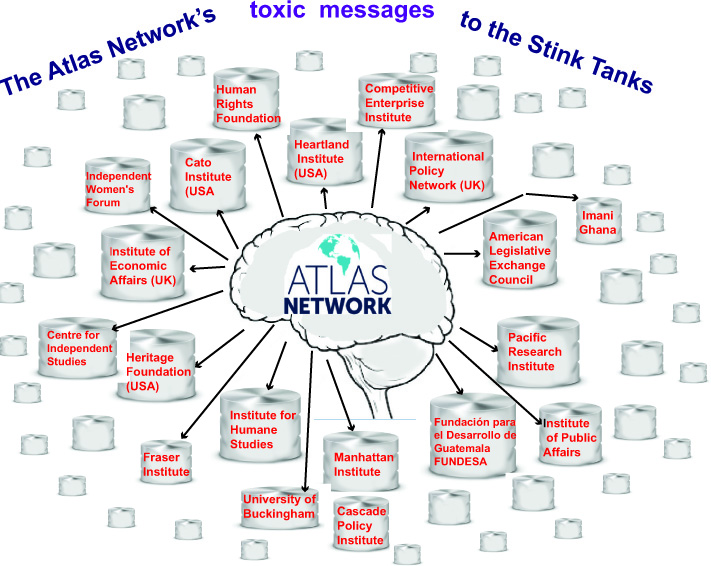
Michael Mazengarb, Feb 28, 2024 https://reneweconomy.com.au/the-network-of-conservative-think-tanks-out-to-kill-the-switch-to-renewables/
Australia’s renewable energy and emissions reduction plans are being targeted by coordinated campaigns from conservative “think tanks”, as the Coalition embraces nuclear and its MPs rail against all forms of large scale renewables and transmission lines being built as part of the clean energy transition.
Having successfully defeated the Voice to Parliament referendum by feeding the distribution of disinformation, conservative groups like the Institute of Public Affairs (IPA), the Centre for Independent Studies (CIS), the Liberal-party aligned Menzies Research Group and the ‘campaign group’ Advance Australia are all ramping up their pro-nuclear, anti-renewables campaigns.
Anyone familiar with Australian climate and clean energy policy over the last couple of decades will be familiar with the Institute of Public Affairs. The well-funded think tank – thanks to generous donors that include mining billionaire Gina Rinehart – has long railed against any efforts to tackle climate change, calling for the abolition of the carbon price and virtually any policy that supports renewable energy.
The IPA has published a flurry of reports that have sought to stoke fears renewables causing the loss agricultural land in Victoria, and high costs of renewables in Western Australia – two claims that rely on gross exaggeration.
Like the IPA, the Centre for Independent Studies has strong links with the Coalition parties – promoting the works of Coalition MPs, and several of the group’s ‘alumni’ going on to serve as Liberal Party MPs or candidates.
The group recently launched a new campaign to promote nuclear energy and to actively attack the efforts of energy market regulators and institutions, including the Australian Energy Market Operator and the CSIRO, to plan the transition to renewables.
The Menzies Research Centre has the clearest, explicit, ties to conservative politics – having been named for former prime minister Robert Menzies – and pumps out opinion pieces critical of renewables and advocating for fossil fuels that are often published by News Corp outlets.
For example, a recently authored piece by Menzies Research Centre’s senior fellow, Nick Cater, blamed renewables for the Victorian blackout (which was caused by storms and an outage at the Loy Yang A coal power station).
All of these campaigns are having an impact, being embraced and fuelled by the Federal Coalition, with opposition leader Peter Dutton set to reignite the ‘climate wars’ by pushing for an Australian nuclear power industry – despite the astronomical costs, and the huge wait times for the industry.
Coalition MPs dominated the speakers list of a recent anti-renewable energy rally, that descended on Canberra earlier this month.
The group that is likely to be running the pro-nuclear ground campaign ahead of the next election, Advance Australia, previously led substantial efforts to oppose the recent First Nations Voice to Parliament referendum. The group is already running campaigns that denigrate renewable energy technologies, campaign against net zero targets, question climate change and promote nuclear energy.
While attempting to portray itself as a ‘grassroots’ roots movement, a conservative counter to GetUp! that claims to be taking on ‘woke elites’ – Advance Australia has amassed significant funds from some of Australia’s wealthiest individuals.
Donors to Advance Australia include former Vales Point power station owner Trevor St Baker, Bakers Delight founder Roger Gillespie, owner of Kennards Self Storage Sam Kennard, the former Blackmores CEO Marcus Blackmore, former fund manager Simon Fenwick, and former Shark Tank investor Steve Baxter.
Recent political donation disclosures show Advance Australia receiving a massive, $1.025 million donation from Perth-based car salesman Brian Anderson, and $1.1 million over the last three years from Fenwick.
Sam Kennard – who is worth an estimated $2.6 billion and who also sits on the board of the Centre for Independent Studies – regularly attacks renewables and promotes climate change denial on social media, and donated $165,000 to Advance over the last three years.
The depth of the interconnections between these think tanks is difficult to assess, but there is growing evidence that points to a coordinated international campaign to undermine renewables and promote the interests of fossil fuels and the pro-nuclear lobby.
The efforts of researchers like University of Technology Sydney professor Jeremy Walker have drawn links between the campaigns of Australia’s conservative lobby groups and other members of a global ‘Atlas Network’ of conservative think tanks. The US-based Atlas Network disperses grant funding and runs training on campaigning and fundraising for its international network, including to Australian think tanks.
Australian members of the Altas Network include the IPA, the CIP, and the Australian Institute for Progress – which has also adopted anti-renewable energy and anti-electric vehicle positions.
A recently published submission by Walker draws the parallels between these ‘think tanks’ and the anti-wind farm campaigns that have targeted the Illawarra Renewable Energy Zone, and culminated in a bizarre anti-renewables rally outside Parliament House in Canberra – and similar campaigns that opposed wind farm developments in the United States.
Anti-off-shore wind farm campaigns in the states of New Jersey and Rhode Island have used similar, disproven, claims about impacts on whale populations. These campaigns, as reported by the New York Times, were being funded and coordinated on the other side of the United States, by fossil-fuel industry linked the Texas Public Policy Foundation – itself a member of the Atlas Network.
International members of the Atlas Network include high-profile propagators of climate denial and pro-fossil fuel propaganda, including the US-based Heartland Institute, and the London-based Global Warming Policy Foundation – which now features former Australian prime minister Tony Abbott on its board of trustees.
The complexity and opaqueness of the network is noteworthy, and has made the drawing of distinct relationships between groups and individuals difficult to track and analyse. But the shear number of linkages is clear, as are the relationships between the groups and Australia’s conservative political parties.
Several current and former members of the Australian-based think tanks have done stints with the Atlas Network and its members, with some members openly acknowledging the coordination between groups on training and funding.
This includes ex-IPA executive Alan Moran – who formally spearheaded the IPA’s climate denial efforts, former Abbott-government adviser and climate sceptic Maurice Newman – who have both held roles across several members of the Atlas Network
What is clear is that efforts to undermine the phase-out of fossil fuels remain strong, remain well funded and efforts are being coordinated globally.
The Voice to Parliament referendum was a stark example of how misinformation and disinformation can be deployed to influence the public and public policy, and Australia’s renewables sector will need to be ready to counteract these efforts when facing a similar campaign in the lead up to the next federal election.
Submarine boss refuses to answer questions over multi-billion-dollar AUKUS payments
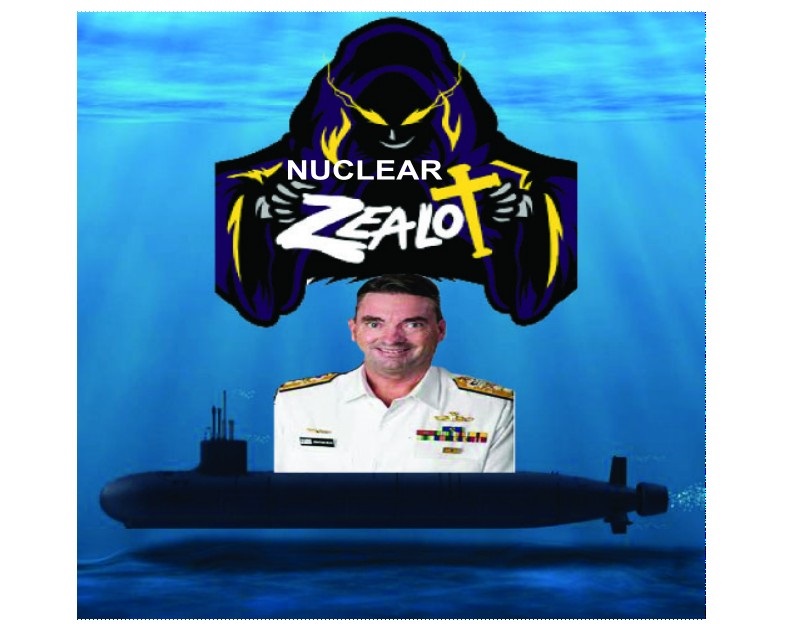
By defence correspondent Andrew Greene, https://www.abc.net.au/news/2024-06-07/submarine-bossmulti-billion-aukus-payments/103952528
The head of the AUKUS submarine program has refused to say whether an almost $5 billion government payment to the United States will be refunded if no nuclear-powered boats are delivered to Australia.
Under the tri-nation agreement, Australia is providing multi-billion-dollar contributions to the United States and United Kingdom to help expand their submarine industrial bases, but for months officials have declined to discuss details of the transfers.
During a Senate estimates hearing, Greens senator David Shoebridge attempted to extract details of the impending $4.7 billion payment to the US from the head of the Australian Submarine Agency, Vice Admiral Jonathan Mead.
Under questioning late on Thursday, the ASA boss repeatedly refused to say if a refund clause was included with Australia’s payment in case the United States fails to transfer Virginia class submarines in the 2030s.
“I just go back to the original statement — the US has committed to providing two US submarines from its submarine industrial base in the early 2030s and a third one on procurement,” the vice admiral told the committee.
What if the United States determines not to give us a nuclear submarine? Is there a clawback provision in the agreement?” Senator Shoebridge then demanded to know.
“That’s a hypothetical and I’m not going to entertain … The US has committed to transferring two nuclear-powered submarines to Australia,” the ASA boss asserted.
“It may be embarrassing that you have entered into an agreement that sees Australian taxpayers shelling out $4.7 billion — which we don’t get back if we don’t get our nuclear submarines,” Senator Shoebridge responded.
Under the final stage of AUKUS the United Kingdom will help develop a new class of nuclear-powered submarine to be known as SSN-AUKUS, with Australia’s boats to be built locally in Adelaide.
Ahead of the ambitious venture, Australia will hand almost $5 billion to British industry over the next decade for design work and to expand production of nuclear reactors that will eventually be installed on AUKUS submarines
Navy apologises to traditional land owners over nuclear expansion
Defence has apologised to traditional land owners in Western Australia who live around the Garden Island naval base for not consulting them about upgrades being made to accommodate visiting nuclear-powered submarines.
During Senate estimates, Greens senator Dorinda Cox, who is a Yamatji-Noongar woman, expressed concerns on behalf of her community about the AUKUS work that will soon occur at HMAS Stirling.
Chief of Navy Vice Admiral Mark Hammond told the Senator he wanted to discuss the matter on his next visit, an offer she accepted.
“I’m just surprised that this has been such an oversight for an extended period of time, I do apologise, I’m in Western Australia in a couple of weeks’ time and again in July. I’d like to formally engage with your concurrence.”
Was ABC’s firing of Antoinette Lattouf influenced by a pro-Israel group? | Real Talk – Online.
23 Jan 2024 Real Talk
Australian-Lebanese presenter Antoinette Lattouf was fired by Australia’s ABC just three days after she started. It has now surfaced that her firing may have been orchestrated by a pro-Israeli WhatsApp group. Now she’s fighting back, and she joins us to speak about it on Real Talk online. (Note: After this interview was recorded, ABC issued a statement saying that Lattouf was not fired. Lattouf responded on Twitter, saying: “If I wasn’t sacked, what was it?”) #RealTalk is a Middle East Eye interview show hosted by Mohamed Hashem that delves into the stories and experiences of a diverse range of guests.
Lockheed Martin deletes Australian F-35 ties
The world’s biggest weapons manufacturer, Lockheed Martin, has deleted from its website details about Australia’s key role in building F-35 fighter jets, which Israel is using to bomb Gaza.
MICHELLE FAHY, JUN 05, 2024 https://theklaxon.com.au/lockheed-martin-australian-government-joined-at-the-hip/
Among the details quietly scrubbed from Lockheed Martin’s website are that Australian businesses are supplying components ‘for the entire F-35 fleet’ and that, ‘Every F-35 built contains some Australian parts and components’.
The material was included in the section ‘Industrial Partnerships’, which was deleted entirely between March 15 and April 7 this year.
Around that time, Lockheed Martin and the Albanese Government were under heavy scrutiny following a February Senate hearing in which the supply of ‘weapons’ to Israel was hotly contested, specifically F-35 parts and components.
The deleted ‘Industrial Partnerships’ section of the Lockheed Martin site states: ‘As a programme partner, Australian businesses are supplying components for the entire F-35 fleet, not just Australian aircraft.’
It continues: ‘In total, more than 70 Australian companies have been awarded export contracts valued at AU$4.13 billion.’
Web archive Wayback Machine, which sporadically screenshots webpages, shows the ‘Industrial Partnerships’ section was on Lockheed Martin’s site until March 15, but had been deleted by April 7, the next time it screenshot the page.
Also deleted from the site is a profile of Melbourne F-35 parts manufacturer Marand Precision Engineering, which supplies the F-35 ‘global fleet’ with an ‘engine removal and installation mobility trailer’ comprised of ‘around 12,000 individual parts’.
The Marand article was on the Lockheed site when the Wayback Machine took a screenshot of the page on March 28, but it had been deleted by the time of the next screenshot taken on May 9.
Lockheed Martin’s Australian F-35 page now contains only information relating to the Australian Defence Force’s F-35 program.
On March 25, Greens Senator David Shoebridge tried (and failed) to move a motion in the Senate that accused the Federal Government of being ‘content to send weapons and weapons parts to Israel to literally fuel the genocide’.
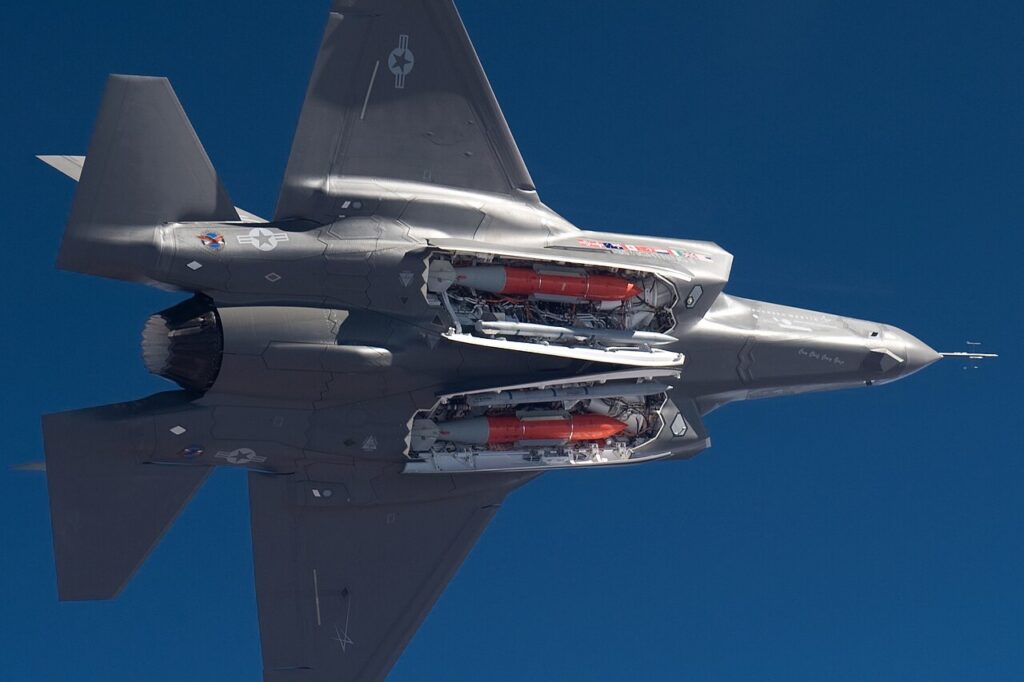
On February 14, participating in a Senate committee, Shoebridge asked Hugh Jeffrey, a Department of Defence deputy secretary: ‘Do you consider parts of an F-35 fighter jet, such as the parts manufactured in Australia and used on Israeli Defence Force fighter jets to open the bomb bay doors, to be weapons?’
Jeffrey responded: ‘A pencil is used for writing. It’s not designed in and of itself to be a weapon, but it can be, if you want to use it as a weapon.’
Shoebridge said: ‘Bomb bay doors are generally used to release bombs.’
Jeffrey said that under the UN definition, ‘weapons are defined as whole systems’, such as ‘armoured vehicles’, ‘tanks’ and ‘combat helicopters’.
The Albanese government has repeatedly said that no ‘weapons’ have been sent to Israel for at least the past five years.
Focusing on the word ‘weapons’ enables the government to ignore exports of ‘ammunition/munitions’ and ‘parts and components’, all of which are covered by the 2014 Arms Trade Treaty, which Australia championed at the United Nations and ratified in 2014.
The Albanese government is coming under increasing pressure, with concerns mounting that Australia will be found to be complicit in genocide because it has not ceased military exports to Israel.
More than 800 public servants last week released a signed open letter calling on the government to immediately stop all military exports to Israel.
The Department of Defence has admitted it approved two new export permits to Israel after the October 7 attack.
In a Senate estimates hearing on February 14, the Defence Department‘s Hugh Jeffrey said: ‘Two export permits have been granted since the time of the last estimates’, the date of which was 25 October 2023. The permits were approved between October 25 and October 31. Mr Jeffrey refused to say what items the new permits covered.
The Defence Department and DFAT have also refused to answer questions about whether approved military export permits that were in place before the Hamas attacks have been suspended.
Australia’s key role in the F-35 fighter jet program
More than 70 Australian companies supply parts and components into the global supply chain of the F-35.
Several of the companies are the sole source of the parts they produce. Without them, new F-35 jets cannot be built, nor can parts be replaced.
In December last year a US Congressional hearing revealed that the F-35 joint program office had been moving ‘at a breakneck speed to support … Israel … by increasing spare part supply rates’. (Emphasis added.)
On October 30, the Defence Department issued a media release trumpeting the important role played by Australian industry in the production and maintenance of the global F-35 fleet. The release announced that Melbourne company Rosebank Engineering had established an important repair depot under the F-35 global support solution for aircraft operating in or deployed to the Indo-Pacific region. Rosebank Engineering and the Defence Department had partnered with the US F-35 joint program office and Lockheed Martin to establish the new facility.
Rosebank has been part of the F-35 supply chain since 2004 and now manufactures more than 150 components for the landing gear and weapons bay systems on the F-35, including the components that enable the bombs to be dropped on Gaza. Rosebank (formerly RUAG Australia) is the sole source global supplier of the F-35’s ‘uplock actuators’ that open and close the F-35’s weapons bay doors.
Sydney-based Quickstep Holdings is another long-term supplier to the F-35 program. In December 2020, it announced it had produced its 10,000th component – just 20% of its commitment to the program. Quickstep manufactures more than 50 components and assemblies, worth about $440,000 in each F-35, it says.
Lockheed Martin also acknowledged Queensland’s Ferra Engineering in providing products for the F-35 since 2004 and said it remained a vital partner.
Rosebank Engineering, Quickstep Holdings and Ferra Engineering have all supplied parts and components into the F-35’s supply chain during the past five years.
Scott Morrison on the revolving door- government nuclear AUKUS deal, to Dyne, company advising on AUKUS
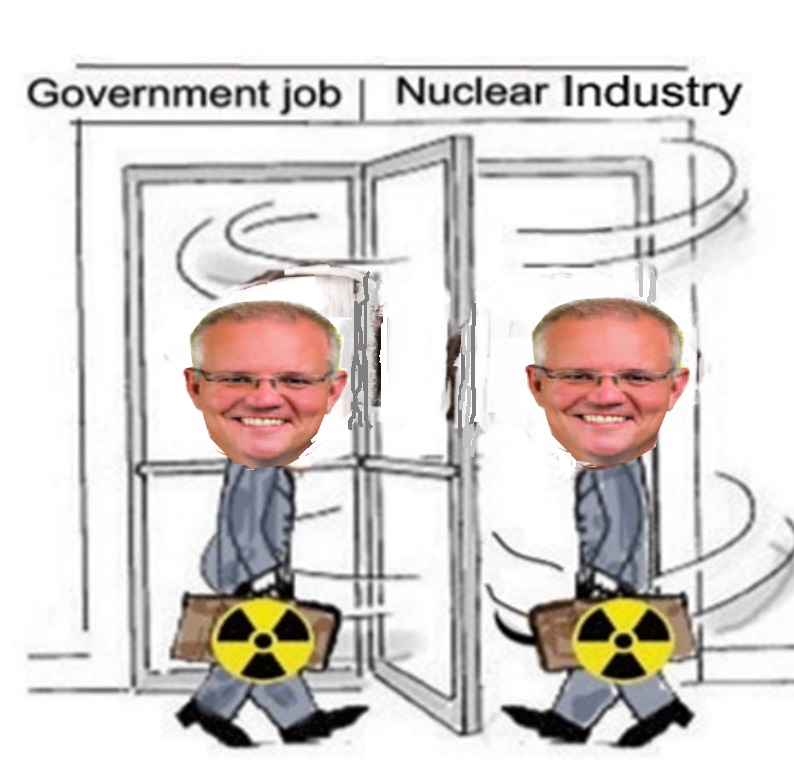
As a strategic advisor to DYNE, Morrison hopes to advance investment in dual-use technologies — inventions that have military and civilian applications. That innovation is being helped by the second pillar of AUKUS, the one that has to do with tearing down military-industrial trade barriers between the US, UK and Australia.
Facing post-Parliament poverty, multitasking Morrison looks to seafloor for riches
What to do when your taxpayer-funded salary drops from $549k, to $225k, to nothing? Multitask, of course.
Crikey, ANTON NILSSON, MAY 30, 2024
Scott Morrison has yet another new job — and like some of his other post-Parliament gigs, it’s tangentially linked to the AUKUS submarine pact he helped set up as prime minister.
The Age reports Morrison is listed as a strategic advisor at a newly created venture called the Seafloor Minerals Fund, alongside ex-US secretary of state Mike Pompeo. Both men are also behind venture capital firm DYNE, set up to support the strategic goals of AUKUS, and which also has interests in deep sea mining, according to the story.
Crikey figured it was time to have another look at Morrison’s post-politics career.
In need of cash …………………………………………..
Multitasking
So what has Morrison done to set himself up for success? His LinkedIn lists three jobs: author, non-executive vice chairman of American Global Strategies, and board member at “various companies”. The voters who brought you Scott Morrison want stronger anti-corruption protectionsRead More
As an author, he’s already published his first work: the religious memoir Plans For Your Good. The book was aimed at the $1.175 billion US Christian book market, but in Australia, it’s reportedly sold very few copies so far.
At American Global Strategies, Morrison is working with two former Donald Trump staffers to “help clients navigate a highly dynamic geopolitical landscape that presents risks and opportunities”, in the ex-PM’s own words.
As a strategic advisor to DYNE, Morrison hopes to advance investment in dual-use technologies — inventions that have military and civilian applications. That innovation is being helped by the second pillar of AUKUS, the one that has to do with tearing down military-industrial trade barriers between the US, UK and Australia. The new gig, with the Seafloor Minerals Fund, will set Morrison and Pompeo up for taking advantage of the estimated trillions of dollars in rare metals estimated to be on the seafloor. According to The Age, Australians can expect a fierce future debate about the merits and risks of mining the seabed for minerals, as China seeks to do the same. https://www.crikey.com.au/2024/05/30/scott-morrison-seafloor-minerals-fund/?utm_medium=Social&utm_source=Twitter#Echobox=1717042244
Off the Books: how the Army privatised SAS elite to dark ops outfit Omni
Michael West Media, by Stuart McCarthy | May 4, 2024
Former SAS officers referred to national corruption watchdog over $230 million in government contracts to private security and intelligence “front company” Omni Executive. A Stuart McCarthy investigation.
According to the company’s website, Omni was established in 2012 and focuses on “delivering innovative national security, intelligence and critical infrastructure solutions to further our national interests.”
Since 2015, Omni has been awarded more than $230 million in security and intelligence related contracts by the departments of Defence, Foreign Affairs and Trade, Home Affairs, Prime Minister and Cabinet, the Australian Signals Directorate, the Australian Federal Police and the Australian Criminal Intelligence Commission.
Omni contracts hidden……………………………………………………………….. more https://michaelwest.com.au/army-privatised-sas-elite-to-dark-ops-outfit-omni/
Australia and the F-35 supply chain: in lockstep with Lockheed
The Australian government has continued arms exports to Israel while assuring Australians it has not sent weapons to Israel for five years
MICHELLE FAHY. MAY 03, 2024, https://undueinfluence.substack.com/p/lockstep-with-lockheed-australia?utm_source=post-email-title&publication_id=297295&post_id=143751160&utm_campaign=email-post-title&isFreemail=true&r=1ise1&triedRedirect=true&utm_medium=email
Australia is one of six western countries that are complicit in the ‘genocidal erasure’ of the Palestinian people by continuing to supply Israel with arms, according to Dr Ghassan Abu-Sittah, a British-Palestinian surgeon and newly elected rector of Glasgow University.
Israel’s relentless bombing campaign has systematically destroyed all of Gaza’s 11 universities plus more than 400 schools, and killed 6,000 students, 230 teachers, 100 professors and deans, and two university presidents.
The elimination of entire educational institutions (both infrastructure and human resources) is ‘scholasticide’ and is a critical component of the genocidal erasure, says Dr Abu-Sittah.
He named the United States, Germany, the United Kingdom, Australia, Canada and France as comprising an ‘axis of genocide’ because they have been supporting the genocide in Gaza with arms, and had also maintained political support for Israel.
Dr Abu-Sittah worked in Gaza for 43 days in the immediate aftermath of the October 7 attacks. His experience was cited in South Africa’s genocide case at the International Court of Justice (ICJ).
In his submission to the ICJ, Dr Abu-Sittah wrote: ‘There was a girl with just her whole body covered in shrapnel. She was nine. I ended up having to change and clean these wounds with no anaesthetic and no analgesic. I managed to find some intravenous paracetamol to give her…her Dad was crying, I was crying, and the poor child was screaming…’
Australia defies the UN
The Albanese government has consistently denied it is supplying weapons to Israel, even as the United Nations pointed a finger directly at Australia, alongside the US, Germany, France, the UK, and Canada, asking these countries to immediately halt all weapons transfers to Israel, including weapons parts, and to halt export licences and military aid.
The Defence Department has refused to answer questions about whether it has halted the arms export permits for Israel that were in place before October 7, the day of Hamas’s deadly attack in Israel.
Defence approved new export permits to Israel after October 7
Defence approved three new export permits to Israel in October 2023, and none in November, December or January (to 29/1), according to figures Defence released following a Freedom of Information (FOI) request I lodged on 29 January.
In a Senate estimates hearing on February 14, the Defence Department revealed it had approved two new export permits to Israel since the Hamas attacks of October 7. Asked for clarification about the timing, Defence’s deputy secretary of Strategy, Policy, and Industry, Mr Hugh Jeffrey, said, ‘Two export permits have been granted since the time of the last estimates’. The previous estimates hearing had been on 25 October 2023.
The Senate Estimates and FOI evidence together show that Defence approved one export permit to Israel prior to October 7 and two in the period October 25–31.
Mr Jeffrey refused to say what items the two new permits covered. Instead he said they ‘would have been agreed on the basis that they did not prejudice Australian national interests under the criterion of the legislation’.
Possible implications
Israel has been using its F-35 fighter jets in its bombardment of Gaza. Australia is one of a number of countries that manufacture and export parts and components into Lockheed Martin’s F-35 fighter jet global supply chain. Given this, there are several reasons why the above information may be significant:
- The head of the F-35 joint program office, Lieutenant General Michael Schmidt, a US Air Force officer, said a year ago that the F-35 program was established with a ‘just in time’ supply chain, where parts arrive just before they’re needed and very little inventory is stockpiled. [Emphasis added.] Lt-Gen Schmidt described that situation as ‘too risky’.
In mid-December, a US Congressional hearing on the F-35 program revealed that the F-35 joint program office had been moving ‘at a breakneck speed to support…Israel…by increasing spare part supply rates’. [Emphasis added.]- More than 70 Australian companies are involved in the global supply chain for the F-35. Several of the companies are the sole global source of the parts they produce. Without them, new F-35 jets cannot be built and those parts in existing jets cannot be replaced. The US recently authorised the transfer to Israel of 25 more F-35s.
The F-35 global supply chain is vulnerable to disruption, which is why Australia could be under pressure to continue meeting supply contracts.
In his testimony to the December 12 Congressional hearing, Lieutenant General Schmidt also made clear the role of the F-35 joint program office in closely supporting Israel:
I had the opportunity to talk with [Israel’s] Chief of Staff just yesterday… [Israel is] very satisfied with [the] performance [the] sustainment enterprise is giving them. We could learn a lot from them in terms of the quickness with which they’re turning airplanes, [plus] all of the things we’re learning ourselves with moving parts around the world in support of a conflict. [Emphasis added.]
Defence Department and Australian industry partnering with F-35 program office
Defence issued a media release on October 30, around the same time it approved the two additional export permits to Israel.
The release announced that Melbourne company Rosebank Engineering had established an important regional F-35 capability that would also contribute to the global F-35 program. The release said Australian industry is playing an increasingly important role in the production and sustainment of the global F-35 fleet and that Rosebank and the Defence Department had partnered with the US F-35 joint program office and Lockheed Martin to establish the new facility.
Lockheed Martin removes information from its website
US multinational Lockheed Martin is the world’s largest arms manufacturer and the prime contractor for the F-35 fighter jet. As the horror of Israel’s war on Gaza has unfolded over the past seven months, there have been court cases and protests targeting the F-35 and its global supply chain.
In this context, Lockheed Martin recently edited the Australian page of its F-35 website to remove the ‘Industrial Partnerships’ section. The text had acknowledged that Australian parts were used in every F-35 fighter jet.
The deleted section can be viewed at the Wayback Machine web archive. This was the opening paragraph:[screenshot on original]
Lockheed Martin has also deleted other information from its website. A feature post about Marand Precision Engineering, another Melbourne-based company supplying the F-35 program, has been removed. The page had described how Marand engineered, manufactured, and now sustains ‘one of the most technically advanced mechanical systems’ ever created in Australia. The system, an engine removal and installation mobility trailer for the F-35, comprises 12,000 individual parts. The page said, ‘Marand has worked in close concert with Lockheed Martin on the F-35 program for many years’ and revealed that in 2022 the company had established a maintenance facility for its F-35 trailer in the US, ‘to better meet Lockheed Martin’s sustainment needs’. The deleted page can be viewed at the Wayback Machine web archive.
Sydney-based Quickstep Holdings is another long-term Australian supplier to the F-35 program. In December 2020, it announced it had produced its 10,000th component for the F-35 program. Quickstep estimated it had completed just 20% of its commitment to the program. The company revealed it manufactures more than 50 individual components and assemblies for the F-35, representing about $440,000 worth of content in each F-35.
Last year, Lockheed Martin also acknowledged that Queensland’s Ferra Engineering had been providing products for the F-35 since 2004 and that it remained a vital partner supporting delivery of the aircraft.
Despite the Albanese government’s persistent and misleading claim that no weapons have been supplied to Israel for the past five years, all of the above companies have supplied parts and components into the F-35’s supply chain during this period.
Threshold for genocide met, says UN Special Rapporteur
On March 26, Francesca Albanese, the UN Special Rapporteur on the Human Rights Situation in the West Bank and Gaza, said, ‘Following nearly six months of unrelenting Israeli assault on occupied Gaza, it is my solemn duty to report on the worst of what humanity is capable of, and to present my findings.’
Ms Albanese said there were ‘reasonable grounds to believe that the threshold indicating the commission of the crime of genocide… has been met’.
On April 5, the UN Human Rights Council adopted a resolution that included a call for an arms embargo on Israel.
Some 28 countries voted in favour of the resolution and 13 abstained. Israel’s two largest suppliers of weaponry, the US and Germany, along with four other countries, voted against it. (The Council has 47 members elected for staggered three-year terms on a regional group basis. Australia is not currently a member.)
US bases including Pine Gap saw Australia put on nuclear alert, but no-one told Gough Whitlam
“The Australian government takes the attitude that there should not be foreign military bases, stations, installations in Australia. We honour agreements covering existing stations. We do not favour the extension or prolongation of any of those existing ones.” – Gough Whitlam
ABC News, By Alex Barwick for the Expanse podcast Spies in the Outback, 25 Apr 24
During the 1972 election campaign, Gough Whitlam promised to uncover and share Pine Gap’s secrets with Australians.(ABC Archives/Nautilus Institute)
When Australia was placed on nuclear alert by the United States government in October 1973, there was one major problem.
No-one had told prime minister Gough Whitlam.
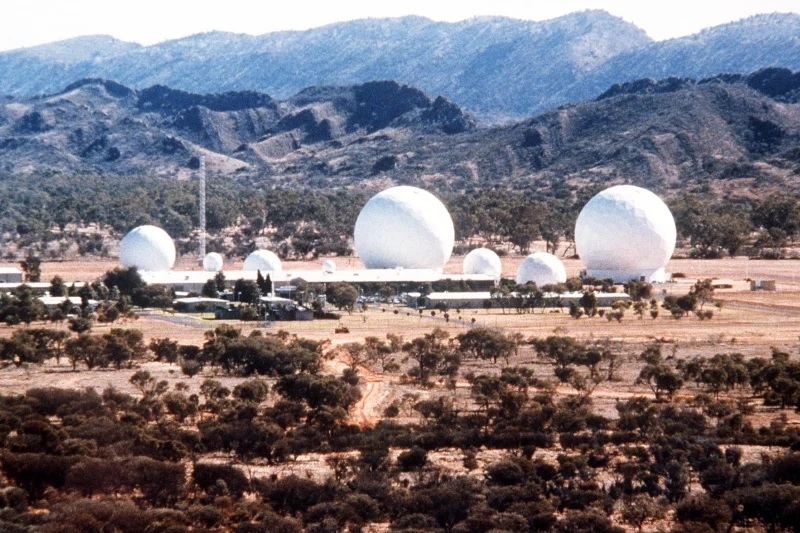
One of the locations placed on “red alert” was the secretive Pine Gap facility on the fringes of Alice Springs.
Officially called a “joint space research facility” until 1988, the intelligence facility was in the crosshairs with a handful of other US bases and installations around Australia.
In fact, almost all United States bases around the world were placed on alert as conflict escalated in the Middle East. Whitlam wasn’t the only leader left out of the loop.
A prime minister in the dark
“Whitlam got upset that he hadn’t been told in advance,” Brian Toohey, journalist and former Labor staffer to Whitlam’s defence minister Lance Barnard, said.
Toohey said Whitlam should have been told that facilities including North West Cape base in Western Australia, and Pine Gap were being put on “red alert”.
“There had been a new agreement knocked out by Australian officials with their American counterparts, that Australia would be given advance warning.”
They weren’t.
Suddenly, the world was on the brink of nuclear war.
Why were parts of Australia on ‘red alert’?
The Cold War superpowers backed opposing sides in the Yom Kippur War.
The Soviet Union supported Egypt and the United States was behind Israel.
As the proxy war escalated in October 1973, United States secretary of state Henry Kissinger believed the crisis could go nuclear and issued a DefCon 3 alert.
A DefCon 3 alert saw immediate preparations to ensure the United States could mobilise in 15 minutes to deliver a nuclear strike.
The aim was to deter a nuclear strike by the Soviets.
And, it simultaneously alerted all US bases including facilities in Australia that a nuclear threat was real.
This level of alert has only occurred a few times, including immediately after the September 11 attacks.
Politics, pressure and protest
The secretive intelligence facility in outback Australia caused Whitlam more trouble beyond the red alert.
During the 1972 election campaign, the progressive politician had promised to lift the lid on Pine Gap and share its secrets with all Australians.
“He gave a promise that he would tell the Australian public a lot more about what Pine Gap did,” Toohey said.
But according to Toohey, the initial briefing provided to Whitlam and Barnard by defence chief Arthur Tange left the prime minister with little to say.
“Tange came along and he said basically that there was nothing they could be allowed to say. And that was just ridiculous,” Toohey said.
“He said, the one thing he could tell them was the bases could not be used in any way to participate in a war. Well, of course they do.”
Whitlam would cause alarm in Washington when he refused to commit to extending Pine Gap’s future.
In 1974 on the floor of parliament he said:
“The Australian government takes the attitude that there should not be foreign military bases, stations, installations in Australia. We honour agreements covering existing stations. We do not favour the extension or prolongation of any of those existing ones.”
According to Toohey, “the Americans were incredibly alarmed about that”.
“As contingency planning, the whole of the US Defence Department said that they would shift it to Guam, a Pacific island that America owned,” he said.
And the following year, allegations would emerge that the CIA were involved in the prime minister’s dismissal on November 11, 1975…………… https://www.abc.net.au/news/2024-04-24/when-australia-was-put-on-nuclear-alert-expanse-podcast/103733194
1 This month
17 October, Free Public Talk on Nuclear Issues in South Australia
David Noonan will speak on public interest concerns over the new Roxby Downs Indenture Act 2026 on BHP copper-uranium mining and ore processing in SA, and on how AUKUS may face SA with a High-Level nuclear waste agenda.
Dr Jim Green will discuss international developments in the field of nuclear power including ‘small modular reactors’ and Generation 4 ‘advanced’ nuclear reactor concepts.


Help Aunty Sue Protect Her Land and Sacred Sites From Destructive Rocket Testing.
.

Australians deserve the truth
about
AUKUS – https://aukuspublicinquiry.com/

PETITION – To: Prime Minister Anthony Albanese and the Australian Labor Government

of the week – Australians for War Powers Reform (AWPR)
To see nuclear-related stories in greater depth and intensity

