Australia pays former US defence chiefs $7000 a day for advice
By Matthew Knott, April 27, 2023 https://www.smh.com.au/politics/federal/australia-pays-former-us-defence-chiefs-7000-a-day-for-advice-20230427-p5d3lh.html
The federal government is paying retired senior American military officials up to $7500 a day for advice on major defence projects such as the AUKUS nuclear-powered submarine pact.
The government this week announced that, following its sweeping defence strategic review, retired United States Navy vice admiral William Hilarides would be hired to lead a snap review of the Royal Australian Navy’s surface fleet.
The review, to be handed to the government later this year, will examine whether planned fleets of Australian-made frigates and patrol vessels should be cut to free up money for smaller and more nimble vessels.
Hilarides has previously charged the Australian government US$4000 ($6000) a day for his consulting services, according to US Navy documents first reported by The Washington Post.
Hilarides has won naval consulting contracts from the federal government worth up to $1.6 million ($2.4 million) since 2016, according to figures from the Department of Defence.
Hilarides serves as chair of the Australian naval shipbuilding expert advisory panel and advised the government over the past 18 months while it finalised the deal with the United States and Britain to build a fleet of nuclear-powered submarines.
Defence Industry Minister Pat Conroy defended Hilarides’ appointment to the new navy fleet review this week, saying he had “a long association with Australia” and would do a good job.
In an investigation published last year The Post described Hilarides, a career submariner, as part of a large group of former senior US officials that Australia had relied upon heavily to guide its naval policies.
“To an extraordinary degree in recent years, Australia has relied on high-priced American consultants to decide which ships and submarines to buy and how to manage strategic acquisition projects,” The Post said.
Retired admiral John Richardson, who headed the United States Navy from 2015 to 2019, has received US$5000 ($7570) a day as a part-time consultant to the federal, according to documents released by the Pentagon to the US Congress.
Richardson was hired by the Department of Defence last November to provide advice on the best pathway for Australia to acquire a fleet of nuclear-powered submarines.
According to the documents, Richardson receives travel and lodging expenses to complete his work in Australia.
Richardson, the former US navy chief, told The Post: “I spent most of my life helping to keep America and our allies and partners safe and secure.
It’s a privilege to be invited to be able to use my experience, and help where I can to continue that work.”
Defence Minister Richard Marles on Thursday said outside advice was crucial to ensuring the government makes the correct decisions about significant defence policies.
“When we seek expert advice in relation to critical issues and challenges that we face, we have a global perspective in terms of where we seek that advice from and that’s really important because we want the very best advice,” he said.
“We make no apology for that because the kinds of challenges and decisions we’re making are profoundly important for the future of our country and where we have sought advice from those former officials in the US Navy that has been on issues of profound importance for our nation’s future.”
Greens defence spokesman David Shoebridge said he was shocked that Australia could seemingly not find local experts available to do these jobs.
“If that is true then it’s a pretty extraordinary failure on the part of the government and the ADF,” he said.
“You can only really explain this by Defence’s ongoing dependence on, and deference to, the US.”
He said it was remarkable that the US government had been more transparent than Australian government contracts than the federal government.
CIA’s surveillance methods on Assange revealed
https://www.rt.com/news/574018-cia-spies-assange-firm/ 2 Apr 23, A private contractor installed microphones inside the Ecuadorian Embassy in London where the WikiLeaks co-founder lived, an El Pais investigation has found.
The CIA used private Spanish security company UC Global to secretly install microphones inside the Ecuadorian Embassy in London to monitor WikiLeaks co-founder Julian Assange, El Pais reported on Wednesday, citing the company’s internal communications.
UC Global was hired to provide security for the embassy. Assange, who was granted asylum by Ecuador at the time, resided in the diplomatic compound from 2012 to 2019, before he was forcibly removed by British police. The Spanish company’s alleged links to US intelligence agencies were first reported by El Pais in 2019.
According to the newspaper, UC Global founder and head David Morales first came into contact with the CIA in 2017. Around that time, Morales informed his employees that the company would have to provide a new American client named ‘X’ with remote access to the server that collected the data from the Ecuadorian Embassy in London, which was referred to as the ‘Hotel’.
“Regarding the Hotel work, I would like to offer our information collection and analysis capability to the American client,” Morales wrote in a September 2017 email. “We must… try to make it attractive and easy to interpret.”
The information shared reportedly included profiles of Assange’s visitors, including lawyers and diplomats, as well as cell phone data. Morales was quoted as saying in a chat message that “the people in control are our friends in the USA.”
One of microphones that Morales’ team secretly planted inside the embassy was hidden in the base of a fire extinguisher in order to listen in despite Assange’s habit of using a white noise machine to prevent surveillance, El Pais said. Stickers were attached to window corners to avoid vibrations and allow sound to be recorded through laser microphones. “I know it is of the utmost interest and that the USA wants to do it,” Morales reportedly wrote to his employees.
According to El Pais, UC Global’s work helped Washington foil a plan to sneak Assange out of the embassy in December 2017. Lenin Moreno, Ecuador’s president at the time, allegedly wanted to grant the WikiLeaks co-founder Ecuadorian citizenship and get him out of Britain in a diplomatic car.
Morales’ team reportedly recorded a conversation between Assange and Ecuadorian officials and then quickly sent it to the US. Washington responded by issuing an arrest warrant for Assange to Britain, which apparently prompted organizers to abort the plan.
In 2019, the Spanish authorities launched an investigation into Morales’ company and briefly detained him. He has since been released on bail.
Australian government always knew that Australia would end up with AUKUS nuclear wastes – they just didn’t let on to the public.

“…………………………………… our ALP federal gov says they will within 12 months make an announcement of a process to dispose of High Level nuclear waste (a feat no other country has achieved) from AUKUS nuclear powered submarines on existing or future defence lands,
this will involve a site study across ‘remote’ areas and likely be by imposition, with compulsory land acquisition and override of State / Territory laws and may be without recognising a right of affected traditional owners to Say No…
Deputy Leader Hon Richard Marles MP has said ‘keeping the waste was always a pre-condition to AUKUS nuclear subs’ – the ALP gov just didn’t let on to the public till after they’d sought to lock in an ‘pathway’ https://cosmosmagazine.com/…/explainer-radioactive…/…
Inside the AUKUS machine: scrutinising the political links to defence contracts
there has not been nearly enough scepticism about the AUKUS deal from Australia’s major media players
Led by a prime minister with a penchant for fudging reality, the $368 billion AUKUS submarine deal leaves much unexamined.
DAVID HARDAKER, MAR 28, 2023 https://www.crikey.com.au/2023/03/28/inside-aukus-submarine-deal-political-links/
This is part one in a series. For the full series, go here.
There is much about the AUKUS deal that is surprising — if not shocking.
There is the astronomical cost of $368 billion, double the most extravagant guesstimates made by experts before Prime Minister Anthony Albanese’s announcement in San Diego earlier this month.
There are the hurried circumstances in the run-up to the federal election — all done within 24 hours — in which the ALP opposition committed itself to the deal proposed by then prime minister Scott Morrison.
And there is the extreme secrecy that has surrounded AUKUS from its inception, with Morrison having orchestrated events on a need-to-know basis, only ever consulting those who had a direct interest in expanding Australia’s defence budget.
The AUKUS arrangement emerged from the final desperate days of one of Australia’s worst governments. It was led by a prime minister who had a habit of fudging reality and who secretly sought to accumulate the powers of five of his ministerial colleagues, without having a coherent rationale.
At the same time, there has not been nearly enough scepticism about the AUKUS deal from Australia’s major media players. Some have even been offended that former prime minister Paul Keating would raise serious questions, focusing more on the manner than the substance of what he said.
For these reasons, Crikey will be introducing a bit of sunlight — the best disinfectant — into the fetid corners of the AUKUS machine.
You don’t have to be a China stooge to question AUKUS, yet that is how much of the public debate has been conducted so far.
To begin our coverage, this week we report on the activities of two of the biggest political names from the Coalition’s decade in office. They are former treasurer Joe Hockey and former defence minister (and before that minister for defence industry) Christopher Pyne.
The two have one thing in common: they both leapt from public office directly into the lucrative world of defence industry and investment. In Hockey’s case, he ceased his role as Australia’s ambassador to the US on January 30 2020. ASIC records show that his consultancy, Bondi Partners (which relies on Washington contacts), was registered on January 29 2020.
In Pyne’s case, he ceased as defence minister and retired from federal Parliament in April 2019. Within a month, the Pyne & Partners business name was registered. The record shows that predecessor entities had been set up by a former Pyne staffer before Pyne retired. These moves are separate from Pyne’s work with consulting firm EY, which he began within weeks of leaving Parliament. Pyne’s work with EY, where the former defence minister advised on defence matters, led to a Senate inquiry into whether or not he had breached ministerial standards.
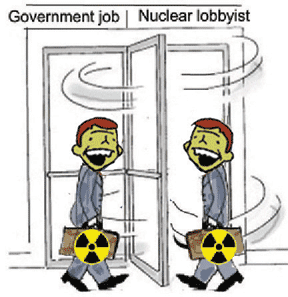
Pyne and Hockey aren’t the first from the political class to turn to the defence industries after leaving office. The political revolving door is well known.
Continue readingPorky pies and half-truths from our USA- captured Prime Minister Albanese.

Today’s significant AUKUS announcement about Australia’s acquisition of nuclear-powered submarines provides significant, long-term strategic benefits for all three countries……..a transformational moment for our nation [Ed. it sure does! – transformed to a colony of USA’s military-industrial-complex]
…. provides significant, long-term strategic benefits [?] for all three countries……… our ability to be sovereign [?] ready.
……creating around 20,000 direct jobs [a very dubious claim – ?jobs for Americans and British military experts]
……… Businesses right across the country in every state and territory will have the opportunity to contribute to and benefit from these opportunities. [ a totally unlikely unrealistic claim, backed by no data]
…….. Importantly, the SSNs will be an Australian sovereign capability [is he joking or is he stupid?] … https://www.theguardian.com/world/2023/mar/13/aukus-australian-submarine-nuclear-loophole-proliferation-fears
The US Can Secretly Rotate Nuclear Warheads Through Australia
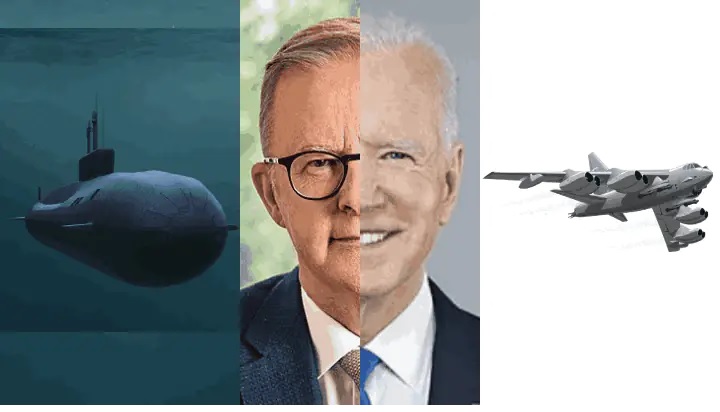
And the clear message coming from Moriarty, with the consensus of foreign affairs minister Penny Wong, is that for all Australia knows, the US could run nuclear warheads through the country, without informing anyone, and that’s what governments going back decades have agreed to.
Washington’s proposed rotating of B-52s through the north is understood to be a threat to Beijing, and coupled with the broad US access to our military sites, as well as the joint facilities at Pine Gap and North West Cape, these arrangements likely hardwire us into any US war on China.
22/02/2023 BY PAUL GREGOIRE, https://www.sydneycriminallawyers.com.au/blog/the-us-can-secretly-rotate-nuclear-warheads-through-australia/
After a midmorning break on budget estimate proceedings, defence secretary Greg Moriarty delivered a response to a question put by Greens Senator Jordan Steele-John earlier in the day, which has since escalated the current debate over Australia relinquishing sovereignty to the US.
Steele-John quizzed Moriarty, on 15 February, as to whether B-52 bombers that will be “cycling through” the country, following the US Army having built storage space for six such fighters as part of its upgrade of RAAF Base Tindal, “will be solely conventionally capable, not nuclear capable”.
“It’s clear that stationing of nuclear weapons in Australia is prohibited by the South Pacific Nuclear Free Zone Treaty, to which Australia is fully committed,” advised Moriarty, adding that this treaty, nor that of non-proliferation, prevent foreign aircraft visiting or transiting local airfields or airspace.
According to the defence head, “successive Australian governments have understood and respected the longstanding US policy of neither confirming nor denying the presence of nuclear weapons on particular platforms”.
And the clear message coming from Moriarty, with the consensus of foreign affairs minister Penny Wong, is that for all Australia knows, the US could run nuclear warheads through the country, without informing anyone, and that’s what governments going back decades have agreed to.
Unimpeded access
When Steel-John further queried Moriarty as to whether this could see nuclear weapons transiting, Wong intervened stating that the question involves talk of “rotational forces under an agreement with another government”, so she’d like to provide an answer after the “opportunity to consult”.
The pre-prepared response later delivered by Moriarty included the admission that “US bomber aircraft have been visiting Australia since the early 1980s and have conducted training in Australia since 2005”. And over this time, Canberra has respected Washington’s policy of warhead ambiguity.
Moriarty added that this policy is in line with the 2014 Force Posture Agreement between the two nations, which provides the US with unimpeded access to certain local military facilities, of which it gains operational control over when it’s carrying out any construction activity at such a site.
The FPA officially established that US troops rotate through the north of Australia, with their number now having grown to 2,500 marines annually, as well as having improved interoperability between the nations’ air forces. And it’s this agreement that’s led to the construction of a B-52 storage site.
Washington’s proposed rotating of B-52s through the north is understood to be a threat to Beijing, and coupled with the broad US access to our military sites, as well as the joint facilities at Pine Gap and North West Cape, these arrangements likely hardwire us into any US war on China.
Ambiguity abounds
“As I understand from that, secretary, the government’s reading of Australia’s treaty obligations does not prohibit nuclear armed B-52s from being temporarily present in Australia,” Senator David Shoebridge suggested to Moriarty following his explanation of the opaque US stance on warheads.
However, at this point, Wong cut in on what appeared to be a fairly straightforward assessment coming from the Greens senator in regard to what the defence secretary had just explained.
“There’s no suggestion,” the foreign minister countered. “No one at this table has talked about nuclear armed B-52s.”
Wong then reiterated some of the points made by the defence secretary that clearly led to Shoebridge’s assumption: Canberra has long understood and respected “the longstanding US policy of neither confirming nor denying” and this doesn’t impinge on our international obligations.
Shoebridge then framed it in a different way, as he asked whether Defence considers this nation isn’t under any obligation to prevent nuclear armed US bombers from entering if they’re not a “permanent presence”. However, the minister, again, claimed he was “reading more into it”.
Then, after further reasonable prodding from the Greens member, Wong, quite tellingly, explained that she and the defence secretary weren’t in a position to go any further than the answer that was provided, and she then implied it was unfair to the community to posit further “hypotheticals”.
Whilst initial diplomatic moves made by Wong since taking over the foreign affairs portfolio have served a modicum of hope that the mounting tensions between Beijing and Canberra might be allayed, her December visit to the US saw this dashed.
Wong and defence minister Richard Marles were in Washington to meet with US secretary of state Antony Blinken and defence secretary Lloyd Austin late last year, as part of the annual AUSMIN conference, which had a focus on countering China’s “destabilising military activities” this time.
And the conference saw Austin extend an invitation to Japan – which is a part of the QUAD security arrangement, along with this country, the US and India – to join in the US Force Posture Initiatives, which are the operational arrangements established under the FPA, on Australian soil.
The resurrected QUAD has become of increasing importance with its new focus on Beijing. In fact, Anthony Albanese’s first act as prime minister was to fly to Japan for a QUAD meeting, while the following month saw him in Madrid for a NATO conference, which had China on its agenda.
And while the Albanese administration hasn’t repeated the hawkish ravings that former PM Scott Morrison and defence minister Peter Dutton were spouting at the end of their reign, the US presence in Australia, likely guarantees involvement in a war with China prior to any official decision.
Ending at the starting line
Following Wong’s explanation that all that could be said had been, Shoebridge put it to Moriarty that he understands that Australia doesn’t challenge the US on warhead ambiguity, and he then asked whether our treaty obligations aren’t breached by B-52s potentially carrying nuclear arsenal.
In response, the minister became even more ruffled than she had been prior, and she reiterated that the various treaties aren’t being threatened.
Wong then accused Shoebridge of drumming up concerns, to which he countered that he wasn’t “fearmongering” and put the question to the defence secretary one more time.
“I think the minister has outlined Australia’s treaty obligations,” Moriarty told the Greens senator, as he brought the exchange regarding B-52s to a close.
“As I said, under the South Pacific Nuclear Free Zone Treaty, to which we are fully committed, stationing of nuclear weapons is prohibited.”
ASIO spied on Pine Gap military base protesters in the 1980s, declassified documents reveal
ABC Alice Springs / By Lee Robinson, Sat 21 Jan 2023
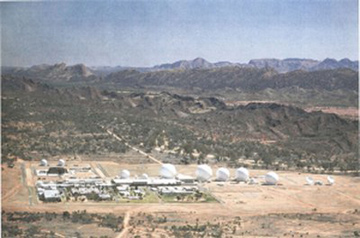
Declassified ASIO files have revealed the national security agency planted spies among a group protesting against the Pine Gap military base in Alice Springs during the 1980s.
The 1987 documents, released last year by the National Archives of Australia, show intelligence about peace activists and their protest plans were being fed to ASIO’s central office by one or more covert operatives who surreptitiously attended the group’s meetings.
The peace movement had gained momentum in the political landscape during the Cold War era, as concerns ran high over the threat posed by the Soviet Union and the possibility of nuclear warfare.
Pine Gap, the top-secret defence facility that had begun operating during the previous decade on the outskirts of town, was feared to be a target due its strategic importance to the United States Department of Defense and the Australian government.
Surveillance of peace group no surprise
Russell Goldflam was a bright-eyed idealist and vocal member of the Alice Springs Peace Group (ASPG) in the late 1980s.
Now a semi-retired lawyer still living in Alice Springs, he was not surprised to learn that ASIO had been surveilling the group’s activities.
“I would have been amazed if there hadn’t been a spy amongst our ranks,” Mr Goldflam said.
“We were campaigning against the largest spy base run by the United States outside the continental US.
“It would have been absolutely extraordinary if [ASIO] — or somebody in the security establishment — didn’t go to some trouble to try and make sure that there was no threat to that base from local people who were publicly saying, ‘We want to get it closed down’.”
Protest meetings documented
There are hundreds of files, with some revealing nothing more than bland meeting minutes, while others contain heavy redactions and delve into the perceived threats posed by peace activists……
Covert operatives remain a mystery
Mr Goldflam, who was arrested several times for trespassing at the military base during demonstrations, said he was never able to confirm the identity of any covert operatives…………………………………………………………..
A ‘great privilege’
Mr Goldflam has provided legal assistance throughout his career to a number of peace activists who had broken the law at Pine Gap and faced serious charges.
“It was a great privilege to be able to work as a lawyer for those people fighting for what are pretty fundamental rights, and that’s the right to be able to express an opposing point of view,” he said.
He believed the documents also painted the national security agency as holding grave concerns about the peace movement having a “malign influence” on local Aboriginal people, which Mr Goldflam said “couldn’t be further from the truth”.
“Our concern is where opinions tip into the promotion of violence, or actual acts of violence.” https://www.abc.net.au/news/2023-01-21/asio-spies-1980-pine-gap-peace-protesters-declassified-documents/101815740
The Australian government joined enthusiastically into America’s espionage law attack on whistle blowers and journalists
Key US Allies Collaborate On Espionage Laws Considered Harmful To Whistleblowers And Journalists

Since the legislation was passed, Australian Federal Police have raided the homes and offices of journalists who reported on war crimes in Afghanistan and the monitoring of Australian citizens’ communications.
Groups, such as Reporters Without Borders and the National Union of Journalists, wrote to lawmakers and warned that the bill conflated journalism with spying, expanded the definition of classified information, and disproportionately increased the penalty of espionage to life imprisonment.
Many of these new elements align existing laws with the United States Espionage Act, an antiquated law that was adopted over a century ago.
Richard Spence, Jan 5, 2023 https://thedissenter.org/us-allies-collaborate-to-write-new-espionage-laws/
Ministers and security officials in Australia, Sweden, and the United Kingdom have coordinated with the United States to develop new espionage laws.
Each of the countries have faced criticism from news media and civil society organizations for proposing laws that will harm journalists and whistleblowers’ ability to report on abuse and corruption in their own and each other’s countries.
These states have close intelligence ties to each other and the United States, and they have played some role in the extradition of WikiLeaks founder Julian Assange, whose prosecution is widely recognized as a threat to global press freedom. In fact, disclosures of the kind that Assange published have been cited as what the laws aim to make illegal.
FBI Director Christopher Wray had several days of meetings with “law enforcement partners in the United Kingdom” during July 2022. After these meetings, MI5 chief Ken McCallum promoted the “National Security Bill,” the first change to UK espionage laws since 1989.
The law would purportedly address the perceived threats Wray and McCallum discussed.
McCallum and other intelligence officials’ warnings and suggestions were frequently referenced by parliament members and government ministers who supported the bill when it was debated in the UK Parliament in November 2022.
Priti Patel, when she was UK Home Secretary, said the bill “was designed in close consultation with security services.”
In Sweden, the 2022 Foreign Espionage Act, which was adopted last November, specifically criminalized disclosures that cause “substantial damage” to Sweden’s relations with other countries or organizations. That led reporters to warn that journalists revealing war crimes committed by the US government could be prosecuted.
The Australian espionage bill also defined information that “harm[s] or prejudice[s] Australia’s international relations” as illegal to disclose.
Australia Security Intelligence Organization (ASIO) Director Duncan Lewis, who advised the country’s premier on their legislation, was asked at a parliamentary committee hearing, “Is there a connection, in your view, between our diplomatic and economic relations and our national security? In other words, if someone causes harm to our diplomatic relations with a foreign country, like the United States, can that harm our national security?”
“Absolutely,” Lewis responded. “You would need [to] go no further than perhaps the case of [Edward] Snowden to think about that—the enormous damage that was done to various diplomatic relations as a result of the leaks that came out of Snowden.”
The Espionage and Foreign Interference Act of 2018 introduced a range of measures the Australia government claimed were meant to combat Chinese interference.
A collection of media outlets, including The Guardian and News Corp, opposed the law, saying that “journalists and their support staff continue to risk jail time for simply doing their jobs” due to the possibility of being prosecuted for dealing with classified information.
Since the legislation was passed, Australian Federal Police have raided the homes and offices of journalists who reported on war crimes in Afghanistan and the monitoring of Australian citizens’ communications.
The ASIO gave “extensive operational briefings” on foreign interference to Malcolm Turnbull, when he was Australia’s prime minister, and Turnbull noted their input as he introduced the legislation in Parliament.
ASIO Director Duncan Lewis explained what in part motivated the push to expand the country’s espionage law. “Our international allies and partners with whom we share threat information tell us resoundingly that Australia is not alone in confronting a new threat environment, one that’s different from what we’ve seen before. In ASIO’s view, we must now adjust to this harsh reality.”
Lewis pointed to UK Prime Minister Theresa May who had urged allied powers to do more to “clamp down on the hostile activity of foreign agents.”
During parliamentary debate in the UK, Patel referred to these discussions.
“Let me say something about the legislation we want to introduce. We are learning from other countries, such as Australia—indeed, I had a bilateral meeting just last week. This is also part of the work of Five Eyes,” Patel shared. “A lot of work is being done to look at the institutional impacts of hostile state activity, alongside issues such as foreign agent registration. We want to get this right through future legislation, and that is what we are working on.”
Groups, such as Reporters Without Borders and the National Union of Journalists, wrote to lawmakers and warned that the bill conflated journalism with spying, expanded the definition of classified information, and disproportionately increased the penalty of espionage to life imprisonment.
Many of these new elements align existing laws with the United States Espionage Act, an antiquated law that was adopted over a century ago.
During a Novembr 2021 speech for the right-wing Heritage Foundation on the US-UK alliance, Patel acknowledged this fact.
“We will modernize existing counter-espionage laws to better reflect the contemporary threat; and we will improve our ability to protect official data and strengthen the associated offenses,” Patel declared “Our strategic partnership must continue to address all this activity – which is uninhibited and growing along with all the other threats we see day in, day out.”
The UK’s proposed legislation updates the current espionage laws to now be applicable to non-UK citizens. Press organizations have complained, “The lack of geographic limits and the overly broad definition of the safety and interests of the United Kingdom can extend the reach of the bill across the globe.”
Australia’s new laws also apply outside of the country and like the UK include assisting (or benefiting in the UKs case) foreign entities, leading to criticism that officials are criminalizing those who work with foreign press outlets.
According to the Australian chair of the Five Eyes Law Enforcement Committee, the organization will arrest those who have committed espionage “no matter where those criminals are in the world.”
Swedish military and intelligence officials studied changes to espionage legislation at the behest of the Swedish government and used WikiLeaks’ release of US diplomatic cables in 2010 as an example of a kind of leak that would harm Sweden’s relationship with other countries if it happened today.
Officials also singled out the North Atlantic Treaty Organization (NATO) and the US as powers that were important to protect from damaging leaks.
In June 2022, Conservative Party parliamentary member Sir John Hayes asked Damian Hinds, who was the UK minister of state for prisons, parole, and probation, if “a WikiLeaks-type disclosure dressed up as being by a guardian of liberty or some such other nonsense” would be illegal.
“The defenses in part one of the bill provide law enforcement with several options for prosecuting disclosures, where the person is acting for or on behalf of a foreign power or where the disclosure would materially assist a foreign intelligence service,” Hinds responded. “That can include bulk disclosures.”
“To be clear, with this bill, the maximum sentence for an indiscriminate disclosure—a bulk data dump—will be higher than it is today if that act is done for a foreign power or the disclosure would materially assist a foreign intelligence service, even if not procured by that foreign intelligence service itself,” Hinds further stated.
Canada, which is a Five Eyes country like Australia and the United Kingdom, has also followed their lead. Canadian security officials briefed the press and politicians, claiming that China aims to influence Canadian democracy.
Security officials in Canada have submitted reports to their government requesting new security laws to prevent Canada from becoming a “weak link” amongst its allies.
How Defence chiefs committed Australian special forces to the US drug war in Afghanistan
by Stuart McCarthy | Jan 6, 2023 https://michaelwest.com.au/how-defence-chiefs-committed-australian-special-forces-to-the-us-drug-war-in-afghanistan/
What is the accountability of Australia’s military top brass in alleged war crimes in Afghanistan? Stuart McCarthy, a veteran of two tours in Afghanistan, looks at the case of former defence minister Stephen Smith who has just been appointed High Commissioner in London.
“The DEA people were having troubles getting their own country to support them, and they had these Australians saying yes. They were very appreciative.”
Special Operations Task Group Plans Officer Greg Barton, quoted in Ben McKelvey, The Commando, 2017.
The Albanese government’s appointment of former foreign affairs and defence minister Stephen Smith back into public office as the next High Commissioner to the UK is merely another example of a political mate landing this plum overseas posting.
Much in the way of Kevin Rudd’s appointment as Australia’s ambassador to the US, or the Liberal government’s appointments of Joe Hockey and Arthur Sinodinos before Rudd. That these are all “jobs for the boys” is no reflection on competence or their expertise. There would be few less qualified than Kevin Rudd or Stephen Smith for their respective positions.
Yet, if Australia’s alleged war crimes in Afghanistan are ever heard at The Hague, or even tested in a bona fide war crimes commission in Australia, there will be political ramifications.
The Wong choice
Smith’s appointment at the completion of his Defence Strategic Review early next year reflects “the eminence of Australia’s relationship with the UK,” announced foreign affairs minister Penny Wong on 30 September. Not much to see here.
Not much to see at all, until we consider Smith’s connection to the alleged war crimes by Australian special forces in Afghanistan, and the possibility that senior defence officials might have to answer charges of command responsibility in the International Criminal Court (ICC).
Australia’s military commitment to Afghanistan was at its peak in 2010 when Stephen Smith became Minister for Defence. Critical of the lack of a coherent strategy and having derided European troop contributing countries for “organising folk dancing festivals,” in 2009 Prime Minister Kevin Rudd had increased our Afghanistan troop presence from 1100 to 1550.
Part of a NATO “surge,” the intention was to build the country’s fledgling democratic institutions while defeating a growing Taliban insurgency.
The Narco State
One of the wicked problems in dealing with both the insurgency and endemic Afghan government corruption at the time was the country’s decline into a nascent narco-state. So lucrative was the opium trade and so pervasive the corruption that in 2009 the estimated export value of opiates produced in Afghanistan amounted a third of the country’s GDP.
[ABC News YouTube video – Mark Willacy 21 Oct 2020 story on allegations of Afghan detainee murdered during 2 Cdo Regt/DEA counter-narcotics raid in Helmand province, mid-2012]
Coinciding with the NATO surge was a switch in the counter-narcotics component of the nation building strategy from eradicating opium poppy crops to interdicting the financial “nexus” between the drug trade and the insurgency.
Poppy eradication had proven not only unsuccessful but counter-productive. The prerequisite stable security situation, alternative livelihoods, functioning law enforcement and judicial systems, would take a decade or more to establish. Worse, destroying the only viable cash crop in most parts of the country was a surefire way to push impoverished farmers into the ranks of the rural insurgency.
In the minds of its proponents, a “counter-nexus” campaign targeted at the Taliban-aligned drug lords thus came into play as a silver bullet that could win the war. This despite the fact that no such endeavour has ever succeeded, anywhere, in the context of an ongoing war.
While the folly of fighting a drug war amid an escalating insurgency precluded most of the International Security Assistance Force (ISAF) armies from directly supporting this US Drug Enforcement Administration (DEA)-led campaign, the main question was actually one of legality.
How legal was it?
Targeting an active participant in hostilities with lethal force is perfectly legitimate under the internationally accepted laws of armed conflict (LOAC), but extra-judicial killing of crime suspects is questionable at best. Summary execution is certainly illegal under Australian law.
Concerns about rewriting the rules of engagement (ROE) to target Afghan drug producers and facilities under the legal auspices of international armed conflict had been raised at the highest levels in ISAF. In a classified letter to NATO high command leaked to Der Spiegel in 2009, ISAF commander U.S. General David McKiernan wrote that this would:
“… seriously undermine the commitment ISAF has made to the Afghan people and the international community … to restrain our use of force and avoid civilian casualties to the greatest degree predictable.”
Hence in 2010 the DEA mandarins in Kabul had a problem. To prosecute their counter-nexus drug war in the opium heartland of Helmand province they needed a willing contingent of well-trained special operators. When even the US military wouldn’t provide this, they looked further afield and found the commando component of the Australian Special Operations Task Group (SOTG) in nearby Uruzgan province.
[ABC News YouTube video – Mark Willacy 21 Sep 2022 story on allegations seven civilians were killed during 2 Cdo Regt/DEA counter-narcotics raid at Qarabagh, Oct 2012]
On a visit to Uruzgan soon after he was shuffled from Foreign Affairs to Defence in September 2010 – making way for Rudd in the new Gillard cabinet – Smith was approached by officers from the 2nd Commando Regiment. The commandos had developed a counter-nexus joint operating concept with their DEA colleagues, but encountered “every kind of obstacle” in seeking approval through the chain of command.
According to one account, when the commanding officer briefed Smith in person during his visit:
“From the beginning, [the minister] saw the logic in the proposal and was just as keen to get the idea underway as [we] were.”
With Smith’s direct approval, over the next two years the commandos undertook dozens of DEA-led drug raids in southern Afghanistan, principally in Helmand. These were tactically successful, as one of the commandos explains in Ben McKelvey’s 2017 book The Commando:
“They were instant gratification missions. You go in there at night, fuck up a bunch of shit, blow up drugs, ruin some bad dude’s week … you were basically Batman.”
A decade later, reports of exactly the civilian casualties McKiernan anticipated in 2009 are emerging in the Australian media. A US Marine Corps helicopter crewman has alleged that an Australian commando executed a detainee during a mid-2012 raid in Helmand.
In another incident in Helmand later that year, local Afghans and “Defence sources” have alleged that seven civilians were killed, including six who were “under the control” of Australian commandos.
At least two of the incidents from the DEA-led counter-nexus raids are now reportedly under criminal investigation by the Office of the Special Investigator, newly established by the federal government amid the national outcry which followed the publication of the Brereton Report in 2020.
One of the Brereton inquiry’s questionable findings was that accountability for the crimes identified in his report does not extend to higher Australian commanders “because they did not have a sufficient degree of command and control” over SOTG.
In reality, the decisions to commit the commandos to the DEA-led counter-nexus campaign, and the national rules of engagement governing the use of force and prevention of civilian casualties during those raids, were made by senior Australian officials.
Like the 2012 SAS raids in Sola and Darwan villages, the paper trail for these counter-nexus raids goes all the way up to Stephen Smith. There is arguably a potential case here for recklessness or negligence, supporting charges of higher command responsibility under Article 28 of the Rome Statute – although his story makes no imputations as to Smith’s culpability.
Nevertheless, these incidents might not have happened without Smith’s personal approval of SOTG’s participation in the DEA’s ill-fated, legally questionable, “instant gratification” campaign to “fuck up a bunch of shit” like Batman in Helmand.
Undue influence of the arms industry
Michelle Fahy, IPAN National Conference, 23 November 2022
Undue influence of the arms industry in Australia
Most stories I do end up being about two things: transparency and accountability. More accurately, the lack thereof, in this industry.
Today I’ll give you a snapshot of the intersection between the arms industry and the Australian government – the power and influence on one hand, and the secrecy and lack of accountability on the other. It’s hard to do simply and in a short space of time, so I have chosen a particular example from my work so far – as a case study which typifies how it works – to shine a spotlight on the undue influence of this industry. It’s by no means the only example, but it’s a really good one for illustrating how this industry can manipulate and control government decision-making to undermine the public interest to serve its own private interests. We know a fair bit about this one thanks to the Australian National Audit Office and its report.
This undermining of the public interest to serve private interests, when it becomes entrenched, is called state capture. The World Bank describes it like this: “State capture is the exercise of power by private actors — through control over resources, threat of violence, or other forms of influence — to shape policies or implementation in service of their narrow interest.”
First, a bit of context showing how the arms industry here fits in with the global arms industry.
You don’t need to read the chart. The simple point I’m making is the number of names in red – on both sides.

At left is a list of the top 15 global arms manufacturers. At right is a list of the top 15 contractors to Defence in Australia. The names in red are those that appear in both lists – showing a large amount of crossover. This is not surprising, but it’s useful to get a visual sense of the overlap.
The left column shows where those foreign companies rank globally. All of Australia’s 11 foreign-owned top defence contractors are global top 40-ish companies (KBR = 43rd), seven of them are in the global top 15.
I’m making this point, using the top 15 in particular, because the Australian Strategic Policy Institute (ASPI) did a study in 2017 that found, on average, in the 20 years to 2015, the top 15 contractors in Australia took 91% of the revenue.
Along with this quick look at the extensive presence of the global arms industry here, I’ll mention a 2020 report from SIPRI (the respected Stockholm International Peace Research Institute which tracks global arms sales and military expenditure). The report is called Mapping the international presence of the world’s largest arms companies.
The report took the world’s top 15 arms manufacturers and systematically investigated how many subsidiaries and joint ventures they had dotted around the globe. To be included, the subsidiaries had to be involved in arms production and military services activities and they had to be selling their products or services to military clients. They couldn’t just be sales or marketing shopfronts, or shell companies: those types of entities were excluded.
SIPRI found 400 subsidiaries of these 15 companies spread across at least 49 countries. They are mostly in countries that have two features:
1. the country is a large arms importer
2. it’s trying to establish a local arms industry.
Makes sense, right? You can see why a foreign arms-maker would move in.
And – you guessed it – Australia ticks both those boxes. Australia is currently the world’s 4th largest arms importer, and we are one of America’s biggest clients. In the five years from 2016-20 Australia was the United States’ second biggest arms customer, after Saudi Arabia. Even before that, we have been a top 5 US arms industry customer for a long time. It’s worth bearing that in mind when the US calls us its very good friend.
We are also BAE Systems’ (UK) fourth largest market. After the Turnbull government announced its massive planned spend on weaponry, BAE’s director of international markets said in 2017: “We are really in … exciting times in the Australian market. The government procurement plans are hugely ambitious. There aren’t too many countries who have that scale of defence procurement ambition in the next 15 years.”
And that was before AUKUS came along!
This is the Australian summary from SIPRI’s report:
1. Australia is now the largest military manufacturing hub outside the two major hubs of North America and Western Europe.
2. Australia ranks second in the world for the number of foreign subsidiaries of the top 15: we have 38 subsidiaries of those 15 companies here. The UK has most with 56, Saudi Arabia is third with 24.
So, that sets the scene. It’s obvious there’s a significant presence in Australia of the topmost echelons of the global arms industry: a lot of power and influence.
The Thales Hawkei vehicle procurement is a strong example of undue influence. How the company came from nowhere to win this $1.3 billion contract is a complex and highly political story that beggars belief, frankly. It contains many elements of undue influence that pop up across other procurements, yet here they are all in one story, so it’s a great example.
It also shows, starkly, how industry bent both sides of politics to its will – that’s state capture……………………………………
The Thales Hawkei vehicle procurement is a strong example of undue influence. How the company came from nowhere to win this $1.3 billion contract is a complex and highly political story that beggars belief, frankly. It contains many elements of undue influence that pop up across other procurements, yet here they are all in one story, so it’s a great example.
It also shows, starkly, how industry bent both sides of politics to its will – that’s state capture.
So – there you have it – it’s a big story and a great example of the undue influence of the arms industry in Australia, bending both political parties to its will, against the public interest, which fits in with the World Bank’s definition of state capture – not as the only example of course. If you Google “Confronting State Capture” you will see the report I contributed to, which includes this story and a lot of other examples, alongside similar material from the fossil fuels industry. It was published earlier this year by the Australian Democracy Network.
Further reading: my November 2020 series (Part 1 and Part 2) contains additional disturbing details about the Thales Hawkei procurement. https://undueinfluence.substack.com/p/speech-undue-influence-of-the-arms?utm_source=post-email-title&publication_id=297295&post_id=89729647&isFreemail=true&utm_medium=email
Prep work to start next week on Kimba Nuclear Waste dump, despite Government assurances not to pre-empt court case

https://www.nationaltribune.com.au/prep-work-to-start-next-week-on-kimba-nuclear-waste-dump-despite-government-assurances-not-to-pre-empt-court-case/?fbclid=IwAR1twuStY12rRYgZ-APTeOHNplE3dAStSxXM19ZZN1KQEkB7S957Bh8UfxQ 11 Nov 2022 Australian Greens
In a letter from Minister for Resources, Madeleine King to Greens Senator Barbara Pocock, it is revealed that despite the ongoing court case against the Barngarla Determination Aboriginal Corporation (BDAC), preparatory works will be going ahead starting next week.
In Senate estimates last night, Senator Pocock pushed the Senator representing the Minister for Resources, Tim Ayres, for answers around the future of the Kimba Site.
SA Labor does not support the dump, the SA people do not support the dump and have not been properly consulted, the Traditional Owners have unequivocally opposed it at every opportunity. The Government is continuing to spend $50 000 per week of taxpayer money in legal costs for something with no social license.
Senator Tim Ayres used the ongoing court case to dodge Senator Pocock’s questioning throughout estimates. He stated that the Government would respect and not pre-empt the outcome of the case. Despite this, it’s clear initial works will be proceeding as early as next week as per Minister King’s Letter.
It’s clear the process of site selection was mishandled. The Labor government now has the opportunity to halt works and review the decisions made previously, to show the Kimba community and the Barngarla people that they are committed to proper consultation and respecting first nations voice and rights.
“Minister for Resources, Madeleine King, has today informed me that preparatory works will be starting on the Kimba Site next week. Although it is not construction of the facility yet, this is a significant escalation that goes against reassurance in last nights estimates that court proceedings will be respected.
“Throughout estimates questioning last night, Senator Tim Ayres repeatedly stated that they would respect and not pre-empt the outcome of the court case. The letter I received right before estimates is a direct contradiction to this statement.
“I am deeply concerned that these preparatory works are going ahead.
“The site selection process was done without proper community consultation. This is a terrible decision inherited from the previous government. Labor can still turn this around. They must stay true to their word and immediately halt all works.
Government accused of hiding ‘lazy $591 million’ in extra costs from scrapped French submarine program
ABC, By defence correspondent Andrew Greene, 8 Nov 2022
Details of up to $591 million in additional expenses for the cancelled French submarine program have emerged, including asset writedowns on unused infrastructure and re-employment programs in Adelaide.
Key points:
- The extra costs to taxpayers only came to light in a late-night hearing
- $470 million has been spent on a South Australian facility which will have to be partially bulldozed
- A talent pool program costing $28 million has secured 223 jobs
The extra costs to taxpayers were revealed by officials from the government-controlled enterprises Australian Naval Infrastructure (ANI) and Australian Submarine Corporation (ASC) during a late-night Senate estimates hearing on Monday.
Last year the Morrison government cancelled the $90 billion Attack-class submarine program with French company Naval Group, in favour of nuclear-powered boats under the AUKUS partnership.
Earlier this year the Albanese government agreed to an $830 million compensation payment to Naval Group for the scrapped project, but more than half a billion dollars in other costs has now emerged in parliament.
In Senate estimates ANI confirmed a $300 million asset writedown related to the Osborne North Development project, a naval yard constructed for the now scrapped French designed Future Submarine project.
The committee was told $470 million has been spent to date on the Osborne North facility, including some assets which could still be repurposed for the new nuclear submarine program.
However ANI CEO Andrew Seaton told Greens senator David Shoebridge a partly-built “platform land-based test facility” which had been designed for the French submarines would probably now have to be bulldozed.
Separately the head of ASC also revealed that the cost of rehiring workers from the scrapped French submarine program is expected to reach $291 million over three years, but may be extended by the Defence department.
Since beginning six months ago, the Sovereign Shipbuilding Talent Pool (SSTP) has cost $28 million, with 223 workers hired by ASC following the scrapping of the French submarine program………………
Senator Shoebridge said the additional costs had been “ferreted away off the Defence budget”, but the public was paying the price for the scrapped submarine project.
“Only in a bungled multi-billion Defence project would a government even try to hide a lazy $591 million in additional costs,” he said.
“When we pay an extra $591 million for not building submarines we lose those funds for public housing, schools or income relief.
“While there are strategic arguments for retaining skilled staff, the fact that the ASC contract costs $1.3 million for every job is astounding.” https://www.abc.net.au/news/2022-11-08/591-million-most-in-costs-scrapped-french-submarines-australia/101629310
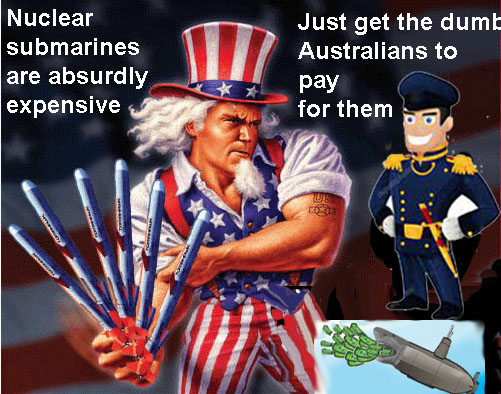
Australia’s ongoing nuclear submarine debacle – A tangle of overlapping interests’
https://undueinfluence.substack.com/p/a-tangle-of-overlapping-interests?utm_source=post-email-title&publication_id=297295&post_id=82059669&isFreemail=true&utm_medium=email Michelle Fahy 5 Nov 22
The federal government’s secret hiring from 2015 of numerous former US Navy officials to advise on Australia’s submarine procurement was exposed by The Washington Post a fortnight ago. “Some of the retired admirals have worked for the Australian government while simultaneously consulting for US shipbuilders and the US Navy, including on classified programs,” the Post said. The US officials benefited financially from “a tangle of overlapping interests”. The Post revealed that one former US admiral had been consulting to Australia while also occupying a full time position as chairman of the board of Huntington Ingalls Industries, a US company that builds US nuclear-powered submarines. That arrangement was abandoned in April this year due to conflict of interest concerns.
Australian defence experts Mike Scrafton and Richard Tanter have outlined the implications of these revelations in John Menadue’s public policy journal, Pearls and Irritations.
Mike Scrafton said, “What remains unclear now is the extent to which the abandonment of the French submarine and the decision to pursue a nuclear powered version was influenced by the Americans. The dramatic shift to the AUKUS project casts the role of the ex-US officials in a different light.”
Red flags have been a feature of Australia’s submarine procurement process since the original deal with France’s Naval Group in 2016. Concerns there included the government’s selection of Naval Group despite it being under investigation for corruption in three earlier shipbuilding contracts, with a fourth investigation added after Australia handed Naval Group the deal. Neither this alarming fact, nor other questionable aspects of the deal, triggered a rethink to find a more suitable contractor. The Washington Post revelations now raise even more questions about the backroom dealings in this disastrous extended procurement process.
The Pentagon builds a network in our Australian Department of Defence amidst media silence

https://johnmenadue.com/pentagon-takes-over-australias-defence-policies-amidst-media-silence/ By John MenadueOct 29, 2022,
It is more than inter-operability and inter-changeability with the US military. Anthony Albanese and Richard Marles need to break up the American network in our Department of Defence that the Washington Post has exposed.
The Washington Post has found that a retired US Admiral is ‘now a Deputy Secretary of Defense for Australia’.
I wonder how the Admiral handles ASTEO documents- for Australian eyes only?
In the last few days in Pearls and Irritations, Mike Scrafton and Richard Tanter have exposed how retired US Admirals have been employed as highly paid consultants to shape our policies on submarines.
At the same time our media has shown no interest or concern. This is more than ‘foreign influence’. It looks more like foreign control.
As Paul Keating recently put it,‘our strategic sovereignty is being outsourced to another country, the US’.
It was the Washington Post, not our Corporate Media that has given us an insight into the abdication of responsibility of our politicians, public officials and journalists who have been on a Washington drip feed for so long. They have been captured by American interests, particularly the US military and industrial complex that former President Eisenhower warned us about.
Following the first Washington Post exposures, the authors then ran a webinar from which the Post has printed a Q and A.
The webinar includes the following:
“In court papers, the Justice Department and Pentagon officials were very clear about this: They argued that disclosing the documents might subject retired generals, admirals and others to embarrassment and/or harassment, and would be an invasion of their privacy.”
“We have more stories we’re working on – stay tuned. Congress has taken some half-steps in recent years to require the Pentagon to disclose more details about retired generals and admirals working for foreign governments. But the Pentagon hasn’t been very forthcoming. Maybe that will change now.”
Q: “What was something which personally shocked you during your investigation?
From Nate Jones:
“I was surprised to learn Admiral Stephen Johnson is now a deputy Secretary of Defense for Australia.”
From Craig Whitlock:
“I was surprised by how many retired U.S. generals went to work as advisors and consultants to the Saudi Crown Prince AFTER he approved the assassination of Saudi journalist Jamal Khashoggi in 2018. I mean, hello?”
Q: “Do they have to disclose anything about what they do?
From Nate Jones:
“Here is a sample of former national security advisor James Jones’s application. You can see he discloses some things in a page or two.”
From Craig Whitlock:
“The war in Yemen is a good example of a terrible, unintended consequence. The Pentagon and State Dept have authorized more than 300 retired US military personnel to work as contractors or consultants for Saudi Arabia and UAE since 2015. During that time, KSA and UAE have bombed the heck out of Yemen, turning their civil war into a far worse humanitarian disaster. US has enabled that to a significant degree by allowing so many veterans to build up the KSA and UAE armed forces.”
From Craig Whitlock:
“With one exception, there were no instances of retired US personnel seeking to work for nations that the US govt categories as “foreign adversaries” eg., China, North Korea, Iran, Cuba or Venezuela. The lone exception was a retired US Air Force officer who sought – and received – approval to work for a satellite launch company owned by the government of Russia.”
The Washington Post revealed that one of the American consultants was (probably still is) being paid $6000 a day for his consultancy to Prime Minister Morrison, plus whatever he might have been receiving from Peter Dutton, plus presumably a fee for participating in a longer running US Defence project. No doubt he was also on some sort of “compensation” from the US Defence Industry. Presumably he was the mystery source when Dutton persisted in claims that he could get a couple of US submarines much earlier.
The inclusion of the UK in AUKUS was only a cover for the US/Australia deal.
But all the $10m of funding to US Admirals is of lesser concern than the peddling of US interference in our national security debate. We have known all along that the need for the submarines stemmed from concerns in the US defence community years ago about the so-called “submarine gap” in the containment ring around China – which they intended Australia to fill. And we would pay for it!
And all of that has been borne out by the relentless pressure applied recently by US service chiefs and Pentagon officials to promote so shamelessly major new Australian defence procurement in advance of the Smith/Houston review.
While Morrison and Dutton created the astonishing network, it appears that Albanese and Marles have not moved to break it up. They should do so quickly.
This has all the makings of a major can of worms which both major parties will be keen to keep the lid on.
This is not just a national disgrace. It is positively dangerous.
Malcolm Fraser called the US a dangerous ally.
I have written many times about how we are joined at the hip to an ally that is almost always at war. And we keep tagging along in one US defeat after another. The US is now goading China.
Our future is not to be a spear carrier for the US in our region. Our future is learning to live securely in our own region.
China is not going away but the US ultimately will.
Our captured corporate media will not examine the offence to our national dignity that the Washington Post has exposed. Our media has abandoned all pretence of independence and professionalism.
Can our Parliament rouse itself and help restore some trust in our institutions and expose what is going on?
John Menadue is the Founder and Editor in Chief of Pearls and Irritations. He was formerly Secretary of the Department of Prime Minister and Cabinet under Gough Whitlam and Malcolm Fraser, Ambassador to Japan, Secretary of the Department of Immigration and CEO of Qantas.
1 This month
Chernobyl: The Lost Tapes – A good documentary on Chernobyl on SBS available On Demand for the next 3 weeks– https://www.sbs.com.au/ondemand/tv-program/chernobyl-the-lost-tapes/2352741955560
15 April – Zoom –Nuclear Power is Not the Solution
Apr 15, 2026 01:00 AM in Canberra, Melbourne, Sydney

Join the International Physicians for the Prevention of Nuclear War (IPPNW) on Tuesday, April 14th for a timely webinar exploring the risks associated with nuclear power and challenging the myth that it offers a simple, safe, carbon-free solution to the climate crisis

21 April Webinar: No Nuclear Weapons in Australia
Start: 2026-04-21 18:00:00 UTC Canberra, Melbourne, Sydney (GMT+10:00)
End: 2026-04-21 19:30:00 UTC Canberra, Melbourne, Sydney (GMT+10:00)
Event Type: Virtual
A virtual link will be communicated before the event.
Host Contact Info: australia@icanw.org

of the week – Australians for War Powers Reform (AWPR)
To see nuclear-related stories in greater depth and intensity
 Antinuclear