Aust OECD nuclear power claim is false, Leader, Australian Associated Press, 12 Aug 19,
AAP Fac tCheck Investigation: Is Australia the only OECD country that does not use nuclear power?
The Statement:“We are the only OECD country that doesn’t utilise this type of technology (nuclear power).” – Federal Liberal National Party MP Keith Pitt. August 7, 2019.
The Verdict False – The checkable claim is false.
The Analysis Federal coalition MP Keith Pitt has campaigned for nuclear power to be investigated as an option to form part of Australia’s energy mix. Mr Pitt believes nuclear should not be excluded and Australia should re-examine its moratorium on the construction of nuclear power plants.
AAP FactCheck examined the Queensland MP’s claim that Australia is the only OECD country that does not use nuclear power. [1]
Mr Pitt’s statement was made as the federal government announced on August 7 an inquiry into the feasibility of using nuclear energy as a power source for Australia. The new inquiry follows a 2016 nuclear fuel cycle royal commission by the South Australian government and a 2006 federal review by the Howard government. The 2006 review found Australia would need about 25 reactors to supply one-third of the nation’s electricity supply by 2050, while the 2016 commission’s found SA “could safely manage” used nuclear fuel from other countries. Submissions to the new federal government review are open until September 16 with a view to finalising a report by the end of the year. [2][3]……
Australia’s ban on nuclear power and nuclear power plant construction is enforced by two acts of federal parliament – the Environment Protection and Biodiversity Conservation (EPBC) Act 1999 and Australian Radiation Protection and Nuclear Safety Act 1998.Section 140A of the EPBC Act 1999 states: “The minister must not approve an action consisting of or involving the construction or operation of any of the following nuclear installations: a) a nuclear fuel fabrication plant; b) a nuclear power plant; c) an enrichment plant; d) a reprocessing facility”. The Australian Radiation Protection and Nuclear Safety Act applies to Commonwealth bodies and is not a barrier for state government body or private developer. [4] [5] [6] [7]
……. Listed under non-nuclear countries for OECD Pacific are Australia and New Zealand, while in Europe there are 14 nations listed and for the Americas, Chile is a non-nuclear country. [8] [9]
Industry Super Australia chief economist Stephen Anthony, was quoted as saying on June 26, 2019: “The point about nuclear is that all other OECD countries have nuclear, we do not.” Mr Anthony’s interview with the ABC’s World Today program included an editor’s note which stated: “The interviewee in the report states that all OECD countries use nuclear power – except for Australia. According to OECD figures, 16 of its members do not use nuclear power”. [10]
When contacted about the source of his claim, Mr Pitt’s office told AAP FactCheck that the Hinkley MP “misspoke” during the interview with Sky News.
Based on this evidence AAP FactCheck found Mr Pitt’s statement to be false. Australia is not the only OECD nation that does not use nuclear power.
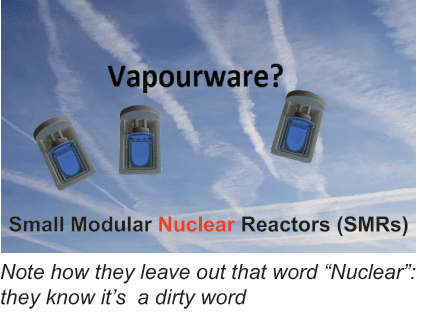
Are SMRs vaporware? https://johnquiggin.com/2019/08/08/are-smrs-vaporware/ AUGUST 8, 2019JOHN QUIGGINIt seems as if nuclear fans in Australia have given up on conventional Generation III/III+ reactors such as the Westinghouse AP1000 and Areva EPR: unsurprising in view of the massive cost overruns and delays experienced in attempts to construct them.
They’ve also gone quiet on the prospect of more advanced “Generation IV” reactors. Again that’s unsurprising. Most of the leading research projects in this field have been abandoned or deferred past 2030, even for prototypes.
The great hope now is for Small Modular Reactors, which will, it is hoped, be assembled on site from parts built in factories. The idea is that the savings in construction will offset the loss of the scale economies inherent in having a larger reactor (arising ultimately from the fact that the volume of a sphere grows faster than its surface area).
Lots of SMR ideas have been proposed, but the only one with any serious prospect of entering commercial use is that proposed by NuScale, with funding from the US Department of Energy. NuScale has recently claimed that it should have its first reactor (consisting of 12 modules) in operation by 2027.
A couple of observations on this. First, when the project was funded back in 2014 the proposed start date was 2023. So, in the course of five years, the target time to completion has been reduced from nine years to eight. That suggests the 2027 target is pretty optimistic.
Second, NuScale isn’t actually going to build the factory that is the key selling point of the SMR idea. The press release says that the parts will be made by BWX, formerly Babcock and Wilcox (who abandoned their own SMR proposal around the time NuScale got funded).
So, is BWX going to build a factory, or is this going to be a bespoke job using existing plants (presumably much more expensive). I went to their website to find out. But far from getting a clear answer, I could find no mention at all of a deal with NuScale, or of any recent activity around SMRs.
So, there you have it. Australia’s proposed nuclear strategy rests on a non-existent plant to be manufactured by a company that apparently knows nothing about it.
Nuclear reactors called SMRs are being touted as possible energy source for Australia, ABC News By political reporter Jackson Gothe-Snape 7 Aug 19, Energy Minister Angus Taylor has ordered a parliamentary inquiry into nuclear energy.
Key points:
Small modular reactors (SMRs) will be investigated in a parliamentary inquiry
These are designed to be built in factories then shipped to a location for operation
Some expect SMRs will become popular in coming decades, but none are currently operational
“This will be the first inquiry into the use of nuclear power in Australia in more than a decade and is designed to consider the economic, environmental and safety implications of nuclear power,” he wrote this week.
The inquiry follows campaigns from Coalition senators James McGrath and Keith Pitt, New South Wales Nationals leader John Barilaro, and the Minerals Council to re-examine the nuclear option.
Investigating nuclear is controversial however, given both major parties agree to a ban on nuclear energy in Australia and the Fukushima nuclear disaster occurred in Japan less than a decade ago.
The biggest change in the nuclear sector since the last federal government review is the emergence of “small modular reactors” (SMRs). This technology was specifically referenced in Mr Taylor’s request for an inquiry.
Benefits of SMRs…..
South Australia’s 2016 royal commission into the nuclear fuel cycle sets out their key benefit: cost.
Developers of SMRs “are aiming to lower the typical construction costs associated with nuclear plants through serial fabrication at an off-site facility, with components brought together at the operational site for final assembly”.
Much like Ikea’s economies of scale, the more reactors are built, the cheaper each new one becomes. And multiple reactors can be deployed together on the same site if more energy is needed.
Mobility, safety and … uncertainty
There are other theoretical benefits too.
Because they are built at a factory and then shipped to a location, SMRs could be appropriate for a remote, energy-intensive factory or off-grid settlement needing power.
A similar idea is currently being pursued by Russia, which will soon tow a new floating nuclear power station to its remote far east.
But SMRs won’t look like a Soviet cruise ship. If they ever get built, they will be transportable on road by trucks.
Traditional nuclear power stations are located near rivers, lakes or the coast because they need large volumes of water.
SMRs promise to use less water, which would open up more remote sites.
And they are also designed to be “passively” safe — that is, they promise not to require an operator or backup water or energy to avoid meltdown.
The mooted benefits of SMRs sound promising, but none have been deployed so far.
In fact, they have been discussed for years with only slow progress. NuScale, a prominent SMR company owned by global engineering giant Fluor, is more than a decade old.
Construction on an SMR in China is reportedly set to commence in 2019, while approvals for the first test SMR are currently being worked through in the US and Canada. These may take several more years.
Cost criticism
South Australia’s royal commission found small modular reactors could be an option in future, but flagged there was a risk of cost blowouts associated with unproven technologies.
Despite the theoretical benefits of SMRs, Malcolm Turnbull — a proponent of pumped hydro project Snowy Hydro 2.0 when he was prime minister — argued this week that nuclear options were more expensive than what else is available right now.
“The cheapest form of new generation is renewables plus storage,” he posted on Twitter. …..
Individuals associated with the push for small modular reactors in Australia are closely associated with coal generation.
The NSW Nationals leader John Barilaro attended a 2018 SMR conference in the US with Tony Irwin, a director of SMR Nuclear Technology.
The company’s website states it was “established to advise on and facilitate the siting, development and operation of safe nuclear power generation technologies”.
Another director of that company is Trevor St Baker from Delta Electricity, the company that operates Vales Point on the NSW Central Coast.
A submission from SMR Nuclear Technology to a current uranium inquiry in New South Wales sets out how nuclear may replace coal.
“It should be acknowledged at the outset that there may be an important continuing role for gas-fired and coal-fired power generation,” it states……..
‘Untapped potential’ of uranium
Kevin Scarce, the man who led South Australia’s royal commission, said there was an opportunity to mine more uranium and convert it into a fuel source, “but at the moment that part of global supply is oversupplied”.
“Realistically, in the next 10 to 15 years there doesn’t appear to be much of a market unless nuclear starts to become more seen in the rest of the world.”…
The Minerals Council has long argued for Australia’s ban on nuclear energy to end.
It also wants uranium mining removed from the definition of a “nuclear action” in the Environment Protection and Biodiversity Conservation Act.
“These activities are not nuclear actions. They are mining activities,” a Minerals Council policy document states.
“Uranium projects should not automatically trigger a duplicative federal environmental approval process, and the costs and delays that come with that, for no environmental benefit.”
A joint media release this week from Treasurer Josh Frydenberg and Assistant Minister to the Prime Minister Ben Morton announced a Productivity Commission review into resources sector regulation.
In an article in The Conversation, Heiko Timmers, Associate Professor of Physics, UNSW, puts the case for Australia storing, presumably importing, the world’s nuclear waste.
Paul RichardsWhile nuclear power in Australia has a somewhat shaky business case, a much stronger argument can be made for the back end of the nuclear fuel cycle: storing nuclear waste’ Heiko Timmers Associate Professor of Physics, UNSW
A case can be made, that’s true.
However, the nuclear industry never talks about the whole nuclear fuel cycle. Furthermore, no one in the nuclear estate has proved they can look after unspent nuclear fuel, and contaminated material for the time needed without an indefinite supply of sovereign wealth.
What you are proposing is that Australia enters the sales channels of waste storage, for the profit of a very limited few in the nuclear estate. An unrealistic proposal, as no other nation has been able to solve this back door nuclear waste issue that even the IAEA admits, there is no economically viable solution for.
Unlike all the other sales channels in this nuclear estate, waste storage in terms of cost is indefinite, and on that basis, the cost is then based on our sovereign wealth. In other words, an indefinite cost to our Australian taxpayer’s.
The key takeaway is;
there is no way that nuclear waste storage as a business is economically viable, as the nuclear war hawks propose, it will be a cost to Australia indefinitely.
However, introducing nuclear waste storage as a sales channel for the nuclear estate changes our Federal Legislation of nuclear non-proliferation and that is the ‘Trojan Horse’ being wheeled out yet again. In yet another amoral attempt at introducing;
• nuclear energy,
• waste, and
• weapons,
despite developed nuclear nations phasing out nuclear fuel as obsolete, because the energy system is unviable economically and environmentally.
A Powerful Depiction’: Chernobyl Workers Reflect On HBO Series
ABC’s Media Watch takes aim at nuclear misinformation and bias
The ABC’s Media Watch program last night took aim at Australia’s pro-nuclear propagandists and the extreme bias of Australia’s nuclear ‘debate’.
Media Watch discussed HBO’s hit miniseries ‘Chernobyl’, which tops IMDB’s list of the greatest TV shows of all time, and took aim at Andrew Bolt and others for trivialising the death toll (discussed here) and for ignoring the broader impacts of the disaster such as the permanent relocation of 350,000 people and the thousands of children who suffered thyroid cancer due to exposure to radioactive fallout.
Dr Jim Green, national nuclear campaigner with Friends of the Earth Australia, said: “Nuclear lobbyists argued that Chernobyl was a result of the dysfunctional Soviet system and that a similar disaster couldn’t happen in Western countries. That argument collapsed with the March 2011 Fukushima disaster in Japan. Nuclear disasters can happen anywhere and a nuclear disaster anywhere is a nuclear disaster everywhere due to the spread of radioactive fallout. Chernobyl’s radioactive fallout contaminated the whole of Europe and Fukushima fallout reached northern Australia.”
“In addition to their other devastating impacts, nuclear disasters greatly increase the overall cost of nuclear power. The cost of the Chernobyl disaster is estimated at over one trillion dollars [US$700 billion] and the Fukushima disaster could prove to be just as expensive.”
Citing a recent expert analysis, Media Watch noted that nuclear power “doesn’t even get to first base on cost” and took nuclear lobbyists to task for failing to acknowledge the extraordinarily high cost of nuclear power (all reactors under construction in western Europe and north America are estimated to cost $14‒24 billion each while the South Carolina reactor project was abandoned in 2017 after the expenditure of at least A$12.9 billion).
Dr Green said: “Dr Ziggy Switkowski used to be Australia’s most prominent supporter of nuclear power and he led the Howard government’s nuclear review in 2006. But nuclear costs have increased four-fold since then and Dr Switkowski has acknowledged that the window for large-scale nuclear power in Australia has closed as renewables are clearly cheaper.“
“John Howard was no anti-nuclear ideologue yet he had the good sense to ban nuclear power. Prime Minister Scott Morrison needs to state unambiguously that the legislation banning nuclear power in Australia will remain in place,” Dr Green concluded.
Contact: Dr Jim Green 0417 318 368 More information: Last night’s Media Watch segment on nuclear power (video and transcript) A recent detailed article by Dr Green, cited by Media Watch.
The Uranium Conference is on in Adelaide on July 4th and 5th. The conference will be addressed by
Hon Dan van Holst Pellekaan MP, South Australian Minister for Energy and Mining. The keynote speaker will be Professor Geraldine Thomas, from Imperial College . She will also speak later on Radiation: Science, Protection and Communication.
A quaint choice, for importing a “radiation expert”, as Prof Thomas is well known as the nuclear lobby’s favourite radiation propagandist, and also well known as not a reliable source for radiation knowledge.
Coal and the nuclear lobby (updated), John Quiggin AUGUST 13, 2018JOHN QUIGGIN Updated 26 May 19, “……… It’s reasonable to ask why I would bother arguing about nuclear power, given my frequently expressed view that it’s DEAD AS A DOORNAIL. The problem is that nuclear fans like Ben Heard are, in effect, advocates for coal. Their line of argument runs as follows
(1) A power source with the characteristics of coal-fired electricity (always on) is essential if we are to decarbonise the electricity suppy
(2) Renewables can’t meet this need
(3) Nuclear power can
Hence, we must find a way to support nuclear
The problem is that, on any realistic analysis, there’s no chance of getting a nuclear plant going in Australia before about 2040 (see over the fold). So, the nuclear fans end up supporting the Abbott crew saying that we will have to rely on coal until then. And to make this case, it is necessary to ignore or denounce the many options for an all-renewable electricity supply, including concentrated solar power, large-scale battery storage and vehicle-to-grid options. As a result, would-be green advocates of nuclear power end up reinforcing the arguments of the coal lobby.
Looking at the argument set out above, point (1) is generally taken as self-evident, even though the idea of baseload demand is basically a nonsense, at least until the renewables share gets much closer to 100 per cent.
Point (3) is based on the claim that since France did this 40 years ago, Australia can do it today. The fact that France has long since lost the special characteristics that made its dash for nuclear power possible isn’t even considered. When I looked at the issue a few years ago, I concluded that only China had anything like the characteristics needed, but nuclear power has stalled even there.
Coming back to the Australian debate, it’s striking that it’s still going on, given the negative findings of the SA Royal Commission, established at the behest of the nuclear lobby. But I’ll spell out the problem one more time. Let’s look at the most optimistic possible timetable. The hardest evidence relates to the time between the issuing of a contract to build a nuclear power plant and the connection to the grid. The best-case scenario is that of the KEPCO contract in the UAE, one of the rare cases where the construction phase was completed on time and on budget. There have, however, been unexplained delays in startup. The contract was signed in December 2009 and, on current projections, the first plant (of four) will be connected to the grid ten years after that, at the end of 2019.
So, to get nuclear power going in Australia before 2040, we’d need signed contracts by 2030 at the latest. What needs to happen before that goal can be achieved.
* First, obviously, both major parties need to be convinced of the case for nuclear power. That’s highly unlikely but let’s suppose it can somehow be done by 2020
* Next, the current ban on nuclear power needs to be repealed. This ban looms large in the minds of nuclear fans, but actually it’s such a minor problem we can ignore it
* Next, we need to set up, from scratch a legislative and regulatory framework for nuclear power, and establish and staff a regulator similar to the US NRC. Bear in mind that there is essentially no one in Australia with any relevant expertise. I’d be surprised if this could be done in five years, but let’s suppose three
* Next we need to license designs that can be built here and, at the same time, completely remodel the National Electricity Market in a way that makes nuclear cost-competitive with both gas and renewables, while not opening the door for new coal (again, three years would be incredibly optimistic)
* Next we need to identify greenfield sites for multiple nuclear power plants, almost certainly on the east coast, and go through the processes of EIS, Environment Court and so on. In any realistic view, this would never succeed, but let’s suppose another three years.
After all that, we have to find companies willing to build the plants, and organize the necessary contracts. Given the absurdly opimsitic schedule set out above, this would have to be done inside a year. In summary, even on magical assumptions it would be impossible to get nuclear power going in Australia before 2040, by which time we would already have had to close most of the coal-fired generation fleet. It follows that the only effect of nuclear advocacy is to prolong the life of coal-fired power to the limits of technological feasibility.
M’s claim Coalition saved reef from nonexistent ‘endangered list’ condemned as ‘ridiculous’, Guardian, Lisa Cox, Mon 13 May 2019
Scott Morrison says government took reef ‘off the endangered list’ – despite no such list existing. Scott Morrison has credited his government with having “saved” the Great Barrier Reef, a claim rejected as “ridiculous” by scientists, environmental groups and the Queensland government.
At the Liberal party’s campaign launch in Melbourne on Sunday, Morrison thanked the former environment ministers Greg Hunt and Josh Frydenberg for their work on reef issues.
“We have saved the Great Barrier Reef – well done to Greg Hunt particularly on his work when he was environment minister – taking it off the endangered list,” he said.
“We’ve invested record funds in researching and protecting its future thanks to Josh’s time as environment minister.”
Morrison’s statement contained more than one inaccuracy, including the suggestion the reef was on an “endangered list” at all.
“There is such a thing as the ‘in danger list’ for world heritage properties,” the coral reef scientist Prof Terry Hughes said. “The barrier reef was never on that list.
“If Morrison is claiming Hunt got Australia off the ‘in danger’ list, the obvious response is: it never was on it.”
In 2017, Unesco opted not to list the reef as in danger after reviewing the government’s Reef 2050 plan. But it will reassess that decision in 2020 and whichever party wins the federal election must submit an update on progress of the plan at the end of this year.
Hughes said recent surveys of the Great Barrier Reef showed the impact climate change and rising ocean temperatures were having on coral cover.
The Australian Institute of Marine Science – the government’s own agency responsible for monitoring reef health – reported in 2017-18 that trends in coral cover in the north, central and south reef showed steep decline that “has not been observed in the historical record”.
Hughes’s most recent paper found that the production of baby coral on the reef had fallen by 89% after the climate change-induced mass bleaching of 2016 and 2017.
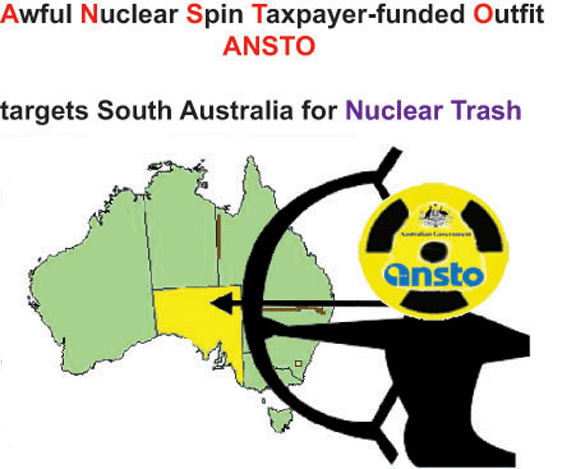
Kazzi Jaihttps://www.facebook.com/groups/941313402573199/Fight To Stop Nuclear Waste In The Flinders Ranges 23 Apr 19,How many times do you have to explain this to people? In response to some of ANSTO’s propaganda directed at the rural communities targeted for nuclear waste dumping……
So you have a specific inventory of what’s in the drums do you? You must be very special then – because that is not what has yet been released to the public! You seem to assume it’s in your words “aprons and gloves” from handling radioactive objects. There is much more to it. Did they mention that it must be shielded to be handled safely? The steel drums themselves act as the shield for the Low Level Nuclear waste and must be monitored to ensure they remain intact. The proposed dump is for the PERMANENT DISPOSAL of the Low Level Nuclear Waste as an above ground dump, but covered with yet to be determined substance so that it qualifies as an “near-surface” disposal site…and must be monitored for several hundred years for safety.
No-one in their right mind would guarantee that there will not be some form of leakage during all of those hundreds of years! Steel drums…concrete….do not last forever….especially when it comes to radioactivity as well as other external factors.And then there’s the above ground “Temporary” storage of the Intermediate Level Nuclear Waste which will be coming with it. We have been told that the proposed dump is not worth doing without the Intermediate Waste being “temporarily” stored there, from Lucas Heights – which is in fact double handling and NOT World’s Best Practise in any way shape or form! What is in the Intermediate Level Nuclear Waste shielded casks – Did they say? Did they say how long the Intermediate Level Nuclear Waste remains dangerous? Did they say how long the casks were guaranteed by the manufacturers?
Did they mention any hazards or risks? Any at all?
IF it is so safe as they say – why was Sally’s Flat NSW not hounded to take this waste instead? Sally’s Flat is MUCH closer to Lucas Heights at 260kms – Lucas Heights is where over 90% of Australia’s nuclear waste is generated on site – and Sally’s Flat was deemed suitable as one of the six sites chosen by the Federal Government! Even Oman Ama in Qld is closer! Why transport it over 1500+kms into a prime export grain area or into the iconic world renowned Flinder’s Ranges in South Australia?
The answer is that once it is over the state border it becomes South Australia’s responsibility and liability and South Australia’s problem!
And to top it off – as the NATIONAL Nuclear Dump – not just ANSTO’s – the title of it should ring alarm bells – then all of the other states can effectively become “nuclear-free” at South Australia’s expense!
This is NOTHING to do with FEAR OF THE UNKNOWN or “green goo”. It is nothing to do with comparing it with other objects which frankly is pretty stupid because it is just a way of selling it and blurring lines of understanding! It is MUCH to do with SHAFTING nuclear waste from Lucas Heights, where it is currently safely stored and monitored, and is securely held. Lucas Heights in fact are the first to say “not in my backyard”!
Keep it all at Lucas Heights until the Intermediate Nuclear Waste can be PROPERLY dealt with! Then the Low Level Nuclear Waste can go in with that! In fact that was the intention of Lucas Heights and its enormous space all along – is that they would retain any waste they generated on site UNTIL they had found a suitable way of dealing with it once and for all and not for the next generations to have to come to deal with this man-made problem which they continue to generate! They had given themselves 80 – 100 years to find a solution. This current proposal is NOT a solution. It is simply burying the waste and abandoning it – a caveman’s solution to a 20th century problem!
South Australia is NOT the Nation’s Nuclear Dumping Ground!
The Minerals Council of Australia joins in the current pro nuclear propaganda push – classing nuclear power as “reliable, at a very low cost, and with zero emissions” — Mining.com 22 April
Here’s my comment, which they did not publish – surprise, surprise
Nuclear power is not all that reliable, particularly now, as climate change brings extremes of weather, for which nuclear reactors are not prepared. As they require lots of water, they are usually placed near sea or rivers, posing an increasing problem with sea level rise, and sea surges. Australia is a water short country, and should not contemplate such a water-guzzling industry.
As for nuclear being “cheap” – it’s “cheap” only where the tax-payer cops the bill – Russia, China, France etc. In USA and UK the nuclear lobby is screaming for subsidies, and the building of new reactors -Hinkley Point C, and the boondoggle in South Carolina provide a cautionary tale. As for small nuclear reactors – their only hope of being economic is if the are ordered en masse – such a risk, and consequently there are no buyers. Then there’s that little problem of radioactive trash accumulating, with no solution in sight.
Meanwhile,Australia has the opportunity to be a leader in truly clean renewable technologies, which are getting cheaper, while nuclear costs mount.
Senator Cory Bernardi has backed nuclear power after the Prime Minister said he is not considering the energy alternative. Nuclear power plants are illegal in Australia but experts say [these “experts” turn out to be the Australian Nuclear Association] it could be the answer to Australia’s energy concerns.
Senator Cory Bernardi had introduced a bill last year to remove a ban on nuclear energy.
He tells Luke Grant he was hopeful when he heard Scott Morrison had been open to the idea.
“The Prime Minister got my hopes up when he said nuclear energy might be a part of the mix if it stacks up on its own two feet. But within 48 hours all the usual suspects come out and monster him into a position which is basically ‘oh no it’s not on the table’.
“Any idea that’s not driven by the left is outrageous and terrible and awful.”
Many are calling for the construction of High-Efficiency Low Emission (HELE) coal power plants, in order to avoid outages and soaring power prices.
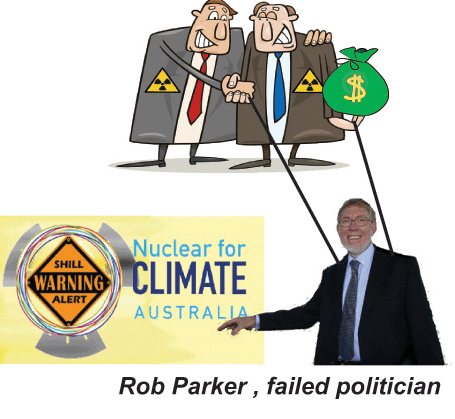
But Australian Nuclear Association Vice President Rob Parker tells Natalie Peters and Erin Molan nuclear energy is the most environmentally friendly and cost-effective option.
“When we look at nuclear energy we find that it is established as being the safest form of power generation that we have on the planet.
“It is safer than coal, safer than oil, safer than anything, including solar and wind. “We have established that we can have a clear low carbon, low-cost, future using nuclear energy.”
War, What Is It Good For… Besides Blood Lust And The Avalon Airshow? New Matilda, Dave Sweeneyon February 26, 2019
The iconic Avalon Airshow kicks off next week. But events actually get underway today, with a special exhibition for those who like their planes weaponized for death and destruction, writes Dave Sweeney.Australians are generally lucky where it comes to the air – we have big skies and safe planes that routinely take off and land and relocate us for holidays, family re-unions and commerce.
Our airborne images are red kangaroos, flying doctors and grainy newsreels of early aviators breaking new records in old planes.
It is a world away from many other places experience of the sky as a hostile space that threatens rapid and remote destruction and death………
The Avalon Airshow is comprised of two concurrent events: the Australian International Aerospace and Defence Exposition is an industry-only trade-fest that runs for three days before merging with the co-located and more public Australian International Airshow for a further three days of ‘the ultimate family adventure’.
If websites could get breathless this one would need a respirator.
Experience the awesome power of military aviation. A high voltage array of combat aircraft takes centre stage with the thrust and grunt of the latest heavy metal. Marvel as jet fighters, strike bombers and heavy lift leviathans are joined by swarms of attack helicopters, from home and abroad, for a series of breath taking routines and simulated combat manoeuvres.
TOP STUDENTS SELECTED TO WORK WITH AUSTRALIA’S BEST NUCLEAR SCIENTISTS, 20 February 2019 ANSTO
This month ANSTO is opening its doors to 11 talented young people from across Australia as the two-year Graduate Program kickstarts.
Working from Lucas Heights, ANSTO’s 2019 graduates will get extraordinary insights into nuclear science, engineering and technology and how it is being applied to help achieve sustainability for our health and environment industries.







 Antinuclear