Last year, the submission of Universities Australia to the Defence Strategic Review was almost begging to link universities with the defence needs of the country. All the Defence Department and Australian Defence Forces needed to do was ask.
How fortunate, then, that AUKUS came bumbling along.
Here they go. Vice-chancellors, university managers, and creatures with titles unmentionable and meaningless (deputies, semi-deputies, sub-deputies), a whole cavalcade of parasitic creatures in need of neutering, keen to pursue another daft idea. Australian universities do not want to miss out on the military-industrial-education complex, whatever its imperilling dangers. With the war inspired AUKUS security pact, which promises the stripping of the Australian budget to the tune of $AUD 368 billion over the course of three decades, a corrupt establishment promises to get worse.
The AUKUS distraction could not have come at a better time. The tertiary sector in Australia is becoming increasingly cadaverous, marked by cost-cutting, rampant casualisation and heavy teaching and workloads for those battling away in the pedagogical trenches.
In a recent piece by Guardian Australia’s higher education reporter, an academic, who preferred to remain anonymous fearing institutional retribution, likened the modern Australian university to a supermarket. Students were the customers filing through the self-checkout counters; the staff, increasingly rendered irrelevant, were readily disposable.
The stories have been familiar for years, even as the offending by university management continues unabated: tutors being paid insufficiently to read and grade work adequately; virtually non-existent job security; the suppression of academic freedom and criticism of ghastly management practices. Given the pathological secrecy under which universities work under, essential data shedding light on class sizes, staff-student ratios, and contracts with private business interests, is virtually impossible to attain.
But despite the Australian university sector proving unsustainable, unprincipled, and ungainly, individuals such as Catriona Jackson, the CEO of Universities Australia, are on the hunt for new frontiers.
Last year, the submission of Universities Australia to the Defence Strategic Review was almost begging to link universities with the defence needs of the country. All the Defence Department and Australian Defence Forces needed to do was ask.
As the Australian Financial Reviewreported at the time, “The universities need to be prepared to respond in an adaptable and efficient manner to a clear demand signal from defence in terms of workforce needs – both skills and numbers – as well as technology and hardware needs.”
How fortunate, then, that AUKUS came bumbling along. For Jackson, principles in education are less important than inflated commercial opportunities or, to use her lingo, commercialisation. Distant from the process of learning itself, unaware of the delivery of courses and the classroom, she sees this war making security pact as packed with promise. “It’s workforce, workforce, workforce,” she sloganeered to her Sky News host Kieran Gilbert. “It’s not just nuclear physicists we need, although we do need some of those and it’s a very specialist profession. Almost every area of human endeavour we need a capacity uplift, so engineers, doctors, nurses, psychologists, pretty much everyone.”
Evidently hearing the war jingles around the corner, Jackson is journeying to Washington for meetings with national security officials from the US State Department and National Science Foundation. It is her hope that the number of Australian university partnerships will be expanded, “with more than 10,000 formal partnerships already in place with fellow institutions around the world.” The message she takes to the US capital will, however, be focused on “developing the capability [of Australian universities] to deliver the project, including through the provision of skilled workers and world-class research and development.”
Certain publications have also exuded jingoistic cheer on the new role of Australia’s tertiary sector. The Australian, one of Rupert Murdoch’s premier rags of froth and bile, is ever reliable in this respect. The paper’s higher education editor, Tim Dodd, in a March contribution [paywalled], posed two questions to those in the university sector: Had Australian universities ever played such a vital role in national defence as they would be likely to do over the next two decades in building nuclear-powered submarines? Would they even want to be involved?
Throughout his piece, Dodd seems to think that a university system untethered to the defence establishment is a morally questionable thing. In doing so, he betrays his ignorance of those wise words from US Democratic Senator J. William Fulbright, who warned that “in lending itself too much to the purposes of government, a university fails its higher purposes.”
Dodd can merely observe that, “In the post-war period universities were still not critical to defence programs.” AUKUS and the nuclear submarine program had changed matters. “Australia is now embarking on an enormous program to build, operate and maintain nuclear-powered submarines and a clear goal is sovereign capability.” All in all, it was “a critical national priority that universities are right to give their full support to. Their backing is critical.”
Leaving aside such platitudinous nonsense as “sovereign capability” – the technology, expertise, control and guidance over this new promised machinery will always be directed from Washington – the sentiments are clear. The military-industrial-university complex is a matter to be celebrated. There are, for instance, “other parts of AUKUS” that will involve “our top universities” in such areas as “advanced research cyber security, artificial intelligence and quantum technologies.”
Bizarrely, Dodd gets the question about academic freedom the wrong way around: that expressing a choice in favour of the blatant war drumming of AUKUS is something that should be one for academics. If he had any idea about despotic university environments, he would be aware that academics, whatever they agree with, will have little say in the matter. Distant, estranged managements, unaccountably enthroned in administrative towers, will be making such decisions for them; the only real free expression will be exercised by those opposing the measure.
Despite insisting that Julian Assange has been held captive for too long, the Albanese Government still won’t intervene while the AUKUS pact keeps us in lockstep with the U.S., writes Dr Binoy Kampmark.
THE SHAM that is the Julian Assange affair, a scandal of monumental proportions connived in by the AUKUS powers, shows no signs of abating. Prior to Prime Minister Anthony Albanese assuming office in Australia, he insisted that the matter dealing with the WikiLeaks publisher would be finally resolved. It had, he asserted, been going on for too long.
Since then, it is very clear, as with all matters regarding U.S. policy, that Australia will, if not agree outright with Washington, adopt a constipated, non-committal position. “Quiet diplomacy” is the official line taken by Albanese and Foreign Minister Penny Wong, a mealy-mouthed formulation deserving of contempt.
‘“Quiet diplomacy” to bring Julian Assange home by the Albanese Government is a policy of nothing. Not one meeting, phone call or letter sent.’
Kellie Tranter, a tireless advocate for Assange, has done sterling work uncovering the nature of that position through Freedom of Information requests over the years:
‘They tell a story – not the whole story – of institutionalised prejudgment, “perceived” rather than “actual” risks and complicity through silence.’
The story is a resoundingly ugly one. It features, for instance, stubbornness on the part of U.S. authorities to even disclose the existence of a process seeking Assange’s extradition from the UK, to the lack of interest on the part of the Australian Government to pursue direct diplomatic and political interventions.
Former Australian Foreign Minister Julie Bishop exemplified that position in signing off on a Ministerial Submission in February 2016 recommending that the Assange case not be resolved; those in Canberra were ‘unable to intervene in the due process of another’s country’s court proceedings or legal matters, and we have full confidence in UK and Swedish judicial systems’. Given the nakedly political nature of the blatant persecution of the WikiLeaks founder, this was a confidence both misplaced and disingenuous.
The same position was adopted by the Australian Government to the United Nations Working Group on Arbitrary Detention (WGAD), which found that same month that Assange had been subject to ‘different forms of deprivation of liberty: initial detention in Wandsworth Prison which was followed by house arrest and his confinement at the Ecuadorean embassy’.
The Working Group further argued that Assange’s ‘safety and physical integrity’ be guaranteed, that ‘his right to freedom of movement’ be respected and that he enjoy the full slew of ‘rights guaranteed by the international norms on detention’.
At the time, such press outlets as The Guardian covered themselves in gangrenous glory in insisting that Assange was not being detained arbitrarily and was merely ducking the authorities in favour of a “publicity stunt”.
The conduct from Bishop and her colleagues did little to challenge such assertions, though the Department of Foreign Affairs and Trade (DFAT) did confirm in communications with Tranter in June 2018 that the Government was ‘committed to engaging in good faith with the United Nations Human Rights Council and its mechanisms, including the Working Group on Arbitrary Detention’. Splendid inertia beckoned.
The new Australian High Commissioner to the United Kingdom, Stephen Smith, has kept up that undistinguished, even disgraceful tradition: he has offered unconvincing, lukewarm support for one of Belmarsh Prison’s most notable detainees. As the ABC reports, he expressed pleasure “that in the course of the next week or so, he’s agreed that I can visit him in Belmarsh Prison”. (This comes with the usual qualification: that up to 40 offers of “consular” support had been previously made and declined by the ungrateful publisher.)
The new High Commissioner is promising little:
“My primary responsibility will be to ensure his health and wellbeing and to inquire as to his state and whether there is anything that we can do, either with respect to prison authorities or to himself to make sure that his health and safety and wellbeing is of the highest order.”
Assange’s health and wellbeing, which has and continues to deteriorate, is a matter of court and common record. No consular visit is needed to confirm that fact. As with his predecessors, Smith is making his own sordid contribution to assuring that the WikiLeaks founder perishes in prison, a victim of ghastly process.
As for what he would be doing to impress the UK to reverse the decision of former Home Secretary Priti Patel to extradite the publisher to the U.S., Smith was painfully predictable:
“It’s not a matter of us lobbying for a particular outcome. It’s a matter of me as the High Commissioner representing to the UK Government as I do, that the view of the Australian Government is twofold. It is: these matters have transpired for too long and need to be brought to a conclusion, and secondly, we want to, and there is no difficulty so far as UK authorities are concerned, we want to discharge our consular obligations.”
Former Australian Senator Rex Patrick summed up the position rather well by declaring that Smith would be far better off, on instructions from Prime Minister Albanese, pressing the current UK Home Secretary Suella Braverman to drop the whole matter. Even better, Albanese might just do the good thing and push U.S. President Joe Biden and his Attorney-General Merrick Garland to end the prosecution.
Little can be expected from the latest announcement. Smith is a man who has made various effusive comments about AUKUS, an absurd, extortionately costly security pact appropriately described as a war-making arrangement. The Albanese Government, having placed Australia ever deeper into the U.S. military orbit, is hardly likely to do much for a publisher who exposed the war crimes and predations of the Imperium.
Environment and Other Legislation Amendment (Removing Nuclear Energy Prohibitions) Bill 2022 Submission No. 118 (Name Withheld)
Don’t let the nuclear lobbyists scuttle the clean energy movement to line their bottomless pockets
Senate members may not realise that hundreds of submissions to lift the ban on nuclear power in Australia have come from a so-called environmental protection organisation, RePlanet. This group has broadcast a lengthy pre-prepared submission, advising that lodging it (by simply giving a name and an email address) will “help Australia’s federal politicians understand that there is strong public support for lifting the ban on nuclear energy so that it may be used as part of the clean energy transition”.
This lobby group argues that nuclear has the lowest lifecycle environmental impact, provides reliable 24/7 clean energy, has a very small land use footprint, and provides high paying, long term employment. Nothing could be further from the truth, on all counts – including ‘strong public support’.
Nuclear’s environmental impact is horrendous (Three Mile Island, Chernobyl, Windscale, Fukushima). It is demonstrably the dirtiest and most dangerous of all forms of energy. Its land use footprint and the employment it provides are irrelevant – a solar panel on a rooftop has a very small footprint, and projects designed around genuinely clean green energy conversions will provide countless high paying long-term job opportunities.
Please don’t be swayed by the hundreds of submissions from this source. Australians on the whole are moving to renewable energy, voting with their rooftops. RePlanet is trying to infiltrate genuine groups caring for the future of this planet. We succumbed to the oil barons’ promises a hundred years ago, and lost an amazing electric car industry.
To Mr Shaun Jenkinson , Chief Executive Officer , Australian Nuclear Science and Technology Organisation, 31 Mar 23
Dear Shaun Jenkinson
While I should be congratulating the Australian Nuclear Science and Technology Organisation (ANSTO) on the occasion of its seventieth anniversary I cannot agree with its euphemistic contention that Australia punches above its weight in the international nuclear arena
You know well enough that this is far from the truth in the eyes of many leading experts internationally in all aspects of nuclear science and technology and which is particularly confirmed by various circumstances involving ANSTO in the past few years
This situation relates to the very existence and necessity of ANSTO and no degree of membership of various global committees by its staff can justify the claim that Australia holds its own (presumably through ANSTO) on the international stage among the leading nuclear nations of the world BECAUSE IT SIMPLY DOES NOT
The prime examples of this are the completely misleading contentions by ANSTO as to its its leadership in the production of nuclear medicine and its continued operational problems at Lucas Heights
While you have claimed that the production of nuclear medicine by ANSTO represents 80% of its undertaking the fact is that it relates to reactor generated medicine from which the medical profession worldwide is turning away due to its inherent and dangerous nature
In fact the better medical opinion internationally is that reactor generated nuclear medicine will ultimately be completely replaced by other means of diagnostic and curative treatment based on which a large part of the purpose of ANSTO would be lost
This fact could be readily verified if you and the federal government on your advice allowed a proper independent and internationally based review of the production of nuclear medicine by ANSTO which of course as a comprehensive business case would completely destroy a large part of its commercial undertaking
As far as the operations at Lucas Heights are concerned it is incredible how many times the nuclear reactor breaks down and has to cease its activity and also the number of leakages and mishandling of nuclear material all of which ANSTO hides from public scrutiny but is well-known overseas
However perhaps the most damaging fact to the reputation of ANSTO has been its inapt handling of the proposed but completely unsuitable nuclear waste management facility at Kimba in South Australia which through international peer group pressure will never see the light of day
Although it appears that it has now passed on its functions for Kimba to another entity yet to be legislated ANSTO had previously and seemingly wilfully ignored all of the major and necessary prescriptions of the International Atomic Energy Agency (IAEA) relating to the development of a nuclear installation including principally the lack of a proper safety case from the outset of its intentions
This is viewed internationally as a major breach of human rights and is a devastating blow to the self-proclaimed qualifications of ANSTO internationally
That is why no degree of membership in many instance of not highly relevant international committees for Australia can overcome these major failings by ANSTO
You are no doubt still sticking voodoo pins into me over my exposure of ANSTO by the Senate estimates committee hearing in October 2020 relating to the mistruths – in fact open lies – about the dismissal of its previous chief executive and the underhanded payments to China for the development of small nuclear power generating reactors for local use to which no proper answers have yet been provided
It gave me no pleasure to have to expose these situations and as I have previously told you that in a normal commercial context they would have been tantamount to corporate criminality
Instead of its unrealistic claims of international standing and self appraisement ANSTO would gain far more respect if it addressed these circumstances and heeded external advice and guidance
While the federal government would find it most unpalatable if it were to reduce ANSTO to its true operational and useful existence based on properly justified scientific and commercial reasons rather than involvement in somewhat meaningless committees which have little national relevance this may be necessary for Australia to gain the international respect it so badly seeks
From producing reports and analysis for U.S. policy-makers, to enlisting representatives to write op-eds in corporate media, to providing talking heads for corporate media to interview and give quotes, think tanks play a fundamental role in shaping both U.S. foreign policy and public perception around that foreign policy. Leaders at top think tanks like the Atlantic Council and Hudson Institute have even been called upon to set focus priorities for the House Intelligence Committee. However, one look at the funding sources of the most influential think tanks reveals whose interests they really serve: that of the U.S. military and its defense contractors.
This ecosystem of overlapping networks of government institutions, think tanks, and defense contractors is where U.S. foreign policy is derived, and a revolving door exists among these three sectors. For example, before Biden-appointed head of the Pentagon Lloyd Austin took his current position, he sat on the Board of Directors at Raytheon. Before Austin’s appointment, current defense policy advisor Michèle Flournoy was also in the running for the position. Flournoy sat on the board of Booz Allen Hamilton, another major Pentagon defense contractor. These same defense contractors also work together with think tanks like the Center for Strategic and International Studies to organize conferences attended by national security officials.
On top of all this, since the end of the Cold War, intelligence analysis by the CIA and NSA has increasingly been contracted out to these same defense companies like BAE Systems and Lockheed Martin, among others — a major conflict of interest. In other words, these corporations are in the position to produce intelligence reports which raise the alarm on U.S. “enemy” nations so they can sell more military equipment!
And of course these are the same defense companies that donate hundreds of thousands of dollars each year to think tanks. Given all this, is it any wonder the U.S. government is simultaneously flooding billions of dollars of weaponry into an unwinnable proxy war in Ukraine while escalating a Cold War into a potential military confrontation with China?
The funding to these policy institutes steers the U.S. foreign policy agenda. To give you a scope of how these contributions determine national security priorities, listed below are six of some of the most influential foreign policy think tanks, along with how much in contributions they’ve received from “defense” companies in the last year.
All funding information for these policy institutes was gathered from the most recent annual report that was available online. Also note that this list is compiled from those that make this information publicly available — many think tanks, such as the hawkish American Enterprise Institute, do not release donation sources publicly.
1 – Center for Strategic and International Studies According to their 2020 annual report
$500,000+: Northrop Grumman Corporation
$200,000-$499,999: General Atomics (energy and defense corporation that manufactures Predator drones for the CIA), Lockheed Martin, SAIC (provides information technology services to U.S. military)
$100,000-$199,999: Bechtel, Boeing, Cummins (provides engines and generators for military equipment), General Dynamics, Hitachi (provides defense technology), Hanwha Group (South Korean aerospace and defense company), Huntington Ingalls Industries, Inc. (largest military shipbuilding company in the United States), Mitsubishi Corporation, Nippon Telegraph and Telephone Corporation (provides intelligence and information technology services to U.S. military), Qualcomm, Inc. (semiconductor company that produces microchips for the U.S. military), Raytheon, Samsung (provides security technology to the U.S. military), SK Group (defense technology company)
$65,000-$99,999: Hyundai Motor (produces weapons systems), Oracle
$100,000-$249,000: Huntington Ingalls Industries, Neal Blue (Chairman and CEO of General Atomics), Qualcomm, Inc., Raytheon, Boeing.
$50,000-$99,000: BAE Systems, Booz Allen Hamilton, Intel Corporation (provides aerospace and defense technology), Elbit Systems of America (aerospace and defense company), General Dynamics, Palantir Technologies
one American commentator has already labelled the tripartite AUKUS project a looming “Goat Rodeo”. For which Google provided the following explanation : “a slang term for something going totally, unbelievably, disastrously wrong, and there’s nothing left to do but to sit back and watch the trainwreck. In other words, a goat rodeo is a chaotic situation, fiasco, or, more vulgarly, a s…show.”
Australia will have absolutely no sovereignty over the USN submarines
Details of the proposed AUKUS submarine deal to be announced next week in San Diego are leaking out all around the world. It seems that it will be much more complicated and expensive than intended at the outset of the path to the Holy Grail of an “optimal” solution. Already there are ominous signs that the three countries cannot even harmonise their rush into PR to launch the program.
Reflecting the reaction of a growing number of gobsmacked Australians to the extraordinary explosion of rumoured detail of the tripartite project, one American commentator has already labelled the tripartite AUKUS project a looming “Goat Rodeo”. For which Google provided the following explanation : “a slang term for something going totally, unbelievably, disastrously wrong, and there’s nothing left to do but to sit back and watch the trainwreck. In other words, a goat rodeo is a chaotic situation, fiasco, or, more vulgarly, a s…show.”
The claimed details of the project have been well covered in the media but what do they mean?
Sovereignty
A word in which Prime Minister Albanese has come to place great faith – and avoid others like “dependency” which has been expunged from the discussions. In a TV interview in India, Albanese has asserted that “Australia will retain, absolutely, our sovereignty — absolute sovereignty, 100 per cent. it is very important [for] Australia, as a sovereign nation state — and that’s something that’s respected by all of our partners as well.” It is arrant nonsense to claim “absolute” sovereignty when our geostrategic interests have become so enmeshed with those of the US – and have been for some time.
Let us not forget how we needed the US to weigh in with Indonesia before we launched the East Timor operation. Or more recently when Julia Gillard folded to US pressure for the rotational deployment of US Marines and greater USAF use of airfields in Northern Australia and our Defence force posture plans in return for a visit by President Obama. And so this has developed over subsequent years with embedment of senior Australian defence officers in the US IndoPacific Command in Hawaii and elsewhere, our increasing dependence on the US dominated Five Eyes intelligence network (despite some of its failures) and, of course, our ready participation in the disastrous US controlled “coalitions of the willing “ in Afghanistan and Iraq. And the conga line of US service and Pentagon chiefs which has graced our shores in the past year with their megaphones proffering “advice” on Australian strategic policy and defence procurement . Imagine if any other foreign country had done this in Australia with the DSR and submarine project underway !
Even without that background to just how “absolute” our sovereignty has not been, the details of the project definitely take this a significant step further. It is here where the spin from the US and Australia has already diverged. Defence Minister Marles has the temerity today to posit that there will not be any submarine “capability” gap because the Collins class subs are still very much in operation and will be around as we wait for the first of the new submarines to become operational.
(The Collins class, of course, does not have anything like the operational capability or weapons system of the new submarines).
But the US leaks have argued that the capability gap will be covered by US nuclear powered submarines expanding their current operations by regular visits in our region to Stirling in WA. The USN has long been keen to establish some homeporting arrangements there for its nuclear powered submarines and aircraft carriers. US media are also reporting that the early US Virginia class submarines to be delivered would be under US command with that gradually phasing out to mixed crews before eventually being run by the Australians. So Australia will have absolutely no sovereignty over the USN submarines in the first 15 years or so – and probably only very limited consultation with the Americans about their operations – which naturally are always so tightly held. For the following 10 years or so the command and control lines will be at best messy until the second set of submarines emerge. The British will want part of that action! So Albanese could well end up being the one with the credibility gap! As another US commentator has rightly pointed out that will be for politicians years down the track to sort!
Where will they be built?
Another key question on which there is some diverging spin. In keeping with his overall political strategy, Albanese has presented the deal so far as being a major plank in his efforts to boost manufacturing and R&D in Australia (and help argue the case for the huge budget damage the submarines alone will do). From the US side the push has been to emphasise how big a contribution the construction ( seemingly of all 5 or so) will be to US manufacturing and shipbuilding in particular. Some of the leaks have pointed out that very significant Australian funding will be required to US shipbuilders to expand their capacity to manufacture the Australian submarines. There has also been some persistently strong arguments in the US that the deal will exert too much pressure on US industry’s capacity.
A recent article in Foreign Policy summarised these concerns :
“But is it going to work? That’s been the major question all along through phase one of AUKUS, which has been beset by sticky U.S. export control and intelligence-sharing rules that have depth-charged key features of submarine design. First, the United States has to expand its own shipyard output to send five nuclear-powered submarines to Australia as well as make sure Congress is on board. Second, even if all goes to plan, the land Down Under will be operating a Frankenstein-like Navy with nuclear subs from two different countries, a potential nightmare for training and spare parts—and presumably, and most importantly, reactor maintenance and little details like that.”
Then there is the British spin. It seems clear from Prime Minister Sunak’s exuberant reaction to the leaks that they have probably received more out of the deal than they might have expected. No doubt BaE (in which the UK Government has a major interest and which also has bought out ASC in Adelaide) which runs the Astute class construction program in Barrow has been a major player in what appears to have been a relatively recent improvement in their prospects. This is also what Peter Dutton’s curious intervention would suggest as the Astute track record has been littered with failures, delays and cost overruns. ……………..
How much will it all cost?
Without confirmed details this cannot be estimated. But there is a consensus that it will well exceed not only the original French submarine but go well beyond.
Is the Virginia class submarine the best answer ?
In his rush to announce his preference for the Virginia class submarine over a new British design, Dutton placed weight on it being a simpler solution given that it was a proven design. But as I pointed out earlier this year in these columns (Nuclear submarines: from “optimal” to “the best they can get”) the Virginia has been the subject of detailed criticism from the Congressional Research Service and the GAO over its maintenance problems.
“Just last December the US Congressional Research Service issued a very detailed report (Navy Virginia (SSN-774) Class Attack Submarine Procurement: Background and Issues for Congress) outlining the significant delays in SSN repair and maintenance. It contains frequent references to serious concern expressed by a range of US Admirals with command responsibility for submarines. There have been similar criticisms from the GAO in recent years about the poor performance on SSN maintenance reducing significantly the already deficient number of SSN’s the USN can deploy.” https://johnmenadue.com/albanese-and-the-subs-the-goat-rodeo/—
the Australian order will be filled with a new and advanced SSN® model still in development. This is where the British come in. In a sense, Australia will be (a) serving as a test run and (b) will be creating extra economies of scale for the British Navy’s plans to develop and build SSN( R) models to replace its Astute class submarines by the early to mid 2040s.
China may well regard Taiwan as a renegade province. Yet the invasion of Taiwan – as the Australian economist and commentator John Quiggin points out – would pose massive challenges for the forces or Xi Jinping……………………………………………………What Quiggin is getting at here is that a concerted campaign is currently being waged by sections of the Aussie media with the aim of scaring the pants off the Australian public about the imminent threat from China in the Pacific, in the South China Sea and with regard to Taiwan.
The aim of this campaign is to justify a sky-high level of new defence spending by the Australian government. New Zealand is at risk of being carted along by the same momentum into authorising increases in our own defence spending that we don’t need, and can’t afford.
Acting the part
The campaign kicks into high gear today. As the Oscars get handed out in Los Angeles, another pantomime of power will be playing out on the docks just down the coast, in San Diego. Anthony Albanese, Rishi Sunak and Joe Biden will be standing shoulder to shoulder as they announce the first concrete manifestation of the AUKUS pact – a military alliance between Australia, Britain and the Americans that has China as its common target……………………………………
. As Reuters put it:
….[The] AUKUS pact, will have multiple stages with at least one U.S. submarine visiting Australian ports in the coming years and end in the late 2030’s with a new class of submarines being built with British designs and American technology, one of the officials said….after the annual port visits, the United States would forward deploy some submarines in Western Australia by around 2027.
In the early 2030’s, Australia would buy 3 Virginia class submarines and have the option to buy two more. AUKUS is expected to be Australia’s biggest-ever defence project and offers the prospect of jobs in all three countries.
That last bit is very important. Like his predecessors, Albanese will be treating Australia’s defence policy as a cutting edge ingredient of its manufacturing policy.
Australia’s defence policy as a cutting edge ingredient of its manufacturing policy. For Australian politicians, military policy and defence spending is as much about (a) creating jobs for Aussie workers, (b) gaining technology upgrades for Aussie industry and (c) scoring lucrative contracts for Aussie goods and services firms as it is about the actual defence of the nation.
…………………………………………………………………. In a worst case scenario, the Australians could well invite New Zealand to join AUKUS and assign us some “friend of AUKUS” status, as an observer. Our anti-nuclear legislation would complicate such a role. That aside, and given the ocean currents and prevailing winds, New Zealand has every good reason to feel nervous about the prospect of our near-neighbour learning on the job about how to build and maintain the nuclear reactors on its new submarine fleet.
Luckily, most of the new Aussie subs won’t be delivered until the early to mid 2030s. That means these massively expensive new purchases probably wouldn’t arrive in time to deter China from invading Taiwan, given that this is supposed to be imminent.
In the US, the building of Virginia-class subs are shared between two shipyards, one in Groton Connecticut and the other in Newport News, Virginia. Reportedly, the design variant that Australia has in mind will have been a three-headed upgrade project to the Virginia-class that will have been co-designed by Britain and the US, as amended to Australian specifications, with at least some of the subs being built by US-trained Australians who had no prior experience in this sort of construction. On top of these complications, all participants will be coming under pressure to deliver every stage of the project at the lowest cost possible. I mean, what could possibly go wrong with such a design and construction plan? And in this case, I don’t just mean the danger of cost blowouts.
Attack and defence
AUKUS is likely to make New Zealanders feel more unsafe in a number of other ways as well. For starters, AUKUS is not a “defend the homeland” pact. It is a forward projection alliance, to attack enemy targets and stifle the enemy’s ability to defend itself and respond. (Enemy = China.) Before we bow to the pressure coming from our traditional allies to join in with their chest-bumping rivalries with China, it is probably worth looking at the Aussie nuclear submarine deal in more detail.
The Albanese government has said the Aussie subs will not be nuclear-armed. (Not yet, anyway) However, the roughly 40 Tomahawk cruise missiles (the final design will limit the number) that each submarine will carry can all carry nuclear warheads. Only previous treaty commitments with Russia have prevented the cruise missiles carried on Virginia-class subs from being nuclear-armed.
Yet with the scrapping of nuclear proliferation treaties with Russia in the wake of the war in Ukraine, we could well be sailing in a few years time into “neither confirm nor deny” territory with our Australian neighbours. Regardless of their potential for carrying nuclear tipped Tomahawk cruise missiles alongside the usual torpedoes, mines, autonomous undersea drones, etc etc ….Would these nuclear-powered Australian subs be barred from docking at New Zealand ports under the terms of our anti-nuclear legislation? Yes, they would.
Therefore, it would be good to know if our current political leaders share a bi-partisan agreement to preserve our anti-nuclear stance in its current form and thereby ban those Aussie subs from our ports, now and forever more. Even if Labour and National did agree, the reality is that our new and expensive Poseidon anti-submarine surveillance aircraft will still be taking part in exercises which will increasingly have (a) a nuclear component and (b) an anti-submarine (ASW) component, courtesy of our ANZAC buddies. Lest we forget. (The growing ASW role for Virginia-class SSN category subs is mentioned on page 9 of the Congressional Review Service evaluation of the SSN programme. )
From what can be gleaned at this point i.e. prior to the formal announcement, the Australian order will be filled with a new and advanced SSN® model still in development. This is where the British come in. In a sense, Australia will be (a) serving as a test run and (b) will be creating extra economies of scale for the British Navy’s plans to develop and build SSN( R) models to replace its Astute class submarines by the early to mid 2040s.
To repeat: It would be unwise for New Zealand to be stampeded by the “defence” lobbyists both here and offshore into making significant increases to the allocations for Defence in the May Budget. If nothing else, the Aussie subs saga is a useful reminder that the regional tensions in the Pacific and the China bogey are both being driven and monetised by firms within the military-industrial complex, via the pork barrel politicking (lucrative jobs and contracts for our neighbourhood! ) that is so rife among our traditional military allies.
Footnote: While we spend billions on a fleet of new Poseidon anti-submarine aircraft, and the Aussies buy their fleet of mega-expensive nuclear submarines, the future of underwater warfare is seen by some observers to rest with unmanned underwater vehicles (UUVs). Apparently, the Australian military has a programme to develop UUVs called Ghost Shark, cutely named after the US Ghost Bat programme.
Independent Australia, By John Quiggin | 10 March 2023,
As Nine newspapers attempt to spread panic about a Chinese invasion, Professor John Quiggin explains why the logistics of such an event happening are unrealistic.
“…………………………………………….We are being told that within the next few years, a seaborne invasion that would dwarf D-Day is going to take place. The most extreme version of this claim is the ‘Red Alert’ series now being published by the Nine newspapers.
China, it is claimed, plans to invade Taiwan, a country with 290,000 soldiers under arms and reserves of 2.3 million. To achieve the kind of numerical superiority seen on D-Day, China would need to land nearly a million men in the first days of an invasion.
But unlike D-Day, there could be no element of surprise. With modern technology, any attack would be detected before the ships left port. They would have to travel 170 kilometres across open water, within range of air attack and anti-ship missiles for the entire voyage. On arriving, they would have a choice of eight small beaches, all of which have been fortified over many decades. Assuming the troops somehow got ashore, they would deal with terrain that makes the bocage look like an open plain.
And to achieve this, the PLA Navy has less than 50 operational landing craft, many dating from the 1970s. The rest of the invasion is supposed to be undertaken by converted ferries, which would be virtually defenceless even against small-arms fire.
Any attempt at grinding down defences with a preliminary bombing campaign would be doomed to failure. Taiwan’s air and missile forces are dug deep into mountains. And retaliatory strikes would impose huge costs, even assuming that the U.S. did not take part.
A variety of other strategies (decapitation attacks, blockades and so on) have also been canvassed. All were tried by the Russians in Ukraine and all failed.
How do the fearmongers of the ‘Red Alert’ series respond to this widely known analysis? The answer is that they don’t. Instead, they canvass every possible scary scenario they can come up with (germ warfare, cyber-attacks, even a nuclear strike on Pine Gap) in the hope that Australians will be terrified enough to back a big increase in military spending. The striking contradiction is that the conventional weapons they are pushing for would be of no use in countering the threats they are talking about.
Of course, the idea of an invasion of Taiwan isn’t just a fantasy of the Nine newspapers. It suits all the main players to pretend that it’s a realistic possibility. Chinese President Xi Jinping wouldn’t last five minutes as China’s dictator if he renounced the idea of forcible reunification. U.S. Navy figures like Admiral Michael Gilday, who says an attack might come this year, want an increased share of the U.S. defence budget. And, obviously, the Taiwanese Government has no incentive to understate the threats it faces from the Chinese regime.
And at 45:50 we finally get to the real purpose of this Sky News special: the need to “dramatically increase” the Australian military budget, and the need to manufacture consent for that increase.
I always get people complaining that I focus too much on the US war machine when I live in Australia, but anyone who’s paying attention knows the behavior of the US war machine is as relevant to Australians as it is to Americans. They are beating the drums for a future war of unfathomable horror all to please a dark god known as unipolarism, and it threatens to destroy us all.
In the latest escalation in Australia’s increasingly forceful campaign to manufacture consent for war with China, the Murdoch-owned Sky News Australia has aired a jaw-droppingly propagandistic hour-long special which advocates a dramatic increase in the nation’s military spending.
Australians are uniquely vulnerable to propaganda because our nation has the most concentrated media ownership in the western world, the lion’s share of it by Rupert Murdoch, who has well-documented ties to US government agencies going back decades. The propaganda campaign against China has gotten so aggressive here in recent years that I’ve repeatedly had complete strangers start babbling at me about the Chinese threat in casual conversation, completely out of the blue, within minutes of our first meeting each other.
The Sky News special is one of the most brazenly propagandistic things I have ever witnessed in any news media, with its opening minutes featuring footage of bayonet-wielding Chinese troops marching while ominous cinematic Bad Guy music plays loudly over the sound of the marching. In its promotional clip for the special, Sky News Australia tinged all footage pertaining to China in red to show how dangerous and communist they are. These are not decisions that are made with the intention of informing the public, these are decisions that are made with the intention of administering war propaganda.
The first expert Sky News brings on to tell viewers about the Chinese menace is Mick Ryan, an Adjunct Fellow at the Center for Strategic and International Studies, which is funded by military-industrial complex entities like Raytheon, Boeing, Lockheed Martin and Northrop Grumman, and is also directly funded by the US government and its client states, including Australia and Taiwan. Sky News of course makes no mention of this immense conflict of interest while manufacturing consent for increased military spending, calling Ryan simply a “former major general.” This is on the same level of journalistic malpractice as running an article by Colonel Sanders on the health benefits of fried chicken but calling him “Harland David Sanders, former fry cook.”
The next expert Sky News presents us with is Australian former major general Jim “The Butcher of Fallujah” Molan, who oh-so-sadly passed away last month. I’ve written about Molan previously specifically because the Australian media love citing him in their propaganda campaign against China, last time when he was pushing the ridiculous claim that China is poised to launch an invasion of Australia.
The other experts Sky News brings in are former CIA Director and US Secretary of Defense Leon Panetta, Taiwan’s Foreign Minister Joseph Wu, Taiwan’s Director of Chinese Affairs Dr Lai Chung, Japan’s ambassador to Australia Yamagami Shingo, Australian Shadow Defense Minister Andrew Hastie, and John Coyne of the Australian Strategic Policy Institute, a virulent propaganda firm which is once again funded by US-aligned governments and military-industrial complex war profiteers.
So it’s about as balanced and impartial a punditry lineup as you’d expect.
At the 8:15 mark of the special, Sky News repeats the unevidenced propaganda claim that former Chinese president Hu Jintao was politically purged during the 20th Communist Party Congress last year.
At 19:15 Jim Molan talks about the need to fight and die with our allies the Americans while patriotic cello music plays in the background.
At 21:30 we are shown images of Australia being bombed alongside the Chinese flag (very subtle, guys).
At 24:25 Sky News accidentally does a version of the “look how close they put their country to our military bases” meme with a graphic display of all the US war machinery that surrounds China. The US would never tolerate being encircled by the Chinese military like that and would immediately wage war if China tried; it’s clear that the US is the aggressor in this conflict and China is reacting defensively.
“The United States plays a major strategic role in the Indo-Pacific,” says Sky News anchor Peter Stefanovic as the screen lights up with graphics showing the military presence surrounding China. “With 375,000 personnel, there’s a vast network of operations that extend from Hawaii all the way to India.”
At 26:30 we are shown a digital representation of China’s satellite systems in space, with the Chinese satellites colored red to help us all appreciate how evil and communist they are.
At 27:45 we are shown illustrations of how much smaller Australia’s military is than China’s or America’s to help us understand how important it is to increase the size of our nation’s war machine, ignoring the fact that Australia’s total population is a tiny fraction of either of those countries.
At 32:45 we are told that the AUKUS pact will “beef up America’s military presence in the north of Australia,” and that “America has long used Australia as a key strategic outpost,” showing images of Pine Gap and other parts of the US war machine which dot this continent. “Now, there’s more to come,” says Stefanovic, with US Secretary of Defense Lloyd Austin describing the surge in US military presence we’re to expect in Australia.
At 34:10 the Australian Strategic Policy Institute guy explains why the US is so keen to use Australia in its planned confrontation with China, saying the continent’s geography puts it in “the Goldilocks location” of being close enough to China to be meaningful but far enough away that its war machinery can’t be easily struck.
At 35:15 Stefanovic warns that “our nation could quite literally be brought to its knees” if a war to the north sees shipping lanes cut off since Australia is so heavily dependent of imports. You would think this is an argument about the importance of maintaining a peaceful relationship with China, but instead it’s used to foment fear of China and argue for the need to be able to defeat it in a war.
And at 45:50 we finally get to the real purpose of this Sky News special: the need to “dramatically increase” the Australian military budget, and the need to manufacture consent for that increase. Australia currently has a military budget of $48.7 billion, a little less than two percent of the nation’s GDP. The late Butcher of Fallujah tells Sky News that “we need to at least double our defense expenditure” to four percent, and the special’s pundits openly discuss the need for Australians to be persuaded to accept this using narrative management…………………….
To be clear, this is not just a call to increase military spending, this is a call to propagandize Australians into consenting to more military spending. It’s not very often that the propaganda comes right out and explains to you why it is propagandizing you.
I always get people complaining that I focus too much on the US war machine when I live in Australia, but anyone who’s paying attention knows the behavior of the US war machine is as relevant to Australians as it is to Americans. They are beating the drums for a future war of unfathomable horror all to please a dark god known as unipolarism, and it threatens to destroy us all.
That the Cesium source was not a Commonwealth responsibility…..um….those sources need to be registered and licenced through ARPANSA!!!
Is ARPANSA NOT a Commonwealth body??
We do NOT have data or details on the transport of these huge quantities of CLASSIFIED NUCLEAR WASTE through the Blue Mountains or inverse estuaries like the Spencer Gulf !!! There have been reports in the past dealing with these considered inadequacies of these magnitude in Australia- it CANNOT AND MUST NOT BE GLOSSED OVER!
How do the Blue Mountains or Spencer Gulf which is a inverse estuary deal with contamination which WILL NOT “IF” happen!!
X-rays are NOT PART OF THE NUCLEAR DUMP!
They have NO NUCLEAR COMPONENT!!!
Nuclear Medicine Sector ? How about explaining the INDUSTRIAL PRODUCTION of Technetium 99m which is the MAJOR PRODUCTION at Lucas Heights where THE MAJORITY ISNT USED IN AUSTRALIA BUT IS EXPORTED!!!
And we in Australia SHOULDER THE COSTS!!
Also – there is a REGISTER held by ARPANSA called the AUSTRALIAN RADIATION INCIDENT REGISTER – which includes ALL INCIDENTS INCLUDING TRANSPORT MISHAPS AND ACCIDENTS! It was once available as an open public portal but now you must apply for it through ARPANSA…
Peter Remta. 14 Jan 23 Minister visits Kimba to discuss Nationa Radioactive Waste Management Facility, 13 January 2023
Minister for Resources and Northern Australia, the Hon Madeleine King MP, has visited Kimba to meet with local community members and view the planned site for the National Radioactive Waste Management Facility.
It is going to be a long wait for another 10 years
The town of Kimba, on South Australia’s Eyre Peninsula, has been involved in more than seven years of consultation on the location of Australia’s National Radioactive Waste Management Facility.
Still have not provided a safety case or even details of the radionuclide inventories and activity of the intermediate level waste.
Will the high-level light waste processed in France be included in the storage?
“It was a pleasure to visit Kimba for the first time as Minister for Resources and Northern Australia and meet with community members to understand their views firsthand,” Minister King said.
“I was also able to meet with representatives from the Barngarla Determination Aboriginal Corporation (BDAC) Board in Kimba and other Traditional Owners.”
Minister King said she was strongly committed to protecting the cultural heritage of the site.
If she is so committed why does she continue opposing the Barngarla peoples’ review litigation?
The National Radioactive Waste Management Facility will consolidate Australia’s low level radioactive waste permanently and intermediate level waste temporarily, which is currently stored in more than one hundred locations across the country.
Please correct this total lie as many of the more than one hundred locations handle their own low-level waste and in the federal government’s own previous statements it will be lucky to get 10% of that waste for disposal at the national facility.
Most of this waste comes from nuclear medicine production, which is an essential part of an advanced healthcare system like ours and one that most Australians will benefit from over their lifetimes.
Again please don’t be cute as the waste you are speaking about is the intermediate level waste generated at Lucas Heights in the course of producing nuclear medicine and that should soon be dramatically reduced as the medical profession worldwide is turning away from reactor generated medicine
“As part of my visit, I engaged with a number of local community groups and stakeholders to discuss how the social and economic benefits of the project could be maximised for the local community,” Minister King said.
None of this will in any way improve or safeguard the community from all the potential problems of the aboveground facility and the destruction of its agricultural industry.
“I understand there is a wide range of views about the project in this community and I wanted to listen to those views firsthand.”
Minister King also met members of the community at a sundowner event at the upgraded Kimba Medical Centre, which was funded under the National Radioactive Waste Management Facility Community Benefit Program.
“The upgrades to the Kimba Medical Centre will drive health and social improvements in a community that sorely needs it,” Minister King said.
[Ed note: I understood that Kimba was a thriving, healthy community, a State leader in agriculture.
Are we to understand that instead, it is a sickly pathetic situation, and indeed, the radioactive waste dump’s purpose is to be the saviour of this sad place?]
The only benefit of upgrading the so-called medical centre will be hopefully to provide better care for the people who are affected by radiation – and there will be quite a few believe me with the above ground facility.
Other projects funded in previous rounds include the upgrades to the Kimba Medical Centre, resurfacing Kimba District sporting fields, as well as various mental health initiatives.
[Ed. note. I wonder how much mental health and community cohesion have been damaged by this whole nuclear waste fiasco?]
‘Cherish’ the power: Physicists issue call to arms over nuclear skills gap
Associate Professor Tilman Ruff, founder of the Nobel prize-winning International Campaign to Abolish Nuclear Weapons, said he feared the nation’s universities were becoming “academic prostitutes” for the nuclear industry – particularly firms that make nuclear weapons.
“The organisations that have historically funded nuclear research at universities have been those with interests in either uranium mining and nuclear power, or nuclear weapons. That’s the problem. There’s not big amounts of money in the more socially constructive areas.”
Australia’s physicists say we must learn to cherish nuclear science and invest in training a new generation of experts to run satellites, quantum computers and submarines.
But their colleagues in environmental science are wary of what such an investment might produce.
Australia’s physicists say we must learn to cherish nuclear science and invest in training a new generation of experts to run satellites, quantum computers and submarines.
Australia has committed to buying or building a fleet of American or British-designed nuclear submarines, with the first expected to be in the water late next decade.
They will probably require a crew and workforce of nuclear engineers, technicians and scientists – but Australia lacks a civil nuclear industry.
The nation is already struggling to fill key nuclear safety positions, let alone produce a new workforce, says Dr AJ Mitchell, senior lecturer in the Australia National University’s Department of Nuclear Physics and Accelerator Applications.
“The need is urgent. The captain of our first nuclear submarine is probably already in secondary school today,” he said. “This must be a sovereign capability. And it needs to start yesterday.
“We need to make people understand that ‘nuclear’ is not something to be scared of, but rather to cherish and appreciate.”
Mitchell is leading the development of a national vision for nuclear science, a project launched this month at the Australian Institute of Physics Congress in Adelaide. The strategy includes a national program of nuclear science education.
Nobel laureate and Australian National University vice-chancellor Brian Schmidt made waves last month when urged Australia not to “drag its feet” on the nuclear submarines issue.
The boats represented “one of the biggest training and workforce development challenges Australia has faced”, he said.
That warning adds to pre-existing concerns about the training of engineering and science graduates generally.
Australia has been slowly increasing its number of new engineers, but most of the workforce growth is from overseas labour, according to a report by Engineers Australia.
Fewer students are studying advanced mathematics or physics in year 12, while applications for engineering courses at university fell between 2010 and 2015. Australia has the third lowest number of engineers as a proportion of graduates among developed countries.
Changes to the way engineering courses are funded led the Group of Eight – a coalition of the country’s top research universities – to declare this year that the Australian model for the university education of engineers was “broken” and could not deliver enough skilled engineering graduates to meet the government’s infrastructure investment.
But not all scientists share a conviction that nuclear physics and engineering need investment.
“There is already controversy about the nuclear submarines deal, and anxiety in our region about some sort of arms race and nuclearisation,” said Associate Professor Peter Christoff, a climate policy researcher at the University of Melbourne and former assistant commissioner for the environment in Victoria.
“Significant funding for research into nuclear physics and engineering would send precisely the wrong signals to our regional neighbours and increase their anxieties that what we’re seeing is precisely the start of that nuclear arms race.”
Associate Professor Tilman Ruff, founder of the Nobel prize-winning International Campaign to Abolish Nuclear Weapons, said he feared the nation’s universities were becoming “academic prostitutes” for the nuclear industry – particularly firms that make nuclear weapons.
“The organisations that have historically funded nuclear research at universities have been those with interests in either uranium mining and nuclear power, or nuclear weapons. That’s the problem. There’s not big amounts of money in the more socially constructive areas.”
The Australian Greens have strong, principled anti-nuclear policies (with some obvious allowances for the beneficial uses of nuclear technology e.g. nuclear medicine).
A group called ‘Australian Greens for Nuclear Energy‘ has nothing to do with the Australian Greens. The spokesperson for the group, Tyrone D’Lisle, is NOT a member of the Australian Greens. He resigned as convener of the Queensland Young Greens in 2013 following behaviour which he attributed to stress and exhaustion. A Greens representative said: “Mr D’Lisle’s views do not represent Greens policies.” D’Lisle resigned from the Greens altogether in 2017.
It is unclear if there are ANY members of the Australian Greens in ‘Australian Greens for Nuclear Energy’. The group is either partially fake (it includes non-members of the Greens) or completely fake (with NO members of the Greens). We do not know if the group is breaking any state or federal laws by calling itself ‘Australian Greens for Nuclear Energy’ when some or all members of the group are not members of the Australian Greens.
We’ve only come across two people who identify as members of ‘Australian Greens for Nuclear Energy’. They may be the only two people in this group. ‘Australian Greens for Nuclear Energy’ acknowledge that they are a “relatively small group”.
Update: ‘Australian Greens for Nuclear Energy’ claim that the ‘real’ name of their group is ‘Greens for Nuclear Energy Australia’ but they can’t change their facebook group name ‘Australian Greens for Nuclear Energy’! Evidently the group has tried to change its name, an implicit acknowledgement that they have been falsely misrepresenting themselves as members of the Australian Greens and as a sub-group of the Australian Greens political party.
Furthermore, they are shifting their propaganda over to new sites called ‘Australians for Nuclear Energy’ … another implicit acknowledgement that they have been falsely misrepresenting themselves as members of the Australian Greens and as a sub-group of the Australian Greens political party.
It was only after Friends of the Earth exposed the fakery of this ‘Australian Greens for Nuclear Energy’ group that they announced that their ‘real’ name is ‘Greens for Nuclear Energy Australia’ and decided to shift their propaganda to new sites which make no mention of the Greens.
What to make of the new name ‘Australians for Nuclear Energy’? As far as we know there are only two members in the group, so it should be called ‘Two Australians for Nuclear Energy’. Or to use their own terminology, ‘A Relatively Small Number of Australians for Nuclear Energy’.
The Big Lie
‘Australian Greens for Nuclear Energy’ lie. For example, they claim that “senior people within environmental organisations like Greenpeace or Friends of the Earth have stated they don’t want to change [their position regarding nuclear power] because they will lose funding.”
D’Lisle has been asked on countless occasions to substantiate or retract that claim but he has done neither. There is no truth to the claim. It is a fabrication. It is a lie.
D’Lisle claims he was not responsible for the lie but he refuses to say 1) who was responsible for it, 2) who else apart from him posts on facebook as ‘Australian Greens for Nuclear Energy’, and 3) whether anyone other than D’Lisle posts on facebook as ‘Australian Greens for Nuclear Energy’.
The claim about Friends of the Earth and Greenpeace is a dishonest fabrication and it is also defamatory. Perhaps that is why ‘Australian Greens for Nuclear Energy’ are concealing authorship of the lie.
Perhaps D’Lisle was responsible for the lie, in which case he has lied about Friends of the Earth and Greenpeace and then lied about lying. Or perhaps another member of ‘Australian Greens for Nuclear Energy’ was responsible for the lie, in which case D’Lisle is concealing the deceit of another member of his group.
D’Lisle acknowledged in correspondence with Friends of the Earth that he has zero evidence to support the accusation against Friends of the Earth and Greenpeace. So why no public retraction and apology?
As for the contributions of ‘Australian Greens for Nuclear Energy’ to energy debates, it’s a concoction of misinformation, half-truths and outright lies:
* They claim that “civilian nuclear energy programs don’t lead to nuclear weapons programs” even though they repeatedly have.
* They claim there were no radiation deaths from the Fukushima disaster DESPITE BEING WELL AWARE of the World Health Organization report which concluded that for people in the most contaminated areas in Fukushima Prefecture, the estimated increased risk for all solid cancers will be around 4% in females exposed as infants; a 6% increased risk of breast cancer for females exposed as infants; a 7% increased risk of leukaemia for males exposed as infants; and for thyroid cancer among females exposed as infants, increased risk of up to 70%.
* They make dishonest claims about the Chernobyl death toll. They suggest a death toll of less than 100. Blatant deceit. They ignore studies such as: the estimate of 16,000 cancer deaths across Europe in a study published in the International Journal of Cancer, and the World Health Organization’s estimate of “up to 9,000 excess cancer deaths” in Belarus, the Russian Federation and Ukraine. For a longer discussion on pro-nuclear deceit regarding Chernobyl, click here.
* ‘Australian Greens for Nuclear Energy’ trivialise Chernobyl (and other nuclear disasters) by peddling the argument that the psychological trauma was greater than the biological effects from radiation exposure. There’s no dispute that, as the World Health Organisation states, the relocation of more than 350,000 people in the aftermath of the Chernobyl disaster “proved a deeply traumatic experience”. How to compare that psychological trauma to estimates of the cancer death toll from radiation exposure, such as the UN/WHO estimate of 9,000 cancer deaths in ex-Soviet states or the International Journal of Cancerstudy estimating 16,000 deaths across Europe? They can’t be compared. Apples and oranges. Most importantly, why on earth would anyone want to rank the biological damage and the psychological trauma from the Chernobyl disaster? Chernobyl resulted in both biological damage and psychological trauma, in spades. Psychological insult has been added to biological injury. One doesn’t negate the other.
* And they make false and indefensible claims about numerous other nuclear-related topics.
Australia has a new little nuclear fake group. attempting to copy George Monbiot’s group in UK. Monbiot has at least some reaL environmental aims. I doubt that the Aussie attempt has any aim other than to lobby for the nuclear industry
The ‘revolving door’ is a term used to describe the movement of individuals from public roles into related private industry roles and vice versa. Such moves are not illegal and not necessarily problematic. Declassified Australia is not alleging any illegal activity by Kim Beazley. However, given the potential for undue influence and conflicts of interest, global integrity bodies recommend clear guidelines and a transparent process of scrutiny and approval before such appointments take place.
Unfortunately, Australia’s guidelines for managing revolving door appointments are weak and largely unenforced. It is also unclear whether they exist for certain positions, such as state governors.
There is a never-ending conga line of politicians, intelligence, military and defence officials quick-stepping through revolving doorways onto the boards of lucrative military weapons companies.
Kim Beazley, former WA governor, ex Labor defence minister, two-time federal opposition leader, and former ambassador to the USA, was known, because of his enthusiasm for all things military, as ‘Bomber Beazley’ during his Defence ministership.
Just two months after his vice-regal role ended on 30 June this year, he joined the board of defence contractor Luerssen Australia. The move is another example in the long list of Australia’s revolving door appointments in the military-industrial sector.
In 2018 the federal government awarded Luerssen Australia, the WA-based subsidiary of the German naval shipbuilder Lürssen, a contract to supply twelve Offshore Patrol Vessels to the navy. The $3.7 billion contract was one of 28 projects listed as a concern in October by new defence minister Richard Marles, and was said to be running a year behind schedule.
Quality issues with the hull of the third vessel, being built by Luerssen’s WA project partner, the engineering firm Civmec, were revealed last month by unnamed defence sources to the Australian Financial Review. The first two vessels were built by Luerssen’s South Australian partner, ASC, at Osborne near Adelaide.
In February this year, Beazley, then WA state governor, made an official visit to Luerssen at Civmec’s facility in the Australian Marine Complex at Henderson, 35 kilometres south of Perth, where the remaining ten vessels are planned to be built.
The Morrison Government invested around $1.5 billion in infrastructure at both the marine complex at Henderson and at Fleet Base West at HMAS Stirling. Just across the waters of Cockburn Sound from Henderson, Stirling, Australia’s largest naval base, has long been coveted by the US military as an Indian Ocean base for its nuclear submarines and other naval ships.
Photos and a story of Beazley’s visit to Henderson were posted on the WA Government House website, including his description of the Luerssen vessel as ‘the ship of the future’.
Then, in early May this year, Governor Beazley met with a delegation of Luerssen executives at WA’s Government House. Present at this meeting were two Australian executives, Jens Nielsen, Luerssen Australia’s chief executive, and Matt Moran, its strategy and government relations executive. More significantly, however, there was also Tim Wagner, the chief executive of Naval Vessels Lürssen (NVL) Group, the German multinational conglomerate that owns Luerssen Australia. Government House downplayed Wagner’s presence, describing him only as the chairman of Luerssen Australia.
The Government House webpage says the Luerssen executives updated the Governor on the offshore patrol vessel program and that discussion then turned to ‘the possibilities of relocating further defence industry works to Western Australia to bolster our sovereign shipbuilding capabilities’. No further details are provided.
There is a wider context that raises questions about what was discussed at this meeting, which took place less than three weeks before the federal election and just four months before Beazley joined Luerssen’s board. In response to a request from Declassified Australia for more details, Beazley said only that, “Discussions centred on the subject on the website”, the subject being the sentence quoted above.
What is Lürssen seeking?
The possibility of a multinational naval shipbuilder relocating potentially billions of dollars of additional works to Henderson is significant. It could become more so if reports in international media of potential consolidation in the German naval shipbuilding industry, including speculation about a possible merger between ThyssenKrupp Marine Systems (TKMS) and Lürssen, prove accurate. TKMS is the large naval shipbuilding subsidiary of German industrial giant ThyssenKrupp. It was one of the three firms shortlisted for Australia’s ill-fated submarine contract, losing out to France’s Naval Group.
Lürssen launched its new NVL Group entity, which Wagner leads, in October 2021 to house its naval shipbuilding businesses, separating them from its super yacht division, a move that indicates it may be positioning itself for future industry consolidation.
In November, executives from TKMS were in Canberra seeking meetings with Australian Navy officials to discuss a potential new shipbuilding project, which the Financial Review said could lead to the Navy scrapping the offshore patrol vessels and replacing them with more heavily armed corvettes.
This may be significant because Lürssen and TKMS are already working in partnership (also see here) supplying the German navy with corvettes. No formal Australian corvette project yet exists, but it’s reported that it is being considered as an option by the Albanese government’s Defence Strategic Review.
Beazley’s term as WA Governor ended on 30 June 2022. Luerssen Australia announced his appointment to its board on 30 August 2022.
Beazley has joined the former chief of navy, Christopher Ritchie, and former Howard government cabinet minister John Sharp on the Luerssen Australia board. Both Ritchie and Sharp have also accepted other board positions with foreign arms manufacturers.
Sharp was with European group Airbus, a significant federal defence contractor, from 2002–2015, prior to joining Luerssen in 2017. Ritchie was a director of Lockheed Martin Australia, local subsidiary of the world’s largest arms manufacturer, from 2013–2020, adding the Luerssen board in 2017.
Ritchie is also chair of the AMDA Foundation, curiously a registered charity, that organises arms industry expos around Australia for local and international defence officials, military representatives, and arms corporations to network and do business.
The Luerssen board appointment is not Beazley’s first move through the revolving door. After returning from Washington DC, where he had been ambassador from 2010 to 2016, he joined Chris Ritchie on the board of Lockheed Martin Australia.
Around this time, Beazley was appointed as co-chairman of the Australian American Leadership Dialogue, a Director and Distinguished Fellow at the Perth USAsia Centre, and president of the Australian Institute for International Affairs
Beazley was also appointed a Distinguished Fellow at the Australian Strategic Policy Institute (ASPI), for whom he wrote and spoke regularly. ASPI is designed to be the federal government’s ‘independent’ primary source of external advice on defence and national security matters, though there are serious questions over its independence, as shown previously by Declassified Australia.
Beazley left Lockheed’s board in April 2018 ahead of taking up the WA governorship. Since resigning as governor, he has taken up the role of chairperson of the Australian War Memorial, which has been sponsored by weapons manufacturers Lockheed Martin, Thales, BAE, and Boeing.
Defending the state
Two months after the Turnbull government signed the offshore patrol vessel contract with Luerssen Australia in late January 2018, WA Labor Premier Mark McGowan visited Lürssen’s Bremen headquarters in Germany. There he discussed the program and Western Australia’s potential as a base for defence exports into the Asia-Pacific region.
McGowan said his government had “identified defence as a key pillar for diversifying Western Australia’s economy, creating more jobs for Western Australians”.
Within days of returning to Australia, McGowan announced Kim Beazley’s appointment as governor. “[He is] a great West Australian, a great advocate for our state, someone respected across the political divide, someone that can represent our state overseas… someone that can represent us interstate and be an advocate for WA in a unique way.” Beazley commenced in the vice-regal role on May 1.
The following year, Governor Beazley undertook his first official visit, to the United Kingdom and Germany, from 25 March–2 April 2019. While in Germany, his official engagements included a site visit to the Lürssen corporation. Beazley and WA Government House both declined to respond to Declassified Australia about the purpose of this visit.
While in London, in addition to meeting with Queen Elizabeth II, some of Governor Beazley’s engagements were specifically defence industry related. He met with Sir Roger Carr, the chair of BAE Systems, the UK’s and Europe’s largest arms manufacturer, and sixth largest globally. He made a site visit to Airbus, a global top 15 arms multinational, which has established a drone launch site in WA. He also gave a keynote address to a gathering at the King’s College London’s Menzies Australia Institute event, Contemporary thinking in Australian defence policy.
Expanding the role of governor into ‘strategic’ advocacy
In May 2019, WA Today reported that Governor Beazley had won an additional $1.4 million in the McGowan government’s 2019 Budget. The budget on page 85 revealed that the extra funding covered the new Governor’s ‘expanded role of advocacy and representation’.
WA Treasurer Ben Wyatt told Perth radio the budget increase was because the Governor would help attract a bigger share of Australia’s defence industry to WA in addition to performing his job under the constitution, the report said. It quoted Wyatt:
The deal is that the Governor is uniquely placed to advocate for WA in respect of doing what we’ve been trying to be doing… in attracting more defence investment into Western Australia…
As a result of that, that’s why three extra staff have been allocated to the Governor.
This is unique, there’s no question about that in respect of roles the Governor has traditionally played. But, because we’re very fortunate to have a Governor that has quite a global background… we want to attract more jobs.
Wyatt said while advocacy was not the Governor’s formal role, the Governor’s expanded responsibilities were ‘not political’: “Under the constitution, this is a broader remit that has been asked of him and it’s one that I think is not in conflict with the constitution.”
The WA Government House website entry for ‘Role of the Governor’ was updated to read: ‘The Governor advocates for the State’s strategic interests and capabilities’, and ‘The Governor has a key role in… promoting the strategic interests and capabilities of the State’.
Premier McGowan said the inclusion of advocacy by Beazley had ‘modernised’ the role of governor.
Revolving doors and undue influence
The ‘revolving door’ is a term used to describe the movement of individuals from public roles into related private industry roles and vice versa. Such moves are not illegal and not necessarily problematic. Declassified Australia is not alleging any illegal activity by Kim Beazley. However, given the potential for undue influence and conflicts of interest, global integrity bodies recommend clear guidelines and a transparent process of scrutiny and approval before such appointments take place.
Unfortunately, Australia’s guidelines for managing revolving door appointments are weak and largely unenforced. It is also unclear whether they exist for certain positions, such as state governors.
The WA Public Sector Commission has developed an integrity strategy for public authorities. It has however advised Declassified Australia it doesn’t issue a code of conduct for the WA Governor. WA Government House declined to respond to questions from Declassified Australia about whether any such guidelines exist for the role of governor.
In 2018, the Grattan Institute produced a report – Who’s in the room? – which notes that Australia is vulnerable to policy capture by vested interests and that a key risk factor is Australia’s “lax revolving door rules [which] permit ‘cosiness’ between politicians and influence-seekers”.
Reasonable minimum cooling-off periods (12-18 months) should be adopted by governments to mitigate the risk of conflicts of interest. They should accompany a comprehensive, transparent and formal assessment procedure which assesses whether post-public office employment is compatible with former duties.
In response to Declassified Australia’s questions, Kim Beazley said: “Whilst Governor I visited many industries involved in Defence in Western Australia and industries in other sectors. All were aimed at encouraging investment in WA. With none of them at any stage did I discuss a role with them after my time as Governor.”
Luerssen Australia declined to respond to questions, instead pointing to its August media release announcing Beazley’s appointment to its board.

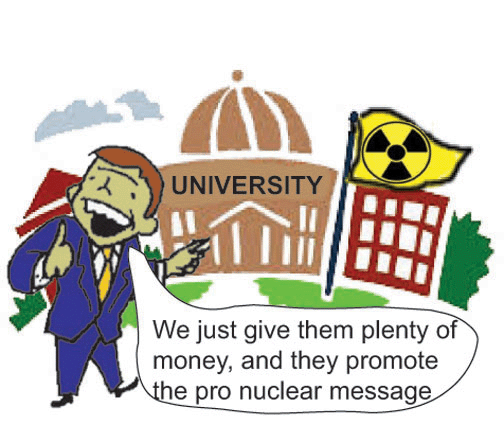

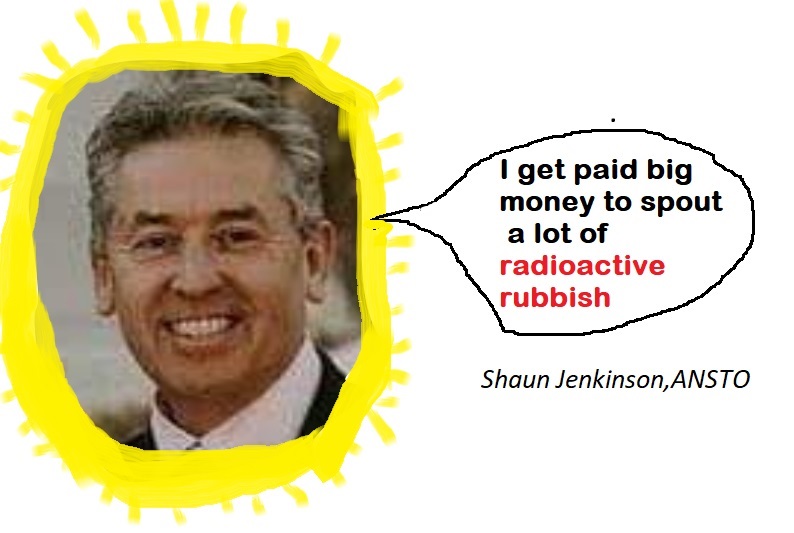
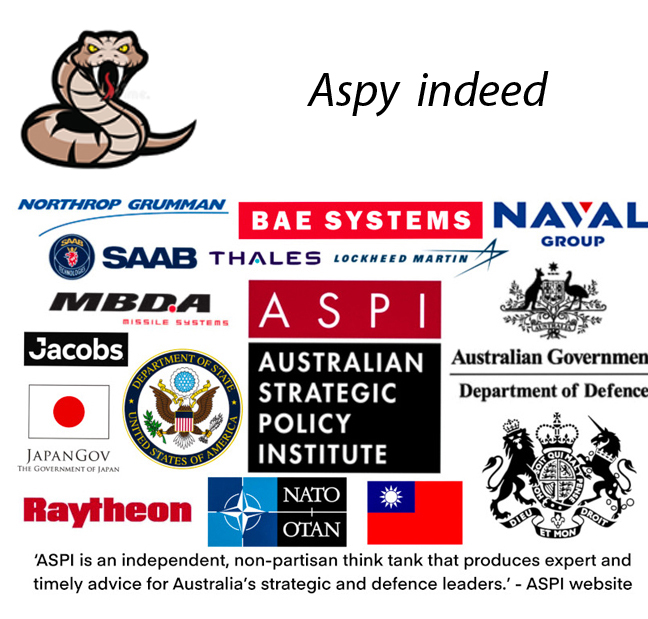


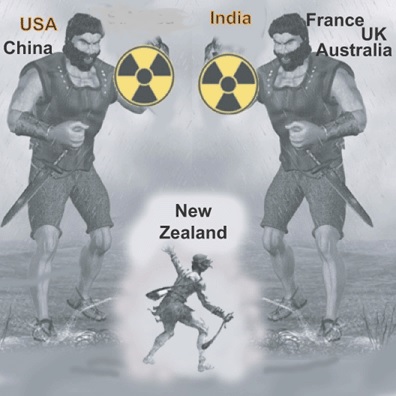

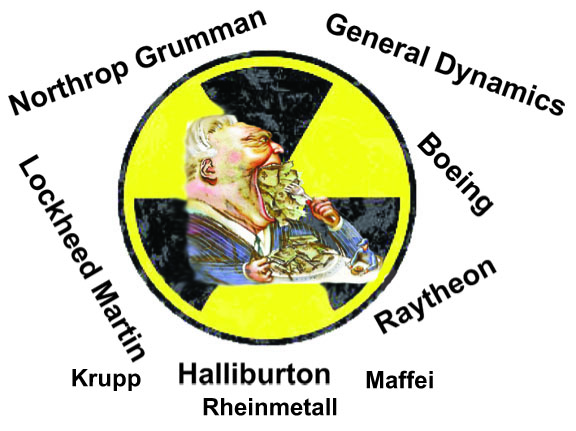


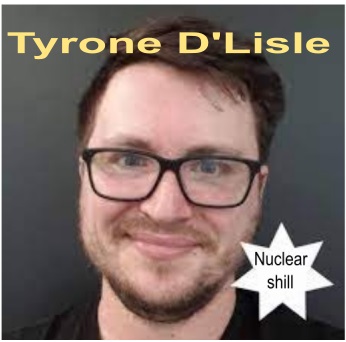
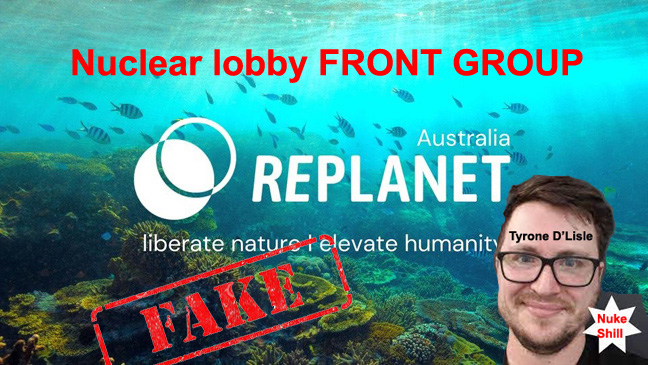

 Antinuclear