The massive holes in Senator Edward’s arguments for “new nuclear” technology for South Australia
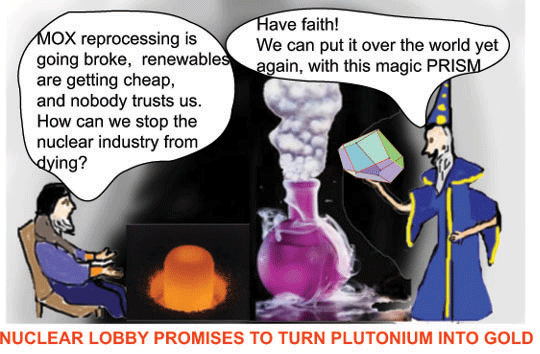
not a single PRISM [ (Power Reactor Innovative Small Module] has actually been built…. the commercial viability of these technologies is unproven
Crucially, under the plan, Australia would have been taking spent fuel for 4 years before the first PRISM came online, assuming the reactors were built on time.
if borehole technology works as intended, and at the prices hoped for, why would any country pay another to take their waste for $1,370,000 a tonne, when a solution exists that only costs $216,000 a tonne, less than one sixth of the price?
 The impossible dream Free electricity sounds too good to be true. It is. A plan to produce free electricity for South Australia by embracing nuclear waste sounds like a wonderful idea. But it won’t work. THE AUSTRALIA INSTITUTE Dan Gilchrist February 2016
“……NEW TECHNOLOGY This comprehensively researched submission asserts that a transformative opportunity is to be found in pairing established, mature practices with cuspof-commercialisation technologies to provide an innovative model of service to the global community. (emphasis added) Edwards’ submission to the Royal Commission
Lynas Rare Earths shares at all-time low
A tiny paragraph on page 25 of the business section of The Age (print version 29/6/15) tells that Lynas shares have plunged. Meanwhile Alkane resources, near Dubbu, NSW, is launching mining of rare earths.
What The Age didn’t tell us, in this tiny paragraph – is what is happening about the reprocessing of these rare earths, and disposal of the highly radioactive wastes. . I’m pretty sure that in the case of Alkane – thi is to be done in China. China, having learned very much the hard way, has now become a lot more careful about these wastes.
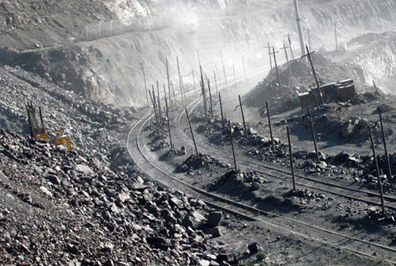
In the case of Lynas, they plan to process the rare earths in Malaysia. Lynas has been vague on what they planned to do with the radioactive wastes. No wonder the Malaysians objected – as they too have in the past, suffered a rare earth’s wastes radioactive disaster. No wonder Lynas is struggling now.
Rare earths AND URANIUM company allying with Clean Energy Council
 We do need to keep an eye on rare earth developments. In the longer term, recycling must be the major way to obtain these. In the shorty term, rare earths are needed, but require vigilant management because of their radioactive toxicity, and need for secure radioactive wastes disposal
Yellow Rock Resources has been accepted as an associate member of the Clean Energy Council of Australia.
Yellow Rock Resources (ASX:YRR) has been accepted as an associate member of the Clean Energy Council (CEC) of Australia.
The membership will allow Yellow Rock to engage with industry participants and policy makers.
Yellow Rock’s admission as a member demonstrates the company’s commitment to developing its world-class Gabanintha vanadium deposit in Western Australia specifically for emerging technology servicing the renewable energy market.
Gabanintha is a project which has the ability to support renewables as a supplier of vanadium for Vanadium Redox Battery technology.
Yellow Rock in discussions with renewable energy suppliers
Yellow Rock has initiated discussions with renewable energy suppliers SunEdison and Total Energy Australia, among others, focused on potential collaborative opportunities at Gabanintha.
Vincent Algar, chief executive, commented: “The latest excellent drilling results give us another opportunity to expand our relationships in the financial and renewable energy sectors.
“Gabanintha is a project which has the ability to support renewables as a supplier of vanadium for battery storage technology.
“In addition, Gabanintha can be supported by renewable energy generation to reduce its own operating costs, making it a unique opportunity for investors.”
About Gabanintha
The Gabanintha deposit is an intrusive layered intrusive body smaller, but displaying similar characteristics to the igneous Bushveld Complex, host to some of the world’s most significant platinum, vanadium and chromite deposits.
The project will have continued newsflow over coming weeks as more results flow through from the recent reverse circulation drilling program. commence on receipt of all assay results.
Currently 167 historical drill holes support an Inferred Resource of 125 million tonnes at 0.70% vanadium, 8.64%TiO2 and 32.6% iron.
This includes a separate high grade Indicated and Inferred Resource of 60.4 million tonnes at 0.98% vanadium, 11.4% TiO2 and 42.15% iron.
Opposition to Australian uranium/rare earths mining company in Greenland
 Uranium opponents look to other sectors for job growth Opponents of uranium mining in southern Greenland have put forward a list of proposals they believe can create jobs and in the process make a highly contested mine unnecessary The Arctic Journal, May 13, 2015 – By Kevin McGwin In the town of Narsaq, on Greenland’s southern tip, debate is coming to a head over whether residents can make do without a near-by mine that will create jobs, but which some fear will make the town unliveable.
The concerns come as Greenland Minerals and Energy, an Australia-based mining outfit, closes in on final approval to begin production rare earths, a mineral vital for use in modern technologies……
in order to extract rare earths, GME will also need to mine uranium as a by-product, and that has raised fears, particularly among farmers, sheep farmers and those making a living off tourism, that dust from the open-pit facility will taint the region’s soil and water, and in the process spoil the region’s image. Continue reading
Recycling of rare earths – an industry already under way
Recycling gives old electronics new life JAMIE DUNCAN AAP MAY 01, 2015 Herald Sun
IMAGINE a world in which billions of dollars of gold, silver, platinum and other precious metals are thrown into a pit like rubbish.
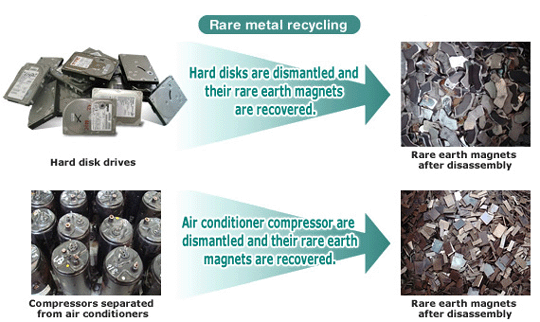
IT seems unlikely, but it’s happening now at landfills around the globe.
- A recent United Nations University report found consumers threw out 41.8 million tonnes of unwanted electronics, or e-waste, in 2014 but recycled only 6.5 million tonnes.That discarded e-waste included an estimated $US52 billion ($A65.78 billion) of precious and other metals.Rose Read, recycling manager with MobileMuster (MobileMuster), says recycling components from e-waste is good for the economy and the environment.”The benefits are massive, and not just in terms of dollar value, but also the environmental benefits of slowing the rate of mining,” Ms Read told AAP.”The amount of energy it takes to recover product materials from a mobile phone is a tenth of digging them up.”MobileMuster is a federal government-accredited product stewardship scheme funded voluntarily by a range of mobile phone manufacturers and retailers that collects unwanted mobiles to recycle components.A similar scheme operates for end-of-life televisions.Consumer thirst for the latest technology is forcing the need to recycle e-waste, Ms Read said…….
- Recycling e-waste entails significant costs, hence the need for industry-funded stewardship schemes, but Ms Read says Australia could build a new, self-sustaining e-waste industry.
- Already, a lead smelter in South Australia is considering expanding to recycle circuit boards locally rather than send them overseas, she said.”There is a whole range of opportunities to create a new industry and employment,” she said.”A lot of new jobs could come out of this. There is some innovative new technology that we can use.”
Essential to design for recycling of rare earths. – theme for April 15
The world is still in the grip of the philosophy of endless growth, endless consumption of material “goods” and energy. Along with that goes the “throwaway mentality.
The result – not just the disappearance of precious resources – water, land , biodiversity – but also the dirty pollution of the ecosphere with wastes. One of the worst is radioactive wastes. (Don’t be caught by the nuclear lobby lie about the’nuclear fuel cycle’ – which is really a chain leading to toxic wastes needing burial)
However, environmentalists must wake up to the fact that nearly all of our advanced technology requires “rare earths” – cerium, 15 lanthanoid elements and one or both of the elements yttrium and scandium. Thorium is often classed with them. Mining these elements results in highly toxic radioactive tailings.
If we’re serious about not creating radioactive wastes disasters, such as the notorious ones in Malaysia and China then the answer must be – DESIGN – designing wind turbines, cell phones, lap-tops etc – in a such a way that the rare metals can be easily retrieved and used again.
“The situation clearly calls for international policy initiatives to minimize the seemingly bizarre situation of spending large amounts of technology, time, energy and money to acquire scarce metals from the mines and then throwing them away after a single use.”
RECYCLING, DESIGN, RARE EARTHS, and the NUCLEAR CHAIN – theme for April 15
FIRST – there is NO “Nuclear Fuel Cycle” – only a toxic Nuclear Fuel Chain 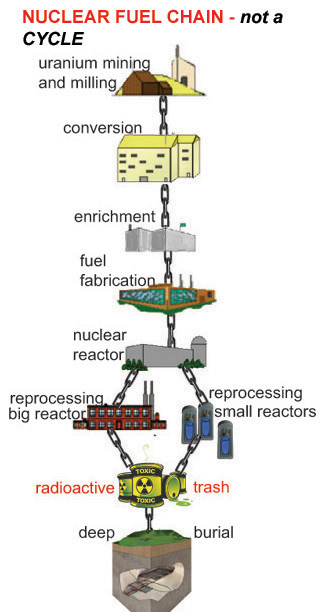
The nuclear lobby is telling one of its finest whoppers – that there really is a “nuclear fuel cycle” – that toxic radioactive wastes can be turned into lucrative nuclear fuel – for a never ending glorious “cycle”
Not true. It is truly a Nuclear Fuel Chain – that the lobby hopes to put around Australians’ necks. The new geewhiz (not yet existing) Liquid Fluoride Thorium Reactors (LFTRs) and Small Modular Nuclear Reactors (SMRs), including the Power Reactor Innovative Small Module (PRISM) – all produce highly toxic wastes that have to be buried. Reprocessing is NOT a “cycle”
SECOND – Rare Earths involve highly radioactive wastes – and require a big switch in DESIGN – so that they can be recycled.
Environmentalists must wake up to this. There must be a paradigm shift from the thinking, (so entrenched in Australia) – from “dig it up – use it – throw it away” – to DESIGN.
The modern technologies that we value – from wind turbines to mobile phones must be redesigned, so that their rare earths can be easily retrieved and re-used.
Otherwise the planet will be further plagued by radioactive wastes from rare earths.

Small Nuclear Reactors for Australia would require same planning as large, proponents conclude
INFRASTRUCTURE, GOVERNMENT AND RESOURCE REQUIREMENTS FOR BOTH LARGE AND SMALL MODULAR REACTOR POWER PLANTS IN AUSTRALIA PART 1- INFRASTRUCTURE 1,2 JAMES BROWN, 1,2 STEFAAN SIMONS and 1,2ANTHONY D. OWEN 1 International Energy Policy Institute (IEPI), UCL Australia, Adelaide, Australia 2 University College London, UK e-mail: james.c.brown@ucl.ac.uk
Abstract This paper considers the minimum infrastructure, construction and waste resource requirements for Australia to deploy both large reactors and small modular reactors to be licensed in the near term, including NuScale, mPower and Westinghouse SMR. The requirements for other types of small modular reactors are provided in some of the comparisons to broaden the range of estimates.
Preliminary estimates suggest that FOAK large and small reactor plants would likely have similar land, infrastructure, fuel and waste requirements per MWe capacity under current regulatory regimes.
This is somewhat in contrast to the perception that SMRs allow for faster approvals, siting and deployment of power plants requiring less infrastructure and resources. However, in the U.S. the development of regulatory approaches for SMR licensing continues, in order to take into account the various designs, modularity, collocation features, and size of the emergency planning zone (EPZ).
 This paper concludes that there are sound arguments for reducing the regulatory requirements due to the inherent safety features of new reactor designs.
However, it would be prudent, though, for governments to proceed with nuclear infrastructure and regulatory planning on the basis that the regulatory requirements for SMRs will not be significantly different to large nuclear power plants, until sometime after they have been commercially deployed.
While this paper acknowledges that SMRs may provide some financial benefits over larger reactors, it is argued that there is little difference in the scale of preparations required to develop Australia’s nuclear that there is little difference in the scale of preparations required to develop Australia’s nuclear power programme capabilities in the near term……..ttp://www.jnrd-nuclear.ro/images/JNRD/No.7/jnrd-7_art1.pdf
IAEA finds Lynas rare earths plan unsatisfactory – no proper radioactive waste plan
 IAEA reports no long-term plan for Lynas waste, Malaysian Insider 17 October 2014 The International Atomic Energy Agency (IAEA) on Friday gave a passing safety grade to a controversial Malaysia rare earths plant, but raised concerns that there was no long-term plan for properly disposing of the plant’s potentially radioactive waste.
The rare earths processing plant in the state of Pahang has generated opposition from green groups who fear radioactive contamination and have accused authorities and Lynas of overriding public concern.
In a report, the IAEA said it saw little risk of contamination due to the low-level radiation involved, and that its investigators were “not able to identify any instances of non-compliance” with international standards. “Lynas needs to demonstrate that the disposal of solid waste can be carried out in a safe manner over the long-term,” the report said.
It recommended that Malaysian authorities require Lynas to come up with a plan.
“There is a lack of a plan for managing the waste from the decommissioning and dismantling of the plant at the end of its life,” it said……
However, it also appeared to underscore environmentalists’ concerns that Australian miner Lynas Corp has no long-term plan for the disposal of waste from the plant.- http://www.themalaysianinsider.com/malaysia/article/iaea-teams-says-lynas-plant-generates-low-level-radioactive-waste-bernama#sthash.JEFk1poD.dpuf
Australian govt’s Energy White Paper misrepresents Friends of the Earth Australia, on nuclear power
to Energy White Paper Taskforce
Department of Industry ,
from D Jim Green
The White Paper misrepresents Friends of the Earth in relation to nuclear power and I am seeking immediate clarification on a couple of points.
The WP states: “However, the relative safety of nuclear power is reflected in a 2013 study commissioned by Friends of the Earth, which concluded that, “overall the safety risks associated with nuclear power appear to be more in line with lifecycle impacts from renewable energy technologies, and significantly lower than for coal and natural gas per MWh of supplied energy.”
 Question 1: Why does the WP not specify that the study was commissioned by Friends of the Earth UK?
Question 2: Why does the WP fail to note that the commissioned paper raised multiple objections to nuclear power, and that FoE UK retained its anti-nuclear policies as a result of the review process, e.g. from the article below ‘The non-nuclear energy pathway that Friends of the Earth advocates is credible …’
http://www.foe.co.uk/news/nuclear_40884
Please provide immediate answers to the above questions since the misrepresentation is a matter of great concern.
Please also advise if the Department or the Minister will immediately issue a media release correcting the mirepresentation. Alternatively, will the Department put a note on the relevant webpage noting that the WP fails to specify that the Friends of the Earth group in question is FoE UK and that FoE UK retained its anti-nuclear policies as a result of the review process.
Jim Green
——————————————–
Jim Green B.Med.Sci.(Hons.), PhD
National nuclear campaigner – Friends of the Earth, Australia
Dear Dr Green
Thank you for your email to the Energy White Paper Taskforce regarding the citation of the Tyndall Centre report.
To clarify, the paper released is the interim Green Paper, which is the basis for consultation on policy issues. Submissions received until 4 November will help inform the development of the Energy White Paper. We expect to release the Energy White Paper later this year.
On the referencing of the report, we note that the quotation is accurate, and the footnote referencing provides enough detail to clarify that the report is based on a UK analysis, and allows for easy access to the online report in full, including the report origins and relevant disclaimers, as would be normal practice.
We acknowledge your preference that the report be linked to Friends of the Earth UK more explicitly in text, rather than through accessing the commissioning and disclaimer detail of the report itself. Given that concern, should the reference be used in the Energy White Paper, we will ensure that the body of our text includes the distinction. We would appreciate your guidance as to whether the preference is to use UK, or the full ‘England, Wales and Northern Ireland’ as per the report cover.
Regards
Energy White Paper Taskforce
Department of Industry
GPO Box 9839, Canberra ACT 2601
Email: ewp@industry.gov.au
Internet: www.ewp.industry.gov.au
Risks of uranium mining outweigh any benefits
 Anti-uranium activists criticise NSW exploration program, Australian Mining 15 September, 2014 Vicky Validakis Anti-nuclear campaigners have criticised the NSW government for opening up the state to uranium exploration.
Last week the state government invited six companies to apply for exploration licences.
The move comes two years after NSW overturned a uranium exploration ban. Mining uranium is still restricted.
Three locations around NSW – near Broken Hill, near Cobar and south of Dubbo – have been earmarked for drilling activity.
Natalie Wasley, spokeswomen for the Beyond Nuclear Initiative, said the decision was disappointing, ABC reported.
“Uranium has very unique and dangerous properties and risks,” Wasley said. “It’s linked to the production of the world’s most toxic and long-lasting industrial waste, as well as proliferation of the world’s most destructive weapons, so it poses a risk to workers, to communities and the environment.”
Wasley said the sector will only create a small number of jobs, and claims the risks associated with uranium outweigh any economic benefits. “We know that in rural and regional areas there’s a much better opportunity for long-lasting sustainable jobs in the renewable sector.”
“We’d really encourage those local governments and the state governments to be putting money and resources into developing more creative, long-term and sustainable jobs for people.”……..
The six companies invited to apply for licenses are Australian Zirconia, Callabonna Resources, EJ Resources, Hartz Rare Earths, Iluka Resources and Marmota Energy. http://www.miningaustralia.com.au/news/anti-uranium-activists-criticise-nsw-exploration-p
Uranium mining still prohibited in New South Wales, and not considered economically viable
Uranium exploration in western NSW – but mining is still prohibited NSW Country Hour Sally Bryant and Julie Clift 15 Sept 14, The New South Wales Government has invited six mining companies to put in expressions of interest to explore for uranium, but mining will remain prohibited, until deposits prove economically viable.
However not all of the mining companies who are involved in this process are actually interested in mining for uranium.
One of six companies invited to tender for an exploration licence, Alkane Resources, is developing a rare earth project near Dubbo, in the state’s central west.

Alkane say they’re not interested in uranium, that they are merely protecting their rare earth project from other resource companies applying for an exploration licence over the top of them
Managing Director Ian Chalmers says this is an insurance policy for his company……..http://www.abc.net.au/news/2014-09-15/uranium-exploration-in-western-nsw/5743584
Rare Earths mining in Central Australia
Note: We mightn’t like mining, and it will be good when eventually product design is such that recycling of rare earths will pretty much eliminate this. Still, rare earths are needed in 21st Century technologies, especially in renewables. At least this company is not involved in the difficult and hazardous rare earths processing. I understand that processing is to be done in China, – where, after their disastrous history, they now do have the most advanced methods
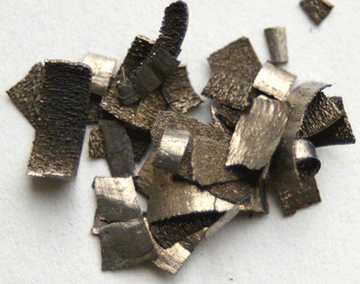 Mining company Arafura Resources says plans to mine rare earth minerals in central Australia remain ‘on track’, despite uncertainty over future funding for the project, ABC Rural News 3 Sept 14, NT Country Hour By Carmen Brown
The company hopes to extract up to 20,000 tonnes of rare earth oxide per year from the Nolan’s Bore deposit, 135 kilometres north-east of Alice Springs in the Northern Territory.
A comprehensive project report released this week, indicates mining could begin at the site in 2019, six years later than previously expected. General manager of exploration and business development, Richard Brescianini, says while there has been strong interest in the project from investors, the company is yet to secure full financial backing for the mine……http://www.abc.net.au/news/2014-09-03/rare-earth-mine-on-track-for-central-australia/5715100
Troubled rare earths miner Lynas to move from Sydney to malaysia
Nervous investors ditch Lynas ahead of move to Malaysia July 3, 2014 The Age, Brian Robins Troubled rare-earth miner Lynas Corp is to shift its head office abroad as part of a renewed cost-cutting regime as the company seeks to stop haemorrhaging cash.
It also comes amid production difficulties at its recently commissioned Malaysian processing unit that have yet to be resolved, and as negotiations continue to refinance a key funding package.
Lynas said it would move its head office to Kuala Lumpur, from Sydney, which will result in an unspecified number of job losses, with further jobs to go at its Perth office…….Investors were unnerved by the latest news, pushing Lynas shares down 7 per cent to close at 13¢.
Lynas is not the only rare earths producer encountering ongoing problems in lifting output, with US group Molycorp also struggling to bed down a capacity expansion.
Equally important to Lynas Corp’s near-term progress is resolving negotiations to refinance a $US325 million loan, via Nomura.
There has been ”no material development” with this refinancing, a Lynas spokesman said.
To help shore up its balance sheet, Lynas recently raised $40 million from shareholders as well as replacing its chief executive. http://www.smh.com.au/business/nervous-investors-ditch-lynas-ahead-of-move-to-malaysia-20140702-3b8so.html#ixzz36Xf4ozEk
Activist Natalie Lowrey freed, following Malaysian arrest for ant-Lynas protest
Aust activist freed from Malaysia cell http://www.heraldsun.com.au/news/breaking-news/aust-activist-freed-from-malaysia-cell/story-fni0xqll-1226970174011l AAP JUNE 28, 2014 SYDNEY woman Natalie Lowrey has been released after being detained for six days in Malaysia, where she was protesting against an Australian company’s metals plant.
MS Lowrey was arrested on Sunday while demonstrating at Lynas’ controversial plant for rare earths, which are used in tech products like smartphones.
Police were weighing a charge of unlawful assembly, which carries a maximum two-year jail term.
But on Friday night, as the New Zealander was preparing to spend a weekend behind bars with no visitors, she was suddenly released on bail.”It was a big surprise, I didn’t believe it until I had changed out of my purple jail uniform,” she told AAP.
“I felt very strong the whole week because I knew there were vigils all over Australia and Malaysia for me. I have a lot of people to thank.”
Lowrey was released along with 15 Malaysians who had also been arrested.
The lack of transparency around Ms Lowrey’s detention concerned lawyers and NGOs, who collected more than 15,000 signatures on a petition to free her.
She has her passport back and plans to leave Malaysia next week.
1 This month

of the week – Australians for War Powers Reform (AWPR)
To see nuclear-related stories in greater depth and intensity
 Antinuclear