Rare Earths Reprocessing in Australia
Note – I am not opposed to the mining and reprocessing of rare earths. I recognise that they are a necessary “lesser evil” in the development of modern and renewable technologies. BUT – rare earths reprocessing does produce toxic radioactive wastes, and the disposal of these wastes is an important issue that must be adressed, and clearly shown [ rather than spun] to the public. – Christina Macpherson
 Whilst working with Alkane on a pilot rare earths processing plant, ANSTO has previously partnered with BHP Billiton at the Olympic Dam mine, Energy Resources Australia at the Ranger uranium mine, and a number of other Australian-based miners.
Chalmers marked final government approvals as other major hurdles beyond the research with ANSTO.
And while so far steering clear of local opposition, the company remains mindful of the importance of keeping those outside the industry on side.
All eyes on ANSTO, Australian Mining, 10 August, 2012 Andrew Duffy “….. On a tour of its ANSTO pilot plant Alkane managing director Ian Chalmers told Australian Mining the company [ Alkane Resources ] was aiming to be producing rare earths by 2015…..
The company also runs tours for schools and interested community members to ensure everyone’s well informed.
Chalmers told Australian Mining Alkane’s close relationship with the community had been part of the reason why the company had avoided the difficulties faced by Lynas. Lynas has faced significant community opposition to its rare earth
processing plant in Malaysia, and protestors have been the source of ongoing delays, cost blowouts, and multiple court battles. ….
while the company’s community and environmental relations are a focus, the research at its ANSTO plant is all about the science behind rare earths processing. Continue reading
Lynas rare earths project in trouble: investment advice to dump Lynas
 Analysts recommend investors dump Lynas Australian Mining, 10 August, 2012 Andrew Duffy Foster Stockbroking has recommended investors sell shares in Lynas because the company’s rare earths processing plant in Malaysia is likely to face further delays. In an investor note today Foster said approval of the Lynas Advanced Materials Plant had been “a drawn out saga” and the upcoming Malaysian election would force further delays.
“Appeals by local groups and the opposition party regarding the environmental impacts of the plant have resulted in the LAMP becoming a politically sensitive issue and delayed a final decision on issuing the licence,” Foster analysts said…..
http://www.miningaustralia.com.au/news/analysts-recommend-investors-dump-lynas?fb_ref=.UCX0ch5fn6U.like&fb_source=home_oneline
Australia’s ACDC stars in hacking into Iran’s nuclear facilities
 The latest cyber weapon to rock Iran’s nuclear program? Australia’s AC/DC The Star, July 25, 2012, Bloomberg, DUBAI, UNITED ARAB EMIRATES — Iran’s nuclear facilities have suffered a cyber attack that shut down computers and played music from the rock band AC/DC, the F-Secure Security Labs website says.
A new worm targeted Iran’s nuclear program, closing down the “automation network” at the Natanz and Fordo facilities, the Internet security site reported, citing an email it said was sent by a scientist inside Iran’s Atomic Energy Organization.
The virus also prompted several of the computers on site to play the song “Thunderstruck” by AC/DC at full volume in the middle of the night, according to the e-mail, part of which is published in English on the website……
AC/DC has played “high voltage rock ‘n’ roll” since the band was formed in 1973 in Australia, according to the band’s website. The group’s songs were among the loud music played to detainees at the Guantanamo Bay prison facility in preparation for interrogations, the Associated Press reported in October 2009, citing the National
Security Archive in Washington….. http://www.thestar.com/news/world/article/1231457–the-latest-cyber-weapon-to-rock-iran-s-nuclear-program-australia-s-ac-dc
Australia cannot ignore the problems of rare earths, and should develop recycling, as one answer
 Recycling Rare Earths Stop Lynas, 11 July 12, “…….We know that human induced climate change is a fact. Solutions to cut carbon emissions include energy efficiency, hybrid cars and renewable technologies like wind power which all need rare earths. But it is a dangerous path we are on when we continue with the ‘business as usual’ moto – instead we must continue to challenge the influence of governments and corporations that do not take people’s needs into account by protecting human rights and the environment for future generations.
One partial solution to the negative impacts of rare earth mining and processing would be to reduce consumption and increase the reuse and recycling rates of rare earth elements. Currently the recycling rate for most rare earth metals is around 1% or less . Japan is exploring increased recycling of rare earths fromelectronic waste . If the price of the final materials included the true social and environmental costs of rare earth mining, the incentive to recycle and dig up less would increase.
We must be concerned not only with how our use of rare earths contributes to their depletion, but also how pollution from the production, processing and use of rare earths should be considered in the context of our use – particularly because rare earths are recyclable. http://stoplynas.org/recycle-rare-earths/
Olympic Dam copper/uranium mine’s future more doubtful, with rise of RECYCLING of metals
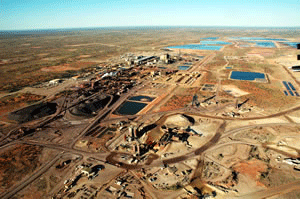 Olympic Dam is surely under review,” said UBS mining analyst Glyn Lawcock. “It’s not an issue of
 finding the cash,” he
said, but rather ensuring a good return on the investment……
Further curbing the appetite for refined copper, BHP now sees recycled scrap meeting up to 50 percent of China’s overall demand in the coming year for the metal, up from 35 percent now.
there is a much bigger question mark over it [Olympic Dam new mine] now
BHP Olympic Dam delay would tighten copper supply Reuters, By James Regan SYDNEY | Fri Jul 6, 2012 “….. A 25 percent drop in benchmark international copper prices since early 2011 has eroded potential returns from the project, and the economic slowdown in top base metal consumer China has dampened the demand outlook.
BHP’s scheme to quadruple output from Olympic Dam – the fourth-largest known copper deposit and largest uranium source in the world – is one a growing number analysts believe likely to be shelved until markets stabilize…. London copper prices have fallen to around $7,650 a metric ton (1.1023 tons) from a peak over $10,000 in early 2011 as big copper buyers such as car and computer manufacturers slow consumption… Continue reading
Australian invention – laser uranium enrichment raises nuclear weapons proliferation risks.
a tension between the United States’ goal of safely commercializing nuclear-power technology and its efforts to control the proliferation of nuclear materials. “When there’s a conflict, generally speaking, the policy to spread nuclear technology overrides the non-proliferation policy.”
 Laser-based uranium enrichment plant sparks controversy 07/05/2012 Laser Focus World by Gail Overton Senior Editor Washington, DC–A July 4 Nature news story from Sharon Weinberger says that the U.S. Nuclear Regulatory Commission’s decision to open a plant that uses laser-based uranium enrichment will be considered in private. Although the controversial laser uranium-enrichment technology is on the cusp of making it cheaper to create fuel for nuclear power plants, some non-proliferation experts are concerned that the efficiency of the laser-based technology will also smooth the path for bomb makers. Continue reading
Globe company mining rare earths, but sending them to China for processing
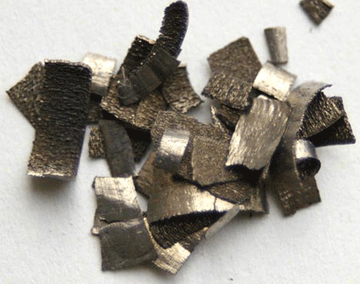 Globe tests waters with new rare earth spinoff Kate Emery | View Archive, The West, June 11, 2012, “……..Uranium had its pre-GFC day in the sun and, more recently, it was rare earths’ time to shine, with prices for the not-actually-so-rare metals soaring on the back of moves by China to restrict supply. Prices for the handful of Australian-listed rare earths players rocketed in response and investors were suddenly talking about the likes of scandium and yttrium.
Fast forward to mid-2012 and the heat has decidedly come out of rare earths stocks.
There’s no one reason for the fall, most likely a combination of the dramas encountered by Australia’s sole rare earths miner, Lynas Corp, at its Malaysian processing plant, global macroeconomic conditions and a realisation that the surge in prices is unsustainable.
Globe Metals and Mining knows something about how quickly investor sentiment can turn when it comes to commodity bubbles, having lived a past life as Globe Uranium….. Arafura has encountered its share of obstacles and, as with Lynas, they have been largely associated with the processing side of the business.
Globe hopes to sidestep that potential pitfall by establishing Mount Muambe as a mining-only operation, shipping the product to China for processing….. http://au.news.yahoo.com/thewest/opinion/post/-/blog/13920051/globe-tests-waters-with-new-rare-earth-spinoff/
Lynas rare earths plant in Malaysia to go ahead without plan for long term disposal of radioactive wastes?
 why are we talking about a storage facility in Malaysia when it was made clear that one of the prerequisite to the Temporary Operating License or TOL is that the waste be shipped back to Western Australia?
The Australian government reiterated that it will not accept responsibility for any waste material produced by Lynas, although one of the five conditions attached to the recent approval of its temporary operating license is that it must take full responsibility for waste management from its plant including returning the waste to the source, if necessary.
But in a media briefing, AELB director-general, Raja Abdul Aziz Raja Adnan, gave his assurance that the board would insist on a letter of undertaking from Lynas Australia that it would adhere to this condition.
TOL sell-out by PSC: The final smirk from Lynas Malaysia Chronicle, by Charles Santiago, 19 June 12, We welcome the report of the Parliamentary Select Committee which has produced its recommendations, including the upgrading of the standards used by the AELB. But while we appreciate the effort, this is clearly a document which has only looked at ways to keep the Lynas Advance Material Plant (LAMP) in operation.
The key area – returning the radioactive waste to Western Australia – has not been looked at although it was one of the earliest pre-conditions to the government granting Lynas a Temporary Operating License.
Violating pre-requisite to the Temporary Operating License (TOL) Over a ten-year period of the plant’s operation, the total volume of wastes will amount to 2,766,600 cubic metro. Over a 20-year period, as Lynas continues to enjoy its tax break, the waste would presumably have doubled. And it is highly inconceivable that there will be enough soil and technology available to “dilute” the wastes and remove its radiation level to natural ground level radiation.
This is especially crucial as Lynas plans to store the wastes onside in the Residue Storage Facility (RSF). Continue reading
Lynas’s rare earths stockpile near Fremantle – call for transparency in its radiation monitoring
 Rare earth stockpile radiation levels questioned ABC News, June 20, 2012 An MP is calling on the State Government to make radiation monitoring results public after revelations the Lynas Corporation has been stockpiling rare earth concentrate in Bibra Lake. The Member for Fremantle, Adele Carles, says the Government is yet to confirm whether
monitoring is being conducted.
The Environment Minister Bill Marmion has confirmed the containers have been held at Lynas’ holding yard since March…… Ms Carles says the Government is basically saying the material is perfectly safe. “I say to them, well, if it’s so safe, then release to us the radiation monitoring so that we can see that for ourselves,” she said.
Ms Carles says monitoring is required under a Radiation Management Plan. “That requires that if this material is stored anywhere for more than 24 hours, there must be radiation monitoring,” she said. “I’ve asked to get copies of this monitoring and the Minister has basically denied that information.” http://www.abc.net.au/news/2012-06-20/questions-over-rare-earth-stockpile/4081280?section=wa
Australian rare earths company Lynas backing out of its processing project in Africa
Lynas Likely To Give Up Rare Earths Project in Africa International Business Times, By Esther Tanquintic-Misa | June 14, 2012 With its highly-controversial Malaysian rare earths processing plant an already ample source of headache, Lynas Corp. has been reported to be likely backing out from another rare earths project, this time in Africa.
Citing unidentified industry sources, The West Australian reported that Lynas Corp. is thinking of shunning the Kangankunde rare earths project in Malawi after a Malawi High Court questioned the authenticity of the Australian miner’s ownership over the project…..
With the recent development, the Australian rare earths miner deemed it might be better to give up the African project altogether, than suffer again the same fate as with its highly controversial rare earths processing plant in Malaysia, The West Australian reported…. Lynas Corp. “is reassessing the project’s risks in the context of Malawi’s present governance and institutional frameworks,” sources told The West Australian. … http://au.ibtimes.com/articles/351984/20120614/lynas-corp-rare-earths-malawi-africa-malaysia.htm
Australia will NOT be getting radiation “backscatter” airport scanners.
 Christina Macpherson, 6 June 12, Contrary to a report in the Sun Herald today (http://www.heraldsun.com.au/ipad/full-body-scanners-to-rollout-at-australian-airport/story-fn6bfm6w-1226381431157) the radiation hazards of “backscatter” scanning will not be hitting Australians at our airports.
Australia will be getting the safer type , see https://antinuclear.net/2012/02/05/australias-compulsory-airport-scanning-will-be-of-the-safer-type-not-ionising-radiation/#more-14153
Report on Aviation Transport Security Amendment (Screening) Bill 2012
The report of the Committee into this Bill was issued last week, and recommended against back scatters for people. While it may be possible some time in the future to use them for some special case, this is most unlikely. Australia does not have the radiation type of scanner, and it is highly expensive. The report can be read at . http://www.aph.gov.au/Parliamentary_Business/Committees/Senate_Committees?url=rrat_ctte/aviation_screening_2012/index.htm
Australian rare earths company Lynas held back by public opposition in Malaysia
the expanding protest movement …… has already delayed the project by eight months and cast a shadow over its future.
The resistance – fed by social networks and Malaysia’s increasingly lively independent online media – also raises broader questions over the global expansion of an industry that has created huge environmental problems in China
Opponents say the Lynas plant doesn’t meet with best practice standards for the industry as it is too close to heavily populated areas and in a place where the ground water level is high. Molycorp’s plant in California, by comparison, is situated far from residential areas in an arid climate.
Citizen backlash keeps Malaysia rare earth plant on hold, The West, Siva Sithraputhran, Reuters May 9, 2012 GEBENG, Malaysia – The expensive machinery lies silent, idling as Malaysia’s government weighs a delicate decision to allow shipments of raw material to arrive from Australia and finally start operations at the world’s largest rare earths plant outside China. Continue reading
Financial analysts recognise the risks of radioactive by-products of rare earths processing
Uranium and thorium present real risk to rare earths developers – Dennis Mineweb 2 May Interview with Carolyn Dennis of Dundee Capital Markets “….. TCMR: Some rare earth deposits include uranium and thorium byproducts and, if a company is not recovering those, it needs to dispose of them. Is that a challenge most REE miners face?
CD: It’s a real risk across the board for rare earth companies. Each deposit, depending on the type of mineralogy, will have varying grades of uranium and thorium. The jurisdiction the deposit is in and how it approaches dealing with the uranium, thorium and radioactivity will dictate how much of an issue it is for the project. It can be a problem in processing as well. In a lot of cases, the thorium should be removed from the concentrate earlier in the process in order to improve processing downstream. Beyond that, radioactive waste material needs to be disposed of….”
Australian Nuclear Science and Technology Organisation helping Japan to study radiation
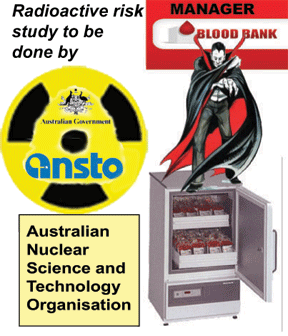 It’s interesting that ANSTO will be studying ‘naturally occurring radiation” and will be “supporting Japan in the wake of the Fukushima nuclear disaster “. They don’t seem to be showing much interest in monitoring nuclear-power-caused radiation, and I can’t help wondering about that support for Japan. Could it be support for the Japanese government and nuclear industry minimising the real impact of the Fukushima disaster? After all, ANSTO’s main business is in keeping the door open for nuclear power in Australia.
Centre gauges radiation St George and Sutherland Shire Leader BY KATE CARR 27 Apr, 2012 AFTER months of searching for the perfect concrete and pre-World War II steel, ANSTO’s new $8.7 million radioactivity measurement centre officially opened on Tuesday. Federal Science and Research Minister Chris Evans helped ANSTO chief executive Adi Paterson cut the red ribbon and opened the centre, where scientists can accurately measure naturally occurring radiation…..
Dr Paterson said the centre would give ANSTO the tools to monitor the amount of radiation in the environment and undertake research which could support Japan in the wake of the Fukushima nuclear disaster that followed an earthquake and tsunami.
The new centre needed to be built using specialised materials so that it had such low background radiation that equipment could detect tiny amounts of radiation which might otherwise be drowned out. The centre also includes the only ITRAX core scanner in Australia, a piece of equipment used to measure the composition of sediment core samples taken by drilling. http://www.theleader.com.au/news/local/news/general/centre-gauges-radiation/2535888.aspx
Australian company Lynas suing Malaysian news portal for defamation
Local regulators Atomic Energy Licensing Board (AELB) had said in January it would approve a TOL subject to added conditions including identifying a suitable long-term waste disposal site.
Lynas had said last month that identifying this site “is a work in progress.” It also said prior to AELB’s decision that a permanent depository facility (PDF) will only be needed in a “worst-case scenario” where it is unable to reprocess the waste into a commercial product.


 Lynas sues news portal, protest groups for defamation, The Malaysian Insider, By Anisah Shukry April 20, 2012 KUALA LUMPUR, — Lynas Corp has filed a defamation suit against online news portal Free Malaysia Today for “false and misleading statements” in a recently published article.
The Australian mining group is also suing Save Malaysia, Stop Lynas’s (SMSL) directors and committee members over an open letter published on the group’s web site…..
Lynas has faced fierce protests from Kuantan residents and opposition politicians who say that the RM2.5 billion rare-earth refinery in nearby Gebeng will cause radiation pollution Continue reading
1 This month

of the week – Disrupting War & Militarism in Oceania. Active solidarity. Radical practice.
 Antinuclear