Save Malaysia Stop Lynas (SMSL) group calls on Malaysian govt to shut down Lynas rare earth refinery
Shut down Lynas plant immediately, Harapan gov’t urged, malaysia kini 12 Nov 2018, Anti-Lynas group Save Malaysia Stop Lynas (SMSL) has called on the Pakatan Harapan government to immediately shut down the Australian-owned Lynas rare earth refinery plant in Gebeng, Kuantan.
In a statement after a public meeting held by the Lynas Review Committee in Kuantan, SMSL said that the citizens have demanded the shutdown of Lynas, which was evident by the presence of about 600 people at the meeting….
SMSL, which has been campaigning against the operation of the plant since 2011, said that several court cases have been initiated to stop the then-Najib government from issuing Lynas Corporation the licence to operate and leave massive amounts of waste contaminated with radioactive materials.
These include thorium and uranium, and hazardous substances like arsenic, cadmium, chromium and lead as well as chemicals from its refinery plant using ore concentrates from its Australian mine.
SMSL legal adviser Hon Kai Ping claimed that Lynas had breached its licensing conditions in many ways and there has been no subsequent action from the regulators. …..
SMSL said Lynas’ water leached purification residue (WLP) waste has radioactivity of close to 8Bq/g, according to a 2014 UKM research findings, eight times higher than the regulatory exemption limit.
“According to a Department of Environment document, over 450 kilo-tonne of WLP waste is now stored next to the refinery plant in dams lined only with thin HDPE (high-density polyethylene) plastic…….
It said that Lynas has proposed to turn its wastes into various commercial products – from building and road paving materials to a soil filler known as Condisoil.
It added that all of the proposed diluted products by Lynas, when released to the market, will almost certainly exceed the 1mSv/year cumulative dose limit, posing serious health and environmental risks to the whole country.
“The toxic legacy of Bukit Merah was created from monazite from our domestic tin tailing……
Pahang Department of Environment (DOE) director Rosli Zul said in his presentation that Lynas had indeed followed rules imposed by authorities since it began operations. https://www.malaysiakini.com/news/451530?fbclid=IwAR2fGT-ABGsw7Rxxv8jm3POzWdeSRKgTs_1tO30VFpd9uaph0h3Es9ohjBI
Radioactive pollution problems: Australia’s rare earths mine in Malaysia
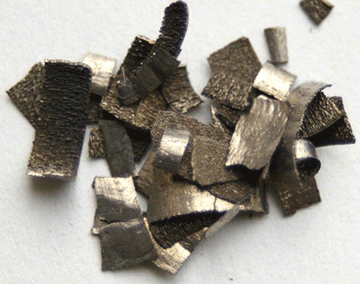 Australian mining plant in Malaysia faces radioactive waste inquiry, As China, the world’s largest producer of rare earth metals, scales back its export operations, the future of Australia’s industry is under a cloud. https://www.sbs.com.au/news/australian-mining-plant-in-malaysia-faces-radioactive-waste-inquiry By Jarni Blakkarly 30 Oct 18, The Chinese government has announced a slashing in the production of rare earth metals, a type of metal used in a range of high-tech products from mobile phones to wind turbines and electric cars.
The country, which is the largest producer and consumer of rare earth metals, has cut its quota for the separation and smelting of rare earths by 36 percent, Reuters reported last week.
China produces roughly 80 per cent of the world’s rare earth metals and the move will likely send global prices skyrocketing. Meanwhile, the joint Australian-Malaysian rare earths operation run by Perth company Lynas, the only major production plant outside of China, is having its own problems.
Earlier this month, the Malaysian government launched a broad parliamentary inquiry into the mine and the management of its radioactive waste.
The Australian company mines rare earth metals in Western Australia before shipping them to Malaysia for processing.
Resources analyst Dylan Kelly from finance group CLSA told SBS News: “It is really critical in a strategic sense as the only real rare earth producer outside of mainland China and one that is high in quality and it is highly sought after in terms of strategic interest, not just for the Japanese, but also the US.”
But questions remain over the management of radioactive waste from the plant and what long-term solutions are in place for its management.
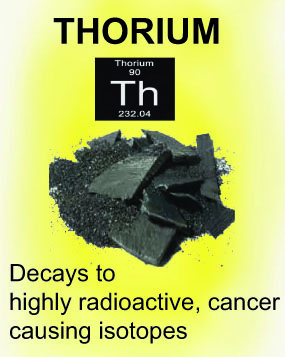 RMIT Professor of environmental engineering Gavin Mudd told SBS News all rare earths processing involves the generation of radioactive thorium and sometimes uranium waste.
The company’s current long-term waste management plans involve repurposing that waste into a soil fertilizer product, but Professor Mudd says not enough has been done yet to guarantee the by-product would be safe.
“Historically the rare earths industry hasn’t got a good track record in being able to demonstrate that safety case,” he said.
While the current government inquiry appears unlikely to shut the processing plant down in its entirety, Professor Mudd says more can be done in terms of increasing environmental reporting and public disclosure around the plant.
Lynas declined to comment to SBS News ahead of the inquiry, but in the past has defended its waste management practices as safe and transparent.
When the plant was approved in 2012 it set a wave of protests by thousands of concerned locals, which was largely ignored by the government.
But with the Opposition coming to power in a surprise election victory in May, the new government is taking a closer look at the plant.
Local Kuantan MP Faziah Salleh says the company needs to develop a new long-term storage plan for the radioactive waste.
“The company has to think about how they dispose of their radioactive waste, because Malaysians, especially people of [the city of] Kuantan, will not except the waste being left … dumped in our backyard, as it is right now,” she said.
The inquiry is due to report back to the government before the end of the year.
Department of Industry, Innovation and Science chief economist enthusiastic about the lithium industry
|
Lithium ‘buzz’ could be worth hundreds of billions to Australia, WA Today By Hamish Hastie, 2 October 2018 —Australia has the potential to capture more wealth and jobs from its lithium sector by moving down the battery supply chain but this would be contingent on a number of factors, one of the federal government’s top economists thinks.
In his resources and energy quarterly update Department of Industry, Innovation and Science chief economist Mark Cully said lithium and battery demand could result in billions of dollars for a country that grabbed the opportunity………https://www.watoday.com.au/business/the-economy/lithium-buzz-could-be-worth-hundreds-of-billions-to-australia-20181002-p507cb.html |
|
|
Another lithium mine opened in Western Australia
WA’s newest lithium mine plans to double down, WA Today By Hamish Hastie, 5 September 2018 Western Australia’s newest lithium mine was officially opened this morning, marking the seventh operating mine in the state.
Altura Mining’s 100 per cent-owned Pilgangoora lithium mine is located 90 kilometres south-east of Port Hedland and will support 130 ongoing jobs. The mine will produce about 220,000 tonnes per annum of lithium spodumene concentrate but the company is already considering plans to double production to tap into growing global battery demand for electric vehicles and storage.
The Pilgangoora lithium deposit currently has an ore reserve estimate of 41.1 million tonnes…..
Beyond just exporting lithium the state government’s lithium and energy materials industry taskforce is investigating the state’s ability to produce and process lithium and other energy materials.
The taskforce will present a lithium and energy materials strategy to cabinet over the next few months……https://www.watoday.com.au/business/companies/wa-s-newest-lithium-mine-plans-to-double-down-20180905-p501v3.html?crpt=index
Australia should follow Canada- producing medical isotopes in cyclotron, not nuclear reactor
Steve Dale Nuclear Fuel Cycle Watch South Australia, 5 Aug 18 Is this what they call a strawman argument? Who wants to import isotopes? I don’t want Australia to import isotopes, I want Australia to make them here using Cyclotrons and other forms of accelerators. If you read the author’s twitter feed you will see he is strongly advocating for nuclear power reactors, which makes you wonder if he is looking at isotope production objectively.
Here are some things to think about –
– dissolving Uranium plates to extract the Moly is a process that produces a lot of waste with many steps in the process that have potential for failure or human error
– using Low enriched Uranium plates produces much more waste than High enriched Uranium plates (obviously neither is desirable)
– apparently there is a move away from Technetium99 because it is considered low resolution imaging, some predicting that it will not be used in 10 years because of the superior imaging of PET/cyclotron isotopes
– the isotopes generated in a cyclotron have a very short half life, so they can be kept for a few days and thrown in the general trash
So to summarise. Moly99/Technetium99 is on the way out, yet tax payers have funded a factory to build a factory that can only make Moly99/Te99 – unlike a cyclotron that can make all sorts of isotopes. And instead of building a facility to cater for our own supply, they have built a taxpayer funded factory to speculate on the world wide isotope market.
Canada is showing another way using cyclotrons-
“”The newer radionuclides that are used, the so-called PET imaging agents, give a much more high-resolution picture,” said Wilson. “We’re slowly moving toward more PET isotopes.” https://www.facebook.com/groups/1021186047913052/permalink/2053022201396093/?comment_id=2053155368049443
Australian company Silex pulls out of U.S. laser uranium enrichment projects
Silex pulls out of U.S. laser enrichment projects, JUNE 13, 2018
Silex Systems Limited, an Australian company that own the Silex laser enrichment technology, announced that it will not be participating in the restructuring of the Global Laser Enrichment (GLE), a venture that was set up by General Electric and Hitachi to use the technology to build uranium enrichment facilities in the United States. Canadian company Cameco joined the project in 2008.
In 2012 GLE obtained a license to build an enrichment facility in Wilmington, NC. That project, however, was put on hold as the demand for enrichment services dropped after Fukushima. In 2014, GLE expressed interest in building a facility in Paducah, at the site of the gaseous diffusion plant closed down in 2013. The new plant was supposed to enrich tails of the old enrichment operation to produce “natural-grade” uranium. In November 2016 GLE secured an agreement with the U.S. Department of Energy to acquire the tails. In April 2016, however, GE-Hitachi announced its intent to leave GLE. Silex Systems considered acquiring the GE-Hitachi stake in the company (which is 76%), but now ti decided against it.
In addition, Silex said it intends to give notice to GLE of the termination of the SILEX technology license “unless circumstances change dramatically in the short term”. This most likely means that all plans to build a Silex-based commercial uranium enrichment facility in the United States are now terminated.
Queensland’s nuclear medicine from cyclotron produced at the hospital, leaving no nuclear waste problem
Cancer care in Queensland relies on nuclear medicine made in this concrete bunker http://www.abc.net.au/news/2018-07-03/nuclear-medicine-concrete-bunker-central-to-states-cancer-care/9920624 ABC Radio Brisbane By Hailey Renault
Staff at the Royal Brisbane and Women’s Hospital’s nuclear medicine department get to work in the morning around the same time as a baker starts serving up hot bread.
But instead of kneading dough and priming ovens, the labcoat-clad workers manufacture medicines that diagnose and treat cancer.
It’s a delicate operation with rigorous quality control and testing protocols that start deep in the bowels of the hospital behind several layers of thick concrete.
A vault with walls more than a metre thick houses a particle accelerator called a cyclotron.
“It creates a proton beam which bombards oxygen-18 water and turns it into fluorine-18. That’s what we attach to those pharmaceuticals,” Dr Marissa Bartlett, manager of the Radiopharmaceutical Centre of Excellence, said.
The cyclotron is switched on at 4:00am every day to make a new batch of radiopharmaceuticals for lifesaving treatments and therapies.

“We make products that are taken up by cancer cells, so when a patient goes under the [PET] scanner the doctors can see pictures and images of where the cancer cells are,” Dr Bartlett told ABC Radio Brisbane’s Katherine Feeney.
“One of the therapies some patients who have cancer can have is a radionuclide therapy, which goes to the cancer cells and uses radiation to kill those cells.”
There’s no hazmat suits in sight — they’re not needed in a lab largely devoid of dangerous chemicals — but Dr Bartlett said lab workers were protected from radiation by a series of lead, lead-glass and concrete shields.
“When the cyclotron is on it generates very large amounts of radiation so it would be extremely dangerous to be anywhere near it when it’s on,” she said.
“In order to have it on campus we have it inside a concrete room. The walls of that room are thicker than I am tall.”
Medicines go direct to patients
Even though Dr Bartlett described the nuclear medicine department as an “obscure little branch” of hospital operations, many Queenslanders would come into contact with the radiopharmaceuticals it produced.
The Cancer Council of Queensland estimates nearly 27,000 people receive a cancer diagnosis each year.
“One of the things that makes this an amazing place to work is that you literally walk past the patients to get to the lab,” Dr Bartlett said.
“They might get news they really don’t want or maybe they’re coming back to see how their cancer is progressing or responding to treatment.
“We’re very aware of the patients who are lining up every day to get the products we make.”
And what happens to any radioactive materials that aren’t used?
“Everything we make has a very short half-life, so we basically store it until it decays away,” Dr Bartlett said.
“Then it’s completely cold and you wouldn’t know that it had been radioactive.”
Geophysicists say that North Korean nuclear blast ‘moved mountain’. Australia’s seismic station plays role in monitoring
While Dr Wang and his team used data from seismic monitoring systems in China and the surrounding area, Australia has one of the best in the world, Professor Tkalcic said: the Warramunga monitoring station in the Northern Territory, near Tennant Creek.
It’s almost smack bang in the centre of the continent, in an incredibly quiet part of the world, seismically speaking; far from tectonic plate edges, cities and the shoreline, where waves crashing on the coast create seismic noise.
There is also an infrasound detection system at Warramunga station, which detects waves that travel through the atmosphere produced by bomb blasts.
The data is transmitted by satellite to the Comprehensive Nuclear-Test-Ban Treaty Organisation in Vienna, where it is monitored round the clock.

North Korean nuclear test had energy of 10 Nagasaki bombs and moved mountain, geophysicists say http://www.abc.net.au/news/science/2018-05-11/north-korea-nuclear-test-satellites-seismic-monitoring/9746676 By science reporter Belinda Smith, 11 May 18,
An underground North Korean nuclear test in September last year exploded with 10 times the energy of the atomic bomb that exploded over Nagasaki in 1945.
It also caused the overlying mountain peak to sink by half a metre and shift about 3.5 metres south.
These are conclusions drawn by geophysicists, who used satellite radar and instruments that pick up waves travelling through the earth, to calculate the explosion’s depth and strength.
In the journal Science today, they also report signs that a subterranean tunnel system at the test site collapsed 8.5 minutes after the bomb detonated.
In the past, satellite technology — called synthetic radar aperture imagery — has mapped how the ground stretches and warps after earthquakes.
But this is the first time it has been used to examine a nuclear bomb test site, according to Teng Wang, study co-author and a geophysicist at Singapore’s Nanyang Technological University.
Since the United Nations General Assembly adopted the Comprehensive Nuclear-Test-Ban Treaty in 1996, nine nuclear tests have taken place.
Six of these were by North Korea, five of which were at its Mt Mantap facility in the country’s north.
The bombs were detonated in chambers tunnelled into the mountain itself — a granite peak that extends upwards just over 2,200 metres.
But this means the details of the tests, such as the energy produced by the bombs, have been largely unknown outside North Korea — until now.
Eye in the sky, ear to the ground
Dr Wang and his colleagues suspected they could deduce the strength and precise location of the bomb test on September 3 last year, which triggered a magnitude-6.3 earthquake.
Clandestine nuclear activities are tracked by a global monitoring system of sensors that pick up the faint shivers and shudders generated by distant underground blasts and earthquakes.
But while these instruments are capable of picking up the wave signature of a bomb blast thousands of kilometres away, more information is needed to pinpoint exactly where an explosion has taken place.
So in the weeks after the September North Korean bomb test, Dr Wang and his colleagues received images of the Mt Mantap terrain before and after the test, snapped by the German TerraSAR-X satellite.
To map the bumps and dips on the Earth’s entire surface, TerraSAR-X pings radar towards the ground and measures how long it before the signal is bounced back up again.
“As long as the ground is deformed, we can measure it from space using synthetic radar aperture,” Dr Wang said.
Combined with a bit of nifty mathematical modelling — the first time anyone’s modelled an underground nuclear test with radar data — he and his colleagues got a fix on the exact location of the detonation site.
This is a highlight of the work, said Hrvoje Tkalcic, a geophysicist at the Australian National University, who was not involved in the study.
“What’s always difficult is pinpointing an exact location [of a bomb test],” Professor Tkalcic said.
Dr Wang and his team calculated that the top of the mountain subsided about half a metre after the September test, and parts of it shuffled south.
To manage this deformation, the bomb released the energy equivalent to between 109,000 and 276,000 tonnes of TNT in a chamber 450 metres below Mt Mantap’s peak.
The “Fat Man” bomb that exploded over Nagasaki yielded an energy level equivalent to 20,000 tonnes.
Among the data, they found the seismic shivers of a second, smaller event — an aftershock that appeared 700 metres south of, and 8.5 minutes after, the explosion.
The waves produced by the aftershock weren’t consistent with an explosion; rather, it looked like the ground had imploded.
This, the geophysicists suggest, “likely indicates the collapse of the tunnel system of the test site”.
While Dr Wang and his team used data from seismic monitoring systems in China and the surrounding area, Australia has one of the best in the world, Professor Tkalcic said: the Warramunga monitoring station in the Northern Territory, near Tennant Creek.
It’s almost smack bang in the centre of the continent, in an incredibly quiet part of the world, seismically speaking; far from tectonic plate edges, cities and the shoreline, where waves crashing on the coast create seismic noise.
It uses an array of buried instruments to pick up waves that travel through the ground, acting as a giant antenna to amplify weak signals.
“They’re used in the same way as astronomers use arrays of antennas to look at deep space. It’s just that our antennas are pointed to the centre of the earth,” Professor Tkalcic said.
There is also an infrasound detection system at Warramunga station, which detects waves that travel through the atmosphere produced by bomb blasts.
The data is transmitted by satellite to the Comprehensive Nuclear-Test-Ban Treaty Organisation in Vienna, where it is monitored round the clock.
So how do geophysicists know if seismic waves are caused by bomb blasts and not, say, an earthquake or landslide?
In a subterranean explosion, the ground is pushed outwards and compressed, sending a particular type of wave through the ground, Professor Tkalcic said.
An earthquake’s seismic signature is different. If two plates collide, rub against each other or slip, they send out another type of wave.
“We can tell if the first motion was predominantly a compression or if it was a shear type of motion,” Professor Tkalcic said.
Australia’s first lithium battery recycling plant established in Gisborne, Victoria
Australia’s first lithium battery recycling plant launched https://reneweconomy.com.au/australias-first-lithium-battery-recycling-plant-launched-19366/, By Sophie Vorrath on 27 April 2018
Australia’s first lithium battery recycling plant has been officially anointed in Victoria, in conjunction with the launch of $16.5 million state government e-waste processing plan.
The plant, established in New Gisbourne by Victorian company Envirostream Australia, is the first in the nation to recycle lithium batteries – the now ubiquitous power source for mobile phones, tablets, electric cars and home energy storage systems.
But while batteries – and in particular lithium batteries – are playing a central role in facilitating the world’s digital and clean energy revolutions, only 3 per cent of Australian batteries are currently recovered – the lowest rate in the OECD.
Envirostream’s $2 million recycling facility, which began operations last year, is trying to change that. In 2017 alone, the plant recycled 240,000 kilograms of batteries that would otherwise have gone to landfill, or been shipped to China for processing
Electronic waste – or e-waste – is defined as anything with a plug or battery that has come to the end of its useful life; including old mobile phones, computers, audio devices, refrigerators and other white goods, hair driers, TVs, heaters and air-conditioners.
The amount of e-waste generated in Victoria is projected to increase from 109,000 tonnes in 2015 to approximately 256,000 tonnes in 2035.
The plan, which is being rolled out by Sustainability Victoria, comes ahead of the impending state ban on sending e-waste to landfill, which takes effect on 1 July 2019.
It includes $15 million in grants to help Victorian councils and state government entities upgrade infrastructure to collect e-waste at more than 130 sites.
This will ensure that 98 per cent of Melburnians are within a 20-minute drive of an e-waste disposal point, and 98 per cent of regional Victorians are within a 30-minute drive of one.
It will also include a $1.5 million awareness campaign to educate Victorians on recognising e-waste, how it should be managed, and the environmental and economic benefits of reusing, donating, repairing or recycling it.
To Envirostream, Sustainability Victoria has extended a grant of $40,000 to go towards boosting the company’s recovery of valuable materials in lithium batteries.
“As one of the country’s trailblazers in reprocessing electronic waste, it’s helping to keep valuable resources out of landfills,” said Sustainability Victoria CEO Stan Krpan.
“Envirostream is showing how opportunities can be developed in Australia’s resource recovery sector, create jobs in regional communities and capture valuable chemicals, copper, steel, nickel, lithium, other metals and graphene captured so they can be sent to South Korea to be used in new batteries.”
Envirostream Director, Andrew McKenzie, said recycling batteries at New Gisborne would create five new jobs over the next year and help build Victoria’s recycling capacity.
“We have a nationally coordinated partnership to increase Australia’s low recovery rates of batteries and mobile phones and want to make sure these recoverable resources are not just thrown away or sent offshore for recycling.”
“We’re in an increasingly mobile world. Lithium batteries are now the dominant mode of energy storage for domestic and industrial uses, and like other e-waste, their use is growing fast,” he said.
Rare earths mining in Central Australia approved
EPA approves $900m rare earths mine in Central Australia despite radioactive risk, ABC News, By Ben Millington, 5 Jan 18,A proposed $900 million rare earths mine in Central Australia has been recommended for approval by the Northern Territory Environment Protection Authority (EPA), after an assessment process lasting more than two years.,
Arafura Resources’ Nolans Project at Aileron, 135 kilometres north-west of Alice Springs, would mine rare earth materials such as neodymium and praseodymium, used to manufacture strong magnets for wind turbines and electric vehicles.
The EPA identified several long-term environmental risks and impacts with the project, but found they could be managed.
“There will have to be a high level of operational management control for this project over a couple of generations, and there’ll have to be a high level of regulatory scrutiny, there’s no two ways about that,” EPA chairman Paul Vogel said.
The primary risks include the permanent storage of naturally occurring radioactive material onsite and the use of significant groundwater resources over the 35 to 55-year lifespan of the project……http://www.abc.net.au/news/2018-01-05/epa-approves-rare-earth-mine-in-central-australia/9306610
Unrealistic call for rural Australians to host Small Modular Nuclear Reactors (SMRs)
Volunteers wanted – to house small modular nuclear reactors in Australia,Online Opinion, Noel Wauchope , 11 Dec 17,
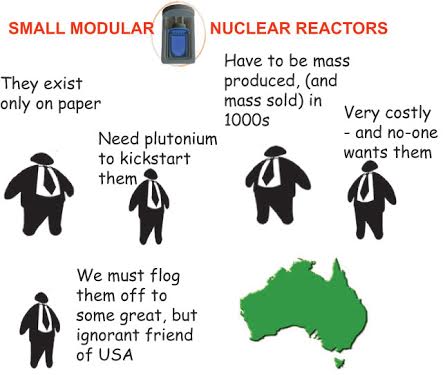
We knew that the Australian government was looking for volunteers in outback South Australia, to take the radioactive trash from Lucas Heights and some other sites, (and not having an easy time of it). But oh dear– we had no idea that the search for hosting new (untested) nuclear reactors was on too!
Well, The Australian newspaper has just revealed this extraordinary news, in its article “Want a nuclear reactor in your backyard? Step this way” (28/11/17). Yes, it turns out that a Sydney-based company, SMR Nuclear Technology, plans to secure volunteers and a definite site within three years. If all goes well, Australia’s Small Modular Reactors will be in operation by 2030.
Only, there are obstacles. Even this enthusiastic article does acknowledge one or two of them. One is the need to get public acceptance of these so far non-existent new nuclear reactors. SMR director Robert Pritchard is quoted as saying that interest in these reactors is widespread. He gives no evidence for this.
The other is that the construction and operation of a nuclear power plant in Australia is prohibited by both commonwealth and state laws.
But there are issues, and other obstacles that are not addressed on this article. A vital question is: does SMR Nuclear Technology intend to actually build the small reactors in Australia, or more likely, merely assemble them from imported modular parts – a sort of nuclear Lego style operation?
If it is to be the latter, there will surely be a delay of probably decades. Development of SMRs is stalled, in USA due to strict safety regulations, and in UK, due to uncertainties, especially the need for public subsidy. That leaves China, where the nuclear industry is government funded, and even there, development of SMRs is still in its infancy.
As to the former, it is highly improbable that an Australian company would have the necessary expertise, resources, and funding, to design and manufacture nuclear reactors of any size. The overseas companies now planning small reactors are basing their whole enterprise on the export market. Indeed, the whole plan for “modular” nuclear reactors is about mass production and mass marketing of SMRs -to be assembled in overseas countries. That is accepted as the only way for the SMR industry to be commercially successful. Australia looks like a desirable customer for the Chinese industry, the only one that looks as if it might go ahead, at present,
If, somehow, the SMR Technologies’ plan is to go ahead, the other obstacles remain.
The critical one is of course economics. …….
Other issues of costs and safety concern the transport of radioactive fuels to the reactors, and of radioactive waste management. The nuclear industry is very fond of proclaiming that wastes from small thorium reactors would need safe disposal and guarding for “only 300 years”. Just the bare 300!
The Australian Senate is currently debating a Bill introduced by Cory Bernardi, to remove Australia’s laws prohibiting nuclear power development. The case put by SMR Technologies, as presented in The Australian newspaper is completely inadequate. The public deserves a better examination of this plan for Small Modular Reactors SMRS. And why do they leave out the operative word “Nuclear” -because it is so on the nose with the public? http://www.onlineopinion.com.au/view.asp?article=19460&page=2
NO to Deputy Premier and Nationals Leader, John Barilaro: New South Wales does NOT need nuclear power

This follows musing by Deputy Premier and Nationals Leader, John Barilaro, that nuclear reactors could be operating in NSW within 10 years. Mr Barilaro said on social media: “We could have them (small nuclear reactors) operating here in a decade – which is not long for the energy industry…”
Opposition Energy spokesman Adam Searle said it was the second time this year Mr Barilaro had raised the possibility of nuclear energy for the State.
In May, Mr Barilaro said he was “prepared to talk about nuclear as an option”. One pro-nuclear power group, Nuclear for Climate Australia, has identified 12 regions of NSW as possible sites for nuclear reactors – including on the North Coast.
“A pro-nuclear power group is on the record suggesting reactors should be on the North Coast – does Mr Barilaro agree?” Mr Searle said.
“He should be clear with the public on where he thinks the nuclear reactors should be.
“Our farmers’ clean and green reputation is known throughout the world but a nuclear industry in these areas would end all that.”
Some recycling of lithium already going on in Australia
 LITHIUM ION BATTERIES ore http://www.batteryrecycling.org.au/recycling/lithium-ion-batteries The number of lithium-ion reaching end of life is expected to increase exponentially over the next 20 years. A report from Randell Environmental Consulting and Blue Environment can be downloaded here.
A report from Anna Boyden on the environmental impacts of lithium ion batteries provides useful background material and can be downloaded here.
Lithium-ion batteries (UN No. 3480) are classified as Dangerous Goods under the Australian Code for the Transport of Dangerous Goods by Road and Rail (ADG Code).
The ADG Code requires all dangerous goods, including lithium ion batteries, to be carried in a secure, safe and environmentally controlled manner. The carrier has the right to refuse carriage if dangerous goods are not packed in accordance with the regulations. There is a special provision (377) and packaging instruction (P909) for ‘lithium ion and lithium metal cells and batteries and equipment containing such cells and batteries transported for disposal or recycling, either packed together with or packed without non-lithium batteries…’
The following ABRI members provide a collection and recycling service for used lithium-ion batteries. Contact the company or check their web site for details. Continue reading
Australia VERY QUIETLY signs up to help develop new nuclear reactors
 Noel Wauchope, 20 Sept 17, Now, many weeks after Australia signing up to the Framework Agreement For Generation IV Nuclear Energy Systems, the public is informed of this. I found it at the bottom of page 23 of the print version of The Age today. Why haven’t we heard about this before?

Norther Territory may be close to getting a lithium mine
NT lithium mine moves closer
THE push to build and develop the Northern Territory’s first lithium mine is gaining momentum
http://www.ntnews.com.au/business/nt-lithium-mine-moves-closer/news-story/fe9071bc2a42cbc28bbdb9fe5a741369
1 This month


Help Aunty Sue Protect Her Land and Sacred Sites From Destructive Rocket Testing.
.

Australians deserve the truth
about
AUKUS – https://aukuspublicinquiry.com/

PETITION – To: Prime Minister Anthony Albanese and the Australian Labor Government

of the week – Australians for War Powers Reform (AWPR)
To see nuclear-related stories in greater depth and intensity

