Olympic Dam an unprecedented attack on Australia’s environment
 BHP Billiton’s Olympic Dam mine expansion will leave an uprecedented environmental legacy THE AUSTRALIAN, BY:PAUL CLEARY October 11, 2011 FUTURE generations of Australians will have to contend with an unprecedented environmental legacy from the expansion of Olympic Dam’s copper-uranium mine, but our system provides no way of compensating them.
BHP Billiton’s open-cut expansion of mining to extract an estimated $800 billion in mineral wealth will leave behind an above-ground heap of radioactive tailings spread over 44sq km and as high as the Sydney Opera House.
After 40 years of production, the mine will also leave behind a toxic crater measuring 4km wide and more than 1km deep.

Both legacies pose significant risks to ground water, according to BHP’s environmental impact statement . . . although these were dismissed yesterday by Environment Minister Tony Burke.
Under Australia’s federal-state system, the South Australian government has no incentive to set up a future fund so that it can compensate future residents for having to live with much less mineral wealth, and with the environmental costs of this development. Nor has the federal government or opposition shown any interest in measures to compensate our grandkids, and their descendants, for having used our inherited mineral wealth to inflate our standard of living….. the mineral resources rent tax won’t collect any of the above-normal profits earned from developing one of the world’s biggest ore deposits, because it only taxes coal and iron ore production. http://www.theaustralian.com.au/business/opinion/counting-the-cost-of-bhps-olympic-dam/story-e6frg9if-1226163362958
You’ve heard of Penis Envy? Now Rio Tinto brings Dirty Great Uranium Hole envy
Under today’s announced agreement, Tasman will get an immediate cash injection of A$10 million from Rio Tinto and that would see Tasman undertake a A$5 million search programme over Vulcan in the next 12 months. Tasman’s executive chairman Greg Solomon said Rio has the right but not the obligation to earn up to 80% in the project by committing to a two-stage farm-in arrangement by spending up to A$75 million and, in addition, paying Tasman up to A$17 million including the initial A$10 million payment….
The ambitious programme would see Olympic Dam transformed from a big underground mine to an open pit, but the ore system is under about 400 metres of sterile cover and would involve creating mountains of stockpiles in the pancake-flat terrain.
The market is awaiting a decision on Olympic Dam going open cut and it was considered imminent given the fact that South Australian Premier Mike Rann, who is soon to depart, indicated that he wanted to stay in the chair to be able to announce the mine upgrade…. http://www.mineweb.com/mineweb/view/mineweb/en/page103118?oid=137193&sn=Detail&pid=102055
A better plan for South Australia than accepting BHP Billiton’s toxic radioactive plan at Olympic Dam
“There is an alternative model that would see a lower greenhouse footprint and skilled jobs retained in South Australia. A peer-reviewed study by Monash University’s Dr Gavin Mudd demolished the myth that uranium is central to the mine’s expansion. His model for the expansion is safer, would use much less water and energy, and would mean more jobs and greater economic return for the local economy.
 Scott Ludlam, 10 Oct 11, The Federal Government’s approval of the Olympic Dam expansion will see the creation of a carcinogenic mountain range of finely powdered radioactive waste in South Australia, the Greens warned today. Australian Greens spokesperson for nuclear issues Senator Scott Ludlam said the proposed expansion of the BHP Billiton site to will be a disaster for the environment, human health and local jobs.
“BHP Billiton has designed a world’s-worst-practice uranium mine. Continue reading
Uranium SA address to shareholders – all the right weasel words
 Russel Bluck Chairman Uranium SA Limited gave a brave Address to Shareholders
on 6 October. It was designed to jolly them up, and Mr Bluck is to be admired, for he has learned all the right terms. I was reminded of schooldays, when I was taught certain religious beliefs and words by rote. Obviously Australia’s uranium mining executives have followed the same sort of teaching.
First comes the admission – ” The rate of corporate and generational change has been slowed [ a better word than plummeted?] by external circumstance”
But this is followed quickly by the new nuclear dogmas: about “robust returns on invested capital”,…..”The failure of the Fukushima nuclear plants was an industrial [ not a nuclear?] catastrophe within the context of a major natural disaster.”…
…as the fog of disinformation [does he mean the facts on radiation?] clears , it is again clear nuclear power generation is safe and made even safer by the lessons of Fukushima,…
New uranium mines not likely to be viable, with costs greater than uranium prices
with demand lower than was expected before, the price outlook is also down in both the medium and long-term..
It is clear that some of the anticipated new mines, heavily promoted by financial backers, will be ‘out of the money’—in other words, too expensive to develop in the new environment. Future uranium projects are very sensitive at prices in the $50 to $70 per pound level, and many may need more than $70 for viability.
 Uranium – what are the prospects post-Fukushima?, Nuclear Engineering, Steve Kidd Deputy Director General of the World Nuclear Association, 06 October 2011“………..Falling uranium demand in the short-term is likely to delay some new projects, particularly those in Africa where financial requirements are heavy. But the reaction of producers will largely depend on the continuation of China’s new build programme and its willingness to finance new mines abroad.
…….Turning to potential new reactors, where the anticipated demand has been important in pushing up the uranium price since 2003, the position has also become arguably more difficult. A highly politicised industry has become, rightly or wrongly, even more politicised, and nuclear plans in some countries may be scaled back, or at best delayed. The position of China in this is not surprisingly crucial, as it has almost half of the reactors under construction around the world. Its immediate reaction to stop the approval process for new units and look more closely at the safety of those already approved is a typical reaction. Continue reading
Uranium mining – Global X Uranium ETF is down over 60% this year!
 Over the last month, these companies have lost between 25 and 29 percent, and they have lost between 57 and 84 percent so far this year. These significant losses proliferate uranium miners and producers, as can be seen from the Global X Uranium ETF (URA), which tracks the Solactive Uranium Index and is down over 60% so far this year…..
 An Abysmal Month For Uranium Producers Extends Their 2011 Pain, Seeking Alpha 4 Oct 11, The uranium industry is not what it used to be, nor are the share values of the uranium producers. This may well go down as the worst year for uranium in the modern era, even though several nuclear power experts continue to claim that uranium use is sensible and safe.
This first quarter of 2011 started off with Japanese nuclear concerns following the destruction caused by the earthquake and tsunami that hit the nation, and uranium prices entered a tailspin shortly thereafter. In the wake of tsunami, Germany opted to discontinue nuclear power plant development and reveal plans to eventually eliminate nuclear power as an energy source.
It also appears likely that Japan may be hesitant to build more nuclear power plants in the near future. For many years, Japan and Germany have been significant users of nuclear power. This perceived vacuum to demand weakened the price of uranium. It also weakened the shares of those companies that produce and/or provide uranium…..
In the third quarter, which just ended last week, uranium and its producers continued to drop along with the broader market, only mostly to a broader extent as the investment was deemed more and more speculative. Most uranium producers ended the third quarter at their 2011 lows.
Below are the 1-month, 3-month, 6-month, and 2011-to-date performance rates for several companies that mine and/or provide uranium for energy production: Continue reading
Short or long term , the news is all bad for uranium industry
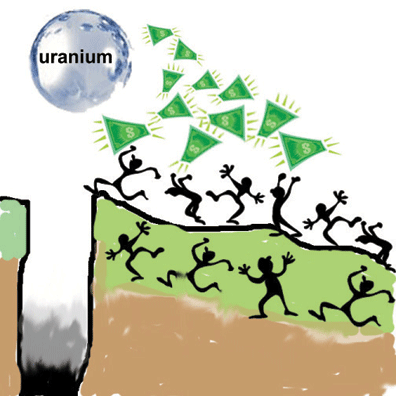 Uranium Contract Prices Slip, FN Area News, 4 Oct 11, by Greg Peel, Unlike the uranium spot market, which in recent weeks has been dominated by traders and hedge funds on both sides of the price, the uranium term market more represents legitimate supply deals between producers and utilities, and is thus more representative of ongoing longer term uranium demand.
Shares of Denison Mines and Uranium Resources Face Strong Downward Pressure, MarketWatch, NEW YORK, NY, Sep 30, 2011 (MARKETWIRE via COMTEX)–– Uranium stocks have struggled this month as prices for the radioactive material have plunged. According to the latest quarterly report by Resource Capital Research, uranium prices are down 27 per cent over the past three months and 23 per cent over the past year….
Kazakhstan Ends Rise In Uranium Production To Stabilize Prices Fox Business, By Christopher Pala & contributing to Dow Jones Newswires, October 03, 2011 ALMATY, Kazakhstan – After more than tripling its output of uranium in four years to become the world’s top producer, Kazakhstan has stabilized production to around 20,000 metric tons annually in order to avoid further depressing prices, Sergei Dara, Director of Strategic Development and International Projects at Kazatomprom, the state nuclear company, said Monday.
He said as long as prices remain at their current low levels, “Kazakhstan will not develop new projects and our production will remain at the current level.”..
Radioactive dust storms from uranium mine will threaten Australia’s cities
Dust storm envelopes Coober Pedy, South Australia – September 27 11, Christina Macpherson Dust storms can travel thousands of km, from South Australia – the Olympic Dam uranium mine area, to three capital cities, and even to New Zealand.

These winds travelled similarly to the 2009 Red Dust storm and went across to NSW and through Victoria. Coober Pedy is just East of Emu Field.
Weather forecast was : A vigorous front moving across South Australia 28 September 2011, with west to southwest winds averaging 60-km/h with damaging wind gusts in excess of 80 km/h
RED DUST STORM TWO YEARS AGO to the week was: Forecast September 2009 A vigorous front moving across South Australia 22-25 September [2009], with west to southwest winds averaging 60-70 km/h with damaging wind gusts in excess of 90 km/h.
This time around, Australia’s capital cities have been lucky. Not like two years ago, when dust covered dozens of towns and cities in three states, affecting Adelaide , Melbourne and blanketing Sydney. The dust from the Olympic Dam region might have carried radioactivity – the uranium mine then , and now, an underground mine.
But what happens when Olympic Dam uranium mine becomes the world’s biggest open cut mine?
Similar wind storms will happen. But then the winds will be carrying the radioactive dust from BHP Billiton’s massive mountain of tailings. The waste rockpile (overburden) will be an enormous mountain on the landscape, 150 metres high and up to 8 kilometres wide.
BHP Billiton themselves admit – or is it boast ? – that this giant mine will alter the region’s weather patterns – to such an extent that aircraft flight paths will have to be changed.
Wake up, city-dwelling Australians – the radioactive threat of Olympic Dam means that Coober Pedy’s dust storms will concern you, too
Expansion of Olympic Damn uranium mining is not yet certain
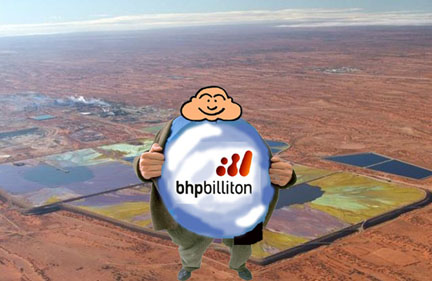 it is a lengthy process as BHP lines up all the necessary government approvals before taking the project to its board next year.
South Australia digs deep to take part in mining boom Telegraph UK 28 Sept 11, Deep in the South Australian outback, change is in the air. Quite literally in fact, since the plans under way to develop the Olympic Dam mine will create a site so vast that it is expected to affect local weather patterns.
Negotiations are now in advanced stages to give BHP Billiton the go–ahead to turn its existing operation some 560km (350 miles) north of Adelaide into the world’s biggest open cast mine. Continue reading
Australian govt’s corporate welfare to the Big Non Australian BHP Billiton
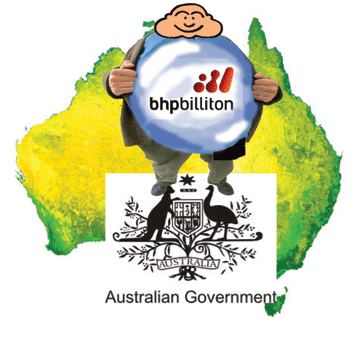 “The fuel tax credits effectively act as a massive subsidy for BHP Billiton, begging the questions as to why the Federal Government is subsidising one of the largest mining companies in the world.” said Nectaria Calan of Friends of the Earth Adelaide.
Once known as the “Big Australian,” BHP is now 76 per cent foreign owned, so whilst the Federal Government is funneling taxpayers money into the company, the vast majority of its profits will end up overseas.
BHP Billiton – record profits and still on corporate welfare, 30 Sept 11 The Olympic Dam Expansion Draft Environmental Impact Statement states that the proposed new mine will require 346 million litres of diesel per year in its initial development stage, 394 million litres per year in the intermediate stage, and over 490 million litres per year at full production. This is in addition to the 26 million litres per year currently used at the mine.
Under current fuel tax credit rates, BHP stands to gain $128 million per year in diesel rebates in the initial development period of the mine, $144 million per year in the intermediate stage, and $178 million per year at full production. Continue reading
Uranium mining’s horrible year continues – Paladin and Uranex
Paladin raising fails to impress, SMH, Peter Ker, September 30, 2011 “……Paladin has endured an annus horribilus this year, as an easing uranium price, rising costs, reduced production targets and concerns about debts have savaged the company’s share price to barely a quarter of its former value…..
Fall in uranium miner Paladin’s market value
Reuters Australian Business News, SYDNEY, Sept 29 2011 “…..Paladin Energy yesterday launched a A$70 million equity raising through UBS and RBC Capital Markets due to unforeseen cost increases at its two African projects. Costs at the uranium producer’s newest mine, the Kayelekera development in Malawi, have risen to A$50 a pound of uranium oxide. Paladin’s market value has fallen from over A$5 million to A$1 million after the Fukushima nuclear disaster in March depressed uranium equities markets ….”
http://www.reuters.com/article/2011/09/28/digest-australia-business-idUSL3E7KS3Z120110928
Australia’s Lynas company’s problems – share price, governance, Malaysia protests
 It is interesting to keep an eye on Australia’ s Lynas corporation. For one thing, that devious old propaganda
 merchant, Ziggy Switkowski is on Lynas’ board of directors. Wherever Ziggy is, spin will abound.
For another thing, Lynas is dedicated to make a mint out of rare earths processing in Malaysia. (nothing wrong with the idea – after, making a mint is the correct mission for a corporation – its only responsibility, unfortunately).
Still – the rare earths processing is fraught with danger. Both USA and China had to stop rare earths operations, due to very bad environmental pollution, though both are now starting again. China got away with it for ages, by putting the rare earths processing in a rural area, with an unsophisticated indigenous population. But Malaysia – that is a different situation, with a much more educated and urban population, who don’t want the pollution risk.
And now – Lynas has a couple of other problems – its plummeting share price, and some questions about corporate governance
Corporate governance guidelines outlined by the Australian Securities Exchange recommend that ”the role of chair and chief should not be exercised by the same individual”.
 Lynas is expected to report a full-year loss before tax of $57 million today as it ramps up towards production. Shares in Lynas closed 17.5¢, or 14 per cent, lower at $1.105 – more than 60 per cent off its April high of $2.70.
Lynas shareholders demand that chairman steps down, The Age, Philip Wen, September 23, 2011 A VOCAL group of retail shareholders in rare-earths miner Lynas is seeking to remove mining entrepreneur Nick Curtis as chairman, citing concerns over ”risks to corporate governance”. Continue reading
Uranium mining company Rio Tinto on a losing streak
Rio Tinto: The Losing Streak Continues (RIO) Financial News Network, 09/22/2011, By Robert Cotte, Rio Tinto (NYSE:RIO) traded at a new 52-week low today of $45.56. So far today approximately 10 million shares have been exchanged, as compared to an average 30-day volume of 3.2 million shares.
Rio Tinto PLC is an international mining company. The Company has interests in mining for aluminum, borax, coal, copper, gold, iron ore, lead, silver, tin, uranium, zinc, titanium dioxide feedstock, diamonds, talc and zircon. Rio Tinto’s various mining operations are located in Australia, New Zealand, South Africa, the United States, South America, Europe, and Indonesia…… http://www.fnno.com/story/52-week-high-lows/331-rio-tinto-losing-streak-continues-rio-52-week-high-lows
Rio Tinto not really optimistic about uranium mining
 Rio Tinto hopes for a short nuclear slowdown, The Australian, Dow Jones Newswires , September 23, 2011 JAPAN’S Fukushima nuclear accident in March has damaged the credibility of the uranium mining industry and will slow nuclear power growth for up to two years, predicts a Rio Tinto executive…..
The medium-term outlook for uranium, the key fuel for nuclear reactors, remains clouded in the wake of the Fukushima crisis.The crisis began in March when explosions crippled the Fukushima reactor complex following the country’s devastating earthquake and tsunami. Rio Tinto is a major uranium producer via its majority ownership of Energy Resources of Australia and the huge Rossing Uranium mine in Namibia….
Mr Lloyd said that, in addition to uncertainty about demand, the “high capital cost” of new nuclear reactors might be an issue for the sector as it sought to attract funding in coming years. ……http://www.theaustralian.com.au/business/mining-energy/rio-tinto-hopes-for-a-short-nuclear-slowdown/story-e6frg9df-1226144025698
1 This month

of the week – Australians for War Powers Reform (AWPR)
To see nuclear-related stories in greater depth and intensity
 Antinuclear