 These people seem to have no grasp at all of the concerns of people worldwide about the effects of nuclear pollution on the environment and on future generations.
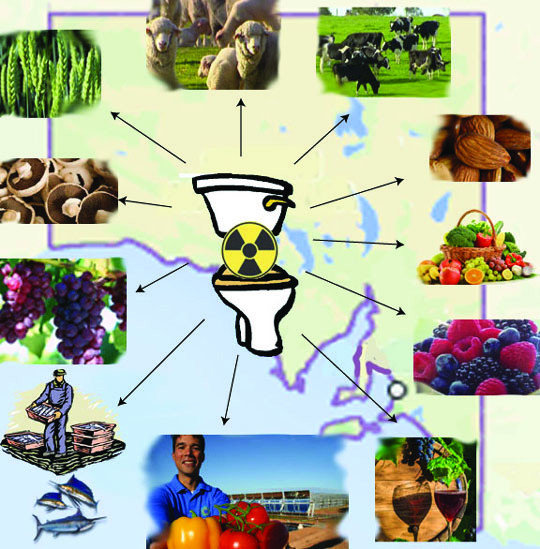
It is as if they have no understanding whatsoever of the risks to South Australia’s precious groundwater, to South Australia’s agricultural reputation, nor of the risks of transport accidents, terrorism, and the longterm situation of stranded radioactive trash.
Just consider these inane comments:
“the majority, we’re just so excited about the possibilities.
“it’s a way of ensuring a future for his young children.”
“I think it’s far safer than my own farming industry”
Decision looms for SA town of Kimba divided over nuclear waste The town of Kimba is struggling for economic growth. Some see nuclear waste as the industry that could help it prosper. https://www.sbs.com.au/news/decision-looms-for-sa-town-of-kimba-divided-over-nuclear-wasteBy Rhiannon Elston, 13 May 18
The small community of Kimba sits roughly halfway across the national highway stretching between South Australia’s east and west coasts. Wheat is the main crop grown here, but mayor Dean Johnson

says it’s marginal farming land. “We’re very reliant on rainfall in our area,” he tells SBS News.
The town’s uncertain future is the reason some residents have thrown their support behind a plan to store the nation’s nuclear waste. Local small business owner and farmer Michelle Raynr and her husband have offered to sell a small parcel of their land to the government for a future radioactive waste facility.
“You kind of just dread to think what the town will be like in another five, ten years if it doesn’t happen,” she says.
It would be a permanent facility for Australia’s low-level nuclear waste, and a temporary site for intermediate level disposal.
Ms Raynr says not everyone has been supportive of her decision. “It’s been a little bit disappointing, people’s reactions,” she says.“But the majority, we’re just so excited about the possibilities.”
Andrew Baldock is one who agrees. His parents have also offered to sell a piece of their land. He says it’s a way of ensuring a future for his young children.
“I’d really like to see something like this to help underpin the community, and perhaps, put us ahead of the other struggling towns in the region,” Mr Baldcock says.
“To me, it’s a lot less scary than the chemicals and the petrol, diesel and everything else that comes through our road here. I think it’s far safer than my own farming industry, to be honest.”
Radioactive waste is currently held across 100 different facilities. The federal government says it wants a central facility, housed in a community willing to support it.
Peter Woolford, Chairman of an anti-radioactive waste group in Kimba, wants the concerns of those who don’t support the project, to be heard.
“They’ve continually said they’re not going to impose it on a community, that it has to have broad community support, but I don’t think they have that in Kimba at all.”
The location for a national facility has been narrowed down to three sites, all in South Australia. Two are in Kimba, and the other is near Hawker, in the Flinders Ranges. The federal government says any facility would be constructed and managed under a strict regulatory framework.
Kimba local Graham Tiller believes any radioactive waste should be stored on existing government land.“There’s just no guarantees that land values won’t depreciate, or that grain won’t be devalued,” he says.
Tina Wakelin, another resident, says she agrees the site must go somewhere, but questions why it has to be in Kimba. “We must not be depicted as trying to stop nuclear medicine, that’s not the aim at all,” she says.“But a little town like ours should not feel responsible for all of Australia.”
Last month, the Resources Minister announced $4 million dollars in community funding grants for both Hawker and Kimba.
Mayor Dean Johnson says dozens of groups benefited from the cash injection.
“There’s the pony club… tennis courts, playgrounds, all sorts of things.”
Graham Tiller’s wife, Janet Tiller, says the money is not worth the impact of such a project. “No amount of money’s worth the health and livelihoods and friendships that have been lost in the town,” she says.
A postal ballot will be held on August 20 to measure community support.
The final decision as to where the waste site will go rests with the Resources Minister, who is expected to make his choice by the end of the year.
May 14, 2018
Posted by Christina Macpherson |
Federal nuclear waste dump, South Australia |
Leave a comment
Fight To Stop Nuclear Waste Dump In Flinders Ranges SA, 14 May 18 It is not just Kimba that needs to be consulted. I live at Whyalla, just up the road. At the very least all of Eyre Peninsula needs to be consulted, better still all South Australia. It will effect and affect us all. Especially the reputation of any agritculture or aquaculture. Unbelieveable that there are some people in Kimba who think this will “save” their town. I believe if it goes ahead, it will be the demise of the town.
Gov thinks that people can be bought – they did with the Shire of Kimba as it is a dying town like many rural towns n those who want this to happen decided $$$$ is what they need to boost it.
When the Mayor decided that the vote should only be for Kimba residents three quarters of the Shire didn’t want it, as everyone I have  spoken to is against it. Somehow the Mayor and Ramsay had found a loophole and they ran with it. People are getting blinded by being healed by Nuclear Medicine saying it’s OK to av this dump but don’t realise that the Nuclear Waste is completely different than Nuclear Medicine.
Yes the gov is trying to cover up the negatives and saying it is harmless but it’s not as it was why then a worker last year when he got contaminated by a work accident is still not well. When the governments put out No Bullying ads why don’t they take action as at the moment that is what they are doing BULLYING US INTO SAYING YES FOR MANY NEGATIVE IDEAS THEY WANT TO DO ALL AROUND AUSTRALIA.
the tax payer as insurance companies hate nuclear, – USA has plenty about it on google and the tax payer pays not the nuclear corporation. I say NO Nuclear dump and people should research and see Medical isotopes have a half life of 3 days, This is not about medical isotopes. https://www.facebook.com/groups/344452605899556/
May 14, 2018
Posted by Christina Macpherson |
Federal nuclear waste dump, opposition to nuclear, South Australia |
Leave a comment
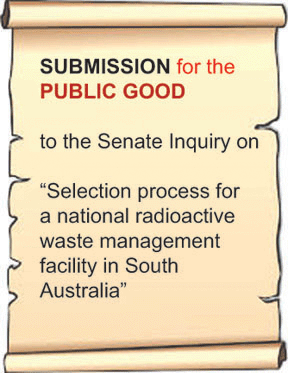
Submission To: Senate Standing Committees on Economics Regards “Selection process for a national radioactive waste management facility in South Australia”Ken and Carole Wetherby (Submission No. 12)
We live on a ‘hobby farm’ 10km east of Cleve which is outside the Kimba District Council.
Terms of Reference, our comments refer to items b, d and e. b)
“Broad community support”, the level of community support required for acceptance should be set at a 2/3 majority- then stick to this figure – don’t ‘waffle’.
d) Essentially the ‘community benefit program’ is a bribe and that is what it should be called.
e) This is the point which we have disagreed with from the outset. The establishment of a radioactive waste management facility at Kimba will have an effect on the whole of Eyre Peninsula, not just the Kimba Council area and we should all be allowed to have our say.
The ‘clean green’ reputation of the agricultural, fishing/aquaculture and tourism industries could be negatively affected. “Hobby farm’ values could also be affected – in our case we retired to our ‘hobby farm’ at Cleve because of Eyre Peninsula’s ‘clean green’ reputation. The agricultural zone on Eyre Peninsula is isolated from other farming areas by Spencers Gulf, the Nullarbor Plain and pastoral land to the north and as such it has a unique ability, as an entity, to claim and retain our “clean green’ reputation.
May 12, 2018
Posted by Christina Macpherson |
AUSTRALIA - NATIONAL, Federal nuclear waste dump |
Leave a comment
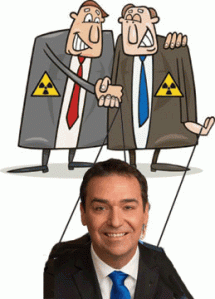 NUCLEAR WASTE DUMP: NOW A FEDERAL ELECTION ISSUE? Mark Simpkin Fight To Stop Nuclear Waste Dump In Flinders Ranges SA, 10 May 18
May 12, 2018
Posted by Christina Macpherson |
Federal nuclear waste dump, South Australia |
Leave a comment
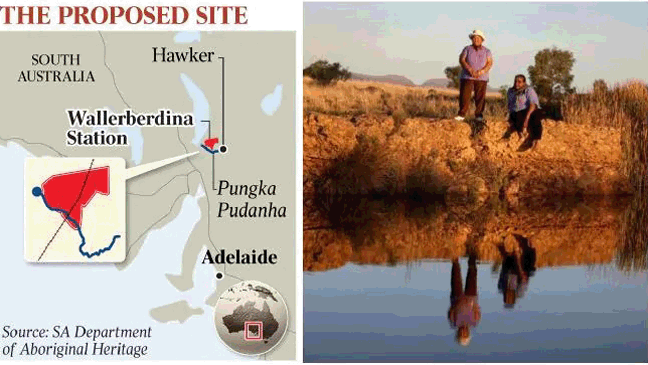
Eddie Hughes Submission to Senate Inquiry on Nuclear Waste Dump Sit Selection Process (Submission No. 57 My name is Eddie Hughes and I am the State Member for Giles. Please accept the speech I gave in Parliament on the 31 May 2017 as my submission for the Senate Inquiry into “The selection process for a national radioactive waste management facility in South Australia”.
I believe that the selection process is deeply flawed as a result of being based on an individual site nomination process.
NUCLEAR WASTE
GRIEVANCE DEBATE – 31 MAY 2017
Mr HUGHES ( Giles ) ( 15:23 ): I rise today to talk about the process that is on the way to determine whether a facility to accommodate domestic nuclear waste is built in South Australia. It is very strange, given the vastness of the Australian continent and, indeed, the concentration of nuclear expertise at Lucas Heights, that the only three sites being considered are all in the electorate of Giles. The reason all the sites are in Giles does not reflect any particular set of comparative advantages.
What it does reflect is a fundamentally flawed site selection process. It is a site selection process that has little regard for the impact on the communities that have been put in the spotlight and a site selection process that has absolutely no regard for the division that has been created.
Let me be clear: we do need to manage our domestically-produced waste in a responsible fashion. The adoption of such a divisive process does not, however, represent a responsible approach. The trigger for the engagement process is at the heart of why this is a seriously flawed approach. If you look at Kimba and the surrounding district, and if you look at Hawker and its district, you will see the division that has been caused. The trigger for the Flinders Ranges site was totally centred on the action of one person. That person does not live in the region; he lives in Adelaide. He is an absentee landlord. This absentee landlord nominated Wallerberdina Station which is under a pastoral lease. The absentee landlord is Grant Chapman, a former Liberal Party Senator.
The process adopted by the Federal Government did not call for communities to nominate a site; it called for individuals with land tenure to nominate sites, a bizarre approach which then left communities to react. The absentee landlord did not consult with his neighbours prior to nominating his property. I understand that he did not discuss his intention with neighbouring pastoralists and he did not consult with the local Aboriginal people, some of whom live on the adjoining property at Yappala Station. I spent a night at Yappala, listening to the concerns expressed by the residents. They were shocked by the nomination and the arrogance of the absentee landlord. We now know that the presence of Aboriginal people in the Flinders Ranges dates back 40,000 years. They are not blow-ins, they are not absentee landlords, they have lived and walked the country for generations.
The nomination of Wallerberdina was marked and will always be marked by a complete lack of respect for the Adnyamathanha. The absentee landlord did not speak to his neighbours, neighbours whose connection to the land he obviously has no appreciation of. We are not all that far from terra nullius. His neighbours were invisible. The nomination and the ongoing process has generated division not just in the European community but also in the Aboriginal community. The nomination process in Kimba also centred on the actions of individuals and has also led to community division. In the lead-up to the Federal election, the people of Kimba were under the impression that the two sites nominated near Kimba had been taken off the table, only to magically reappear after the election.
Most of the waste generated comes from the Eastern States. Lucas Heights can easily accommodate the long-lived intermediate waste for decades to come. That is where the expertise is and that is where the more serious waste is generated. When it comes to that waste and other waste streams, we have ample time to get this right, and a starting point at a national level is to initiate a roundtable process involving all the various interests, including non-government environmental bodies. We have an obligation to do this properly and we can build a consensus about our long-term management of nuclear waste. What has happened to date should become a case study in how not to do it.
May 11, 2018
Posted by Christina Macpherson |
AUSTRALIA - NATIONAL, Federal nuclear waste dump |
Leave a comment
 The proposed above ground Store in SA is primarily for ANSTO nuclear wastes
It is axiomatic that site selection at Kimba will require requisition of an Eyre Peninsula Port for decades of intended shipments of ANSTO nuclear fuel waste, first due from the UK in circa 2020-21.
The SA Nuclear Fuel Cycle Royal Commission (2016) concluded that terrorist attack scenarios are conceivable during the transport of nuclear fuel wastes & that if a cask was lost at sea and was irrecoverable the radioactivity that escapes is expected to affect thousands of cubic km of seawater.
ANSTO has produced irradiated nuclear fuel wastes & Intermediate Level Wastes at Lucas Heights for 60 years without any nuclear waste disposal capacity (or even a program to do so) and intends to continue this mal-practice for another 40 years under an OPAL reactor Operating License up to 2057.
It is an untenable fact that the proposed nuclear fuel waste Store in SA is intended to operate “above ground for approx. 100 years”, however responsible management of ANSTO irradiated nuclear fuel wastes requires isolation from the environment for 10,000 years.
A Store in SA is unnecessary given the safe option of Extended Storage at Lucas Heights
This Inquiry should find no manifest need for a nuclear waste Store in SA other than Federal agenda. There is no Safety, Licensing or technical reason to bring these nuclear wastes to SA.
the Federal Minister holds a draconian discretion under the National Radioactive Waste Management Act 2012 (NRWMA) to over-ride both Federal and State Aboriginal Heritage Acts.
Ending the process now is far preferable to “a final right of veto” which forces Aboriginal people through to the end of a divisive demanding site selection process that is harming their community.
An immediate adjoining property to the proposed NRWMF siting in the Flinders is an Indigenous Protected Area, a part of the National Reserve System that is supposed to be under Federal protection. AND the proposed sites and the broader area are part of a precedent registered Story
Line, values that must be respected, under the protection of the SA Aboriginal Heritage Act 1988
However: the Federal Minister holds a draconian discretion under the National Radioactive Waste Management Act 2012 (NRWMA) to over-ride both Federal and State Aboriginal Heritage Acts.
This ERC Inquiry should recognise that Aboriginal people’s ‘voice must be heard and their consent is essential’ as a core part of “broad community consent” and make a Finding that NRWMF siting on Adnyamathanha country in the iconic Flinders Ranges is inappropriate and must stop forthwith.
 David J Noonan B.Sc., M.Env.St. Independent Environment Campaigner . Submission to Senate Economics References Committee Inquiry “Selection process for a national radioactive waste management facility in SA” (Submission No. 31)
RE: Flaws in site selection process, inappropriate indefinite storage floats best practice, failure to follow essential Nuclear Safety Committee advice, and serious threat to human & cultural rights.
Dear Secretary Please accept this public submission & consider my request to appear as a Witness at this Inquiry
This submission focuses on the “appropriateness and thoroughness of the site selection process” & associated matters for the proposed National Radioactive Waste Management Facility (NRWMF).
Specifically: on inappropriate Siting of a proposed indefinite above ground Store for primarily ANSTO irradiated nuclear fuel wastes & long lived Intermediate level reactor wastes in regional SA.
An Executive Summary and a few public interest & Safety Questions for this Inquiry to consider under your Terms of Reference are provided – along with an offer to expand on points raised.
Over the last two full years the Federal government has solely targeted regional communities in SA to site the nuclear waste Store & associated required nuclear Port and waste transport routes.
In doing so, the Federal process is unacceptably inadequate (rather than thorough) in failing to follow essential advice of the Nuclear Safety Committee to the regulator ARPANSA (NSC advice to the CEO, Nov 2016) on the NRWMF: for transparency in decisions and for “The ongoing requirement to clearly and effectively engage all stakeholders, including those along transport routes.”
My submission to the Minister (May 2017) on his decision under the National Radioactive Waste Management Act 2012 to assess two sites near Kimba as potential sites for the proposed NRWMF raised a range of issues that have not been thoroughly addressed since (see Attachment 1).
I request opportunity to appear as a Witness to provide evidence at a Hearing of this Inquiry, and was a Witness as an individual on nuclear waste issues at the SA Parliament Joint Committee Inquiry on the Findings of the Nuclear Royal Commission, held in 2016. Continue reading →
May 9, 2018
Posted by Christina Macpherson |
AUSTRALIA - NATIONAL, Federal nuclear waste dump |
Leave a comment
Gary Cushway
18 Feb 2018 Submission to Senate Inquiry on Selection Process for Nuclear Waste Dump Site. (submission no. 6) Cushway addresses these terms of reference:
b) how the need for ‘broad community support’ has played and will continue to play a part in the process
’Broad community support’ should reflect a large majority, both across the community and within stakeholder groups (including the indigenous community) in favour of moving to the next process advancement stage.
c) how any need for Indigenous support has played and will continue to play a part in the process, including how Indigenous support has been or will be determined for each process advancement stage;
It is not simply enough to say that consultation with indigenous stakeholders and neighbours has occurred, without elaborating on the results.
The ‘Community sentiment survey’ conducted by DISI in April 2016 recorded 3% support from the indigenous community for the Barndioota site to proceed to the next stage. (p10 sec C)
source:
http://www.radioactivewaste.gov.au/site-selection-process/key-documents-andfaqs -Community Sentiment Survey (3.05MB)
A copy of this report has been attached to this emailed submission.
Given the presumably low sample size I would suggest that this likely represents support of one or perhaps two individuals. It is vital that the sample size of this
survey is published.
Additionally, the process behind the decision to disregard the significantly low support in the indigenous community from this survey and to progress the Barndioota site to the next stage should be discussed publicly as a matter of importance.
d) whether and/or how the Government’s ‘community benefit program’ payments affect broad community and Indigenous community sentiment
Although making funds available for ‘community benefit’ is clearly welcomed for any reason, the inclusion of offers of money as a part of the consultation
process has created a few potential problems with regard to whether support from the community can be measured as broad support for the actual proposal or as support for the community benefit money being offered.
This could also create a disparity when trying to effectively gauge ‘broad support’ in the community when some may be receiving significant amounts of money while others may not.
 There also could exist a perceived conflict of interest when bodies such as the Flinders Ranges Council are a recipient of this funding, when the Council may in future be required to make impartial planning decisions on, for example,
infrastructure or local environmental policy that is related to any future facility in the area.
There also could exist a perceived conflict of interest when bodies such as the Flinders Ranges Council are a recipient of this funding, when the Council may in future be required to make impartial planning decisions on, for example,
infrastructure or local environmental policy that is related to any future facility in the area.
Although local community support is vital, in a proposal such as a National
Radioactive Waste Management Facility a broader consent should be sought from across the country.
As the NRWMF is a part of national plan of radioactive waste management any proposed site should require a ‘broad support’ nationally as well as locally.
The current proposal involves the storage of radioactive waste from sites across the country as well as the interim storage of waste returning to Australia from overseas. Federal, state and international governments have a responsibility to ensure that their involvement in the movement of radioactive waste complies with all national, state and international laws, regulations and best practice meaning that these governments and their constituents have a stake in ensuring that the site selection meets their own requirements in terms of legislation and broader social values.
Limiting the consultation to a small local community area inhibits the ability of these stakeholders to have a voice in the process.
May 9, 2018
Posted by Christina Macpherson |
AUSTRALIA - NATIONAL, Federal nuclear waste dump |
Leave a comment
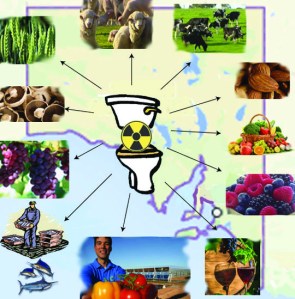 Others however do not consider that the financial risks are adequate. Their concerns have been articulated in community discussions:
• The loss of value to the spectacular tourist lands of the Flinders ranges
• The damage to farming country near Kimba
• The harm to below surface water tables
• The adverse effect on the prices of livestock and crops, caused by proximity to radioactive waste
• The adverse effect on the prices of land adjoining the site
• The fear that the Commission’s case for a nuclear making a profit is based on inflated estimates of the income and deflated estimates of the costs and risks
The sites near Kimba are in a productive agricultural region. This is in conflict with the National Health and Medical Research Council’s Code of Practice on radioactive waste, which states that radioactive waste disposal sites should have “little or no potential for agriculture”
The question for all of us must be faced. What sort of planet will our children, grand children and great grand children inherit, if this land is used in the way proposed by the Government?
Josephite Justice Office, North Sydney NSW 2060, Submission to Senate Inquiry SELECTION PROCESS FOR A NATIONAL RADIOACTIVE WASTE MANAGEMENT FACILITY IN SOUTH AUSTRALIA Contact Jan Barnett rsj (Submission No. 68)
INTRODUCTION
This submission is presented on behalf of the Josephite Justice Office, a ministry of the Congregations of the Sisters of St Joseph. The Sisters of St Joseph and our Associates (numbering approximately three thousand women and men) were founded in the mid-nineteenth century by Mary MacKillop and Julian Tenison Woods to work with those suffering from poverty and social disadvantage. We educate, advocate and work for justice, for earth and people, especially those pushed to the margins.
We commend this Inquiry into the siting of national radioactive waste management facility (NRWMF) at Kimba and Hawker. It is particularly encouraging to note that the Government has stated unequivocally that it will not impose such a facility on an unwilling community. The controversy surrounding the siting of a NRWMF in any area of Australia over recent years indicates the strength of feeling and the contradictory evidence being argued. It is our belief that until these arguments can be resolved, then even the specific terms of reference nominated for the Inquiry will be grossly inadequate. Continue reading →
May 7, 2018
Posted by Christina Macpherson |
AUSTRALIA - NATIONAL, Federal nuclear waste dump |
Leave a comment
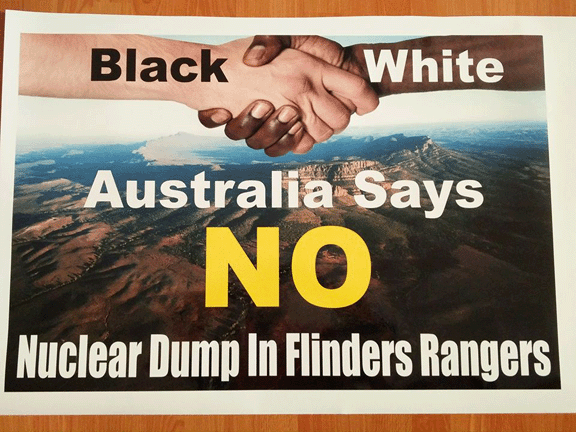
Anti-nuclear protesters increase fight against radioactive dump being established in SA
The Advertiser Erin Jones, Regional Reporter, Sunday Mail (SA) May 5, 2018
http://www.adelaidenow.com.au/news/south-australia/antinuclear-protesters-increase-fight-against-radioactive-dump-being-established-in-sa/news-story/55f7c369b17f03c747c1de824428b4df
ANTI-NUCLEAR campaigners will increase their fight to stop South Australia from becoming the nation’s radioactive waste ground, ahead of a final vote by the community.
Hundreds of postcards will be sent to Federal Resources Minister Matt Canavan demanding cultural heritage sites, agricultural land and the environment be protected from nuclear waste.
The Federal Government is expected to decide in the coming months whether to build a low-level and intermediate-level waste facility at Kimba or Barndioota, in the Flinders Ranges.
The two-year site selection process has divided both communities, those in favour believed it would create economic opportunities, while those opposed said it would jeopardise industries.
Conservation SA nuclear waste campaigner Mara Bonacci said the government needed to be more transparent about the facility ahead of an August 20 community ballot.
“There is division in both communities, whether it’s people who are pro-nuclear waste or anti-nuclear, they both want what’s best for the community,” Ms Bonacci said.
“But the pro-waste people are saying it will create lots of jobs, but we haven’t got any clarity around the numbers or if they’re full-time.
“We also want to know what number the Minister wants in a community vote to show ‘broad community support’ for the facility.”
Before the government decides on the successful site, residents from both communities will be given a final chance to accept or reject the proposal.
The ballot will be held less than a week after findings of a Senate Inquiry into the site-selection process are to be released, on August 14.
Mr Canavan told the Sunday Mail the government would provide more detailed information on the project’s design, job creation, cost, community benefits and safety, ahead of the ballot.
He said a nuclear waste facility would not be imposed on an unwilling community and it would need “broad community support” – although no arbitrary figure was provided.
“As we have always said, a range of factors will be used to determine broad community support, including the results of a public ballot, public and private submissions, and feedback from stakeholders during community discussions, including neighbours, councils and local groups,” Mr Canavan said. “The consultation process is engaging people on all sides of the discussion, and all views – supportive, neutral and opposed – are taken into account.”
The ballot will include residents of the Flinders Ranges Council and within a 50km radius of the Barnidoota site, and the Kimba District Council.
May 7, 2018
Posted by Christina Macpherson |
AUSTRALIA - NATIONAL, Federal nuclear waste dump, Opposition to nuclear |
Leave a comment
 Shame on ANSTO and DIIS bringing yura to speak about waste dump in Wallerbidina. Who gave welcome to yartah? Did the Adnyamathana peoples give permission for them to have meeting on yartah?
Disrespectable man shame on him!
So this guy from Darwahl tribe in NSW didnt ask permission to come on to your Ancestors Lands. That seems very disrespectful as having good Indigenous friends they used to explain to me the Indigenous Law was ‘Didnt matter where one wanted to travel in other parts of Australia,they needed to go the that destination’s Elders to ask permission to enter into their Lands’. Like those from Adnyamathanha Country who wanted to travel to Lucas Heights would out of respect go to the Elders of the Darwahl Tribe to ask permission to step onto their land. I feel that Indigenous Laws once very strong amongst Australia’s Indigenous are being lost in today’s world. Also I feel that is why some Indigenous Children run amuck as they are lost and living in a White Society under the White Laws have lost their way .
He didnt ask. He come with Australian Nuclear Science and Technology Organisation and Department of Industry Innovation and Science on Taxpayers money to have dinner at the Hawker Social Club where there was a function with invited guests.
May 6, 2018
Posted by Christina Macpherson |
Federal nuclear waste dump, South Australia, spinbuster |
Leave a comment
Ken McKenzie, Submission 78 TO THE SENATE ENQUIRY FOR THE SITE SELECTION PROCESS FOR WALERBERDINA STATION FOR A NATIONAL RADIOACTIVE WASTE FACILITY
My name is Ken McKenzie. I am seventy nine years old . I am a traditional Adnyamathanha tribal elder.
My mother was one of the stolen generation. She married my father who was a Wilyaru man . I come from a very large aboriginal family of fourteen brothers and sisters. I went to school at Blinman area school and spent most of my life working and living in and around the Flinders Ranges. I am now a senior resident of the Flinders House nursing home in Quorn. All thru my younger years I was taught my traditional heritage and my connection to the land. This was all done around the Wallerberdina area where my forefathers lived and hunted and are buried there .
I was told in early 2016 that the government wanted to put a radioactive waste dump on this land at Wallerberdina. This is causing me great sadness and distress. I have tried many times to make my voice heard about my protest against the dump, but it seems to have fallen on deaf ears. The government keep saying you can’t stop the process. Well this process is causing huge distress to my people. It is causing anger and bitterness in my own family and it is splitting us apart. Is that what the government wants, to drag out this process for so long that they think they will wear us down?
I love Australia and I love the Flinders Ranges .
Even in my own room at Flinders House, at 2 o’clock in the morning, I have received phone calls telling me I’d better change my mind or else face tribal retribution. Because of my traditional ties to this land, these phone calls frightened me terribly. I am not a violent person. I’ve also had phone calls through the day saying huge benefits ie house, property could come my way if I was to say yes and encourage my people to also say yes to the dump.
Through all of this process over the last two years the government finally, in January of this year, 2018, employed a company who did a site cultural survey on Wallerberdina Station. This group of people desecrated one of our women’s traditional sites. Once again the terrible anguish that is being put on the people to see what has happened, is something that I never dreamed would be happening to my family and friends both black and white.
I cannot understand why so many people have tried to tell the government, so many times over the last two years that Wallerberdina Station is not the area to put a waste dump, that they will not listen. They say they are, but they are not. We keep being told the dump may not be put on Wallerberdina Station if the community does not want it, but this has changed again as Mr Canavan said this will not necessarily be the deciding factor on his decision.
May 6, 2018
Posted by Christina Macpherson |
AUSTRALIA - NATIONAL, Federal nuclear waste dump, South Australia |
Leave a comment
 Heather Mckenzie Stuart Fight To Stop Nuclear Waste Dump In Flinders Ranges SA, 5 May Why is ANSTO and DIIS bringing a yaninjanha yura from Darwahl tribe in NSW to Hawker in the Flinders Ranges, making trouble saying urdnus are the only ones protesting against the proposed nuclear waste dump at Barndioota and are using yuras?
We go to protests and we will keep going to protests we will stand against the vartani. Anyway who gives that man the right to come here and talk in Adnyamathanha country, Wilyaru mirus and Adnyamathanha artuyani yarta. This is our ancestors lands, he has no shame we wouldnt go and talk in his yarta about his country. Dont come here pushing a nuclear waste dump on us, keep the poison in your country. You ANSTO and DIIS keep that yura in his country and let him dribble his rubbish over there in NSW. Hands off our sacred sites and stay in your yarta!! Ps his cultural consultancy means nothing to us, he want to stay at Lucas Heights.
May 5, 2018
Posted by Christina Macpherson |
aboriginal issues, Federal nuclear waste dump, South Australia |
Leave a comment
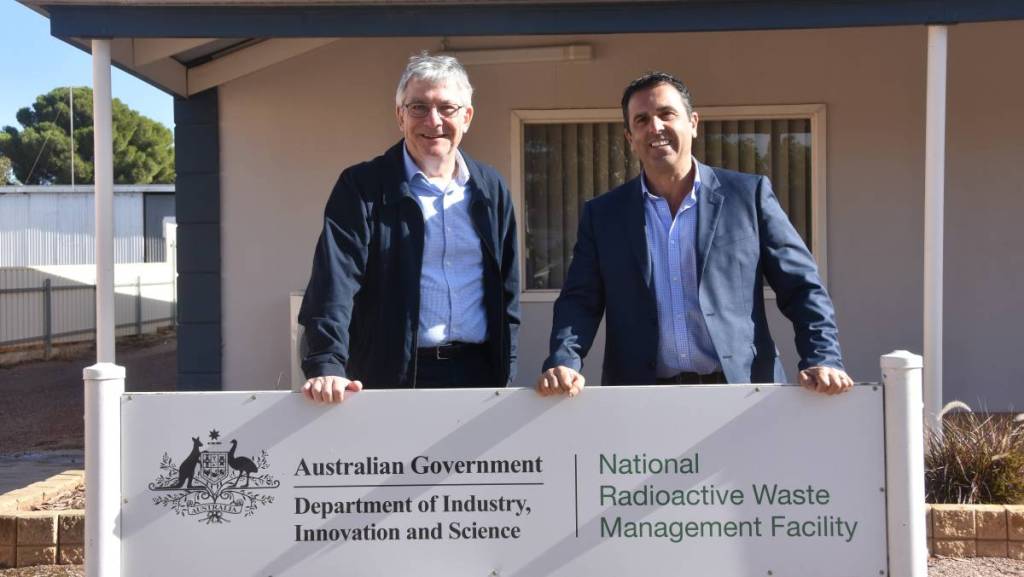
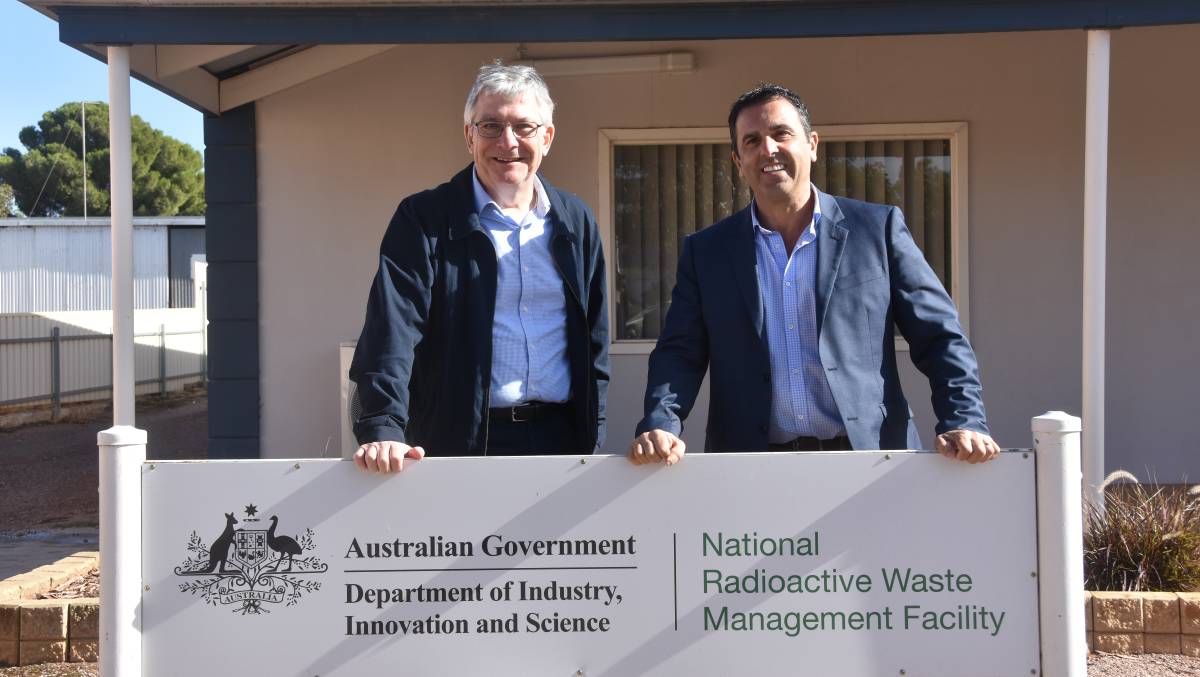
Dr Paterson visited Kimba on Friday with Carmelo Pesce, the mayor of the Sutherland Shire, which is home to the Lucas Heights reactor. According to the Eyre Tribune, the nuclear guru promised “45 jobs [that] will vary from full-time work, to shift work and on-call.
Dr Paterson said the announcement to the Kimba Economic Working Group and Consultative Committee and other members of the community received a positive reaction. ……..
If the proposed facility does go ahead in Kimba, Dr Paterson said it would receive a number of ongoing visits.
“There would be ongoing visits from independent regulators, visiting scientist and general visitors like tourists and school groups.”
May 5, 2018
Posted by Christina Macpherson |
AUSTRALIA - NATIONAL, Federal nuclear waste dump |
Leave a comment
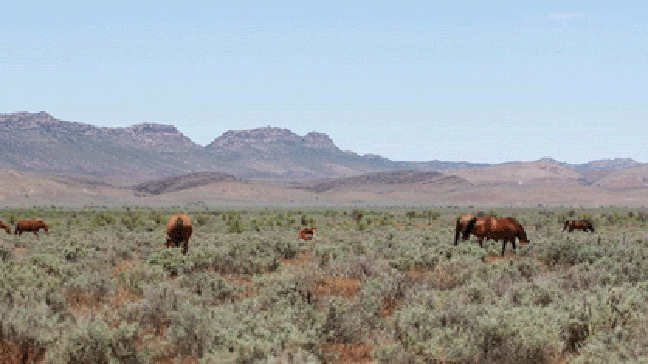
I feel we are scapegoats for the eastern seaboard. There is 450 hectares at Lucas Heights and only 60 hectares at present. It has been said that only an area the size of three Olympic swimming pools are required so there is room at Lucas Heights for many years to come – why shift it now.
Mr Donald Fels Submission to inquiry regarding the proposed nuclear waste repository at Barndioota, Submission 76 to Senate Inquiry on Selection process for a national radioactive waste management facility in South Australia
I am a 65 year old 4th generation pastoralist, owner of Merna Mora Station, which has been in the family for 130 years, and is located approximately 19 kms from the proposed facility. I also own Wintabatinyana Station located 10 – 15 kms northwest of the facility site.
As well as running stock we have a tourist development at Merna Mora which commenced 50 years ago. From this clean, green belt we have been selling steers to the Japanese market for 24 years via AMH and JBS Swift as marbled shorthorn beef now part of Thousand Guineas Beef as well. We have very good quality merino wool and sheep meat which is sought after. We recently sold wethers to Turkey and as such must meet strict marketing codes. It has been important to keep our options
open as margins are very small in the meat and wool game. We definitely do not need the stigma of nuclear waste for our products or indeed in terms of our equity if we are ever to sell.
We are in the driest state in the driest continent in the world so water is another great concern and needs very little to upset the ecosystem. My grandchildren are 6th generation here and wish to continue here but none of the family want a waste facility near us.
The land here is very seismically unstable, the ground is very porous and the water table very close to the surface within 1 -2 km radius is less than a metre down.
The process of selection was not done properly. Many people were not surveyed. A lot of younger people who only have mobile phones were not surveyed. We were not surveyed and there are 4 families of us. We were advised why bother we were against it anyway. When consultants are employed to do surveys the right questions are asked to get the outcome needed.
Five very talented long term geologists working in an immediate area advised that it is not the right area in which to construct as the ground is too unstable, porous and prone to flooding. In a one in a hundred year flood it could result in a major catastrophe. Temporary Intermediate storage could
result in a longer term than this.
As for the job creation very few would eventuate as most construction would be by a major firm such as Downer or John Holland. They would bring in their preferred sub- contractors and place in a mobile camp. Tours would be unlikely to persist and really don’t see this as continuing.
The landlord is absentee, never likely to live here. Neighbours and community were not consulted prior to the land being offered. Land is perpetual lease country which is out of district council areas.
In outback areas, perpetual lease is exempted from native title but not native heritage.
I feel we are scapegoats for the eastern seaboard. There is 450 hectares at Lucas Heights and only 60 hectares at present. It has been said that only an area the size of three Olympic swimming pools are required so there is room at Lucas Heights for many years to come – why shift it now.
I feel strongly against this proposal to build this facility – please take these points into your consideration in the selection process. The consultation process has caused a deep rift in our once close knit community with many friendships now very distanced. All some see is the money but there is so much more to this. No monies should go to individual businesses only to community projects but there is already a bad precedence right from the first round. Several individuals received funds and now it is expanding to whole of the Flinders Ranges Council area 70 – 80 kms away.
I have been disappointed with the lack of continuity by ANSTO and do not feel that the consultation process has been fair and equitable.
May 4, 2018
Posted by Christina Macpherson |
Federal nuclear waste dump |
Leave a comment
Stephen Darley – Co-ordinator, Independent and Peaceful Australia Network IPAN (SA) SUBMISSION ON PROPOSED NUCLEAR WASTE MANAGEMENT FACILITIES IN South Australia We wish to respond to your Terms of Reference in relation to the appropriateness and thoroughness of the site selection process for a national radioactive waste management facility at Kimba and Hawke in South Australia, noting that the Government has stated that it will not impose such a facility on an unwilling community.
Our first response is to query whether your committee has given cognisance of the results of the recent Royal Commission into the Nuclear Fuel Cycle held in Adelaide in 2015, where the Citizens Jury (representing citizens selected at random and given comprehensive, expert information), overwhelming voted that they wanted NO part of the nuclear cycle developed here. This included nuclear waste management facilities.
The SA government agreed to abide by this decision. Consequently we would like to know under what legislation the Commonwealth can now override this decision and welcome your response to this query.
We make the following comments in response to your terms of reference :
a) The financial compensation offered to applicants for the acquisition of land under the Nominations of Land Guidelines:
This is a vexed issue as we would prefer that this proposal does not proceed, but should it do so, we believe that an independent panel should recommend the appropriate compensation where required and no land should be compulsorily acquired without the full consent of the owner and the surrounding community agreeing to any facility placement in their vicinity.
b) How the need for “broad community support” has played and will continue to play a part in the process, including:
i)The definition of ‘broad community support’ and
It is imperative that the broadest possible support be obtained before proceeding further as this is a national project that could affect other States where waste material is transported from. Transport, whether by sea, rail or road, will be a major hurdle for the proposed project as many communities have actively campaigned against waste material being trucked or shipped through their community (ie the sustained Port Adelaide and South Australians opposition to earlier proposed nuclear waste facilities). Not only is safe transport a major concern, but also the water table being contaminated if a spill occurs or the facility is not secured safely underground. We have no details of the type of facility proposed but all proposed waste management facilities, even low and intermediate level nuclear waste are recommended to be stored in very stable rock at considerable distance underground. How can people make a decision when they have no details of the actual storage being proposed ? To ask people to consent to transport and storage of toxic waste (which could conceivably increase to high level nuclear waste at some future date) is disingenuous.
Citizens must have all the proposed site facts put before them so that they can make a well informed decision on how this could/would impact on their State and/or community.
We recommend that both local, state and nationwide support be sought with all the above pertinent facts on the proposed structure, transport and guarantee, including exactly what level nuclear waste would be housed, with a firm guarantee that this would not be increased over time. A response level of 90% YES vote would be appropriate to ensure this proposal does have wide, genuine support – perhaps a postal vote would be the way forward. This process should also be carried out by an independent body.
- How broad community support has been or will be determined for each process advancement stage. Our response is incorporated in the above recommendation.
c) How any need for Indigenous support has played and will continue to play a part in the process including how indigenous support has been or will be determined for each process advancement stage;
We believe it is paramount that the Australian government fully outline and commit to whatever level of nuclear waste material would ever be stored at these sites. There is talk of intermediate level waste (and perhaps even high level). These levels require very stringent and specific storage sites which we doubt are available at the areas selected ie stored in stable geological rock for thousands of years with no possibility of leaching into any water table – mindful that the Artesian Basin is close by which stores most of Australia’s underground water. Your proposal needs to cover all the levels of waste and how they will be stored in full compliance with international standards.
It is paramount that indigenous peoples, especially around the proposed sites, should be in agreement first, before proceeding to canvass wider state and national support. Our local knowledge and experience, doubts that this will occur as we are mindful of the sustained and successful campaigns opposing any nuclear waste facilities in South Australia in the past, especially the Kunga Juta Aboriginal Women’s successful campaign to stop nuclear waste facilities on their land in the 1990s. They remember the consequences of the Maralinga Tests which adversely affected many of their communities, so there is a strong resistance to any nuclear waste facilities. Their combined support for such a facility would need to be evident through signatures and spokespeople standing up publicly to support any proposal, before canvassing this idea further.
- Whether and how the Government’s community benefit program payments affect broad community and indigenous community sentiment;
We are not cognisant of the community benefits program but suggest that they should be disentangled from this issue, as any monetary or community program inducement would be seen as a bribe to ensure support for a nuclear waste facility. Indigenous people should be provided with all the community services they require, without tying them to this proposal.
e) Whether wider Eyre Peninsular or state-wide community view should be taken into consideration and, if so, how this is occurring or should be occurring,
As mentioned above it is imperative that such an important and long lasting project gets overall support from first the local indigenous people, then the local communities, South Australians and lastly Australians overall. All the salient facts need to be published and people invited to vote. This information should the fact that waste is currently being stored successfully on-site where it is subject to regular scrutiny. People would need to have all transport routes identified and a guarantee that this project will not escalate into high level waste from overseas being shipped and stored here.
The project should only proceed if it has an overall majority vote of 90% in favour as what is proposed, once begun can not easily be undone.
f) Any other related matters. As seen above there is a lot more information and project management work to be drawn up before this proposal should be taken any further. At the moment it seems in the “wish list” category but serious information and planning needs to occur before this proposal cam be taken further. The first matter to be solved being the right of the Australian government to override the SA legislation which opposes any nuclear waste facility here. We would appreciate your response on this matter.
May 2, 2018
Posted by Christina Macpherson |
AUSTRALIA - NATIONAL, Federal nuclear waste dump |
Leave a comment







 Antinuclear