The nuclear industry lobbyists rule the Australian radiation regulator
 Steve Dale Fight To Stop Nuclear Waste Dump In Flinders Ranges SA https://www.facebook.com/groups/344452605899556/ So many words – just a lot of management speak. Not one mention of the words inhalation or ingestion (of radioactive particles). The nuclear industry/lobbyists rule the regulator. From their page – “Since the promulgation of the 1992 Code of Practice, there have been significant international advances in radioactive waste safety. For example, the International Commission on Radiological Protection (ICRP) has revised its radiation protection limits and the International Atomic Energy Agency (IAEA) has published a range of revised waste safety standards. These changes have been progressively reflected in other Australian standards and codes.” – I think this is code for – international standards have been watered down, and it will be easier to get a nuclear industry going here if we wait
I will say NO to the waste dump
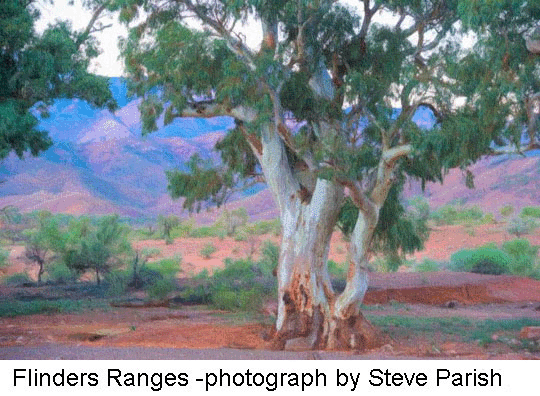 Regina McKenzie Fight To Stop Nuclear Waste Dump In Flinders Ranges SA, Back home on the Range, seeing it made a lump come into my throat, how can any one even think of putting a waste dump in such a beautiful ancient land?
We the people of this land comes from a group of nations, that were hunted in the past, the Government of them days actually supported the activity of early settlers, a five pound bounty, which was a lot of money in those days, was paid per scalp of Aboriginals, blankets that was exposed to small pox given out to unsuspecting yura’s, who then shared these gifts to the wider Aboriginal people, hence spreading the disease to people who had no immunity to it and can’t forget the water hole being poisoned, what I am getting at is back then, when we were hunted, this land was our sanctuary all the decimated nations fled into the hills, thus forming the Adnyamathanha people, adnya meaning rock and mathanaha meaning groups, it was the hills of this beautiful land that saved us,
I hear many say oh thank goodness for the missionaries they helped us ….. NO they only contained us on missions, taking control of our lives, banning the people to practice culture and making public enemies of the ones who stood strong, it was the land that gave us places to hide and why we are still here, so why do Yura’s take it for granted? why do they turn their back? why do they so cowardly bend their knee?
I will stand for the land, I will fight with every ounce of my strength, I live and breath this land, it is my solace, my love, the place where I am whole, I will say NO to the waste dump, I stand proud and I will protect my Mudah, my past, present and future https://www.facebook.com/groups/344452605899556/
South Australian Premier Jay Weatherill may take High Court action against proposed Federal Nuclear waste Dump
 Jay Weatherill changes mind on nuclear dump ahead of election, https://www.theaustralian.com.au/national-affairs/state-politics/jay-weatherill-changes-mind-on-nuclear-dump-ahead-of-election/news-story/a11667e1cfcb443812ef0052bfc6fbef THE AUSTRALIAN 30 Jan 18, MICHAEL OWEN, SA Bureau Chief, Adelaide @mjowen
Jay Weatherill has held open the possibility of High Court action to stop a national nuclear waste dump in South Australia, despite his own failed proposal for the state to take the world’s most dangerous radioactive material.
The Labor Premier’s threat comes more than 13 years after his predecessor Mike Rann won a High Court challenge against Howard government plans to establish a national nuclear waste dump at Olympic Dam in the state’s north.
Radioactive waste is stored at more than 100 sites throughout Australia, with 656 cubic metres of intermediate waste at Lucas Heights in southern Sydney.
Asked if the state government would pursue a High Court case against the Turnbull government if a national facility were approved in South Australia, Mr Weatherill said: “We would have to explore our options to see what steps can be taken.”
The change of heart on nuclear waste, seven weeks before the state election, has taken the federal government by surprise as it considers three South Australian sites for a national low- and medium-level facility.
- The state opposition accused Mr Weatherill of being “deceptive, sneaky and tricky”, noting the Premier had backed down last year on his own proposal to import the world’s nuclear waste only after a bungled community- consultation process and criticism from the state Liberal Party and Aboriginal groups.
Federal Resources Minister Matt Canavan told The Australian the Turnbull government was running a bipartisan process in communities that broadly supported the placement of a facility, including three South Australian properties — two near Kimba, on the Eyre Peninsula, and Wallerberdina Station, near Hawker in the Flinders Ranges.
Senator Canavan said the second phase of consultation had started only after landowners volunteered their land for consideration and the community was found to “broadly support continuing the conversation”.
“Up until now, the South Australian government has been supportive of this process … I wonder why the Premier would go against what is majority support so far in the communities around Wallerberdina Station and Kimba?” Senator Canavan said.
Mr Weatherill, who campaigned in regional South Australia this week, said his government now “opposed any further involvement in the nuclear fuel cycle, including waste repositories” whether high or low level.
This is despite establishing in 2015 a royal commission to pursue a greater involvement in the nuclear fuel cycle, including a proposal for South Australia to build a permanent facility to house the world’s high-level nuclear waste in return for more than $100 billion over 120 years. Mr Weatherill abandoned the plan last year. “The process they (federal government) have adopted is not one we support; it shouldn’t be driven by landowners, it should be driven by, essentially, communities and we think that the Aboriginal community also should be given special consideration,” he said.
Any South Australian nuclear waste dump must have broad social consent and specific community consent
 Tim Bickmore Fight To Stop Nuclear Waste Dump In Flinders Ranges SA, 29 Jan 18
Joint Committee on Findings of the Nuclear Fuel Cycle Royal Commission. Final report. Tabled in the SA Parliament October 2017…..
p19:
“The Royal Commission found that “both broad social consent and specific community consent must be obtained for any new nuclear activity to commence in South Australia”. (Finding No. 95).
……..
[Commissioner Scarce] …. We have seen overseas that a particular vote has been taken at a particular point in time and then the community has subsequently lost confidence in that process.
………
…it is not about just having one vote from the public at one point in time. Social licence is something that needs to be maintained for the life of a project, and it therefore needs to be an ongoing dialogue and an ongoing relationship between the developer and the public.
”
p29
“…….. based on the failure of pure voluntarism in the UK, the NDA is currently revising its policy away from this model. In order to obtain outcomes, and streamline negotiations, it aims to tighten definitions of “community”, “representation” and “consent”. ….. The NDA also hope that an appropriate definition of “community” will inhibit contribution from non-representative groups.”
Australian Government Department of Industry and Science hides the truth on radiation risks
 Paul Waldon Fight To Stop Nuclear Waste Dump In Flinders Ranges SA 29 Jan 18 “People lie when they want something, because they think the truth wont get it for them.” (Cary Grant, Charade).
DIIS failure to catalogue the known risks of a radioactive waste dump in Hawker or Kimba may be testimony of burying the truth, in a attempt to jump-start the progress of waste abandonment, while knowing they can’t tick all the boxes.
We must remain resolute in our fight to preserve a clean, safe environment for future generations.
Dishonest scare-mongering linking nuclear medicine and radioactive waste dumps
NUCLEAR MEDICINE AND THE PROPOSED NATIONAL RADIOACTIVE WASTE REPOSITORY , Jim Green 27 January 18, “As health organisations, we are appalled that access to nuclear medical procedures is being used to justify the proposed nuclear waste dump. Most waste from these procedures break down quickly and can be safely disposed of either on site or locally.” − Dr Bill Williams, Medical Association for the Prevention of War
“Linking the need for a centralized radioactive waste storage facility with the production of isotopes for nuclear medicine is misleading. The production of radioactive isotopes for nuclear medicine comprises a small percentage of the output of research reactors. The majority of the waste that is produced in these facilities occurs regardless of the nuclear medicine isotope production.”
− Nuclear Radiologist Dr Peter Karamoskos.
Proponents of a national radioactive waste facility (a repository for lower-level wastes and a co-located store for higher-level wastes) claim or imply that nuclear medicine would be jeopardised if the facility does not proceed. There is no basis to such claims – they amount to dishonest scare-mongering.
Proponents claim that most or all of the waste that the federal government wants to dispose of or store at a national repository/store arises from medicine, specifically the production and use of medical radioisotopes. However, measured by radioactivity, the true figure is just 10-20%. Measured by volume, the figure may be within that range or it may be higher than 20% − but it takes some creative accounting to justify the claim that most or even all of the waste is medical in origin.
In any case, the fact that some waste is of medical origin doesn’t mean that a national repository/store is the best way to manage the waste.
If the plan for a national repository/store does not proceed, medical waste will continue to be stored at the Lucas Heights reactor site operated by the Australian Nuclear Science and Technology Organisation (ANSTO) and, in much smaller volumes, at hospitals. Some waste is used in hospitals and then sent back to ANSTO (e.g. molybdenum ‘cows’ that have been ‘milked’ of the daughter radionuclide, technetium-99m − by far the most commonly used medical radioisotope). That is no problem since ANSTO and hospitals continue to produce radioactive waste and thus they have an ongoing need for on-site waste stores and waste management expertise regardless of the options for periodic off-site disposal.
Nuclear medicine is not being adversely affected by the absence of a national radioactive waste repository/store. Nuclear medicine will not benefit from the creation of a national radioactive waste repository/store.
The incessant references to nuclear medicine to ‘sell’ the proposed radioactive waste repository/store amount to emotive propaganda and scare-mongering. Ironically, that is what critics of the proposed national radioactive waste repository/store are routinely accused of!
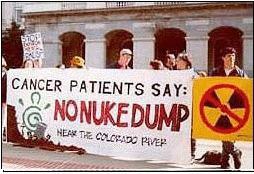 Dishonest scare-mongering linking nuclear medicine and radioactive waste dumps is also evident in other countries. Protests by cancer patients helped end plans to build a radioactive waste dump in Ward Valley, California. http://ens-newswire.com/ens/jun2002/2002-06-04-06.html
What should be done?
Two parallel processes should be initiated regarding radioactive waste management in Australia: a radioactive waste audit, and a National Commission or comparable public inquiry mechanism.
The federal government should immediately initiate an audit of existing waste stockpiles and storage. This could be led by the federal nuclear regulator ARPANSA in consultation with relevant state agencies with responsibility for radioactive waste. This audit would include developing a prioritised program to improve continuing waste storage and handling facilities, and identifying non-recurrent or legacy waste sites and exploring options to retire and de-commission these.
A National Commission would restore procedural and scientific rigour, and stakeholder and community confidence in radioactive waste management. It would identify and evaluate the full suite of radioactive waste management options. That would include the option of maintaining existing arrangements, keeping in mind that 95% of the waste is securely stored at two Commonwealth facilities: ANSTO’s Lucas Heights facility, and a large volume of very low level waste stored on Defence Department land at Woomera, SA.
The above issues are addressed in detail in a 2014 paper posted at: www.nuclear.foe.org.au/waste
The facts on PROPOSED NATIONAL RADIOACTIVE WASTE DUMP
Anti-Nuclear Coalition South Australia antinuclearcoalition@gmail.com 24 Jan 18 The Federal Government proposes to establish a National Radioactive Waste Management Facility in SA. This ‘repository’ would co-locate:
- Various low-level and hazardous but short lived intermediate level wastes requiring isolation for 300 years in a shallow ground repository.
- An above-ground store designed to operate for 100 years to house used reactor fuel from Lucas Heights. This intermediate-level long-lived waste requires isolation from
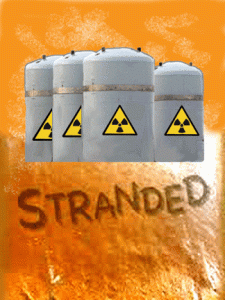 the environment for over 10,000 years.
No plans have been made available for structures or maintenance for the first 100 years of this above-ground store. Plans for the ensuing 10,000 years are unavailable.
There are no plans available to establish a ‘permanent’ solution for this waste. It is not currently known how to safely store such higher level nuclear waste in isolation from the environment for such a long period of time.
Nuclear waste is currently stored at Lucas Heights where it is securely monitored.
Lucas Height’s ‘Interim Waste Store” has been identified by ANSTO as capable of safely storing reprocessed nuclear fuel waste and intermediate-level waste has been stored at Lucas Heights since the 1950s. Lucas Heights has been identified as the best resourced and secure facility to responsibly manage the extended storage of Australia’s nuclear waste.
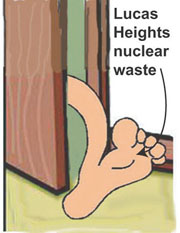 A national radioactive waste dump could be used as a “foot in the door” to establish an International Radioactive Waste dump at the same site or another site in the future. This was advocated as an objective by state Liberal Party adviser Richard Yeeles who advised that “…as a first step in such further development, the
S A Govt. offers to host a national facility for storage and disposal of Australia’s own low and intermediate-level radioactive waste with the ultimate aim of securing Federal Govt. support for hosting an international radioactive waste management facility in SA.”
Although plans for an international waste dump in SA have been rejected by the public at this time advocates for an international waste dump and the nuclear industry continue to lobby and work towards the establishment of such a dump. If a national waste dump was established with higher-level radioactive waste stored above ground at the same site, pressure could be brought to bear to establish a deep-level below ground facility to store both this waste and international radioactive waste from overseas.
Film company to abandon plans for production in South Australian area if Federal nuclear waste dump goes ahead
 Paul Waldon Fight To Stop Nuclear Waste Dump In Flinders Ranges SA, 20 Jan 18,
Nuclear waste dumping decisions promoted as just a “local” issue – Australia unaware
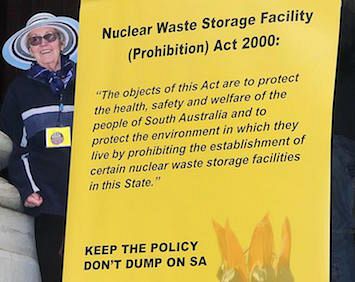 How a planned nuclear waste dump in the tiny SA town of Kimba impacts us all, Independent Australia, Should a remote farming community in South Australia be charged with the momentous decision of storing radioactive waste? Noel Wauchope reports.
THE AUSTRALIAN GOVERNMENT’S drive for a national radioactive trash dump continues.
It is being depicted by the Federal Government and the media as not a national matter. Indeed, it’s now not even a State matter concerning South Australia. It is now portrayed as just a local matter for small rural areas such as Kimba — population 1,100.
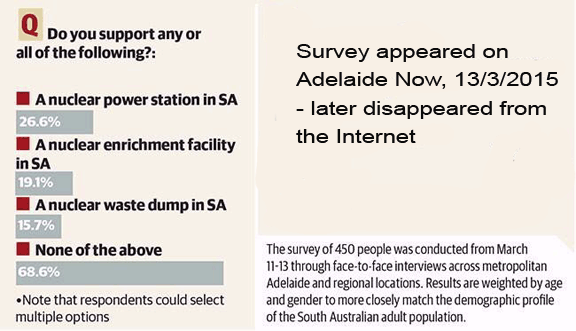
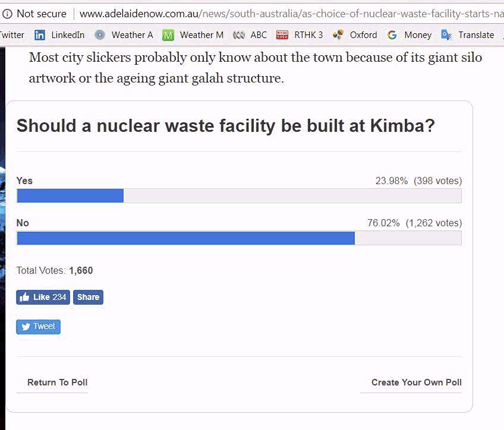
However, an opinion poll in Adelaide Now showed strong rejection of the plan for a nuclear waste dump at Kimba.
Kimba is an agricultural area, most noted for bushfires (Kimba means “bushfire”), wheat farming and a giant statue of a galah.
At the moment, Kimba is well in the running to host the national radioactive trash dump. In 2017, a Kimba town vote favouring this was 396 to 294 in favour. Not an overwhelming endorsement from this small community, but enough to keep enthusiasm for the project going, seeing as the matter is apparently of little concern to the rest of the State or the nation.
How come that Kimba is such a likely place for the dump?
Australia’s nuclear lobby has for decades been pursuing its plan for importing nuclear waste. In more recent years, this nuclear push has also turned its focus towards a dump for Australia’s own nuclear waste. The Australian Government, directed by its statutory body Australian Nuclear Science and Technology Organisation (ANSTO), joined in this because ANSTO is obligated by contract to deal with the high-level waste returning to Australia from processing in France and the UK. This waste is currently stored in containers at Lucas Heights in Sydney……….
in 2018, ANSTO and the ever-persistent nuclear lobby are going for what appears to be a moderate aim — the same old “low level” nuclear waste dump that Howard sought in 1998. The National Radioactive Waste Management Act 2012 stressed the idea that the selection of a site should be “consent-driven” — though, in fact, it gives the Federal Government extraordinary powers to override state/territory governments, councils, communities, traditional owners and, indeed, anyone else.
With the emphasis on landowners volunteering sites – and with financial inducements offered – rural South Australians were encouraged to come forward.
The Turnbull Government claimed it had:
‘ … widespread support from direct neighbours of the nominated properties.’
 Farmer Jeff Baldock nominated his property – and will be paid four times its value – if his offer is successful. Wallerberdina Station, near Hawker, has volunteered. Both communities can expect $2 million in government grants plus a $10 million fund for community development for the chosen site.
No wonder that there’s enthusiasm for the project in this somewhat economically stressed area. However, strong opposition to the dump continues from traditional owners the Adnyamathanhapeople and from 204 paid-up members of the Kimba local group, No Radioactive Waste Facility for Kimba District.
The process has been fraught with problems, starting with the problem of overriding South Australia’s law against setting up nuclear waste facilities.
Because the discussion has been confined to communities in the region, there is little input from experts other than those provided by ANSTO. Farming community members have been transported to Lucas Heights at ANSTO’s expense and given reassuring technical information on nuclear waste storage in canisters. ANSTO medical and nuclear experts have been running science lessons in schools and offering hopes of scholarships to ANSTO.
A very problematic area, indeed, is the fraudulent story about storage of “low-level medical wastes” being the purpose of the facility. The practice of nuclear medicine has in no way been adversely affected by the absence of a national repository and it won’t in any way benefit from the establishment of a repository thousands of kilometres away from Lucas Heights. The real need is to store the processed spent fuel rod waste returning to Lucas Heights from France and the UK. This is classified by the French Nuclear Safety Authority (ASN) as “high level” waste.
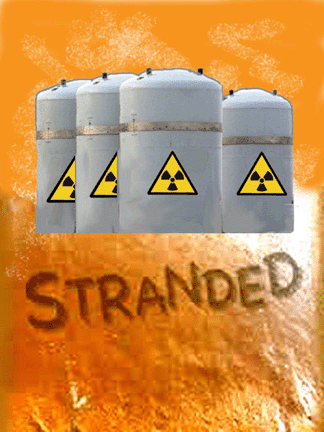
An equally problematic area is in the temporary nature of the planned waste storage. This long-lasting radioactive trash will require burial for its thousands of years of toxicity. Kimba – or whichever area ends up with this facility – is facing the risk of “stranded” nuclear waste.
An Adelaide Now article (no longer available online) quoted a local teacher, Meagan Lienert, assuring us that she has done the research and that the waste facility would not affect the local farming environment. This illustrates a major problem with the way that this issue is being pitched to the locals.
As food produce marketing expert Kristen Jelk discussed in community discussions last year on the South Australian Government site, ‘Your Say’ the perception of clean, green South Australia is all-important. The presence of a nearby nuclear waste dump would ruin that market.
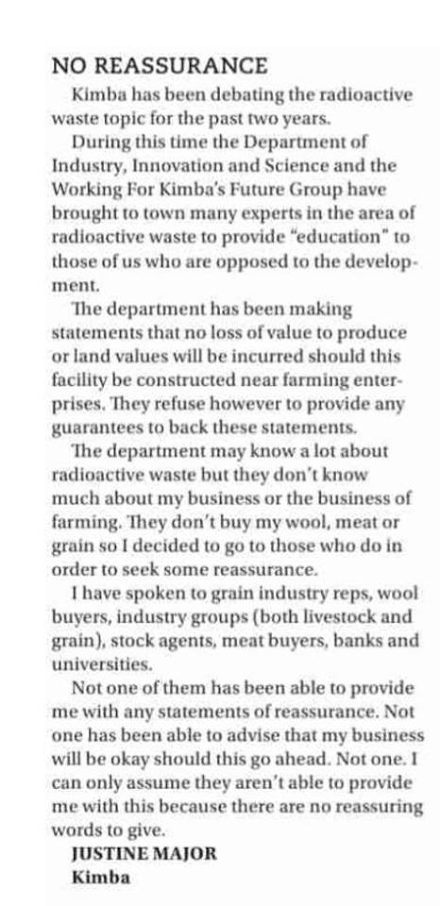
Similarly, Kimba farmer Justine Major wrote to the Eyre Peninsula Tribune, concerned about the image of the local agricultural produce if the radioactive dump should go ahead.
While some in Kimba, including its Mayor, are keen for further investigation of the project as a promising boost for the local economy, are they aware of the irony in that Kimba was, in 2017 State winner of KESAB’s Sustainable Communities top town? This award honours the community that does the most to protect the environment and embrace sustainability.
They hope to go on to win the Australian title.
The Federal Government has set up consultative committees at the local level to advise on the radioactive waste facility proposal. Perhaps it is time for the rest of Australia to have a say. https://independentaustralia.net/environment/environment-display/how-a-planned-nuclear-waste-dump-in-the-tiny-sa-town-of-kimba-impacts-us-all,11102
Brett Stokes – a reminder about ANSTO and its zeal for the nuclear industry
 Brett Burnard Stokes about ANSTO 15 Jan 18
(a) government backed nuclear corporation ANSTO are spending lots of money to establish a nuclear waste dump in South Australia,
|(b) there are laws in SA against nuclear waste dumps (see http://petition.dyndns.org/ ) including a provision that no public money be spent promoting nuclear waste dump.
(c) in contempt of SA laws, ANSTO has spent millions of dollars of public money on propaganda campaigns in South Australia, targetting various places with three sites active now, two in Kimba and one in the Flinders.
(d) ANSTO have run polling a while back, where the results were pretty marginal … and way short of “clear local consent” to proceed.
(e) ANSTO want to pretend that there is “clear local consent” so they are lying and also changing the rules,
(f) ANSTO have dodgy expansionary business plans involving huge export earnings from “medical isotopes” they plan to make at Lucas Heights.
If they do this, it will produce a lot of waste that they do not want to keep at Lucas Heights where there is room.
The business plans are dodgy on many levels.
(g) ANSTO are bullies with lots of cash.
Jeff Baldock looks to four times value of his land to host nuclear waste dump: others not so keen.
Opinion poll results 8 Jan 17 “3.30 pm – “NO vote is currently up to 76.75%
The Advertiser, South Australia is running an opinion poll – Should a nuclear waste facility be built at Kimba? on their article
As choice of nuclear waste facility starts narrowing, people of Kimba are either excited or disgusted
[Ed note 12 Jan – at a later date, the “NO” vote jumped to 85%]
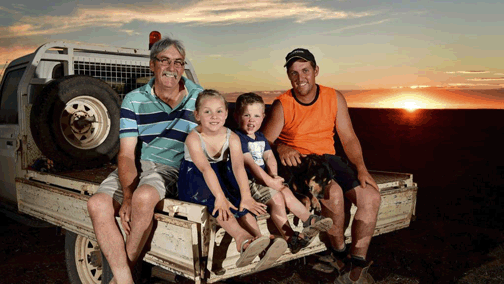
Jeff Baldock and family: A Kimba nuclear waste dump on their property would be a bonanza for them
But what would it do for the market’s perception of South Australia’s farm produce?
Keep ANSTO’s deadly radioactive waste at Australia’s only accepted high grade nuclear waste dump, Lucas Heights.
Paul Waldon, Fight To Stop Nuclear Waste Dump In Flinders Ranges SA Australian Nuclear Science 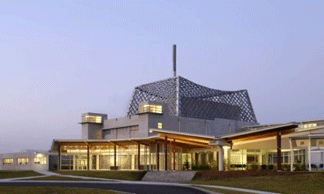 and Technology Organization, founded 1987… Australian Atomic Energy Commission, established 1952… Atomic Energy Policy Committee, created 1949…
How long it was on the drawing board is unknown. However the locals willingness to embrace and accept a nuclear waste producing machine with its ever growing stockpile of manufactured waste in their region is alive and strong.
For 69+ years the facility has been endorsed every time someone relocates to Lucas Heights/Barden Ridge and surrounding burbs,, or when a contract for a house or business in the area has been secured. 69 Years is along time in the cycle of a persons life, and presents a question:are there any surviving post nuclear residents residing in the district? So keep ANSTO’s deadly radioactive waste at Australia’s only accepted high grade nuclear waste dump, Lucas Heights. https://www.facebook.com/groups/344452605899556/
Kimba town hopes to win top environmental award – but wants nuclear waste dump !!
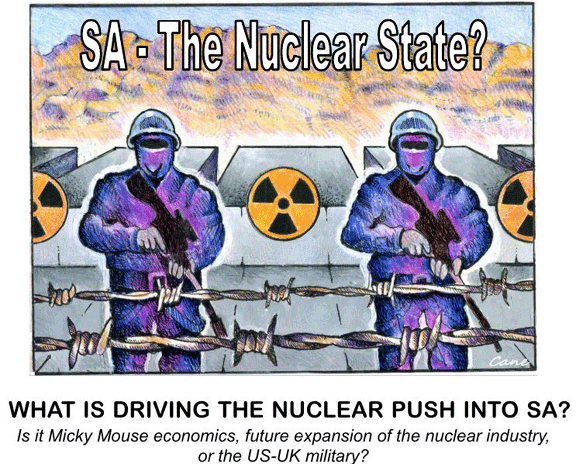
where do we want to see Kimba in 300 years? We’ll be a national centre for rubbish.
The community is a finalist for the Australian title of KESAB’s Sustainable Communities top town…..the award honours the community that does the most to protect the environment [!!!]
As choice of nuclear waste facility starts narrowing, people of Kimba are either excited or disgusted, Erin Jones, Sunday Mail (SA) January 6, 2018 IF there are two words that can split an already isolated South Australian town and destroy lifelong friendships, they are “nuclear waste”.
Kimba, on the northern edge of the Eyre Peninsula’s vast grain-growing belt, is home to two of the three proposed sites where the nation’s radioactive waste might be stored.
Most city slickers probably only know about the town because of its giant silo artwork or the ageing giant galah structure. But it is where farming is the lifeblood of the community and where the proposal to use agricultural land as a nuclear site weighs heavily on some residents in the town of 650.
“We were a really tight-knit community but now we’re just a town,” says farmer Amy Koch. “We’re not even a community anymore.”
Everything changed two years ago when the owners of two farms nominated to be the site for a nuclear waste repository. The move has had a polarising effect. Long-time friendships have broken down, businesses have been boycotted and people deliberately avoid each other in the street and at events.
Mrs Koch’s friend, Rachel Yates, also a farmer, says the division between residents is palpable.
“When you go into town, you make sure you know a friend is going to be there and you have someone to talk to,” Mrs Yates says. “I’ve never seen anything like this that has divided the whole town.” The women are part of No Radioactive Waste on Agricultural Land in Kimba or SA — a group started in response to the two farming families offering their land.
If approved, the successful farm will hold low-level waste from the Lucas Heights nuclear facility, in NSW, and Australia’s intermediate-level waste such as that from industrial, medical and research applications. (Ed. note: no mention of the high level nuclear waste from the Lucas Heights nuclear reactor, which will also come)
Many see the facility as a way forward, helping to boost the local economy and creating jobs.
Others say there will be little economic benefit and the town’s reputation will be tarnished.
Third-generation farmer Jeff Baldock defends his decision to offer 100ha of his Napandee property, 25km northwest of Kimba, despite some resistance.“When this process first started I felt physically ill going to Kimba and my family would feel really uncomfortable going to functions,” he says.“Twelve months ago I asked if it’s worth it but one of our neighbours said ‘If you believe in it you just have to keep going’. “Now we feel more than happy to go to town.
“Ninety per cent of people are still chatting away merrily to whoever but there is a group that has decided that they don’t want to be a part of that.
“I still say ‘G’day’ to everybody — if they choose not to say it back, that’s up to them.”
Mr Baldock and his wife, Jenny, nominated another of their properties last year but it was ruled out by the Federal Government following the assessment process and opposition.
As a result, they nominated their Napandee property, where they live with their children and five grandchildren. If successful, they will be paid four times the value of the land — believed to be about $400,000 — and Mr Baldock says they aim to crop the site’s 60ha buffer zone to put money back into the community through the local Agricultural Bureau and Lions Club.
But Mr Baldock believes the real benefit of the repository will be for the town’s residents in safeguarding them financially in the event of drought.
About 50 per cent of residents are employed in agriculture, according to figures from the Australian Bureau of Statistics. “This is an industry that doesn’t rely on agriculture, that’s the big thing,” Mr Baldock says.
“Seven of the last 10 years have been good but it won’t keep going that way and it might be a bit ugly if we have two or three droughts.
“We see this as drought-proofing the community.”
An Electoral Commission ballot of Kimba residents found 57 per cent of the 698 respondents — there are 1100 residents in the council area — agreed the sites should progress to the next round of consultation.
The process included a 90-day consultation period and the Government said there was widespread support from direct neighbours of the nominated properties, with all but one supporting proceeding to the next phase.
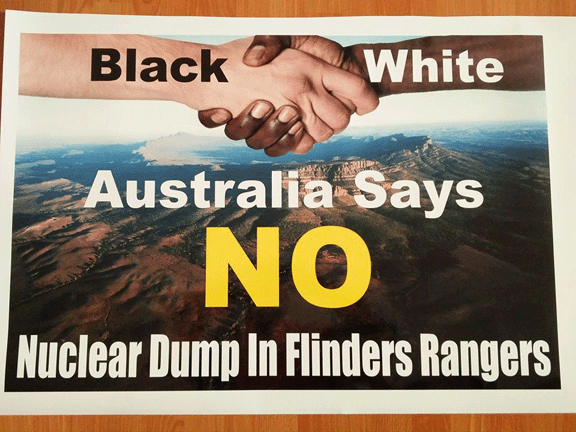 The Kimba properties have now joined Wallerberdina Station, near Hawker, to advance to stage two of consultation but the Flinders Ranges site is facing strong opposition from the Adnyamathanha people — the traditional owners — for cultural reasons.
Both communities now have access to $2 million worth of grants — from the Government’s community benefit fund for local projects to create economic or social benefits — in recognition of any disruption during the assessment process.
A $10 million fund for community development projects has been promised to the area of the final chosen site — expected to be announced in the second half of this year — which critics fear is a sweetener to encourage the waste facility’s approval.
Michelle Rayner believes the nuclear debate has already had positive benefits in town, including accommodation being filled with government workers and the media visiting on a regular basis.
Mrs Rayner, who owns Eileen’s cafe just off the main street, and her husband, Brett, proposed their Lyndhurst farming property as the other potential site to become the repository. That decision resulted in them being castigated by former acquaintances. but Mrs Rayner said the town needed something to boost its economic prospects.
“My husband wasn’t interested in it all initially but then he came to a community meeting and was blown away by the opportunities for the town,” she says.
“To become a government town, you’re guaranteed to have a decent hospital, better infrastructure and better internet communications.”
The Federal Government says wherever the facility is located, it will bring a minimum of 15 jobs in
administration, waste management and security.
As well, a facility of this scale would likely have additional investment in infrastructure such as roads and telecommunications.
Mayor Dean Johnson does not skirt around the issues and the importance of finding new ways to bring more people to the town, which currently has dozens of empty houses. “The truth is our population is on a slow decline and if we can’t turn that around our sustainability will be questioned,” he says.
“While we have the agriculture roots — and it will always be the main industry in Kimba [Ed note: Not when then market learns about the radioactive trash dump nearby]— any opportunity to diversify the economy and bring more jobs into the town should be investigated.
“That’s not saying this definitely is the thing but we believe we have to investigate it fully and the community has supported that view.”
The stage two consultation process was announced in June and, last month, 16 community members were appointed to a local consultative committee by the Federal Government.
In total, 51 people applied and explained why they wanted to be part of the committee to act as a link to
the government, the Department of Industry, Innovation and Science and residents.
The committee is to provide advice on jobs and business opportunities, relay information on the project’s technical aspects and review nominations for the $2 million community benefit fund.
TEACHER Meagan Lienert — one of the committee members — supports the waste facility because of the benefits she believes it will bring, especially to the school’s 174 students.
 She says medical and nuclear experts had run science lessons at the school and there was talk of access to scholarships at the Australian Nuclear Science and Technology Organisation, at Lucas Heights.
But she understands some people fear nuclear waste because they believe it will affect farming land.
“From my research, I can see the facility is safe and I know it won’t have any affect on the things around it but the fear some people have is real,” Mrs Lienert says.
“I don’t take that away from anyone but I hope to be able to help people gain a bit of understanding and perhaps relieve some of that fear through the consultative committee.”
No Radioactive Waste on Agricultural Land in Kimba or SA secretary Toni Scott is also on the consultative committee and raises concerns about whether the process will be fair.
Mrs Scott says there is a struggle to get information from the Government on why federal land is not used and how many jobs the waste facility will create, saying the number has fluctuated from 15 to 30.
“How do we trust the Government building this facility when we can’t even trust the process?” Mrs Scott says.
“We’re trying to get in writing that if there’s another vote what percentage the Minister needs for this to go ahead. The department head said he would need more than 65 per cent to build the facility but it has never reached 60 per cent.”
FOR two years, Mrs Scott has represented the group’s 204 financial members to oppose the facility, including 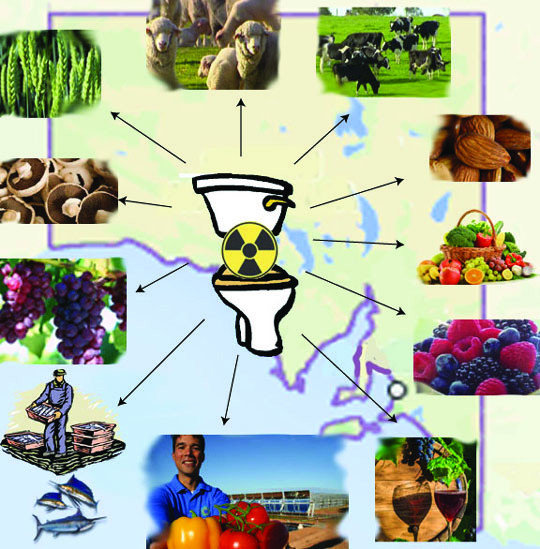 making representations at Parliament House in Adelaide and Canberra.
“The key concerns we have are for our farming and our produce; we live in a big country and only 4 per cent is arable farming land — and we sit within that,” she says. “We think we don’t need to risk productive land when there is so much non-arable land. They should try a bit harder to find a suitable site because people aren’t very happy here and it feels like two years of a government process has been forced upon you.”
Kimba farmer and former federal Liberal MP Barry Wakelin is a member of the anti-nuclear group and believes the Government is struggling to find a suitable site — an issue plaguing successive governments since 1992.
“This is their third go after Woomera, Mataranka, and now we have the Kimba/Hawker situation,” Mr Wakelin says.
“The Federal Government has so many other options; it’s absurd to have a community divided on this issue.
“The other thing that weighs heavily on people’s minds is where do we want to see Kimba in 300 years?
We’ll be a national centre for rubbish.” Federal Minister for Resources Matt Canavan told the Sunday Mail
no final decision on the site had been made. He says the Kimba community will get another vote on whether they support a facility — but says there is no “arbitrary figure” which will determine whether it will go ahead.
“The people of Kimba will have a chance to have their say again through another vote after this more comprehensive consultation period concludes,” he says. “There is no arbitrary figure for each step but I have always said there must be broad community support.” Mr Canavan says the process has been rigorous and transparent and a decision would not be made without consultation.
NEW LANDMARK PRAISED
KIMBA locals are forever trying to attract more visitors to their town — and now their efforts are gaining national attention.
The community is a finalist for the Australian title of KESAB’s Sustainable Communities top town — previously the Tidy Towns competition — after being named state winner in November.
The award — to be announced in April — honours the community that does the most to protect the environment, enhance their town and embrace sustainability.
Kimba Community Development Group chairwoman Heather Baldock says their entry included the Igniting Kimba arts project, which included stunning artwork on the town’s grain silos — a refreshing foil to the better-known but now tired-looking Big Galah.
“In a community where sport has always been important, art adds a whole other element to our community and it’s excited the locals even more than we expected,” she says.
“The media interest from across Australia regarding our silo art has been amazing and I think it’s something the whole community is quite proud of.
“We saw a 35 per cent increase in traffic when it was finished (in September) which was over 600 vehicles, so we’re pretty pleased with that.
“Anything that can make people stop for an extra night or two will help us economically because we have businesses that are struggling.”
The award also recognises the town’s grey nomad program, encouraging travelling retirees to work alongside local volunteers, pass on skills and, in return, stay for free….., http://www.adelaide now.com.au/news/south-australi a/as-choice-of-nuclear-waste-f acility-starts-narrowing-peopl e-of-kimba-are-either-excited- or-disgusted/news-story/ 8460ea159b77d47d915dc0abfc362b 37
Timeline of present and recent plans to dump radioactive trash in the Flinders Ranges
 As choice of nuclear waste facility starts narrowing, people of Kimba are either excited or disgusted, http://www.adelaide now.com.au/news/south-australi a/as-choice-of-nuclear-waste-f acility-starts-narrowing-peopl e-of-kimba-are-either-excited- or-disgusted/news-story/ 8460ea159b77d47d915dc0abfc362b 37Erin Jones, Sunday Mail (SA)
January 6, 2018 “………..1998: The Howard Government announces plans for two low-level nuclear waste sites in SA, both at Woomera. Low level nuclear waste includes items like contaminated clothing, rags, tools, medical tubes and swabs.
2003: The SA Government passes a Bill banning the establishment of a low-level waste dump, but the Commonwealth tries to acquire the land at Woomera.
2004: The Federal Court rules that the acquisition is unlawful and the Commonwealth abandons its SA plans.
February, 2015: SA Premier Jay Weatherill announces a royal commission into the role the state could play in the nuclear future, including establishing a high-level waste facility in SA. High level waste includes spent nuclear fuels and waste from the vitrification process.
May, 2015:Mr Weatherill decides upon a citizen’s jury process, to decide whether SA should pursue a high-level dump.
November, 2015:Six sites across Australia, including two at Kimba and one in the Flinders Ranges, are short-listed for a low-level nuclear waste site.
April, 2016: Wallerberdina Station, near Hawker, in the Flinders Ranges, goes to the next stage of the consultation phase — ahead of the five other sites.
November, 2016:The majority of Citizen’s Jury participants vote against a high-level waste dump.
June, 2017 Mr Weatherill formally abandons his high-level nuclear waste push.
■ Two more properties at Kimba nominate to be a low-level nuclear waste site and also progress to the next stage of consultation. http://www.adelaide now.com.au/news/south-australi a/as-choice-of-nuclear-waste-f acility-starts-narrowing-peopl e-of-kimba-are-either-excited- or-disgusted/news-story/ 8460ea159b77d47d915dc0abfc362b 37
1 This month
To see nuclear-related stories in greater depth and intensity
– go to https://nuclearinformation.wordpress.com/


 Antinuclear
