Australia has another go at cleaning up decades old pollution from old uranium mine Rum Jungle.

This is why Rum Jungle is so important: it was one of the very few mines once thought to have been rehabilitated successfully.
We got it wrong with Rum Jungle …….. Getting even a small part of modern mine rehabilitation wrong could, at worst, mean billions of tonnes of mine waste polluting for centuries.
Let’s hope we get it right this time.
The story of Rum Jungle: a Cold War-era uranium mine that’s spewed acid into the environment for decades https://theconversation.com/the-story-of-rum-jungle-a-cold-war-era-uranium-mine-thats-spewed-acid-into-the-environment-for-decades-160871, Gavin Mudd Associate Professor of Environmental Engineering, RMIT University, May 18, 2021
Buried in last week’s budget was money for rehabilitating the Rum Jungle uranium mine near Darwin. The exact sum was not disclosed.
Rum Jungle used to be a household name. It was Australia’s first large-scale uranium mine and supplied the US and British nuclear weapons programs during the Cold War.
Today, the mine is better known for extensively polluting the Finniss River after it closed in 1971. Despite a major rehabilitation project by the Commonwealth in the 1980s, the damage to the local environment is ongoing.

first visited Rum Jungle in 2004, and it was a colourful mess, to say the least. Over later years, I saw it worsen. Instead of a river bed, there were salt crusts containing heavy metals and radioactive material. Pools of water were rich reds and aqua greens — hallmarks of water pollution. Healthy aquatic species were nowhere to be found, like an ecological desert.
The government’s second rehabilitation attempt is significant, as it recognises mine rehabilitation isn’t always successful, even if it appears so at first.
Rum Jungle serves as a warning: rehabilitation shouldn’t be an afterthought, but carefully planned, invested in and monitored for many, many years. Otherwise, as we’ve seen, it’ll be left up to future taxpayers to fix.
The quick and dirty history
Rum Jungle produced uranium from 1954 to 1971, roughly one-third of which was exported for nuclear weapons. The rest was stockpiled, and then eventually sold in 1994 to the US.
The mine was owned by the federal government, but was operated under contract by a former subsidiary of Rio Tinto. Back then, there were no meaningful environmental regulations in place for mining, especially for a military project.
The waste rock and tailings (processed ore) at Rum Jungle contains significant amounts of iron sulfide, called “pyrite”. When mining exposes the pyrite to water and oxygen, a chemical reaction occurs generating so-called “acidic mine drainage”. This drainage is rich in acid, salts, heavy metals and radioactive material (radionuclides), such as copper, zinc and uranium.
Acid drainage seeping from waste rock, plus acidic liquid waste from the process plant, caused fish and macroinvertebrates (bugs, worms, crustaceans) to die out, and riverbank vegetation to decline. By the time the mine closed in 1971, the region was a well-known ecological wasteland.
Continue readingSouth Australian Supreme Court rules that information on the Kimba nuclear waste dump can be made public.
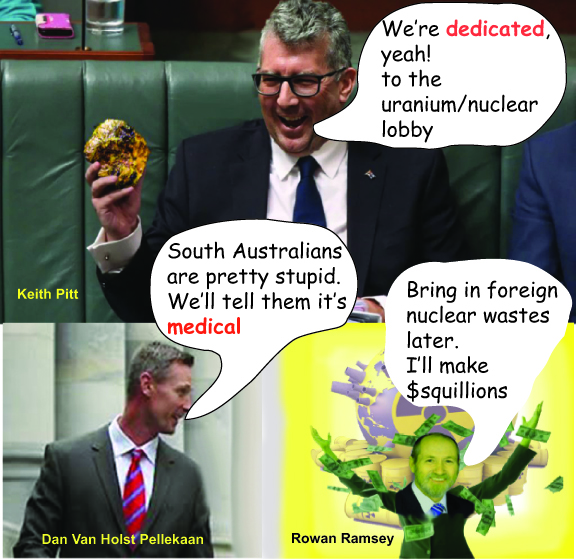
Senator Rex Patrick · SA GOVERNMENT TRANSPARENCY FAILURE, 18 May 21,
Yesterday the South Australian Civil and Administrative Tribunal overturned a decision by SA Energy and Mining Minister Dan van Holst Pellekann to keep information on the National Radioactive Waste Management Facility (NRWMF) from the public. In August last year I made a Freedom of Information request to the Minister asking for access to correspondance between the SA and Federal Government relating to the establishment of a NRWMF facility at Kimba. In November he released four documents to me, with significant redaction on one of them.
When I challenged the redaction the Minister threatened me with legal costs. Yesterday Justice Hughes rejected the Minister’s arguments and found that the document he wished to keep secret was not exempt under FOI.People have a right to know what their Government is saying and doing so that they can properly participate in democracy. This is especially the case when there is a major issue being played out. Minister van Holst Pellekaan needs to rethink who he really owes a duty to. Ministers should serve the people, not their own narrow political interests. https://www.facebook.com/senator.rex.patrick/posts/924739811419769
Federal Government’s budget details indicate increased nuclear waste storage at ANSTO, Lucas Heights, rather than a rush for a nuclear waste dump at Kimba South Australia.
The recent Budget sent mixed messages on this significant issue, both funding the current deeply flawed approach while also holding the possibility of a more considered pathway.
The budget allocations for radwaste were interesting: $100 million to advance Kimba (not good) but also $60 mill for increased interim ILW storage capacity at ANSTO
Like radioactive waste, the Coalition’s waste dump plan will not die https://independentaustralia.net/politics/politics-display/like-radioactive-waste-the-coalitions-waste-dump-plan-will-not-die,15096 By Dave Sweeney | 18 May 2021,
Like the waste itself, a dubious Coalition plan to temporarily dump nuclear waste for a future government to re-locate, 100 years later, at another undecided location is long-lived and toxic, writes Dave Sweeney.
IN THE RECENT Federal Budget, as with much in life, the devil is in the detail.
One public policy area that received a bucket of cash but not a lot of comment is the Government’s approach to Australia’s radioactive waste. Like the waste itself, the political positioning around this issue has been both long-lived and toxic.
Since the mid-1990s, with varying degrees of enthusiasm, successive federal governments have sought to advance one management approach: regional or remote co-location. This involves centralising the bulk of Australia’s radioactive waste in two adjacent facilities at the one location.
One site is for the internment and disposal of low-level waste. This material, which needs to be isolated from people and the wider environment for up to 300 years, would forever remain at the site.
The neighbouring site would hold intermediate-level waste, which needs to be isolated for up to 10,000 years, in extended above ground storage in a purpose-built shed.
The plan is that a future federal government, sometime in the next 100 years, would re-locate this material for deep burial at another currently undecided location via an undisclosed and unfunded process.
Critics of this Federal waste plan see this as a short-term political fix rather than a credible approach to managing inter-generational industrial waste. They are calling for a policy recalibration away from the push to find a compliant or vulnerable postcode and towards a rigorous, transparent, and evidence-based process to identify the least bad management option.
Nothing about the nuclear industry, especially nuclear waste, is clean or uncomplicated.
The recent Budget sent mixed messages on this significant issue, both funding the current deeply flawed approach while also holding the possibility of a more considered pathway.
The Morrison Government remains intent (Budget Papers p138) on advancing a contested plan to locate the twinned national radioactive waste facility near Kimba, a small rural town at the top of South Australia’s Eyre Peninsula.
The issue is deeply divisive with strong local supporters who see the facility as an economic lifeline and fierce critics who see the plan as a threat to the region’s primary economic driver — high-quality cereal cropping.
The local Native Title holders, the Barngarla people, have been actively excluded from participation in Federal mechanisms to measure community sentiment and are also vigorously opposed, as are growing stakeholder voices across the region and the nation.
The Barngarla have previously taken legal action against the Kimba site selection and, in a move to shut the door on any further legal contest, Resources Minister Keith Pitt has been spruiking an amendment to the Federal radioactive waste laws to remove key stakeholders right to judicial review.
Fortunately, this heavy-handed piece of legal corner-cutting remains blocked in the Senate. To their considerable credit, the Greens, Labor and most crossbenchers are not supportive of denying Australians a day in court to challenge a controversial project with inter-generational impacts.
Despite this stalemate, the 2021 Budget saw around $100 million dollars allocated to maintain momentum on a waste plan that lacks support, evidence or meaningful public health or radiological protection rationale.
Interestingly, though, the Budget also contained an allocation that may provide a much-needed circuit breaker.
A separate allocation of $60 million was made ‘to support the interim storage of intermediate level solid radioactive waste’ at the Australian Nuclear Science and Technology Organisation’s nuclear facility at Lucas Heights in southern Sydney.
The majority of Australia’s radioactive waste – and around 95% of the most problematic intermediate-level waste – was both produced and is currently stored at the Australian Nuclear Science and Technology Organisation (ANSTO).
Critics of the Kimba plan maintain that ANSTO is currently the best place to store Australia’s worst waste and that extended interim storage of Australia’s intermediate-level waste at Lucas Heights, coupled with a transparent review of future management options is the most prudent and credible approach.
Not only is the waste already there but ANSTO has certainty of tenure, a secure perimeter, is monitored 24/7 by Australian Federal Police and the waste will be actively managed as ANSTO’s operations are licensed for a further three decades.
Importantly, this approach keeps waste management on the radar of the agency with the highest level of nuclear expertise and radiation monitoring and emergency response capacity in Australia, and helps reduce the negative impacts of a highly politicised decision-making process like we are seeing with Kimba.
After community opposition and Federal Court action ended an earlier proposed waste site at Muckaty Station in the Northern Territory, ANSTO constructed and commissioned a new purpose-built store dedicated to housing reprocessed, spent nuclear fuel waste, which returned from France in late 2015.
This interim waste store has a conservative design life of 40 years, its license is not time-limited and it has (if required) regulatory approval to store these reprocessed wastes until the availability of a final disposal option.
Storage at ANSTO has been previously identified as a credible and feasible option by ANSTO and nuclear industry lobby group, the Australian Nuclear Association.
Most importantly, the CEO of the Federal nuclear regulator, the Australian Radiation and Nuclear Safety Agency (ARPANSA), confirmed to a Senate Inquiry in June 2020 that intermediate-level ‘waste can be safely stored at Lucas Heights for decades to come’.
Builders have a maxim: measure twice, cut once. This sensible approach should also inform Australia’s approach to radioactive waste management, especially in relation to the unnecessary double handling of intermediate-level wastes.
Nothing about the nuclear industry, especially nuclear waste, is clean or uncomplicated.
However, extended interim Federal storage – coupled with a comprehensive public review of the full range of longer-term management options – is the approach that is most likely to advance and realise lasting and responsible radioactive waste management in Australia.
Such an approach would help turn this political football into a worthy goal.
It’s not acceptable to ignore Aboriginal land owners, in order to impose high level nuclear waste on their land.
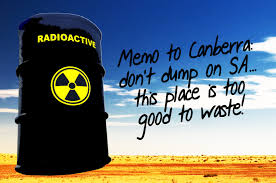
Kim Mavromatis,No nuclear waste dump anywhere in South Australia, 18 May 21, In 2020 it’s not acceptable to completely ignore the traditional owners of country and not acceptable to deliberately remove Independent Scrutiny or Rights of Appeal from the Legislation process. But these bullies don’t care what South Australia thinks.
The world classifies Spent Nuclear Fuel (10,000 times more radioactive than uranium ore) and Nuclear Waste from reprocessed SNF (still contains 95% of the radioactivity of SNF) as High Level Nuclear Waste but Aust and ANSTO classify it as Intermediate level – and that’s what the Fed Govt want to dump on SA farmland. https://www.facebook.com/groups/1314655315214929
New developments: particle accelerators could make Lucas Heights’ Opal nuclear reactor obsolete. And the pro Kimba waste dump argument useless.

Greg Phillips , Nuclear Fuel Cycle Watch Australia, 14 May 21
Lest we forget. The majority of the radioactivity they want to send to SA/Kimba is from the production of medical isotopes using a method that should be replaced by much cleaner/safer/reliable accelerator/cyclotron methods:”Pallas’s original business case was mainly based on the production of technetium-99m, which is obtained from molybdenum-99 via a generator. Despite the initially favorable forecasts for this reactor isotope, the business case ultimately did not hold up. This is partly due to the rise of the cyclotron, the linear particle accelerator (linac), and the advent of new large-scale production techniques, based on systems or reactors driven by particle accelerators, such as SHINE.
In the current market, the major role of research reactors is mainly determined by the production of technetium-99m, a SPECT isotope and by far the most widely used medical isotope in radiodiagnostics. But new suppliers will soon be entering the market, including SHINE, producers with cyclotrons, and a series of suppliers with linacs.More important than the future production of technetium-99m is the amazing innovative power of the accelerator technology.
For example, the PET isotope rubidium-82 has been marketed fairly recently for measuring the blood flow in the heart muscle. However, this treatment will soon face competition from the even more efficient PET drug fluorine-18 Flurpiridaz.
Although these treatments are more expensive than traditional technetium-99 (SPECT) treatment, they can compete because the imaging is very accurate and takes place in “real time”. This means that one treatment suffices, saving costs.
Pallas’ latest business case focuses mainly on the production of therapeutic isotopes for the treatment of cancer and tumors, with beta-emitter isotopes such as lutetium-177 and yttrium-90 in particular determining the picture in this growing market. But here too the question applies: can Pallas really withstand the innovative power of accelerator technology? Then it is not so much about SHINE, which can certainly become a formidable competitor of reactor manufacturers for the production of lutetium-177 (and later also yttrium-90), but mainly about the advance of new generations of therapeutic accelerator isotopes. For example, alpha emitters, and a new class of beta emitters, will conquer an increasing part of the current beta emitter market. …” more https://www.technischweekblad.nl/opinie-analyse/pallas-versus-de-innovatiekracht-van-versnellertechnologie?fbclid=IwAR2T6Ns_xt27fPBsbTHP0BkNG6x0Xk3x-nbaSJshNSQrZ2W5Q21C4GdvwY0 https://www.facebook.com/groups/1021186047913052
Questions that must be asked of Resource Minister Pitt, about the new money for Kimba, designated as Australia’s nuclear waste dump.

The contentious Waste Management Amendment (Site Specification, Community Fund and Other Measures) Bill 2020 has been listed in the Senate’s order of business for Tuesday 11 May 2021 as number 11 in the government business—orders of the day
The senator representing the responsible minister for the bill is Senator the Hon. Zed Seselja as Minister for International Development and the Pacific.
It is now important that people who care about the Kimba community,about South Australia, about Australia should contact politicians, especially Keith Pitt, Rowan Ramsey, and also Kimba Mayor Dean Johnson, and ask them these vital questions about the money that the Federal government plans to shower on Kimba.
Member for Grey, Rowan Ramsey MP, said the new nvestment highlighted the government’s commitment to
Kimba. Applications for projects will be open later in 2021 and will be assessed by Business Grants Hub in consultation with the Kimba community.
Pitt and Ramsay should be asked with regard to the latest grant:
1. How will it “drive further economic and socialimprovements across the Kimba community?
2. What is the economic success of Kimba?
3. What is the disruption which this has caused for the people in the area by the progress of the facility when
no effort has been made by Pitt and Ramsay to enable those objecting to the facility the opportunity to have an
independent assessment of the safety and economic consequences of the facility’s establishment?
4. Will the services and infrastructure under the new round of funding include payment for an independent assessment sought by the the many persons objecting to the facility proposals.?
5. Would the funding for this payment be made automatically by Pitt without the intended application process?
6. Does Pitt accept that a major part of the disruption to the people in the area has been caused by his government
failing in providing them with a safety case and enabling an independent assessment as demanded by them since the initial proposals for a facility?
7.Surely he would acknowledge that “this funding will be invested into therefore the disruption which this has
caused for the people who live in the area” by paying for an independent assessment as sought by them?
8. How does Ramsay expect that this funding will “include projects which will grow employment in the community”
when there is a justified fear and concern among many in the community that the facility’s presence will destroy the region’s economy“?
9. Is this “a warm welcome”?
10. How can Johnson justify this as “a win for Kimba businesses and residents” when there is the strong
likelihood based on overseas experience that the local economy will be destroyed through the presence and operations of the facility?
11. What are the important health care initiatives, tourism funding and economic diversification projects referred to in the media release as they presumably should have been normal funding obligations of the federal and state
governments?
Minister Keith Pitt – desperate times, desperate measures – to get Kimba nuclear waste dump
 | |||
Kazzi Jai No nuclear waste dump anywhere in South Australia, 9 May 21
DESPERATE TIMES CALL FOR DESPERATE MEASURES!!….”Kimba community to receive $2 million funding boost8 May 2021Joint media release with Rowan Ramsay MP, Member for Grey
The Kimba community will benefit from an additional $2 million investment in services and infrastructure under a new round of the Community Benefit Program announced by the Coalition Government.”So….this PRESS RELEASE by Minister Pitt was released YESTERDAY SATURDAY 8TH MAY 2021. Interesting timing given that the Senate reconvenes THIS COMING TUESDAY 11TH MAY 2021!
More money to build public toilets?….Can’t have TOO MANY toilets!!….Or what OTHER Community Benefits projects would they be considering…..given that the GRANT money is not to be used for COMPETITIVE ADVANCEMENT or PERSONAL GAIN. Not looking at anyone specific there – maybe a certain MAYOR, and a certain other person EMPLOYED directly by the department from last Grant Round!!What really intrigues me is that Kimba Council released a public document 30th April 2021 regarding their ANNUAL BUSINESS PLAN AND BUDGET 2021-22 PUBLIC CONSULTATION DRAFT….and in it stated, under Non-Financial Performance Measures – 2021-22 (page 10)…
“Lobby Australian Radioactive Waste Agency and the Minister for resources, Water & Northern Australia for grant funding promised as part of stage 2 of the establishment of the Nuclear Waste Facility. (Strategy3.1)“Feedback due 17th May 2021.So…..this announcement throws up a number of questions. Firstly, “lobby” is a term used to “try to influence the decision-making of a government or opposition representative in the exercise of their official functions”. Does this mean that the Kimba Council had no idea that the money was to be released as part of the continued Stage 2 – which Hawker now is no longer a part of?
Remember Matt Canavan (the previous minister) only announced the so called “New Community Benefit Program 2019-22” JUST MOMENTS BEFORE THE KIMBA AND HAWKER BALLOTS STARTED – on October 8th 2019!! So it isn’t an annual anticipated thing!!….especially when they named the Community Benefit Program 2019 – 22!! Of course Matt Canavan then jumped ship and resigned his ministry on 3rd February 2020.
Is it AGAIN to sway people in Kimba that they are “special”? Remember that $2 million is chicken feed in the grand scheme of things – even the total which would be now $6 million is chicken feed given what they intend doing – making the CURRENT EXPORT PRODUCING AGRICULTURAL LAND OF KIMBA A NUCLEAR WASTELAND….which is over 1700 KMS AWAY from the industrial producer of this nuclear waste – Lucas Heights!!Or is it a way of convincing people that sellout RAMSEY is worth re-electing in this coming Election Year for the Federal Government? (The latest that a Federal Election can be held will be next year May 2022.)
Hunters Hill low level radioactive trash to be sent to USA
Are you turning green?‘: Neighbours’ relief as radioactive land to be shipped overseas, rioritised. https://www.smh.com.au/national/nsw/are-you-turning-green-neighbours-relief-as-radioactive-land-to-be-shipped-overseas-20210429-p57nk3.html. , 30 Apr 21,
April 30, 2021 — Up to 1800 tonnes of contaminated land affecting six waterfront properties in one of Sydney’s wealthiest suburbs will be sealed up and shipped to the US in a NSW government resolution that ends decades of anxiety over the harbourside blight.
After more than 100 years, pollution from a carbolic acid plant and a uranium refinery that led to the government’s acquisition of three Hunters Hill homes since the 1980s, and later prompted a parliamentary inquiry over health concerns, will be exported to Idaho over a meticulous, 18-month operation starting from July.
Following media reports that deaths and illnesses of former residents could possibly be attributed to contamination, a NSW parliamentary inquiry was set up in 2008 to determine the extent of radioactivity on the site, concluding it was difficult to establish any link between any reported cancer cases and the low doses of radiation.
However, it found there was a need to remediate the site, which included the government-owned foreshore.
In 2012, Property NSW attempted to have the material sent to a landfill in Kemps Creek, in western Sydney, but the proposal was abandoned after fierce backlash from the community.
A May 2019 proposal to encapsulate the contaminated material onsite in purpose-built cement “containment cells” was also rejected by residents as well as the local council………
Mr Stokes said the latest proposal had overwhelming support from the community and that he was pleased the stakeholders had finally reached an agreement.
“This safe and secure plan will mean these waterfront properties, which have laid dormant for decades, can now be used once the waste is safely moved away,” Mr Stokes said.
Member for Lane Cove and government minister Anthony Roberts, whose electorate serves the area, said the decision would be welcomed by residents after the waste “caused a lot of stress over the decades”.
Two of the three lots owned by the government are empty, while one contains an unused four-storey home with an indoor swimming pool that will have to be demolished. It is likely all lots will be sold on the private market once they are decontaminated.
According to a recent NSW government report on the remediation project, the fresh plan involves excavating the contaminated soil, sealing it in bags, loading them into shipping containers and transporting them to a secure facility in Matraville before shipping them overseas in scheduled consignments.
Property and Housing Minister Melinda Pavey said ANSTO would oversee the excavation and transport of the material and the safety of residents would be prioritised.
”Low Level” radioactive trash to be removed to USA from posh Sydney suburb, while govt plans to send Higher Level nuclear waste to Kimba, rural South Australia.

This is very interesting. They say it’s ”low leve” – presumably ”safe”. Yet for the residents of a posh Sydney suburb, its worth a century-long fight to get it removed – and sent to America !! Makes you see why the residents of Lucas Heights , – now called Bardon Ridge – might be keen to have their much higher-level radioactive trash foisted on distant rural Kimba, South Australia
Hunters Hill radioactive waste to be removed sent to United States https://www.abc.net.au/news/2021-04-30/hunters-hill-radioactive-waste-to-be-removed-sent-to-us/1001
By Rani Hayman 1 May 21,
Key points:
- The land was the former site of the Radium Hill refinery, which closed in 1915
- The removal will begin in the coming weeks and take 12 months
- Melinda Pavey said the issue had taken a long time to resolve because it was “complicated”
Several properties on Nelson Parade at Hunters Hill were built on land contaminated by a former uranium processing site, which closed in 1915.
The area was also occupied by a carbolic acid plant until the early 1900s and a tin smelter until the 1960s.
Residents have spent decades fighting for the state government to remove the affected soil.
Finally, their calls have been heard, with the waste due to be excavated and sent to the United States.
Philippa Clark from the Nelson Parade Action Group said she was pleased the issued had finally been resolved.
“This is the way you deal with this kind of contamination and the best way possible for us and the environment and future generations,” she said.
The NSW government said the process would begin in the next few weeks and was expected to take 12 months.
The Minister for Water, Property and Housing Melinda Pavey said the health and safety of the community would be the main priority during site remediation works and the transportation of the material.
“The Australian Nuclear Science and Technology Organisation (ANSTO) will supervise the excavation and packing of the contaminated material into sealed bags and containers prior to transport to the USA,” she said.
While there is a sense of relief within the community, the decades-long battle has put strain on the affected residents.
When asked why it has taken so long to find a solution, Ms Pavey said: “Because it was complicated.”
A parliamentary committee in 2008 called for a comprehensive remediation plan for the site and in 2014 the Environmental Protection Agency (EPA) issued a management order to Property NSW to commence the works — although it said the development consent still had not been issued.
A plan to move the contaminated material to Kemps Creek in Sydney’s west was also abandoned in 2014 following community backlash.
The Mayor of Hunters Hill, Ross Williams, said the residents were looking forward to the area being rehabilitated.
“It’s been a health issue and a legacy issue for all that time.
It’s low-level radioactive material and it came from an industry that was essential [really?] back in those days,” he said.
“In modern times the environmental consequences wouldn’t have been tolerated.
“Once it’s totally cleaned up it will be available for any use.”
Ms Clark is pleased with the outcome despite how long it has taken.
“The government has listened to what we all wanted and what the parliamentary inquiry recommendation had been,” she said.
“We overwhelmingly just want to see ordinary houses and [go] back to [living in] an ordinary street, but without the stigma and without the constant anxiety that we’ve had to live with.”
Australian government plan for a nuclear waste dump tears apart the small rural community of Kimba
Kimba: A town torn apart by nuclear waste proposal https://independentaustralia.net/environment/environment-display/kimba-a-town-torn-apart-by-nuclear-waste-proposal-,15027 By Noel Wauchope | 28 April 2021
Bogged down in the Australian Senate is a Bill that selects a farming area, Napandee, near Kimba, South Australia, as Australia’s national radioactive waste dump. If that Bill becomes law, that matter will be settled, and there will be no possibility of legal appeal against it.
From a small close-knit community, in a top Australian wheat-growing area, Kimba has become a place of tension. In 2016, a farmer, Jeff Baldock, offered part of his land, Napandee, for the radioactive waste facility, and the offer was accepted by the Federal Government. From then on, the debate has raged in the area, and beyond it. It’s not always a reasonable discussion, and social media has made this worse. Now, years later, there’s no sign of a resolution to this matter. Residents try to get on with their lives, in this uneasy situation. Some people have left town, some are not speaking to former acquaintances. Opinions are black and white, or the subject is avoided completely – there’s no middle ground.
The Federal government’s plan for a nuclear waste facility at Kimba hit the Aboriginal community of the Eyre Peninsula hardest. The Barngarla people, Native Title holders, were excluded from the government’s ”community ballot” held in 2019. Voting was restricted to those living within the Kimba local council area . The Barngarla held their own ballot, resulting in a unanimous ”No” to the dump. Nevertheless, some Aboriginal people supported the plan, and this dispute has divided families.
”As an ally and advocate for Indigenous peoples for more than 30 years, I was appalled at the terrible toll fighting the nuclear waste facility took upon my friends. I watched one of my closest friends visibly age as she surrendered her art practice and her enjoyment of life to dedicate herself to challenging it. ”
– Felicity Wright – Submission to Senate Committee on National Radioactive Waste Management Amendment (Site Specification, Community Fund and Other Measures) Bill 2020 [Provisions] Submission 98
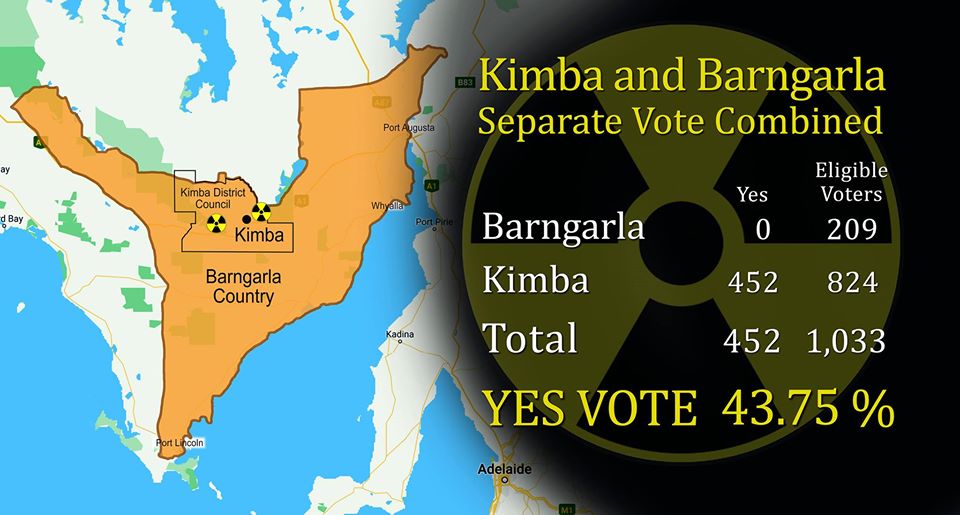
The non indigenous community has been equally affected. There were two community ballots held, 2017 and 2019. While in both cases the result favoured the nuclear waste facility, it was far from overwhelming support. At the final ballot, 824 people were eligible to vote: of 735 votes accepted, 452 said “Yes”.
The plan for the facility was pitched to the community as a medical necessity for Australia. It was an attractive idea. On the one hand Kimba could proudly provide a service to the nation. On the other hand, it was bringing a new industry, and new jobs, to a sometimes drought-stricken agricultural area. More immediate benefits: the farmer who volunteered land would be paid at 4 times the market value. A Community Benefits scheme brings up to $11 million to the town, over the next 4 years, and $20 million when the dump is up and running.
The plan was greeted with enthusiasm from some residents. They relied on the copious information provided by the the Department of Industry Innovation and Science, and by the former Resources Minister, Matt Canavan. When it was pointed out to Mr Canavan that some residents close to the selected site were ineligiblt to vote, he promised that their views would be included. But then he left that Ministry.
The Industry Department has controlled the information reaching the community, and has provided the visiting experts. There has not been any debate provided, with opposing views. Still, there is strong opposition, led by farmers. The group No Radioactive Waste on Agricultural Land in Kimba or SA, is optimistic thar Kimba, despite the prevailing mood of anxiety, can survive and go ahead, without the waste facility.
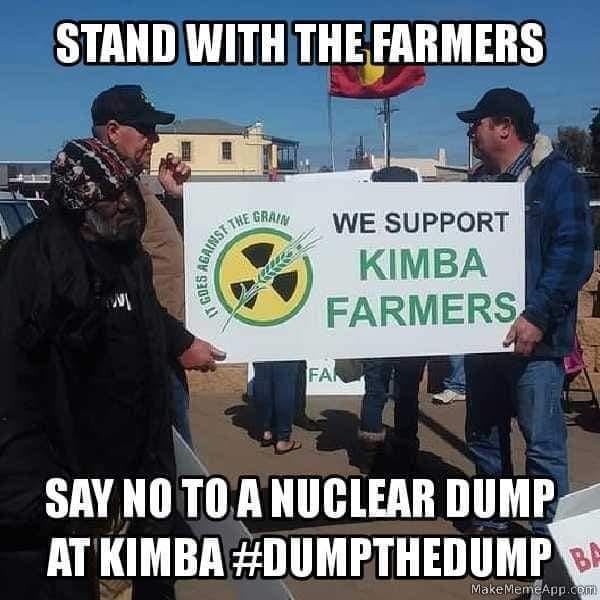
The group, of 5 years’ standing has researched the issue, and sent submissions to Parliament. Radioactive waste is not recommended for agricultural land. There are concerns about possibile environmental pollution, damage to groundwater. Perception of the area is important, and the presence of a radioactive waste dump could be very damaging to its clean, green image .
Community understanding is at the heart of this problem. The current Resources Minister, Keith Pitt, enthused about the facility, describing it to the Nationals Federal Conference on 27 March 2021 as “a low-level nuclear waste facility to house the by-products from cancer treatment.”
That’s a misleading statement. The waste proposed to be taken to the nuclear dump is waste generated from the industrial production of these isotopes. – not their usage!
There is uncertainty about the toxicity of the nuclear wastes to be placed in “interim storage” at Napandee, with the classification of these wastes as “intermediate level”, but the same wastes classified in Fance as “high level”.
The Kimba community remains troubled, as this nuclear waste problem remains paralysed in the Senate. Freedom of Information documents revealed that the government is well aware of mental health problems likely to be caused by the issue.
Minister Pitt has the option of clearly designating Napandee as the site for the nuclear waste dump. That could solve the problem, and certainly bring clarity to the Kimba community. But, the hitch for the government is that if he does this, it will be possible for opponents of the plan to take legal action against it.
Labor Party’s platform on uranium/nuclear and radioactive waste issues.

Dave Sweeey, 31 Mar 21, At its National Conference federal Labor adopted the platform (below) on uranium/nuclear and radioactive waste issues.
Clearly it is not what we would write but there’s a lot that is useful and important – including options to further contest Australian uranium sales, a commitment to responsible radioactive waste management and a rejection of domestic nuclear power.
Yesterday federal Labor also clearly reaffirmed its commitment to sign and ratify the Treaty on the Prohibition of Nuclear Weapons (the ICAN Ban) in government.
Uranium
1. The production of uranium and its use in the nuclear fuel cycle present unique and unprecedented
hazards and risks, including:
Threats to human health and the local environment in the mining and milling of uranium and
management of radioactive materials, which demand the enforcement of strict safety
procedures;
The generation of products that are usable as the raw materials for nuclear weapons
manufacture, which demands the enforcement of effective controls against diversion; and
The generation of highly toxic radioactive waste by-products that demand permanently safe
disposal methods.
2 Labor accordingly will allow the mining and export of uranium only under the most stringent
conditions.
3. In relation to mining and milling, Labor will:
Ensure the safety of workers in the uranium industry is given priority. Labor has established a
compulsory register for workers in the uranium industry that includes regular health checks
and ongoing monitoring. The register is held by an independent agency and will be subject to
privacy provisions;
Ensure Australian uranium mining, milling and rehabilitation is based on world best practice
standards, extensive continuing research on environmental impacts and the health and
safety of employees and affected communities, particularly Indigenous communities;
Ensure the Australian public is informed about the quality of the environmental performance
of uranium mines through public accountability mechanisms;
Foster a constructive relationship between mining companies and Indigenous communities
affected by uranium mining; and
Prohibit the mining of uranium within national parks under International Union for
Conservation of Nature protected area category 1A, category 1B, and category 2, and listed
world heritage areas.
4. In relation to exports other than to India, Labor will allow the export of uranium only to those
countries that observe the Nuclear Non-Proliferation Treaty (NPT), are committed to nonproliferation
policies, and have ratified international and bilateral nuclear safeguards agreements.
Labor will export uranium only to countries that maintain strict safeguards and security controls
over their nuclear power industries.
5. In relation to India, an important strategic partner for Australia, commitments and responsible
actions in support of nuclear non-proliferation, consistent with international guidelines on nuclear
supply, will provide an acceptable basis for peaceful nuclear cooperation, including the export of
uranium, subject to the application of strong safeguards.
6. In addition, Labor will work towards:
Strengthening export control regimes and the rights and authority of the International
Atomic Energy Agency (IAEA);
Appropriate international responses to violations of existing safeguard commitments;
Limiting the processing of weapon usable material (separation of plutonium and high
enriched uranium in civilian programs);
Tightening controls over the export of nuclear material and technology;
Universalising of the IAEA additional protocol making it mandatory for all states and
members of the Nuclear Suppliers Group to adhere to the additional protocol as a condition
of supply to all their transfers;
Criminalising actions of individuals and companies that assist in nuclear proliferation;
The development of an international guarantee of nuclear fuel supply to states foregoing
sensitive nuclear technologies;
Revising the NPT to prevent countries from withdrawing from the NPT and passing a new
resolution in the United Nations Security Council addressing the penalties for withdrawal
from the NPT;
Encouraging all nuclear states to join the NPT;
Reserving the right to withhold supplies of uranium permanently, indefinitely or for a
specified period from any country that ceases to observe the non-proliferation safeguards
and security conditions applied to Australian uranium exports to that country, or which
adopts nuclear practices or policies that do not further advance the cause of nuclear nonproliferation;
Supporting the maintenance and enhancement of international and Australian safeguards to
ensure that uranium mined in Australia, and nuclear products derived from it, are used only
for civil purposes by approved instrumentalities in approved countries that are signatories to
the NPT (with the exception of India) and with whom Australia has safeguard arrangements;
and
Seeking adequate international resourcing of the IAEA to ensure its effectiveness in
undertaking its charter.
7. Labor will progress these commitments through diplomatic means including the re-establishment
of the Canberra Commission to re-invigorate Australia’s tradition of middle power, multilateral
diplomacy. In doing so, Labor believes that as a non-nuclear armed nation and a good international
citizen, Australia can make a significant contribution to promoting disarmament, the reduction of
nuclear stockpiles, and the responsible use of nuclear technology.
8. Labor will:
Vigorously and totally oppose the ocean dumping of radioactive waste;
Prohibit the establishment of nuclear power plants and all other stages of the nuclear fuel
cycle in Australia;
Fully meet all Australia’s obligations as a party to the NPT; and
Remain strongly opposed to the importation and storage of nuclear waste that is sourced
from overseas in Australia.
9. Labor acknowledges that radioactive waste management is a complex policy challenge that
requires the highest levels of transparency and evidence, while balancing the need of the
community to benefit from treatments for diseases like cancer. Accordingly, Labor will act in
accordance with scientific evidence, and with full transparency, broad public input and best
practice technical and consultative standards, taking into account the views of traditional owners,
to progress responsible radioactive waste management
Australian Senate vote on Kimba nuclear dump delayed till mid-May, but dump opponents will be fighting on
Resources Minister Keith Pitt on radio today – same old same old Bluff and Bribery about Kimba nuclear dump plan
 Kazzi Jai, No nuclear waste dump anywhere in South Australia, 19n Mar 21,
Pitt having a news grab this morning Monday 15/03/2021 on ABC 639 North and West. Had nothing new to say – same old, same old – …..but it was the first interview from him for the dump for 2021!
The Bluff and the Bribing continue as Minister Keith Pitt spruiks on radio about Kimb nuclear waste dump plan
 Kazzi Jai, No nuclear waste dump anywhere in South Australia, 15 Mar 21,
 MP Josh Wilson’s excellent submission Senate, about nuclear wastes
|
another well written submission – presented as a speech this time in Parliament in 2020
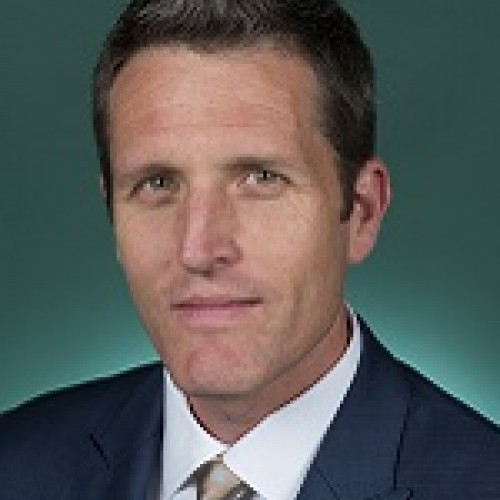 Josh Wilson MP, Federal Labor Member, Shadow Assistant Minister for Environment, June 2020 “There is no question that Australia needs to make progress when it comes to the proper long-term storage of nuclear waste. It is just that this bill doesn’t help take us towards that end. It’s taken us 40 years and it’s cost $55 million to get us to this point. There’s no question that we benefit significantly from nuclear medicine, from the use of radiopharmaceuticals, especially as a diagnostic tool. We benefit here in Australia and we provide those benefits to other parts of the world. We have the nuclear facility, the OPAL reactor, that’s operated by the Australian Nuclear Science and Technology Organisation, ANSTO, at Lucas Heights. It creates the relevant material for nuclear medicine and it creates the need to carefully and safely deal with the waste. It’s not an easy task to do that, but this bill doesn’t help. Josh Wilson MP, Federal Labor Member, Shadow Assistant Minister for Environment, June 2020 “There is no question that Australia needs to make progress when it comes to the proper long-term storage of nuclear waste. It is just that this bill doesn’t help take us towards that end. It’s taken us 40 years and it’s cost $55 million to get us to this point. There’s no question that we benefit significantly from nuclear medicine, from the use of radiopharmaceuticals, especially as a diagnostic tool. We benefit here in Australia and we provide those benefits to other parts of the world. We have the nuclear facility, the OPAL reactor, that’s operated by the Australian Nuclear Science and Technology Organisation, ANSTO, at Lucas Heights. It creates the relevant material for nuclear medicine and it creates the need to carefully and safely deal with the waste. It’s not an easy task to do that, but this bill doesn’t help.Effectively this bill seeks to rush and force the issue of community acceptance, which is a mistake. The minister has the power to make the decision in question. You can only guess that the reason for this legislation is to lock in an outcome, when the minister and the government accept that there are some concerns with the community acceptance process that has occurred so far. The bill effectively also wants to ignore, avoid and further neglect the key issue of a permanent disposal site for intermediate-level waste. There are two kinds of waste that this bill proposes to send to a site in South Australia—low-level waste and intermediate-level waste—and they are very different. A lot of what has been said, including what the minister said in introducing this bill, glides over that difference in a way that is wrong and is certainly not helpful in terms of getting to where we need to get to with a permanent disposal site for low-level waste and a permanent site for intermediate-level waste.
If we know anything about nuclear technology, we know that it relies upon toxic radioactive material and it generates toxic radioactive waste. That’s why there are serious engineering challenges in relation to waste and that’s why there are quite legitimately very serious issues in relation to social licence around nuclear technology. People are wary of it, especially of nuclear waste, and they should be. We have to get towards a long-term disposal solution, and yet this bill raises two serious questions about how the government wants to take us there. There’s concern over the site selection process, which goes to the question of consultation, engagement and community agreement, and there are concerns about the purpose and function of the facility. I want to talk mostly about the latter, but, in relation to the former, in relation to community decision-making, I support the fundamental proposition that the people of South Australia, or any state or territory where a waste disposal site is proposed, should decide, and the agreement about a site should be a meaningful agreement without the serious question marks that remain in this case. Really, for the government to take us to that end, it would do better to work on achieving that meaningful agreement rather than steamrolling over the top in the way that this bill seeks to do.
The second issue is the fact that this site is proposed to be a permanent disposal site for low-level waste and a temporary storage site for intermediate-level waste. To the extent that it proposes that it’s going to be a temporary storage site, it really stretches the ordinary concept of the word ‘temporary’. The problems with that are really quite considerable. There is a very serious risk, and no-one in this place should be ignorant of the possibility, that intermediate level waste will go to this site and it will be there forever, effectively. I’m sure that moving it from its current location will mean that the long-neglected task of preparing for a permanent disposal site will only be further delayed and ignored.
As other speakers have mentioned, low-level waste is mostly personal protective equipment and it contains limited amounts of long-lived radioactive substances. It needs to be stored for a few hundred years in what are described as near-surface facilities. At the moment, it’s stored in 200-litre drums in a big shed at Lucas Heights, and presumably it would be not dissimilarly stored at a site in South Australia if that’s where it went. Intermediate-level waste is something quite different. Intermediate-level waste comes from spent and reprocessed nuclear fuel and the residue from parts of the radioisotope production process. It does not decay in a way that makes it acceptable for near-surface-level disposal. You get a sense of the toxicity of intermediate-level waste when you consider the time frame that’s involved. The proposal here for the permanent disposal of low-level waste is for it to be stored and for the facility to be actively operated for a period of 100 years and then ‘institutionally monitored’— that is the phrase in the explanatory memorandum—for a further period of 200 years. Intermediate-level waste, by contrast, needs to be stored for thousands of years. It remains toxic for thousands and thousands of years. It needs to be buried deep in the ground.
I also make the point that there is no permanent disposal site for high-level waste anywhere in the world. At the time when members of the government are going around spruiking the take-up of nuclear power in Australia—in defiance of all logic, in defiance of the international trends away from nuclear and in defiance of the economic evidence and the energy needs of this country—let’s remember that this is a 70-year-old industry. It’s been around for 70 years, and the industry still is incapable of dealing with its most toxic waste.
In relation to this site, I want to make a few points about how we’ve got here. It has taken 40 years and, as I said, cost $55 million to get to the point of nearly selecting a site. Departmental officials came before the energy and environment committee when we were inquiring into nuclear energy, and they gave us some very rough estimates of what the construction of the site itself would cost. That will be somewhere around $340 million to $350 million. That’s for the construction of the site, and that was described to us as a conservative estimate. Bizarrely, there is no current process underway with even a single dollar of government resources going towards the issue of a permanent disposal site for intermediate-level waste. It’s quite strange. It’s almost hard to believe that, when it’s taken us 40 years to get to the brink of a permanent site for low-level waste, there is not yet any departmental group or any taskforce on this and there’s not a single dollar going to the process of site selection, engineering design or anything else around the question of a permanent disposal site. We actually have an answer on notice from the then Department of Industry, Innovation and Science on that issue:
“A government decision on the entity responsible for the waste management technical coordination function— in relation to intermediate-level waste—has yet to be determined and is required before an Intermediate Level Waste disposal project timeline and budget can be determined.”
So, while we’ve taken 40 years and $55 million to get to the brink of a permanent low-level waste disposal site, no process is advancing by a single hour, let alone a day or a year, towards what the department itself said will likely be another 30- or 40-year process.
So this bill says, ‘Let’s send intermediate-level waste to South Australia for temporary storage.’ What does ‘temporary storage’ mean to the average person? Do you think it means 30, 40, or 50 years or forever? I doubt that very much. But that is, in effect, what this bill seeks to do with intermediate-level waste, which is a whole other kettle of fish.
The government, in the material, suggests there are reasons for the waste being moved, and a lot of the members from the government have said that they’re running out of space at Lucas Heights. That might be true for low-level waste. It is not true for intermediate-level waste. Like the previous speaker, I’ve been into the enormous shed. It’s bigger than the chamber in which I stand—well, it’s about the same size as the chamber in which I stand—and there’s a canister of intermediate-level waste. There’s one of them. There’s another one due back before long. There is plenty of room in that interim storage facility, so there’s no issue with space as far as intermediate-level waste is concerned, and there’s no issue in relation to safety or health concerns either. That is really important. If anyone is suggesting that there are health and safety reasons for moving intermediate-level waste to South Australia, they should point to the evidence of that, and then they should answer the question of how it came to be there in the first place, because we started receiving intermediate-level waste, the reprocessed fuel rods, back in 2015. There was a proper process, supervised by ARPANSA, that saw that waste come and be stored at Lucas Heights, and there’s never been any suggestion whatsoever that there is a safety or health concern about the location of intermediate-level waste at that site. If the government are in possession of any evidence to that effect, they should share it with the public. The member who spoke previously said that he walked up and gave the canister a hug. I was there and I found that quite strange to observe. But where is the evidence that there is any problem with the intermediate-level waste staying where it is, as it should do, until the government of Australia identifies and resources an appropriate permanent disposal site for intermediate-level waste?
When the interim facility was set up, there was no suggestion it was only for a few years. The licence that exists for the storage of the intermediate-level waste at Lucas Heights runs to 2055. ARPANSA itself addressed this issue in the submission that it made to the Senate inquiry. I want to quote from it, because this is important:
“ARPANSA is aware that some stakeholders have interpreted ARPANSA’s decisions regarding the IWS— which is the intermediate-level storage— as a requirement for relocation of the waste stored in the IWS, even suggesting that there is an urgent need for relocation. This is not correct. ARPANSA has not raised safety concerns regarding storage of waste at the IWS. ANSTO seems to share this view. ANSTO has indicated to ARPANSA that the mandatory recertification of the TN-81 casks every 10 years can be carried out at the IWS …”
But the claims that the government and government members in this place have made that intermediate-level storage needs to go to South Australia because there’s no room for it and that there are health and safety concerns about where it is currently are rubbish. And so it should stay where it is as a spur to the government to get on with the process, which currently hasn’t even started, of finding and resourcing a permanent disposal site. That is not occurring, and that’s one of the chief flaws of this bill.
The government is going about this important task the wrong way. Labor support a permanent national radioactive waste facility. We know it needs to be created. We just think the government should do it in the right way. They shouldn’t steamroll over the issue of community acceptance and community engagement, and they don’t need to. If they do that, they are going to put social licence at risk, and that will be even worse if they move intermediate-level waste to South Australia. They need to immediately start and resource the process of a permanent disposal site for intermediate-level waste. They should commit to maintaining that waste where it is currently stored, which is another reason for an inquiry on this issue.
More broadly, the government need to recognise that the social licence for nuclear technology is fragile at best. And that’s for good reason. We have our own chequered history in this country. We allowed the British to detonate 10 nuclear bombs in this country, all of which were as big or bigger than the bombs dropped on Japan. That didn’t go through a parliamentary process. What’s worse, we allowed the British government to explode nuclear material just to see what would happen if an aeroplane carrying nuclear material was shot out of the sky. That meant that radioactive material was strewn over South Australia, the clean-up efforts for which didn’t conclude until the early part of this century, and cost millions and millions of dollars, which the British government only very reluctantly contributed to. We know there are problems with uranium mining. We’ve watched events like Chernobyl and Fukushima. Yet there are members of the government running around saying that nuclear power should be part of our energy mix in our communities across Australia. Frankly, that is not only deeply irrational but ridiculous and unhelpful in the task this bill presents to us.
This bill is not a sensible or appropriate way in which to move towards the waste storage solution. It puts the program at risk. That’s why we don’t support the bill.” –
|
|
1 This month
15 April – Zoom –Nuclear Power is Not the Solution
Apr 15, 2026 01:00 AM in Canberra, Melbourne, Sydney

Join the International Physicians for the Prevention of Nuclear War (IPPNW) on Tuesday, April 14th for a timely webinar exploring the risks associated with nuclear power and challenging the myth that it offers a simple, safe, carbon-free solution to the climate crisis

of the week – Australians for War Powers Reform (AWPR)
To see nuclear-related stories in greater depth and intensity
 Antinuclear