Australian politics: Deep disagreement on federal radioactive waste plan

The growing uncertainty and contest over Federal Government plans to advance a national radioactive waste facility at Kimba on South Australia’s Eyre Peninsula has been highlighted today in a new Senate report.
The Senate report reflects growing divisions about how to manage radioactive waste in Australia, with government members supporting the plan while Labor, Green and independent Senators raised serious concerns and reservations or actively opposed the plan.
The report was set up to examine controversial changes to national radioactive waste laws in order to the secure the Kimba site and then remove this decision from judicial review.
“This is a deeply deficient plan based on a flawed and constrained process,” said Australian Conservation Foundation campaigner Dave Sweeney. “That one Committee inquiry has generated four separate responses from Senators shows there is no consensus on the plan”.
“The government dominated majority report predictably supports the waste plan, while the three other responses are critical of the approach”.
“The government’s plan would lead to sub-optimal radioactive waste management outcomes and is actively contested by many in the wider region, including the Barngarla Traditional Owners who have been consistently excluded from the consultation process.”
The federal waste plan has drawn criticism and opposition from a range of civil society and community groups and South Australia’s Labor opposition. Federal Labor voted against the plan in the House of Representatives in June. Key concerns with the plan include:
- There is no pressing need for a centralised national waste storage site. The federal nuclear regulator ARPANSA says there is no urgency to move the most problematic waste from where it is stored at the Australian Nuclear Science and Technology Organisations (ANSTO) reactor site at Lucas Heights.
- The unnecessary double-handling and transport of intermediate level waste from an above-ground extended interim storage facility at ANSTO to an above-ground extended interim storage facility in a less resourced regional area is inconsistent with best practice.
- The bill would disproportionately and adversely affect Barngarla Traditional Owners.
- There has been no consultation outside the immediate region. Communities on the wider Eyre Peninsula and along the extensive transport corridors have not been consulted.
“This is not a credible plan,” said Dave Sweeney, “it is a politicised and fragile promise.”
“Australians deserve better than an approach which lacks credibility, is inconsistent with international standards and shirks hard question about what to do with the worst waste.”
For context or comment contact Dave Sweeney on 0408 317 812
Read ACF’s 3-page background brief on the federal radioactive waste plans
Farmers, Traditional Owners fight radioactive waste dump
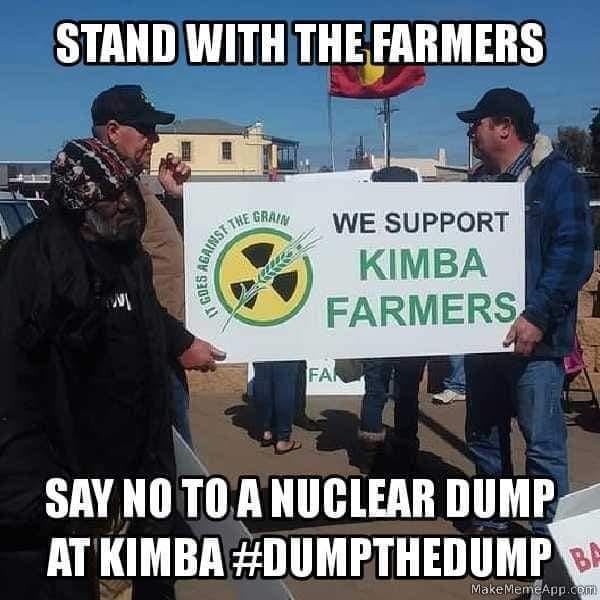
Farmers, Traditional Owners fight radioactive waste dump https://www.greenleft.org.au/content/farmers-traditional-owners-fight-radioactive-waste-dump, Renfrey Clarke, Adelaide, September 8, 2020
A 160-hectare tract of farmland has been purchased near the small town of Kimba and, as inducement to deliver support for the plan, local residents have been promised a $31 million “community development package.” A non-binding ballot conducted last November among residents of the Kimba District Council area recorded 62% in favour of the scheme.
But opponents of the dump remain active and vocal. As well as farmers and townsfolk concerned for their safety and for the “clean and green” reputation of the district’s produce, those against the plan include the Barngarla First Nations people, who hold native title over the area.
Critics argue that last year’s ballot sought the views of only a narrow section of the people affected. In particular, members of the Barngarla people, who do not live locally, are angry at being excluded.
The federal Coalition government, however, has not been deterred. In June, the House of Representatives passed a set of amendments to the legislation governing the scheme. These changes would strip opponents of the dump — including the Barngarla — of the right to mount legal challenges.
The amendments still have to pass through the Senate. But, confident of victory, in July the government set up the Australian Radioactive Waste Agency as part of the Department of Industry, Science, Energy and Resources. With its base in Adelaide, and a satellite office in Kimba, the agency is to “lead the process to deliver” the waste dump.
Low and intermediate-level wastes
In volume terms, the great bulk of the radioactive waste currently produced in Australia results from nuclear medicine, and is considered low-level. These materials do not require shielding in handling or storage, but must be kept secure until the radioactivity has decayed to the point where they can safely go to landfill. At present, these wastes are stored at more than 100 sites around the country, mostly in hospitals or universities.
The amount of low-level waste created here each year is about 40 cubic metres, roughly three truckloads, suggesting that the need to collect these materials into a centralised store is questionable.
More than likely, the risks of shifting these wastes exceed those of keeping them where they are for the decades needed until their radioactivity falls to natural background levels.
There are also intermediate-level wastes. These accumulate at a rate of about five cubic metres a year, and are in a very different category. Highly dangerous, they require shielding, and must be kept secure for as long as 10,000 years. They consist almost entirely of spent nuclear fuel from the research reactor at Lucas Heights, near Sydney, returned after reprocessing in Europe and currently stored on the reactor premises.
The waste dump planned for the farm property Napandee, near Kimba, is meant to provide a permanent home for Australia’s low-level wastes — but not for the intermediate-level materials. The latter are to be held in above-ground canisters at the facility until permanent storage provisions have been made.
Will this “interim” storage turn out to be permanent?
Kimba is remote enough that the temptation will be great for governments to leave these dangerous, long-lasting materials there indefinitely.
Meanwhile, if the Napandee dump is to hold the intermediate-level wastes for only a few decades, where is the need to move these materials there at all? The store at Lucas Heights has room to hold the wastes for many years to come, while permanent disposal methods are being devised and tested. Simply keeping the materials on site would avoid the risks of multiple handling and long-distance transport.
Community rifts
In Kimba, the social rifts from years-long disagreements over the dump remain painful. Many local people look to the facility to sustain a town that is steadily declining as farmers are compelled to “get big or get out”, and as the regional population shrinks.
Farmer Heather Baldock, who supports the dump, lamented to a Senate committee hearing in August: “We lose students, youth, neighbours, friends, sporting club members, emergency service volunteers … We gain more empty houses and property for sale.”
The federal government has suggested that a total of 45 jobs will be created by the facility — a big boost for a town of barely 600 people. Many of these jobs, however, will likely be part–time, or will be performed on a fly-in-fly-out basis.
The $31 million community package will create excellent town amenities, but not a long–term basis for the local economy. It will not solve the worst problem confronting regions like northern Eyre Peninsula: global warming, which raises temperatures, reduces already sparse rainfall and sends farmers into crippling debt.Opponents of the dump, meanwhile, speak bitterly of the deceits by a government determined to impose its scheme regardless of local objections.
Farmer Peter Woolford, who heads the group No Radioactive Waste on Agricultural Land in Kimba or SA, told the Senate hearing: “The path that the federal government has taken … has been a long road of propaganda, manipulation and promises without justification.”
The flow of information to the community, Woolford noted, has been tightly controlled and almost entirely narrated by the department. “No assistance, practical or financial, has been given to provide independent advice. Every speaker who has visited Kimba at the expense of the government has been a supporter of the proposal.”
Ballot manipulation
Opponents of the scheme are especially angry at the way the terms of last year’s ballot were manipulated. Rejecting a call for voting to be open to all residents within a 50-kilometre radius — a far more meaningful measure of the people for whom Kimba is the local hub — the government and the Kimba District Council insisted on the smaller area within the council boundaries. If the 50-kilometre boundary had applied, critics argue, the vote would have failed.
Particularly impressive has been the resolve of the Barngarla people to have their say in deciding the outcome. In 2018, the Barngarla fought and lost a court case against the district council, demanding to be included in the prospective ballot.
Excluded from the official vote, the Barngarla Determination Aboriginal Corporation organised its own independently-run ballot. This recorded a total of 83 members against the dump and zero in favour. A recent letter from the Barngarla to the federal resources minister stated: “The systematic racist behaviour by your government is a stain on the collective consciousness of this country.”
In any case, opponents of the dump ask why “community support” for the dump should be measured only by the views of a few hundred people. Why should the decision not be one for the whole population of South Australia — where indications are that the idea of hosting a radioactive waste dump is highly unpopular?
As Woolford pointed out, of 2789 submissions received in a public consultation 94.5% oppose the facility.
The nuclear stigma – some Kimba residents selling their assets before the nuclear dump sets sail?
Australia’s National Radioactive Waste Management Taskforce plays deceptively with statistics
 Kazzi Jai Fight to stop nuclear waste dump in the Flinders Ranges
There are so many things which are really wrong with this flawed proposal….
“The co-location of low and intermediate level waste at the facility has been the basis of the facility proposal since 2015 and the Kimba community was well informed about the proposal, in advance of their local council ballot.
Sixty-two per cent of respondents from the Kimba community supported the proposal moving ahead – 90.41 per cent of eligible locals participated in the ballot.
Apart from the fact that THIS proposal is the EXACT SAME PROPOSAL put forward FORTY YEARS AGO….and the “assumption” that the Kimba community was well informed (how EXACTLY did they determine the level of being “informed”?)…what really irks me most is the use of PERCENTAGES!
And not only that – BUT THE SELECTIVE USE OF NUMBERS IN WORDS AND FIGURES! Unless you are being a Secret Squirrel – you need to be CONSISTENT with YOUR NOMENCLATURE!
It needs to read….
” 61.58% of respondents from the Kimba community supported the proposal moving ahead – 90.41% of eligible locals participated in the ballot.
39.71% of the Barngarla Determination Aboriginal Corporation voted against the proposal in their own ballot – 58.38% did not respond – BUT 0% VOTED FOR THE DUMP!”
Or even better yet – “100% of the respondents of the Barngarla Determination Aboriginal Corporation voted against the proposal in their own ballot”….
And include….“In fact, there was no BROAD COMMUNITY CONSENT achieved in the Kimba community at all, as the MINIMUM of 2/3RDS or OVER 66.67% WAS NOT ACHIEVED IN THE COMMUNITY BALLOT!”
Indecent haste in Australian government’s push for law making Napandee the nuclear waste dump. What’s going on?
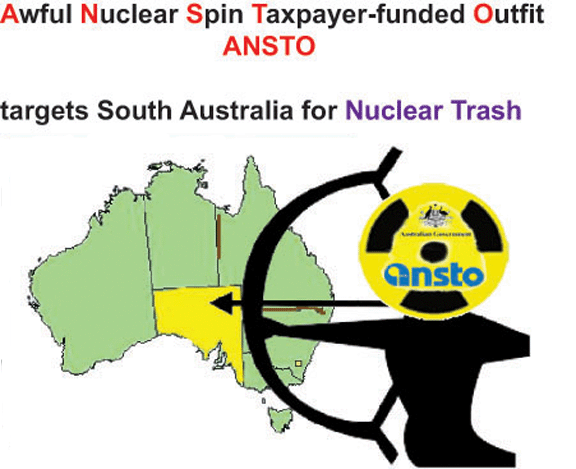
New nuclear legislation set to provide toxic dumping ground in South Australia, Independent Australia, By Noel Wauchope |
UNDER THE PRESSURE of The Australian Nuclear Science and Technology Organisation (ANSTO), The Australian Government is in a hurry to get a new bill passed. It’s not really a new bill, it’s actually a new bit tacked on to an existing one. It’s called the National Radioactive Waste Management Amendment (Site Specification, Community Fund and Other Measures) Bill 2020.
The amendment does two important things: it selects a definite place in South Australia, a farmer’s property called Napandee, as a radioactive waste dump and it removes the possibility of a judicial review of that selection.
The proposed dump is an “interim” radioactive waste facility.
It would consist of two parts:
- Temporary above-ground storage for what is known as low-level waste (LLW). LLW is a general term for a range of objects that are radioactively contaminated, but not considered to be highly radioactive nor toxic for thousands of years.
- A “temporary” above-ground storage for intermediate-level waste (ILW). ILW is a term for a mix of wastes that contains some very long-lived highly toxic radioactive matter, that does require isolation for thousands of years. While this amount would be smaller in volume, it would be far more significant. 95 per cent of this radioactive content would be spent nuclear fuel rods from ANSTO’s nuclear reactor at Lucas Heights, Sydney.
At present, these highly radioactive wastes are stored in giant canisters at Lucas Heights, where there is ample space for further canisters and experienced and skilled staff to monitor them and provide security.
ANSTO has plans to expand its operation and CEO Dr Adi Paterson’s dream of a world-leading business in exporting radionuclides for medicine and industry. Meanwhile, international nuclear security obligations demand that Australia develop a plan for the permanent disposal of nuclear wastes.
Unfortunately, this Napandee plan does nothing towards meeting these obligations. ……….
There is no plan whatsoever for the permanent disposal of this highly radioactive trash.
There’s a vague story that these wastes will later be moved from Napandee to a permanent disposal — anything from 40 to 300 years. They are most likely to suffer the fate of other such facilities in the USA and other countries and become stranded wastes…….
There was a heavy emphasis on “medical” wastes. But the reality is that the vast majority of wastes from nuclear medicine are very short-lived radioisotopes, that have no need to be transported thousands of miles and are routinely disposed of close to places such as hospitals where they are used.
A ballot was held in the area, of ratepayers only, on whether or not to support the project. Some residents close to the property were excluded, as were the Native Title holders, the Barngarla Aboriginal community. The vote result, from 824 voters, was 452 “yes”. The Barngarla held their own vote — 80 Barngarla voted, with the unanimous result of “no”.
The whole issue of the transport of the nuclear wastes and their “temporary” dumping does concern also the region, the state of South Australia and the nation. The decision should not be made solely by 452 ratepayers in one small rural area………
Non-ratepayers did not get a look-in. In this modern, almost Trumpian paradigm, outsiders such as economists, environmentalists, medical experts, sociologists and independent radiation experts are seen as “the elites” that can’t be trusted. Unfortunately, independent overseas experts on nuclear waste management have been excluded, too. Apart from the problems raised for the town and region of Kimba itself, there are serious questions about the appropriateness of the planned system, the area environmentally and geologically……..
Of course, this plan is confined to nuclear wastes produced in Australia. For now.
The plan is obviously helpful to ANSTO. They can pass this uncomfortable buck of 10,000 year-lasting radioactive wastes on to a distant South Australian rural community. It will then be managed and funded by whom? The South Australian and Australian tax-payers.
This will take the pressure of ANSTO, make it look as if they’re doing something about their radioactive trash and avoid any Lucas Heights, or rather Barden Ridge fuss, as they expand their operations. (The residential area previously part of Lucas Heights was renamed Barden Ridge to increase the real estate value of the area, as it would no longer be instantly associated with the nuclear reactor.)
It’s not so helpful to South Australia, or to Australia. The best solution is to leave those nuclear reactor wastes safely stored at Lucas Heights for the time being and to develop a national discussion and plan for what to do with those wastes for permanent disposal. Under this present, rather rushed scheme, Resources Minister Keith Pitt, Dr Paterson and the whole crew of the NRWMF will be dead and gone, long before the stranded wastes at Napandee will be properly dealt with.
A solution for the common good is what’s needed, not just a solution that suits ANSTO. ANSTO is a statutory body — a case of the tail wagging the dog, perhaps?
The National Radioactive Waste Management Amendment (Site Specification, Community Fund and Other Measures) Bill 2020 has been passed by the House of Representatives. It will be debated in the Senate later this year.
Meanwhile the Senate Economics Legislation Committee is holding an Inquiry into this bill…….
it gets interesting. Suddenly, a public hearing becomes private. The topic for this new secrecy was the discussion of some documents from the NRWMFT that had been requested by the Committee and received only a very short time before the hearing. The documents were heavily redacted. They relate to the process by which the Napandee site was selected. How spontaneous was the farmer’s offer of his land? What roles did the NRWMFT, ANSTO and the Industry Department, play in instigating this offer?
So many questions surround this plan:
- Is the new amendment being pushed because Minister Keith Pitt fears the opposition of Aboriginals, or indeed of the public in general?
- The exclusion of the Barngarla from the decision — how does this square with Indigenous rights?
- Why did the Government not provide any independent advice to the Kimba community?
- Why are the South Australian and Australian public excluded from decision-making?
- Why is this Senate Committee public hearing to be held in secret?
- Why is this all happening in such a hurry? https://independentaustralia.net/politics/politics-display/new-nuclear-legislation-set-to-provide-toxic-dumping-ground-in-south-australia,14256
Kazzi Jai reports on the latest Senate hearing on Nuclear Waste Amendment Bill
 Kazzi Jai Fight To Stop Nuclear Waste In The Flinders Ranges, 28 Aug 20, I will try and keep this summation as brief as possible regarding the Senate Hearing with DIIS this morning.
South Australian MP Peter Treloar says “Kimba nuclear waste dump is a federal issue”, but he’s fine with it anyway
Kimba nuclear waste site OK with Member for Flinders ahead of proposed new electoral boundaries, ABC, ABC Eyre Peninsula, By Evelyn Leckie and Gary-Jon Lysaght 28 Aug 20
With proposed electoral boundaries changing for the Eyre Peninsula, local MP Peter Treloar is poised to take on a community that remains divided on hosting the country’s nuclear waste.
Key points:
- Proposed electoral boundaries may lead to Kimba falling within the state seat of Flinders
- Peter Treloar is poised to take on Kimba’s nuclear waste storage issues
- The Kimba community remains divided on the region’s nuclear waste site
The Member for Flinders, whose electorate is slated to include Kimba after the redistribution, said although the nuclear waste dump was ultimately a federal issue, he had no problem with its proposed location.
“The Kimba community have decided themselves that they’re prepared to be accepting of that, so this process is playing out in the federal jurisdiction,” Mr Treloar said………
Earlier this year a cross-party parliamentary committee found “significant risk” that local Indigenous groups were not consulted about the nuclear dump to a standard required under international law. ……
https://www.abc.net.au/news/2020-08-27/flinders-member-weighs-in-on-nuclear-waste-in-kimba/12603022
Australia’s Dept of Industry hiding the facts on choice of Kimba nuclear waste site
 Kazzi Jai No Nuclear Waste Dump Anywhere in South Australia, 22 Aug 20,
 FRIDAY NIGHT QUIZ QUESTION: How many times did the DIIS quote this EXACT SAME STATEMENT in their “Answers to Questions Notices” tabled recently for the Senate Inquiry?….more https://www.facebook.com/groups/1314655315214929/
Reject the racist, undemocratic National Radioactive Waste Management Amendment Bill
|

Conflict of interest in Kimba Community Liaison Officer’s connection to nuclear waste dump push
 Kazzi Jai, Fight to Stop a Nuclear Waste Dump in South Australia, 20 Aug, 20
Here is what the Community Liaison Officer job was meant to entail: Job Description……”The Community Liaison Officer will represent a project, through consultation activities including meetings with members of the public, information sessions, and presentations. The Officer must possess local knowledge and be of an approachable demeanor to ensure meaningful engagement with all interested community members.”
Desired Skills and Abilities:…..”Ability to be approachable by all members of the Kimba community, regardless of their views on the Project, to provide information about the Project in a professional and independent manner.”
This really in fact comes as no surprise, given what actually happened in Hawker at the SAME time with THEIR Community Liaison Officer! – Submission 109 of previous Inquiry*
*Senate Committee Inquiry on Selection Process for Nuclear Waste Dump Site, August 2018 https://www.aph.gov.au/Parliamentary_Business/Committees/Senate/Economics/Wastemanagementfacility/Submissions
17 August: The Senate Nuclear Waste Inquiry- Public Hearings go Secret
This is my impression of events

Senate Nuclear Waste Inquiry gets vague and incomplete answers from Department of Industry
It is difficult to understand why important legislation now before Parliament should include or involve information that cannot be publicly disclosed as this is completely counter to the open and uninhibited nature of parliamentary business and the inquiry committee would at the very least be given a summary of the suppressed information which could then be dealt with by the privileges committee.
If it is being suggested that legal privilege is needed with respect to a judicial review preventing the development of the facility then surely this must be part of the legislative process in dealing with the bill since one of the central issues is eliminating any rights of judicial or administrative review
Peter Remta, 13 Aug 20, My comments on some of the written answers by the department to the questions put on notice at the Senate committee hearing on 30 June 2020.
SENATE COMMITTEE INQUIRY – NATIONAL RADIOACTIVE WASTE
MANAGEMENT AMENDMENT (SITE SPECIFICATION, COMMUNITY FUND AND OTHER MEASURES) BILL 2020
Answer to Question by Senator Hanson-Young:
Question: What does ANSTO understand is the proportion of your waste that would make up what is stored at the Kimba site?
Answer:
As per the Australian Radioactive Waste Management Framework dated April 2018, it is anticipated that the wastes resulting from ANSTO’s operations anticipated that the wastes resulting from ANSTO’s operations and nuclear medicine production will account for approximately 78 per cent* of all wastes that would be managed at the National Radioactive Waste Management Facility(NRWMF).
*This figure is subject to revision as more information becomes available…….
Answers to Questions 4, 5 and 6 by Senators McAllister and Patrick:
From the rather vague and incomplete answers to the specific questions posed by Senator McAllister it appears that the bill for amending the present legislation was hastily put together with little time for proper planning.
It is easier to fully quote the parts of the department’s answer:
Over the life of the program the department has briefed respective Ministers on risks to the National Radioactive Waste Management Facility development associated with judicial review.
On 31 July 2019, the department provided a brief to the former Minister for Resources and Northern Australia, the Hon Matthew Canavan, which also noted the potential to specify a site in the National Radioactive Waste Management Act 2012 (the Act).
On 20 August 2019 the Minister wrote to the Prime Minister seeking amendments to the National Radioactive Waste Management Act 2012 (the Act).
On 21 and 22 August 2019, at community forums in Kimba and Hawker, Minister Canavan indicated that Parliament would have a role in the site selection decision making process.
On 30 September 2019, the Prime Minister responded to the Minister’s letter of 20 August 2019. On 17 October 2019 and on 4 November 2019, the department provided further briefs to the Minister on potential amendments to the Act.
On 8 November 2019, the Minister wrote to the Prime Minister seeking policy authority to develop legislative amendments.
The answer then went on to say that it was the practice not to disclose information about the business of the cabinet and that certain sensitive information contained in some documents to be given to the committee on a confidential basis which would not be in the public interest to reveal and has therefore been redacted
It is difficult to understand why important legislation now before Parliament should include or involve information that cannot be publicly disclosed as this is completely counter to the open and uninhibited nature of parliamentary business and the inquiry committee would at the very least be given a summary of the suppressed information which could then be dealt with by the privileges committee.
If it is being suggested that legal privilege is needed with respect to a judicial review preventing the development of the facility then surely this must be part of the legislative process in dealing with the bill since one of the central issues is eliminating any rights of judicial or administrative review
The forums on 21 and 22 August last year only dealt with ensuring that the government’s grants would be paid direct to the communities and not the state government as this was a major concern to the members of both communities,
To protect their position Minister Canavan undertook to enshrine the the grants payments to the communities through appropriate legislative action but there was nothing along the lines suggested by the department’s answer.
From the totality of all that has been said or done by the department and ANSTO it is quite clear that they want to pursue their own means of identifying an appropriate site and method for the permanent disposal of the local intermediate level waste. Continue reading
Kimba area locals point out the unsolved problems of nuclear waste transport to Napandee
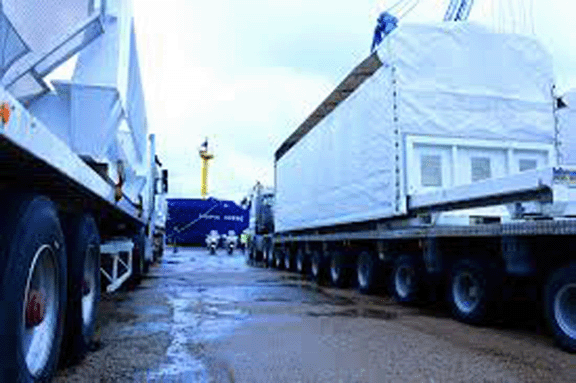
Kazzi Jai Fight To Stop A Nuclear Waste Dump In South Australia, 11 Aug 20
Noted disadvantages are that waste might pass close to Kimba … (after actually coming through a number of other locations)
-
Annette Ellen Skipworth Thats a lot of road to upgrade to take the weight of the canisters ..
Loads of Murray water..
Who is paying to upgrade the roads..
Government or local council and the maintenance of said roads.. 100 years i believe to dump will operate..Roni Skipworth Criterion 2 what hogwash to rail the Waste from Port Lincoln. Still has to go to Kimba Silos as we don’t have a RAILWAY SYSTEM ANYMORE being closed down by Viterra last year n all grain movement is trucked along our 3 local highways on dirt roads all over EP.
Looks like no one has worked out the transport side of things yet and why should we the locals who like using these dirt roads to get from A to B put up with these Trucks fucking them up so we can’t use or then not allowed cos of the Dump

Problematic selection of “community” in decision to site nuclear waste dump at Kimba. South Australia
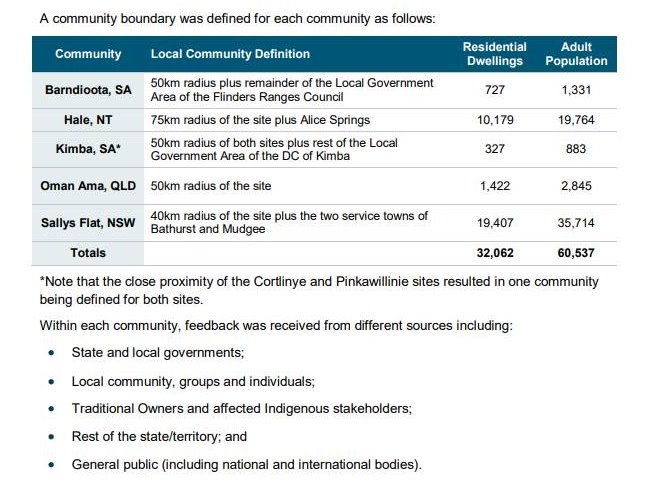
Kazzi Jai Fight To Stop A Nuclear Waste Dump In South Australia 9 Aug 20
There’s something that has been bothering me for some time…..This is a copy of a table from page 9 of the Phase 1 Document released in April 2016 by the Minister at that time Josh Frydenberg. Even with the “service towns” included for some of them – and of those, some of them DEFINITELY OUTSIDE the so called 50 km radius of the sites….doesn’t it seem interesting that the LEAST POPULATED SITES remained those IN SOUTH AUSTRALIA!
It was ULTIMATELY decided by Matt Canavan, as Minister, that Kimba would only have its Council boundary as the community ballot area, and not have the 50km radius involved at all!
And remember during all of this that the South Australian Royal Commission into the Nuclear Fuel Cycle was running AT THE SAME TIME – March 2015 to May 2016!
No wonder people thought that the nuclear dumps were one in the same! And they had thought it had ALL been dealt with when the Citizen’s Jury came back with an over two-thirds majority (70%) saying NO MEANS NO!https://www.facebook.com/groups/941313402573199/
Call for public release of ANSTO Nuclear Waste Reports and ARPANSA’s Response
To: The Secretary, Senate Standing Economics Legislation Committee of Inquiry National Radioactive Waste Management Amendment Bill 2020 economics.sen@aph.gov.au
RE: David Noonan Supplementary Public Submission No.6.1
Call for public release of ANSTO Nuclear Waste Reports & ARPANSA’s Response; the Department fails test of transparency; and Concern over EPBC Act amendments to affect NRWMF assessment
Dear Secretary
Please consider matters raised in this Supplementary Submission, following my Public Submission No.6. in February 2020.
- Important ANSTO ILW nuclear waste reports due to ARPANSA by 30 June must be made public ASAP – along with the ARPANSA response, to provide for proper public scrutiny in this Inquiry.
- The Department has failed the test of transparency in its treatment of public submissions.
Note: Attachment of the Department’s redacted copy of my submission, to show the extent of redactions made, in blacking out over 50 public source quotations, without a proper basis to do so.
- Concern over proposed rushed changes to the EPBC Act to affect assessment & approvals of the NRWMF.
First: There are public interest concerns the scope of EPBC Act “whole of environment” nuclear action assessments will be replaced by new National Standards based on ARPANSA Codes, with limited “graded” assessments and use of pro-nuclear industry standards of IAEA origin.
Second: It should be no surprise that a Bill to amend the EPBC Act transfers EPBC Act assessment and approval of the NRWMF over to ARPANS Act Licensing.
Recommendation of this Supplementary Submission on assessment and approval of the NRWMF:
This Inquiry should investigate and report on the potential impact of pending changes to the EPBC Act on assessment & approval of the NRWMF, as flagged for introduction in a Bill in late August.
The Committee should call for EPBC Act “whole of environment” assessment of the NRWMF to be retained. The Committee should oppose potential transfer of EPBC Act environmental assessment of the NRWMF over to ARAPNS Act Licensing, Codes and Guides and limited “graded” assessment.
In Conclusion: The Committee must at a minimum reject the Bill’s proposal to legislate for specified siting of the NRWMF, and therefore of unnecessary less safe and more insecure imposition of above ground indefinite storage of ILW, at Napandee near Kimba on Eyre Peninsula in South Australia.
Rights to Judicial Review and Procedural Fairness must be retained for public interest reasons.
Please feel free to contact regarding any aspect of this public submission, by Mobile, Text or E-Mail.
Yours sincerely
Mr David J Noonan B.Sc., M.Env.St.
Independent Environment Campaigner and Consultant (ABN Sole Trader)
1 This month

of the week – Australians for War Powers Reform (AWPR)
To see nuclear-related stories in greater depth and intensity
 Antinuclear