Petition to stop federal government’s plans to build a nuclear waste facility in Kimba or Hawker
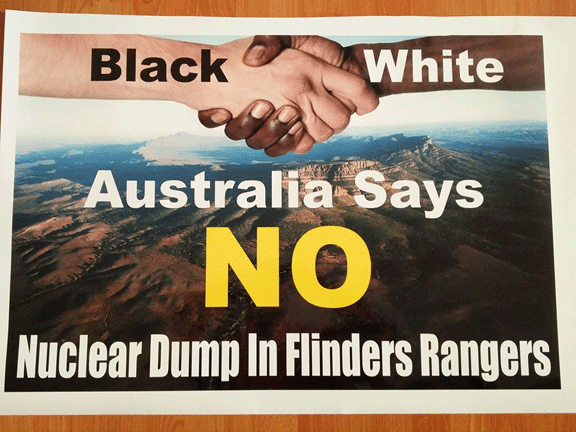 Alliance petition government over nuclear https://www.whyallanewsonline.com.au/story/6094410/alliance-petition-government-over-nuclear/, Louis Mayfield , 29 Apr 19,
A community postcard opposing the federal government’s plans to build a nuclear waste facility in Kimba or Hawker will be delivered to the Whyalla Office of Member for Grey Rowan Ramsey on Tuesday.
The postcard, which urges the federal government to ‘investigate all safe options before proceeding with this current plan’ has been put together by the No Dump Alliance, a group that represents community opposition to the nuclear waste dump.
Flinders Rangers Adnyamathanha woman Vivianne McKenzie said ‘there are many people in the community who have opposed this nuclear waste dump since it was first announced’.
Monday marked three years since Wallerberdina Station in the Flinders Ranges was named as the federal government’s preferred site for a national radioactive waste facility.
Currently three sites are under federal consideration: two near Kimba on the Eyre Peninsula and one near Hawker in the Flinders Ranges.
Doctor Susi Andersson from Hawker said most people, for or against the facility, felt that three years of uncertainty was too long.
“The process of finding a site for a NRWMF is dividing and harming our community,” she said.
Kimba farmer Peter Woolford said jobs were at risk because of the government’s ‘unpopular and unnecessary’ plan.
“We will not sit quietly and allow a flawed plan to have a lasting negative impact on our way of life,” he said.
 Member for Grey Rowan Ramsey said he totally agreed that three years was too long for the site selection process – however he noted that the nuclear proposal was tied up in a court case launched by the Barngarla Determination Aboriginal Corporation.
“While we’re still waiting for the judge’s decision there’s nothing we can do in that space,” he said.
“There are differing views (on nuclear) in each community, I am aware of that. From day 1 my government made a commitment that we wouldn’t be forcing this facility on a community that does not want it.
“The towns of Hawker and Kimba are without a doubt the best educated communities in Australia on this issue and should be left to have their say in a voting mechanism.”
Mr Ramsey said he would pass on the postcard from the No Dump Alliance to Minister Canavan.
Grey voters see red over 3 years of federal radioactive waste plan
Maria Bonacci, 29 April 2019, Today marks three years since the federal government named Wallerberdina Station in the Flinders Ranges as its preferred site for a national radioactive waste facility.
Since then, Kimba on the Eyre Peninsula has also been targeted. Members of both communities have since worked consistently to prevent becoming home to Australia’s radioactive waste.
Adnyamathanha woman from the Flinders Ranges Vivianne McKenzie said “there are many people in the community who have opposed this nuclear waste dump since it was first announced. We need Canberra to listen to us, because we will never give up.”
As part of these efforts a community postcard initiative opposing the planned waste site is being delivered tomorrow to the Whyalla office of current federal member for Grey, Mr Rowan Ramsey. He is being requested to take it to Federal Resources Minister Matt Canavan on behalf of the community. Copies will also be given to Shadow Minister Kim Carr, the Kimba District and Flinders Ranges Councils and the SA state government.
One of the messages collected on the postcards was “please investigate all safe options before proceeding with this current plan”. The Government is rushing and wrong and we want a different approach.
There are three sites currently under federal consideration: two near Kimba on the Eyre Peninsula and one near Hawker in the Flinders Ranges. All three sites are actively contested and all are in Grey, the largest electorate in South Australia.
Dr Susi Andersson from Hawker said “three years of uncertainty is too long. The process of finding a site for a NRWMF is dividing and harming our community. Most people, for or against the facility, feel three years is too long. This is affecting the well-being of individuals and the community.
“The Cadence Economic Report commissioned and published by DIIS predicts an 8% increase in GRP (gross regional product) when the facility is expected to be operational in 2030. SA tourism predict a State-wide rise in tourism activity by 2030 of 32%. Tourism and primary production are the basis of our economy and our future, not a radioactive waste facility. DIIS produces lots of slick propaganda promoting their proposal but when we ask questions or for clarification, it usually takes months to get an answer” Dr Andersson concluded.
Peter Woolford, a farmer from Kimba said “Our homes – our communities – our jobs are at risk from this unpopular and unnecessary plan. We will not sit quietly and allow a flawed plan to have a lasting negative impact on our way of life.”
The No Dump Alliance – a broad grouping of SA community, Aboriginal and agricultural representatives – is calling on the current and any future federal government to scrap the current site selection process, take the three sites in SA off the table and hold an independent inquiry into the full range of ways to manage Australia’s radioactive waste.
For media comment or to arrange interviews please call Mara Bonacci: 0422 229 970
South Australian aborigines again face a nuclear threat – as Federal Government plans a nuclear waste dump
 Trident celebrations ignore Aboriginal victims of British nuclear weapons testing, Green Left, Linda Pearson, April 26, 2019 Issue 1218, Scotland New threat from nuclear waste dump
“………..Aboriginal communities in South Australia now fear that they will be forced to bear the risks of radioactive contamination again. The Australian government is currently considering three sites for the location of a national nuclear waste dump, two on Barngarla land, near Kimba, and one on Adnyamathanha land at Wallerberdina Station, near the Finders Ranges.
The dump will host nuclear material currently stored at different sites in Australia, plus waste from Britain pursuant to a 2012 agreement between the British and Scottish governments. The agreement relates to waste generated by the reprocessing of Australian nuclear fuel at Dounreay. However, that waste is to remain where it is and a substituted amount will be shipped from the Sellafield nuclear reprocessing and decommissioning site, located on the coast of the Irish Sea.
The views of traditional owners have been sidelined throughout the process for choosing the dump’s location and Adnyamathanha’s traditional owners say that federal government contractors have already damaged sacred sites. As a result, two separate human rights complaints are outstanding in Australian courts.
Campaigners have called on the British and Scottish governments to halt the shipment while there is a risk that it will end up dumped on Aboriginal land without the consent of the Traditional Owners. However, the British government said the shipment “will comply with all relevant international laws” and the eventual destination of the waste is “a matter for the Australian authorities”. The British Environment Agency has so far failed to respond to requests to halt the shipment of waste from Sellafield.
The Scottish government has also failed to act to stop the shipment, despite expert advice it commissioned, which states that the Scottish Environment Protection Agency and, ultimately, Scottish ministers could refuse to authorise the shipment on human rights grounds.
Britain’s plans to celebrate 50 years of at-sea nukes erases the experience of Indigenous people affected by nuclear weapons testing. Those experiences should be front and centre in any discussion about nuclear weapons, as ICAN recognised.
Instead of celebrating, we should be looking at ways to redress the past and prevent future harm. Britain should apologise for its nuclear weapons testing and pay adequate compensation to those affected. The shipment of nuclear waste from Sellafield should be stopped.
But there is only one way we can prevent more lives being destroyed by nuclear weapons and that is by eliminating them altogether. https://www.greenleft.org.au/content/trident-celebrations-ignore-aboriginal-victims-british-nuclear-weapons-testing
Lynas rare earths corporation still struggling with its tricky problem of radioactive wastes
 Record result but still no breathing space for Lynas, The Age, Colin Kruger, April 20, 2019
It should have been a great week for Lynas Corp….. Despite soft prices in the rare earths market – and a forced shutdown of its operations in Decemberdue to a local Malaysian government cap on its production limits – Lynas reported a 27 per cent jump in revenue to $101.3 million in the March quarter……
the company was still “seeking clarification” on comments earlier this month by Malaysian Prime Minister Mahathir Mohamad, which appeared to solve the problem of the licence pre-condition that Lynas says it cannot meet – removal of the radioactive waste by September 2.
Mahathir said Lynas – or any potential acquirer (without explicitly naming Lynas’ estranged suitor, Wesfarmers, whose $1.5 billion indicative offer for the group was rebuffed in March) – would be able to continue to operate in Malaysia if it agreed to extract the radioactive residue from its ore before it reached the country.
Despite two cabinet meetings since that announcement, Mahathir has failed to clarify his comments, or confirm whether it means Lynas might not need to move the existing mountain of radioactive waste that has been accumulating at its $1 billion, 100-hectare processing facility in Kuantan province.
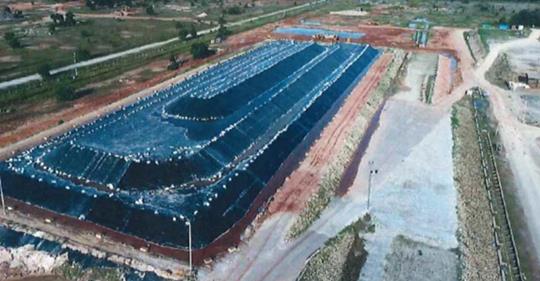
Malaysian government insists that Lynas must remove its 450,000 tonnes of radioactive waste from the country
|
Lynas still has to move a radioactive mountain, say Malay officials, SMH, By Colin Kruger, April 18, 2019 Malaysian Environment Minister Yeo Bee Yin accused Lynas Corp of putting its bottom line before the environmental concerns of local Malays in a letter to the company’s employees last year, and it appears that her hard line stance against the controversial rare earths group is prevailing.Malaysian Government officials told the Sydney Morning Herald and The Ageon Wednesday that Lynas Corp still needs to remove more than 450,000 tonnes of radioactive waste from the country for its licence to be renewed in September.
Minister Yeo laid down the law in a letter to Lynas employees in December just days after her ministry effectively ordered the company to remove 450,000 tonnes of low level radioactive waste. As of now, there is no viable near-term solution to manage the accumulated residue, which is stored at the open landfill temporary site,” Minister Yeo said in the letter. “The risks to the surrounding communities and environment increases with the increasing amount of accumulated residue as it is exposed to the threat of natural disasters such as major flooding.” The officials, who are not authorised to speak on behalf of the government on this subject, confirmed that the original conditions that the Environment ministry introduced in December remain in place. In the Lynas employee letter, which was posted to her official Facebook page, Minister Yeo emphasised that the government was holding Lynas to its promise of removing the waste from Malaysia and seized on Australian analyst reports indicating that the cost of removing the residue could be as low as $60 million…….. Lynas, and its estranged suitor Wesfarmers, both welcomed comments this month from Malaysian Prime Minister Mahathir Mohamad that appeared to give a green light to Lynas continuing its operations if it agreed to extract the problematic radioactive residue before the ore was shipped to Malaysia. While still seeking further clarification from the government on his comments, it was suggested that the radioactive waste no longer needs to be exported. ” … they can continue if they promise that the raw material from Australia would be brought here only after, what they call, cracking and cleaning it up,” Dr Mahathir told a local press after his cabinet had met to discuss Lynas following public disagreement among his ministers…… https://www.smh.com.au/business/companies/lynas-still-has-to-move-a-radioactive-mountain-say-malay-officials-20190417-p51f1k.html |
|
|
Kevin Rudd, as Foreign Minister in 2011, aware of Lynas’ probable radioactive wastes problem
Malaysian concerns over Lynas raised with Kevin Rudd in 2011, https://www.theage.com.au/business/companies/malaysian-concerns-over-lynas-raised-with-kevin-rudd-in-2011-20190415-p51ebx.html, By Colin Kruger, April 16, 2019, Former prime minister Kevin Rudd warned in 2011 that Australian companies needed to operate to high environmental and safety standards in their overseas operations after being alerted to Malaysian concerns about the radioactive waste produced by rare earths group Lynas Corp.
This was around the same time that ASX-listed Lynas was being warned, in a confidential report it commissioned, that it had failed to engage with the Malaysian community, which could jeopardise its operations in the country.
A letter obtained by The Sydney Morning Herald and The Age details a response from Mr Rudd, who was foreign minister at the time, to Senator Doug Cameron, who had met with a delegation of Malaysian citizens expressing their concerns about Lynas’ $1 billion operating plant in Kuantan.
“The Australian government expects Australian companies to operate to high environmental and safety standards in their overseas operations, as they would in Australia,” said the letter from Mr Rudd dated July 20, 2011.
“While ultimately Malaysian law governs the management of residues from the plant, the Australian government has welcomed the Malaysian government’s decision to establish the independent expert panel as an open and transparent response to community concerns.”
Mr Rudd noted that the Lynas plant, once completed, would be the “largest single investment in Malaysia and as such, the government is taking a close interest in the project”.
The plant’s importance went beyond Australia’s relationship with Malaysia.
At the time, there was significant global concern about the fact that China dominated the supply of rare earths – a group of 17 elements crucial to the manufacture of hi-tech products like digital cars, smart phones and wind turbines. Despite the name, the elements are not actually that rare, but they are environmentally hazardous to extract.
In 2010, the then Japanese foreign minister, Seiji Maehara, raised the issue with Mr Rudd during trade talks in Canberra.
Mr Rudd said at the time that Australia “understands the significance of rare earths globally” and “Australia stands ready to be a long-term, secure, reliable supplier of rare earths to the Japanese economy”.
It was shortly after that trade visit that a deal was unveiled under which $US250 million in Japanese government agency financing was made available for an accelerated expansion of Lynas’s Mount Weld rare earths mine in Western Australia, and its associated processing facilities in Malaysia.
Mr Rudd is understood to have played a key role. The Department of Foreign Affairs and Trade and Senator Cameron were approached for comment.
Lynas, which is being pursued by former Coles owner Wesfarmers with a potential $1.5 billion indicative offer, faces closure of its Malaysian operations by September if it cannot comply with new conditions introduced in December due to the environmental concerns. These currently include the removal of more than 450,000 tonnes of residues containing low-level radiation.
Wesfarmers chief executive Rob Scott met with Malaysian Prime Minister Mahathir Mohamad last month to discuss the regulatory issues faced by Lynas.
The following day, Dr Mahathir announced that a company interested in acquiring Lynas had promised to extract the radioactive waste before exporting the ore to Malaysia.
Wesfarmers has denied any impropriety in its meetings with the Malaysian government.
This month, Australian regulators confirmed they had requested detailed information from Lynas and Wesfarmers about communication between the companies before the public announcement of the takeover bid on March 26.
Earlier last month, four Lynas directors had acquired shares during a designated trading window.
A Lynas spokesman said the company had “no reason to believe that Wesfarmers had an ongoing interest in the company at the time the shares were purchased. The purchases were made in a designated trading window”.
Lynas chief executive Amanda Lacaze will update the market on the company’s operational performance for the March quarter on Tuesday.
The company’s results for the December quarter were affected by a temporary shutdown of its operations after Lynas failed to receive approval to lift the approved limit for processing lanthanide concentrate.
Lynas shares closed 6¢ lower at $2 on Monday.
In 2011, secret report warned of dangers of Lynas’ rare earth’s wastes in Malaysia
|
Secret report: Lynas told of Malaysia risks in 2011, The Age,By Latika Bourke, April 15, 2019, Lynas management was warned eight years ago that the rare earths miner had failed to “engage meaningfully” with Malaysia and its operations in the country could be jeapordised if it did not change the way it dealt with environmental concerns and the government.The Herald and Age have obtained a confidential report delivered to Lynas in 2011 by Australian advisory firm Futureye that concluded the company was in “urgent need” of winning the local community’s support for the Malaysian operations’ future.
The report warned that failure to win local support would not just jeopardise the company’s Malaysian business but also call its reputation as a good corporate citizen into question at home in Australia. Lynas is fighting off a $1.5 billion takeover bid from Perth-based conglomerate Wesfarmers with the viability of its operations now hinging on a decision by Malaysian Prime Minister Mahathir Mohamad. The company continues to face major concerns about its 100 hectare materials plant in Kuantan, with community groups stepping up pressure on the government to suspend its operating license. The Wesfarmers takeover has been mired in allegations of aggressive tactics and has caught the attention of the corporate regulator………. Another condition — something the company [Lynas] has previously said was unfeasible — was the removal of more than 450,000 tonnes of low-level radioactive waste from the country by September. Lynas’ auditor Ernst & Young said in February that if the company could not successfully negotiate with the Malaysian government about its processing plant, there was “a material uncertainty that may cast significant doubt about the consolidated entity’s ability to continue as a going concern”. The confidential 2011 report by Futureye appears to anticipate some of these issues. ….
Lynas’ failure to “engage meaningfully” in the two years it had been in Malaysia meant “community outrage is escalating at a time when Lynas is awaiting its pre-operating licence”. Unless Lynas began immediate engagement, the report argues, the issue would grow beyond the company’s control. The 2011 document also warned Lynas about its reliance on an administration headed by then prime minister Najib Razak, Mr Mahathir’s political rival who is now being investigated for corruption. “Corruption (or suspected corruption) is a serious issue that requires proactive management by Lynas … whether there is a direct allegation of any corrupt practice in relation to the project or not, it is essential that Lynas publicly commits to non-corrupt practices.”……. https://www.theage.com.au/business/companies/secret-report-lynas-told-of-malaysia-risks-in-2011-20190412-p51der.html |
|
Malaysian environmentalists and consumer groups dispute Lynas’ claims about radioactive wastes

Lynas is being unscientific, not SAM or CAP https://www.malaysiakini.com/letters/471173 SM Mohamed Idris 6 Apr 2019 Sahabat Alam Malaysia (SAM) and the Consumers Association of Penang (CAP) refer to the letter by Lynas Malaysia reported in Malaysiakini on 5 April 2019, which says that our recent statements about the plant’s wastes are “false and ignore scientific fact.”
The controversy is over the definition of wastes from the Lynas’ water leach purification (WLP) process, which contains thorium and uranium.
Lynas claims that the wastes are naturally-occurring radioactive material (called NORM), while we claim that the wastes are not naturally-occurring, but have been technologically-enhanced and should be called technologically-enhanced naturally-occurring radioactive material known as TENORM.
Citing “two eminent scientists”, Lynas states as fact that “the small amount of thorium and uranium in the WLP generated are not man-made but naturally occurring radionuclides found in soil, water and in food.”
Lynas is clearly distorting the facts.
First of all, the thorium and uranium containing wastes generated by Lynas are not found to naturally occur in the Gebeng area, where the plant is located. On the contrary, the raw material which is processed by the Lynas plant is lanthanide concentrate that contains the thorium, uranium and the rare-earth.
This raw material is processed and imported from the Mount Weld mine in Australia and is brought to Malaysia. It is then subject to further processing in Gebeng by Lynas.
Therefore, how can it be said that say that the thorium and uranium are naturally occurring in the soil, water and in food when they were not there before in the Gebeng area, if not for the Lynas operations?
Moreover, what is even more significant is that we are talking about the generation of an accumulated amount of more than 450,000 metric tonnes of radioactive wastes from the Lynas operations thus far. To call this naturally-occurring radioactive material is indeed unscientific.
Secondly, the wastes that Lynas has generated from the WLP process clearly falls within the definition of TENORM, as defined by the US Environmental Protection Agency (USEPA) as: “Naturally occurring radioactive materials that have been concentrated or exposed to the accessible environment as a result of human activities such as manufacturing, mineral extraction, or water processing.”
The USEPA also states that “technologically enhanced” means that the radiological, physical, and chemical properties of the radioactive material have been concentrated or further altered by having been processed, or beneficiated, or disturbed in a way that increases the potential for human and/or environmental exposures.”
Indeed, Lynas seems to have forgotten that its own Radiological Impact Assessment of 2010 refers to the residues from its operations as TENORM.
Moreover, in a study co-authored by, Dr. Sukiman Sarmani (the “eminent scientist” that Lynas refers to in its letter) and three others (published in 2014 on the Lynas plant residue), shows that the WLP residue has a high radioactivity of Thorium 232 compared to the natural background levels of Malaysian soils and therefore comes under the purview of the regulatory authorities.
These facts fortify our position.
Lynas in its letter also refers to us as “unqualified people.”
For the record, SAM and CAP have very deep and detailed knowledge of how rare-earth plants can impact public health and the environment, having had years of considerable experience from being involved in the Asian Rare Earth (ARE) case in Bukit Merah, Ipoh.
We assisted the people of Bukit Merah over many years countering the claims of ARE, the Atomic Energy Licensing Board, the International Atomic Energy Agency and others.
This we did by being engaged and involved with many scientists and public health experts both from Malaysia and abroad, who helped the community battle in the courts, that finally led to its closure. We have over the years documented the serious health impacts suffered by the Bukit Merah community, that continue till today, due to the impacts of low-level radiation.
Surely our rich experience and knowledge cannot simply be dismissed by the likes of Lynas. SM MOHAMED IDRIS is president of both environmental movement Sahabat Alam Malaysia (SAM) and NGO Consumers Association of Penang (CAP).
Environment Minister Melissa Price confirms Malaysia’s request for Australia to take back Lynas’ radioactive trash
Minister confirms Malaysian request on Lynas waste, Fin Rev 2 Apr 19 Brad Thompson Environment minister Melissa Price has confirmed receiving a letter from her Malaysian counterpart requesting collaboration on the removal of low-level radioactive waste produced by Lynas Corporation.
Ms Price’s office said on Tuesday that it was premature to comment further until the request had been properly considered.
Malaysia wants Australia to accept 450,000 tonnes of waste created at the Lynas plant near Kuantan in the processing of rare earths from the company’s Mount Weld mine in Western Australia.
A spokesman for Ms Price said Australia’s Department of the Environment and Energy handled import permit applications for hazardous materials on a case-by-case basis.
Similarly, the Australian Radiation Protection and Nuclear Safety Agency handled import permit applications for radioactive material on a case-by-case basis.
It remains unclear how the Lynas waste will be classified. It is understood West Australian authorities would also have to sign off on the transport of any waste within the state, possibly all the way back out to the remote Mount Weld mine.
Lynas refuses to concede it will have to find a way to remove low-level radioactive waste from Malaysia to keep its operations going, despite increasing political pressure.
The Wesfarmers’ takeover target said on Tuesday that it continued to engage productively with the Malaysian government over the waste issue.
Lynas remains optimistic it can resolve the issue within Malaysia despite an order to remove the waste by September if it wants to continue operating its $800 million Kuantan plant.
Lynas, led by Amanda Lacaze, declined to comment on the Malaysian minister’s formal request for the Australian government to collaborate on the waste removal………
Wesfarmers is reported to have told Lynas it is willing to build a first-stage processing plant at Kwinana, south of Perth, to overcome the waste issue. Connect with Brad on Twitter.Email Brad at bradthompson@afr.com.au https://www.afr.com/business/mining/environment-minister-confirms-malaysian-request-on-lynas-waste-20190402-p51a1x?fbclid=IwAR3P_yvHRTW0Z3LAj1bBwWTkFrfdiLP0S9wmykaxQoY-QZfymcRZXtG5U5g
Port Lincoln the likely thoroughfare for nuclear waste entering South Australia?
 Port named as potential nuclear waste thoroughfare https://www.portlincolntimes.com.au/story/5995142/port-named-as-potential-nuclear-waste-thoroughfare/, Lauren Dinni, 5 Apr 19,
Fellow campaigner Jim Green also voiced the same concerns.
Ms Bonacci said the traditional landowners had lodged a formal complaint for racial discrimination and bad consultation.
“It is a non-binding ballot, and very narrow in scope,” she said.
“There are Kimba farms five kilometres from the site but aren’t in the district and so are not eligible to vote.”
She also said towns along transport routes and around the four ports named should also be consulted, which would include Port Pirie, Whyalla, a proposed port on the east coast of the Eyre Peninsula, and Port Lincoln.
Both Mr Green and Ms Bonacci instead advocate for the continuing interim storing of intermediate-level nuclear waste to remain in Lucas Heights in New South Wales, and the continuing storage of low-level waste on defence land.
As Kimba and Hawker are proposed as above-ground, non-permanent (up to 100 years) storage sites of nuclear waste, Friends of the Earth are advocating for a permanent solution to be discussed while capacity is still viable at Lucas Heights.
“Move it once, not twice,” said Ms Bonacci.
“There is no proven need for this facility and there is certainly no need for it to be sited in SA.”
Mr Green said there was “no logic” to moving the waste to South Australia, and the government has no permanent solution for the long-term storage of low-level and intermediate waste.
“There’s no reason for (the government) to drive it,” he said.
Friends of the Earth nuclear waste campaigners have travelled to Port Pirie, Port Augusta, Whyalla and Port Lincoln to meet with councils, Grey Candidates, trade unions and traditional owners to raise their issues.
“It’s divisive and unnecessarily expensive,” said Mr Green.
“Whoever fights the least hardest gets nuclear waste transported through their ports.”
Mayor Brad Flaherty met with the advocates this week and said it was the first he had heard of the Port Lincoln port being named as a potential thoroughfare.
“But I don’t see it as likely (to be used), they would have just looked at the radius around the geographical area and chosen four of the closest ports.”
Incompetent management of CSIRO’s nuclear waste – used by ARPANSA to promote South Australian Hawker waste dump plan?
 This article looks like one of those softening up articles that ANSTO and ARPANSA like
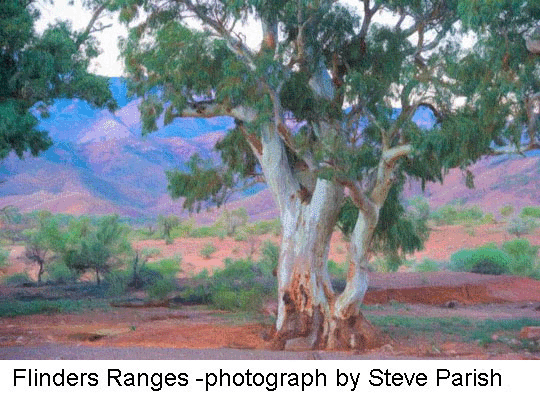 to put out – to persuade the Australian public that a radioactive waste dump is needed, in the beautiful Flinders Ranges.
It’s time that we all really woke up to the fact that the nuclear industry, its ignorant lobbyists and craven politicians, are incompetent simpletons regarding the global nuclear mess, and should not be trusted with their decisions that are aimed at furthering this toxic industry.

Rusted barrels of radioactive waste cost CSIRO $30 million Steven Trask, Canberra Times, 7 Mar 17
CSIRO faces a $30 million clean up bill after barrels of radioactive waste at a major facility were found to be “deteriorating rapidly” and possibly leaking.
An inspection found “significant rusting” on many of the 9,725 drums, which are understood to contain radioactive waste and other toxic chemicals.
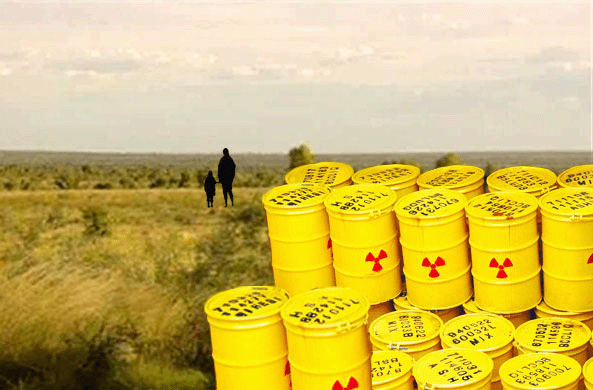
CSIRO flagged a $29.7 million budget provision for “remediation works” at a remote location in its latest annual report. Fairfax Media can reveal the work will take place at a CSIRO facility located on Department of Defence land near Woomera, South Australia.
The Woomera facility is currently one of Australia’s largest storage sites for low and intermediate-level radioactive waste. A damning report of the Woomera facility was issued by the Australian Radiation Protection and Nuclear Safety Agency (ARPANSA) after an inspection in April last year.
“Evidence was sighted that indicates the drums are now beginning to deteriorate rapidly,” read the report, seen by Fairfax Media. “Significant rust on a number of the drums, deterioration of the plastic drum-liners and crushing of some stacked drums was observed.” Tests confirmed the presence of radioactive isotopes at one location and inspectors said there was a possibility the drums were leaking.
“Although unlikely, there is the possibility that the presence of deceased animals such as rodents and birds may indicate that some of the drums, which contain industrial chemicals, may be leaking into the environment.”
The mixture of water and concentrated radioactive material inside some of the drums also had the potential to produce explosive hydrogen gas, inspectors found.
They also noted CSIRO had little knowledge of what was inside many of the barrels, some of which are believed to date back more than 50 years.
“Without full knowledge [of] the contents of the drums, risks cannot be fully identified and risk controls cannot be appropriately implements to protect people and the environment,” inspectors noted in the report.
Many of the drums are understood to contain contaminated soil generated by government research into radioactive ores at Melbourne’s Fishermans Bend throughout the 1940s and 1950s.
The toxic soil was discovered by the Department of Defence in 1989, who sent it to Sydney’s Lucas Heights facility before it was palmed off to Woomera in 1994.
An ARPANSA spokeswoman said the $29.7 million estimate would cover the characterisation, handling, re-packaging and storage of the toxic material.
“As a result of an ARPANSA inspection in 2016, it was recognised that additional work was required to scientifically characterise some of the contents of the legacy materials more accurately,” she said.
“The work that needs to be undertaken is significant.”
A spokesman for CSIRO said the first phase of the three-year clean up would begin next month.
“CSIRO currently has a radioactive waste store located on defence land at Woomera, South Australia. The store currently has 9,725 drums of long-lived waste,” he said…..
The country’s other major radioactive waste storage facility at Lucas Heights, Sydney, is rapidly approaching full capacity. Coupled with issues at the CSIRO site, the revelations highlighted the urgent need for a national radioactive waste storage solution, experts said.. http://www.canberratimes.com.au/national/rusted-barrels-of-radioactive-waste-cost-csiro-30-million-20170307-gusb6v.html
Where do candidates stand on nuclear waste dumping? Friends of the Earth are finding out
 Sounding out candidates on nuclear https://www.whyallanewsonline.com.au/story/5991908/sounding-out-candidates-on-nuclear/?fbclid=IwAR3jlaHvuyECA2gwYQCZOGo6ysCmFwSKSGtyFUA8hD4IEex8CKJg6lK3GkQ, Louis Mayfield 3Apr19
Friends of the Earth National Nuclear Campaigners have been speaking to candidates for the seat of Grey ahead of the federal election to see where they stand on the proposed nuclear waste dump regional SA.
Mara Bonacci and Jim Green were in Whyalla on Tuesday and met with trade unionists and one of the candidates for Grey.
The process of establishing a low-level and intermediate waste dump in Kimba or Hawker is currently delayed because of two court cases brought on by the Barngarla and Adnyamathanha traditional land owners.
“Unless people go out to find the information towns like Whyalla, Pirie or Lincoln don’t get it,” she said
“The Department of Industry, Innovation and Science are still open for submissions. People can still write to the government about this issue.”
Ms Bonacci said the scope of the federal government’s consultation during the site process had been very narrow.
“They’re looking at the sites proposed to house the facility rather than the towns it’s going to impact which is potentially all of the Eyre Peninsula,” she said.
Their visit is also a follow-up on a report from the Department of Industry, Innovation and Science made public last year which named Whalla, Port Pirie and Port Lincoln (among others) as potential nuclear waste ports. “There are communities that haven’t been told at all about being a nuclear port unless NGOs like the ones we work through had trawled through reports and identified these port towns,” Mr Green said.
“They’ve had no say, let alone a meaningful say on whether this goes ahead.”
To make a submission to the Department of Industry, Innovation and Science click here.
The Australian govnt and ANSTO classify spent nuclear fuel from Lucas Heights as intermediate-level nuclear waste
 Kim Mavromatis Fight To Stop Nuclear Waste Dump In Flinders Ranges SA, 31 Mar 19, Everywhere in the world, spent nuclear fuel is classified as high-level nuclear waste and it will remain radioactive for eternity. After 30 yrs, spent nuclear fuel is still 10,000 times more radioactive than uranium ore and will take 10 million years to reduce to the same radioactivity as uranium ore (Canadian Nuclear Authority). Yet the Australian govnt and ANSTO classify spent nuclear fuel from Lucas Heights as intermediate-level nuclear waste.
 Even in 1998, the nuclear lobby and Nick Minchin, were scheming for an international nuclear waste dump in South Australia
 Kazzi Jai Fight To Stop Nuclear Waste Dump In Flinders Ranges SA, 29 Mar 19,
 Guess when this was written (answer at the end)…..and also is a poignant reminder of the role Nick Minchin played in all of this!
“Claims that a low-level radioactive waste dump will be the thin edge of the wedge are not “scare-mongering”, as Nick Minchin has repeatedly claimed. Numerous government reports make it clear that the proposed low-level dump could be followed by an above-ground store for long lived, intermediate-level radioactive wastes (including wastes from thereprocessing of spent fuel from the nuclear reactor in the Sydney suburb of Lucas Heights). In addition, the federal government plans to dismantle nuclear reactors at Lucas Heights and dump them in SA.
The Australian Nuclear Science and Technology Organisation (ANSTO), which operates the Lucas Heights reactor, has said that if overseas reprocessing contracts fall through, spent fuel could be sent to SA for “extended interim storage”. In the event of reprocessing contracts falling through, the federal government might also attempt to establish a spent fuel reprocessing/conditioning plant in SA.
If the federal government succeeds in establishing a dump in SA, then Pangea Resources, the company which wants to dump high-level waste in Australia, can be expected to try its luck in SA.
James Voss, president of Pangea Resources, visited Australia in 1998. Voss offered to operate the proposed low-level waste dump.
Later that year, a leaked corporate video revealed that Pangea, with funding from British Nuclear Fuels Limited, was scheming to dump 75,000 tonnes of high-level radioactive waste in Australia. In 1999, Minchin apologised in the Senate for falsely claiming that no federal minister had met with Pangea.“…..
“The federal government asserts that the plan for a centralised waste dump and store are driven by scientific and safety considerations. The real agenda is political: moving radioactive waste away from Lucas Heights to reduce local opposition to the planned new reactor.
The proposed new reactor would generate another 1600 fuel rods, and according to ANSTO documents, annual generation of radioactive waste would increase up to 12-fold depending on the waste category.
Minchin’s mantra is that South Australians should accept the waste because they will benefit from medical radioisotopes produced. However, the lie that a new reactor is needed for medical isotope production has been exposed from an unlikely source — Dr Barry Elison, president of the Australian and New Zealand Association of Physicians in Nuclear Medicine.
Elison issued a press release in June saying a new reactor was “vital” for isotope production. Yet a month later, when asked how doctors coped during the February-May closure of the Lucas Heights reactor, Elison admitted he was not aware that it had been down!”…… The year – August 2000! An excerpt from an article by Jim Green….”South Australia says No to N-dump
Nuclear waste dump proposal divides rural communities in South Australia
 Why is this writer accepting the nuclear lobby line that ibtermediate level wastes would be stored at Kimba or wherever for only “a few decades” ?
Does she not know that there is no plan for final disposal of the wastes, and that they are most likely to be stuck at Kimba or wherever for hundreds of years?
Will Australia finally get a national nuclear waste facility? ABC, 28 Mar 19, 7.30 , By Angelique Donnellan For 40 years Australia has sought to centralise its nuclear waste, but the question of where to put it remains unanswered because of bitter division.
Key points:
- The Federal Government wants to store the nation’s nuclear waste in South Australia
- Three sites have been shortlisted, two in Kimba and one in Hawker
- The proposal has divided both communities
……… The Howard government dropped its proposal after it lost a fight with the South Australian Labor government in the High Court……
n 2007, a property called Mukaty Station in the Northern Territory was put forward to host the nuclear waste facility.
The plan was abandoned, again because of legal action, this time by the area’s traditional owners.
Tightknit communities divided
The current proposal has three sites in regional South Australia shortlisted — two in Kimba, five hours north-west of Adelaide, and one in Hawker, near the Flinders Ranges.
Landholder Jeff Baldock has volunteered a portion of his property in Kimba for the proposed facility, which would store low-level nuclear waste for up to 400 years, and intermediate-level waste for a few decades before that is moved to another location.
“Kimba is no different to any other small rural community where we have a shrinking population,” Mr Baldock said.
“It’s just a good opportunity for us to find another industry which doesn’t rely on agriculture.
“I don’t seriously think there is any risk of this having an effect on our crops [or] livestock.”
But Kimba resident Barry Wakelin is not so sure. Despite being a federal Liberal MP when the Howard government pushed for a national nuclear waste facility in the early 2000s, Mr Wakelin now opposes one near his town.
And is it a waste facility or a dump? Even what it is called has caused a rift.
Local business owner and teacher Meagan Lienert said she expected it to be a well managed “high-class, world-class facility” and “very different to a dump”.
“What the hell are they talking about? Everyone knows what a nuclear dump is. It’s rubbish,” Mr Wakelin said.
The Adnyamathanha Traditional Lands Association is one group taking legal action.
They are the traditional owners of land around Hawker.
Regina McKenzie said her people had been unfairly excluded from a community vote on the dump and claimed preparatory work at the site had desecrated a sacred women’s area.
“I know they need a site, but not here. Don’t impact our sites, don’t impact our culture, don’t impact us,” Ms McKenzie said.
“I love my country and I don’t want to see a waste dump on it.”
The issue is further complicated because some members of the Adnyamathanha support the facility, including Regina’s brother, Malcolm McKenzie.
“I’m supporting this because our culture can co-exist with economic development,” Mr McKenzie said.
Adnyamathanha woman Angela Stuart backed the facility because she wanted more opportunities for young Aboriginal people.
“We need a change. I’m sick of seeing young people drinking and wasting their lives away on alcohol and drugs,” she said.
“There might be a chance out there even if one person gets a job.”
The Native Title holders around Kimba, the Barngarla people, are taking legal action.
It is unclear when the Federal Court will hand down its judgement in that case.
1 This month

of the week – Australians for War Powers Reform (AWPR)
To see nuclear-related stories in greater depth and intensity
 Antinuclear