Greg Bannon demolishes the case for Kimba/Hawker nuclear waste dump, in a trenchant Submission
This is a National issue and a National problem. Small, remote communities, whether at Kimba, the Flinders Ranges or anywhere else, should never be expected to make the decision alone to accept the toxic by-products of one industry’s lifetime production.
Nuclear Medicine: It was impressed on the community that a primary reason for the NRWMF is the need to dispose of Australia’s radioactive medical waste. DIIS is the only official source of information, some of which implies that procedures such as CAT scans, X-Rays, and cancer treatments require the use of radioactive isotopes. Plain scans, X-Rays and a vast majority of cancer treatments do not use such isotopes.
It is a genuine and valid concern that ILRW may become stranded at this facility for any number of reasons.
ILRW has been the “elephant in the room” from the Day 1 of this process. The emphasis has been on Low Level Radioactive Waste and, even today, people in our community say “it is a low level waste dump”.
Submission from: Greg Bannon, Resident of Quorn, Flinders Ranges Council Region, Barndioota Site to SENATE ECONOMICS REFERENCES INQUIRY – National Radioactive Waste Management Facility (Submission no. 85) 13 attachments
I have connections to this region that go back to the late 1950’s. My family first visited Wilpena Pound on a holiday in 1958. The following year, on a return visit to Wilpena with some overseas friends, my younger brother became lost and died. He is buried at Hawker. I worked on Partacoona and Warrakimbo Stations in the 1960’s. Warrakimbo shares a boundary with Wallerberdina. Later, I worked for a corporate farming company in Esperance, WA, for over 30 years. During that time I made many visits to this region.
My partner and I purchased land on the outskirts of Quorn in 1999 and came here in 2003 to renovate a building, live and retire. We chose the region because of a long affinity to it, a love of the landscape, a connection to the community and friends who live here. We have tried to contribute by involving ourselves in community life and activities.
It was a great disappointment to hear that the region had been nominated to accept a radioactive waste facility. We had never considered this as a possibility. This proposal is completely at odds with everything that is promoted for our region. We believe that on many grounds, set out below, it should never have been nominated, let alone made it on to the short-list.
Addressing the Terms of Reference:
- a) Financial compensation offered to applicants for the acquisition of land under the Guidelines.
There is considerably more to the issue of site selection than the compensation offered to the successful nominator. The process to select a site for the National Radioactive Waste Management Facility (NRWMF) has been problematic since this current search was announced by Senator Ian McFarlane in March, 2015. All previous attempts to establish a facility have met with resistance from local communities and/or State Governments and have not been successful. Legislation was enacted in a number of States to prohibit the establishment of certain types of nuclear waste storage facilities in direct response to the Federal Government’s actions.
The Department of Industry, Innovation and Science (DIIS) nomination process started in March, 2015, with an invitation to landholders to offer land for the NRWMF. This was claimed to be “international best practice”, however, there was no requirement for the nominator to consult or inform his community, or even his nearest neighbours. That would have been “best practice”.
Housing a radioactive waste management facility on a pastoral property is a major departure from the accepted land use for the area and contrary to conditions of operating a pastoral lease. It would seem a serious omission of compliance has been committed in proposing this facility without consulting State land use regulators. Once established, the facility will be actively accepting low level radioactive waste (LLRW) for 100 years and will require oversight and management for a further 300. Co-located on the same site will be an unspecified amount* of intermediate level radioactive waste (ILRW), to be temporarily stored for an unspecified time*.
(*unspecified amount – ANSTO is planning increased production of radioactive isotopes for medical use to potentially supply an international market. Increased production must increase waste.
*unspecified time – “Temporary” has been defined variously as from 20, 30, 40, even up to 100 years .)
ILRW can only be stored at this site on a temporary basis. DIIS has stated that for permanent disposal it requires deep burial in geologically stable conditions – no such site exists in Australia today and there is currently no plan to develop one.
It is not clear how widely the invitation to submit nominations was advertised. Site nominations closed on the 5th May, 2015. 28 were received, 25 were assessed and a short list of 6 was announced by Minister Frydenberg on 13th November, 2015. One of three in SA was named as Barndioota, in the Flinders Ranges region. This was the first time I became aware that my region was being assessed to accept radioactive waste. Research was required to find where “Barndioota” actually was.
It is not clear why the name “Barndioota” was used as the location of the site instead of by the well-known property name “Wallerberdina”. “Barndioota” was not a name in regular local use and very few people knew where it was. Only a landowner paying rates in that section of the Flinders Ranges Council (FRC) region would know of the “Hundred of Barndioota”. In fact, the area of Wallerberdina that is currently being assessed for the NRWMF is in the neighbouring “Hundred of Cotabena”. This area is classified as “Out of Districts”, outside local government boundaries, and under the jurisdiction of the Outback Communities Authority.
Prior to the November 2015 announcement, nearly nine months after the call for nominations, very few of the community if any, were aware that Barndioota/Wallerberdina had been nominated to house radioactive waste. Not even the Flinders Ranges Council was informed of the nomination.
(See attachment #1 – The Flinders Ranges Council Community Newsletter, November, 2015)
By contrast, the nominator was fully informed on the entire history and scope of the project. A partner in the lease of Wallerberdina for a relatively short time, he does not live on the property. He is a former South Australian Federal Senator and served on three Senate Select Committees related to this industry – Dangers of Radioactive Waste, 23/03/95 to 24/04/96 (Chair from 30/03/95); Uranium Mining and Milling, 08/05/96 to 15/05/97 (Chair from 23/05/96); and Lucas Heights Reactor, 17/08/00 to 24/05/01.
- b) How the need for “broad community support” has played and will continue to play a part in the process, including:
- i) Definition of “broad community support”.
Submission from Australian Nuclear Science and Technology Organisation (ANSTO) tells how good ANSTO is
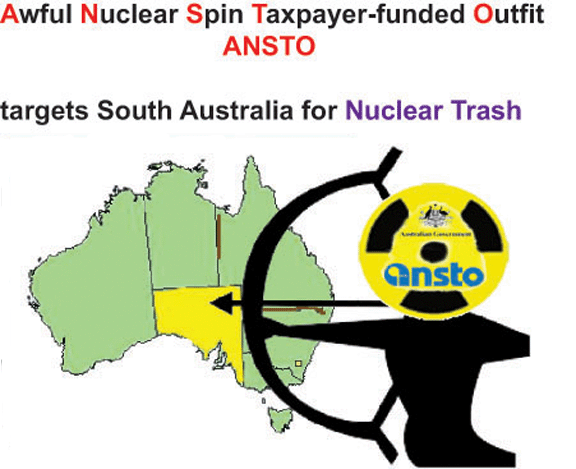
The Australian Nuclear Science and Technology Organisation (ANSTO) Submission to the Senate Economics References Committee Inquiry into the appropriateness and thoroughness of the
site selection process for a national radioactive waste management facility at Kimba and Hawker in South Australia (Submission No 58)
(This submission does not seem to address the Terms of Reference directly. )
The Australian Nuclear Science and Technology Organisation (ANSTO) is Australia’s national nuclear research and development organisation, and the centre of Australian nuclear expertise. ANSTO operates a large proportion of Australia’s landmark research infrastructure, including the OPAL multipurpose reactor, the Australian Synchrotron, the Australian Centre for Neutron Scattering, and the Centre for Accelerator Science. This infrastructure places Australia at the forefront of research and innovation for the benefit of public health, industry and the environment, and is used by universities, researchers andindustry from around Australia and internationally.
ANSTO applies its unique expertise to the production of lifesaving nuclear medicine as well as research into areas of national importance. Research areas include the environment, climate change, water resource management, materials engineering and human health.
ANSTO welcomes the opportunity to contribute to the Senate Economics References Committee’s inquiry into the appropriateness and thoroughness of the site selection process for a National Radioactive Waste Management Facility (NRWMF) at sites near Kimba and Hawker in South Australia. Through this submission, ANSTO seeks to describe its\involvement in the process to date, as well as how the process aligns with international best practice. Given the focus of the inquiry’s terms of reference is on community consultation and consent aspects of the process, ANSTO has not commented on the technical aspects of site selection in this submission.
ANSTO’s involvement in the site selection process
ANSTO has been closely involved in the process to establish the NRWMF through the provision of technical support and expert advice to the Department of Industry, Innovation and Science (DIIS). ANSTO’s capabilities stem from decades of experience in safely managing its own radioactive waste and producing lifesaving nuclear medicines.
ANSTO has applied its dedicated expertise in community consultation and collaboration, having developed strong supportive relationships with the communities surrounding its facilities and other stakeholders across Australia and the world. ANSTO has drawn on this expertise, and its links with leading international nuclear bodies, including the International Atomic Energy Agency (IAEA), to support the process, helping ensure it continues to be managed in accordance with international best practice.
Since late 2015, ANSTO staff have made more than 20 visits to the communities of Hawker and Kimba and the surrounding areas to share information on radiation and radioactive materials, and how the latter can be safely stored. ANSTO has made its expertise available to all community members. ANSTO’s activities in the Hawker and Kimba communities have included:
Conducting outreach to local businesses;
- Delivering science workshops in all major local schools;
- Participating in information booths at the Kimba, Quorn and Hawker community shows;
- Participating in multiple meetings of the Kimba and Hawker Community Consultative Committees, which act as the conduit between the government and the communities (each Committee is comprised of around 12 people with a variety of views, and who represent a cross section of the area – including agriculture, business and young adults);
- Supporting the Department’s consultation with the Traditional Owners by participating in meetings with the ATLA Traditional Landowners Association, the Villiwarina Yura Aboriginal Corporation, and other groups of traditional owners from the Hawker area1;
- Meeting with landowners and the local councils; and
- Attending ‘town hall’ meetings to help answer questions from the community.
Over this same period, ANSTO has welcomed members of the Kimba and Hawker communities to its campus in Lucas Heights, New South Wales, to tour the OPAL multipurpose reactor and nuclear medicine and radioactive waste management facilities, and to speak to people who live and work with radioactive materials. To date, more than 100 community members have visited Lucas Heights, including landowners, community members, Traditional Owners, neighbours and other key stakeholders. Continue reading
Regional Development Australia Far North sits fairly firmly “on the fence” regarding nuclear waste dump sit selection

“There are approximately 1,770 residing in the ‘broader community’ area, and this original survey result now only represents 16.5% of the population.”
“the views of the wider population who visit, pass through and stay in these areas could be considered in the overall picture as an element in a broad consultation process.”
“whilst a Statewide viewpoint has a role, it should not be a deciding factor”
Regional Development Australia Far North (RDA Far North) SUBMISSION FOR SELECTION PROCESS FOR A NATIONAL RADIOACTIVE WASTE MANAGEMENT FACILITY IN SOUTH AUSTRALIA Submission No 41
Background Regional Development Australia Far North (RDA Far North) is a not-for-profit incorporated association governed by a volunteer Board comprised from local people with a skills mix across industry, business, government and community.
Our role is to foster and enhance a robust, diversified, vibrant and growing economy across Far North SA through the timely and professional provision of economic development services.
RDA Far North maintains a neutral position in regards to the National Radioactive Waste Management Facility proposal being considered within the region we cover. The Far North SA Region The Far North region of South Australia, as per Regional Development Australia Committee boundaries, covers approximately 65% of South Australia. The area has a land mass of just under 650,000km2 with a population of 127,629 and incorporates the Anangu Pitjantjatjara Yankunytjatjara Lands.
The region takes in the iconic Flinders Ranges and Outback region, popular and well visited tourism destinations in the State. The Flinders Ranges is also now going through the process to be recognised as a World Heritage site. The main townships in the region include (but are not limited to) Port Augusta, Quorn, Hawker, Leigh Creek, Copley, Lyndhurst, Marree, Innamincka, William Creek, Oodnadatta, Marla, Mintabie, Coober Pedy, Glendambo, Pimba, Woomera and Roxby Downs. Some of these remote townships are between 800 – 1,000 kilometres from Port Augusta, the largest city in the region (population of 113,808). Barndioota (Wallerberdina Station) is in the RDA Far North region.
Terms of Reference The appropriateness and thoroughness of the site selection process for a national radioactive waste management facility and Kimba and Hawker in South Australia, noting the Government has stated that it will not impose such a facility on an unwilling community, with particular reference to: Continue reading
Kimba District Council seems mainly concerned about getting finances and services, in return for hosting nuclear wastes
District Council of KIMBA Submission to Senate Inquiry on Selection process for a national radioactive waste management facility in South Australia (Submission No.19)
(I was not able to copy this submission, so have just put an excerpt here with the main points. )
Kimba council addresses Term of Reference e) Whether wider Eyre Peninsula or Statewide community views should be taken into consideration, and if so, how this is occurring or should be occurring.
“Council remains of the view that its Local Government area represents the best reflection of the wishes of its community.”
“Kimba has been visited by a multitude of experts..” “Associate Professor Geoff Currie believed that Kimba was now one of the most educated communities in the country on radioactive waste….”
“Council would expect that the Australia Government would provide specificity on what financial and service benefits it will provide, and how these will be administered through the National radioactive waste Management Act (2012) before a final ballot occurs.”
Without this information available, Council does not believe the community would be in a position to make an informed decision that addresses the questions and concerns identified during phase two of the site selection process.
Council acknowledges the Australian Government is committed to undertaking community engagement as it selects a site for the NRWMF, and believes that by continuing to provide detailed information about the process, it will allow those participating in the final ballot the opportunity to make a considered decision which factors in both the impacts and benefits of constructing the facility in their region.
Debra Larwood Chief Executive Officer
T: 08 8627 2026 E: council@kimba.sa.gov.au
F: 08 8627 2382 www.kimba.sa.gov.au
South Australian Branch Australasian Radiation Protection Society seems unaware of Intermediate Level Waste for planned dump
South Australian Branch Australasian Radiation Protection Society (ARPS) Submission to Senate Inquiry: Selection process for a national radioactive waste management facility in South Australia (Submission No 66) __________________________________________________________________________________ The Australasian Radiation Protection Society is a professional society that promotes the principles and practice of radiation protection. It establishes and maintains professional standards amongst its members and advises on safe use of radiation for its many applications in industry, research and medicine.
Until now the Society has not had direct input to the National Radioactive Waste Management Project. It has viewed the public consultation process as one carried out between the Federal Department of Industry, Innovation and Science and the local communities who have put forward sites for consideration under the project.
This submission relates to points (b) and (e) of the Terms of Reference, ie in relation to the discussion around the definition of broad community support and the question as to whether the community views of the whole the Eyre Peninsula or the whole of South Australia should be taken into consideration.
While the Terms of Reference of the Inquiry are narrowly targeted to the site selection process it is important that this process is viewed in the light of two major aims of the Project:
- For Australia to meet its responsibilities to manage its own radioactive wastes including those originating from South Australia;
- To manage waste radioactive materials produced as a by-product of beneficial use of radiation in Australia: medical research, diagnosis and treatment of diseases, industrial processes and scientific research.
Our Society believes that it is appropriate that consultation occurs at the level of the local community. However, if it is decided from the deliberations of this Inquiry that public consultation will be extended to the wider South Australian community, the SA Branch of ARPS requests community views should be sought from:
1) South Australians who utilise radioisotopes in medicine, industry and research, particularly those who are responsible for management of waste radioactive materials
2) (where practicable) the many tens of thousands of South Australians from all parts of the community who have benefitted from diagnosis or treatment of life-threatening medical conditions using radioisotopes produced in Australia at the Lucas Heights facility.
These groups from the community are not organised into lobby groups of any form and therefore their views may be overlooked or undervalued in the consultation process.
Regarding point (1) above, many of our members advise on the safe management of radioactive materials. Over a period of decades legacy radioactive wastes used in industry, research and medicine have accumulated in South Australia (and Australia more broadly). The quantity of legacy radioactive materials is not substantial, and storage at multiple sites in South Australia is safe and compliant with current regulations.
However, radioactive materials are classified as hazardous materials and some represent a security concern. Hospitals and university campuses are not the place for storing unwanted hazardous materials. It is clearly more desirable to have a centralised managed facility which is purpose-built for the management of radioactive materials as there are for chemical or physically hazardous materials. After decades without progress, this National Project offers room for optimism that our waste material can be removed from the many individual sites across Australia and managed in accordance with international best practice.
On point (e) of the Terms of Reference, we comment that compared to any other small scale semiindustrial operation or a hazardous waste disposal or management process being proposed, the level of consultation with the local community is exceptional. The public consultation process in this case of radioactive waste materials may be contrasted with the process followed when asbestos or hazardous chemical waste disposal sites are established. Asbestos, for example, is a carcinogenic material with no half-life: once disposed of it persists in the environment forever. Radioactive materials will eventually decay away.
We note that the Inquiry website quotes the undertaking by the Government that it will not impose a facility on an unwilling community. We also note that the Government has indicated that no individual or group has an automatic right of veto.
Our concern is that in meeting demands from special interest groups who may not be from the local community and do not necessarily represent the local community, the requirements for demonstrating public acceptance will become unreasonable. Given the important service that this facility will provide to South Australia and Australia it is important that the project be given a reasonable opportunity to succeed. Should consideration of the current sites in South Australia fail, South Australians must then rely on other states or territories to accept the radioactive wastes from our hospitals and universities.
In summary, the Australasian Radiation Protection Society holds that the views which are the most important are those sought from the local community. The public consultation process should take into account the benefits enjoyed by all the South Australian and Australian community from past and future operations of the Lucas Heights reactor, and the use of radionuclides more broadly in science, medicine and industry. Any local community which accepts the establishment of a facility is providing a valuable service to the Australian community with minimal associated risk. Consultation should take place with a constructive intent, allowing the opportunity for fair input from the community while giving the facility every opportunity to succeed.
I Furness Chair, South Australian Branch Australasian Radiation Protection Society
South Australian Chamber of Mines & Energy (SACOME) supports the plan for nuclear waste dump for Kimba or Hawker
South Australian Chamber of Mines & Energy (SACOME) Submission to Senate re the selection process for a national radioactive waste management facility in South Australia (submission No 69)
The South Australian Chamber of Mines & Energy (SACOME) welcomes the opportunity to make this submission to the Senate Standing Committee on Economics’ selection process for a national waste management facility in South Australia.
By way of general comment, SACOME recognises that a majority of residents in Kimba and Hawker have expressed their support for the proposed facility; and that the site selection process continues to be rigorous and focused on genuine community engagement.
SACOME notes that the Commonwealth Government has clearly stated that it will not impose a national radioactive waste facility on an unwilling community and expresses strong support for this position as a guiding principle in the site selection process. SACOME’s specific comments are limited to the following terms of reference:
- e) Whether wider (Eyre Peninsular or state-wide) community views should be taken into consideration and, if so, how this is occurring or should be occurring.
SACOME views the site selection process as one that is specifically relevant to those local communities identified as possible site locations. As such, the views of the wider community are secondary to those of residents of Kimba and Hawker.
While SACOME recognises that the proposed facility has attracted significant attention and opposition due to its nature, it is questionable as to whether wider community views have sufficient connection to the proposed facility to justify them being taken into consideration.
This development has direct local impacts and benefits and, as such, the views of local communities should be given primacy.
- f) Any other related matters
Construction of a national radioactive waste management facility at Barnidoota near Hawker or in Kimba in South Australia has the potential to create significant economic benefit to local communities, both through creation of local jobs and through Commonwealth funding provided to the host community.
Yours sincerely Rebecca Knol Chief Executive Officer
Name Withheld (Submission No 92) fears Barndioota might end up stuck with Intermediate Level stranded nuclear wastes
Name Withheld (Submission No 92)To the Senate standing committee on Economics, re Selection Process for nuclear Waste Dump Site Firstly I would like to thank the standing committee for the forum to express the communities thoughts on this process. I have been a resident of Quorn in the beautiful Flinders Ranges for the past thirteen years. I consider myself lucky to live in such a stunning and geologically fascinating natural environment.
Name Withheld (Submission No. 90) has serious concerns about the nuclear waste dump plan
Name Withheld (Submission No. 90) Inquiry into selection process for a national radioactive waste management facility in South Australia
The appropriateness and thoroughness of the site selection process for a national radioactive waste management facility at Kimba and Hawker in South Australia noting the Government has stated that it will not impose such a facility on an unwilling community, with particular reference to:
ORIMA Research submission re nuclear waste dump siting- all about their survey methods
ORIMA Research Submission to Senate Inquiry into the selection process for a national radioactive waste management facility in South Australia (Submission No 108)
Name Withheld (No 91) – simplistic pro nuclear submission re nuclear waste dump plan
Name Withheld (Submission No 91) toSenate Standing Committees on Economics Re- Proposed National Radioactive Waste Management Facility I have spent all my 60 plus years schooling, socialising and volunteering in the community of the Kimba district. I have spent all my working life in agriculture starting as a farm employee both on “the family farm ” as well as on neighbours farms, before owning and managing the farm business along with my wife. I value the strength and functionality of our community and have a strong will to see this prosper into the future.
Name withheld (No 89)- another repetitive pro nuclear submission re nuclear waste dump siting
Name Witheld To: Committee Secretariat, Senate Standing Committee on Economics economics.sen@aph.gov.au Subject: Proposed National Radioactive Waste Facility – (submission no 89)
We are aware there is another location (Hawker), that is also being looked at. We should be able to decide what is best for our community ourselves, and so should they. We don’t think this enquiry is required as we feel communities know what is best for them. Everything has been open and above board in this process.
Dolores Wells: nuclear waste dump will save Kimba’s future: Shame on Vocal Anti-Nuclear Critics!
Dolores Wells. Submission to Senate standing committee on Economics Re – Proposed Radioactive Waste Management Facility
My husband and I lived, worked and began our family in Kimba over 45 years ago and we still regularly visit Kimba to stay with family on their farm at Cortlinye (north of Kimba). This farm has been in the family for 3 generations and is currently owned by our son-in-law and our daughter. Any decision to grant the National Radioactive Waste Management Facility to the Kimba district will not discourage or negatively affect our future visits to our family. I give my permission for this submission to be made public and would be available to speak with the Senate Committee to answer further questions on the Kimba processes with particular reference to:
a). the financial compensation offered to applicants for the acquisition of land under the Nominations of Land Guidelines.
I believe the financial compensation offered is not excessive and would be only a small percentage of future earnings from cropping and mixed farming and is in fact only a piece of an overall farm holding. No farmer would be a willing party to a perceived health risk for his family or future livelihood.
Over 45 years ago when my husband worked as Stock and station agent in Kimba it was a thriving country town and it is now in dire need of another industry to “drought proof” and ensure the continuation of this wonderful rural community. We have observed the trend of the small farmers struggling to survive (with the high cost of machinery, chemicals etc) and the larger farmers increasing their holdings while some smaller farmers are forced from their family homes.
b). how the need for ‘broad community support’ has played and and will continue to play a part in the process, including:
- the definition of ‘broad community support ‘ I believe broad community support has been demonstrated in this instance by ** The majority vote solicited through the Electoral Commission vote involving all local or invited vested interest registered voters ** Direct neighbour support from the two locally selected sites in the Kimba district
- ii) how ‘broad community support ‘ has been or will be determined for each process advancement stage; The status quo must remain to maintain the integrity of the process
- How any need for indigenous support has played and will continue to play a part in the process, including how indigenous support has been or will be determined for each process advancement stage;
Consultation with indigenous groups is an integral component of any new initiative in this state and it is my understanding in this instance that liaison with the Barngarla people has occurred, the recognised original custodians.
- whether and/or how the Government’s ‘community benefit program’ payments affect broad community and indigenous community sentiment;I see the ‘community benefit program’ and the resulting payments in similar light to mining company incentivising when they are considering new mining sites, political parties incentivising prior to elections and I feel reasonably confident that Kimba individuals and families would not be blinded by financial issues to the detriment of their own and their families present and future health and safety. They will only vote yes when they believe they are free from issues associated with radiation.
e). whether wider (Eyre Peninsular or state-wide) community views should be taken into consideration and, if so, how this is occurring or should be occurring; and
My husband and I currently reside in Adelaide and we wanted to offer our support to the Kimba community via this submission. However, we firmly believe that the residents of Kimba should be the sole decision makers on this issue and the result should be decided by a majority vote of over 50 percent (Continuing the integrity of the whole Kimba related process)
f). any other related matters
Media interest in the Kimba district appears biased and we read about and get deeply upset at the behaviour of a minority of people who manage to voice their opinions rather loudly. On our visits to see our family we see increasing tourist interests with admiring visitors loving the silo painting, the free R V park, beautiful sporting areas and other evidences of civic pride. The people who talk loudest are boycotting and not supporting local businesses and are negatively impacting on this wonderful little community and local businesses. Shame on them! I look forward to the findings on this Enquiry. Yours sincerely, Delores Wells
Shaun Barford approves of Nuclear Waste Dump Siting Process, thanks the “caring” Federal Government

Shaun Barford. Submission to Senate Committee on Selection Process for Nuclear Waste Dump Site. (Submission no. 83)
I write with regards to the senate inquiry into the site selection process for a national waste management facility in Kimba, South Australia.
I am a local business owner and operate the Kimba Gateway Hotel located in the centre of town and have intently followed the process since this opportunity first came about in 2015. To date, I have found the process to be both appropriate and thorough and sincerely appreciate the time and resources dedicated by the Federal Government in providing the opportunity to become better informed across all aspects of this subject.
Our community has been offered the opportunity to:
- Attend multiple public information sessions hosted by industry professionals
- Meet with people from the Department weekly to discuss the facility· Read newsletters and other factual information distributed in our letterboxes
- Visit the Australian Nuclear Science and Technology Organisation to see how they manage and store waste safely and gain a better understanding of our own Nuclear Industry
The team from Canberra have gone to great lengths to provide the factual information to the community and continue to do so as we move through phase two. It is clear the process has been designed and implemented to provide a considered approach in informing and addressing the concerns of our local community. To acknowledge the possibility of disruption Kimba has received two million dollars for local projects that will significantly benefit our entire community.
I remain supportive of this opportunity and thankful for the caring and informative approach shown by the Federal Government thus far
Kerri Cliff shows a touching faith in Rowan Ramsey and the whole ANSTO pro nuclear propaganda

Kerri and Trevor Cliff Submission to Senate Inquiry re Selection Process for Nuclear Waste Dump Site. (Submission No. 65) I have lived in Kimba for the past 34 years as part of a family that has farmed in the district for 100 years and am proud to see our children continuing that tradition into the fourth generation. I live on our family farm which is currently cropping over 4,000 hectares annually, with my husband, son and full-time and part-time employees. We are fortunate to still have his parents take an avid interest in our business (and this issue) in their declining years. Our home is only 8km from one of the two Kimba sites and we also farm land within 12 kilometres of the other site. We have nothing but support for the proposal that one of these properties may become the successful host of the facility.
We are passionate about our community and are involved with a number of community organisations and are pleased to hereby submit information to the inquiry on the appropriateness and thoroughness of the National Radioactive Waste Management Facility (NRWMF) site selection process in Kimba SA. I give my permission for this submission to be made public and would be available to speak with the Senate committee to answer any further questions on the Kimba process.
The appropriateness and thoroughness of the site selection process for a national radioactive waste management facility at Kimba and Hawker in South Australia, noting the Government has stated that it will not impose such a facility on an unwilling community, with particular reference to:
We are very proud to see the Kimba community embracing the challenge of participating in the site selection process for a national radioactive waste management facility. I acknowledge that there are people in our community who do not want to see the facility developed in Kimba. We applaud the process for giving everyone in the community the opportunity to have their say with a vote to that end before a suitable site is chosen.
Various Federal Governments have been trying to find a suitable location for managing Australia’s radioactive waste to the international standard for the past 30 years. However, this particular effort has engaged directly with individuals and their communities that are willing to at least progress through the process to establish community support (or not), beginning with the nominations of the sites themselves being completely voluntary.
We were first made aware of the project when our local Federal Member for Grey Mr Rowan Ramsey advertised a public information session. Although interested, we had a prior commitment that evening and chose not to attend as we had no major concerns with the idea of hosting a Radioactive Waste facility in our area. In particular, we trusted that Mr Ramsey had already done his own research on the proposal and would not be bringing the idea to the community if he thought it would be in any way detrimental to the people or businesses here.
On hearing of the first two nominations we were excited to see Kimba people voluntarily putting their hand up but disappointed to hear of the reactions and behaviour of some people. Sadly, that included some bullying and aggression towards the two families. We felt this intimidated many people who would have perhaps been otherwise interested in finding out more information for themselves. We sense this situation has eased somewhat, however believe some people in our community are still somewhat reluctant to publicly share their views about the project. Those decisions, to respond in a bullying way, are personal decisions. They reflect individual decisions, they don’t reflect this process or our community.
Following on from this, I was extremely disappointed that at least one of the two Kimba sites initially nominated did not make it through to the next phase and Hawker was the only site to progress. However, having heard the Minister at the time of making that announcement say he was still open to further nominations I felt there was hope for us to proceed further. I felt strongly that Kimba was missing out on an opportunity to introduce a new industry that brought jobs and security and was completely unrelated to agriculture. From here, I found other people who had similar views and we proceeded to contribute what we could in a non-threatening manner, towards informing people of our community what the project was about, seeking other interested parties to offer land and engaging with the process to get the two current nominations back on the Minister’s table.
I am proud to have taken the time to inform myself, my family and where possible my community – on the process, project and the potential for Kimba’s benefit to participating – through my involvement with the Working for Kimba’s Future Group
Although the process has been challenging for our communities, I strongly believe the free access to information from the Department, numerous experts (both from ANSTO and independent) and guest speakers gave the people of Kimba confidence to vote in favour (57.4%, with 80% of the vote returned) of seeking more information by continuing in the process.
- a)the financial compensation offered to applicants for the acquisition of land under the Nominations of Land Guidelines;
I don’t believe the compensation offered to landowner applicants is at all significant, nor do I believe it was a strong reason for them to offer land for consideration. 100ha is a very small parcel of land in the broad acre scheme of farming in the Kimba District. If that land was continued as farmland the landowner would directly benefit, however this would be a very small part of the landowner’s overall program.
As a National Radioactive Waste Facility, this small parcel of land would, over a very short space of time, be vastly more productive and economically viable given the jobs associated with the facility and its construction for the community, than its entire lifetime in agricultural production (for the landowner). The overall benefit to the community far outweighs the small recompense offered to the landowners. I believe that greater benefit is the reason they have put forward their land in the Kimba area.
- b) how the need for ‘broad community support’ has played and will continue to play a part in the process, including: i) the definition of ‘broad community support’,
I believe the definition of broad community support must recognise the fact that as with any controversial major project, there needs to be allowance for shifts in public opinion. As we live in a democratic society, the very act of allowing our community to vote is a very true reflection of democracy. The 57.4% majority yes vote with about 80% eligible voter participation in Kimba reflected a vibrant and informed community. I firmly believe that support for the project has been at the very least maintained. I am confident that due to the high-quality information being presented to the community and the terrific access we have had to information, that support will be increased over time.
I believe the use of the term broad community support was the most appropriate in this project instance as the communities engaging in the process are all vastly different in makeup. In the democratic place we live, anything over 50% is considered a majority significant enough to elect governments. I believe a definitive number % would not allow the Minister to take into account a diverse range of contributing factors such as the support of neighbours to the facility etc. It is simply not a black and white issue and we elect our government representatives to make informed decisions based on all of the presented information.
and ii) how ‘broad community support’ has been or will be determined for each process advancement stage;
Our local District Council received many deputations, letters and direct conversations with councillors and from there chose a vote of people within the council boundaries as being the fairest way of determining community support. I support their choice of a vote which was conducted by the Australian Electoral Commission. Although some felt they ‘missed out’ there was also an option for people who had a vested interest (e.g. business) in Kimba to register for 1 vote that was publicised to the wider community.
- c)how any need for Indigenous support has played and will continue to play a part in the process, including how Indigenous support has been or will be determined for each process advancement stage;
I believe it is important for the Indigenous community to play a part in the site selection process. Although the Indigenous population differs greatly between Kimba and Hawker, I believe there has been fair opportunity for their input to the process, as there has with all residents of the two communities. I hope this continues.
- d)whether and/or how the Government’s ‘community benefit program’ payments affect broad community and Indigenous community sentiment;
I feel this program is a fair and just contribution to the communities who have been committed to going through the process, whatever the final outcome. We need to reflect that this process has been underway for 30+ years, has a direct impact on community and is a project of national and long-term significance. I don’t believe that people’s opinions on hosting the facility, for the most part, will be changed given the payments made from the community benefit fund (yet to be allocated in Kimba). People voted to continue the discussion for the long-term benefit of jobs and attracting new people and industry to the Kimba community.
- e)whether wider (Eyre Peninsula or state-wide) community views should be taken into consideration and, if so, how this is occurring or should be occurring;
I strongly believe that only the communities potentially hosting the facility should have direct input to the process. I have found by talking to many people outside of my community, that they are not necessarily aware of the project, don’t have the information (although freely available to them) and have nothing but support for the project. I am aware that a strong ‘fear’ campaign has created confusion about the actual project both within our community and outside. I believe the communities directly involved should be the one’s making the choice to host the facility or not and feel that without an extremely long and intensive education program, outside communities (both Eyre Peninsula and South Australia) will not be well informed enough to warrant a valid contribution to the discussion. We don’t get to have a say on most major developments such as mines etc that are not within our local boundaries and I don’t see this project as any different.
Department of Industry Innovation and Science Submission to Senate, (with emphasis on “medical” nuclear wastes)
Department of Industry Innovation and Science (DIIS) Radioactive Waste Management TaskforceSubmission to the Senate Inquiry into the Site Selection Process for a National Radioactive Waste Management Facility
(This submission has a supplementary submission, that I have been unable to copy. The supplement outlines the continuing consultation process. The Kimba Council and Flinders Ranges Council will hold community votes from 20 August 2018, run by the Australian Electoral Commission. The supplement has copious attachments copied from the website of the National Radioactive waste Management Facility.)
Executive Summary ………………………………………………………………………………………………………… 3
Background………………………………………………………………………………………………………………….. 7
Response to the Terms of Reference ……………………………………………………………………………… 9
- a) The financial compensation offered to applicants for the acquisition of land under the Nominations of Land Guidelines…………………………………………………………………………………. 9
- b) How the need for ‘broad community support’ has played and will continue to play a part in the process, including:………………………………………………………………………………………….. 10
- i) The definition of ‘broad community support’, and…………………………………………………… 10
- ii) How ‘broad community support’ has been or will be determined for each process advancement stage…………………………………………………………………………………………………. 10
- c) How any need for Indigenous support has played and will continue to play a part in the process, including how indigenous support has been or will be determined for each process advancement stage…………………………………………………………………………………….. 11
- d) Whether and/or how the Government’s ‘community benefit program’ payments affect broad community and Indigenous community sentiment………………………………………………………… 12
- e) Whether wider (Eyre Peninsular or state-wide) community views should be taken into consideration and, if so, how this is occurring or should be occurring……………………………… 15
- f) Any other related matters………………………………………………………………………………………. 16
Annexure 1 – Site Selection Process ……………………………………………………………………………….. 17
Annexure 2 – Additional publicly available documents …………………………………………………………. 21
Annexure 3 – Summary of community consultation …………………………………………………………….. 25
Annexure 4 – Summary of consultation with Indigenous members of the community ……………….. 28
Annexure 5 – Examples of technical considerations …………………………………………………………… 30
Annexure 6 – Chronology of site selection process ………………………………………………………………
Executive Summary
The Department of Industry, Innovation and Science (‘the department’) is pleased to make the following submission to the Senate Economics References Committee Inquiry into:
The appropriateness and thoroughness of the site selection process for a national radioactive waste management facility at Kimba and Hawker in South Australia, noting the Government has stated that it will not impose such a facility on an unwilling community.
Australia, through its people, communities and businesses, has benefited enormously from nuclear research activities and the production of nuclear medicine over the past 70 years. With these benefits comes a responsibility to safely and securely manage the associated radioactive waste products.
Internationally, the approach to managing radioactive waste has evolved from one focused on short-to-medium term storage to one based on a full life cycle approach ensuring that waste is minimised and then stored and disposed of safely and securely. Currently radioactive waste is held in over 100 sites across Australia, with over 80 sites identified in South Australia alone. Many of these sites have not been constructed for long term waste management.
The Australian Government (‘the Government’) is modernising its approach to radioactive waste management, and a major part of this process is to establish a central National Radioactive Waste Management Facility (‘the Facility’) to permanently dispose of the Government’s legacy and future streams of low level radioactive waste along with waste holdings of other entities where these meet the Facility’s acceptance criteria. The Facility will also store, on an interim basis, our relatively modest holdings of intermediate level waste. Australia does not produce or store any high level radioactive waste, and any such waste would not be accepted at the Facility.
The process of finding a suitable site for the Facility, which began in the 1970’s, is complex with a suite of technical, economic, environmental, social, indigenous culture and heritage activities taking place over an extended period of time. While the department would be pleased to discuss any aspect of the process with the Committee, the focus of this submission is on the points explicitly referenced in the inquiry’s terms of reference.
The authority and broad process for finding land to establish the Facility is defined under the National Radioactive Waste Management Act (2012) (‘the Act’). The Act prescribes the minimum set of steps that must be followed by the responsible Minister (‘Minister’) in selecting a preferred site. To be selected, a site must be voluntarily nominated by freehold landowners, Crown leaseholders, or body corporates that hold native title.
The Minister may then consider accepting a nomination and instruct the department to undertake relevant technical assessments before selecting a single preferred site. At each stage the Minister is only required to consult with, and take into account, comments from the nominator and persons with a right or interest in the nominated land.
The Act itself does not prescribe a requirement for general community engagement or support in selecting the site. However, the Government has consistently said that the location of the Facility should have broad support in the hosting community. Continue reading
1 This month

of the week – Australians for War Powers Reform (AWPR)
To see nuclear-related stories in greater depth and intensity
 Antinuclear