Decades overdue Ranger Uranium Mine rehabilitation plan released The world is watching
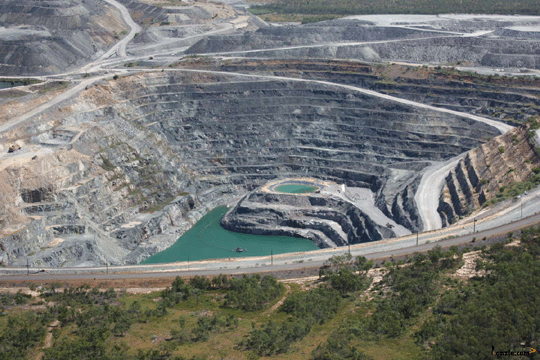
Northern Land Council, 5 June 2018 The Northern Land Council and Gundjeihmi Aboriginal Corporation welcome today’s public release of the Ranger Mine Closure Plan by Energy Resources of Australia. The plan is decades overdue and critical to the company meeting the objectives of rehabilitation.
The NLC and GAC, representing the Mirarr Traditional Aboriginal Owners of the mine site, will now review the plan and engage with stakeholders as part of the approval process. While not part of a public environmental impact statement process, the public release of the plan does provide the broader community with an opportunity to comment on the plan to the Australian government.
The Mine Closure Plan is of a very high level and even though Ranger’s closure is imminent, a significant amount of detailed planning and supporting studies remain outstanding. ERA and its parent company Rio Tinto must clearly demonstrate that they have sufficient resources devoted to mine closure to provide stakeholders with confidence that the objectives outlined in the closure plan can be met.
The Ranger plan remains unenforceable until it is approved by the federal Minister for Resources. The mine’s operational life must cease by January 2021, ahead of five years’ rehabilitation. The future of Aboriginal communities downstream of the mine and the World Heritage listed values of Australia’s largest national park are at stake.
ERA and Rio Tinto’s rehabilitation obligations include remediation of the site such that it can be incorporated in the surrounding Kakadu National Park. The final determination as to whether the area can be incorporated into the World Heritage area sits with the UNESCO World Heritage Committee, on advice from its expert advisory bodies the International Union for Conservation of Nature (IUCN) and International Council on Monuments and Sites (ICOMOS).
NLC contact: Martha Tattersall 0427 031 382 GAC contact: Kirsten Blair 0412 853 641
Ranger mine closure and rehab to cost $1bn
The $1 billion plan for the closure and rehabilitation of Australia’s oldest operating uranium mine has been released by Energy Resources of Australia… (subscribers only)
http://www.ntnews.com.au/business/ranger-mine-closure-and-rehabilitation-to-cost-1-billion/news-story/f86aa022ca5c700cf3264c7fe8d3abdd
Conservation Council South Australia: No adequate case has been made for the establishment of a National Radioactive Waste Management Facility.

In the case of the site nomination of Wallerberdina Station, the pastoral lease is held by an absentee landlord. It is of deep concern that this person can receive financial gain for the siting of a radioactive waste facility which will impact the local community that he is not part of.
To date, there is no definition of the boundaries of “community”, what proportion of a community must support the proposal to be regarded as “broad” or how it will be gauged.
It is a fundamental flaw of the guidelines and the process that these critical parameters have not been defined. They should have been clear before Phase 1 began.
Justification The current proposal for which site selection is already underway has not been justified. No adequate case has been made for the establishment of a National Radioactive Waste Management Facility. The failure of the proponent to consider and review other management options means that justification of the proposal and the site selection process cannot be proven.
It is of deep concern that a site selection process has commenced prior to an investigation of the need for a site.
Conservation SA believes that there is a strong case for extended interim storage at ANSTO’s Lucas Heights reactor, particularly for the intermediate level waste created and already stored there.
The three sites currently under consideration are all in South Australia. South Australia has legislation11 that explicitly bans the establishment of radioactive waste management facilities. There is a lack of clarity and disclosure about how this legislation will be considered in the site selection process.
The nomination process is still open. No nominations should be accepted until the report from this Senate Inquiry has been released so as to minimise any negative impacts on communities and ensure the best possible management of Australia’s most hazardous waste
Conservation SA Craig Wilkins Chief Executive RE: Submission to Senate Inquiry into the selection process for a National Radioactive Waste Management Facility in South Australia (Submission No 55. Contains excellent references)
Conservation SA is an independent, non-profit and strictly non-party political organisation representing around 60 of South Australia’s environment and conservation organisations and their 90,000 members. Conservation SA is grateful for the opportunity to provide comment to the Senate Inquiry into the selection process for a national radioactive waste management facility in South Australia.
We welcome the inquiry into “The appropriateness and thoroughness of the site selection process for a national radioactive waste management facility at Kimba and Hawker in South Australia, noting the Government has stated that it will not impose such a facility on an unwilling community”. Each of the Terms of Reference are addressed in turn below. Continue reading
Nuclear Waste Dump Site Selection: Leszek Gaweda points out the Conflict of Interest, and other negative factors
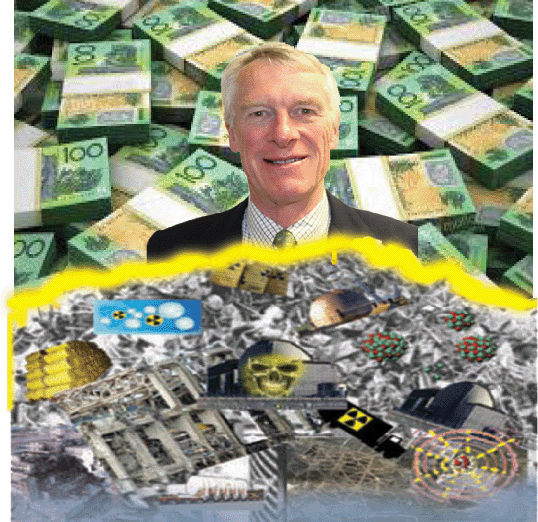
Leszek Gaweda Submission to Senate Inquiry on Selection process for a national radioactive waste management facility in South Australia (Submission No 54)
I am opposed to the current process on the following grounds:
1. Site Selection: Site nominated by ex Liberal politician Mr Grant Chapman. His nomination should never have been accepted on the grounds of conflict of interest.
Mr Chapman was a strong supporter of storing nuclear waste in Australia during his time as a senator, chairing a Senate committee into the subject and recommending a single national facility, a clear conflict of interest.
Best practice in the world for storage nuclear waste is to store it as close as possible to the production site (Lucas Heights in this case) not thousands of kilometres away.
- Broad Community Support:Communities involved: Transport to the site about 2000km, it’s not just the immediate area that would be effected. In case of accident a large part of the country could become uninhabitable. People from the towns, communities along the route should be consulted.Does the community understand that majority of the waste to be stored there is intermediate to high level? Example Lucas Heights reactor and vitrified nuclear waste brought back from France is intermediate and high level waste as classified in France. This requires isolation from the biosphere for hundreds of thousands of years.
Majority of Low level is only dangerous for hours to days (max few weeks) and doesn’t require a specialised facility.
- Aboriginal Communities‘It’s like getting news of a death’ Adnyamathanha woman Regina McKenzie said the local Indigenous community has been shattered by the announcement.Why haven’t the local Aboriginal community been consulted prior to the announcement? These people lived on these lands for 50,000 years in harmony with the environment and they deserve better.
The nuclear strategists know that Maralinga wounded the Aboriginal people. It is still an open sore and just like vultures, they are still picking on the wounded. Politicians should be protecting the disadvantaged and instead they are supporting and encouraging this assault.
Adnyamathanha Native Title Representative Body (NTRB) known as ATLA.’
They go on to oppose nuclear activities on several counts, including the advisability of renewable energy development instead, and roundly condemn the waste dump proposal:
‘The push for a waste dump in SA keeps coming up repeatedly; we didn’t want it then and we don’t want it now…….Pressuring poverty stricken and isolated communities is unethical, and the public of SA have faced this issue several times in the last decade or more. Enough is enough.’ No means No
4. Water
Much of the region relies heavely upon aquifers to supply settlements, stations, fauna and top up dams.
Polluted water means no business, no food production, no communities just a toxic wasteland to be passed to the future generations.
5. Floods
This region is prone to heavy flooding. Nuclear waste should never be located where flooding occurs. Containment leaks can’t be guaranteed.
On the 14th of February 1955 a huge flood flowed down the Hookina creek only a stone throw away from the proposed Wallerberdina site and washed away a bridge. In the images below you can see the large concrete bridge pylons laying on their sides. The weight of these would be at least 80 tons.
Hookina Spring
“Australia’s first registered Adnya¬mathanha storyline runs 70km from Hawker to Hookina Spring through pastoral and indigenous lands between Lake Torrens and South Australia’s picturesque northern Flinders Ranges, where it is emerging as a battleline ¬between anti-nuclear activists and the federal government ”
She said the Adnyamathanha didn’t want the risk of contamination of groundwaters that fed mound springs on the floodplain where Ms McKenzie brought groups to camp, drink from the spring, and hunt and cook kangaroo in trad¬itional ground ovens and share stories. “We want to share the culture so we can promote this region to the world,’’ she said. “Nobody takes the Aboriginal belief systems seriously — it’s our belief system. I just wish that non-Aboriginal people will look and see the richness in our culture.’’ (Source: The Australian May 23, 2016)
Hopkins Spring is only a stone throw away from the proposed site
- Seismic ActivityFlinders Ranges is the oldest mountain range in the world, the area selected is not seismically stable. In fact it is probably the most seismic area in the whole of Australia 7.7.Food production – Kimba
About 4% of Australia’s land is suitable for agriculture and Kimba is in the 4%, this land must be given highest protection as our future food supply is paramount. If a nuclear waste dump was to be located in Kimba, its reputation as a clean and green supplier of food would be adversely effected.
The perception that SA would be a nuclear waste dump would surely effect our clean and green image and price our agricultural products would attract.
8.Summary
Many locals don’t want industries such as tourism and farming threatened. Many traditional owners do not want cultural heritage sites and their spiritual connection to country put at risk.
South Australians do not want their state turned into nuclear dump.
This issue continues to cause deep division and stress in the affected communities where friends even families are divided and turn against each other.
SA parliament passed the Nuclear Waste Facility Prohibition Act 2000. The object of this Act are “to protect the health, safety and welfare of the people of South Australia and to protect the environment in which they live by prohibiting the establishment of certain nuclear waste storage facilities in this state.
It’s a real travesty of justice that such a proposal is being seriously considered in our beautiful tourist mecca Flinders Ranges and food bowl of our state Kimba.
A cry from a brave indigenous heart
Heather Mckenzie Stuart Fight To Stop Nuclear Waste Dump In Flinders Ranges SA, 4 June 18 Hmm, Regina McKenzie Vivianne C McKenzie I feel that our intelligence has been insulted by DIIS especially how we have been disrespected and ignored in our stand against the proposed nuclear waste dump Barndioota on Adnyamathanha yarta.
Honestly people, we might be Aboriginal and are still part of the flora and fauna and not in the Australian Constitution, but we have a mind of our own and can go between the non Aboriginal world and our culture.
We started our campaign against the dump talking to media etc, attending protest marches, visiting politicians. Vivianne and Regina went to Melbourne to see the then minister Frydenburg. Regina and my grand daughter went to Canberra campaigning with others. Regina’s daughter attended functions in Sydney.
I dropped out attending functions interstate, due to the loss of my only son. The grief of a loss of a child, no matter how old is horrendous, I wouldn’t wish it on anyone, but at the time, the DIIS lot didn’t care about me my feelings, my hurt, my sorrow as a human being, a mother who was in mourning, they still persisted liaisoning with my family organisation and visited family homes in Port Augusta causing unrest among our once close family. During this time, culturally at different times, I should have had my loved ones around me, but due to the unrest among everyone that those lot caused, me and my family were left on our own. Everyones world was turned upside down as we had already lost a dear family member 4 months before my son’s passing, we were already grieving for a nephew.
I love all my family no matter what, but I with my sisters and my family will trudge on against what we believe in and that’s standing up and say NO to a nuclear waste dump on Adnyamathanha yarta. We will never forget the hurt that has been caused through this dump by DIIS dividing and conquering. We have had enough of our family been destroyed bad enough our mum was stolen from her family. #WeWillKeepSayingNoToNuclearWaste#EnoughIsEnough #WeWillNeverGiveUp https://www.facebook.com/groups/344452605899556/

MNEMOSYNE GILES’ powerful submission exposes the deceit in the National Radioactive Waste Management Facility plan
 MNEMOSYNE GILES (citizen of South Australia) to Senate Inquiry on Selection process for a national radioactive waste management facility in South Australia (Submission 51)
I submit that the process of selecting a site for a NRWMF has been fundamentally flawed by the fact that it has not been properly or publicly debated whether a NRWM F is an appropriate response to the problem of Australia,s radioactive waste. It is therefore premature to be selecting a site. The inappropriate campaigns of ANSTO and ARPANSA to find a site as soon as possible,(within one year it is suggested) , are part of the misguided nature of their task
I therefore recommend that this Senate Inquiry lead on to a full independent Judicial inquiry into Australia,s radioactive nuclear waste and whether we should keep producing it. I recommend a moratorium on uranium mining should be held while a decision on what to do with the waste is made.
World wide there is no solution to the long lived ILW (Intermediate Level Waste), and this must be acknowledged and emphasised at all levels of discussion and public consultation. Instead of this the NRWMF site selection process has given the illusion that a National site would be a “safe”solution allowing the industry to continue.
- CORRUPTION The Act 2012 that allows nominated private land to become nuclear radioactive dump sites, allowing State prohibition laws to be over-ridden, needs to be examined in connection with the possible corrupt volunteering of land, ………. I recommend an independent inquiry into how and why the National Dump process was initiated,and what interests,(including defence,may have been involved).
An inquiry should ask :why is nuclear radioactive waste at present not better secured at sites such as Woomera where it currently is held? :how”safe” is any storage of ILW? :would one National site be “safer” than more smaller sites,considering that a National site provides a more definite military target and involves the hazards of transport.
2) COLLUSION It needs to be explained how it came to be that the two campaigns for an International dump in S.A. And a National dump were run in parallel during the year of the NFCRC (Nuclear Fuel Cycle Royal Commission).
I submit that there was communication and co-operation between State and Federal Govts.or other bodies to keep the two separate. The effect of the concurrent campaigns was to confuse the public : if it was designed to confuse , it succeeded :after the S.A. “Citizen,sJury” rejection of the International dump, most South Australians believed the threat of a “Dump” for S.A. was over.
Now many South , Australians believe that this proposed National dump must be quite different, a smaller proposal,necessary for low level medical waste only. I perceive because I have talked to hundreds of people, handing out information leaflets to passers by on the streets of Adelaide, over the last two years. I submit that the separating of the National and International dump proposals has been and is a deceitful strategy. Well known and influential Richard Yeeles submitted to the NFCRC that a National dump was a good strategy to lead eventually to an International dump. So this strategy is well known to government and industry leaders. But the distinct possibility of a National dump leading to an International dump is never admitted to the public, (especially not to people at Kimba or the Flinders Ranges). This is collusion at a high level to deceive the public. If it is the blind leading the blind it is not good enough when so much is at stake.
3) DECEIT
I also submit that the presentation of medical waste as the main purpose of a National dump is deceitful. Other submissions I am sure will give details of the small proportion of waste which is medical, and the fact that nuclear reactors are not necessary for producing isotopes for medical treatment Nuclear contamination has caused innumerable cancers and will continue to do so. People in contaminated districts can not forget this, but further away people wonder where their cancer comes from.
4) CONFUSION OVER LEVELS OF WASTE In the early stages of the ARPANSA National dump campaign people were led to believe that it was for LLW only. Even politicians seemed to need to have it explained repeatedly that ILW was to be “co-located”.An inquiry should look at bringing Australian definitions of HLW and ILW into conformity with international definitions.
5) BROAD COMMUNITY SUPPORT
Why is the definition of this only now being questioned? For an honest straight forward process it should have been defined at the outset. Leaving it vague has caused uncertainty, confusion, and ultimately angst and division in previously harmonious districts..Whoever decided that small remote townships should be targeted to become willing hosts for the most toxic waste ever produced, and to make a decision which would affect all of us and future generations for thousands of years? South Australian land and people have already suffered contempt and abuse from nuclear /military actions and we will not accept disenfranchisement now. Both State and Federal Govts. (lab and Lib), ape the Finnish with a mantra of “not imposing” on any unwilling community. But this is disingenuous. Finland is a nuclear nation reliant upon nuclear power, so a small local community can have some sense that it is acting in the public interest in hosting a dump. Most Australians do not want Australia to be further implicated in the nuclear fuel cycle:this is probably why we are not being asked about this dump, or given the relevant information. This is not democracy. Finland also has very different geology, with plenty of water and has an absolute veto on the transport of nuclear material across its borders (which we do not have).
This is not a local issue but a National and a State one.
6) FINANCIAL BENEFITS
Small communities are easier targets for bribery and this has been shameless, and benefit to the local community is the most often cited reason for local acceptance. Public money has also been used to fund paid staff to have a constant pro- dump presence in town,and a “local project office” in Kimba. This use of funds means that the pro-dump people in town are supported and can be seen as pillars of the community, positive in attitude, while those against lack funds and support except from volunteers. The current ICAN tour of remote nuclear sites and the target dump sites of Kimba and the Flinders Ranges , is in response to this isolation. ARPANSA has not and does not intend to appear in Adelaide to explain what they are presenting to Kimba and the Flinders communities. I recommend that they should complete an inventory of what is intended before people can be expected to consider the proposal
7) INSUFFICIENT INFORMATION
This is the most serious defect of the ARPANSA campaign. Target communities of Kimba and the Flinders Ranges are being asked to make a decision on a project that is not described or defined. Attached is an appendix of questions asked of ARPANSA . After a year most of these questions are still not answered satisfactorily .They are basic questions about the waste and the need for an
8) PERCEPTION OF “SAFETY”
All the local people who accept the dump proposal think that it is “safe”,although they do not know what it actually would or could be.(none of us do , it is an open ended process it seems). This is a result of ARPANSAs campaign to create a “perception “of “safety”, an example of which was their hosting of a French pro-nuclear delegation from the Aube. The mayor and others told locals at Kimba and the Flinders ranges how they felt comfortable living and producing near a nuclear waste store, and how tourists flocked to see it. No mention was made of France,s terrible problem with ist waste. When asked about the tritium that leaked(irreversibly) into the water system it was explained that this was only because the facility originally did not have a roof. So contamination and accidents belong to the past, and are not expected in the thousands of years of future storage.
9) MANIPULATION
“In its pursuit of a “willing community”within a year, ARPANSA is manufacturing consent in the same way as the S.A. NFCRC tried to do with its accompanying Road Show”, and the Citizens Jury. The techniques are quite usual nowdays but I submit they are inappropriate for major decision making. They include: -No genuine public meetings ie. No independent chair -Casual style consultation instead, with individuals usually addressed in ones or twos – -low attendance at ARPANSA consultations is normal, similar to roadshow”attendances -questions from the floor usually relegated to private discussion after the meeting.
In conclusion I submit that the site selection process shows pro-nuclear bias and avoids democratic scrutiny. Therefore an inquiry by the Senate into the process should not only condemn the process,but ask for a judicial inquiry into its inception and the basic assumptions it makes about Australia,s further nuclear involvement
. Mnemosyne Giles 2/4/2018
APPENDIX:
Further questions to ANSTO, ARPANSA & the DEPARTMENT OF INDUSTRY, INNOVATION and SCIENCE (DIIS) from ENuFF (Everybody for a Nuclear Free Future SA) Continue reading
Sydney’s Opal nuclear reactor’s High Level Wastes off to France, later to return to planned Federal Nuclear waste Dump
Guarded nuclear shipment to secretly depart Sydney SBS News, 1 June 18 Any day now a decade’s worth of heavily guarded nuclear cargo will be secretly transported through Sydney’s  streets and sent to France for reprocessing. ….. Any day now a decade’s worth of spent nuclear fuel assemblies weighing 24 tonnes will be moved out of Sydney’s Lucas Heights facility in a highly sensitive transport mission months in the making.
 specific timing of the operation remain classified with the Australian Nuclear Science and Technology Organisation (ANSTO) only disclosing it will happen mid-year.
An ANSTO spokesman has assured the public of the operation’s safety, saying the radioactive materials will be enclosed in specially-designed transport casks reinforced with lead and made to withstand almost anything, including a jet fighter crash.
“There is no credible chance of any accident or incident that could result in the cask being compromised,” an ANSTO spokesman said.
It will be the 10th transport mission of spent nuclear fuel assemblies, with the last shipment sent to the United States in 2009.
The spent fuel has come from Australia’s multi-purpose OPAL reactor…..The reprocessing project will cost $45 million, including the contract with France, equipment, staff and other costs.
Once the uranium and plutonium are extracted, they will be recycled into overseas civil power and research programs, with the remaining materials vitrified into a safer form for waste storage and sent back to Australia…..
The spent fuel assemblies, which would have been considered high-level waste, become transformed into an intermediate level waste, Hef Griffiths, ANSTO’s Chief Nuclear Officer told AAP.
But the question of where it will be stored remains.
The waste from this year’s transport mission will be returned from France in many years’ time and sent to the yet-to-be-built National Radioactive Waste Management Facility where it will be kept in storage for several decades.
Eventually, the waste will need to be moved again to a permanent disposal facility. https://www.sbs.com.au/news/guarded-nuclear-shipment-to-secretly-depart-sydney
Leanne Lienert not necessarily opposed to nuclear waste dump, but very critical of the process

There are far too many discrepancies in the information, consultation process and long term impacts to have such a facility based at Kimba (or Hawker).
the consultation process has been an insult to the intelligence of rural people.
Leanne Lienert Submission to Senate, re National Radioactive Waste Management  Facility in South Australia Submission (Submission No. 50) I wish to offer my thoughts to the process currently occurring within two regional areas of South Australia with an emphasis on the Kimba area. From the outset I wish to say that I am not opposed entirely to such a facility being built within South Australia – but I am extremely concerned about the process of consultation, the logisitics and location of such a site and the long term effects on vibrant farming/rural communities.
Financial Compensation interestingly the offer of substantial money to individuals to offer up their land plus the supposed ongoing dollars is the driving force locally for the facility to be placed at Kimba. Kimba farming district, as all farms across the world, are being farmed by fewer people as technology and modern machinery changes farming practices. It also often means that individual farmers are buying up more and more land for their own needs as smaller farmers can’t compete. Interestingly those buying up land are also the ones now edging to gain financially from this current waste facility proposal. I read one article where a farmer who has offered his farm considers it will drought proof the Kimba District to have the $2 million dollars – This amount of money divided between those affected by a drought would be chicken feed where the costs each year to produce a crop is significant. This community is not poor – it is creative and community minded with little unemployment. Nowadays many young people gain a trade to supplement the farms where they live and work – and as happens across the world others gravitate to the cities
While this money is a huge enticement, logically, the big picture cost of transporting radioactive waste from all over Australia to a small rural community doesn’t seem to be discussed in the consultation! If this waste is as safe as promised why is there a need to move it such long distances when it could presumably be located closer to the source with smaller facilities within each state or shared states?
“Broad community support” –how has it played out currently and will continue into the future I spent my childhood up until early adult years in this vibrant rural community where community participation, comradery, innovation and support has always been paramount. I still have a brother and his family on the farm plus my mother. I specifically know people who have been affected on both sides by this whole process and it is beyond me with the ongoing extent of the consultation that this disconnection and destruction of the community fabric has not been the deciding factor in saying this location is inappropriate on so many levels – socially, emotionally and mentally. It is sad that locally and politically at a Federal level that the lure of money (greed) has risen to hold such a high position in exchange for a totally altered community ethos!
This process has divided the community to such an extent that (people I know well)
- – sporting teams have been affected because people will not play with those of differing opinion.
- – people have moved out of Kimba because they no longer feel comfortable in long term friendship groups who are now split by differing opinions
- – people do not patronise business who are known to have opposite views to each other e.g. supermarkets, coffee shop, cafe – a distrust of information given to support the facility
- – queries that there is too much wider information that has not been disclosed or has been misleading e.g. the locations were deliberately local farm names or Hundred names to disguise it not being at Kimba – such as Pinkawillinie, enticements to visit Lucas Heights in an attempt to ‘prove’ and market how safe it is while choosing to locate it so far away in a rural community, and also emotionally tagging people who are against it insinuating that they will have xrays or nuclear medicine treatments and are therefore hypocrites to not support it.
- – voting for the facility only included those in the Kimba District
- – interestingly a farmer who borders a proposed property and who is opposed to the waste facility idea is in the next council area and he didn’t get a say – I consider this an injustice. Even to the extent that he was told that it wasn’t ‘adjacent’ because it was across the other side of a dirt road – I wonder if the same person on a city block would think this was fair if a facility was built on a vacant block over the road from them!!
- – A person I know very well owns a sheep stud – he has chosen not to disclose his own opinion of the facility for a real fear that those with an opposite view will not by rams from his stud.
- – The need to remain neutral has caused some tensions between a son and mother (who is opposed to the facility) for fear he will be linked publicly to her views and it will reflect on his business and therefore affect those who patronise him.
- – The notion that many jobs will be created also doesn’t ring true
- – with a world of fly-in, fly-out employment it doesn’t seem logical that many jobs would be permanently located at Kimba. – I have heard locals say it will attract tourists!!
- – what would they see? How big will this facility actually be?
- – What is the impact to transport this type of waste such long distances through populated areas all across Australia to some tiny area on Eyre Peninsular?
- – again if it is so safe why haven’t areas much closer to the source of radioactive waste been considered? It doesn’t seem to make logical sense?
Broad Community Support
- – what does this mean? Initially it was promised that any opposition to such a facility would mean it wouldn’t go ahead. The goal posts changed dramatically in a short space of time so that a vote with a slim majority of 2-3% meant the second round of consultation went ahead and if this continues it’s possible that as few as 300 people will make the decision for all of South Australia to have such a facility here. Is it a fair process if there is not a majority of at least 70:30 to allow this facility to go ahead especially in a decision that has an ongoing impact for many generations to come in terms of governance, changing definitions of “medium’ levels of waste, possible mishaps etc. Community Benefits Program
- – If community benefits programs were to eventuate I am wondering how this would happen constructively in a community divided by the process – will the damage created continue to foster antagonism in gaining support for initiatives?
- – Who would manage the money within the community and how would allocation of funds be decided? Would it be at a local level or would it become a political football?
- – How would such a small community have a voice in changing political processes into the future?
- – Would ‘medium level’ waste alter as the years go on? How would this be guaranteed and trusted?
Eyre Peninsular and state wide considerations
– The wider implications of a radioactive waste facility being located within a vibrant grain growing area and its impact on a clean and green agricultural area cannot be dismissed.
This issue is not just for this productive region but all of the Eyre Peninsular and South Australia as a whole therefore the consultation needs to be widened and include both the region and the state in any final considerations. – I feel that the whole economic impact area needs some dialogue and debate because once this process begins it cannot be reversed. – In a country where the greatest population and food growing areas are positioned relatively close to the coast it doesn’t seem logical to locate such a facility in an area known for its quality and quantity of agricultural produce – there is a massive land mass that could be utilised instead of impacting on a small vibrant farming district.
Other related matters
I wonder why (and would like to see the reasons ‘why not’) places such as Leigh Creek (already exposed areas that could be covered within the open cut mine areas to the degree needed), Roxby Downs (already radioactive, with large areas that could house such a facility with easy access via rail or road), Woomera (where the government already utilises vast areas of land and with ready access) or even the Defence Force land at El Alamein near Port Augusta (where the area extends all the way to Iron Knob) – because once again it is promoted as being extremely safe.
In conclusion, after following the progress of the consultation in the Kimba district over the last two years, I feel that there are far too many discrepancies in the information, consultation process and long term impacts to have such a facility based at Kimba (or Hawker).
I also feel that the consultation process has been an insult to the intelligence of rural people. That it was considered (especially in the earlier parts of the consultation), this was one small, insignificant community who could be bluffed/lured into such a facility with money and would really have no idea about radioactive waste and probably wouldn’t care!
If South Australia decides to take on the responsibility of a radioactive waste facility then I hope that this enquiry can honour the true spirit that makes a rural community flourish and not set up processes that will continue to drive wedges between its people in the name of money. Please find a place that does not interrupt genuine people who lives are entwined with the land – whether that be our Aboriginal people, farmers or country towns.
No clear meaning of “broad community support” – the fatal flaw in Australian government’s push to impose a nuclear waste dump
 Brian Cant Elected member District Council of Kimba, Submission RE: SITE SELECTION PROCESS FOR A NATIONAL RADIOCTIVE WASTE MANAGEMENT FACILITY IN SOUTH AUSTRALIA (Submission no. 49)
(b) How the need for ‘broad community support” has played and will continue to play a part
in the process
The definition of “broad community Support” has consistently been one of the most significant points of contention since the NRWMF project was announced, not just in Kimba, but from every corner of Australia.
One constant throughout the process has been criticism from both sides about a lack of clarity from the Department about how ”broad community support” would be defined, and subsequently measured, during the consultation process.
As a result, this uncertainty has exacerbated community angst on what was already an
emotive subject. It is possible that the community stress could have been either minimised or
avoided altogether had the Department identified defining “broad community support” as a
project priority from the outset.
Adnyamathanha Traditional Land Association again confronts Resources Minister Matt Canavan on nuclear waste dumping
AdnyamathanhaTraditional Land Association (ATLA) RNTBC Email ceo@atla.com.au ICN 3734 ABN 14 146 238 567 PO Box 4014 Port Augusta 5700 Ph 0429900222 29/5/2018
 To. Minister Canavan PO Box 6100 Senate Parliament House Canberra ACT 2600
per email senator.canavan@aph.gov.au Minister Canavan [Minister.Canavan@industry.gov.au]
Dear Minister
I again write to you with regards to your departments treatment of ATLA.
I have already stated on numerous occasions, ATLA is the prescribed body corporate in terms ofour Native Title and we are an Aboriginal Regional Authority with the State Government and recognised as the peak organisation with regards to any heritage issues in our area. We are the representative body for Adnyamathanha people.
However, your department continues to use divide and conquer tactics with regards to the nuclear waste dump in our land.
We raised very grave concerns in relation to the Heritage Assessment and we had no choice but to pull out of this very early in the process. We have no faith in the process or the assessment and we will not accept any findings from this flawed non-inclusive process.
You visited our land recently and didn’t even contact ATLA.
It is not true that Bruce Wilson tried to contact me, I have had no communication with him in relation to your visit. The first I knew about you being here was when I was told you were meeting with individual Adnyamathanha people at Mamma Lou’s café in Port Augusta, that is only about 500 metres from my office in Port Augusta! You then added to the insult by entering our land with no contact with us.
I call on you as Minister to tell the truth and remove these lies from your website.
ATLA is a vital part of this whole process we are the Traditional Owners and we say NO!
Now you are going to hold some sort of vote for the people who live very close to Wallerberdina, however, this is Adnyamathanha land and ALL Adnyamathanha people must get the chance to vote.
I demand you include all Adnyamathanha people who are on the electoral roll in this vote!
This process has been flawed from the start, you continue to ignore our concerns and opposition to this dump and the very least you can do is include us in the vote. I believe there are at least 1500 Adnyamathanha people eligible to vote.
This is our land, ATLA is the peak body, show us respect as the Traditional Owners.
Please take action on this matter with some urgency and include Adnyamathanha people in the vote.
Yours sincerely
Vince Coulthard, CEO
Submission: NO RADIOACTIVE WASTE ON AGRICULTURAL LAND IN KIMBA OR SOUTH AUSTRALIA.
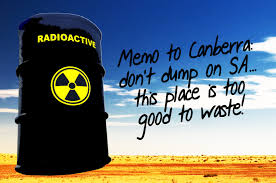 NO RADIOACTIVE WASTE ON AGRICULTURAL LAND IN KIMBA OR SA.SUBMISSION TO THE SENATE INQUIRY INTO THE SELECTION PROCESS FOR A NATIONAL RADIOACTIVE WASTE MANAGEMENT FACILITY IN SOUTH AUSTRALIA.“To campaign against any nuclear radioactive waste management facility in South Australia’s agricultural land and in particular the District Council of Kimba” Toni Scott Secretary No Radioactive Waste on Agricultural Land in Kimba or SA (Submission No. 46)
The No Radioactive Waste on Agricultural Land in Kimba or SA is a group of local residents, farmers and business owners opposed to building a Radioactive Waste Facility on prime farming land in Kimba. Our 240 financial members consist mainly of people from Kimba and the broader Eyre Peninsula.
We would like to thank the Senators that have given their time to investigate this process. Through our experiences with the process we conclude that the site selection process for the siting of a national radioactive waste dump is flawed, we have taken the time to outline some of our concerns and ask that you would consider our recommendations.
- The definition of Broad Community Support has been inconsistent throughout the process. We recommend that the Minister sets a % for broad community support.
- 2. We are strongly opposed to the siting of a Radioactive Waste Facility on Agricultural Land.
- 3. The process is divisive and lacks honesty, fairness and transparency.
Members of the No Radioactive Waste on Agricultural Land in Kimba or SA invite further consultation with your inquiry and would be happy to provide more information through a hearing.
ATTACHMENTS:
1.National Radioactive Waste Management Facility (NRWMF)
Phase 1 Summary Report April 2016
- National Radioactive Waste Management Facility Project Summary of engagement in the Kimba community December 2016 www.radioactivewaste.gov.au
- Declaration of Results. Distric Council of Kimba. National Radioctive Waste Management Project Ballot
- National Radioactive Waste Management Facility Phase 1 Summary Report. Kimba 2017
- Attachment A. Objectives and Criteria
- Code of Practice for the near surface disposal of radioactive waste in Australia (1992). Radiation health series No 35
- Low – Intermediate Level Radioactive Waste Facility Process Timeline NRWMF in Kimba
These attachments can be downloaded with this Submission No. 46 at https://www.aph.gov.au/Parliamentary_Business/Committees/Senate/Economics/Wastemanagementfacility/Submissions
Federal Government National Nuclear Waste Dump Selection Process – a B-grade horror movie plot.

Image courtesy Kim Mavromatis
Kim Mavromatis No Nuclear Waste Dump Anywhere in South Australia, 28 May 18 The Federal Government National Nuclear Waste Dump Selection Process for South Australia is like a B-grade horror movie plot.
Australian Federal Liberal Government’s Land Selection Criteria for a National Radioactive Nuclear Waste Dump proposed for South Australia :
· Nothing scientific about the land selection process – anyone can nominate their land, including Pro-Nuclear Ex-Federal Liberal politicians – and get paid 4 times what it’s worth.
· Doesn’t matter where the land is located.
· Don’t worry about your neighbours – their land will appreciate in value with a toxic radioactive Nuclear Waste Dump next-door.
· The majority of Aboriginal people, who say NO to a Nuclear Waste Dump, will be given the same amount of respect they received during British Nuclear testing at Maralinga and Emu Fields.
· Doesn’t matter if the region is a national icon and major tourism attraction.
· Don’t worry about seismic activity or if the area is prone to flooding.
· Doesn’t matter if the land nominated is in an important grain-growing region.
· Doesn’t matter that building a Nuclear Waste Dump facility in South Australia is against the law.
· You can trust politicians to keep their word – once in place the Nuclear Waste Dump won’t get changed from an Intermediate to High-Level Nuclear Waste Dump.
· Special Note : the new South Australian Premier Steven Marshall and the state Liberals said No to a Nuclear Waste Dump before the election.
· Most of the state won’t have a say in the Clayton’s consultation process – community support will only be solicited within a 50km radius of the Nuclear Waste Dump – and 2 million carrots will help bribe the locals.
· Don’t worry about Nuclear Waste accidents – there won’t be any and they won’t be catastrophic. It’s not irresponsible to ship nuclear waste half way across the country through populated Australian cities and towns, on busy public roads and highways, on ships and trains – no safety concerns – livelihoods won’t be lost – property values dive – who pays the insurance? – nothing to see here, move along.
· The Nuclear Waste Dump will be in operation for 100 years and monitored for 200-300 years, but don’t worry that Intermediate-Level Nuclear Waste can remain highly radioactive for 100,000 years and can be as hazardous as High-Level Nuclear Waste.
· Don’t worry that the temporary canisters holding the Nuclear Waste above ground are temporary because nothing is permanent.
· In 60 years, the nuclear industry hasn’t found a solution for Nuclear Waste, but she’ll be right mate, they’ll find a solution in the next 60 years.
· The Nuclear Waste Dumps proposed for South Australia are located near Kimba (Eyre Peninsula grain-growing region), 75kms from the Spencer Gulf coastline – and in the Flinders Ranges near Hawker (national icon and major tourism attraction), 29kms from Lake Torrens and 84kms north of Port Augusta.
Q&A
Q: Once in place how easy is it for politicians to change an Intermediate-Level Nuclear Waste Dump into a High-Level Nuclear Waste Dump?
A: Very easy.
Q: How long does it take High-Level Nuclear Waste to become harmless?
A: It never becomes harmless.
Q: Compare High-level Nuclear Waste (spent nuclear fuel) Radioactivity to Uranium ore?
A: After 30 years, High-Level Nuclear Waste is 10,000x more radioactive than uranium ore – after 140 yrs, 1,000x more radioactive – after 2,000 yrs, 100x more radioactive – after 43,000 yrs, 10x more radioactive – after 10 million yrs, same radioactivity as uranium ore (NWMO Nuclear Waste Management Org, Canada). https://www.facebook.com/groups/1314655315214929/
South Australia’s No Dump Alliance sends a powerful submission opposing Federal nuclear waste dump plan for Flinders Ranges
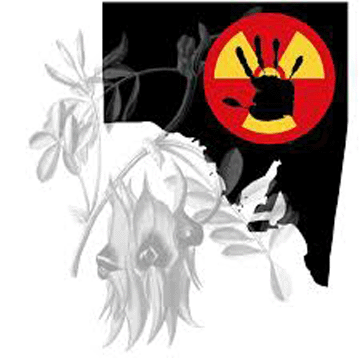
The project has been framed by the government since its inception as a project where only local communities will be consulted.
Such an approach is untenable as this is a federal government initiative to develop a purpose built facility for the disposal and storage of Australia’s radioactive waste. This is a national issue that demands national attention and assessment. While it may be politically expedient, it is neither credible nor responsible for the federal government to treat this issue as a local government or community matter.
“The Adnyamathanha Traditional Lands Association remains totally opposed to the nuclear waste dump at Wallerberdina”
There is a strong risk that the waste could become stranded and forgotten about should future governments fail to find the finances or political will to dispose of the waste deep underground.
the residents who are in favour of the proposal have not been given full, complete and unbiased information to inform their decision.
No Dump Alliance submission into the appropriateness and thoroughness of the site selection process for a national radioactive waste storage facility Introduction .” Vince Coulthard, CEO of the Adnyamathanha Traditional Lands Association. (Submission No. 45)
The No Dump Alliance is a broad cross-section of South Australian civil society, including Indigenous, public health, trade union, faith and environment groups, academics and concerned individuals that formed in response to proposals to open South Australia up to international high-level nuclear waste importation and dumping. The Alliance also opposes the federal government’s continued push to establish a national nuclear waste dump and store in regional SA.
The No Dump Alliance supports local communities to voice their concerns, welcomes state government legislation that prohibits a nuclear waste dump in SA, and calls for a better process for the management of Australia’s nuclear waste. The No Dump Alliance welcomes this inquiry and the opportunity to contribute this submission. The Alliance also encourages the Committee to hold hearings in the regional areas of Hawker and Kimba to hear firsthand from the communities on the front line. The Alliance also welcomes hearings in Canberra to consider the views of national and state stakeholders and groups. This is a national project and is of national concern.
Spokespeople for the Alliance include Vivianne McKenzie from the Flinders Ranges and Peter Woolford, No Radioactive Waste Dump on Agricultural Land in Kimba or SA President and Jamie Newlyn from the MUA SA Branch.
The radioactive waste to be disposed and stored is both “low level” and “long lived intermediate level”. The latter must be managed safely for many thousands of years and current best practice to realise this is by deep geological disposal.
No Dump Alliance members have been closely involved with the current federal waste plan and process and concluded that the site selection process for a national radioactive waste storage facility at Kimba and Hawker in South Australia is flawed and neither appropriate nor thorough. We maintain that the current project should be discontinued.
The following specifically addresses the terms of reference.
- a)the financial compensation offered to applicants for the acquisition of land under the Nominations of Land Guidelines;
We believe that inviting private landowners to nominate their land for financial gain far in excess of the land value is a non- scientific way to determine a location for a national radioactive waste facility. We also believe that a single party nomination model cannot be credible considered to represent a ‘volunteer’ process.
- b) how the need for ‘broad community support’ has played and will continue to play a part in the process, including:
- i) The definition of ‘broad community support’
Since May 2015 the federal government and its DIIS representatives have consistently refused to define “broad community consent” in both public meetings and in writing. Members of our organisation have been told different definitions but none have been able to be confirmed in writing.
The figure 65% has been mentioned and we believe this figure was determined by the result in the flawed Orima telephone survey which purported to survey whether residents of the Flinders Ranges council district wished to proceed to Phase 2 of the site selection process.
A postal vote of Kimba council residents resulted in a 56.5% positive result to proceed to Phase 2, which is well short of the 65% previously mentioned. We reject the claim that this is broad community support, rather it is a sign of a much-divided community.
- ii) How ‘broad community support’ has been or will be determined for each process advancement stage. The figure 65% has been mentioned and we believe this figure was determined by the result in the flawed Orima telephone survey which purported to survey whether residents of the Flinders Ranges council district wished to proceed to Phase 2 of the site selection process. A postal vote of Kimba council residents resulted in a 56.5% positive result to proceed to Phase 2, which is well short of the 65% previously mentioned. We reject the claim that this is broad community support, rather it is a sign of a much-divided community. ii) How ‘broad community support’ has been or will be determined for each process advancement stage.
The NRWMF Community Sentiment Survey purported to survey whether residents of the Flinders Ranges council district (Hawker, Quorn and Cradock) wished to proceed to Phase 2 of the site selection process.
This telephone survey was incomplete and inadequate because it did not survey the entire population of the area and was biased because it only surveyed residents with landline telephones. The flawed survey only asked residents if they wanted to proceed to the evaluation of the site and not actually build a facility. Flinders Ranges council residents have not had an opportunity for a complete postal vote conducted by the AEC.
The Adnyamathanha people are the Traditional Owners of the Barndioota site and their representative body the Adnyamathanha Traditional Lands Association (ATLA) has repeatedly expressed clear opposition. The No Dump Alliance believes that it is critical that the views and position of the overwhelming majority of Traditional Owners are listened to and respected in relation to the appropriateness of a site.
A postal vote was held for the Kimba council region and resulted in a 56.6% positive result to proceed to Stage 2. This survey did not include the views of the Traditional Owners from the area who must be consulted and should have been consulted at the initial nomination.
We believe that both survey results were influenced strongly by the offer of $2 million to be spent in the community, and that this was an intentional and deliberate inducement to sway the community opinion towards a positive result.
Despite seeking clarification, we have not been able to ascertain what the procedure and process will be to evaluate whether there is broad community consent should the government wish the project to proceed from Phase 3 to construction.
- c) how any need for Indigenous support has played and will continue to play a part in the process, including how Indigenous support has been or will be determined for each process advancement stage;
The federal government has stated that no individual group will have a right of veto. The Citizen’s Jury into the former Weatherill state government’s international radioactive waste facility proposal found overwhelming support for the right of veto for Aboriginal people. Former Premier Weatherill wrote to Prime Minister Malcolm Turnbull on 24 October 2017 outlining concerns about a national nuclear waste dump and store plan and recommending that local Aboriginal people should have the right of veto over any dump being built on their lands. The relevant quote from Mr Weatherill’s letter is as follows:
“I recently met with Traditional Owners of the Adnyamathanha community who expressed deep concern about the proposed site at Hawker, and the potential impacts on Adnyamathanha Cultural Heritage”…….” This engagement process was insightful and highlighted the need for a bigger conversation about how Aboriginal people want to be seen, valued and recognised and on ‘unfinished businesses from the past. In particular, Aboriginal people’s history with the nuclear industry demonstrates a need for significant healing. In recognition, the South Australian government committed to provide a local Aboriginal community with a final right of veto over any future facility proposed on their lands. I recommend that the Commonwealth Government now consider adopting a similar policy position as part of the National Radioactive Waste Management Facility process.”
In the NRWMF community sentiments survey by Orima Research released in April 2016 it shows on page 60 of the report that 97% of Indigenous people opposed the facility at Barndioota.
The Orima report did not table any views of Indigenous people in relation to support for the project to continue.
The Adnyamathanha Traditional Lands Association (ATLA), composed of 23 different organisations and interest groups released a statement in May 2016 opposing a nuclear waste facility.
Recently on March 24, 2018 the ATLA board reaffirmed opposition with the passing of this resolution:
“The Adnyamathanha Traditional Lands Association remains totally opposed to the nuclear waste dump at Wallerberdina
This is our land, our culture and we must have veto over this toxic waste being dumped in our country. Udnyus come and go but we will be here forever. We say NO to the waste dump, for our grandchildren and their grandchildren and many generations to come.”
In the 2016/2017 ATLA annual report stated: “The National Waste Dump continues to be an issue and ATLA remains totally opposed to the waste dump at Wallerberdina. ATLA has been treated very poorly in this whole process and it has been a real struggle to ensure our voice is heard.”
The No Dump Alliance understands that ATLA was not approached or engaged until the NRWMF project was into stage 2.
Surveys are not assessing the views of Adnyamathanha people who live outside the region; with a significant part of the community living in Port Augusta and Adelaide.
- d) whether and/or how the Government’s ‘community benefit program’ payments affect broad community and Indigenous community sentiment;
We believe that the government has linked the project to the promises of jobs and community grants as an inducement to deliberately influence community consent. We believe this is intentional and deliberate, and designed to sway the community into returning a positive result towards the project.
There have been many discussions and assertions by local residents that they have decided to be in favour of the facility by the mere fact that the government says it will bring jobs and money. This is despite scant detail being provided by the project proponent about the employment and economic impacts of the planned facility.
- e) whether wider (Eyre Peninsular or state-wide) community views should be taken into consideration and, if so, how this is occurring or should be occurring; and
The project has been framed by the government since its inception as a project where only local communities will be consulted.
Such an approach is untenable as this is a federal government initiative to develop a purpose built facility for the disposal and storage of Australia’s radioactive waste. This is a national issue that demands national attention and assessment. While it may be politically expedient, it is neither credible nor responsible for the federal government to treat this issue as a local government or community matter.
The community to be consulted for the Barndioota facility was originally designated at a 50km radius around the dump, which was then extended to include Quorn and the whole Flinders Ranges council.
The community to be consulted for the Kimba facility was designated as residents of the Kimba council on the electoral roll.
The construction of a facility could have a significant impact on the reputation of either community, with a detrimental impact on the tourism and farming industries upon which the communities depend.
- f) any other related matters.
The radioactive waste facility is intended to dispose and store both “low-level” and “longlived intermediate level” radioactive waste.
The facility is intended as an “interim” location for the “long-lived intermediate level” radioactive waste, as world’s best practice currently views deep geological disposal as the preferred management option. The waste would be stored above ground, as the current government does not have a site or a process to determine a site to build its final deep geological burial facility. There is a strong risk that the waste could become stranded and forgotten about should future governments fail to find the finances or political will to dispose of the waste deep underground.
Our members and colleagues have attended many of the federal government’s presentations and have found them biased and flawed towards focus on the “low-level” waste, and with no attention given to the extremely long-term risks involved in the storage of “long-lived intermediate level” radioactive waste.
The presentations have also failed to acknowledge any terrorism risks of creation of a “dirty bomb” from the “intermediate” waste.
We therefore believe that the residents who are in favour of the proposal have not been given full, complete and unbiased information to inform their decision.
A decision this serious to accept the so-called “interim” storage of “long-lived intermediate level” radioactive waste that has implications for the future security of South Australia and should not be solely or primarily made by the small community of people who currently reside in the districts of the Flinders Ranges and Kimba councils. Such an approach also deeply disenfranchises communities along the extensive transport corridors any such facility would require.
Conclusion
The members of the No Dump Alliance maintain that the site selection process for a national radioactive waste storage facility at Kimba and Hawker in South Australia is flawed, and neither appropriate nor thorough. We share the view held by many civil society groups that the current project should be halted whilst a thorough national audit of radioactive waste is conducted with an independently assessed review of the range of options available to best manage Australia’s waste. Our members and spokespeople continue to witness and seek to highlight the high level of stress and pressure this plan is causing in the communities of Hawker and Kimba. In December 2017 the No Dump Alliance supported a ‘Don’t Dump on SA’ rally on the steps of Parliament House in Adelaide. Invited speakers made the following statements about support for the National Radioactive Waste Management Project:
“I was the member of parliament that tried to get the last dump on the road at Woomera. The Kimba experience has taught me a very great amount. Quite frankly, the government and ANSTO cannot be trusted with this job. They cannot be trusted with the management of nuclear waste.” Barry Wakelin, former federal Liberal politician. “
Last year we voted as the Uniting Church in SA to stand in solidarity with the Adnyamathanha people in opposing the placing of a nuclear waste dump on their land. We are here today renewing our commitment to that solidarity and to join with you as fellow South Australians in this resolve.” Dr Deidre Palmer, former moderator Uniting Church (SA)
“The Flinders Ranges is not the right place for any nuclear waste facility. The purported benefits of this dump, if realised, will equal only 1% of jobs in tourism and just 2% of one year of tourism income for the Flinders Ranges and outback. Any drop-in tourism will wipe out any possible economic benefit. Everyone, including the government and ANSTO (Australian Nuclear Science and Technology Organisation), agree that the Flinders is not suitable for long term disposal of intermediate level waste, but that is where it will be stored until another site is proposed, accepted and built. This may take decades or centuries and may never happen. We are creating a toxic legacy for our children and grandchildren. Safeguards and legislation put in place today will be brushed aside when it’s convenient for future governments. This can never be the right place to bring intermediate level waste.” Dr Susi Andersson, Hawker resident and local GP. “
We stand with Traditional Owners of this land, we stand with the farmers of this land”. Jamie Newlyn, Secretary of the Maritime Union of Australia SA Branch and No Dump Alliance spokesperson.
“The Flinders Ranges is an iconic area, people come from all over the world to visit. I’m saddened to hear that the government wants to spoil this beautiful, pristine area with a devastating piece of junk. We certainly understand that there has to be somewhere they can store it, but you don’t take a pristine area and destroy that. We ask that the state government stand with the Adnyamathanha community to stop this waste dump
Toni Scott asks: will the government hound the Kimba and Hawker communities until they support nuclear waste dumping?
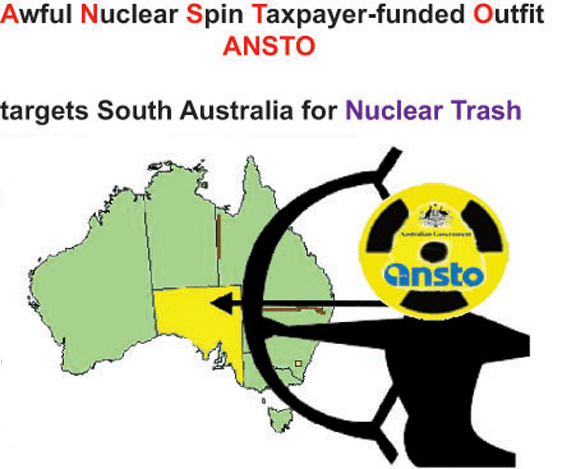
How many times can the Government come back to a community and hound them until they gain broad community support?
I recommend that for something as signiWficant as building a permanent facility hosting hazardous waste it is imperative to have broad community support of no less than 70% absolute majority (meaning 70% of those eligible to vote)
Toni Scott SUBMISSION TO SENATE INQUIRY INTO THE SELECTION PROCESS FOR A NATIONAL RADIOACTIVE WASTE MANAGEMENT FACILITY IN SOUTH AUSTRALIA. (Submission No. 44, with 4 attachments) Thank you for the opportunity to present my views to the senate inquiry into the process for a national radioactive waste management facility at Kimba and Hawker in SA.
I am an active resident of the Kimba Community and am involved with many community organisations within the town. I own and operate a farming business with my husband, we have 3 small children and I also work part time in Administration at the local Hospital.
Over the past 2 years my husband and I have been involved with this process as direct neighbours of the first round of nominations at Kimba. We have found the process inconsistencies extremely frustrating and stressful.
I ask that you please take my views and recommendations into consideration and I would be happy to be called as a witness to provide further information in the form of a hearing.
- a) The financial compensation offered to applicants for the acquision of land under the Nominations of Land Guidelines;
All financial incentives been offered to individuals should be made available through public information including monies received through access agreements.
It is my view that communities should nominate to host the facility not individual land owners. This process could include local council coordinated public consultation including information from both sides of the argument prior to nominating, if there is broad community support from a town then the nomination is submitted instead of the other way around.
- b) How the need for ‘broad community support’ has played and will continue to play a part in the process, including:
- i) The definition of broad community support and
- ii) How broad community support has been or will be determined for each process advancement stage
The definition of broad community support is very vague. The Minister has refused to set a% of support required for the process to progress through the stages. I have submitted a freedom of information request asking for communication between the Department and Minister Canavan outlining information on how they intend to define broad community support. My FOI request was rejected and I am currently waiting for a case manager to follow up for me through the Australian Information Commission.
Phase 1 Summary Report 2016 ii – The independent Orima Survey indicated 51% of the Kimba Community was not opposed. 582 submissions were received and 80% of them were opposed.
– Summary of Engagement in the Kimba Community December 2016iii – This engagement was prior to the second round of nominations in Kimba. The Working for Futures group indicated to the department that there had been a large increase in support. Results showed there was in fact only a slight shift, of the 300 members that spoke to the Department 56% were supportive of a new nomination.
– Phase 1 Summary Report 2017iv – The Department received 112 written submissions from Kimba residents with 86% opposed. A total of 396 letters were received in relation to the Kimba nominations but for those from outside of the Kimba council boundary results were not reported on. This included letters from people only 20kms out of Kimba who fall outside the council boundary or land holders with property only 10km from nominated site but they fall outside of the council boundary.
AEC Results v– 56% voted yes to go through to stage 2 of the process this % is of those that voted (it is actually only 50% of eligible voters)
How many times can the Government come back to a community and hound them until they gain broad community support?
I recommend that for something as significant as building a permanent facility hosting hazardous waste it is imperative to have broad community support of no less than 70% absolute majority (meaning 70% of those eligible to vote)
- d) Whether and/or how the Governments community benefit program payment affect broad community and Indigenous community sentiment;
The $2 million dollar community benefit fund can only be seen as a bribe for people to vote to go through to the next stage. The Department representatives have encouraged people to dream about what the money could do for the community. Many of the projects they have suggested including improved phone and internet service and better health facilities are all things that our town like all other Australian Communities should be entitled to anyway.
- e) Whether wider (Eyre Peninsula or state-wide) community views should be taken into consideration and, if so how this is occurring or should be occurring;
I believe the views of those living close to the facility are ultimately affected the most and therefor their opinion is of the highest importance closely followed by people living or owning property in the community of where the land is nominated. I don’t believe the boundary should be measured by a council boundary it should be set by a radius and should be prioritised in the following order
– Neighbours within the 10km radius views should be of the highest ranking
– Residents & land holders within 50km of the property should all have the opportunity to vote.
– Residents of the Eyre Peninsula and communities along potential freight routes should be consulted and their submissions taken into consideration.
– South Australians should have the opportunity to have their say on the State Legislation prohibiting the building of any Radioactive Waste Facilities within our state.
- f) Any other related matters.
Community members find it very difficult to trust the process when time and time again issues of unfairness arise, I have many other concerns including but not limited to:
– In the National Waste Management Act 2012 it states $10 million will be credited to the host state or territory to be spent on health, education and infrastructure.
It should be the communities money not the state and the Community should decide if, when and how it is spent.
– Throughout this second consultation neighbours from the 10km radius have been disregarded and only those with an immediate fence line have been considered neighbours. This is inconsistent with our first round of consultation and with the consultation at Hawker.
– The Kimba Consultative Committee (which I am a delegate on) was supposed to consist of an even spread of people who are opposed, neutral and supportive of the facility. Unfortunately of the 15 committee reps only 4 people are opposed.
– The Community Liaison Officer was supposed to be a person with neutral views but to no surprise the Department employed a local who has been openly supportive of the facility. Community members who are opposed find it difficult to speak openly with the Liaison officer about their concerns.
– For a process to be considered truly transparent information such as nominated sites, nominator financial payments and information regarding processes around broad community support need to be made readily available to the public.
I strongly believe prior to a final community vote as to whether a facility is to be sited in a community, members of the community NEED to be given all the information in writing including:
- What percentage of support will be required for broad community support.
- Exactly what waste will be stored at the facility.
- What will the facility look like.
- What are the jobs that will be required to run the facility and exactly how many are there.
- How much money will the community receive and how will it be distributed.
i FOI Internal Review Letter
ii Phase 1 Summary Report 2016
iii Summary of Engagement in the Kimba Community December 2016
iv Phase 1 Summary Report 2017
v AEC report
Selection process for a national radioactive waste management facility in South Australia
Environmental Defenders Office shows up flaws in Department of Industry, Science and Innovation’s report on nuclear waste siting
 With all of the proposed sites there was strong opposition to moving onto phase 2 of the process. The two preferred sites chosen, both in South Australia, also had strong opposition, but the strong opposition was slightly less that the other three sites. Slightly less opposition cannot amount to ‘broad community support’.
Barndioota site:
The Phase 1 summary report also states that 65% of those surveyed were in support of progressing to stage 2. From our assessment of the raw data, this figure is incorrect. The data shows a figure of 51% of those surveyed being opposed to progressing to stage 2.3 Additionally, there was almost unanimous indigenous opposition to this site.
The Kimba site does not meet the Government’s criteria as having ‘broad community support’ and needs to be abandoned as a potential national radioactive waste facility
All Australians should have the right to have a say on this issue. Furthermore communities along any transport routes need to be informed of the risks and consulted in relation to the proposed sites before any site is chosen. This is an essential part of ascertaining support for the project .
Environmental Defenders Office. Melissa Ballantyne Coordinator/Solicitor Environmental Defenders Office (SA) Inc. Submission to the Senate Committee Inquiring into Site Selection for the National Nuclear Waste Facility (Submission No. 43)
The Environmental Defenders Office (SA) Inc (“the EDO”) is an independent community legal centre with over twenty-five years of experience specialising in environmental and planning law. EDO functions include legal advice and representation, law reform and policy work and community legal education. The EDO appreciates the opportunity to provide a submission to this Inquiry, which is seeking comment on a number of Terms of Reference.
The EDO submission relates to the following terms of reference: “The Government has stated that it will not impose such a facility on an unwilling community, with particular reference to:
.b) how the need for ‘broad community support’ has played and will continue to play a part in the process, including:
- The definition of ‘broad community support’ and ii) how ‘broad community support’ has been or will be determined for each process advancement stage …………..e) whether wider (Eyre Peninsular or state-wide) community views should be taken into consideration and, if so, how this is occurring or should be occurring; …….” 1. Broad community support
1 This month

of the week – Australians for War Powers Reform (AWPR)
To see nuclear-related stories in greater depth and intensity
 Antinuclear