Time for South Australians, ALL Australians, to rally against nuclear waste dumping in beautiful Flinders Ranges
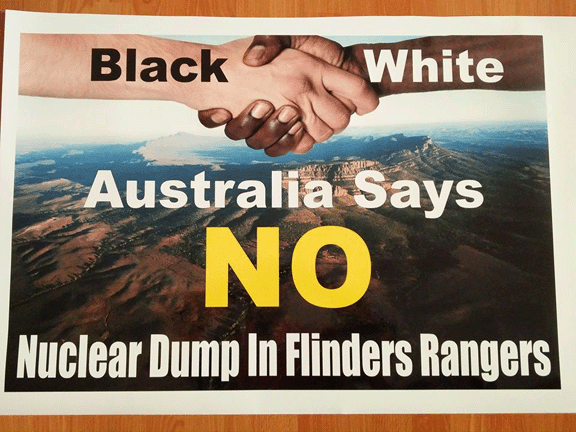
Anti-nuclear protesters increase fight against radioactive dump being established in SA
The Advertiser Erin Jones, Regional Reporter, Sunday Mail (SA) May 5, 2018
http://www.adelaidenow.com.au/news/south-australia/antinuclear-protesters-increase-fight-against-radioactive-dump-being-established-in-sa/news-story/55f7c369b17f03c747c1de824428b4df
ANTI-NUCLEAR campaigners will increase their fight to stop South Australia from becoming the nation’s radioactive waste ground, ahead of a final vote by the community.
Hundreds of postcards will be sent to Federal Resources Minister Matt Canavan demanding cultural heritage sites, agricultural land and the environment be protected from nuclear waste.
The Federal Government is expected to decide in the coming months whether to build a low-level and intermediate-level waste facility at Kimba or Barndioota, in the Flinders Ranges.
The two-year site selection process has divided both communities, those in favour believed it would create economic opportunities, while those opposed said it would jeopardise industries.
Conservation SA nuclear waste campaigner Mara Bonacci said the government needed to be more transparent about the facility ahead of an August 20 community ballot.
“There is division in both communities, whether it’s people who are pro-nuclear waste or anti-nuclear, they both want what’s best for the community,” Ms Bonacci said.
“But the pro-waste people are saying it will create lots of jobs, but we haven’t got any clarity around the numbers or if they’re full-time.
“We also want to know what number the Minister wants in a community vote to show ‘broad community support’ for the facility.”
Before the government decides on the successful site, residents from both communities will be given a final chance to accept or reject the proposal.
The ballot will be held less than a week after findings of a Senate Inquiry into the site-selection process are to be released, on August 14.
Mr Canavan told the Sunday Mail the government would provide more detailed information on the project’s design, job creation, cost, community benefits and safety, ahead of the ballot.
He said a nuclear waste facility would not be imposed on an unwilling community and it would need “broad community support” – although no arbitrary figure was provided.
“As we have always said, a range of factors will be used to determine broad community support, including the results of a public ballot, public and private submissions, and feedback from stakeholders during community discussions, including neighbours, councils and local groups,” Mr Canavan said. “The consultation process is engaging people on all sides of the discussion, and all views – supportive, neutral and opposed – are taken into account.”
The ballot will include residents of the Flinders Ranges Council and within a 50km radius of the Barnidoota site, and the Kimba District Council.
Disrespect by ANSTO toting NSW Aboriginal man across Australia to promote nuclear waste dumping
 Vivianne C McKenzie Shame on ANSTO and DIIS bringing yura to speak about waste dump in Wallerbidina. Who gave welcome to yartah? Did the Adnyamathana peoples give permission for them to have meeting on yartah?
Heather Mckenzie Stuart Disrespectable man shame on him!
Roni Skipworth So this guy from Darwahl tribe in NSW didnt ask permission to come on to your Ancestors Lands. That seems very disrespectful as having good Indigenous friends they used to explain to me the Indigenous Law was ‘Didnt matter where one wanted to travel in other parts of Australia,they needed to go the that destination’s Elders to ask permission to enter into their Lands’. Like those from Adnyamathanha Country who wanted to travel to Lucas Heights would out of respect go to the Elders of the Darwahl Tribe to ask permission to step onto their land. I feel that Indigenous Laws once very strong amongst Australia’s Indigenous are being lost in today’s world. Also I feel that is why some Indigenous Children run amuck as they are lost and living in a White Society under the White Laws have lost their way .
No Nuclear Waste Dump Anywhere in South Australia, 6 May 2018 https://www.facebook.com/groups/1314655315214929/
Adnyamathanha tribal elder, Ken McKenzie, rejects pressure to agree to nuclear waste dumping at Wallerberdina
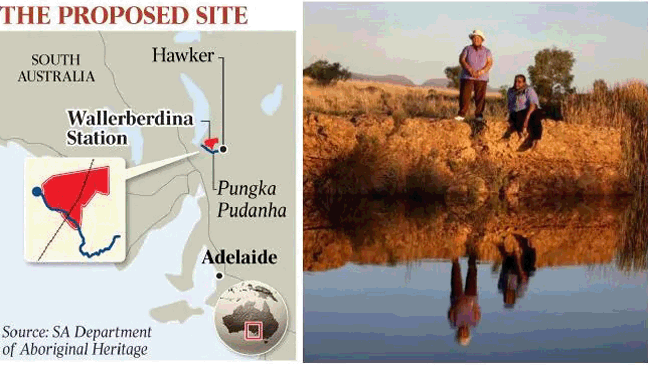 Enice Marsh, left, and Regina McKenzie at Yappala in the northern Flinders
I love Australia and I love the Flinders Ranges .
Even in my own room at Flinders House, at 2 o’clock in the morning, I have received phone calls telling me I’d better change my mind or else face tribal retribution. Because of my traditional ties to this land, these phone calls frightened me terribly. I am not a violent person. I’ve also had phone calls through the day saying huge benefits ie house, property could come my way if I was to say yes and encourage my people to also say yes to the dump.
Through all of this process over the last two years the government finally, in January of this year, 2018, employed a company who did a site cultural survey on Wallerberdina Station. This group of people desecrated one of our women’s traditional sites. Once again the terrible anguish that is being put on the people to see what has happened, is something that I never dreamed would be happening to my family and friends both black and white.
Local indigenous not impressed! ANSTO brought an indigenous nuclear spruiker from New South Wales to Flinders Ranges
 Heather Mckenzie Stuart Fight To Stop Nuclear Waste Dump In Flinders Ranges SA, 5 May Why is ANSTO and DIIS bringing a yaninjanha yura from Darwahl tribe in NSW to Hawker in the Flinders Ranges, making trouble saying urdnus are the only ones protesting against the proposed nuclear waste dump at Barndioota and are using yuras?
We go to protests and we will keep going to protests we will stand against the vartani. Anyway who gives that man the right to come here and talk in Adnyamathanha country, Wilyaru mirus and Adnyamathanha artuyani yarta. This is our ancestors lands, he has no shame we wouldnt go and talk in his yarta about his country. Dont come here pushing a nuclear waste dump on us, keep the poison in your country. You ANSTO and DIIS keep that yura in his country and let him dribble his rubbish over there in NSW. Hands off our sacred sites and stay in your yarta!! Ps his cultural consultancy means nothing to us, he want to stay at Lucas Heights.
Australia’s “Nuclear Archbishop” Dr Adi Paterson, graced Kimba with a visit
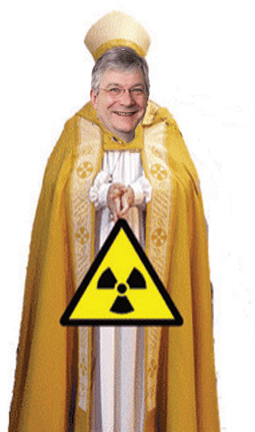
Dr Paterson visited Kimba on Friday with Carmelo Pesce, the mayor of the Sutherland Shire, which is home to the Lucas Heights reactor. According to the Eyre Tribune, the nuclear guru promised “45 jobs [that] will vary from full-time work, to shift work and on-call.
Dr Paterson said the announcement to the Kimba Economic Working Group and Consultative Committee and other members of the community received a positive reaction. ……..
If the proposed facility does go ahead in Kimba, Dr Paterson said it would receive a number of ongoing visits.
“There would be ongoing visits from independent regulators, visiting scientist and general visitors like tourists and school groups.”
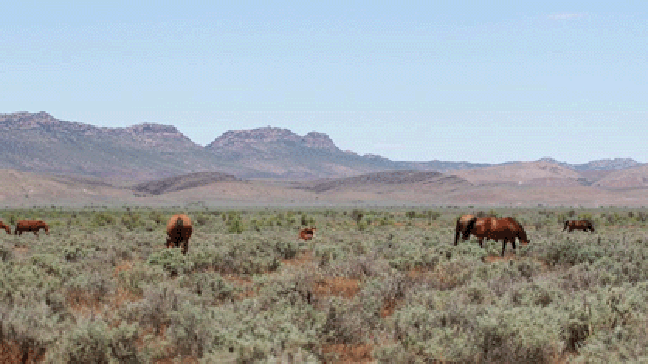
Pastoralist Donald Fels finds that Barndioota, South Australia, is a totally unsuitable site for a nuclear waste dump
I feel we are scapegoats for the eastern seaboard. There is 450 hectares at Lucas Heights and only 60 hectares at present. It has been said that only an area the size of three Olympic swimming pools are required so there is room at Lucas Heights for many years to come – why shift it now.
Mr Donald Fels Submission to inquiry regarding the proposed nuclear waste repository at Barndioota, Submission 76 to Senate Inquiry on Selection process for a national radioactive waste management facility in South Australia
I am a 65 year old 4th generation pastoralist, owner of Merna Mora Station, which has been in the family for 130 years, and is located approximately 19 kms from the proposed facility. I also own Wintabatinyana Station located 10 – 15 kms northwest of the facility site.
As well as running stock we have a tourist development at Merna Mora which commenced 50 years ago. From this clean, green belt we have been selling steers to the Japanese market for 24 years via AMH and JBS Swift as marbled shorthorn beef now part of Thousand Guineas Beef as well. We have very good quality merino wool and sheep meat which is sought after. We recently sold wethers to Turkey and as such must meet strict marketing codes. It has been important to keep our options
open as margins are very small in the meat and wool game. We definitely do not need the stigma of nuclear waste for our products or indeed in terms of our equity if we are ever to sell.
We are in the driest state in the driest continent in the world so water is another great concern and needs very little to upset the ecosystem. My grandchildren are 6th generation here and wish to continue here but none of the family want a waste facility near us.
The land here is very seismically unstable, the ground is very porous and the water table very close to the surface within 1 -2 km radius is less than a metre down.
The process of selection was not done properly. Many people were not surveyed. A lot of younger people who only have mobile phones were not surveyed. We were not surveyed and there are 4 families of us. We were advised why bother we were against it anyway. When consultants are employed to do surveys the right questions are asked to get the outcome needed.
Five very talented long term geologists working in an immediate area advised that it is not the right area in which to construct as the ground is too unstable, porous and prone to flooding. In a one in a hundred year flood it could result in a major catastrophe. Temporary Intermediate storage could
result in a longer term than this.
As for the job creation very few would eventuate as most construction would be by a major firm such as Downer or John Holland. They would bring in their preferred sub- contractors and place in a mobile camp. Tours would be unlikely to persist and really don’t see this as continuing.
The landlord is absentee, never likely to live here. Neighbours and community were not consulted prior to the land being offered. Land is perpetual lease country which is out of district council areas.
In outback areas, perpetual lease is exempted from native title but not native heritage.
I feel we are scapegoats for the eastern seaboard. There is 450 hectares at Lucas Heights and only 60 hectares at present. It has been said that only an area the size of three Olympic swimming pools are required so there is room at Lucas Heights for many years to come – why shift it now.
I feel strongly against this proposal to build this facility – please take these points into your consideration in the selection process. The consultation process has caused a deep rift in our once close knit community with many friendships now very distanced. All some see is the money but there is so much more to this. No monies should go to individual businesses only to community projects but there is already a bad precedence right from the first round. Several individuals received funds and now it is expanding to whole of the Flinders Ranges Council area 70 – 80 kms away.
I have been disappointed with the lack of continuity by ANSTO and do not feel that the consultation process has been fair and equitable.
Nuclear waste dump site decision an all-Australia matter , says Independent and Peaceful Australia Network South Australia
 Stephen Darley – Co-ordinator, Independent and Peaceful Australia Network IPAN (SA) SUBMISSION ON PROPOSED NUCLEAR WASTE MANAGEMENT FACILITIES IN South Australia We wish to respond to your Terms of Reference in relation to the appropriateness and thoroughness of the site selection process for a national radioactive waste management facility at Kimba and Hawke in South Australia, noting that the Government has stated that it will not impose such a facility on an unwilling community.
Our first response is to query whether your committee has given cognisance of the results of the recent Royal Commission into the Nuclear Fuel Cycle held in Adelaide in 2015, where the Citizens Jury (representing citizens selected at random and given comprehensive, expert information), overwhelming voted that they wanted NO part of the nuclear cycle developed here. This included nuclear waste management facilities.
The SA government agreed to abide by this decision. Consequently we would like to know under what legislation the Commonwealth can now override this decision and welcome your response to this query.
We make the following comments in response to your terms of reference :
a) The financial compensation offered to applicants for the acquisition of land under the Nominations of Land Guidelines:
This is a vexed issue as we would prefer that this proposal does not proceed, but should it do so, we believe that an independent panel should recommend the appropriate compensation where required and no land should be compulsorily acquired without the full consent of the owner and the surrounding community agreeing to any facility placement in their vicinity.
b) How the need for “broad community support” has played and will continue to play a part in the process, including:
i)The definition of ‘broad community support’ and
It is imperative that the broadest possible support be obtained before proceeding further as this is a national project that could affect other States where waste material is transported from. Transport, whether by sea, rail or road, will be a major hurdle for the proposed project as many communities have actively campaigned against waste material being trucked or shipped through their community (ie the sustained Port Adelaide and South Australians opposition to earlier proposed nuclear waste facilities). Not only is safe transport a major concern, but also the water table being contaminated if a spill occurs or the facility is not secured safely underground. We have no details of the type of facility proposed but all proposed waste management facilities, even low and intermediate level nuclear waste are recommended to be stored in very stable rock at considerable distance underground. How can people make a decision when they have no details of the actual storage being proposed ? To ask people to consent to transport and storage of toxic waste (which could conceivably increase to high level nuclear waste at some future date) is disingenuous.
Citizens must have all the proposed site facts put before them so that they can make a well informed decision on how this could/would impact on their State and/or community.
We recommend that both local, state and nationwide support be sought with all the above pertinent facts on the proposed structure, transport and guarantee, including exactly what level nuclear waste would be housed, with a firm guarantee that this would not be increased over time. A response level of 90% YES vote would be appropriate to ensure this proposal does have wide, genuine support – perhaps a postal vote would be the way forward. This process should also be carried out by an independent body.
- How broad community support has been or will be determined for each process advancement stage. Our response is incorporated in the above recommendation.
c) How any need for Indigenous support has played and will continue to play a part in the process including how indigenous support has been or will be determined for each process advancement stage;
We believe it is paramount that the Australian government fully outline and commit to whatever level of nuclear waste material would ever be stored at these sites. There is talk of intermediate level waste (and perhaps even high level). These levels require very stringent and specific storage sites which we doubt are available at the areas selected ie stored in stable geological rock for thousands of years with no possibility of leaching into any water table – mindful that the Artesian Basin is close by which stores most of Australia’s underground water. Your proposal needs to cover all the levels of waste and how they will be stored in full compliance with international standards.
It is paramount that indigenous peoples, especially around the proposed sites, should be in agreement first, before proceeding to canvass wider state and national support. Our local knowledge and experience, doubts that this will occur as we are mindful of the sustained and successful campaigns opposing any nuclear waste facilities in South Australia in the past, especially the Kunga Juta Aboriginal Women’s successful campaign to stop nuclear waste facilities on their land in the 1990s. They remember the consequences of the Maralinga Tests which adversely affected many of their communities, so there is a strong resistance to any nuclear waste facilities. Their combined support for such a facility would need to be evident through signatures and spokespeople standing up publicly to support any proposal, before canvassing this idea further.
- Whether and how the Government’s community benefit program payments affect broad community and indigenous community sentiment;
We are not cognisant of the community benefits program but suggest that they should be disentangled from this issue, as any monetary or community program inducement would be seen as a bribe to ensure support for a nuclear waste facility. Indigenous people should be provided with all the community services they require, without tying them to this proposal.
e) Whether wider Eyre Peninsular or state-wide community view should be taken into consideration and, if so, how this is occurring or should be occurring,
As mentioned above it is imperative that such an important and long lasting project gets overall support from first the local indigenous people, then the local communities, South Australians and lastly Australians overall. All the salient facts need to be published and people invited to vote. This information should the fact that waste is currently being stored successfully on-site where it is subject to regular scrutiny. People would need to have all transport routes identified and a guarantee that this project will not escalate into high level waste from overseas being shipped and stored here.
The project should only proceed if it has an overall majority vote of 90% in favour as what is proposed, once begun can not easily be undone.
f) Any other related matters. As seen above there is a lot more information and project management work to be drawn up before this proposal should be taken any further. At the moment it seems in the “wish list” category but serious information and planning needs to occur before this proposal cam be taken further. The first matter to be solved being the right of the Australian government to override the SA legislation which opposes any nuclear waste facility here. We would appreciate your response on this matter.
Unanswered questions: what does ANSTO do with the high level nuclear waste canisters at Lucas Heights?
 Michael Skeet Kilowsky Fight To Stop Nuclear Waste Dump In Flinders Ranges SA
Gary See They’ve made an arbitrary date where waste has to leave Lucas Heights so they can argue for the first dump. The they’ll have intermediate level waste there that needs to move so that will be the argument for the next dump which will likely temporarily store high level waste so that makes the argument for the high level dump.
Once they have that they can go for new nuclear reactors and look at importing waste for money.
It’s just a low level waste dump though, they say
Now we are told the next shipment from England will be returned to Australia in 2020 -21 and shipped directly to the ‘new’ facility.
I agree, nuclear waste dumps are the trojan horse of the nuclear industry, pushing vunerable communities into believing it is for ‘the good of all’ with bribes and bullshit. A waste host town will just be that. A town that hosts deadly poison for hundreds and (probably) thousands of years. There’ll be no end to it.
Gary See There will be a proposal for an intermediate level facility and then a high level one after that.
At least that is the plan as far as I understand it.
https://www.facebook.com/groups/344452605899556/Two years of community resistance
Sunday 29th April 2018 marked two years since then Minister Frydenberg selected Barndioota in the Flinders Ranges as a possible site to dump and store Australia’s radioactive waste.
Members of the Flinders Local Action Group, No Dump Alliance and Don’t Dump on SA spent the weekend at the Adnyamathanha-run Wilpena Pound and in Hawker to raise awareness of the issue with locals and tourists alike.
Overseas visitors were surprised and horrified to learn about the federal government’s proposal to put a radioactive waste facility in the area and were happy to sign postcards being collected to send to Minister Matt Canavan to show their opposition to a nuclear waste dump in SA.
The cited employment and economic opportunities are modest: some short-term fencing and construction work and just 12 to 15 longer term security and maintenance jobs. In contrast, the South Australian Tourism Commission states that visitor expenditure in the Flinders Ranges is $415 million p.a. with 1,400 jobs directly in the tourism industry and 1,300 indirect jobs – a total employment impact of 2,700 people.
Current federal Minister Matt Canavan recently announced that an AEC community vote for a planned waste dump and store would begin on August 20th. This is despite the fact that there is currently a Senate Inquiry examining the flawed and divisive site selection process and exhibits no regard for recommendations which may arise from the inquiry that will not report to parliament until mid-August. The Minister has not clarified what constitutes ‘broad community support’ despite repeated community requests.
Minister Canavan recently visited the area but failed to consult with the Adnyamathanha people. In response, the Adnyamathanha Traditional Lands Association (ATLA) released a short video message to the Minister.
Regina McKenzie, Adnyamathanha woman who lives next door to the proposed site, said “it’s been two years of the government not listening, they turn deaf ears towards the whole Adnyamathanha Nation who say no to the waste dump. We say no waste dump in our country”.
Greg Bannon, chair of the Flinders Local Action Group, said “this fight has been going since the site was shortlisted. For two years, the government has had a continual presence in district. The process has dragged on, but the government needs to know that we are committed to stopping this proposal. They have using a site selection model that has been tried and failed for years: forcing a radioactive waste dump on a remote community.”
Leading civil society organisations including environment, public health, Indigenous, trade union and faith groups all support an expert, open and independent inquiry into the full range of radioactive waste management options.
Anica Niepraschk calls on the government to dismiss the Hawker and Kimba site nominations for nuclear dumping
I hereby call onto the Minister to dismiss the Hawker and Kimba site nominations and reconsider all options available, including co-hosting the radioactive waste management facility at an already existing nuclear site.
Submission : Anica Niepraschk Selection process for a national radioactive waste management facility in South Australia Submission 29 In this submission, I wish to point out the inappropriateness of the site selection process for a national radioactive waste management facility at Kimba and Hawker in South Australia.
In 2015, when the current voluntarist approach to the National Radioactive Waste Management Project (NRWMP) was in its early phase calling for land nominations to site Australia’s low and intermediate level radioactive waste management facility, I conducted a study on international best practices for such siting processes. Please thoroughly consider my research findings in the attached report. In my research, I found that a number of characteristics have internationally proven to be crucial for the success and integrity of a voluntarist approach. The NRWMP is lacking in most of these. Interestingly, in the cases I looked into, siting has only been successful in communities where a repository can be co-hosted with other nuclear facilities. These are communities with a nuclear history of some sort, such as hosting a nuclear reactor or intermediate storage facilities for radioactive waste.
Even when other communities had shown initial interest in hosting a radioactive waste facility, they ended their engagement in the siting process quite early on. This shows that it is much more likely for a repository to be hosted by a ‘nuclear community’, which partly roots in it already being familiar with the risks and benefits involved and thereby being much more comfortable to make an informed decision. An already existing positive relationship with the respective nuclear operator can furthermore contribute to a community showing interest.
Australia currently has a limited number of nuclear activities and stores its radioactive waste materials in numerous intermediate storage places, most of them very small. Only the site of the Australian Nuclear Science and Technology Organisation’s nuclear reactor and larger radioactive waste storage facility at Lucas Heights would reflect this experience. This is also where the majority of Australia’s radioactive waste is already stored. It would therefore provide the opportunity of simply improving on the current facilities and not having to transport the existing waste to a remote facility, thereby reducing risky and unnecessary transport of dangerous materials.
To be a truly voluntary process, community and public opinion has to be effectively taken into account by the respective decision making institutions and reflected in decisions. This means thatcommitments to not impose a repository on any community have to be observed. Showing respect towards informed decision-making necessitates providing local communities and the wider public with the necessary time and information. This is an essential factor to build trust towards the implementing agency.
Furthermore, a truly voluntary process acknowledges the role of the communities by engaging with them throughout the whole duration of the repository project. This should not be limited to the siting process but extend to the construction, operation and closure phases of the project. As the case of Belgium shows, communities can engage on issues such as the facility design and wider community implications e.g. facility monitoring and socio-economic projects. The early provision of information is essential, providing the community and wider public with the possibility to commission studies, reports and expert opinions. This encompasses an extensive assessment of environmental impacts and of alternative methods and siting options as major references to base a meaningful siting decision on for both the implementing agency and the community. These provisions enhance transparency and accountability and help build a more trusting relationship with the community. They raise the chance of a successful siting process as it is based on an informed decision and allows communities to feel more confident. Indigenous communities and Traditional Landowners play a central role in the siting process in some countries. Their consent and close engagement is critical in Australia where Traditional Owners are directly affected by the sites currently progressed. Furthermore, community engagement should also encompass neighbouring communities, which might be affected by the project.
A non-restrictive timeframe should be applied in siting processes, providing all stakeholders with sufficient time to make informed decisions. In the international case studies this has shown to require years. When the community feels comfortable to make a decision on the matter, a test of community support should be taken to establish its position. Similarly, the right-to-veto the government’s or operator’s siting decision should also provide the community with the final say on hosting a facility or not. In general, a community should be able to leave the siting process at any time if wished. As the UK example shows, this was one of the main factors communities wanted ensured when consulted on how to improve the siting process and has further proven to be a key feature of all the siting processes, making engagement really voluntary.
All the international examples enabled community engagement through providing funding to use according to their own needs to engage effectively on the issue. Additionally, some countries provide benefit packages for communities participating in the process and/or hosting the planned facility as a way to compensate for the efforts and risks associated and further drive local development, apart from the economic benefits already associated with the project such as employment, improved infrastructure and know-how. In case of any provisions in this respect, it is important that communication on funding or contributions is very clear from the beginning and that it does not compromise the position of the community on the issue and can be handled independently from nuclear operators or facility proponents.
In the case of Australia community engagement is completely carried out and funded by the National Radioactive Waste Management Project (NRWMP) and aimed at supporting the understanding of the project, instead of providing room for engaging on the issue. This transactional approach does not allow for the community to engage in ways it finds meaningful.
The main concern regarding the continuation of the site selection process, however, is the community opposition, which has been apparent for both the Barndioota site near Hawker as well as Kimba.
In the case of Barndioota, the local Adnyamathanha community at Yappala station, just kilometres away from the site, has been very vocal in its opposition to the siting from the beginning. With this site, the government chose, after pursuing Coober Pedy from 1998 to 2004 and Muckaty in the NT from 2005 to 2014, to not only once again target an Aboriginal community but also a culturally highly significant site. The proposed property is part of a songline and hosts many cultural sites, including the beautiful Hookina springs, a sacred women’s site for the Adnyamathanha. The local community remains actively connected to the maintenance and preservation of the land and is documenting and preserving their culture and history through recording traditional heritage sites and artefacts and mapping storylines in the area. The proposal is seen as an attack on their cultural beliefs, history and heritage.
The terms of reference of this inquiry clearly note the Government’s statement that it will not impose such a radioactive waste facility on an unwilling community. If the government is serious about its voluntary intentions and wants to be successful in the siting of the facility, it is paramount not to proceed with the shortlisted sites at Hawker and Kimba as they very clearly do not fulfill the essential criteria of community support. Attempts to ‘convince’ the local community of potential benefits of hosting the facility should be avoided under all circumstances, and the informed decision, which communities have taken, respected.
I hereby call onto the Minister to dismiss the Hawker and Kimba site nominations and reconsider all options available, including co-hosting the radioactive waste management facility at an already existing nuclear site. https://www.aph.gov.au/Parliamentary_Business/Committees/Senate/Economics/Wastemanagementfacility/Submissions
Australia’s radioactive trash, and the history of failed attempts to set up a nuclear waste dump
Submission Appendix Anna Niepraschk Wasting Time? International lessons for managing Australia’s radioactive waste, Anica Niepraschk Discussion Paper July 2015 from https://www.aph.gov.au/Parliamentary_Business/Committees/Senate/Economics/Wastemanagementfacility/Submissions
 In her paper Wasting time? International lessons for managing Australia’s radioactive waste, researcher Anica Niepraschk looks at how other countries have approached this challenge and what lessons might help Australia move away from a search for an ‘out of sight –out of mind’ dump site in favour of a responsible and effective management regime
Overview: For over two decades successive Australian governments have floundered when faced with how best to handle Australia’s radioactive waste. They consistently tried – and consistently failed to impose a!national dump site on unwilling communities in South Australia and the Northern Territory.
Now the federal government has a revised approached based on a foundation principle of volunteerism. Industry Minister Ian Macfarlane has called for nominations from around the country and is soon to release a short=list of possible sites where Australia’s low level waste can be buried and longer=lived material stored above ground.
1 Introduction
Finding technically, geologically and socially accepted sites for the storage or disposal of all forms of radioactive wastes has proven an international challenge for decades. Many countries have chosen to engage in various voluntary siting processes after having failed to site facilities on solely technical and/or political grounds due to community opposition and public contest. Australia is the most recent country to develop a voluntary approach after the failure of earlier approaches to realise a site.
For two decades Australia has been trying to find a solution to the disposal and storage of its low and intermediate-level radioactive waste (LILW). Attempts to impose a national repository on communities in South Australia (from 1998 to 2004) and subsequently the Northern Territory (2005 to 2014) have failed amid Federal Court trials, leaving the Australian government needing to engage in a different approach to the challenge of siting a repository. Continue reading
Contradictions and problems in the National Radioactive Waste Management Facility Taskforce process
Selection process for a national radioactive waste management facility in South Australia, Submission 29 – Extract from Attachment 1 Anica Niepraschk
Arising challenges
Even though the current process is still in its early stages, it already either faces new challenges or has not yet dealt with older ones. Despite repeated calls by civil society organisations for an independent Inquiry into the full range of radioactive waste management options available, the government has instead continued its preferred option of a centralised radioactive waste facility. This leaves the current process vulnerable to criticism that the waste should remain at the sites where it is produced rather than being transported long distances through Australia, posing the risks of accidents on the way and the risk of an out of sight – out of mind approach in a remote area far away from expert oversight.
A continuing concern remains the federal government’s perception of urgency to solve the siting challenge, which is used as a justification for avoiding a more time consuming approach based on extensive consultation and consensus. Other countries have recognised that the provision of realistic timeframes is an essential condition in successful siting processes. The Australian government, despite the last 20 years of unsuccessful, rushed and pressured approaches, has again chosen to be bound by a rigid and self-imposed timeframe, trying to resolve the siting in around 18 months.
The current National Radioactive Waste Management Act (2012) is democratically compromised, as it provides for key legislation to safeguard cultural heritage and the environment as well as state legislation to be overridden in order to declare a site. SA, WA, Victoria and the NT all have state legislation in place prohibiting the storage or even transportation of radioactive waste from outside the state or territory. The federal government’s call for all Australian landowners to consider making a site nomination has failed to address this conflict of undermining existing laws and a ‘voluntary’ process. https://www.aph.gov.au/Parliamentary_Business/Committees/Senate/Economics/Wastemanagementfacility/Submissions
Colin Mitchell’s powerful submission to the Senate finds the national radioactive waste selection process to be deceitful
Colin Mitchell Submission to the Senate Standing Committee on Economics re the selection process for a national radioactive waste management facility from Colin Mitchell (independent campaigner)
I believe that the site selection process for a national radioactive waste management facility (NRWMF) is flawed because:
- The notion of ‘broad community support’ is considered far too narrowly as applying only to the local community.The NRWMF is a National project which could have environmental consequences extending far beyond the local community to encompass large areas of SA and beyond into other States of Australia, potentially effecting the whole nation. For example, leakage of radioactive material into the water table could spread over time causing disastrous effects on human and animal health, as well as agricultural crops. Also escape of radioactive material into the atmosphere could have similar negative consequences across wide areas of Australia and beyond. This is a decision which involves far more than the welfare of the immediate local community, rather the welfare of all the people of SA and all the people of Australia should be considered.
Recommendations: ‘Broad community support’ should extend to include the people of SA as a whole. Community opinion in other States of Australia should also be considered
Community support should be gauged by multiple methods including wide-ranging telephone and internet polling, acceptance of petitions and public meetings in Adelaide and all other major cities and towns in SA.
This process should be carried out by an independent body, not controlled by the government organisations involved in the establishment of a NRWMF. (ie not controlled by ANSTO or ARPANSA)
The consultation process should be thorough, be conducted over a long period (suggest a year) and incorporate the provision of full and open information about the project, including plans for both the low-level waste disposal facility and the above-ground store for intermediate level waste to be co-located at the same site.
The establishment of a NRWMF should not proceed without overwhelming support from the population of SA – at least 90% – (as well as 100% support from the local community), because the consequences of an unwise decision, flaws in the design of the facility, accidental releases of radioactive material, or an inability to properly maintain the facility over hundreds or even thousands of years, could be extremely serious to present or future generations.
- The site-selection process is also also flawed because insufficient information about the proposed NRWMF has been provided to the communities consulted. There has been a lack of transparency and bias in the presentation of information.1. Emphasis has been placed on medical isotope waste and there is insufficient information about the proposed co-location of intermediate level nuclear waste from Lucas Heights at the same site. The consultation process is deceitful because of the bias towards discussion of only the low-level waste and failure to properly inform the community about the colocation of Intermediate – level waste.
Recommendation: The co-location of Intermediate level nuclear waste should be mentioned every time the NRWMF is mentioned to avoid the false impression that this is only a low-level waste facility.
2. the communities have not been informed that the Intermediate-level waste to be colocated at the site is much more highly radioactive and has to be isolated for thousands of years compared with hundreds of years for low-level waste.
3. There are no plans presented for the “temporary” above-ground store to hold the intermediate-level waste.
4. The communities are not informed how the intermediate level waste is to be dealt with after “temporary” storage. There are no plans presented for long-term storage or final disposal of this waste.
5.The communities are not informed that the intermediate-level waste may be later disposed of in a deep geological disposal facility which may be built at the site of the NRWMF.
6. The communities are not informed that the construction of a deep geological disposal facility may lead to the importation of intermediate and high level nuclear waste from overseas in the future ie an international nuclear waste dump on the site (as advocated by government advisor Richard Yeeles in his submission to the recent Nuclear Fuel Cycle Royal Commission in SA “……it is open to your Royal Commission to recommend that the South Australian Government actively pursue the State’s further involvement in the nuclear industry with an initial focus on national and international radioactive waste management…….That as a demonstration of its strong interest in, and commitment to the further development of a safe and sustainable Australian nuclear industry, and as a first step in such further development, the South Australian Government offers to host a national facility for the storage and disposal of Australia’s own low and intermediate-level radioactive waste with the ultimate aim of securing Federal Government support for hosting an international radioactive waste management facility in South Australia.”
R.Yeeles, submission to Nuclear Fuel Cycle Royal Commission.)
- By failing to properly inform the communities about the co-location of the intermediate level waste the consultation process leaves itself open to the charge of deceit and thus undermines trust in the process and the agencies conducting the process as well as the government.
- Hazards of transporting nuclear waste over land/water are not being considered.
- Communities are not informed that intermediate-level waste can be securely stored at Lucas Heights itself. There is no advantage to moving this waste to another location and in fact moving the waste increases the risk of hazardous spills.
- Communities are not informed that there is not general agreement that a NRWMF is needed at all in Australia. They are not informed that there is a significant body of opinion that Australia’s nuclear waste should stay where it is and that, in particular, the intermediate-level waste at Lucas Heights is best stored at Lucas Heights where there are the resources and expertise to store this waste securely as it has been for many years. They are not informed that there is a significant body of opinion that there is nothing to be gained from moving this waste across country to another location because it is not presently known how to safely dispose of intermediate or high-level radioactive waste for the thousands of years it remains dangerously radioactive.Recommendation: the deficiencies in the information provided to communities mentioned above should be remedied. An independent community consultation body should be created which can provide full information on the proposed NRWMF in an open transparent manner including plans for the low-level facility and the intermediate-level above-ground store. This body should be independent from ANSTO or ARPANSA.
Christine Wakelin – very sceptical of National Radioactive Waste Management Facility Taskforce’s methods and plans
I do not think that one of two small rural communities should feel that if they do not accept the radioactive waste, these [medical] applications will be forced to stop, as they have been told by Departmental Officials.
Christine Mary Wakelin- Submission to Senate Inquiry on selection process for nuclear waste dump siting
My name is Christine Wakelin and together with my husband, I am a longstanding landowner in the Kimba District. I was a Registered Nurse for over fifty years, much of which I was employed at our local hospital. I had, in this position supervised the administration of IV Chemotherapy and taken simple XRays. A close family member had treatment with Nuclear Medicine for the control of Neuro Endocrine Tumours.
The matters I would like to submit to the Senate Economics References Committee on the appropriateness and thoroughness of the site selection process for a National Radioactive Waste Management Facility at Kimba and Hawker are as follows:
- The compensation to landowners for “volunteering”one hundred acres of land at four times the normal value makes the more remote rural areas of Australia more likely to be selected as the amount of land required, without significant buildings and improvements, is more easily found there than in more closely settled areas and prices at the selected rural sites will be significantly less.
- Cropping land such as offered at Kimba, is, in total, only approximately 4% of Australia’s land mass. Eyre Peninsula, which Kimba is part of, is an important grain, meat and wool exporter.
- To Volunteer, as defined by the Cambridge English Dictionary is doing something willingly without being paid for it. Being paid four times the value of the land does not meet this definition!
- The definition of “Broad community support” has been a very vexatious matter, varying from a two thirds district support to the majority of immediate neighbours supporting the sites. This has caused much anxiety within our community. It has been said that those against the selection of sites in the are only a “small vocal minority” but even with the incentive of the community benefit $2 million, 43% of people voted not to go onto stage two of the selection process.
- It is unclear how “broad community community support” will be defined when the selection process moves to the next stage, with Minister Canavan saying that there is no defined level of voter support from a further ballot. This has given further cause for concern from those apposed to the selection of a site in the Kimba Area.
- The selection of the two original sites in Kimba, following a suggestion by the local Federal member of a site on his farm, which was then withdrawn, caused significant apprehension and distress. There was immense relief when these two sites were rejected by the Federal Government, just prior to the 2016 Federal Election. The nomination of a further two sites soon after this time, has seen distress renewed and added scepticism of the whole process!
- Since the beginning of the two selection process, there have been many visits from Departmental Officers, several glossy information sheets and visits to ANSTO at Lucas Heights by many local residents, with all but two paid for by the Australian taxpayers. In addition are the ongoing costs of a Community Liaison Office and staff member. These are all to promote the siting of the NRWMF at either Kimba or Hawker. Those apposed to the sites in their area have received no financial support. This contrasts to the recent same sex marriage debate which saw funding allocated to both sides.
- The incentive of community benefits program and the $2 million /year that is offered, did, I believe, influence people to vote to go onto stage two of the selection process. Remarks such as “we may as well go onto stage two and get the money” were heard as a justification for voting to go further in the process. “We have to do something” was another reason for voting yes. It was ironical that Kimba had just been recognised as South Australia’s “most sustainable town”!
- The Community Benefits Program is designed, we are told, to overcome any community inconvenience. However no amount of money can compensate for the mental health wellbeing of the community which has been the affect on some community members, both those for and against the NRWMF proposals. I am closely linked only with the Kimba community but I understand the Hawker community has also had these concerns.
- The selection of the members of the Consultative Group must also come under scrutiny, with an apparent imbalance between those known to be for and against the site proposals. Who made the decision on the membership of the group and on what criteria?
- The Kimba District is part of Eyre Peninsula, a rich Grain, meat and fibre producing area. Much of our produce is exported, with benefits being passed on to the wider Australian community. Anything which has potential to affect our valuable industries must be given due consideration. Many on Eyre Peninsula say that their opinions should be considered also.
- We are told that the siting of a NRWMF Facility in our region “should not” affect our markets. This is very different from “will not” and remains a pivotal concern for many people.
- I am supportive and somewhat familiar with the use of Nuclear Medicine for the treatment and diagnosis of a variety of conditions. However I do not think that one of two small rural communities should feel that if they do not accept the radioactive waste, these applications will be forced to stop, as they have been told by Departmental Officials. Surely there is a wider community responsibility.
- Does the 2012 Legislation for the Disposal of Radioactive Waste have the power to overrule South Australian Legislation which currently does not allow the building of the NRWMF in South Australia or the transport of other than our own waste, in the state?
- Does this above legislation have the power to overrule the wishes of Aboriginal peoples of an area?
Australian Human Rights Commission predicts legal challenges that might stop nuclear waste dump plans for South Australia
Radioactive waste dump in SA could be stalled unless indigenous people are properly consulted. http://www.news.com.au/national/south-australia/radioactive-waste-dump-in-sa-could-be-stalled-unless-indigenous-people-are-properly-consulted/news-story/65ddb77090da463024f0d217a0a075ffTHE construction of a radioactive waste dump in South Australia could be stalled by court challenges unless local indigenous people are consulted properly, the Australian Human Rights Commission has warned, Peter Jean, The AdvertiserAPRIL 25, 2018
THE construction of a radioactive waste dump in South Australia could be stalled by court challenges unless local indigenous people are consulted properly, the Australian Human Rights Commission has warned.
The commission has intervened in the debate over potential locations for the dump after some Aboriginal groups complained they were not being fully consulted.
The Federal Government said it was working closely with indigenous people as it considers two sites near Kimba and one at Hawker as possible homes for low and intermediate-level radioactive waste.
But in a submission to a Senate inquiry, the Human Rights Commission said it was concerned that Adnyamathanha indigenous people near Hawker were unhappy with the consultation process.
“This situation requires immediate attention if the consideration of the site at Wallerberdina Station is to continue,’’ the commission said.
The “overwhelming and clearly expressed support of the affected indigenous group” would be required for the facility to go ahead, according to the commission.
The federal Department of Industry, Innovation and Science told the inquiry that it was consulting indigenous people, and an Aboriginal cultural heritage assessment had been conducted at the Wallerberdina Station site near Hawker.
The department said it would continue to work closely with traditional land owners to “preserve, protect and minimise the impact on indigenous heritage”
Legal challenges resulted in earlier plans for a waste dump in the Northern Territory being abandoned in 2014.
1 This month

of the week – Australians for War Powers Reform (AWPR)
To see nuclear-related stories in greater depth and intensity
 Antinuclear