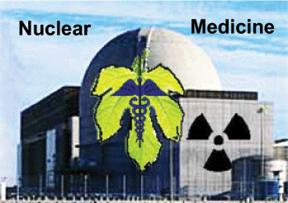
 Misconceptions about radioactive medical isotopes, http://www.onlineopinion.com.au/view.asp?article=19251 , By Noel Wauchope -29 August 2017
Australians get their information about medical isotopes straight from The Australian Nuclear Science and Technology Organisation(ANSTO) via handouts faithfully retailed via the mainstream media. Some recent examples of media coverage:
The message is straightforward and goes like this:
The purpose of the Opal nuclear reactor at Lucas Heights is to make medical radioisotopes to treat cancer. Australia needs a national radioactive waste dump in rural South Australia, thousands of miles away from Lucas Heights, to dispose of the low-level medical radioactive wastes produced. And this will be a bonanza for the lucky rural community of Kimba.
Is this story true?
No. It is misleading on a number of counts.
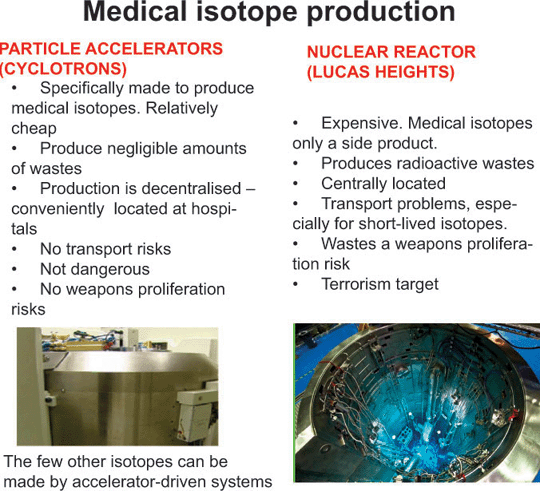
First of all, a nuclear reactor is not essential for making medical isotopes. The IAEA lists 39 countries that use cyclotrons to produce them. That includes Australia, which has them not only at Lucas Heights itself, but also at hospitals in Victoria, New South Wales, Queensland, and Western Australia.
From the invention of the cyclotron (1931) , and discovery of artificial radioactivity (1934), non nuclear particle accelerators were used to produce them. Globally, particle accelerators produced the vast majority of radioisotopes with medical applications until the 1950s. Radioisotopes of medical interest began to be produced as a byproduct of nuclear weapons reactors during World War II. After the atomic bombing of Hiroshima and Nagasaki in 1945, the USA Atomic Energy Commission (AEC)’s main mission was promoting the military use of nuclear material, but “giving atomic energy a peaceful, civilian image” was also part of it. In1948 the AEC took over, and isotopes for biomedical research, cancer diagnostics and therapy were made in nuclear reactors and even became free of charge.
Australia was a bit slow to jump on the medical isotopes bandwagon. The Lucas Heights nuclear reactor began its life in 1958 as the start of a plan for nuclear weapons for Australia.Then it was promoted as research for nuclear power, and later as for making medical radiopharmaceuticals. Lucas Heights and ANSTO itself are very much part of the nuclear lobby’s plan to promote the entire nuclear industry in Australia.
Australia does not need a national radioactive waste dump for medical wastes. Nearly all medical radioactive wastes are very short-lived – a matter of days, or even hours. There is no need to transport them across the continent. Australia does have a problem with higher level wastes: Spent reactor fuel sent to France, USA and UK for processing must be returned. This is the type of waste that needs deep and very secure disposal. That is sure to be the underlying purpose of the South Australian waste dump plan.
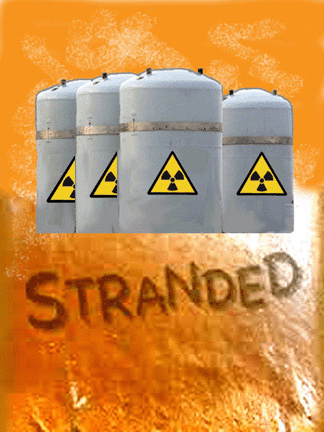
The planned national radioactive waste dump will not benefit the local community. Yes, there will be bribes – so far, not much – a $2 million Community Benefit Package to fund local projects, but I’m sure that the Feds will come with better than that. Jobs, no doubt. However, the underlying problem remains. The community is being asked to accept a temporary nuclear waste dump, which is to be set up long before any permanent dump is set up, if it ever is. Kimba, the proposed dump site, is likely to suffer the fate of so many sad sites in America –stuck with “stranded wastes” of radioactive trash. Think what that would do to Kimba’s environment and reputation as an agricultural area.The nuclear lobby has argued persuasively that the Lucas Heights area has held nuclear wastes for decades. However, the Lucas Heights residents did not grasp the implications when the nuclear reactor was set up. They do now – that’s why they want the wastes sent far away.
The global nuclear lobby is fighting a losing battle. The industry has always struggled to win over public opinion. In Australia, the industry’s “foot in the door” is the Opal reactor at Lucas Heights. Following the South Australian Nuclear Fuel Cycle Royal Commission’s failed attempt last year, to introduce radioactive waste importing, the next sortie is to use Lucas Heights to get a national nuclear waste dump happening. To justify this, the argument put forward is the medical argument.
In the slick salesmanship from ANSTO and the nuclear lobby in general, they don’t mind a few lies and half truths,. For example, they’ll say ” The most important isotope technetium-99m can be made only with nuclear reactors” – conveniently forgetting that Canadian researchers achieved this with a cyclotron in 2015.
They’ll say that cyclotrons are too expensive to set up, conveniently forgetting that the Lucas Heights  nuclear reactor was set up at tax-payer expense, and that tax-payer will have to fund its waste management virtually for eternity.
They’ll ignore the facts that cyclotrons produce negligible wastes. As most medical radioisotopes have very short half lives – it makes sense to produce them in a decentralised way – in cyclotrons close to the hospitals where they will be used. The transport of isotopes from cyclotrons is much less of a problem, than from the centralised nuclear reactor.
The nuclear reactor produces radioactive wastes suitable for use as nuclear weapons fuel – and present a safety problem, with the reactor itself also a target for terrorism. Cyclotrons do not have these risks, and this need for huge, and expensive security measures.
Canada, having abandoned nuclear reactor production of medical isotopes, is now leading the way in their production and export without use of a nuclear reactor. ANSTO’s boast of a future thriving export industry in isotopes is sounding hollow.
We should bear in mind that medical radioisotopes are used 80% for diagnosis, and only 20% for actual treatment of cancer. They are an additional means of diagnosis, but not the only means.
We should also be mindful that radioactive isotopes in medicine carry a small increased risk of cancer for the patient, staff, and sometimes the patient’s family.
Therefore our enthusiasm for nuclear medicine should be tempered with an understanding of its limitations and risks, both at the individual patient level, and in the broader context of nuclear fission and its health and environmental dangers.
August 30, 2017
Posted by Christina Macpherson |
AUSTRALIA - NATIONAL, Federal nuclear waste dump, spinbuster, technology |
Leave a comment
Community torn over Kimba nuclear plan, Eureka Street Michele Madigan | 28 August 2017 The Unlucky Australians, the documentary of the Gurindjis’ campaign for their land, aired on the ABC late on Sunday night 20 August 2017. The Gurindjis’ successful struggle against the combined might of the Vestey empire and the Australian federal government is one of the greatest Australian stories……
What struck me most was their complete solidarity. Despite the government’s intense pressure — the withdrawal of the blind man’s pension, the promise of solid brick houses built in sight of their tin and bush humpies, or any other threat and enticement — every Gurindji stood firm.
Half a century after the Gurindji Walkoff and half a continent away, on Saturday 19 August at a gathering in Port Adelaide, two modern beleaguered groups, one Aboriginal, one non-Aboriginal, shared their current experiences in striving to protect their own lands and ways of life. Like the Gurindji, their struggle is with the federal government and this time, indirectly, with another big business — the nuclear industry. In contrast to the Gurindji struggle however, modern day communities and even families are being torn apart by enticements and pressures.
Two months ago, South Australia’s Premier Jay Weatherill conceded that there is ‘no bipartisan government support’ and ‘not sufficient community support’ to continue with the extraordinary scheme that a SA government sponsored nuclear royal commission had recommended. The Premier gave a commitment that a State Labor government, if re-elected, would now not pursue a high-level international nuclear waste dump.
The federal government however continues its pursuit in SA — the disposable state — of a federal dump for the intermediate long-term nuclear waste from the Lucas Heights nuclear reactor and for medical waste. Now, once again, three sites are being offered up: two in Kimba, at the top of Eyre Peninsula in South Australia, as well as the ongoing Flinders Ranges site.
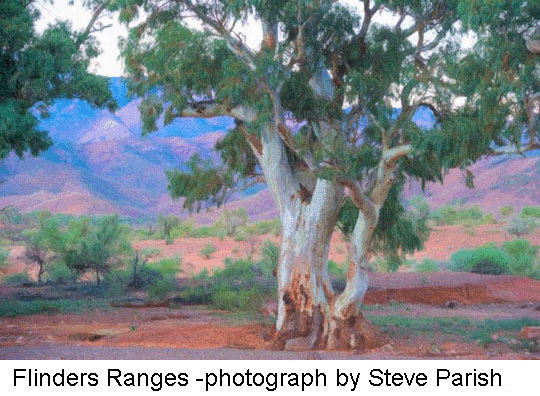
At the 19 August meeting, Kimba farmers spoke of the offers of a paltry $10 million and a tiny 15 (or fewer) permanent jobs as the payoff for the deep divisions and the certain risk to their markets a federal dumpsite would bring. Farmer Toni Scott, overcome by describing a formerly close-knit community now torn apart, broke down in tears. The close voting statistics for and against the site belie the former Minister for Resources and Northern Australia, Matt Canavan’s assertion that Kimba is clearly in favour.
Farmer Tom Harris’s neighbour is one of two Kimba farmers who have offered possible dumpsites. However the site is closer to Tom’s family homestead than it is to the neighbour’s. It was sobering to hear his facts. Kimba region farmers ‘are recognised as some of the best dry farmers in the world’ but the competition between grain farmers for international markets is so intense that the warning from the professionals is clear: proximity to a nuclear waste dump will have predictably disastrous negative effects. And the irony — ‘It’s the farmers who’ve kept the town going.’
Meanwhile, the Adnymathanha and other Flinders Ranges station and townspeople continue their efforts to protect SA’s iconic Flinders Ranges from the same fate. During the 31 months it has been a preferred site, their trauma has deepened as they have seen other locals acquiesce. Sadly, with the government’s ‘no-strings-attached’ $2 million for community projects, the tearing apart of families has intensified.
The Gurindji had Frank Hardy and Australian unions supporting them during their terrible privations. Many Kimba farmers and townspeople, and the Adnyamathanha, together with some of the townspeople and most of the Flinders Ranges landholders, are grateful for their own southern (or eastern) supporters. They plead for more: ‘Please help us to be heard!’ https://www.eurekastreet.com.au/article.aspx?aeid=52964#.WaXSuvMjHGh
August 29, 2017
Posted by Christina Macpherson |
AUSTRALIA - NATIONAL, Federal nuclear waste dump, South Australia |
Leave a comment
 Royal Adelaide Hospital waste to be shipped back overseas when it closes http://www.adelaidenow.com.au/news/south-australia/royal-adelaide-hospital-waste-to-be-shipped-back-overseas-when-it-closes/news-story/a3cdebd7c500f00e67b7913b48e7d900?nk=ba26857f63080120cbd5fc74c94d3959-1503908527, Daniel Wills, State Political Editor, August 27, 2017
RADIOACTIVE waste currently stored at the old Royal Adelaide Hospital is set to be sent back overseas as the site is cleared when health services shift to the other end of North Tce.
With demolition and redevelopment of the site imminent once medical services are transferred to the new hospital next week, The Advertiser can reveal the State Government is developing plans to return the waste back to it European or British origin.
More than a year ago, Renewal SA chief executive John Hanlon told a State Parliament committee how the Government was working on plans to house the waste in SA when the old RAH closed. While no proposal was settled, officials investigated a new SA site that could also be a repository for other low-level radioactive waste scattered in other sites around the state.
A SA Health spokeswoman said the old RAH waste, mostly used for patient treatment and research, was no longer needed once the shift to the new hospital was complete.
“The radioactive sources are currently stored in lead-lined boxes in a secure store in preparation for the removal process,” she said. “Once the old RAH site is decommissioned, the majority of waste radioactive sources will be safely returned to the country of origin.”
Most of the radioactive sources at the old RAH used for medical purposes came from the UK or Europe. SA Health is also working to identify any other origin countries. Final disposal is expected to be dealt with by the source material’s manufacturers.
The department is working with the Australian Nuclear Science and Technology Organisation and the state Environment Protection Authority to ensure safe, and legal removal. The old RAH is one of 78 different facilities in SA currently storing low or intermediate level waste, according to the government’s Nuclear Fuel Cycle Royal Commission.
Low level waste is generated in hospitals and by industry. It comprises paper, rags, tools, and gloves with short-lived radioactivity that do not require shielding during normal handling.
Intermediate waste is typically metal and other materials from decommissioned reactors. It emits higher levels of radiation and requires shielding during handling, transport and storage.
Parliament was told in 2011 that radioactive waste currently at the old RAH is in a basement.SA Health is responsible for the removal of all known radioactive sources before the site is handed over to Renewal SA, which will oversee a $1 billion redevelopment.
August 28, 2017
Posted by Christina Macpherson |
South Australia, wastes |
Leave a comment
 Leonora lobbies for nuclear waste dump in its backyard ABC Goldfields By Jarrod Lucas 18 Aug 17 Leonora in WA’s northern Goldfields is putting together a bid for an outback repository to store radioactive waste.
The Federal Government’s decade-long search for a national radioactive waste management facility appears far from over.
This has provided a window of opportunity for the Shire of Leonora to press its case again to host a national repository for waste arising from medical, industrial and scientific use.
Leonora looked to have missed its chance in November 2015 when it was left off a short-list of six sites, five of which have since been ruled out by the government.
On that occasion, the Shire put together a last-minute bid, nominating about 81 hectares of freehold land owned by Councillor Glenn Baker.
An application for an exploration license for a new site, north-west of Leonora, is currently being assessed by multiple State Government departments.
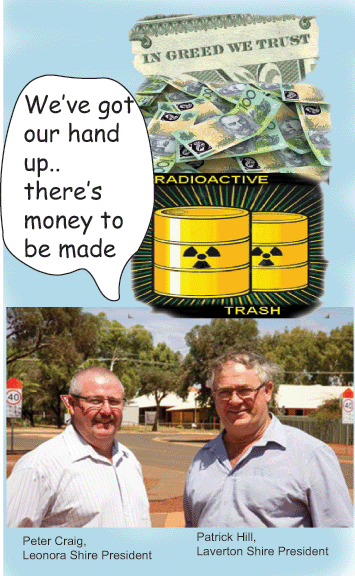
Shire of Leonora president Peter Craig conceded there were no guarantees the new site would receive state approval.
But he said the Council believed the waste dump was an opportunity worth pursuing.
“It’s a long-term prospect – we’re certainly putting ourselves out there there’s no doubt about that,” Mr Craig said. “We feel going forward there’s a lot of opportunities, money to be made.”
….He said the repository would be built underground and the Goldfields mining industry is perfectly placed to build it.
“We’re probably going to have some opposition from the State Government I would imagine, but at the end of the day, the Federal government would more than likely overrule it if the land is in a location which is suitable.”…… http://www.abc.net.au/news/2017-08-18/remote-wa-town-wants-radioactive-waste-dump-in-its-backyard/8821240
August 25, 2017
Posted by Christina Macpherson |
Federal nuclear waste dump, Western Australia |
Leave a comment
 Agency formed to push nuclear waste dump to SA spent $7.6 million http://www.adelaidenow.com.au/news/south-australia/agency-formed-to-push-nuclear-waste-dump-to-sa-spent-76-million/news-story/34c2ed1ade9a24c8d195ecf32f45709d 20 Aug 17, Miles Kemp,
THE taxpayer has been handed a “catering” bill that is the equivalent of 45,000 cups of coffee, for a talkfest on nuclear energy. The catering bill for the so-called “Nuclear Fuel Cycle Royal Commission Consultation and Response Agency” was $182,580.
The extraordinary cost is revealed in Freedom of Information documents released to the Opposition, which show the agency’s budget blew out by $400,000 to $7.6 million. It included $185,477 for media monitoring, $1.04 million for photography/AV and production, $152,373 for accommodation in South Australia, $256,771 for international and domestic travel, and $1.08 million spent on contractors.
The agency’s brief was to sell the findings of the Royal Commission to the South Australian public — that nuclear energy generation was not feasible but a dump should be explored.
Opposition treasury spokesman Rob Lucas said: “Taxpayers should be concerned about how their money was spent chasing the Weatherill Government’s nuclear thought bubble’’.
“It is incredible that the agency managed to rack up an $180,000 catering bill in one year. That could have bought more than 45,000 cups of takeaway coffee or 123 coffees per day. Given the Weatherill Government’s track record of treating taxpayers’ money with contempt, we’ll be pursuing a further breakdown of these costs.”
Former Royal Commissioner Kevin Scarce distanced himself from the budget blowout and said it all happened after his watch. “The commission I led had no connection with CARA. CARA formed as the commission completed its work,’’ he said.
The stated purpose of the agency was to: “Seek to understand the South Australian community’s perspectives on further involvement in the nuclear fuel cycle’’.
Premier Jay Weatherill cut short the nuclear option for SA after the Opposition withdrew support for the idea. The agency comprised four prominent South Australians and included two“citizens’ juries” to discuss the Royal Commission findings.
The second jury comprised 300 people randomly selected from the population, which could explain the large expenditure.
A Government spokesman said the nuclear fuel cycle consultation was “the biggest in the state’s history” and the budget was publicly disclosed and “received bipartisan support”. “The Government makes no apologies for undertaking such an extensive consultation process to ensure all South Australians had the opportunity to have their say on this important matter,” he said.
August 21, 2017
Posted by Christina Macpherson |
NUCLEAR ROYAL COMMISSION 2016, wastes |
Leave a comment
Nuclear medicine production in Australia at risk if dump site can’t be found, industry head says ABC, Landline By Marty McCarthy 19 Aug 17, Australia may have to stop producing nuclear medicine if it cannot find a central site to dump all of the radioactive rubbish made in the process in the next decade.
The Federal Government has been trying to find a site somewhere in Australia to dump nuclear waste for 30 years, including all the waste produced by the government-owned OPAL reactor at Lucas Heights.
There is about 4,250 square metres of radioactive waste in Australia — enough to fill two Olympic-sized swimming pools — and most of it is held at the Australian Nuclear Science Technology Organisation (ANSTO) at Lucas Heights…… the facility also stores a small amount of intermediate-level waste.
This waste comes from the spent fuel rods used in Australia’s first nuclear reactor, HIFAR, which operated for 50 years and was decommissioned in 2007.
The TN81 cask is a 120-tonne rubbish bin that currently contains more than half of the waste from 2,000 spent fuel rods used in HIFAR over its half-a-century-lifespan.
“This does actually represent one of the more radioactive things in Australia,” said James Hardiman, waste operations manager at ANSTO…..
‘It’s for Kimbra we are doing this’
The rural town of Kimba, on South Australia’s Eyre Peninsula, could be the eventual home of all of Australia’s nuclear waste. Two farmers in the region have put forward their properties, along with a third at Barndioota in the Flinders Rangers, for the Federal Government to build its facility on.
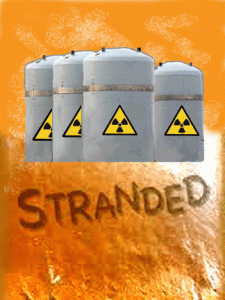 The site would be a permanent dump for all of the low-level waste, which would be buried in cement chambers and left for 300 years, and a temporary storage site for the more dangerous, intermediate-level waste…..To guarantee your town’s future for the next 300 years is pretty good reason for me, because they are talking 100 years of storing the waste and 300 years of monitoring,” Jeff Baldock said.
Bob Maitland, who owns farmland next to Mr Baldock’s property, said he had a moral obligation to support his neighbour’s nuclear dump plan. “It’s for Kimba we are doing this, not for ourselves.” http://www.abc.net.au/news/2017-08-19/nuclear-medicine-production-in-australia-at-risk:-industry-head/8815902
August 19, 2017
Posted by Christina Macpherson |
Federal nuclear waste dump, South Australia |
Leave a comment
The No Dump Alliance has today launched a petition targeting Premier Jay Weatherill and Opposition leader Steven Marshall to take a stand and use SA’s existing no dump laws to publicly oppose the federal government plan to build a nuclear waste dump in South Australia.

One site in the Flinders Ranges and two sites near Kimba on the Eyre Peninsular are now being assessed by the federal government to become the nation’s nuclear waste facility.
The majority of this waste is currently in storage at secure federal facilities and no compelling case has been made for its transfer. There is clear community opposition to Canberra’s plan in both affected regions and the Alliance supports the growing national call for an open review of all waste management options, rather than targeting regional communities for a dump site.
In a statement the Alliance outlined that this “is the time to stand up. South Australians have fought and won the nuclear waste battle before.” The Alliance petition is calling on the leaders of both major political parties in SA to commit to using the existing Nuclear Waste Storage Facility (Prohibitions) Act, 2000 to send a clear message of active opposition to the federal dump plan.
“We need our state leaders to stand with us against this federal plan, this process had already cause immeasurable damage to our community and it needs to stop. We do not want our agricultural region exposed to the risks this nuclear waste presents and we need our leaders to ensure our that state legislation is upheld.” said Kimba resident and No Radioactive Waste Dump on Agricultural Land in Kimba or SA President, Peter Woolford.
Following the end of plans for SA to host international radioactive waste the No Dump Alliance has refocused its work to support communities targeted by the federal government’s plan to build a nuclear waste dump in SA. This will be a key focus of the Alliance’s work in the lead up to the 2018 state election.
“The Australian Education Union applauded the Premier’s announcement that an international waste dump in SA is no longer in question and will not be progressed by the current or future Labor governments. However, if by his own admission the show of solidarity by the wider community with the Aboriginal community in protest of any nuclear storage on SA land is to have any credence this must be followed with a clear rejection of the Federal government’s proposal to use this state as the nuclear waste bin for the nation” Said Dash Taylor Johnson, Australian Education Union and No Dump Alliance member.
August 18, 2017
Posted by Christina Macpherson |
Federal nuclear waste dump, opposition to nuclear, South Australia |
Leave a comment
Last Friday, landowners who volunteered a site for the National Radioactive Waste Management Facility made a trip to Australia’s home of nuclear science, the Australian Nuclear Science and Technology Organisation (ANSTO).
Brett and Michelle Rayner, who volunteered part of their property for consultation on the national facility, toured ANSTO, meeting with ANSTO’s CEO and the local Mayor.
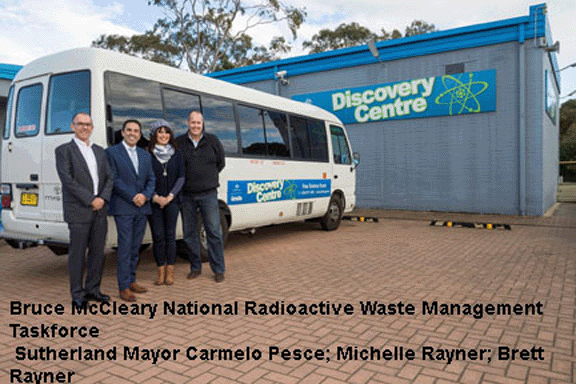
Brett said that the experience showed him that the waste was even safer than he thought.
“I was originally against the proposal, but after attending the community meetings I got the information and could see that there are no safety risks and there is opportunity for our community,” he said
“Based on that I volunteered my land, but coming to ANSTO and seeing this operation in person has really confirmed for me that this waste can and is being safely managed,” he said.
Being able to walk up to the intermediate level waste and touch the container it’s stored in, and to hear and see the different ways that the waste is treated to make it safe, was amazing.
“There is so much more done with this one reactor than I even imagined, so it was great to be able to come, see the way things are done here, and ask all your questions.”
 Michelle said that she really enjoyed the opportunity to come and see the reality of what waste storage looks like.
“What’s done at ANSTO is just mind-blowing, and what stood out is the wide variety of research that goes on here, that people maybe don’t realise the huge contribution nuclear science makes.”
Michelle said that she really enjoyed the opportunity to come and see the reality of what waste storage looks like.
“It has been extremely informative, it’s really opened our eyes to how safe the waste is – in many ways it is no scarier than a garbage bin,” she said.
“What’s done at ANSTO is just mind-blowing, and what stood out is the wide variety of research that goes on here, that people maybe don’t realise the huge contribution nuclear science makes.”
August 2, 2017
Posted by Christina Macpherson |
AUSTRALIA - NATIONAL, Federal nuclear waste dump |
Leave a comment
 Correspondence with Rowan Ramsay MP (2014-present) https://www.righttoknow.org.au/request/correspondence_with_rowan_ramsay/new
Dan Monceaux made this Freedom of Information request to Australian Nuclear Science and Technology Organisation
Currently waiting for a response from Australian Nuclear Science and Technology Organisation, they must respond promptly and normally no later than August 21, 2017 (details).
From: Dan Monceaux Delivered July 20, 2017
Dear Australian Nuclear Science and Technology Organisation,
I wish to receive electronic copies of all correspondence between ANSTO and Rowan Ramsey MP from the years 2014 to present (inclusive).
I am making this request under the Freedom of Information Act 1982.
Yours sincerely,
Dan Monceaux
July 21, 2017
Posted by Christina Macpherson |
AUSTRALIA - NATIONAL, wastes |
Leave a comment
Karina Lester: Aboriginal people do not want a nuclear waste dump in South Australia http://www.adelaidenow.com.au/news/opinion/karina-lester-aboriginal-people-do-not-want-a-nuclear-waste-dump-in-south-australia/news-story/b180d3850f4285c208a334957ef5d6f0 Karina Lester, The Advertiser June 28, 2017 IT was a huge honour to travel to New York for United Nations negotiations on a historic treaty to ban nuclear weapons — a long journey from Walatina in the Anangu Pitjantjatjara Yankunytjatjara Lands in far north west South Australia.
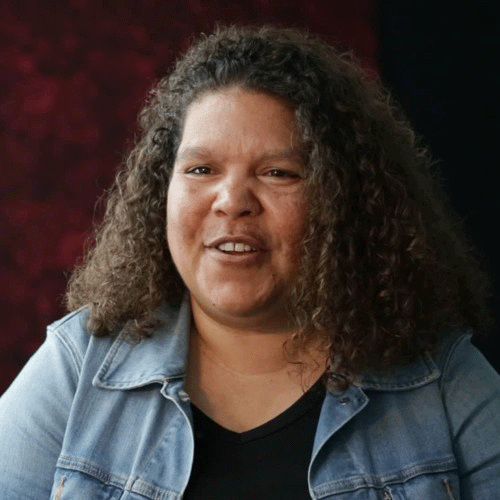
Our Anangu story is not a happy one but it was a privilege to speak up at the UN — for my family and my own people and for indigenous peoples around the world who have suffered the effects of nuclear testing since the dawn of this nuclear age. I felt a great responsibility to acknowledge the many indigenous people who had lost lives and land, and suffered other harm and sickness, including my father Yami Lester.
Dad was blinded by the British nuclear testing at Emu Field in 1953 and has never laid eyes on his Country since, nor ever on his son and two daughters, his 12 grandchildren and two great grandchildren. I shared our family’s story and urged the 130 nations gathered there to produce a strong treaty that will not only ban these destructive weapons but formally recognise the disproportionate impact of nuclear weapon activities on indigenous peoples.
Yet, in the back of my mind in New York, amid all that history making and all that hope, was the knowledge that this fight is not even close to being over at home, that we never seem to be able to draw to a close this dangerous industry in South Australia.
Pitjantjatjara, Yankunytjatjara, Kokatha, Adnyamathanha and other Aboriginal people of South Australia have been fighting this nuclear problem now for decades, since my father heard a British official falsely claiming that Anangu had been consulted on the tests which sent the ‘black mist’ which poisoned our people and land.
Dad’s campaigning helped pave the way for the Royal Commission into British Nuclear Tests in Australia in 1985. But it didn’t take long for this injustice to be forgotten, for our traditional lands to once more to be seen as empty wastelands and for this struggle to become intergenerational.
In 1998 the Howard Government announced its plan to build a national radioactive waste dump in the SA Outback. This time it was the Kupa Piti Kungka Tjuta, senior Aboriginal woman from Coober Pedy — among them my Kami (nana) Eileen Kampakuta Brown — who had to step up for the fight with their “Irati Wanti — the poison, leave it” campaign. It took a huge toll on those old women but they had learnt of the danger from their experience of Maralinga and Emu Field.
Then two years ago came the threat again, with the Royal Commission into the expansion of the nuclear fuel cycle in South Australia and the proposal to ship, store and bury up to one-third of the world’s high-level long-lived radioactive waste. Where? Not in Adelaide, of course.
But as my Kami said, this radioactive risk is not just a problem for our mob, it’s a problem for all South Australians, and the proposal was resoundingly rejected.
Meanwhile, the Federal Government has been looking at Adnyamathanha country in the Flinders Ranges for a national low and intermediate-level nuclear dump. Facing strong Aboriginal resistance, it is also proposing a site on the Eyre Peninsula. Aboriginal people are not the only opponents of nuclear waste, but we have borne the brunt of this industry and have intimate knowledge of its costs.
Governments have stripped Aboriginal people of land rights and heritage protections for nuclear tests and uranium mining, and we fear the same will happen with nuclear waste. At the behest of the United States, the Australian government did not even turn up for the landmark UN Treaty negotiations, though its own people — my people — still bear the impacts of nuclear testing. That is not recognition, respect nor representation.
 My father lost his eyesight because of nuclear weapons testing, but he has never lost his vision of a cleaner and safer future free of nuclear threats from weapons and waste. It’s time this country and this state shared that vision.
Karina Lester is a Yankunytjatjara Anangu woman, who works with the University of Adelaide’s Mobile Language Team as the Aboriginal Co-Manager and Language Worker. She is a member of the Natural Resources Management Council
June 30, 2017
Posted by Christina Macpherson |
aboriginal issues, AUSTRALIA - NATIONAL, Federal nuclear waste dump, personal stories, South Australia |
Leave a comment
 NO RADIOACTIVE WASTE ON AGRICULTURAL LAND IN KIMBA OR SA, President, Peter Woolford, Secretary Toni Scott, camandtoniscott@gmail.com 28 June 17, It is impossible to find words to properly describe how utterly disappointed we are that Minister Canavan has seen fit to progress the two current sites nominated in Kimba to house the National Radioactive Waste Facility to phase two of the selection process.
We trusted the Minister’s promise that he would not progress the sites without proof that broad community support existed, which he had numerous times referred to as needing to be in the vicinity of 65%, a figured which we firmly believed should be the lowest possible definition of “broad’.
Last weeks community ballot returned a result of 57% Yes – 42% No. This result clearly indicated what those of us living in Kimba already know all too well, that our community is completely divided over this issue. The Ministers decision shows a complete lack of understanding and consideration of the impact that this proposal has had on our community over the past two years, and that this division will now continue to escalate.
Minister Canavan has repeatedly promised that he will not impose this facility on a community that doesn’t want it, yet has progressed nominations in Kimba where it is proven that 42.2 % of us do not. Our Community has been lied to. more https://www.facebook.com/No-Radioactive-Waste-Facility-for-Kimba-District-643522385787637/
June 28, 2017
Posted by Christina Macpherson |
AUSTRALIA - NATIONAL, Federal nuclear waste dump, South Australia |
1 Comment
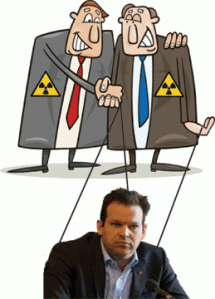 SENATOR THE HON MATTHEW CANAVAN,Minister for Resources and Northern Australia 27 June 2017 KIMBA SITES TO PROCEED FOR CONSIDERATION FOR NATIONAL RADIOACTIVE WASTE MANAGEMENT FACILITY Two proposed sites for a radioactive waste management facility at Kimba will proceed to the next phase of assessment.
The Government has accepted the nominations of land at Napandee and Lyndhurst under the National Radioactive Waste Management Act 2012.
This decision was made after considering direct representations, the results of an independent postal ballot, and submissions in a more than 90-day consultation process.
Kimba voters were asked, in a poll conducted by the Australian Electoral Commission on behalf of the Kimba District Council, Do you support a nomination for a site being progressed to Phase 2 for further consultation for a National Radioactive Low/Intermediate Level Waste Management Facility?
The AEC declaration reported that of the 690 formal votes, there were 396 ‘Yes’ votes and 294 ‘No’ votes, giving a total in favour of proceeding of 57.4 per cent. The Department of Industry, Innovation and Science community consultation found widespread support from the direct neighbours of the nominated properties, with all but one direct neighbour supporting the assessment moving to the next phase.
In-depth consultation and technical assessments of the Kimba sites will now be undertaken.
Phase Two will engage people with all views. The Kimba community will have another chance to express their views before a decision is made about the suitability of either of the sites to host a National Radioactive Waste Management Facility.
This does not change the Phase Two consultation that continues at Wallerberdina Station in South Australia after the community earlier demonstrated broad support for the discussion.
 This next phase in Kimba will include:
- Progression of a $2 million Community Benefit Package to fund local projects;
- Employment of a Local Community Liaison Officer who will act as a conduit between the Government and community;
- Creation of a Kimba Consultative Committee who will gather views about the project; and
- The extension of the local project office, with staff continuing to be onsite regularly to answer questions as the site process progresses.
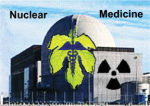 “Nuclear medicine is needed by one in two Australians on average, for diagnosis and treatment of heart, lung and skeletal conditions and a variety of cancers, and along with that comes radioactive waste,” Minister Canavan said.
“Radioactive waste is currently stored in more than 100 locations around the country, and international best practice is that it be consolidated into a single, safe and national facility.
“Progression to Phase Two does not constitute a final decision, rather, we now know that across the community there is broad support for continuing this conversation, and that is what we will do.
“I would like to thank everyone in Kimba for their involvement in this nationally significant discussion.”
At Wallerberdina Station, a process including a heritage assessment, technical studies and community consultation is continuing.
In line with the relevant legislation, the Federal Government can continue to accept and assess any new nominations until a final decision is made on the location of the facility.
For more information on the National Radioactive Waste Management Facility and site selection process, go to www.radioactivewaste.gov.au
June 28, 2017
Posted by Christina Macpherson |
AUSTRALIA - NATIONAL, Federal nuclear waste dump, South Australia |
Leave a comment
Kimba votes yes to radioactive waste dump in Eyre Peninsula http://www.adelaidenow.com.au/news/south-australia/kimba-votes-yes-to-radioactive-waste-dump-in-eyre-peninsula/news-story/96ca27ddaa0f67519b60a366584156bc, Polly Haynes, The Advertiser, June 22, 2017
RESIDENTS of Kimba have voted in favour of building a radioactive waste dump in their Eyre Peninsula district. Posted on the council’s website, the interim results for the postal ballot on the National Radioactive Waste Management Project show 698 ballot papers were received by the Australian Electoral Commission.
Of those, 396 voted for and 294 voted against, while eight ballot papers were informal votes.
The Federal Government is considering two properties near Kimba, in addition to a previously short-listed block of land at Barndioota, near Hawker in the Flinders Ranges.
In March, the Kimba Council called in the Australian Electoral Commission to run a postal vote of the 1100-strong community on the options. At the time, Mayor Dean Johnson said he believed there was strong support in the community for the two local sites to be formally considered. This morning he said: “The numbers are what they are… in the end the people have voted.”
However, a group opposing the dump — No Radioactive Waste on Agricultural Land in Kimba or SA — said the results of the vote showed the community was still divided.
“There has been no shift in community sentiment over the past two years,” a statement said. “Despite the Working for Kimba’s future group’s claims of a large swing toward support … results from three rounds of consultation and surveying show sentiments much the same as previously recorded.”
“This last consultation has resulted in a waste of government time, money and resources. Not to mention unnecessary pressure and stress on our already fractured community.”
The Federal Government is expected to make a decision early next year on the location for the centre, which will host radioactive waste currently held at sites around Australia.
The centre will initially store low and medium-level waste before a second purpose-built centre is opened for the medium-level waste.
Opponents of the waste dump say Australia’s radioactive waste should be centrally stored at the Lucas Heights nuclear reactor campus in Sydney.
Conservation and anti-nuclear groups have petitioned the Federal Government to scrap any plans for a dump at Kimba.
The groups, including Conservation SA, Friends of the Earth and the Australian Conservation Foundation have lodged a submission with the federal Department of Industry, Innovation and Science calling on the government to abandon any plans for a dump at Kimba.
Friends of the Earth campaigner Jim Green says the process to find a dump site had been flawed and divisive.
“The Federal Government has consistently misled Kimba residents about its intentions. Residents have been repeatedly told that the above-ground store for long-lived intermediate-level waste (including spent nuclear fuel reprocessing waste) would hold waste for ‘several decades’ until a deep underground disposal facility is available,” Mr Green said.
“But in fact, several documents from the national regulator ARPANSA indicate long-term storage for 100 years or more. Moreover the Federal Government has no idea what sort of deep underground disposal facility might be built, where or when it might be built, and ‒ incredibly ‒ the Federal Government is doing next to nothing to progress the matter.”
Australian Conservation Foundation campaigner Dave Sweeney said radioactive waste was a national issue that demanded the highest level of inclusion and scrutiny.
“All Australians have a right to be involved to help make sure that this difficult issue is given the best possible consideration,” he said. “What is planned is a national radioactive waste facility so while local community consultation is useful, an evidence based, national conversation is essential.”
June 23, 2017
Posted by Christina Macpherson |
Federal nuclear waste dump, South Australia |
Leave a comment
 Kimba votes to investigate nuclear waste facility on Eyre Peninsula, The Australian, June 23, 2017, MEREDITH BOOTH, Reporter, Adelaide, @MeredithBooth
The thought of having a nuclear waste dump in your backyard would be a step too far for many.
But for wheat farmer Andrew Baldock and the majority of his fellow residents in the shrinking rural South Australian town of Kimba, the promise of a $10 million community fund and better internet was enough to convince them that the positives outweighed the negatives.
Mr Baldock, a father of two, hopes Kimba’s “yes” vote for a nuclear waste dump on South Australia’s Eyre Peninsula will kickstart the town’s shrinking rural economy, which has seen a steady exit of businesses and people over the past two decades.
Kimba’s 700 residents have for years been divided on whether to allow a waste dump near the town, but this week voted 396 to 294 in favour of advancing consultation on building a low- and medium-level facility on the town’s edge.
Mr Baldock and his brother stand to inherit from their parents one of the two farms nominated to house the nuclear waste dump……..
A series of rejected sites was put forward between 1991 and 2004 and the Northern Land Council put forward Muckaty Station in the Northern Territory in 2005. But nine years of opposition, including a Federal Court challenge, saw the NLC withdraw its nomination in 2014 and a fresh search began.
The result of the Kimba vote, reported by the Australian Electoral Commission yesterday, is in line with the opinion polls that have pitted neighbour against neighbour in the rural service centre over the past two years.
Farmer Peter Woolford, part of opposition group No Radioactive Waste on Agricultural Land in Kimba or SA, said the vote had not changed anything and he expected continued railing against the project. “The opposition is still strong,” he said. “The results of the vote showed the community was still divided.”http://www.theaustralian.com.au/news/nation/kimba-votes-to-investigate-nuclear-waste-facility-on-eyre-peninsula/news-story/dab04e32a1be76f1e48ecb2f26fe37ae
June 23, 2017
Posted by Christina Macpherson |
Federal nuclear waste dump, South Australia |
Leave a comment








 Antinuclear