Strong calls to have Kimba nuclear dump plan dumped
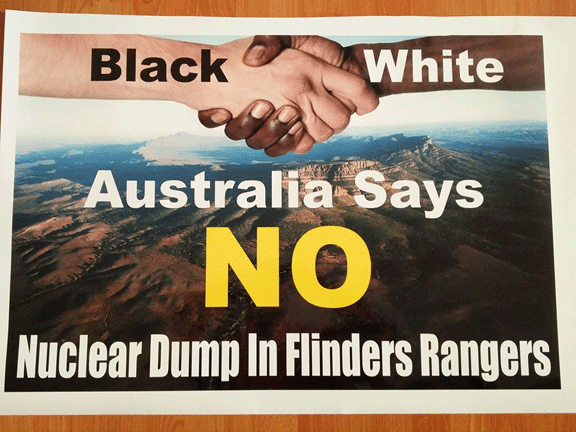 Groups call for nuclear dump to be dropped, http://www.9news.com.au/national/2017/06/20/22/22/groups-call-for-nuclear-dump-to-be-dropped Conservation and anti-nuclear groups have petitioned the federal government to scrap plans for a low-level nuclear waste dump on South Australia’s Eyre Peninsula.
The groups, including Conservation SA, Friends of the Earth and the Australian Conservation Foundation have lodged a submission with the federal Department of Industry, Innovation and Science calling on the government to abandon any plans for a dump at Kimba.
Farming land near Kimba is one of two sites being targeted for the dump, the other near Hawker in SA’s Flinders Ranges.
He says most of the waste is located at the Lucas Heights reactor site south of Sydney and that is where it should stay.
Australian Conservation Foundation campaigner Dave Sweeney said radioactive waste was a national issue that demanded the highest level of inclusion and scrutiny.
“All Australians have a right to be involved to help make sure that this difficult issue is given the best possible consideration,” he said.
“What is planned is a national radioactive waste facility so while local community consultation is useful, an evidence based, national conversation is essential.”
South Australians very definitely dumped the nuclear dump plan, but a new battle looms.
Australia’s handful of self-styled ‘ecomodernists’ or ‘pro-nuclear environmentalists’ united behind a push to import spent fuel and to use some of it to fuel Generation IV fast neutron reactors. They would have expected to persuade the stridently pro-nuclear Royal Commission to endorse their ideas. But the Royal Commission completely rejected the proposal
Another dump proposal is very much alive: the federal government’s plan to establish a national nuclear waste dump in SA, either in the Flinders Ranges or on farming land near Kimba, west of Port Augusta.
How the South Australians who dumped a nuclear  dump may soon have another fight on their hands http://www.theecologist.org/News/news_analysis/2989048/how_the_south_australians_who_dumped_a_nuclear_dump_may_soon_have_another_fight_on_their_hands.html 15th June, 2017 The rejection of a plan to import vast amounts of high-level nuclear waste from around the world for profit was a significant result for campaigners but that threat is still far from over, writes JIM GREEN
Last November, two-thirds of the 350 members of a South Australian-government initiated Citizens’ Jury rejected “under any circumstances” the plan to import vast amounts of high-level nuclear waste from around the world as a money-making venture.
The following week, SA Liberal Party Opposition leader Steven Marshall said that “[Premier] Jay Weatherill’s dream of turning South Australia into a nuclear waste dump is now dead.” Business SA chief Nigel McBride said: “Between the Liberals and the citizens’ jury, the thing is dead.”
And after months of uncertainty, Premier Weatherill has said in the past fortnight that the plan is “dead”, there is “no foreseeable opportunity for this”, and it is “not something that will be progressed by the Labor Party in Government”.
So is the plan dead? The Premier left himself some wriggle room, but the plan is as dead as it ever can be. If there was some life in the plan, it would be loudly proclaimed by SA’s Murdoch tabloid, The Advertiser. But The Advertiser responded to the Premier’s recent comments, to the death of the dump, with a deafening, deathly silence.
Royal Commission
It has been quite a ride to get to this point. Continue reading
Senator Scott Ludlam probes the Australian government’s plan to dump Lucas Heights’ nuclear waste on rural South Australia
 Assuming that the long-lived intermediate-level stuff does go to the sites that you are busy characterising at the moment, how long is it envisaged that it actually stays there before it gets taken somewhere else?
Mr B Wilson: We cannot give a definitive answer on that because we have not commenced a process to identify a permanent disposal solution for the long-lived intermediate-level waste—
Senator LUDLAM: Ouch!
if the really dangerous intermediate-level stuff is to be stored there you cannot tell them how long it is meant to be there for
so we kind of do not really know what is going on there or how long it is meant to be there for.
 ECONOMICS LEGISLATION COMMITTEE, Department of Industry – RADIOACTIVE WASTE 1st June 2017
Full Transcript here: http://parlinfo.aph.gov.au/parlInfo/download/committees/estimate/e3ddf88b-3e9c-4546-9d90-8f646689a98c/toc_pdf/Economics%20Legislation%20Committee_2017_06_01_5134.pdf;fileType=application%2Fpdf
Senator Canavan: I have been to Hawker and I am going there again tomorrow, and I would like to put on record my thanks to many in the Hawker community who engage in this process. Some have certainly changed their mind as they have come to have more understanding of it. I think you have probably been to Lucas Heights, and it I think it makes a big difference to people when they see it. There is a lot of misinformation spread about this, and we are trying to engage with people in a genuine way in good faith to give them the information to make informed decisions.
Senator LUDLAM: Who is spreading this information, Senator Canavan?
Senator Canavan: I hear it from time to time. I do not have any particular allegations to make about individual groups here, but you do hear lots of information from time to time about the potential danger of this material. But, of course, as you would probably know, much of the low-level waste is stored safely at Lucas Heights, a place where people go to and from work every day.
Senator LUDLAM: That begs the question of why it needs to move. ……
Senator LUDLAM: Staying in South Australia: has there been any consideration at all—this is for the department or the minister, whoever wants to take this one on—of the tension between the proposed national radioactive waste facility and the existing South Australian legislation, which would be the Nuclear Waste Storage Facility (Prohibition) Act 2000? The tension between the fact that your entire project is presently illegal under South Australian law: what is being done about that?
Mr B Wilson: We are certainly aware of the South Australian prohibition under their law. However, the National Radioactive Waste Management Act that we operate under overrides South Australian law.
Senator LUDLAM: And that is it? You are just going to squash them? Or are there discussions progressing with the South Australian government?….
Senator LUDLAM: Is the department, or you, Senator Canavan, or any of the federal agencies or other actors in communication with the South Australian government environment or heritage departments, or representatives of any body, actually, in relation to the tension between the two acts?
Senator Canavan: I have raised it with the South Australian government. They have indicated that they may seek to make changes. I am not aware of the status of that at the moment. Obviously, they have their own process, which is a separate to ours, on radioactive waste. Certainly, the issue has been raised. Mr Wilson is also right that we are confident that is not a barrier to this project. But Mr Wilson will be giving you that.
Mr B Wilson: We engage—I would have to characterise it as infrequently—with the South Australian government. It is more in the line of updating where we are. We have not had any recent engagements. They are certainly very well aware of the prohibitions under their law about what the South Australian government and its officials can do in this space….
When I said that the National Radioactive Waste Management Act overrides South Australian law, that is the fact. But what we are trying to do in the development of this project is to develop it and act in a way that is consistent with requirements under other South Australian legislation. For instance, in terms of Indigenous heritage protection and other aspects. While we are not necessarily bound by those laws we want to act in a way that is consistent with them.
Senator LUDLAM: With waste that is as dangerous as this, I am very glad to hear it! Is the department still accepting site nominations?
Senator Canavan: The government remains open to further nominations, as we announced on selecting the Hawker site last year. But the ones we have announced are those that we are proceeding with at this stage.
Senator LUDLAM: Wallerberdina and two at Kimba. Continue reading
South Australian Premier Jay Weatherill declares the nuclear waste importing plan “dead”
 There’s no foreseeable opportunity for this”: Jay declares nuke dump “dead” INDaily, Tom Richardson @tomrichardson, 7 June 17,
Premier Jay Weatherill has officially walked away from one of the major policy hallmarks of his term in Government, pronouncing the nuclear waste dump “dead” and vowing he will not revisit it if he wins another term in office.
The position appears a significant rhetorical shift from his stance last November, when he pledged to keep the debate alive ahead of a future referendum on the issue of nuclear waste storage, after his own Royal Commission found establishing a local industry could net a “$100 billion income in excess of expenditure”.
At the time, his position was seen by critics both inside the Labor Party and more broadly as a refusal to abandon the nuclear dream.
But asked about the future of the nuclear dump at a public forum in Victor Harbor this week, Weatherill declared the project “dead”.
“Yeah it is,” he reaffirmed to InDaily today……..
After the Victor Harbor forum, Conservation SA chief executive Craig Wilkins said the rhetorical shift should be enshrined in Labor policy, calling on Weatherill to “bury the nuke dump plan for good”.
IMPOSITION of ANSTO reactor nuclear wastes onto South Australian community
 28 May 2017, Submission by David Noonan, B.Sc., M.Env.St. To:Senator The Hon Matthew Canavan RE: Proposed Federal government imposition onto community in South Australia of an illegal “100 year” Store for ANSTO’s “10 000 year” irradiated Nuclear Fuel Wastes.
Storage of nuclear wastes affects the rights, interests and safety of all South Australians and is prohibited in our State under the Nuclear Waste Storage (Prohibition) Act 2000.
Proposed imposition of ANSTO reactor nuclear wastes is a major public interest concern in SA and detracts from public trust and confidence in the Federal government, in ARPANSA and in ANSTO.
The National Radioactive Waste Management Facility (NRWMF) comprises two co-located waste management facilities: an above ground 100 year Store for wastes that ARPANSA states require isolation for 10 000 years, AND a Disposal Facility for wastes requiring isolation for up to 300 years.
This submission focuses on the proposed imposition of the illegal Store & consequences thereof.
The Store is primarily for ANSTO irradiated Nuclear Fuel Wastes (NFW) and other existing and proposed reactor wastes, with only minor projected future arising’s of Intermediate Level Wastes (ILW) from States & Territories or from other Commonwealth agencies.
ARPANSA’s CEO (May 2015) has formally considered the proposed NRWMF Store and stated:
“This plan will have the provision for ILW storage above ground for approximately 100 years.”
This indefinite storage plan compromises safety in importing nuclear waste to SA without a waste disposal capacity or even a requisite program for disposal of NFW and ILW.
ARPANSA’s Radiation Health and Safety Advisory Council (April 2010) has provided formal advice which concluded: “that Australia’s current policy of indefinite storage for intermediate level waste does not appear to be consistent with International best practice.”
The import, transport, storage and disposal of ANSTO irradiated Nuclear Fuel Wastes is illegal in SA and was prohibited under the leadership of Liberal Premier John Olsen in 2000:
“The Objects of this Act are to protect the health, safety and welfare of the people of South Australia and to protect the environment in which they live by prohibiting the establishment of certain nuclear waste storage facilities in this State”
Since April 2016 the NRWMF project has exclusively targeted community and environment in SA in an attempt to again impose an illegal Store for ANSTO’s irradiated Nuclear Fuel Waste in our State. 2
The Minister’s release “Kimba 90-day consultation begins”(20 March 2017) invited submissions on potential approval under the National Radioactive Waste Management Act 2012 of two nominated sites near Kimba for assessment as potential sites for the proposed NRWM Facility.
This is in-parallel with the Federal government targeting the iconic Flinders Ranges on the country of the Adnyamathanha people in a serious threat to their human rights and cultural interests.
These are fundamentally State level public interest issues and represent a multi-generational threat to community in SA: including intended Federal requisition of an as yet unnamed SA port for imposition of decades of irradiated Nuclear Fuel Wastes imports, along with affected stakeholders on transport routes, in addition to the rights & interests of community around a potential Store site.
The Federal government has unacceptably failed to take up the recent Advice of the ARPANSA Nuclear Safety Committee (4 Nov 2016) for transparency and for the essential “ongoing requirement to clearly and effectively engage all stakeholders, including those along transport routes”.
This Store also exposes SA to unresolved security and potential terrorist risks in shipping, transport and indefinite above ground storage of irradiated Nuclear Fuel Wastes and other reactor wastes.
However, Lucas Heights is Australia’s best placed institution and facility to responsibly manage ANSTO’s Nuclear Fuel Wastes and can do so through-out the operating period of the Opal reactor.
An “Interim Waste Store” built at Lucas Heights in 2015 has a design life of 40 years and an approved purpose to take both the Nuclear Fuel Waste from France (NFW received Dec. 2015) and NFW to be received from the UK in circa 2020. The ARPANSA license for this Store “is not time limited” and has Contingency options to retain these NFW’s at ANSTO “until the availability of a final disposal option”.
The policy agenda to impose a NFW Store in SA is a flawed, unnecessary, contested and unsafe plan.
A broad public interest campaign protected SA rights and interests from prior Federal government attempts to impose nuclear waste facilities onto our State over 1998 to 2004 – and can do so again.
That “National Store Project” was abandoned – just as this NRWMF Store will have to be set aside.
Further, the Federal government’s flawed policy agenda for imposition of nuclear waste effectively precludes a long term resolution to Australia’s “low level” radioactive waste responsibilities.
The Minister has an obligation to learn the lessons from experience in failure of prior projects in Australia and internationally and not to deny or override key public interest community concerns.
My background includes experience as an Australian Conservation Foundation (ACF) Campaigner over 1996 to 2011 based in Adelaide.
When a dump has a nuclear accident where do you think they will abandon the waste?

 Paul Waldon, Fight To Stop Nuclear Waste Dump In Flinders Ranges SA, 15 Apr 17
Kimba South Australia: Neighbours still opposed to nominated nuclear waste facility sites
 Mrs Woolford said she and other members of the No Radioactive Waste on Agricultural Land in Kimba or SA group had tried to organise a community forum with all sides represented but said the government did not want to participate.
“A debate with everyone represented would be a fair way for the government to allow people in the community to make up their minds, not just a continuous sell of the alleged benefits.
“People should have the right for their government to provide all sides not just one to suit its purpose,” Mrs Woolford said. .
Neighbours in Kimba are still opposed to nominated nuclear waste facility sites, Eyre Tribune, 10 Apr 2017, DISTRUST in the federal government and the process of nominations in the search for a national low to intermediate radioactive waste site are just some of the reasons Austin Eatts is against the facility being placed at Kimba.
Mr Eatts is a direct neighbour to one of the newly nominated sites in the Kimba district and said the national nuclear waste facility was not something rural or regional people should be responsible for.
He said Eyre Peninsula had a long memory for the impact of politicians’ “dishonesty” during and after nuclear bombs were tested at Maralinga, to the north west of Eyre Peninsula “There is a long history of dishonesty about politicians, they told us then and after that Maralinga was safe. “This is the same message they are giving us now, things will be safe, why should we believe them?“My feelings about Eyre Peninsula and the state having anything nuclear has not changed since then,” Mr Eatts said.
He said he did not want the responsibility of making a decision that would impact generations for hundreds of years not only for Kimba or Eyre Peninsula residents but statewide.
“Once we accept this site here, we have opened the door to further nuclear activity.”
Mr Eatts said the vote to be undertaken by the South Australian Electoral Commission would settle the issue for him however he was concerned if the vote was against further progression it would not be the end of the matter.
“Will it be the end of it for those who want it? “They have already brought it back once after we settled it as a community we didn’t want it,” he said. “Two million dollars (offered to the community by the government) is a lot of money to you and I but for a community it is not much and no amount of money will fix the division in the community.” Continue reading
Medical waste will be only a minor fraction of the nuclear waste planned for outback South Australia
 Tim Bickmore Fight To Stop Nuclear Waste Dump In Flinders Ranges SA
Don’t get sucked in by the “medical gloves & gowns” Canberra con-job:
FACT 1 – South Australia’s current hospital waste storage regimen WILL REMAIN in-situ;
FACT 2 – Radioactive metal from the 1940’s British Montebello Atom Bomb Tests IS DESTINED for the suppository;
FACT 3 – Radioactive concrete & steel from the de-commissioned Lucas Heights HIFAR reactor WILL ALSO be supposited;
FACT 4 – If/when the 10,000 Woomera barrels arrive, Radon gas WILL LEAK. This heavy invisible radioactive odourless & poisonous gas flows like water & accumulates in low-lying areas;
FACT 5 – The so-called Intermediate Level Waste ALSO RELEASES invisible radioactive odourless gasses;
FACT 6 – The lowest area in the Wallerberdina precinct is the Hookina Creek line;
FACT 7 – GLOVES & GOWNS WILL BE A MINOR FRACTION OF THE LOW LEVEL WASTE INVENTORY.https://www.facebook.com/groups/344452605899556/
Radiation leaking from Woomera radioactive trash dump – for 16,000 years
 Tim Bickmore Fight To Stop Nuclear Waste Dump In Flinders Ranges SA In April 2016 ARPANSA discovered that Radium had leaked from the 10,000 barrels stored at Woomera. http://www.arpansa.gov.au/…/inspections/2016/R16-05292.pdf This means that Radon gas is being released into the environment. Radon is heavy & tends to flow to the lowest point & accumulate. After about 4 days it transforms into a solid & infects the ground surface. As time passes more & more Radon converts to a solid that builds up & continuously increases the radioactivity wherever it may happen to land – which is at the place it arrives at after about 4 days. This will continue to happen for at least 16,000 years. https://www.facebook.com/groups/344452605899556/
Does Australia REALLY need a radioactive waste facility in outback South Australia?
the biggest unanswered question is whether the planned facility is the best way to manage Australia’s radioactive waste. Extraordinarily, that question has never been asked.
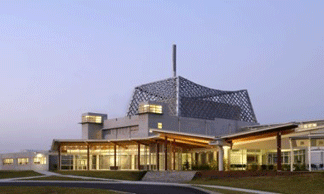 ANSTO [in Sydney] is better placed than a pastoral station or the back paddock of a wheat farm to house this material.
Advantages of storing it at the ANSTO facility include that
- it enjoys assured tenure there;
- has a secured site with a high-level Australian Federal Police presence;
- is currently building new storage capacity;
- has already received reprocessed spent nuclear fuel returns from Europe;
- has the best radiation monitoring and nuclear response capacity in the nation; and
- the fact that the waste is there now answers double handling and transport concerns.
Importantly, the Federal nuclear regulator – Australian Radiation Protection and Nuclear Safety Agency (ARPANSA) – has confirmed there is no regulatory constraint to the waste continuing to be managed at ANSTO “for decades“.
Picking the postcode for a radioactive wasteland https://independentaustralia.net/environment/environment-display/picking-the-postcode-for-a-radioactive-wasteland,10177 Dave Sweeney 5 April 2017, ‘The Federal focus on finding a postcode for a [nuclear waste] facility has been at the expense of independently testing the assumptions behind the need for one.’
ACCORDING to the fridge magnets and stickers in the shop beside the ageing Big Galah sculpture, the small farming town of Kimba in South Australia’s Eyre Peninsula is the half way point on the east-west journey across Australia.
But right now, the local talk is more about half-lives, following the recent decision by Federal Minister for Resources Matt Canavan to further explore two places in the region as possible sites for a national radioactive waste facility.
The search for a place for Australia’s radioactive waste has been in train – and often off the rails – for more than 20 years. Over that time, successive Federal governments have had multiple fights at multiple sites — mainly across South Australia and the Northern Territory. Currently, there are three South Australian sites under consideration.
For the better part of a year, a site near Hawker in the Flinders Ranges has been under examination. The site, on a pastoral station leased by former Liberal senator and long-time nuclear facility supporter Grant Chapman has been strongly contested by many in the wider community. Critical voices include local Adnyamanthanha Traditional Owners, pastoralists and people concerned about the impacts of the region’s steadily growing tourism sector.
Now the inclusion of two parcels of agricultural land at Kimba has seen new tension in a town that has previously been highly divided over the Federal plan.
Last year, two previously nominated Kimba land options were not taken further by then Minister for Resources Josh Frydenberg because of a lack of community support.
However, supporters of a facility have made a new pitch and have found an ear in the new minister.
The planned facility would be in two parts — a repository for the disposal of low-level radioactive waste (LLW) and an above ground store to hold the more serious and problematic long-lived intermediate level waste (ILW). The store would operate for 100 years, at which time a decision would be made about how and where to future manage this long-lived waste, which needs to be isolated from people and the wider environment for thousands of years.
For a project that has had many configurations over many years, there remains considerable uncertainty about the plan.
Part of the series of unanswered questions include:
- final facility design;
- acceptance criteria;
- employment and governance arrangements; and
- longer term plans for managing Australia’s highest level radioactive waste.
ANSTO admits that Federal waste plan is for reactor generated wastes, and that no longterm disposal plan exists
Who’d want to dump Australia’s nuclear waste here? Well, this guy. At Kimba in the heart of the country, a community is divided – in one case literally so – over a plan to deposit the national stockpile of radioactive waste, Guardian, Max Opray, 4 Apr 17 “…..Hefin Griffiths, chief nuclear officer at the Australian Nuclear Science and Technology Organisation, says the facility is needed for the organisation’s gradually accumulating stockpile of radioactive waste at Lucas Heights, where measures are being rolled out to temporarily increase storage space at the 70-hectare site, which is reaching capacity this year.
According to Griffiths, most the waste earmarked for the new facility would be of low-level radioactivity, such as clothes worn by people working in nuclear medicine, or soil now stored at Woomera.
That would only be hazardous for a “short period”, he says, but the intermediate-level waste needs to be stored for far longer. “We’ve got reprocessed residues that have come back from France which will remain radioactive for many thousands of years,” he says.
The returned waste consists of 20 canisters containing 170 litres each, generated by the High Flux Australian reactor, which ran for nearly 50 years before being decommissioned in 2007.
Intermediate-level waste will continue to be generated by the Open Pool Australian Lightwater research reactor and the under-development Synroc waste treatment plant.
The proposed nuclear waste management facility would hold this intermediate waste above-ground for a few decades until a longer term solution can be found. Griffiths says another structure along the lines of the $5.3bn deep-storage facility in Finland will eventually need to be built.
As for the facility that would hold the waste in the meantime, Griffiths says only a detailed technical assessment could confirm Kimba’s suitability, but proximity to agricultural land and the 1,700km journey from Lucas Heights would not be insurmountable obstacles.
Craig Wilkins, the chief executive of the Conservation Council of South Australia, argues a study should be undertaken on the prospect of storing the waste at Lucas Heights, close to nuclear experts, rather than “out of sight, out of mind”.
“We also have concerns about how incredibly divisive this process is on communities already doing it tough,” he says. “When you have individual landowners putting it forward to kickstart the local conversation it pits neighbour against neighbour.
“Last time it nearly tore Kimba apart. It is clear from last time there is significant community opposition.”
Successive federal governments over decades have failed to lock down a remote-area site to store nuclear waste because of regional opposition, and in a separate process the SA Labor government has struggled to sell a plan to develop a high-level nuclear waste storage facility, with a citizen’s jury last year resoundingly rejecting the concept.
Kimba was first floated as a potential location by the Liberal federal member for Grey, Rohan Ramsay, who in 2015 volunteered his property near the town before it was rejected owing to perceived conflict of interest………..https://www.theguardian.com/environment/2017/apr/04/whod-want-to-dump-australias-nuclear-waste-here-well-this-guy?CMP=share_btn_tw
South Australian Liberal Party to launch advertising campaign against Nuclear Royal Commission plan to import nuclear wastes

 Off The Record: Orchestra now in baton race to replace young gun, The Advertiser April 1, 2017 “…….Hitting voters with ion fist OUR atomic adventure might be dead and buried, but a series of targeted nuclear strikes are about to be launched by the Liberals.
Having last November torpedoed Premier Jay Weatherill’s half-hearted push for an international nuclear waste dump, the Libs will now attack him for secret plans to put the dump in various sites across the state, Off the Record has learned.
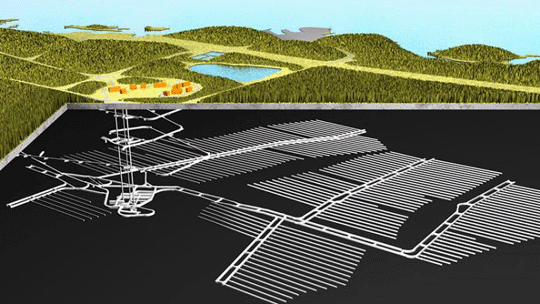
A localised digital and leaflet campaign will accuse Mr Weatherill and his high-level waste dump of risking the destruction of agricultural industry and the environment through toxic nuclear leaks.
The advertising blitz will expand closer to next March’s election.
Regional areas likely to host a dump will be the focus, along with women worried about their children’s futures and those once known as “doctors’ wives” – affluent inner-city Liberal types concerned about the environment and social issues.
Of course, as no site was earmarked by the nuclear royal commission in its final report last May, the Liberals have fertile ground to declare any community could be at risk from the nuclear ogre…… http://www.adelaidenow.com.au/news/opinion/off-the-record-orchestra-now-in-baton-race-to-replace-young-gun/news-story/22c63df9efeb84f31fe3adf21ca65aa9
Some enthusiasts for nuclear waste dump at Kimba, but many opponents
The couple [ Megan and Matt Lienert]say the federal government consultation process has only tried to sell the positives. “It’s like they’re here to sell a car,” James says. “Oh, you don’t want it? Here’s some free seat covers.”
Jacinta jumps in: “Here’s $2m to go to the next stage.
“[The federal government provides] the facts from one side, that’s all we’ve got since day dot. They don’t bring anybody here so people can make an informed decision.
 Who’d want to dump Australia’s nuclear waste here? Well, this guy At Kimba in the heart of the country, a community is divided – in one case literally so – over a plan to deposit the national stockpile of radioactive waste, Guardian, Max Opray, 4 Apr 17, At a point almost halfway between the east and west coasts of Australia, a mob of emus scamper along the Napandee property fenceline. The mallee scrub out this way appears otherwise deserted, the kind of remote location where one could hide a dead body and get away with it – but what about an entire country’s radioactive waste?
Landowner Jeff Baldock is determined to find out. Speaking in a considered gravelly tone through a bristling grey moustache, the third-generation farmer has an Ian Chappell-esque air about him as he defends the decision to formally nominate his land in Kimba, South Australia, as a site for the federal government’s national radioactive waste management facility. It would serve as a repository for intermediate-level waste from the Lucas Heights nuclear site in New South Wales and low-level waste from across Australia.
“We’ve got five grandkids living here on the properties with us,” he says. “If we thought it was dangerous we wouldn’t do this. If I thought it’d upset our grain or sheep we wouldn’t be doing it.”
If his property is selected, Baldock stands to be paid four times the value of 100 hectares of the land, but he says the real advantage would be providing economic benefit to the thousand or so residents of a struggling agricultural district.
“It’s a once-in-a-lifetime opportunity for our town – sorry, our community,” he says. “The antis talk about farmers versus the townies. To me it’s one community.”
It isn’t the first time Baldock has nominated land for consideration. Last year the federal government ruled out another property of his after the assessment process was abandoned because of local resistance. But Baldock says those against the proposal didn’t give it a chance………
In nominating again along with another landowner, Baldock has reopened wounds that were only just starting to heal in a community tightly bound by the challenges of an isolated life in the northern reaches of the Eyre peninsula. Last year Kimba held two of the six possible locations flagged by the government for the nuclear waste site, with one other in SA, and one each in Queensland, NSW and the Northern Territory.
Only one of those, the Barndioota site in SA’s Flinders Ranges, advanced to stage two, but it is meeting considerable resistance from Adnyamathanha traditional owners owing to its proximity to significant Indigenous cultural sites. The return to Kimba suggests the choices are narrowing – or vanishing. In March the resources minister, Matt Canavan, launched the new consultation on Kimba, …….. Continue reading
Radioactive soil dumped at Mary Kathleen mine
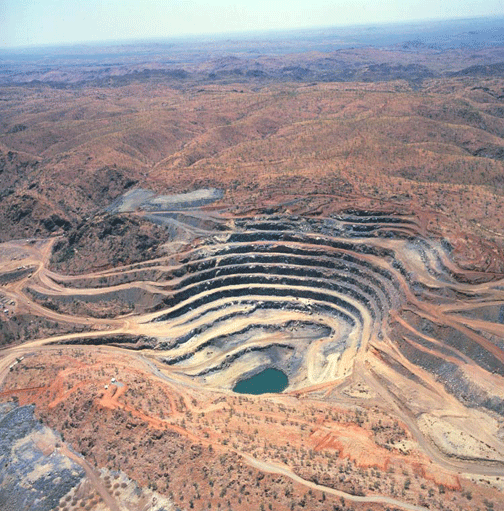 Cabinet papers: Radioactive soil from UQ dumped at Mary Kathleen mine http://www.couriermail.com.au/news/queensland/queensland-government/cabinet-papers-radioactive-soil-from-uq-dumped-at-mary-kathleen-mine/news-story/9bad4b01ffb900f38233aa87474d0cfd January 1, 2017 A HUGE amount of radioactive soil – enough to top-dress a football oval – from the University of Queensland was dumped in the disused Mary Kathleen open-cut uranium mine north of Mount Isa in June 1986 with the approval of the Bjelke-Petersen government.
Cabinet papers released today after 30 years reveal a submission in August 1986 from then mines minister Ivan Gibbs, outlining how 330 cubic metres of contaminated soil was trucked to the mine site and unloaded into the water.
The submission said that in 1984, the UQ Experimental Mine at Indooroopilly was found to have radioactive material from uranium ore samples taken at the Anderson Lode (14km west of Mount Isa).
“Officers of the Health Department carried out a detailed survey of the site and concluded that the pilot plant tailings had caused contamination of the soil under and around the stockpile area, the total mass of contaminated material required to be moved amounting to about 330 cubic metres,” Gibbs’ submission said.
“Discussions were held with officers of my department to identify a suitable site for disposal of the material and I approved for it to be dumped into the abandoned open cut.
“Expert advice has been received that seepage will not take place from the open cut to the surrounding rocks, and studies have shown that the water level in the open cut will stabilise at least 40m below the overflow level.’’
Gibbs said the soil was classed “low specific activity material’’ under the code of practice for the safe transport of radioactive substances. A convoy of trucks transported the soil to the open-cut mine and dumped it below water level. “The access ramp was sealed with large rocks,’’ Gibbs said. “Each truck was washed down and checked for zero radioactive contamination.”
The submission stated that the government was satisfied that material in the abandoned mine would not have any effect on surface or groundwater in the area.
Gibbs said local National Party MP Bob Katter and Mount Isa mayor Tony McGrady objected to the disposal and sought assurances that no more soil would be dumped there.
Gibbs said: “Although it is highly unlikely that the cost of transporting any radioactive material to Mary Kathleen would be justified in future, the possibility of using the abandoned open cut for special cases should not be totally excluded.’’
Radioactive Repeat: federal radioactive waste Groundhog Day increases uncertainty
 A small town on South Australia’s Eyre Peninsula is again in the frame as a site for Australia’s nuclear waste despite being ruled out of consideration less than one year ago because of deep community concern and opposition to the plan.
Yesterday federal Resource Minister Matt Canavan formally accepted two revised site nominations and initiated a 90 day process to measure community views on a planned facility for the disposal of low level and extended storage of higher level radioactive wastes. Last April two previously nominated sites in the region were ruled out of federal consideration.
“This plan is simply not the best way to advance responsible radioactive waste management in Australia”, said ACF nuclear campaigner Dave Sweeney.
“Revisiting a community that has already made its view clear looks more like Canberra’s frustration than community consultation.
“Less than a year ago Minister Canavan’s predecessor Josh Frydenberg ruled the Kimba region out, now it is back on the table. This radioactive waste is a direct hazard for many thousands of years – far longer than any politician’s promise. Short term thinking about long term waste is not good policy or practise.”
ACF joined other environment and public health representatives in the Kimba area last week in a visit that included a public meeting, stakeholder meetings and a regional tour. There is clear and continuing community concern and opposition to the waste plan.
The plan will put further pressure on an already stressed community and further highlights the continued uncertainty in the governments wider approach given it is also exploring a controversial site in the Flinders Ranges at the same.
“There has never been an independent assessment of long-term management options in Australia, rather just a decades long search for a postcode,” said Dave Sweeney. “It is time to stop repeating past mistakes and adopt a new and better approach”.
ACF supports a wide civil society and stakeholder call for Australia’s radioactive waste to be managed in improved storage facilities at existing federal sites to allow for a credible, comprehensive and open exploration of the full range of future management options.
1 This month

of the week – Australians for War Powers Reform (AWPR)
To see nuclear-related stories in greater depth and intensity
 Antinuclear