Kimba Mayor wants a referendum first, before any decision on nuclear waste dump
Kimba wants to take nuke waste, Peter Jean, The Advertiser. p.6 of print version. “…….Kimba mayor Dean Johnson said a referendum of residents should be held before a final decision was made to build a waste dump in the district ….”
S Aust property owners offer land for nuclear waste – at Napandee and Lyndhurst, near Kimba
 SA landowners offer up two more properties as sites for federal nuclear dump http://www.abc.net.au/news/2017-02-02/new-properties-nominated-as-nuclear-dump-sites/8236894 Another two properties near Kimba in South Australia have been put forward as potential sites for the nation’s first nuclear waste dump.
Six sites around Australia, including two others near Kimba, were previously shortlisted by the federal government to store low- and intermediate-level waste.
Wallerberdina station near Barndioota in the Flinders Ranges was the only one to reach a formal consultation phase, which remains ongoing.
The nomination of the previous sites caused significant divisions within the Kimba community, but two other local landowners have since offered up their properties, called Napandee and Lyndhurst.
Bruce Wilson from the federal resources department said Industry Minister Matt Canavan had not decided on whether to take the proposals forward. “By no means has there been any decision to accept the nominations at this point,” Mr Wilson said. “We are hopeful that in the next few weeks there will be a decision made.”
Mr Wilson said a French nuclear delegation would visit the region, as well as the Flinders Ranges, next week to discuss storage of radioactive waste with locals.
“The French delegation has been invited by the Kimba Council to come down,” he said.”It’s an opportunity for them to ask questions about the issues they’re concerned about.”
Napandee is about 25 kilometres west of Kimba, while Lyndhurst is about 20km north-east of the town.
Kimba mayor Dean Johnson said he was not surprised other local landowners had nominated their properties for nuclear waste storage, and welcomed the chance to meet with the delegation.
“The more information we can get the better, so hopefully this will provide some real answers,” he said.
“The entire question remains around community consent.”
The Federal Government’s selection of Wallerberdina station for further consideration has proved highly controversial and generated a backlash within the local community.
Nuclear propaganda group to visit Port Augusta
 French nuclear delegation to visit Port Augusta, The Transcontinental
  @MattCarcich 1 Feb 2017 Port Augusta will host French radioactive waste experts and those who have lived next to a radioactive waste management facility to share their experiences.
The discussion will be held at the Standpipe Golf Motor Inn on Wednesday February 8, from 11am – 12pm (presentation) and 12pm – 2pm (lunch).
The group will also visit Hawker, Quorn and Kimba.
The delegation from France’s radioactive waste management organisation, Andra, and surrounds, was organised after discussions with the Hawker community and after a specific invitation from Working for Kimba’s Future, who are supporting new land nominations from their area.
The four person delegation will comprise of the following:
- Mayor of Fresnay and champagne producer, Pierre Jobard.
- Mayor of Soulaines and local tourism board member, Philippe Dallemagne.
- Director of the Aube Disposal Facility, Patrice Torres.
- Andra International Business Manager, Jelena Bolia.
The group will hold a number of community presentations that are open to the public.
Staff from the Department of Industry, Innovation and Science, the Australian Nuclear Science and Technology Organisation (ANSTO) and Geoscience Australia will also be available for questions.
Head of the Resources Division in the Department of Industry, Innovation and Science Bruce Wilson, said the group will be spending a number of days within the area, including visiting the nominated site at Barndioota………
The proposed site,160 kilometres north of Port Augusta, will store low-level and some intermediate-level nuclear waste.
The low level purpose-built repository would be about the size of four Olympic size swimming pools with a 60 hectare buffer on the 25,000 hectare property.
Designs have not been prepared for the national repository but it will be modelled on above-ground storage and disposal facilities overseas.
The 95-hectare Aube facility in Northern France manages low and intermediate level radioactive waste….. http://www.transcontinental.com.au/story/4441222/french-delegation-to-visit/
2 earthquakes in 2 days near to Barndioota, the planned Federal nuclear waste dump site
 Gavin Smith , Fight To Stop Nuclear Waste Dump In Flinders Ranges SA shared South Australian Weather Fire & Police Warnings‘s photo. Fight To Stop Nuclear Waste Dump In Flinders Ranges SA
Are the ancient Flinders Ranges lands telling us they are not happy about what is planned ?
South Australian Weather Fire & Police Warnings
#Earthquake #Australia #SA Magnitude ML: 2.3 Near Hawker, SA. Date and Time
UTC: 25 January 2017 @ 11:07:22 Coordinates: -31.806, 138.389 Depth: 10 km
Issued by © Commonwealth of Australia (Geoscience Australia) 2017
To ensure you are viewing the latest information please visit:http://www.ga.gov.au/earthquakes/getQuakeDetails.do
Photo is on the original post at https://www.facebook.com/groups/344452605899556/
Federal nuclear propaganda group to visit proposed nuclear dump towns in South Australia
 National Radioactive Waste Management Facility project 20 January 17 Community members are often concerned how a radioactive waste management facility will affect the reputation of their town.
In the week starting February 6 the project team will host a delegation from the Champagne region in France which hosts a low to intermediate-level radioactive waste management facility.
The delegation will include representatives from the French national radioactive waste management agency ANDRA. The international visitors can talk about the interaction of its facility in Champagne with the tourism and agricultural industries in their local areas.
The Australian Nuclear Science and Technology Organisation (ANSTO) and Geoscience Australia (GA) will visit Hawker and Quorn in the week starting February 6.
ENuFF[SA] https://www.facebook.com/sanuclearfree/
Saving your sacred homeland from nuclear waste dumping
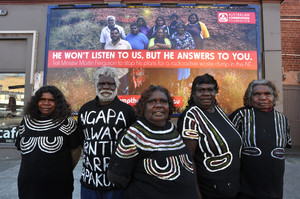 How would you feel if your suburb was being used as a nuclear waste dump? MamaMia, 26 Jan 17 RACHEL WAGNER
There are so many stories of this country that we don’t often hear.
Incredible stories of the earth, and the power of its people.
Sun drenched plains stretching to the horizon. Rich red earth, hot against the cool blue sky. Dreamtime stories indelibly etched in every tree, every rock and every grain of sand.
This is our home, thought the Warlmanpa and Warumungu people.
What a perfect place for a nuclear waste dump, thought the Australian government.
When the Government first proposed Northern Territory’s Muckaty Station, near Tennant Creek, as the site of Australia’s first nuclear waste site, Kylie Sambo was just a school girl confused by a story on the radio.
She had no idea what it meant when her uncle told her it was her time “to be in front, fighting this problem.”
“Just remember,” he told her, “You may think you own the land. But the land owns you.”
Now, after eight years of fighting, the Indigenous activist can say she played an integral role in saving her family’s sacred homeland.
It’s the most amazing Australian story, this week on the Fighting For Fair podcast. It was the death of Kylie’s uncle that was the catalyst for her to take on the Government in a legal challenge to protect the land.
“I heard him through the winds. Through the birds. Through the trees – the branches as they rub against each other,” she said.
“Then I got the idea of making two things that I loved in my life work. My land, and my music. I combined them together and I created something great, something extraordinary, something that is true to me and something that will always be with me.”
A 16-year-old Kylie crafted a song that spoke of the injustice against her people.
Don’t waste the territory, this land means a lot to me / Been living here for centuries, this place we call Muckaty / Let’s get together and fight / Planting your poison in our land, just to get some cash in the hand / You’re drilling a hole right through my soul.
Historically, music and politics are intrinsically linked……..
On behalf of the traditional owners of the land, leading social justice law firm Maurice Blackburn took the case to the Federal Court where Kylie used her voice to fight the dump.
Alongside countless friends, family and supporters of the cause, the young rapper was able to stand up in court as a witness, bringing home a victory for the Warlmanpa and Warumungu people, and saving Muckaty from becoming a dumping ground for nuclear waste.
But as Kylie knows all too well, the fight is not over.
The government is still searching for a new site, with other areas of sacred land in contention and traditional landowners at the helm of the protest.
“As how far my culture goes, I will protect it and I will protect my land. So that’s what it took for us to win this case but there’s still more to come,” Kylie said.
“We don’t own the land. The land owns us.” http://www.mamamia.com.au/native-title-federal-court-case/
Flinders Ranges Community survey – 79% do NOT want the Federal nuclear waste dump.
 Robyn Wood Fight To Stop Nuclear Waste In The Flinders Ranges, 16 Jan 17 So the government claim their survey says that 59% of locals want the national waste dump to be in the Flinders Ranges (The Advertiser 16/1/17). However, they consulted less than 50% of locals – and did not ask the rest of the Flinders Ranges community (especially the tourism industry) and did not ask the whole of SA whose reputation will be damaged by the stigma of being the Nuclear Dump state.
Members of the local community did their own survey of residents within 50km and found 79% do not want the dump.
The government has set up a consultative committee and one of its tasks is to further evaluate whether local people actually do want the dump – I will watch with interest to see if they come up with a better plan to find the true story
Australian government’s pro nuclear propaganda to South Australia’s Barndioota residents
Federal Government woos residents near proposed South Australian radioactive waste dump with trips to nuclear reactor in Sydney http://www.adelaidenow.com.au/news/south-australia/federal-government-woos-residents-near-proposed-south-australian-radioactive-waste-dump-with-trips-to-nuclear-reactor-in-sydney/news-story/c7541a8f23e918f4e2a9e37834282a3e PETER JEAN, POLITICAL REPORTER, The Advertiser, 16 Jan 17
Cabinet is due to make a final decision by the end of the year on whether to build the national low-level radioactive waste management facility at Barndioota, 35km northwest of Hawker.
No other communities have come forward with rival proposals to host the centre since Barndioota was chosen at the preferred location last year.
As part of a community consultation process, a dozen people from the Barndioota area have visited the Lucas Heights Nuclear reactor in Sydney and another nine are due to visit by the end of January.
The Sydney trips were designed to teach community representatives about how the Australian Nuclear Science and Technology Organisation’s OPAL reactor creates medicine and industrial products.
Participants were also provided with information about the storage of radioactive waste at Lucas Heights and how the waste would be packaged for transport to Barndioota.
If regulatory approvals were granted, trucks would begin delivering low and intermediate-level radioactive waste to the new waste dump in 2020.
 Federal Resources Minister Matt Canavan said the Government wanted to give the community as much information as possible about the production and use of nuclear material and the storage of radioactive waste.
“The waste comes mainly from medical procedures,’’ Senator Canavan said. [ed. Antinuclear That’s a lie]
“Visiting the ANSTO facility takes away the air of mystery about the production of nuclear materials and the size and storage of the waste.”
Senator Canavan said the Barndioota community was approaching the issue in good faith.
“I visited the region late last year and met with local landholders, business operators and traditional owners to talk with them about the next steps and to further explain the importance of the facility,’’ he said.
“The next steps will be to complete a heritage survey of the site, working with traditional owners. That will begin in the coming…weeks.”
Indigenous leader Regina McKenzie said she was pleased the Government had agreed to undertake an Aboriginal cultural heritage assessment but remained extremely sceptical about the waste dump proposal.
“We’re very concerned about protecting ecosystems,” she said
Derek Abbott explodes the Royal Commission proposal for a nuclear waste dump
 Derek Abbott No High Level International Nuclear Waste Dump in South Australia, 15 Jan 17
So talk of Ben-Hur proportions that a dump will stimulate expansion of the nuclear industry, allowing power for countries in poverty, meeting power needs for growing populations, and that it fills a moral obligation is invalidated by the fact the dump can’t even keep pace with such visions.
So if we peel away all this hollow rhetoric the only real justification for the dump is to make a fast buck, and the ‘noble’ talk of how the dump will save the world is trumped-up sales hype.
And as we know, the goal of making a profit is highly questionable given considerable economic risks and uncertainties involved.https://www.facebook.com/groups/1314655315214929/
Australian government’s deceptive labelling of nuclear wastes
Steve Dale Nuclear Fuel Cycle Watch South Australia, 5 Dec 16 What we call “Intermediate” level waste is called “High” level waste (HLW) in the USA, Canada, Japan, France and the UK. This mislabeling is so deceptive, that if it was any other product the ACCC would be sinking their gums into them.
Australian government plays dirty tricks with language on High Level nuclear Wastes (HLW)
 Steve Dale Fight To Stop Nuclear Waste Dump In Flinders Ranges SA, 27 Dec 16
UK government avoids the question on nuclear waste going to Aboriginal land
 Radioactive Waste:Written question – 46886
Margaret Henry Fight To Stop Nuclear Waste Dump In Flinders Ranges SA
HERE IS THE ANSWER –
“There is a very small quantity of Australian owned radioactive waste currently stored in the UK. We anticipate that this will be returned to Australia in due course in line with contractual commitments. The location of any storage and disposal facilities for this waste will be a matter for the Australian authorities.
Any shipment of radioactive material out of the UK will comply with all relevant international laws and use ships which meet national and international requirements.” https://www.facebook.com/groups/344452605899556/
British and Australian governments wash their hands of radioactive contamination of Aboriginal lands
Bronwyn Lucas Fight To Stop Nuclear Waste Dump In Flinders Ranges SA, 30 Dec 16 I heard that the British did an absolutely appalling job of cleanup at Maralinga … it was hardly worth the effort, as I understand it. I heard stories of hot winds blowing, dust everywhere, a cursory undertaking. One would think we still had Menzies at the helm. The Dark Side is in this together … if we think our government is taking care of us, I’d say to think again.Margaret Henry Fight To Stop Nuclear Waste Dump In Flinders Ranges SA, 30 Dec 16 In the UK parliament in January 2016, they were asked if the Government will issue an apology to the indigenous people of Australia for British nuclear tests carried out on their land in the 1950s and 1960s.
ANSWER-
“In 1968, Australia signed an agreement with the UK confirming that the clean-up of all test sites had been completed satisfactorily. As announced to the House on 10 December 1993,(Official Report, column 421), the Government agreed to make an ex gratia payment of £20 million to the Federal Government of Australia as a contribution to the cost of the further clean-up of the Maralinga site. A copy of the note giving effect to this agreement was placed in the Library of the House. The note also records that the Government of Australia indemnified the Government of the UK against claims from Australian nationals or residents. The Government now regards the matter as closed.” https://www.facebook.com/groups/344452605899556/
Australia’s responsibility to face up to its radioactive wastes produced at Lucas Heights
 Storing the reprocessed nuclear fuel that is to come back from France at Lucas Heights seems the best of a poor set of alternatives.
We are stuck with highly radioactive material for which we are responsible. Like all countries with nuclear reactors, we should not have produced it in the first place until safe storage technology existed.
 Radioactive game of passing the parcel http://www.brisbanetimes.com.au/opinion/politics/radioactive-game-of-passing-the-parcel-20120523-1z582.html#ixzz1vp20gX9X Richard Broinowski May 24, 2012 Reports indicate France is soon to return reprocessed nuclear waste generated at Lucas Heights to Australia. The federal nuclear agency says the waste is ”intermediate level”, small in volume, and to be stored temporarily at Lucas Heights.
These assurances are misleading in all three respects: the volume of the waste, its toxicity, and its future disposal.
Australia’s first research reactor, the high flux Australian reactor, went critical in January 1958. It was fuelled by highly enriched bomb-grade American uranium. Although small compared with power
reactors, it discharged 37 spent fuel rods a year, each containing the same weapons-grade uranium, plutonium and fission products as its big brothers.
By 2002, it had produced 1665 such rods. Some were sent to Britain and the US for reprocessing. But by 2003, four metric tonnes remained in temporary storage at Lucas Heights
When political pressure forced Britain to cease reprocessing in Scotland, Australia’s nuclear agency arranged with the French company COGEMA to reprocess the rods. Australia is legally bound to take the
lot back – plus, one assumes, the separated plutonium and uranium-235. The problem is there is no agreed permanent place in Australia to put it.
In 2007 the old reactor was decommissioned and replaced by one designed by the Argentine company INVAP. Before construction began, the government stipulated a high-level waste site was to be identified
and a feasibility study completed. No site was found and the stipulation was modified to a strategy for disposal.
The situation becomes more complicated. Argentina initially agreed to take back the spent fuel rods from the reactor for reprocessing, returning the waste to Australia and keeping the weapons-grade uranium-235 and plutonium-239 under full-scope international safeguards. But its officials asserted such reprocessing was in violation of Argentina’s constitution. Australian officials appear not to be worried because they say the reactor has a storage pool with capacity for nine years’ worth of spent fuel rods. A solution, they imply, will turn up.
But like the rapidly filling storage ponds at all civil reactors around the world, this is a short-term solution. The problem of ultimate disposal of irradiated fuel continues unresolved. Australia does not even have a designated repository for low-level nuclear waste such as contaminated clothing and discarded radio pharmaceutical equipment from hospitals.
In 2002, three possible low-level sites were identified in South Australia. But the sites were judged too risky because an errant missile could land on the dump, scattering radioactive debris in all
directions. The state’s then premier, Mike Rann, strenuously opposed it. South Australia, he declared, would not become Australia’s ”nuclear waste state”.
Nor, according to their premiers, would any other Australian state. Australians seem complacent about exporting uranium but become unsettled about storing its end products here, even waste generated by
our reactors.
By February 2010, the only site still under consideration as a nuclear waste dump was Muckaty Station in the Northern Territory, where the federal government can overrule the Legislative Assembly in Darwin.
But deciding on Muckaty was controversial. First, although a small group of traditional owners of the land supported the decision, a greater number opposed it. They launched a case in the Federal Court opposing it.
Second, the site is meant to take low- and intermediate-level waste. But intermediate waste is a narrow definition based on calorific output. If heat is dissipated, runs the argument, high-level waste
becomes intermediate. But whatever its temperature, the waste still contains all the fission byproducts and actinides of high-level waste.
Storing the reprocessed nuclear fuel that is to come back from France at Lucas Heights seems the best of a poor set of alternatives. There are at least suitable storage facilities and chemists and physicists
who know how to handle the material.
But what Australia needs urgently is a solution. We are stuck with highly radioactive material for which we are responsible. Like all countries with nuclear reactors, we should not have produced it in the first place until safe storage technology existed.
How the Australian Federal Government fakes community consent for radioactive waste dump
 Ellenor Ziggy Day-Lutz , Fight to Stop Nuclear Waste Dump in Flinders Ranges, 19 Dec 16, Just shared this info in another group and thought some of you might be interested – it’s about the Australian government’s sample size that they used to make the statement that “The nomination at Barndioota in South Australia demonstrated strong overall support (65 per cent of those surveyed) for moving ahead to Phase 2” (in their Phase 1 Summary Report released earlier this year).
Any people interested in reading the full results of the government’s consultations can find the info here: http://www.radioactivewaste.gov.au/…/NRWMF%20Community%20Se…
They phoned 228 people, 59 refused to be surveyed and contact couldn’t be made with a further 56. So 113 households were surveyed, and in total 146 responses were received. Yep, 146 survey responses out of the 1702 population of the Flinders Ranges Council area to come up with that statistic of 65% supposedly demonstrating strong support for the waste dump. This included 38 people from Hawker and 106 from Quorn (and 2 from other areas around Barndioota). They also surveyed Neighbours, Indigenous people and Businesses, but these were reported separately and aren’t included in the 65% statistic I’m talking about.
In their own document the government said there is a high margin of error for consultations around the Barndioota site. Even they got confused, because on page 68 they say it was +/-10% and on page 100 they said it was +/-9%.
Brenton Barnes The study was outsourced to Orima research and is nothing special. But what’s important is how the government interprets and uses this information. They cherry picked data excluding Aboriginal and neighbours. One small section of this group 35% opposed therefore 65% didn’t oppose. But to use this small sample size and cherry picked data to then go and promote this as “strong overall general community support” is just simply dishonest and misleading. A few of us did petitions around Hawker and Quorn and got about 40% of these two towns physically signing no, just done by me and a couple of others. This latest survey was hardly supporting the dump. Ramsey offering his land in Kimba was a conflict of interest, yet Chapman* is not?
*Grant Chapman Former Liberal Senator https://antinuclear.net/2016/04/29/nice-little-bonanza-for-former-sa-liberal-senator-grant-chapman-in-choice-of-nuclear-waste-dump-site/
1 This month

of the week – Australians for War Powers Reform (AWPR)
To see nuclear-related stories in greater depth and intensity
 Antinuclear