LABOR ENVIRONMENT ACTION NETWORK LEAN position on Nuclear waste
 LABOR ENVIRONMENT ACTION NETWORK LEAN position on Nuclear waste
http://www.lean.net.au/nuclear?utm_campaign=xmas2016wholeli&utm_medium=email&utm_source=lean
Adopted at national conference, 27 November 2016
1.LEAN supports the current ALP national policy on this matter, and sees no evidence or reason to change that policy. The policy states that Labor will:
“Remain strongly opposed to the importation and storage of nuclear waste that is sourced from overseas in Australia.”
2.No State or Commonwealth ALP government should take legislative or executive actions to advance any proposals to store and dispose of nuclear waste from other countries until:
- After well-informed, evidence-based, ALP policy platform decisions at the National and State levels allow such actions; and
- There is sufficient well-informed community consent for such actions.
25 prominent South Australians sign up to Ben Heard’s Bright New Nuclear Bullshit
12 Dec 16 Australian nuclear lobbyists have had remarkable success in making themselves famous internationally, which is probably their main aim. . Barry Brook set this off, with a thin veil of environmentalism covering his dedication to the nuclear industry, in Brave New Climate. He got a heap of well-meaning environmentalists to sign up to a pro nuclear letter.
 Now Ben Heard has gone a step further, with HIS nuclear front group – Bright New World. He’s got 25 important people to sign up to a pro nuclear campaign for South Australia. As with Brook’s disciples, some of these people seem quite altruistic and disconnected with the nuclear and mining industries.
Others do not:
Dr Ian Gould: chairing South Australia Energy and Resources Investment Conference 23-24 May 2017 Adelaide, geologist with 40 years experience in the minerals industry in diverse and senior positions, mainly within the CRA/Rio Tinto Group, current Chancellor of the University of South Australia and was awarded an AM in the 2011 Queen’s Birthday Honours for services to mining.
David Klingberg is a South Australian businessman, civil engineer and former Chancellor of the University of South Australia. director of ASX listed companies E & A Ltd and Centrex Metals Ltd. Klingberg is chair of a technical sub-group working on the Australian Government‘s National Radioactive Waste Management Project.
Dr Leanna Read is South Australia’s Chief Scientist, Expert Advisory Committee of the Nuclear Fuel Cycle Royal Commission in South Australia.] Read is a Fellow of the Australian Academy of Technological Sciences and Engineering,[which advocated for nuclear power in Australia in August 2014.. Read is also the Chair of the South Australian Science Council.
Stephen Young director or Chairman on a number of companies including ,Electricity Trust of South Australia, Australian Submarine Corporation ,The University of Adelaide ,E&A ltd and its Subsidiaries.
Mr Jim McDowell Chancellor of the University of South Australia Jim McDowell is currently Chair of the Australian Nuclear Science and Technology Organisation and non-Executive director of a number of private and listed companies. He advises the Federal Government in a number of areas of Defence and Defence Procurement. He is a member of the First Principles Review of the Department of Defence and is currently on the Expert Advisory Panel for the Future Submarine. Formerly CEO OF BAE Systems Australia, the nation’s largest defence contractor.
Michael John Terlet Primary qualification in Electrical EngineeringNon Executive Chairman of Sandvik Mining and Construction Adelaide Ltd, a Director of Australian Submarine Corporation Pty. Ltd. Served as the Chief Executive Officer at AWA Defence Industries, Chairman of SA Centre for Manufacturing, Defence Manufacturing Council SA (MTIA)
Graham Douglas Walters AM, FCA Mr. Graham Douglas Walters, AM, FCA, serves as Chairman of the Board of Directors at Minelab Electronics Pty Ltd. Mr. Walters serves as Chairman and Director at Minelab International Pty Ltd.
David Noonan dissects the draft ARPANSA Information for Stakeholders on nuclear radioactive waste facility
Effectively this is the same draconian situation that existed under the earlier Commonwealth 
Radioactive Waste Management Act 2005 introduced by the Howard government to override State and Territory interests to protect community health, safety and welfare from the risks and impacts of nuclear wastes and to nullify Federal laws that protect against imposition of nuclear wastes.
 Public submission to the draft ARPANSA Information for Stakeholders & associated Regulatory Guide to Licensing a Radioactive Waste Storage or Disposal Facility
Summary
Revised ARPANSA “Information for Stakeholders” should address the following:
The nuclear fuel waste Store in the Flinders Ranges is intended to operate for approx. 100 years.
The ARPANSA “Information for Stakeholders” fails to be transparent and is not fit for purpose.
ARPANSA must inform the public on the proposed licence period for this nuclear fuel waste Store.
ARPANSA should also publicly acknowledge the Contingency that the proposed nuclear fuel waste Store may be at a different site to the proposed near surface Repository in the Flinders Ranges.
The proposed above ground Store in our iconic Flinders Ranges is unnecessary as the ANSTO’s existing Interim Waste Store (IWS) at the Lucas Heights Technology Centre can manage reprocessed nuclear fuel waste on contract from France and from the United Kingdom over the long term.
The ANSTO application for the Interim Waste Store was conservatively predicated on a 40 year operating life for the IWS, and ANSTO has a contingency to “extend it for a defined period of time”.
ANSTO also has a contingency option for the “Retention of the returned residues at ANSTO until the availability of a final disposal option” – which does not involve a Store in the Flinders Ranges.
The Lucas Heights Technology Centre is by far the best placed Institution and facility to responsibly manage Australia’s existing nuclear fuel waste and proposed waste accruals from the Opal reactor.
The Interim Waste Store (IWS) at the Lucas Heights Technology Centre can conservatively function throughout the proposed operating period of the Opal reactor without a requirement for an alternative above ground nuclear fuel waste Store at a NRWMF in the Flinders Ranges or elsewhere.
It is an inexplicably omission or an unacceptably act of denial for ARPANSA to fail to even identity or to properly explain Australia’s existing nuclear fuel wastes and proposed further decades of Opal reactor nuclear fuel waste production in the “Information for Stakeholders”.
Australia’s nuclear fuel wastes are by far the highest activity and most concentrated and hazardous nuclear wastes under Australian management, and must be distinguished from other waste forms. Continue reading
South Australian nuclear waste dump enthusiasts write to politicians
 List of signatories:
- Fraser Ainsworth AM
- Rob Chapman
- Tim Cooper AM
- Di Davison AM
- Colin Dunsford AM
- Robert Gerard AO
- Dr Ian Gould AM
- Kathy Gramp
- Jim Hazel
- Mike Heard
- David Klingberg AO
- Theo Maras AM
- Jim McDowell
- Prof Mike Miller AO
- Creagh O’Connor (Snr) AM
- Dr Leanna Read
- Richard Ryan AO
- Antony Simpson
- Michael Terlet AO
- Dr Meera Verma
- Stephen Young http://www.abc.net.au/news/2016-12-09/south-australians-urge-nuclear-waste-dump-debate-continues/8107978
Nuclear debate: Businessmen, academics, scientists call on SA politicians to keep discussion alive, ABC News, By political reporter Nick Harmsen, 9 dec 16, A group of prominent South Australian business people, academics and scientists have signed an open letter to the state’s politicians urging them to keep discussion alive on the merits of an international nuclear waste dump. Continue reading
According to Bob Hawke, Aborigines can get a decent life only if Australia imports nuclear waste?
 Former PM Bob Hawke wants Australia to become nuclear dumping ground
 ASHLEIGH GLEESON, The Daily Telegraph December 9, 2016
  AUSTRALIA should become the storage ground for the world’s nuclear waste and pledge a percentage of the profits to helping the indigenous population, former prime minister Bob Hawke says.
Australian government’s nuclear waste dump for Barndioota – a sly prelude for importing nuclear waste
It seems there is no way that the federal plan could develop into that grandiose project [the South Australian Nuclear Fuel Chain Royal Commission importing plan].
But the federal nuclear waste project starts the process in some important ways.
Environmentalists had better stop rejoicing and start examining the machinations behind the Federal Government plan.
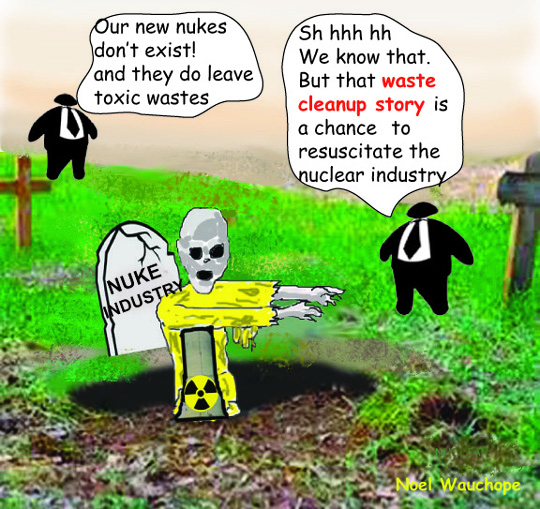 Exhuming South Australia’s nuclear waste import dump plan, Independent Australia, 7 December 2016, The SA nuclear waste dump may be dead in the water but a nuclear waste import plan may now be a Federal affair, writes Noel Wauchope.
POLITICAL SUPPORT for South Australia’s nuclear waste import project has collapsed……..
You would think that, with an election coming up in 2018, Jay Weatherill might ponder on the advantages of making a gracious retreat, respecting the remarkably strong recommendation from his own Citizens’ Jury, that the international nuclear dump was not to go ahead “under any circumstances“.
But Jay Weatherill is persisting with the plan, even though it is a bell tolling his political suicide. We can only suspect that Weatherill has some very poor advisers, or that he is beholden to the nuclear lobby.
Let not the anti-nuclear movement rejoice
The plan for importing nuclear waste to South Australia has been several decades in the making and this recent government push has cost at least $13 million. The nuclear lobby is not giving up so easily. The focus now shifts to the plan for a Federal Government nuclear waste dump in Barndioota.
It would be naive to think that these two plans are not connected.
Australia has a relatively small but enthusiastic pro-nuclear lobby, led by Ben Heard and Barry Brook. Ben Heard – who has just started a pro-nuclear group seeking charity status – made the connection between the two waste dump plans, explaining why South Australia could take not only Australia’s but also the world’s nuclear waste.
It is a simple, and in a way logical, idea to say that once a place is radioactively polluted, well, why not choose that place to dump more radioactive pollution? ……..what if we got a nuclear waste dump in South Australia? One that started out storing “low level medical” nuclear waste but then got “intermediate level” nuclear waste originally derived from Sydney’s Lucas Heights nuclear reactor? Especially as medical nuclear wastes are so short-lived — radioactivity lasting generally for just hours, or a few days, it would be pretty silly to have a great big repository site, with not enough wastes to fill it.
……..if medical wastes are radioactive for only hours, or a few days, why would they need to be transported for thousands of miles across the continent? They are produced in very small quantities and currently stored near the point of use — in hospitals. (There’s actually a strong argument for the use of non-nuclear cyclotrons to produce these isotopes close to the hospitals, rather than at the centralised nuclear reactor at Lucas Heights in Sydney.)
So, an underground nuclear waste facility for medical wastes, at remote Barndioota, in South Australia, doesn’t seem necessary.
But then there’s the processed nuclear waste returning to Lucas Heights, from France and the UK. The Australian Government describes this as intermediate-level waste that isn’t harmful unless mismanaged. The French Nuclear Safety Authority (ASN) has classified it as high-level (long-life) waste according to standards set by ANDRA, the French national radioactive waste management agency. High-level waste is ANDRA’s most severe nuclear waste classification.
Nuclear Shipment Truth Exposed
It is pretty clear that the purpose of the proposed Barndioota nuclear waste dump is the disposal of Australia’s intermediate to high-level waste returning from overseas…….
It seems there is no way that the federal plan could develop into that grandiose project [the South Australian Nuclear Fuel Chain Royal Commission importing plan].
Federal nuclear waste project to start the process
But the federal nuclear waste project starts the process in some important ways.
First, the plan must navigate several legal difficulties. In 2010, former premier Mike Rann brought in laws to prevent a national nuclear waste dump being placed in South Australia — laws which would have to be repealed before the Federal Government could proceed. Federally, the National Radioactive Waste Management Act 2012 did water down prohibitions on nuclear waste dumping but there are still provisions that have to be overcome, particularly in relation to Aboriginal rights.
Secondly, there is that Aboriginal question. I think that the State and Federal governments are justifiably wary of the opposition they might meet from Indigenous communities — and they are working on that problem. The South Australian Government recently imposed Aboriginal Regional Authorities upon the State’s Indigenous communities. These are being used to fast-track and rubber stamp development over much of the land. They would be integral to Jay Weatherill’s strategy of manufacturing consent……
An unspoken part of the process must surely be the development of the Federal Government’s nuclear waste facility in South Australia, which would conveniently overcome some big hurdles and would make that State look like an attractive place for a nuclear hub.
Environmentalists had better stop rejoicing and start examining the machinations behind the Federal Government plan. https://independentaustralia.net/politics/politics-display/exhuming-south-australias-nuclear-waste-import-dump,9814
South Australian Labor govt clings to its nuclear waste dream
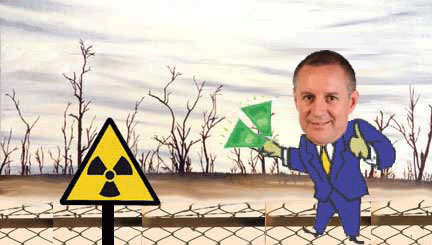 Nuclear roadblock warning but door still open, says Tom Kenyon
 http://www.adelaidenow.com.au/news/south-australia/nuclear-roadblock-warning-but-door-still-open-says-tom-kenyon/news-story/e19a89bfb94a87bbe14d2a18d082da0a Adam Langenberg, Political reporter, The Advertiser November 15, 2016 A SOUTH AUSTRALIAN high level nuclear facility looks further off into the distant future after one of its most strident backers outlined a series of roadblocks before a statewide referendum could be held.
“I think if you go to a population with a vague question, should we have a nuclear waste facility in SA, to be honest I think the result of that referendum would be not much better than what we saw from the Citizens Jury,” Mr Kenyon said.
“If it was ever going to happen firstly it would need bipartisan support to at least continue those investigations and continue discussions.
Then you would need to have quite a lot of information, and I would suspect you would need to know how much you were going to get paid and how much it was going to cost you to store and to know that you almost certainly need to know a site and you would need to have most likely an agreement of a community around a site.”
Asked if the Government could expect support of the Parliament to continue those discussions, Mr Kenyon responded “not at the moment”.
Liberal Treasury spokesman Rob Lucas, the first opposition MP to publicly air concerns about the proposal, told the conference the economic risks were “too great”.
“I always thought it was a naive and ill informed view that you would ever get majority support, whether it be from a Citizens Jury or any other process.
“Frankly if you were going to take on this particular challenge it was going to be an issue of leadership where ultimately the government of the day and the Parliament would have to say, we think it’s in the best interests of South Australia and even though there’s a majority view against it; we’re prepared to support it in terms of the public interest.” http://www.adelaidenow.com.au/news/south-australia/nuclear-roadblock-warning-but-door-still-open-says-tom-kenyon/news-story/e19a89bfb94a87bbe14d2a18d082da0a
Kimba, South Australia, may rejoin the discussion on hosting a federal nuclear waste dump
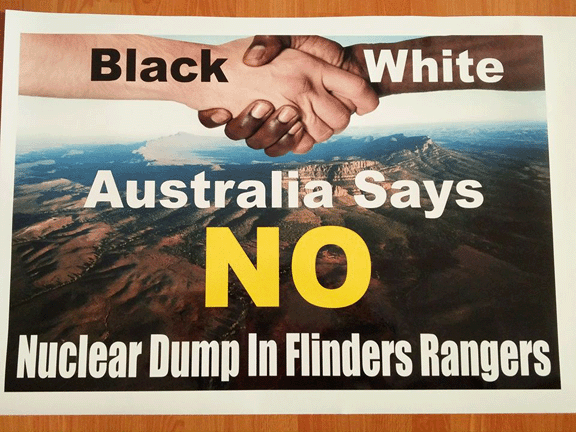 Fight To Stop Nuclear Waste Dump In Flinders Ranges SA, 30 Nov 16 TheNational Radioactive Waste Management Facility project team was invited to Kimba, South Australia, last week by the local group Working for Kimba’s Future.
The team discussed with locals the possibility of Kimba rejoining the process to nominate a site to host the National Radioactive Waste Management Facility.
The team will visit Kimba again on December 6, 7 and 8.
Tiny outback town divided over plan for federal nuclear waste dump
 One misapprehension in this otherwise excellent article.
Residents of Hawker say it has been incredibly confusing that the proposed intermediate-level facility in their community is being discussed at the same time as plans for future high-level nuclear storage elsewhere.
Despite the government saying that many of the jobs and development opportunities near Hawker will benefit the indigenous people at Yappala, McKenzie says they will continue fighting the proposal to the end.
Australian nuclear waste dump divides tiny outback town“This land is our past, present and future and we don’t want a nuclear waste dump on it.”, Aljazeera, by Jarni Blakkarly, 29 Nov 16
While the mountains are named after the British explorer who trekked them in the early 19th century, the indigenous Adnyamathanha people have lived in the region for tens of thousands of years.
This arid and remote part of South Australia has become the unlikely centre of a heated public debate after it was named the preferred site for the country’s first nuclear waste dump. Continue reading
“Medical” uses do not justify Lucas Heights nuclear reactor, nor a Flinders Ranges nuclear dump
Solid forms of low-level waste include materials that have been contaminated – at Lucas Heights or in hospitals using isotopes, or in industrial firms using isotopes, and so on. Waste of this kind has accumulated at scores of places throughout Australia, but it amounts to only a tenth of all radioactive waste, the rest coming from Lucas Heights
A NEW REACTOR? It’s the worst possible option! Nuclear Study Group Sutherland Shire Environment Centre 1998 By R.D. (Bob) Walshe, OAM
Chairman, Sutherland Shire Environment Centre
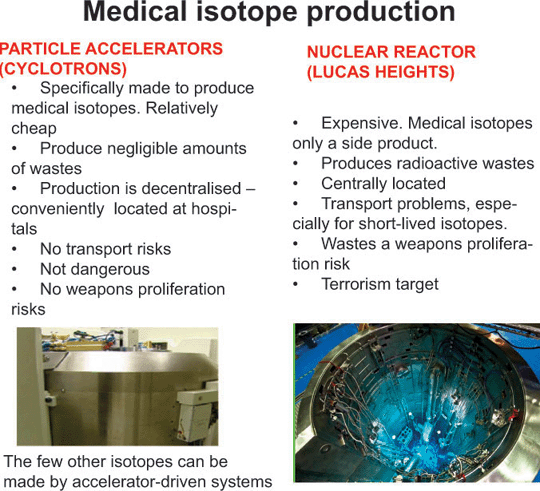
- Medical isotopes can be produced by non- reactor technology, such as cyclotrons, which are much cheaper and safer and are powered by electricity.
- Claims that a reactor serves Australia’s ‘national interest’ do not withstand scrutiny……
‘Medical uses’ don’t justify a new Reactor
Life-saving? In fact reactor-produced medicine won’t save many lives, if only because over 98% of it is used in diagnosis, not in life-saving therapy.
The Minister should have spoken more moderately. Reactor-based nuclear medicine is only one among many medical technologies used in diagnosis. The Minister didn’t explain why he was favouring it over all other diagnostic technologies by heavily subsidisingit through a new hugely expensive reactor. Nor, indeed, why a new reactor is needed when the bulk of nuclear medicine consists in the supplying of medical isotopes that can be obtained much less expensively from sources other than a Lucas
Heights reactor? Consider…
- Most importantly, cyclotrons increasingly produce isotopes and so render a reactor unnecessary (see cyclotrons, p.13); they are cheaper and safer and produce only small quantities of low-level radioactive waste.
- Nearly all countries in the world import the isotopes they need.
- ANSTO, the Australian Nuclear Science and Technology Organisation, itself imports them when it shuts the reactor for maintenance.
- ANSTO’s isotope operations are indeed heavily subsidised, and thus are not really competing economically with those of large overseas suppliers.
- While ANSTO argues that its most-used isotope technetium-99m can’t be
imported because it has a currency (technically, a ‘half-life’) of only six
hours, ANSTO neglects to say that an equally effective, longer-lived
isotope, molybdenum-99, is widely transported all around the world.
So, by using two cheaper alternatives – importation of some isotopes and production of others in cyclotrons – Australia would save itself the huge expense of this new reactor. It’s as simple as that. And safer too……
ANSTO has been stockpiling such waste for 40 years, and there it sits at Lucas Heights….
Not that ANSTO and the Federal Government haven’t tried to get rid of all this embarrassing waste. They have continually invited any and every state government to set up a dump-site (a ‘repository’) for it. But until 1998, no government would have it.
Only in February of 1998 did one government, that of economically troubled South Australia, hesitantly indicate it might accept it, at a site it considers to be ‘remote’ – but Aboriginal communities have expressed opposition. If established, such a dump would soon become ANSTO’s dump for all levels of its waste.
The long failure of the Federal Government to find a remote dump-site for radioactive waste is conclusive proof – though proof is surely not needed – of the dangerous nature of nuclear waste. So why go on creating such waste? No community wants to be saddled with the burden Sutherland Shire has carried for 40 years.
Three ‘levels’ of waste – and all dangerous
There are three general categories of radioactive waste. First, the high-level kind, chiefly the highly radioactive spent fuel rods; second, intermediate-level waste, such as results from reprocessing of spent fuel rods; third, low-level waste, such as the continual gaseous and liquid discharges from nuclear plants, and contaminated materials like gloves and instruments.
But ANSTO chooses not to follow this high-intermediate-low classification, arguing that high-level waste comes only from nuclear power-generating reactors, and since Australia’s reactor is the ‘research’ kind, its operation results only in intermediate-level and low-level waste. This is a semantic quibble which puts ANSTO at odds with US and Canadian terminology.
More than 1600 of the spent fuel rods, high – level waste, have accumulated at Lucas Heights in the past 40 years. ….. the resulting waste will be returned to Australia as ‘intermediate-level waste’, which will again constitute a problem here. Such shipments are never trouble-free: they involve safety, health and environment risks; they spark anti-nuclear protest along the route, resistance from residents around the destinations, and charges of unethical behaviour for dumping what should be one’s own responsibility onto others…. Continue reading
Why dump nuclear reactor waste in Flinders Ranges? Lucas Heights is the best place.
Regina McKenzie to Fight To Stop Nuclear Waste Dump In Flinders Ranges SA November 26
How radioactive is the nuclear waste we got back from France?
 Steve Dale to Fight To Stop Nuclear Waste Dump In Flinders Ranges SA, 26 Nov 16
44,000 times more radioactive than the Uranium Yellowcake we export
13,750,000 times more radioactive than typical Olympic Dam ore
(Yellowcake = 25,000 Bq/g, Olympic Dam ore = 80 Bq/g)
Sources:
Greenpeace report_BBC Shanghai and its nuclear waste cargo report.pdf,
odxEisAppendixSUraniumAndRadiation.pdf,
Guide-to-Safe-Transport-of-UOC.pdf
The saga of the South Australian nuclear waste import plan continues – Michele Madigan
Opposition growing to SA nuclear plan https://www.eurekastreet.
com.au/article.aspx?aeid=50250#.WDIQoNJ97Gg Michele Madigan | 16 November 2016
‘We are not a dump is SA, we want to keep it beautiful’ — Umoona Community. ‘We’ve got to think about the country’ — Ceduna. The last 30 days have seen some big developments in the ongoing attempts of SA Premier Weatherill’s plan to import high-level and intermediate level radioactive waste into South Australia.
On Sunday 6 November came the surprising decision of the Premier-initiated Citizens Jury. By the end of their six day deliberations, the 350 second round jurists showed a decided shift in opinion. Their 50 page report, presented to a somewhat discomfited Premier, had a strong two thirds majority declaring the international nuclear dump was not to go ahead ‘under any circumstances’.
Contrary to expectations, my own included, the jury, realising the bias of the royal commission and other government initiated forums, had insisted on their own choice of counter experts. Continue reading
Sunday Mail survey reveals opposition to nuclear waste dump
 A poll* commissioned by the Sunday Mail reveals that only one-third of South Australians support Premier Jay Weatherill’s plan for a high-level nuclear waste dump in SA and that public support has fallen by 14 percent in the space of just two months.
Respondents were asked to pick which nuclear facilities SA should build and they were invited to choose as many options as they liked. Of the 3702 respondents, only 35% supported an international nuclear waste repository in SA.
Dr Jim Green, national nuclear campaigner with Friends of the Earth, said: “The Sunday Mail poll finds that just one-third of South Australians support Jay Weatherill’s plan to turn SA into the world’s high-level nuclear waste dump. The results are consistent with the findings of the Citizens’ Jury. One-third of the Jury members gave conditional support to the proposal while two-thirds concluded that SA should not pursue a high-level nuclear waste dump under any circumstances.”
“A September 2016 poll** commissioned by The Advertiser found 49 percent support for the nuclear dump. Thus public support has fallen sharply from 49 percent to 35 percent in the space of just two months. If support continues to fall at that rate, Jay Weatherill may be the only South Australian supporting a nuclear dump by the time of the next state election. Even Business SA chief Nigel McBride acknowledges that the dump plan is ‘dead’ yet the Premier keeps trying to revive it.
“A majority of South Australians and a majority of SA political parties oppose Weatherill’s waste dump. South Australians opposed to the nuclear dump will be spoilt for choice at the next state election with the Liberal Party, the Nick Xenophon Team and the Greens all strongly opposed to the plan.
“The Sunday Mail survey also found that only 39.8 percent of South Australians support the establishment of a national nuclear waste dump in SA. The Premier should abandon his efforts to turn around public opposition to an international high-level nuclear waste dump in SA. He should instead defend SA against Canberra’s plan to impose a national nuclear waste dump in the Flinders Ranges and support Adnyamathanha Traditional Owners who are fighting the plan,” Dr Green concluded.
Legal obstacles – State,National, and International, to Australia importing nuclear wastes
 Nuclear waste debate re-emerges in Australia. Moulis Legal 17.11.16
“…….A long history of talk but with little “legal” support
South Australia’s proposal to encourage the world to export its high-level nuclear waste to Australia is in stark contrast to the previous positions of both the Federal and South Australian Governments. Moreover, significant reform to State laws and to existing Federal practice would be required to facilitate the proposal, none of which has been formulated.
In 1998, the responsible Federal Minister condemned a recommendation by nuclear waste management consortium Pangea Resources for a repository for international high-level nuclear waste in the Western Australian outback. He reiterated Australia’s long-standing bipartisan opposition to such a development:
…no high level radioactive waste facility is planned for Australia and the government has absolutely no intention of accepting the radioactive waste of other countries. The policy is clear and absolute and will not be changed. We will not be accepting radioactive waste from other countries.1
1 This month

of the week – Australians for War Powers Reform (AWPR)
To see nuclear-related stories in greater depth and intensity
 Antinuclear