Will Australia’s new Resources Minister Matt Canavan really listen to Aboriginal people?
 Matt Canavan has now the opportunity to correct these mistakes and engage in a truly inclusive and transparent process which actually listens to the concerns of the community and other stakeholders. Although a nuclear proponent, he should ensure that this process is not dealt with light-heartedly and pays attention to all aspects involved.
This would best be achieved through an independent inquiry into Australia’s nuclear waste and options for managing it.
Aboriginal communities all across Australia have sustainably managed the land for thousands of years, longer than any other group of people can claim. Their knowledge and concerns are valuable. Let’s hope they will be listened to.
3rd Minister in two years to handle Australia’s nuclear waste dump http://www.onlineopinion.com.au/view.asp?article=18394&page=0 Anica Niepraschk – , 22 July 2016 The recent federal election has once more seen a bit of a reshuffle in PM Turnbull’s cabinet and thereby thrown the portfolio for Australia’s national radioactive waste dump in the hands of another Minister for the third time in less than two years.
After 20 years of failed siting processes for the proposed dump, then Industry and Science Minister Ian MacFarlane only announced a new attempt in November 2014. The first half of last year saw a voluntary nomination process happen where landowners across Australia could propose their property to host Australia’s low and intermediate level nuclear waste. Out of the 28 sites nominated, six were shortlisted for further consultation and investigation last November. All six site nominations were highly contested by the local communities.
Although the government, with its new ‘voluntary’ approach promised to not impose a nuclear waste dump on any community and therefore rely on voluntary nominations and community consultation, one of these six sites, Wallerbidina/ Barndioota in the Flinders Ranges, SA, made it to the next stage of the process, despite the strong opposition of the local Adnyamathanha community at Yappala station, just kilometres away from the site.
Not only chose the government to once again, after pursuing Coober Pedy from 1998 to 2004 and Muckaty in the NT from 2005 to 2014, to target an Aboginial community but it also chose a culturally highly significant site. The proposed property, nominated by former Liberal Senator Grant Chapman, is part of a songline and hosts many cultural sites, including the beautiful Hookina springs, a sacred women’s site for the Adnyamathanha. The local community remains actively connected to the maintenance and preservation of the land and is documenting and preserving their culture and history through recording traditional heritage sites and artefacts and mapping storylines in the area. Continue reading
South Australia: Resuscitating a Nuclear Waste Nightmare
The project to bury the world’s nuclear poison in the heart of the Australian desert has not sprung out of a void. It is an idea that has been insidiously festering for two decades in a variety of incarnations.
The first stirrings of the hellish project to turn Australia into the world’s nuclear dumping ground emerged in the late 1990s when Pangea Resources, a U.K. based company promoted the construction of a commercially-operated international waste repository in Western Australia. The project was supported by a $40 million budget, 80% of which came from British Nuclear Fuels Limited (wholly owned by the U.K. government), with the remaining 20% from two nuclear waste management companies.
Australia’s Overflowing Nuclear Waste Dumps
One of the more disturbing elements of the Royal Commission report is its explicit endorsement of the progressive nuclearisation of the planet over the course of the next century. But given the make-up of the Royal Commission, this comes as no surprise.
Poison In The Heart: The Nuclear Wasting Of South Australia Counter Currents by Vincent Di Stefano — July 22, 2016 “……..It is a curious thing to observe the confidence with which the recent Nuclear Fuel Cycle Royal Commission has embraced the promotion of South Australia as the ideal destination for over one third of the world’s accumulated stores of spent nuclear fuel. This spent fuel, together with the 400,000 cubic metres of intermediate-level nuclear waste that the Royal Commission recommends be transported to South Australia, represents a problem that nations with decades-long histories of nuclear energy production have failed to resolve. The entrancement induced by a whiff of billions of dollars of new revenue presently has a closed circle of nuclear advocates and politicians straining to persuade the people of South Australia to obligingly make their way as latter-day lemmings towards a dangerous and uncharted nuclear abyss.
In the short term, the Commission calls for the transportation of vast tonnages of highly radioactive materials from around the planet for decades-long storage in above-ground facilities. In the longer term, it proposes the construction of a deep underground repository for the “permanent” burial of the most dangerous wastes produced by a destructive and senescent civilisation. Continue reading
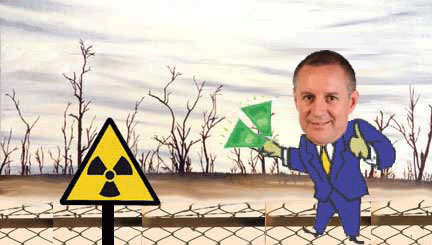
South Australia’s Premier Jay Weatherill and his Citizens’ Jury Nuclear Deception
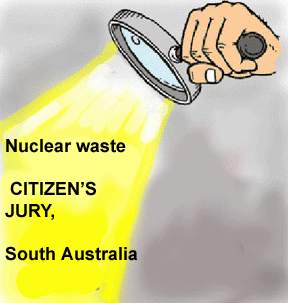 Weatherill trumps up Citizens’ Jury Report in push for SA nuke waste dump, Independent Australia 15 July 2016, Noel Wauchope, who has been covering the Nuclear Fuel Cycle Royal Commission for IA, calls SA Premier Jay Weatherill out over a sleight of hand following the Nuclear Citizen’s Report this week.
SA Premier Jay Weatherill received the Nuclear Citizen’s Jury Report on 10 July. He said that it was a “commonsense” report and that:
“they [the jury] are asking us to also change the legislation to undertake that work”
(i.e: the work of investigating overseas markets for sending nuclear wastes to South Australia)
Here’s where the sleight of hand comes in. That call to change legislation did not come from the Citizens’ Jury. It came from the pro-nuclear Nuclear Fuel Cycle Royal Commission (NFCRC), and the jury was merely doing its appointed task — which was to paraphrase the NFCRC’s recommendations. Throughout the jury process, the jury members were reminded that they had no brief to make any decisions or recommendations and they conscientiously stuck to that rule.
Now I think we know why Weatherill was so adamant that this group be called a “jury”. A later group of 350 members, will also be called a “jury”. There is some possibility that this number 350 could be taken as an adequate sample of the South Australian population of 1.712 million. So again, by regurgitating the NFCRC’s recommendations, this might conceivably be portrayed as the “verdict”of the people. That’s a lot safer than a referendum. …….
NFCRC is over, and finished, but hey — not so! The next move is a massive public advertising process and this kicked off with the recent Citizens’ Jury, which, while being organised by the South Australian firm DemocracyCo, was master-minded and controlled by NFCRC personnel. The witnesses were predominantly pro-nuclear, speakers from NFCRC were prominent and NFCRC staff were present at many, if not all, sessions.
Several times, during hearings, and Q and A sessions, the jury was reminded of the necessity to change State and Federal legislation.
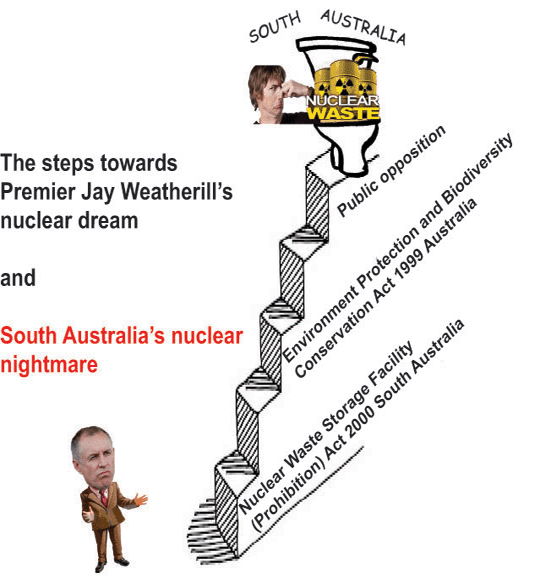
This process had, in fact, already begun, with legislative change that had to be made retrospective, seeing that the government had already spent $7.2 million on the Royal Commission. It is rare for legislation to be made retrospective. As the Greens’ Mark Parnell commented:
‘The retrospective clause is basically saying that if anyone did anything illegal we now legalise it.’
The South Australia Nuclear Waste Storage Facility (Prohibition) Act 2000 used to say:
13 — No public money to be used to encourage or finance construction or operation of nuclear waste storage facility
(1) Despite any other Act or law to the contrary, no public money may be appropriated, expended or advanced to any person for the purpose of encouraging or financing any activity associated with the construction or operation of a nuclear waste storage facility in this State
This section was amended in May 2016. The government wanted to remove Section 13, altogether. However, after several efforts on this, (Greens’ Mark Parnell objecting), Section 13 was amended, to include a new provision:
‘(2) Subsection (1) does not prohibit the appropriation, expenditure or advancement to a person of public money for the purpose of encouraging or financing community consultation or debate on the desirability or otherwise of constructing or operating a nuclear waste storage facility in this State.’
That was a small step forward for the nuclear cause.
Now for a bigger step. The government needs to drastically amend the South Australia Nuclear Waste Storage Facility (Prohibition) Act 2000. Later on, they need to get changes made to the national legislation — The Environment Protection and Biodiversity Conservation Act 1999 (the EPBC Act). They’d probably like these national powers to be removed and have these topics placed under State laws.
In building their argument for changing the law, the Weatherill Government needs to gather persuasive evidence about the proposed economic bonanza to come from importing foreign nuclear wastes. That means another round of expensive trips overseas, and a lot of advertising and promotional meetings in South Australia.
All this can now be justified, because, according to the government, the Citizens’ Jury called for more information, especially on economics, and even more importantly, called for changing the law on importing nuclear waste.
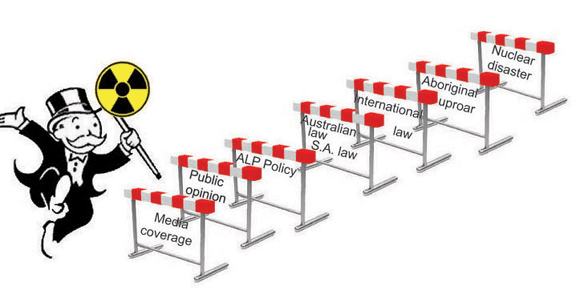
The fact that this jury group diligently summarised the Royal Commission report, without themselves making any recommendations, will almost certainly get lost in the onslaught of pro-nuclear hype that is about to descend upon the South Australian population. https://independentaustralia.net/environment/environment-display/weatherill-trumps-up-citizens-jury-report-in-push-for-sa-nuke-waste-dump,9237
No Profit in Nuclear waste
- A minimal safety margin requires that high level waste not be imported before an agreed licensed geological disposal site…
- High level nuclear waste disposal costs can double in a decade…..
- Dubious claim that disposal of nuclear waste in SA costs one quarter less than in experienced countries….
- SA faces a $60 billion debt in costs across 37 years of ongoing nuclear waste storage operations and nuclear facility decommissioning after the last receipt of overseas revenues for waste imports….
- Nuclear contingency costs are unfunded…
 Brief (July 2016) by David Noonan, Independent Environment
  Campaigner
South Australians are being misled by inflated revenue claims, untenable assumptions and under-reported nuclear waste costs. Reality check analysis shows there is no profit in nuclear waste.
Nuclear waste costs are fast rising and unrelenting for decades after the last recite of waste imports regardless of whether or not claimed revenues and fixed prices over time prove to be realistic or illusory.
The Nuclear Royal Commission Final Report Ch.5 “Management, storage and disposal of nuclear waste” and the Nuclear Commission Tentative Findings Report (p.16-20) present a nuclear waste baseline business case that is near solely reliant on a consultancy “Radioactive waste storage and disposal facilities in SA” (Feb 2016) by Jacobs MCM, summarised in Final Report Appendix J.
There is no market based evidence for the Final Report revenue assumptions and claimed income.
Claimed revenues are a tonnage based multiplier: inflated tonnage equals misleading revenues.
Claimed revenues are doubled by an assumption SA can take twice the waste the US failed to achieve. Continue reading
Indigenous opposition to the international waste dump plan
 Nuclear waste dump case unravels, World News Report, 13 July 16 , Green Left By Renfrey Clarke “……..Yankunytjatjara Native Title Aboriginal Corporation chairperson Karina Lester told a packed venue at a June 16 meeting: “The overwhelming majority of traditional owners … continue to speak out against establishing an international waste dump.”
Indigenous spokespeople have condemned the project since it was first mooted. In May last year, soon after the royal commission on South Australian involvement in the nuclear cycle began its work, representatives of 12 Aboriginal peoples met in Port Augusta.
 The gathering issued a statement that said: “South Australian Traditional Owners say NO! We oppose plans for uranium mining, nuclear reactors and nuclear waste dumps on our lands.
“We call on the Australian population to support us in our campaign to prevent dirty and dangerous nuclear projects being imposed on our lands and our lives and future generations.”
The prime site for the long-term waste repository is on the lands of the Kokatha people, near the towns of Woomera and Roxby Downs.
The Transcontinental Railway crosses the region and, as the Australian explained on June 27, the ancient rocks of the underlying Stuart Shelf are “considered by experts to have the best geological conditions for a nuclear dump”.
Early this year Dr Tim Johnson of the nuclear industry consulting firm Jacobs MCM told the royal commission his company envisaged a new port being built on the South Australian coastline to service the project. An interim storage facility nearby would hold newly-arrived wastes above ground for some decades, until they had cooled sufficiently to be transported by rail to the permanent dumpsite.
The only practical location for the port and above-ground repository would be on the western shore of Spencer Gulf, south of the city of Whyalla. Spencer Gulf is a shallow, confined inlet whose waters mix only slowly with those of the Southern Ocean. Any accident that released substantial quantities of radioactive material into the gulf would be catastrophic for the marine environment. Profitable fishing, fish-farming and oyster-growing industries would be wiped out, and the recreational fishing that is a favourite pastime of local residents would become impossible.
To connect the above-ground repository to the rail network, a new line would need to be built from the present railhead at Whyalla. Taking wastes north for permanent storage, trains would pass by the outskirts of Whyalla and Port Augusta.
Initially, the materials transported would be large quantities of low and intermediate-level waste, also planned for importation and burial. But after several decades, transport of high-level wastes would begin and would continue for another 70 years.
Awareness is growing in the Spencer Gulf region of the dangers posed by the nuclear industry. On June 24 in Port Augusta about 80 people took part in a protest against the federal plans to site a separate dump, for Australian-derived low-level radioactive wastes, near the Flinders Ranges’ tourist area………..https://world.einnews.com/article/334731841/OM4SBscz5Dp42697
South Australia Nuclear Energy Systems in talks with govt on a different nuclear waste import plan
 Mr Hundertmark said his firm’s plans were quite advanced and had already included talks with state and federal governments.
Push for high-level nuclear waste storage at Maralinga, former British atom bomb test site PAUL STARICK, CHIEF REPORTER, The Advertiser February 16, 2016 DUMPING imported high-level nuclear waste at Maralinga after shipping it through a deepwater port south of Whyalla is being pushed by a high-powered company.
In a multibillion-dollar plan similar to that recommended by the Nuclear Fuel Cycle Royal Commission, radioactive waste would be taken by rail to the former British atomic bomb test site.
SA Nuclear Energy Systems is proposing to bury the waste in giant pits, where soil and equipment contaminated during the British tests was stored in the 1990s, while the Royal Commission recommends underground storage.
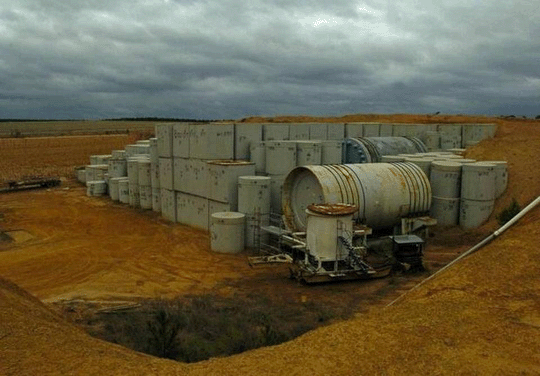
But the site criteria, such as its arid location free from seismic activity, is similar to that proposed by the Royal Commission, as is a dedicated port.
Where could a site go?
The company’s board includes former Premier’s Department chief Ian Kowalick, two Adelaide  University scientists and a former US nuclear industry executive. It is chaired by businessman Bruce Hundertmark……..In a submission to the Nuclear Fuel Cycle Royal Commission, Mr Hundertmark also highlights the fully operational air strip at Maralinga which is capable of receiving the heaviest transport aircraft……
Mr Hundertmark said his firm’s plans were quite advanced and had already included talks with state and federal governments, along with the area’s Aboriginal people, but would require state and federal legislative change.
He said his company’s plan could start far sooner than the late 2020s, because of the existing infrastructure, but did not specify a precise time frame…….http://www.couriermail.com.au/news/national/push-for-highlevel-nuclear-waste-storage-at-maralinga-former-british-atom-bomb-test-site/news-story/65d14a0d7c2f0daf90d7a5ef89da5e9f
Nuclear waste – Interim storage containers not necessarily safe
 LobbyistsRule, – comment on The Advertiser, 11 July 16
The temperatures inside these casks normally sit at 200 to 300 degrees Celcius – but if the vents of the concrete overjacket get blocked the temperature can rise to 500 degrees Celcius.
These casks have only been around for twenty years – they should start popping all over the USA in a decade or two.
All this information is available from the USA’s Nuclear Regulatory Commission web site for anyone to read. http://www.adelaidenow.com.au/news/south-australia/citizens-jury-on-sa-nuclear-waste-dump-releases-initial-report/news-story/e76096fa7ec07edcbe18ae0b989683dd
South Australia Nuclear Citizens Jury afternoon session 9 July
In this session, facilitator (probably Emily Jenke from DemocracyCo) was asking the jury to discuss and develop a consensus on the wording of their reports on several topics.
I hope that there will be a transcript of this – (a) because I missed quite a lot and (b) because the to and fro of questions between jurors is hard to follow in an attempted transcript such as I’m doing.
In fact, I learned only some of the discussion on subjects of Education, Community Consent and Trust, and Safety.
Parts that I found particularly significant –
- On Economics – how much investment does the State of South Australia have to put into development of nuclear waste importing facilities? Some jurors felt that there was not enough economic modelling. on education: when will a yes or no answer be acceptable?
- on Trust : it was stressed that this is important because the current South Australian legislation prohibits import and storage of foreign nuclear waste. We need to decide if South Australia, as producer of uranium, has a moral and ethical obligation to take back wastes. Apparently Haydn Manning in a previous hearing has suggested that there is this obligation. However, one juror stated that this was not the finding of the old Ranger Inquiry. International standards state that the society that generates the waste (i.e in nuclear reactors) has that obligation, (not the society that provides the uranium). The Royal Commission Report also states this.
- on Safety – a comprehensive report was given on this, outlining many questions. Here one juror complained that the risks had been emphasised, rather than safety. He referred the jurors back to then evidence given the previous week on radiation risks. At this point my live-stream reception cut out – just as it was getting interesting, seeing that last week’s Citizens’ jury speakers produced a whole lot of trivial nonsense on this topic.
Nuclear Citizens Jury discusses Community Consent
Enice Marsh from the Adnyamathanha Camp Law Mob led off with a clear and passionate statement on the fact that, despite the friendliness and courtesy of the Nuclear Commission’s Jon Bok, their group utterly rejects nuclear waste importing.
This discussion focused mainly on Aboriginal issues. Of course, mainly white people talking. But it is encouraging to note that these jurors showed real concern for the interests of Aboriginal people.
Some interesting discussion on whether the question of importing nuclear waste is an “ethical question or an economic question”
One juror answered firmly –
“If you read the Royal Commission’s report, it’s all about the money”
Nobody disputed that , and the facilitator moved the discussion on quickly.
A juror questioned the lack of information amongst the ordinary public, including the jurors, about radiation. This matter was not followed up.
Proposals were made that there should be no further discussion, until all potential native landowners be fully consulted, before there is any further progress in the State discussion on nuclear. waste importing. It doesn’t look as if that proposition will be taken up. It was knocked on the head by another Aboriginal speaker – Harry?
The group ended up working out a paragraph for their Final Report. – along these lines:
“We have confidence that the best consultation must be what works for the people being consulted. It should not be rushed, and this must be clear from the start.”
South Australian Greens leader shows up folly of Jay Weatherill’s nuclear waste boondoggle
| Throwing good money after bad – How the nuclear waste dump folly could wreck the State Budget | ||||
The additional $3.6m allocated in the SA State Budget to advance the case for an international nuclear waste dump means that $13m will have been spent on this deeply flawed proposal by the end of the year, according to Greens SA Parliamentary Leader, Mark Parnell MLC.
“If the Government decides at the end of this year to proceed further with the nuclear waste dump, then this amount must be budgeted for. There will be no revenue, only costs. “On the other hand, if the Government abandons this nuclear waste dump folly now, then we can cut our losses and re-allocate that money to genuinely benefit South Australians rather than impose a toxic legacy for countless future generations”, said Mr Parnell. Here are some better uses to which $600m could be spent: · Finish electrification of the Gawler line and new tram lines to make AdeLink a reality · Better cycling infrastructure · Solar panels on all public housing · Better rural health services and mental health services · Reducing payroll tax for wages paid to apprentices and trainees |
||||
Assessing the risks of Australia becoming the world’s nuclear wasteland
 Shunning nuclear power but not its waste: Assessing the risks of Australia becoming the world’s nuclear wasteland http://www.sciencedirect.com/science/article/pii/S2214629616301323 Mark Diesendorf
Abstract
The South Australian Nuclear Fuel Cycle Royal Commission has undertaken ‘an independent and comprehensive investigation into the potential for increasing South Australia’s participation in the nuclear fuel cycle’. In its Final Report, issued 6 May 2016, it acknowledges that nuclear power would not be commercially viable in South Australia in the foreseeable future. However it recommends that ‘the South Australian Government establish used nuclear fuel and intermediate level waste storage and disposal facilities in South Australia’. This is a business proposition to store a large fraction of global nuclear wastes, providing interim above-ground storage followed by permanent underground storage in South Australia. The present critical evaluation of the scheme finds that the Royal Commission’s economic analysis is based on many unsubstantiated assumptions. Furthermore, the scheme is financially risky for both Australian taxpayers and customers and has a questionable ethical basis.
Some uncomfortable questions ignored by the South Australian Nuclear Waste Dump Commission
SA Nuclear waste dump questions http://chriswhiteonline.org/2016/06/sa-nuclear-waste-dump-questions/
Nuclear un-clear: Some questions that need answers before
South Australia becomes the world’s nuclear waste dump
by Dr Tony Webb June 2016
Where is it coming from and where is it going?
• Where is this waste coming from? The Royal commission speculates about various countries wanting us to take their waste but there’s nothing definite.
• Where will it come into Australia? We’ve heard that it might come in via Darwin (unlikely) or (more likely) through a new specially built port in theSpencer Gulf. If so where is this to be built – and at what cost, paid for by whom?
• Where are the detailed engineering plans for this supposedly ‘secure’ but ‘unguarded’ underground site? No other country in the world has yet found a way to safely dispose of nuclear wastes. Several countries are trying – on a much smaller scale than proposed for South Australia – and for their own waste only.
Once again, Australian government wages nuclear war on Aboriginal people
The plan to turn South Australia into the world’s nuclear waste dump has been met with near-unanimous opposition from Aboriginal people.
The Royal Commission acknowledged strong Aboriginal opposition to its nuclear waste proposal in its final report – but it treats that opposition not as a red light but as an obstacle to be circumvented.
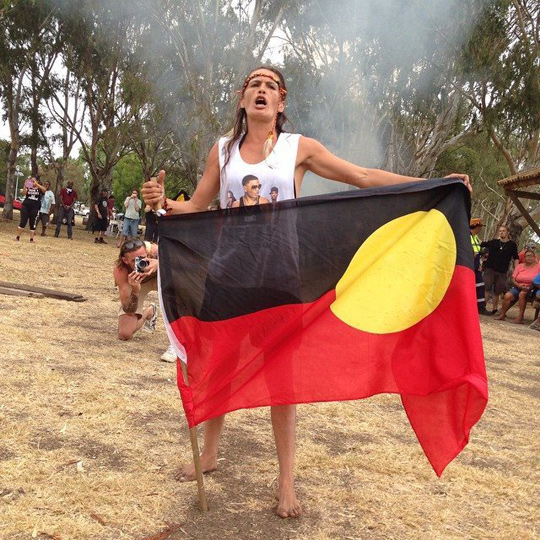
 Radioactive waste and the nuclear war on Australia’s Aboriginal people, Ecologist Jim Green 1st July 2016
Australia’s nuclear industry has a shameful history of ‘radioactive racism’ that dates from the British bomb tests in the 1950s, writes Jim Green. The same attitudes persist today with plans to dump over half a million tonnes of high and intermediate level nuclear waste on Aboriginal land, and open new uranium mines. But now Aboriginal peoples and traditional land owners are fighting back!
Then the government tried to impose a dump on Aboriginal land in the Northern Territory, but that also failed.
Now the government has embarked on its third attempt and once again it is trying to impose a dump on Aboriginal land despite clear opposition from Traditional Owners. The latest proposal is for a dump in the spectacular Flinders Ranges, 400 km north of Adelaide in South Australia, on the land of the Adnyamathanha Traditional Owners.
The government says that no group will have a right of veto, which is coded racism: it means that the dump may go ahead despite the government’s acknowledgement that “almost all Indigenous community members surveyed are strongly opposed to the site continuing.”
The proposed dump site was nominated by former Liberal Party politician Grant Chapman but he has precious little connection to the land. Conversely, the land has been precious to Adnyamathanha Traditional Owners for millennia.
It was like somebody ripped my heart out’
The site is adjacent to the Yappala Indigenous Protected Area (IPA). “The IPA is right on the fence – there’s a waterhole that is shared by both properties”, said Yappala Station resident and Adnyamathanha Traditional Owner Regina McKenzie.
The waterhole – a traditional women’s site and healing place – is one of many archeological and culturally significant sites in the area that Traditional Owners have registered with the South Australian government over the past six years. Two Adnyamathanha associations – Viliwarinha Aboriginal Corporation and the Anggumathanha Camp Law Mob – wrote in November 2015 statement:
“Adnyamathanha land in the Flinders Ranges has been short-listed for a national nuclear waste dump. The land was nominated by former Liberal Party Senator Grant Chapman. Adnyamathanha Traditional Owners weren’t consulted. Even Traditional Owners who live next to the proposed dump site at Yappala Station weren’t consulted. This is an insult.
“The whole area is Adnyamathanha land. It is Arngurla Yarta (spiritual land). The proposed dump site has springs. It also has ancient mound springs. It has countless thousands of Aboriginal artefects. Our ancestors are buried there.
“Hookina creek that runs along the nominated site is a significant women’s site. It is a registered heritage site and must be preserved and protected. We are responsible for this area, the land and animals.
“We don’t want a nuclear waste dump here on our country and worry that if the waste comes here it will harm our environment and muda (our lore, our creation, our everything). We call on the federal government to withdraw the nomination of the site and to show more respect in future.”
Regina McKenzie describes getting the news that the Flinders Ranges site had been chosen from a short-list of six sites across Australia: “We were devastated, it was like somebody had rang us up and told us somebody had passed away. My niece rang me crying … it was like somebody ripped my heart out.”
McKenzie said on ABC television: “Almost every waste dump is near an Aboriginal community. It’s like, yeah, they’re only a bunch of blacks, they’re only a bunch of Abos, so we’ll put it there. Don’t you think that’s a little bit confronting for us when it happens to us all the time? Can’t they just leave my people alone?”
Adnyamathanha Traditional Owner Dr Jillian Marsh said in an April 2016 statement:
“The First Nations people of Australia have been bullied and pushed around, forcibly removed from their families and their country, denied access and the right to care for their own land for over 200 years. Our health and wellbeing compares with third world countries, our people crowd the jails. Nobody wants toxic waste in their back yard, this is true the world over. We stand in solidarity with people across this country and across the globe who want sustainable futures for communities, we will not be moved.”
The battle over the proposed dump site in the Flinders Ranges will probably be resolved over the next 12 months. If the government fails in its third attempt to impose a dump against the wishes of Aboriginal Traditional Owners, we can only assume on past form that a fourth attempt will ensue……
Now Aboriginal people in South Australia face the imposition of a national nuclear waste dump as well as a plan to import 138,000 tonnes of high-level nuclear waste and 390,000 cubic metres of intermediate level waste for storage and disposal as a commercial venture.
The plan is being driven by the South Australian government, which last year established a Royal Commission to provide a fig-leaf of independent supporting advice. The Royal Commissioner is a nuclear advocate and the majority of the members of the Expert Advisory Committee are strident nuclear advocates.
Indeed it seems as if the Royal Commissioner sought out the dopiest nuclear advocates he could find to put on the Expert Advisory Committee: one thinks nuclear power is safer than solar, another thinks that nuclear power doesn’t pose a weapons proliferation risk, and a third was insisting that there was no credible risk of a serious accident at Fukushima even as nuclear meltdown was in full swing.
Announcing the establishment of the Royal Commission in March 2015, South Australian Premier Jay Weatherill said: “We have a specific mandate to consult with Aboriginal communities and there are great sensitivities here. I mean we’ve had the use and abuse of the lands of the Maralinga Tjarutja people by the British when they tested their atomic weapons.”
Yet the South Australian government’s handling of the Royal Commission process systematically disenfranchised Aboriginal people. The truncated timeline for providing feedback on draft Terms of Reference disadvantaged people in remote regions, people with little or no access to email and internet, and people for whom English is a second language. There was no translation of the draft Terms of Reference, and a regional communications and engagement strategy was not developed or implemented.
Aboriginal people repeatedly expressed frustration with the Royal Commission process. One example (of many) is the submission of the Anggumathanha Camp Law Mob (who are also fighting against the plan for a national nuclear waste dump on their land):
“Why we are not satisfied with the way this Royal Commission has been conducted:
Yaiinidlha Udnyu ngawarla wanggaanggu, wanhanga Yura Ngawarla wanggaanggu? – always in English, where’s the Yura Ngawarla (our first language)?
“The issues of engagement are many. To date we have found the process of engagement used by the Royal Commission to be very off putting as it’s been run in a real Udnyu (whitefella) way. Timelines are short, information is hard to access, there is no interpreter service available, and the meetings have been very poorly advertised. …
“A closed and secretive approach makes engagement difficult for the average person on the street, and near impossible for Aboriginal people to participate.”
The plan to turn South Australia into the world’s nuclear waste dump has been met with near-unanimous opposition from Aboriginal people. The Aboriginal Congress of South Australia, comprising people from many Aboriginal groups across the state, endorsed the following resolution at an August 2015 meeting:
“We, as native title representatives of lands and waters of South Australia, stand firmly in opposition to nuclear developments on our country, including all plans to expand uranium mining, and implement nuclear reactors and nuclear waste dumps on our land. … Many of us suffer to this day the devastating effects of the nuclear industry and continue to be subject to it through extensive uranium mining on our lands and country that has been contaminated.
“We view any further expansion of industry as an imposition on our country, our people, our environment, our culture and our history. We also view it as a blatant disregard for our rights under various legislative instruments, including the founding principles of this state.”
The Royal Commission acknowledged strong Aboriginal opposition to its nuclear waste proposal in its final report – but it treats that opposition not as a red light but as an obstacle to be circumvented.http://www.theecologist.org/News/news_analysis/2987853/radioactive_waste_and_the_nuclear_war_on_australias_aboriginal_people.html
Attempts to dump nuclear waste on South Australia 1998-2004
The Kungkas wrote in an open letter: “People said that you can’t win against the Government. Just a few women. We just kept talking and telling them to get their ears out of their pockets and listen. We never said we were going to give up. Government has big money to buy their way out but we never gave up.”
Radioactive waste and the nuclear war on Australia’s Aboriginal people, Ecologist Jim Green 1st July 2016 “………Dumping on South Australia, 1998-2004
This isn’t the first time that Aboriginal people in South Australia have faced the imposition of a national nuclear waste dump. In 1998, the federal government announced its intention to build a dump near the rocket and missile testing range at Woomera.
The proposed dump generated such controversy in South Australia that the federal government hired a public relations company. Correspondence between the company and the government was released under Freedom of Information laws. Continue reading
Botched clean-up of the Maralinga nuclear test site
 Radioactive waste and the nuclear war on Australia’s Aboriginal people, Ecologist Jim Green 1st July 2016 “……..The 1998-2004 debate over nuclear waste dumping in South Australia overlapped with a controversy over a botched clean-up of the Maralinga nuclear weapons test site in the same state.
The British government conducted 12 nuclear bomb tests in Australia in the 1950s, most of them at Maralinga. The 1985 Royal Commission found that regard for Aboriginal safety during the weapons tests was characterised by “ignorance, incompetence and cynicism”.
The Australian government’s clean-up of Maralinga in the late 1990s was just as bad. It was done on the cheap and many tonnes of plutonium-contaminated waste remain buried in shallow, unlined pits in totally unsuitable geology.
Nuclear engineer and whistleblower Alan Parkinson said of the clean-up: “What was done at Maralinga was a cheap and nasty solution that wouldn’t be adopted on white-fellas land.”
Dr Geoff Williams, an officer with the Commonwealth nuclear regulator, the Australian Radiation Protection and Nuclear Safety Agency, said in a leaked email that the clean-up was beset by a “host of indiscretions, short-cuts and cover-ups”.
Nuclear physicist Prof. Peter Johnston noted that there were “very large expenditures and significant hazards resulting from the deficient management of the project”.
Prof. Johnston (and others) noted in a conference paper that Traditional Owners were excluded from any meaningful input into decision-making concerning the clean-up. Traditional Owners were represented on a consultative committee but key decisions – such as abandoning vitrification of plutonium-contaminated waste in favour of shallow burial in unlined trenches – were taken without consultation with the consultative committee or any separate discussions with Traditional Owners.
Federal government minister Senator Nick Minchin said in a May 2000 media release that the Maralinga Tjarutja Traditional Owners “have agreed that deep burial of plutonium is a safe way of handling this waste.” But the burial of plutonium-contaminated waste was not deep and the Maralinga Tjarutja Traditional Owners did not agree to waste burial in unlined trenches – in fact they wrote to the Minister explicitly dissociating themselves from the decision.
Barely a decade after the Maralinga clean-up, a survey revealed that 19 of the 85 contaminated waste pits have been subject to erosion or subsidence.
Despite the residual radioactive contamination, the Australian government off-loaded responsibility for the contaminated land onto the Maralinga Tjarutja Traditional Owners. The government portrayed this land transfer as an act of reconciliation. But it wasn’t an act of reconciliation – it was deeply cynical. The real agenda was spelt out in a 1996 government document which said that the clean-up was “aimed at reducing Commonwealth liability arising from residual contamination.”……http://www.theecologist.org/News/news_analysis/2987853/radioactive_waste_and_the_nuclear_war_on_australias_aboriginal_people.html
1 This month

of the week – Australians for War Powers Reform (AWPR)
To see nuclear-related stories in greater depth and intensity
 Antinuclear