Globally unprecedented scale of Nuclear waste shipments target Australia:
 Nuclear Waste Brief by David Noonan, Independent Environment Campaigner. 3 June 16 An un-declared Australia port is targeted to receive a globally unprecedented scale of high level nuclear waste transport and shipping, facing some 100 000 tonnes of SNF waste over a circa 33 year period of proposed peak Nuclear port operations from project Year 11 to Year 45 (Jacobs MCM, Executive Summary, Figure 3 Timeline of spent fuel transfers, p.5).
This is some 25 per cent higher than the global total of 80 000 tonnes of SNF waste shipped around the world in a 45 year period since 1971 according to the World Nuclear Association report “Transport of Radioactive Materials” (Sept 2015) and the Jacobs MCM consultancy (p.152).
A total of 30 000 tonnes of high level nuclear wastes were shipped to the UK Sellafield reprocessing facility and a total of 40 000 tonnes was shipped to the French La Hague reprocessing facility, by far the world’s largest nuclear ports, in the 45 year period since 1971 (WNA report).
An undeclared Australian port is targeted to take over three times the total tonnage of high level nuclear waste shipped to Sellafield and two and a half times the total tonnage shipped to La Hague.
Some 400 waste ships of high level nuclear waste, totalling 90 000 tonnes SNF waste and requiring 9 000 transport casks, are to be brought into Australia in a 30 year period of peak port operations.
In a comparable 30 year period, there were some 160 high level nuclear waste shipments from Japan to Europe from 1969 to late 1990’s, totalling 7 040 tonnes SNF waste and involving some 4 000 nuclear waste transport casks (WNA report).
Sweden has shipped over 4 500 tonnes SNF waste around the Swedish coast to their CLAB central interim storage facility by mid-2015 (WNA report). Australia is proposed to do so every 18 months.
Questions on the location of a Nuclear port and on the safety of waste shipments:
The SA State government must publicly explain the basis for the farcical claim made by Jacobs MCM (Introduction p.11) of “an abundance of locations” suitable for deep sea Nuclear port sites in SA.
Is a new deep sea Nuclear port and high level SNF waste storage site to be imposed in the coastal region south of Whyalla? Or as reported in The Australian “World’s nuke waste may pass through NT, SA” (12 May 2016): Is the Port of Darwin also in the Nuclear target range?
The Final Report Concludes: “…if a cask was lost at sea and was irrecoverable, there is a potential for some members of the public consuming locally sourced seafood to receive a very small dose of radiation”; and Concludes that terrorist attack scenarios are conceivable and rocket attack has the greatest potential to cause a release of radiation (Appendix L – Transport risk analysis p.312).
A further Jacobs MCM desk top Concludes that radioactivity that escapes from an unrecovered and degrading cask is expected “to be diluted in thousands of cubic kilometres of seawater” (“Safety and risks in the transportation of radioactive material to and from Australia”, April 2016, p.50). see http://www.nodumpalliance.org.au/
New DemocracyCo’s co-CEO Emily Jenke says Citizens’ Jury not about manufacturing nuclear consent
Nuclear jury about the big picture, not manufacturing consent. InDaily, Tom Richardson, 3 June 16 The citizens’ jury beginning this month to debate South Australia’s nuclear future is not an attempt to manufacture the “social consent” alluded to by Royal Commissioner Kevin Scarce, but a bid to establish whether it exists, says one of the architects of the forum.
InDaily can reveal that SA-based startup DemocracyCo has won the tender to deliver the first of the two planned Citizens’ Juries, to be held over two weekends, beginning on June 25.

The company, which also convened last year’s forum on dog and cat management, will oversee a randomly-selected congregation of 50 South Australians to ponder issues surrounding the prospective local establishment of a high-level nuclear waste dump. The jury selection process was conducted by a separate company, the Sydney-based New Democracy Foundation.
New DemocracyCo’s co-CEO Emily Jenke told InDaily the process was part of a broader body of work whose aim was not to engineer public support, but to “get an understanding by the end of the year as to whether the community are comfortable continuing this discussion”.
“This process… is about understanding; it’s not trying to build social consent, but understanding whether it’s there or not,” Jenke said. Continue reading
Nuclear port in Australia to receive and store High level Nuclear Wastes
 The first high level nuclear waste shipment imposes untenable & unfunded liabilities on Australia, without a disposal capacity or even a site, and facing proposed decades of above ground storage.
David Noonan, 3 June 16 Nuclear port in Australia to store High level Nuclear wastes and receive waste ships every 24 to 30 days for decades:
The SA Nuclear Royal Commission Final Report (9 May 2016, 16 Mb) recommends a deep sea Nuclear port in Australia to receive an average 3 000 tonnes of high level Spent Nuclear Fuel (SNF) waste per year throughout the first three decades of proposed operations.
“In summary, the report recommends: Management, storage and disposal of waste, Recommendation: Pursue a purpose-built waste storage and disposal facility for used nuclear fuel. … The Commission’s firm conclusion is that this opportunity should be actively pursued, and as soon as possible.” (Nuclear Commission, Report Delivered, 9 May)
The Nuclear Commission report is based on a desk top nuclear waste consultancy “Radioactive waste storage and disposal facilities in SA” (Feb 2016) by Jacobs MCM, stating baseline requirements for:
the proposed Nuclear port is to take a total of 138 000 tonnes of high level nuclear waste (equivalent to 1/3 of total global SNF waste) over some 70 years from Project Year 11;
a “dedicated port facility specifically developed to transfer the canisters from the delivery ship to rail for transportation to the facility site” stating a “greenfield port is proposed”, with an allowance of A$100 million in baseline costs for the development of the port.
(Jacobs MCM, Enabling infrastructure, Port facilities, p.136);
“…estimated receivals of 3,000 tonne of SNF per year. With typical capacity per cask of 10 tonnes , this translates as 300 casks per year, requiring 12-15 sailings (nuclear waste shipments) per annum, meaning one ship each 24-30 days on average.” At 200 – 250 tonnes SNF waste per ship.(Jacobs MCM, Immediate port receival laydown area, p.170);
the proposed Nuclear port is to store high level nuclear waste on site, with a “minimum immediate port storage capacity for casks unloaded from ships suggested as 28 waste casks” required a storage capacity of some 280 tonnes of high level SNF waste, at an average timeline of 10-12 days to clear a shipment of 20 waste casks from the port (p.170). A loaded high level nuclear waste transport cask weighs in range of 100 to 140 tonnes (by type);
In addition, the proposed Nuclear port is required to receive some 390 000 cubic metres of intermediate level nuclear wastes. At a rate of 10 000 m3 per year for the first 28 years of operations (equating to circa 600 x OSO shipping containers per year) stepping down to circa 4 000 m3 per year over the following proposed 24 years of port operations (p.161 and 172).
The proposed Nuclear port is itself to become a high level nuclear waste dump holding SNF wastes (280 tonnes) equivalent to some 14 years operations of a nuclear power reactor. “A typical nuclear power plant in a year generates 20 metric tons of used nuclear fuel” (US Nuclear Energy Institute).
The first high level nuclear waste shipment imposes untenable & unfunded liabilities on Australia, without a disposal capacity or even a site, and facing proposed decades of above ground storage.
Doubts about the integrity of South Australia’s “Citizens’ Jury” nuclear waste plan
 I am in fact, in favour of the Citizens’ Jury Idea. Instead of us being ‘talked down to’ by experts, (who are likely to have a vested interest in the nuclear waste import plan), ordinary non experts hear all the evidence and opposing opinions, discuss these, and come up with a sensible verdict.
After all, that is what we expect in a criminal trial. We do not trust the verdict to “experts” although we do expect their opinions to be heard.
My problem with the South Australia’s Citizens’ Jury on nuclear waste importing is that it doesn’t seem to be given a truly jury role.
The letter sent to potential jury participants says that their task will be to produce an independent guide to help every South Australian understand the recommendations raised by the Royal Commission’s report.
No mention of a verdict on whether or not the jury thinks that the nuclear waste import plan should go ahead.
The organisation running the process, newDemocracy, is using a trademarked definition of ‘Citizens’ Jury’ That trademark belongs to the Jefferson Center. They define the term;
The Citizens Jury convenes diverse groups of citizens to study an issue deeply, discuss different perspectives on the issue, and recommend a course of action or craft their own solutions to address the issue at hand.
I would like to give newDemocracy the benefit of the doubt. Their all too brief notes on this plan do end with this statement:
The first stage of the project will run from May through November 2016, and results in a gateway decision as to whether or not there is broad social consent to continue to pursue opportunities related to the Nuclear Fuel Cycle.
Will the Citizens’ jury be able to say NO to nuclear waste importing for South Australia?
 Just how strictly controlled the process is becomes obvious when it emerges that the task of those 50, during two weekend meetings in June and July, will be to produce ‘a short independent guide to help every South Australian understand the recommendations raised’ by the report.
ABC news dubbed this whole process the Premier’s ‘public relations exercise’, and surely they’re not wrong.
The Premier is urging all South Australians to remain ‘open’ about the proposal. But are they, including the Citizens’ Jury, allowed to be open to refusal?
SA Premier coopts democracy for nuclear nefariousness http://www.eurekastreet.com.au/article.aspx?aeid=48345#.V0eKYTV97Gg Michele Madigan | 25 May 2016
 I was trying to think what the invitation reminded me of. It took me a moment, but then I had it: the Project for the New American Century, the neo-conservative think tank and ‘educational’ organisation that went on to play a key role in shaping the foreign policy of the George W. Bush administration.
It’s a different time and different circumstances, but there was something about this invitation — a joint missive from the Premier of South Australia and the newDemocracy Foundation — that seemed to resonate with that ominous American institution; a sense that democratic ideas such as consultation and partnership were being co-opted for nefarious ends. In the address section of the envelope, in beautiful script, the partnership was emphasised: ‘An Invitation from the Premier and the newDemocracy Foundation’.
The gold and black lettered document was an invitation ‘to take part in the Citizens’ Jury of the Nuclear Fuel Cycle Royal Commission’s report’. This Citizens’ Jury will take place now that Royal Commissioner Kevin Scarce has handed down his final report, with the primary extraordinary recommendation that South Australia invite high-level radioactive waste from overseas. Continue reading
Xenophon wants nuclear waste referendum, but only AFTER a dump site is selected
Independent Senator Nick Xenophon might vote against company tax cuts, seeks referendum on nuclear waste dump, The Advertiser May 26, 2016 Political Reporter Peter Jean INDEPENDENT Senator Nick Xenophon wants a referendum to decide whether South Australia should be home to a nuclear waste dump……
 After a South Australian Press Club election debate on Thursday, he told The Advertiser that a waste dump referendum should happen once a location was decided.
“The people of SA should have a direct say on it,” he said. If the state referendum passed, it is likely the federal Parliament would pass the legislation needed at that level…..http://www.adelaidenow.com.au/news/south-australia/independent-senator-nick-xenophon-might-vote-against-company-tax-cuts-in-senate/news-story/0207bb0fe9c9fd5761d2ab8b474942
Federal Liberal and Labor support nuclear waste import: Xenophon suggests referendum
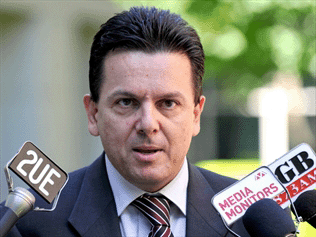 Xenophon calls for SA nuclear referendum http://www.9news.com.au/national/2016/05/26/15/09/sa-needs-nuclear-referendum-xenophon South Australia should hold a referendum on whether to host a high-level nuclear waste dump, independent senator Nick Xenophon says.
The decision to host the dump would have far-reaching consequences, Senator Xenophon told an SA Press Club debate on Thursday.
“If we had a high-level dump it will be around for tens of thousands of years,” he said.
Premier Jay Weatherill has consistently rejected the idea of a referendum, saying the government will instead pursue “qualitative” consultation.
The government will receive feedback from two citizen juries and a bipartisan parliamentary committee.
A decision to host a high-level dump appears likely to be supported at a federal level regardless of who wins the July election.
Education Minister Simon Birmingham said the Turnbull government would change laws to facilitate a dump if the state government wanted to host one.
 Labor Senator Penny Wong expressed misgivings about a nuclear dump but praised the state government’s public consultation.
“I share some of the concerns which have been raised in the community about this,” she told the debate.
“I think the process Jay and the government are going through and the way in which they’re approaching it is the right one. That process itself will yield the outcome. It will have community support or it won’t.”
The Greens remained strongly opposed to a nuclear dump, South Australian senator Sarah Hanson-Young said. http://www.9news.com.au/national/2016/05/26/15/09/sa-needs-nuclear-referendum-xenophon#lR58JolbQ0ZlvYfC.996/15/09/sa-needs-nuclear-referendum-xenophon#lR58JolbQ0ZlvYfC.99
Indigenous owners put Minister Frydenberg on the spot about nuclear waste dump
 Indigenous owners appeal to Minister’s ‘human side’ to shelve proposed nuclear waste site, ABC News By Alex Mann, 27 May 16
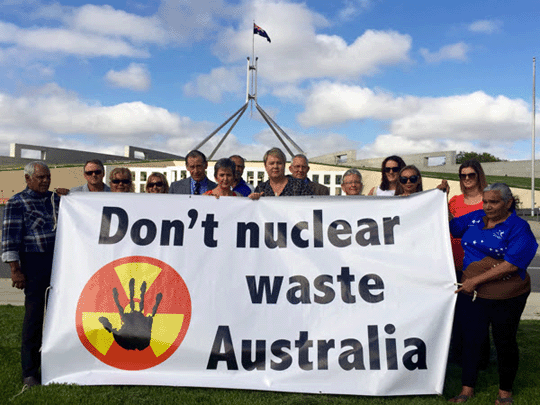
Wallerberdina Station part-owner Grant Chapman did not consult the neighbouring Adnyamathahna community before nominating his land as a nuclear waste site. Opposition to the Federal Government’s proposed nuclear waste facility in the Flinders Ranges is heating up, with traditional owners travelling to meet with Federal Resources Minister Josh Frydenberg to demand the Government shelve its plans.
Traditional owner Regina McKenzie said she hoped travelling the more than 1,000 kilometres to Melbourne would appeal to the Minister’s “human side” and get him to change his mind.
“It’s always, every waste dump is near an Aboriginal community,” she told 7.30.
“Don’t you think that’s a bit confronting for us? When it happens to us all the time?”
Ms McKenzie is also a member of Viliwarina Yura, the corporation that was granted the land neighbouring the proposed waste site in 2000. Now she has teamed up with veteran anti-nuclear campaigner Dave Sweeney to take her message across the country.
Mr Sweeney told 7.30 that as the national anti-nuclear campaigner for the Australian Conservation Foundation, and with more than 20 years experience in nuclear issues, he would use his connections, contacts and ability to amplify the story.
“It just feels disturbingly familiar, and disturbingly like we’re replicating past mistakes,” he said.
Mr Frydenberg declined 7.30’s request for an interview but acknowledged in a statement that “legitimate issues have been raised about the Indigenous heritage in the broader area”. As a result, he said the Government would undertake a “comprehensive and independent heritage assessment and further consult with key stakeholders before any final decisions are made”.
But the traditional owners maintain that nowhere would be acceptable.
Local Indigenous owners not consulted
This is just the latest front in a battle around nuclear waste that has raged for decades…….http://www.abc.net.au/news/2016-05-26/local-indigenous-owners-protest-hawker-nuclear-dump/7449124
Politicians selling out Australian ports to nuclear waste transport
 Darwin at Center of Nuclear Waste Controversy The Maritime Executive, By MarEx 2016-05-23 The Maritime Union of Australia (MUA) has said it will fight any plans to allow the world’s spent nuclear fuel rods and radioactive waste to enter Australia through the Port of Darwin.
The MUA is outraged that Northern Territory Chief Minister Adam Giles has offered to accept the waste which would then be transported thousands of kilometers to South Australia.
“Mr Giles is happy to sell out Territorians so that Malcolm Turnbull can use them as a dirty rag for his own personal gain and to benefit his top end of town mates,” MUA Northern Territory branch secretary Thomas Mayor said.
“It’s like putting Homer Simpson in charge of nuclear waste and his big business “Mr Burns” mates are rubbing their hands together. All the while Chief Clancy, aka Natasha Griggs, is none the wiser.”…….
Turnbull has already sold out Australian shipping, says Mayor. “Not only will foreign flagged ships carry the hazardous cargo, but the port that they are taking it to will also be run by foreign interests.”
Mayor said there was no agreement with traditional land owners to use their land……http://www.maritime-executive.com/article/darwin-at-center-of-nuclear-waste-controversy
No change to Labor’s policy against importing nuclear waste – National President Mark Butler
 Labor National President Mark Butler raises doubts about international nuclear waste dump proposed for South Australia, Adelaide Now , 19 May 16 LABOR national president and Port Adelaide MP Mark Butler has poured cold water over the proposal for an international nuclear waste storage facility to be located in South Australia.
The State Government will need federal approval if it decides to adopt Royal Commissioner Kevin Scarce’s recommendation for the international waste dump.
Labor’s national policy platform prohibits further Australian involvement in the nuclear fuel cycle beyond uranium mining — including the importation of foreign nuclear waste.
Mr Butler, federal Labor’s environment spokesman, said Wednesday the case was yet to be made for a waste dump in SA.
“I think it’s still a very open question about whether the South Australian community will accept that or not,’’ Mr Butler said during a debate with Environment Minister Greg Hunt at the National Press Club in Canberra.
“Our position as federal Labor is that no case has been made to change our longstanding platform about this issue.’’….http://www.adelaidenow.com.au/news/south-australia/labor-national-president-mark-butler-raises-doubts-about-international-nuclear-waste-dump-proposed-for-south-australia/news-story/12626f088948b5b9e72953e65ac2dd30
Maritime Union of Australia will fight plans to import world’s nuclear waste
Despite Northern Territory legislation preventing the transport and storage of nuclear waste, Mr Giles met with the South Australian Premier to discuss the nuclear royal commission findings and to hatch a rail or road transport plan.
MUA Fights Plans to Contaminate Aussie Hands with World’s Nuclear Waste, 18 May 16
The Maritime Union of Australia will fight any plans to allow the world’s spent nuclear fuel rods and radioactive waste to enter Australia through the Port of Darwin.
The MUA is outraged NT Chief Minister Adam Giles has gone out of his way to not only offer to accept the hazardous cargo, but then transport it through Territorian communities to its destination in South Australia.
“Mr Giles is happy to sell out Territorians so that Malcolm Turnbull can use them as a dirty rag for his own personal gain and to benefit his top end of town mates,” MUA NT branch secretary Thomas Mayor said.
“It’s like putting Homer Simpson in charge of nuclear waste and his big business “Mr Burns” mates are rubbing their hands together. All the while Chief Clancy, aka Natasha Griggs, is none the wiser.”
The MUA says the move further compromises Australia’s national security.
“Malcolm Turnbull allowed the strategic Port of Darwin to fall under the control of Chinese company Landbridge, when it was granted a controversial 99 year lease,” Mr Mayor said.
“If his counterpart Adam Giles is successful then he will be allowing a foreign company oversight of high level nuclear waste.
“Turnbull has already sold out Australian shipping. Not only will foreign flagged ships carry the hazardous cargo, but the port that they are taking it to will also be run by foreign interests.
The MUA warns the plan would see high level hazardous waste transported thousands of kilometres through many Territorian communities to South Australia.
Mr Mayor said there was no agreement with traditional land owners to use their land.
“Yet again, Natasha Griggs is silent on an important issue to the people she purports to represent. Has she or any of her CLP counterparts even consulted with the traditional landowners, the Larrakia people?”
Despite Northern Territory legislation preventing the transport and storage of nuclear waste, Mr Giles met with the South Australian Premier to discuss the nuclear royal commission findings and to hatch a rail or road transport plan.
The Commission report says it takes 500 years for the most radioactive elements of high level waste to decay and total isolation from the environment is needed for hundreds of thousands of years.
Global nuclear waste dump for South Australia is opposed by women and Labor voters
Women and Labor voters opposed to international nuclear waste dump in South Australia, poll finds, Adelaide Now, March 21, 2016 PETER JEAN, POLITICAL REPORTER The Advertiser PREMIER Jay Weatherill will need to win the support of women and his own Labor voters if the State Government decides to back the construction of an international nuclear waste storage facility in South Australia.
The results of a new opinion poll show almost 60 per cent of women and most Labor voters are opposed to a global nuclear waste facility being located in the state.
The ReachTEL Poll of 1077 SA residents conducted on March 10 found that 37 per cent of voters supported of voters supported an international nuclear waste dump, 48.5 per cent were opposed and 14 per cent were undecided….
Australia Institute executive director Ben Oquist said South Australians were increasingly aware of the risks posed by the project, including the damage it could do to the state’s reputation.
“I think people are increasingly wise to the projects that are jobs-rich, versus those that are expensive, likely to involve a large upfront government subsidy and won’t produce long-term jobs,’’ Mr Oquist said.
“Those industries that are jobs-intensive are potentially put at risk by South Australia’s brand being threatened by a global nuclear waste dump.’’….. http://www.adelaidenow.com.au/news/south-australia/women-and-labor-voters-opposed-to-international-nuclear-waste-dump-in-south-australia-poll-finds/news-story/35d4ad38cadbaae4798ca89e91c74f5f
Electoral suicide for Labor? The nuclear waste dump plan.
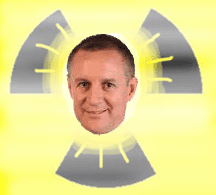 from “Sanity” “Mr Weatherill is understood to be favouring a political decision taken without the delay and additional hassle of a referendum.” Sorry Jay, but it is reasonable to go to the “hassle of a referendum” when the the decision has such a significant impact upon our state and citizens.
Tom Koutsantonis threatened the Liberal party with a referendum on the issue (a nuclear waste dump in SA) so it would be beyond hyporitical (even for a politician) for him not to require one now.
Daniel, could you publish the results of the ‘Advertiser -Galaxy’ poll here too?
Earlier this week a survey of ‘AdelaideNow’ readers gave the following results:
Are you in favour of a nuclear waste dump in SA?
No: 61.04% (1,648 votes)
Yes: 35.63% (962 votes)
Undecided: 3.33% (90 votes)
Which indicates certain electoral suicide for any party that allows SA to become a nuclear dump.
Citizens’ Juries can be a valuable guide in nuclear decision-making
The role of Citizens’ Juries in decision-making on nuclear waste importation, Online opinion, By Noel Wauchope 13 May 2016 On May 10th South Australian Premier Jay Weatherill announced the process by which the state will decide whether or not to host a global nuclear waste import industry, as recommended by the Nuclear Fuel Cycle Royal Commission.
The first step will be to set up a “Citizens’ Jury” of 50 participants randomly selected from 25,000 invitees statewide, to be followed later by another one of 350 participants.
I think that Weatherill might have mistaken his terms here, as a Citizens’ Jury, by definition, means a group of 10 to 12 participants. The Weatherill plan sounds more like a “Deliberative Poll”, which involves a much larger group.
A properly constituted Citizens’ Jury can be a valuable process in participatory democracy. The group of 10 or 12 people serves as microcosm of the public. …… The process depends on having the oversight of a neutral but well informed advisory panel. Questions need to be framed in a way that does not risk influencing the response. Transparency is important, and complete audio or video recordings of all jury hearings should be publicly available, although the actual jury room deliberations should be private.
The citizen jury process can be an empowering one for the participants, and, as long as it is perceived to be fair and transparent, can be a valuable democratic option for assessing public opinion. It also has the advantage of being cost-effective.
The “Deliberative Poll” method is potentially another very useful form of participatory democracy. It is a lot more expensive, and more complicated. The biggest disadvantage of the Deliberative Poll method is probably its cost. Wikipedia notes:
“Imagine how much money is needed to pay for the trips, the hotel and the food for each participant, hiring the research crew and moderators, booking a venue, etc. Additional costs can include paying for participants’ compensation so that people that are randomly selected can put aside their duties to attend the events (i.e. hiring someone to milk a participant’s cow and providing child care”
Some critics insist that funding for either of these processes should not come from on single body.
“Multiple sources of funding help to ensure that the jury’s organisers are not seen as having a financial interest in producing a verdict that supports the interests of a single funding body. To maximise the scrutiny they provide, the two or more funders should have somewhat opposing interests regarding the subject likely to be under discussion.”……
In Japan, in 2012, a Deliberative Poll formed the guide to government decision-making. The Japanese government used the Center for Deliberative Democracy’s Deliberative Polling method to both inform participants and allow them to influence policymakers about the public’s will with regard to energy production issues. As a direct result of the deliberative polling process, Japan’s national government pledged to have zero percent dependency on nuclear energy after 2030. (This decision was overturned by a later government).
The South Australian government’s decision to start with a participatory democracy process is a welcome one, provided that it is done fairly and properly. Neither a Citizens Jury nor a Deliberative Poll can be a substitute for a fully democratic process like a referendum, but either could be a valuable contributor to a wider process of decision making. http://www.onlineopinion.com.au/view.asp?article=18230
Olympic Dam for nuclear waste? BHP does not agree
 Have these people read BHP’s Submission to the Nuclear Fuel Cycle Royal Commission?
BHP clearly states that it doesn’t want to have any involvement in storage or disposal of nuclear waste:
“Irrespective of whether storage or disposal is preferred, BHP Billiton considers that either option would be inconsistent with our core business of mining and the production of high quality copper and associated by-products at Olympic Dam.” – http://nuclearrc.sa.gov.au/app/uploads/2015/11/BHP-Billiton-03-08-2015.pdf
Olympic Dam mooted as nuke dump site The area around BHP Billiton’s Olympic Dam site has been raised in informal discussions within government as a prospective site for a future high-level nuclear waste dump, InDaily can reveal. INDAILY, Tom Richardson, 12 May 15, While a decision on whether to proceed with an international nuclear repository – as strongly recommended by this week’s Scarce Royal Commission final report – won’t be made until November at the earliest, it’s understood the viability of the Stuart Shelf region of the Gawler Craton, much of which is covered by the Olympic Dam indenture agreement, is “a question that’s been asked” in State Government circles.
The discussions also raised the prospect of an approach to Oz Minerals, whose Prominent Hill operation is around 130km northwest of Olympic Dam…….
It’s understood the Rann Government approached BHP in its first term to canvas using Olympic Dam for a low-level state repository, a suggestion the company declined.
It has since maintained that stance, unsurprisingly given the relatively low financial return of such an enterprise, saying in February that it had not been shortlisted for the national waste repository for low and intermediate level waste “and we expect this process to run its course”……http://indaily.com.au/news/2016/05/12/olympic-dam-mooted-as-nuke-dump-site/
1 This month

of the week – Australians for War Powers Reform (AWPR)
To see nuclear-related stories in greater depth and intensity
 Antinuclear