Legal battle ahead for The Australian govt’s plan to impose nuclear waste dump on sacred Aboriginal land
 Plan for Flinders Ranges nuclear waste dump faces legal battle MEREDITH BOOTH, VERITY EDWARDS THE AUSTRALIAN MAY 5, 2016 Environmentalists and traditional owners say eight years of legal wrangling, which saw the withdrawal of Muckaty Station in the Northern Territory as a site for a nuclear waste dump, is a precedent for the fight they are prepared to wage against a dump planned in South Australia.Wallerberdina Station, part-owned by former Liberal senator Grant Chapman and adjoining Adnyamathanha sacred sites in the northern Flinders Ranges more than 550km north of Adelaide, has been chosen ahead of five others as the preferred site for a national low-level nuclear waste dump.
The decision was made independently of the state’s Nuclear Fuel Cycle Royal Commission, which hands down its findings tomorrow and is expected to recommend that the state stores high-level radioactive waste from overseas.
Conservation Council of South Australia chief executive Craig Wilkins said he hoped the fight to stop the Wallerberdina dump did not reach court, but he was prepared to support a legal battle. “Muckaty Station was an eight-year campaign. We’re deeply hopeful that we don’t need to do that again,’’ he said yesterday. “Not only is it incredibly sacred country for the Adnyamathanha people, the land is subject to flash flooding and frequent earthquake activity.’’
Elder Regina McKenzie, who lives next to the station, said she was prepared to go to court to prevent a nuclear waste dump being built on burial areas and through a 70km storyline that was particularly sacred to indigenous women.
“It’s desecration on all fronts, it’s an attack on our religion, it’s cultural genocide,” she said. “There are Aboriginal bones that have calcified and turned to stone and what right do they have to move those?”
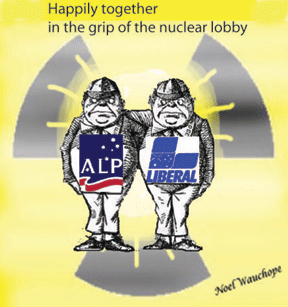 The Greens have slammed Labor and the Liberals for “teaming up” to defeat a motion calling on the government to acknowledge traditional owners’ opposition to the dump.
Federal Resources Minister Josh Frydenberg said that a final decision had not been made.
Why must we always force nuclear waste onto Aboriginal people?
What we believe is needed now is an independent and deliberative inquiry into long-term isolation and stewardship options for this material, and learning from countries overseas who are dealing with much larger inventories of this material than we are. What have they learned, long term? Isolation and stewardship of this material, rather than simply which outstation we should build the shed on.
The second thing that we believe should happen while that inquiry is underway is to properly containerise, in these 60-year licence caskets, the existing spent fuel and reprocessed material that at the moment is lying at the Lucas Heights facility. We believe that should be properly hardened and containerised, and there should be an audit of the existing collections of dispersed waste, non-reactor isotope investigations so that we are not producing this waste, and a commitment to not take international waste.
We need to respect the voices of the communities who are standing up and saying no.
 03 May 2016 | Scott Ludlam I rise this evening to speak on the long history of failed plans to locate national radioactive waste dumps here in Australia at multiple sites across South Australia, the Northern Territory and Western Australia and to point out the disturbing consistency with which it is disproportionately Aboriginal land that is targeted, Aboriginal communities who are expected to host the most dangerous categories of industrial waste that this society is capable of producing.
It seems that so little has been learnt since when long ago, in 1991 or 1992, the federal government embarked on a national site selection process to try and work out where the waste from the HIFAR reactor at Sydney’s Lucas Heights should go—more than 30 years after the reactor first went online. It probably came as something of a surprise to the community then that, 30 years after this industrial facility had started operating, there was still no coherent plan for the disposal of its waste products.
And here we are now, in 2016, and you have to ask: what on earth have we learnt in the intervening time? One thing I think we have learnt is that coercive attempts to dump radioactive waste on unwilling communities are doomed to fail. That is not just the experience here in Australia; international experience bears this out as well. And so little has been learnt from a process which, in my view and in the view of some of my colleagues, actually held some promise…..
Whether it be spent fuel, whether it be radioactive waste from the isotope plant at the Lucas Heights complex, whether it be other categories of medical waste—trash, gloves and other items—or whether it be radioactive waste of various categories from mining operations, the question ‘Which outstation should this stuff be dumped on, which Aboriginal community should host this material, at which outback site can we dump this stuff out of sight out of mind?’ is simply wrong. If we start with the wrong question, we inevitably come to the wrong answer……… Continue reading
South Australia Aboriginal land again targeted, for probably unnecessary radioactive trash dump
The Flinders Ranges site was nominated by Grant Chapman but he has precious little connection to the land. Conversely, the land has been precious to Adnyamathanha Traditional Owners for millennia. The fact that the government is once again targeting a ‘remote’ Aboriginal site is beyond comprehension and creates a lot of frustration and hurt.
“Adnyamathanha Traditional Owners weren’t consulted about the nomination. Even Traditional Owners who live next to the proposed dump site at Yappala Station weren’t consulted. The proposed dump site is adjacent to the Yappala Indigenous Protected Area.
 SA once again targeted for nuclear waste dump, http://www.onlineopinion.com.au/view.asp?article=18200, Anica Niepraschk, 2 May 16
Last Friday the government announced its preferred site for a national radioactive waste dump, near Hawker in South Australia’s Flinders Ranges. The site was nominated by former Liberal Senator Grant Chapman, who holds a long-term lease over the Barndioota station, and his nomination has been endorsed by the Liberal government in Canberra.
The latest process to find a dump site follows 20 years of failed attempts trying to force a dump on Aboriginal communities in SA and later the Northern Territory. Continue reading
The Adnyamathanha people will not be bribed: they will fight the nuclear waste dump plan
 Adnyamathanha to fight federal government’s nuclear dump planned Barndioota location.Transcontinental, Port Augusta,30 Apr 16 ADNYAMATHANHA traditional owners are vowing to fight the federal government’s plans to house a nuclear waste facility Wallerberdina Station near Barndioota in the Flinders Ranges.
The call comes as the site was shortlisted by the federal government as the possible location of Australia’s first facility of its kind on Friday morning
Adnyamathanha Traditional Owner Regina McKenzie, who lives at Yappala Station near the proposed dump site said the Adnyamathanha were not consulted about the nomination.
‘Even Traditional Owners who live next to the proposed dump site at Yappala Station weren’t consulted,” Ms McKenzie said.
“The proposed dump site is adjacent to the Yappala Indigenous Protected Area. On the land with the proposed dump site, we have been working for many years to register heritage sites with the SA government.”
Ms McKenzie said the Arngurla Yarta (spiritual land) holds special significance to her people and the proposed dump site features countless thousands of Aboriginal artifacts.
“Our ancestors are buried there,” Ms McKenzie said.
“The nominated site is a significant women’s site. Throughout the area are registered cultural heritage sites and places of huge importance to our people.”
“We call on the federal government to withdraw the nomination of the site and to show more respect in future. We call on all South Australians − all Australians − to support us in our struggle.
“Adnyamathanha Traditional Owners and Viliwarinha Yura Aboriginal Corporation will fight the proposal for a nuclear waste dump on our land for as long as it takes to stop it.”
Member for Grey MP Rowan Ramsey said the Hawker community would benefit if Barndioota became the site of the low and intermediate nuclear waste repository.
“The open mindedness of the Hawker community on this issue is to be admired and I am very pleased a community in my electorate stands to benefit substantially from this investment. …….
Mr Frydenberg stressed the federal government’s decision was not final. http://www.transcontinental.com.au/story/3879196/adnyamathanha-to-fight-nuclear-dump-plan/
Nuclear inquiry needed for waste dump sites
 29 Apr 2016 The Australian Greens have called for an independent, deliberative inquiry into long-term stewardship options for spent nuclear fuel, drawing widely on international experience in light of today’s announcement to use Wallerberdina Station near Barndioota in South Australia’s Flinders Ranges as a proposed dump sitefor WA Scott Ludlam said this should start with the question, what is the safest way to isolate long-lived wastes from people and the environment for tens of thousands of years, rather than where should we dump it?
“Existing spent fuel and reprocessing wastes should be properly containerised in 60-year licenced castors, effectively big bomb-proof lead and steel containers, and remain at Lucas Heights under active care and maintenance,” he said.
The Government must also come clean about what kinds of waste they intend to dump.
“While the Government emphasises that this debate is about low-level medical wastes (gloves and discarded diagnostic equipment), the real debate is about where the spent nuclear fuel from the Lucas Heights research reactor ends up,” he said.
Mr Ludlam said today’s announcement was only happening because community action led by Aboriginal leaders managed to defeat the proposal to dump nuclear waste at Muckaty Station in the Northern Territory.
“Unless the Government wants a repeat of that disaster, it needs to listen to local voices now. Minister Josh Freydenberg and his predecessor Ian MacFarlane said they would not proceed without consent. That consent is clearly missing: the community is saying no, and this must be respected,” he said.
“What we needed was a genuinely deliberative investigation into how to isolate this waste for tens of thousands of years; instead we got this attempt to cut corners and dump it off on an unsuspecting community.”
The Greens have committed to support local Aboriginal people who recently led a tour of the region for Australian Greens representatives.
The Greens also call for: Continue reading
Adnyamathanha Traditional Owners will fight nuclear waste dump plan
29 Apr 16, The federal government has announced that the Flinders Ranges has been selected as the preferred site for a national nuclear waste dump. The land was nominated by former Liberal Party Senator Grant Chapman and his nomination has been endorsed by the Liberal government in Canberra.
Adnyamathanha Traditional Owner Regina McKenzie, who lives at Yappala Station near the proposed dump site and is a member of Viliwarinha Yura Aboriginal Corporation, said:
“Adnyamathanha Traditional Owners weren’t consulted about the nomination. Even Traditional Owners who live next to the proposed dump site at Yappala Station weren’t consulted. The proposed dump site is adjacent to the Yappala Indigenous Protected Area. On the land with the proposed dump site, we have been working for many years to register heritage sites with the SA government. The area is Adnyamathanha land. It is Arngurla Yarta (spiritual land). The proposed dump site has countless thousands of Aboriginal artifacts. Our ancestors are buried there. The nominated site is a significant women’s site. Throughout the area are registered cultural heritage sites and places of huge importance to our people.
“There are frequent yarta ngurra-ngurrandha (earthquakes and tremors). At least half a dozen times each year, we see and feel the ground move. It is flood land. The water comes from the hills and floods the plains, including the proposed dump site. Sometimes there are massive floods, the last one in 2006.
“We don’t want a nuclear waste dump here on our country and worry that if the waste comes here it will harm our environment and muda (our lore, our creation). We call on the federal government to withdraw the nomination of the site and to show more respect in future. We call on all South Australians − all Australians − to support us in our struggle. Adnyamathanha Traditional Owners and Viliwarinha Yura Aboriginal Corporation will fight the proposal for a nuclear waste dump on our land for as long as it takes to stop it.
“Last year I was awarded the SA Premier’s Natural Resource Management Award in the category of ‘Aboriginal Leadership − Female’ for working to protect land that is now being threatened with a nuclear waste dump. But Premier Jay Weatherill has been silent since the announcement of six short-listed dump sites last year. Now the Flinders Ranges has been chosen as the preferred site and Mr Weatherill must speak up. The Premier can either support us or he can support the federal government’s attack on us by maintaining his silence. He can’t sit on the fence.”
Adnyamathanha Traditional Owner Enice Marsh said:
“Vulnerable communities are suffering from lack of vision from our government and industry ‘leaders’ and should not be the government’s target for toxic waste dumps. This predatory behaviour is unethical and is an abuse of human rights. An Indigenous Protected Area is a Federal Government initiative, but it seems that in the case of Yappala this means nothing to the government. We ask you to honour this commitment to protect, not pollute and damage our land. This facility will cause immeasurable damage to the whole area which is covered with thousands of artefacts, home to people, animals, birds and reptiles. The building of this facility will cause widespread damage. It will scar the area and break the spiritual song-lines like never before in the 60000+ years of human occupation. We don’t want this waste in our country, it’s too toxic and long lived.”
Adnyamathanha Traditional Owner Jillian Marsh said:
“The First Nations people of Australia have been bullied and pushed around, forcibly removed from their families and their country, denied access and the right to care for their own land for over 200 years. Our health and wellbeing compares with third world countries, our people crowd the jails. Nobody wants toxic waste in their back yard, this is true the world over. We stand in solidarity with people across this country and across the globe who want sustainable futures for communities, we will not be moved. We challenge Minister Josh Frydenberg on his claim that this waste is just “gloves, goggles and test tubes” – the intermediate-level waste is much more toxic so why not talk about it? What about the damage to the area that construction of this site will cause? You can’t compensate the loss of people’s ancient culture with a few dollars.”
Scrapped radioactive waste sites supporting Flinders community campaign
29 Apr 16 Since November 13, six communities across Australia have been waking with a nuclear cloud overhead, after individual landholders in their region nominated sites to host the national radioactive waste facility.
This morning Minister Josh Frydenberg announced that only one area would be further pursued: Barndioota, in the iconic Flinders Ranges in South Australia.
Though relieved their regions have now been scrapped from the list, representatives from each of the other five sites have all reiterated support to their counterparts in the Flinders.
Statements from each of the communities are below.
BARNDIOOTA, Flinders Ranges, SA Jillian Marsh- Adnyamathanha Traditional Owner This morning we awoke to a sickening announcement from the Federal government of its intention to continue burdening our lands and our peoples with this toxic nuclear industry. Our lives are as caretakers of the land, as neighbours to other leaseholders, as friends and family to the people who love this region. Once more our communities are split, and our well-being is jeopardised by relentless money makers who can’t think past their own personal or business gains.
Successive Australian governments continue to operate under world’s worst practice in managing toxic nuclear waste, and sadly the Australian public is tested once more for its resilience. Regrets from past Ministers and swapping sides on environmental issues haunt all sides of government, but Traditional Owners remain vigilant.
The onslaught from industry and government is blatant in its colonialism, but the Traditional Owners, the Adnyamathanha men women and children of this region who love their country will not be silent or be silenced.
We thank those who have and continue to support us. Together we are strong.
OMAN AMA, Qld Susan Campbell and Mark Russell- Friends of Oman Ama.The Friends of Omanama stand shoulder to shoulder with our friends and colleagues in the community of Barndioota. This has been an appalling process and we are saddened that they will continue to suffer from its shortcomings.
We will be meeting next week to discuss how we can best provide moral and practical support to them in the next phase of this campaign.
HILL END, NSW The radioactive waste management process has been flawed from the start. From day one ordinary people have had their lives turned upside down. It’s hard to be excited to have been removed from off the list because we know our fellow proposed site of ‘Barndioota Station’ in Flinders Ranges and friends we have made there through this process have woken to the most devastating news this morning. Their site to them is as precious as Hill End is to us. We will continue to support them as best we can. It’s important to note that all sites have supported each other through this process.
What we have learnt? That the Government doesn’t care about ordinary Australians who elect them and vote for them.
It’s not appropriate to hear about being a proposed site on the radio on the morning of 13 Nov 2015 and it’s not appropriate again to hear about our removal from off the list again via media this morning. It shows our fellow elected constituent John Cobb lacks the fortitude to treat his electorate with the respect we deserve.
I’d like to thank our community for giving us their support, especially all the councils within the Central West. The Government has made it difficult to define what is a community but to know that your community is with you in good times and bad is what has made this achievable.
When we have had no alternative to fight as hard as we have, our friends have been what has gotten us through this. Community means everything they couldn’t break us and it goes to show that people power is all we have when our backs are to the wall.
KIMBA (Pinkawillinie and Cortlinye) , SA, Peter Woolford, Toni Scott and Kellie Hunt- No Radioactive Waste on Agricultural Land in Kimba or SA committee.
The No Radioactive Waste on Agricultural Land in Kimba or SA committee together with our members are extremely happy with today’s announcement removing Kimba from the final shortlist to host the nations radioactive waste.
We are pleased the government has acknowledged that there is not broad community support in our district. Eyre Peninsula is an export reliant region, and the decision this government has made to remove Kimba through from the next stage of this process ensures we will maintain our clean green reputation.
However we are disappointed and concerned that the nominated site at Barndioota has been selected for the final shortlist and we will continue to support their opposition wherever we can. This process has been flawed from the beginning and all sites were hopeful that Minister Frydenberg would acknowledge this and seek an alternative solution. Our hearts go out to our friends at the shortlisted site- we understand the uncertainty they are now facing.
HALE, NT Loyola Jones and family- Oak Valley The LeRossignol and Kenny families would like to thank the wonderful people who helped us find our voice and supported us through this process and the Traditional Owners (our family) from Santa Teresa and Tjitjikala for the strong and united stand against this proposal.
We are thankful that all our collective hard work paid off and the Hale site is off the list. But we can’t forget that there is still one of the six sites under threat. My family acknowledge our connection and relationship with Regina McKenzie and the Adnyamathanha mob. They don’t stand alone.
Our hearts ache that they still have to fight this. We stand with them and will offer whatever support we can. We stand in solidarity.
Nice little bonanza for former SA Liberal Senator Grant Chapman in choice of nuclear waste dump site
 Mr Frydenberg said Barndioota, owned by former SA Liberal Senator Grant Chapman, had been chosen ahead of others because of broad community support
If Barndioota is chosen, Mr Chapman and his business partner would get four times the land value for the 100ha excised for the repository from the 6357ha section of their station which has been nominated.
National low-level nuclear waste dump earmarked for Barndioota, near Wilpena Pound April 29, 2016 The Advertiser
A CATTLE station west of Wilpena Pound has been earmarked as the site for a national radioactive dump for medical and laboratory waste. In a surprise pre-election move, federal Resources Minister Josh Frydenberg will on Friday reveal that South Australia’s Barndioota has been pinpointed for the dump ahead of five other voluntarily nominated sites.
Mr Frydenberg emphasised that the short-listing was not a final decision to put the national facility at Barndioota, 35km northwest of Hawker, but it now represents the only option.
In a significant development, Treasurer Tom Koutsantonis said the State Government was supportive of the site’s short-listing and he called the process rigorous.
Overwhelming state and community opposition in 2004 forced the-then prime minister John Howard to abandon plans for a similar national radioactive waste dump near Woomera.
Mr Frydenberg, who will face voters at a July 2 double dissolution election, said he would make a final decision on the site within a year — after design, safety, technical, environmental and indigenous heritage assessment at Barndioota. He had previously been expected to nominate two SA sites — one near Kimba and Barndioota — on a shortlist of two or three ahead of a final decision later this year.
Traditional land owners say the site, near the Flinders Ranges and the famed Wilpena Pound, is home to countless sacred sites and culturally important landmarks that would be destroyed by a radioactive waste dump……. Continue reading
First site chosen for nuclear waste dump – a former Liberal Senator’s property
Former Lib senator’s property first pick for nuclear dump, Fin Rev, by Fleur Anderson Simon Evans 29 Apr 16 A remote South Australian outpost on a cattle station part-owned by former Liberal senator Grant Chapman has been short-listed as the possible site for Australia’s first nuclear waste dump.
Barndioota station, one of six short-listed properties for the dump which would store nuclear waste from hospitals, universities and other locations, will be announced on Friday as the leading contender and there will now be further consultation for the site’s technical suitability and Indigenous heritage.

The Barndioota community, listed as having a population of three people, will receive up to $2 million for local projects that create lasting economic or social benefits and “in recognition of any short-term disruption that this detailed assessment may involve”, Resources and Energy Minister Josh Frydenberg said.
Mr Chapman is one of the owners of the long-term lease over a large 25,000 hectare outback pastoral property near Barndioota, which is about 45km north-west of the town of Hawker in the lower Flinders Ranges.
He chaired a Senate-select committee studying radioactive waste dangers and in 1996 proposed a national repository.
The site which Mr Chapman put forward is understood to only be about 100ha of the pastoral property at the northern end. The site is on dry, arid land where only saltbush grows and is about 440km north of Adelaide, and close to a railway line…….
The nuclear dump process is separate to the Nuclear Royal Commission headed by Royal Commissioner Kevin Scarce who is due to hand down his final report on May 6, but in preliminary findings in February outlined the economic benefits of SA becoming involved in nuclear storage.
The current federal Liberal Member for Grey, Rowan Ramsey, whose electorate covers a vast area on the Eyre Peninsula, in the initial stages of the process had nominated his own property as a potential site but later withdrew from the process because of perceptions of a conflict of interest……http://www.afr.com/news/politics/former-lib-senators-property-first-pick-for-nuclear-dump-20160428-gohggc
Petition against South Australia waste dump plan launched by USA Nuclear Information Service
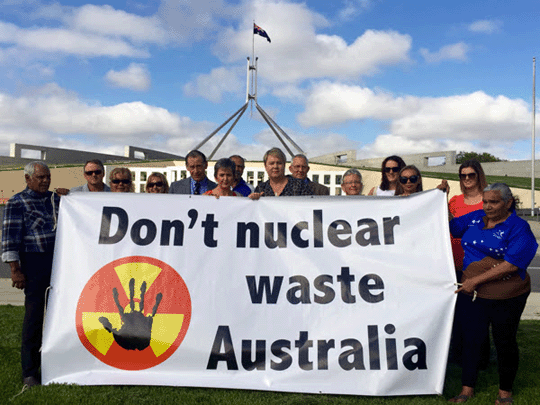 Help stop A Global Mobile Chernobyl! Nuclear Information and Resource Service, 23 Apr 16, A group of politicians and businesspeople are developing a plan to build an international high-level nuclear waste dump in South Australia–a nation that has no commercial nuclear reactors. The plan is strongly opposed by many South Australians and by an overwhelming majority of Aboriginal people, who own the land.
The Australian Nuclear Free Alliance, representing Aboriginal people from across Australia, calls on nuclear nations NOT to dump nuclear waste in Australia. The nuclear industry has a track record of Aboriginal dispossession and environmental pollution–from atomic bomb tests to uranium mining to nuclear waste dump proposals.
NIRS is supporting our friends in Australia and we hope you, and your organization, will too, by signing on to a petition of support by going here. You can also learn more about the issue at this site.
Individuals: please sign the simple statement of support below.
Dear friends in the Australian Nuclear-Free Alliance community,
Thank you for your commitment to “Keep It in the Ground” by your efforts to stop uranium mining in your lands.
We stand with you. We, the people, must and will stop the dirty, deadly and deceptive nuclear industry. We have heard that your lands are now being targeted by global nuclear waste companies. We are the community of Nuclear Information and Resource Service supporters. Collectively and as individuals, we commit to speak out and act to prevent your home from becoming a dumping ground for global nuclear waste.
Our planet and our struggle is shared and NIRS and ANFA are stronger together.
Thank you for standing for health, hope and your home. We stand with you.
USA only – 847 signatures so far http://org2.salsalabs.com/o/5502/p/dia/action3/common/public/?action_KEY=22778
Unlike Britain,Australia is, at present, easily able to avoid a very bad nuclear deal
Secret deals: Australia’s nuclear waste plan and the UK’s Hinkley project, Independent Australia 21 March 2016, The South Australian Government scheme to import international nuclear waste has a major flaw in common with the UK’s Hinkley Point C project — secret contracts with foreign organisations, writes Noel Wauchope.
THESE TWO PLANS have something in common. Both the UK’s Hinkley Point C plan and South Australia’s nuclear waste plan are grandiose and very expensive to set up.
But, more than that, they both require the involvement of foreign governments and companies, in secret arrangements.
 The South Australian Nuclear Royal Commission‘s plan for importing international wastes already involves confidential communications from foreign companies. Put into operation, the plan will mean secret contracts — South Australia being beholden to the provisions of foreign laws regarding disclosure, shipping and transport security, insurance and other matters relating to a client nation’s high level nuclear wastes (HLNW).
Plans have been suggested for foreign companies paying up front towards the setting up of the waste facility, in exchange for “ironclad contracts”to later set up “Generation IV” nuclear reactors. With foreign governments and companies involved, South Australia is very likely to become locked in to a deal from which it cannot escape. A later decision to pull out of the scheme would certainly entail heavy compensation payments to foreign companies.
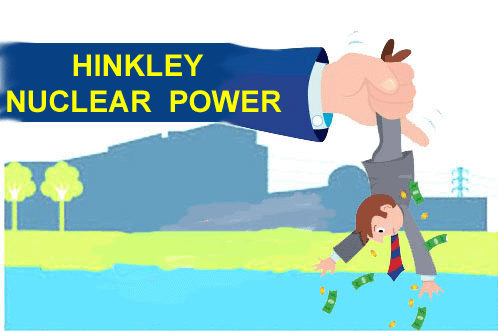 Britain’s Hinkley Point C nuclear project is thoroughly embroiled in complicated negotiations with the government-owned companies of China and France. The major backer, Electricite De France(EDF) is in grave financial trouble and its financial director Thomas Piquemal has resigned, over this Hinkley project. EDF is being bailed out by the French government, so that the £18bn plan can go ahead. UK has had to agree to a contract with EDF, amounting to about £40bn in real terms, and providing State guarantees on insurance, among other matters. The plan locks the UK in, with compensation costs in the event of it being shut down, as shown in an unpublicised departmental “minute“:…….
Professor Catherine Mitchell, an energy policy expert at the University of Exeter, comments in The Guardian:
The £22bn “poison pill” effectively reduces the risk to zero for EDF and its backers, which is great for them. But from an outside perspective, it smacks of desperation.
There could be so many reasons over 35 years that you would want to close the plant, including rising costs, changes to the UK’s energy system or loss of public confidence……..
However, in two important ways, the Australian situation is very different from that of the UK.
Firstly, although the UK Hinkley project is big, the South Australian nuclear waste plan is ginormous. Potentially sourcing high level nuclear wastes (HLNW) from around the world – USA, Canada, Europe, Asia – would be a massive operation, many decades in the setting up, many thousands of years in carrying it out. The money involved would be not dozens of billions of dollars in costs but hundreds of billions.
Secondly, for all the millions in dollars now being spent on the Royal Commission project – the trips abroad, forums, research, public relations and so on – the plan is nowhere near the point of agreement, whereas the UK plan is well advanced…….
It is vitally important for Australia to pay attention to the Royal Commission plan and to the scrutiny of South Australian radiation expert Paul Langley. and others. Unlike Britain, Australia has the opportunity to prevent this plan, while it’s still only a gleam in the eyes of Royal Commissioner Kevin Scarce and the nuclear lobby. https://independentaustralia.net/politics/politics-display/secret-deals-australias-nuclear-waste-plan-and-the-uks-hinkley-project,8797

Is there REALLY profit in nuclear waste importing industry?
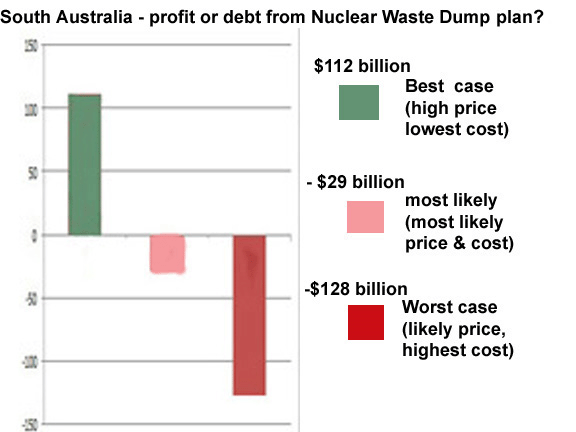
Conservation Council South Australia 18 Mar 16 A high-level nuclear waste dump for SA
Should we do it for the money?
The Nuclear Royal Commission claims some eye-popping revenue figures to take the world’s high-level nuclear waste.
Senate tables over 6,000 signatures against Hill End nuclear waste dump
 18 Mar 16 NSW Greens Senator Lee Rhiannon today tabled 6,282 signatures calling on the government to drop plans for a nuclear waste dump at Hill End. “Over 6,000 people have signed three petitions saying no to a nuclear waste dump at Hill End,” Senator Rhiannon said.
“The Hill End community has voted at three separate community meetings to unanimously oppose a nuclear waste dump and are strongly supported by their neighbouring towns, local councils and business groups.
“The Minister and the Department keep repeating that the nuclear waste dump won’t be imposed on communities that don’t want it.
“Yet the government has spent hundreds of thousands of dollars of public money sending glossy packages promoting the dump to residents in Bathurst and Mudgee, after promising the Hill End community meetings that they had heard the message it wasn’t wanted.
“They’re now following up their promotional package blitz with survey phone calls and face to face visits to Hill End , Bathurst and Mudgee residents fishing for support. “It’s time the Government acknowledges that no one wants nuclear waste at Hill End,” Senator Rhiannon said.
What does the Australian govt REALLY plan about long-lived intermediate-level nuclear waste
What should the government do about LLILW?
First, the government needs to carry out a thorough audit/inventory of LLILW, considering the following issues:
- volume/mass and radioactivity of LLILW at each current storage site;
- whether waste production is ongoing at each particular site and if so, whether storage capacity has been reached or is approaching and if so, whether increasing storage capacity is an option;
- nature and adequacy/inadequacy of current storage conditions;
- nature and adequacy/inadequacy of institutional control.
Second, the government should initiate a thorough, transparent process to consider all options for management of LLILW. There is no logical reason for the initiation of that process to wait until “the National Facility Project is underway” as the government now states. The delay is not only illogical, it also feeds uncertainty and suspicion.
What does the government plan to do with long-lived intermediate-level waste (LLILW)?

 Jim Green, Friends of the Earth, 8/3/2016. Here is the government’s formal position (8/3/16 email from Department of Industry, Innovation and Science):
“Australia’s current management approach toward long-lived intermediate-level waste is for long-term above ground storage pending future disposal. The preferred option for the National Radioactive Waste Management Facility, as identified in the Initial Business Case, provides for the centralised management of intermediate-level waste in a purpose-built storage facility. The Department of Industry, Innovation and Science will undertake a detailed consideration of disposal pathways for Australian generated intermediate level waste once the National Facility Project is underway.”
What is the government really planning?
1. The government is already considering deep borehole disposal of LLILW. It might be at intermediate depth, perhaps 200 metres underground.
2. Deep borehole disposal of LLILW could possibly be pursued at the same site as a shallow repository for lower-level radioactive waste. That option is floated in an ARPANSA document (see below).
3. Or the government could go in a very different direction – a stand-alone shallow repository for lower-level wastes without co-location of a LLILW store (or a deep borehole for LLILW disposal). Government representatives have said in public meetings that ILW would not be moved to the shallow repository site (for above-ground storage) for 10-20-30 years after the shallow repository is established, and presumably the reason for that is that the government is considering alternative options (borehole disposal at a different site, or perhaps above-ground storage at a different site). Or perhaps the statement that ILW wouldn’t be moved to the site for 10-20-30 years isn’t true, or at least it certainly isn’t locked in, and it is simply designed to quell public opposition.
4. Even if the government does decide that borehole disposal of LLILW is the best way forward, it would likely take decades to progress that project. So above-ground storage of LLILW for many decades at the same site as the shallow repository remains a distinct possibility.
5. The government must be considering the potential to reduce opposition to a shallow repository for lower-level wastes by separating that project completely from its half-baked plans for LLILW. That separation could be enshrined in the MoU that the government plans to establish with the host community for the shallow repository. It could also be enshrined in legislation.
That separation might indeed reduce public opposition, although it wasn’t effective in SA in the early 2000s. From 1998–2003, the Howard government planned co-location, and by the time it reversed that position and decided to separate management of lower level wastes from LLILW, opposition was so entrenched and widespread that it made little difference. The Howard government established a National Store Committee to develop plans for LLILW disposal, but it was disbanded in 2004, at the same time as the government abandoned its plan to impose a repository for lower-level wastes in SA……… Continue reading
Joint civil society groups comment to the National Radioactive Waste Management Project.
(please note that this comment refers to the ANSTO radioactive waste, which Australia is bound to accept back from its processing overseas. It is a separate issue from the South Australian Royal Commission’s purpose to invite in the world’s radioactive trash, as a supposedly profit-making industry)
Recommendation:
We believe that extended interim storage of radioactive waste at ANSTO – which is already the site and source of most of Australia’s higher level radioactive waste – would provide the time and opportunity required to build on the foundation work of the NRWMP and Detailed Business Case process.
Coupled with an independent and robust assessment of the full range of radioactive waste management options, we would also support a joint federal-state process to audit the adequacy of existing waste storage facilities and address any deficiencies, identify legacy sites that may be retired and provide an accurate analysis of current and future waste streams and volumes.
The vast majority of Australia’s radioactive waste is currently stored at secured and defined Commonwealth facilities at Lucas Heights (NSW) and Woomera (SA).
Both of these facilities have confirmed they have the capacity to continue appropriate storage of this material for many years, providing an opportunity to revisit this policy arena in order to realise the most effective, equitable and lasting outcome.
 Joint civil society groups comment to the National Radioactive Waste Management Project. March 11, 2016
Our groups represent many Australians across different regions and sectors who share a common desire to advance and realise responsible radioactive waste management in Australia.
We write to provide formal comment on the approach taken to facility siting in the revised National Radioactive Waste Management Project (NRWMP) that was established following the end of the protracted and fiercely contested plan to develop a national radioactive waste facility at Muckaty in the Northern Territory.
For over two decades, successive Australian governments have sought to manage Australia’s radioactive waste inventory through the development of a co-located remote central dump and store at locations chosen by the Commonwealth without adequate consultation or clear community consent.
This approach has repeatedly failed to win social license and has been characterised by division, contest and the inability to realise a site.
Our organisations welcome the commitment repeated through the course of the NRWMP to date not to impose a facility without broad community support.
It is our view that this essential project pre-condition has not been realised at any of the six sites currently being considered. Continue reading
1 This month

of the week – Australians for War Powers Reform (AWPR)
To see nuclear-related stories in greater depth and intensity
 Antinuclear