Seven deadly sins in the Defence industry

In the light of such revelations, and of the fact that nuclear-propelled submarines are really suitable only for deep sea operations, not littoral defence, Richard Marles’s obduracy in continuing to pursue Virginia-Class Attack submarines is astonishing.
It is also about whether the Australian tax payer will be ripped off in the process of acquiring them.
By Richard Broinowski Jul 27, 2023 https://johnmenadue.com/seven-deadly-sins-in-the-defence-industry/
If previous defence acquisitions are any guide, the enormous cost of nuclear-powered submarines for the Royal Australian Navy will almost certainly escalate well beyond the estimated but un-itemised initial price of $A368 billion. The record of corruption of the two US submarine builders suggests that the project will also probably suffer from mismanagement. The final bill is likely to be astronomical.
In my article ‘AUKUS exposes Australia’s incoherent defence policy’, (Pearls and Irritations 14 February 2022), I mentioned the findings of Fred Bennett, Chief of Capital Procurement in the Australian Department of Defence from 1984 to 1988. Bennett listed what he called the seven deadly sins of defence procurement projects – novelty, uncertainty, complexity, interdependence, resource limitations, creative destruction and political constraints. (Security Challenges Vol 6 No 3 Spring 2010).
Bennett claimed that all have been present to a greater or lesser degree in most acquisition projects, and none can be entirely evaded or eliminated. The record over several decades, both in Australia and Britain supports his view.
The Australian Jindalee over the horizon radar system suffered similar delays. The Lockheed Martin F-35 joint strike fighter, designed as a low-cost, lightweight high-performance stealth aircraft, is none of these things, and its project director was sacked in 2010 for cost overruns, schedule delays and a troubling performance record. The BAE Hunter class frigate program has been plagued by design changes which made the ships heavier and slower than intended.
Trying to adhere to a prime contract comprising 22,000 pages with 600 sub contracts, the Collins class submarine all but lost its way in a forest of complexity. This was exacerbated when Wormald, the lead corporation in the submarine consortium changed hands. The head of Wormald was also chair of the Australian Submarine Corporation. The ASC lost its CEO and a period of chaos followed.
But it is not just Bennett’s seven deadly sins we have to worry about with regard to the acquisition of US nuclear powered submarines. Nor is it just about confusion about their primary role, and whether they will be the best possible platform available to realise it. It is also about whether the Australian tax payer will be ripped off in the process of acquiring them.
There are precedents. ……………………………………………………………………………………………………………………………
In the light of such revelations, and of the fact that nuclear-propelled submarines are really suitable only for deep sea operations, not littoral defence, Richard Marles’s obduracy in continuing to pursue Virginia-Class Attack submarines is astonishing. Much cheaper conventional submarines with air-independent propulsion (AIP) are available from Sweden, Germany, Korea or Japan. They are quieter than nuclear submarines, have the capacity to lurk undetected for 30 days or more, are almost as fast, and are very unlikely to suffer the kind of cost blow-outs we are likely to face in nuclear-powered Virginias. We could also get them sooner.
The pro-nuclear lobby in Australia is excited by the prospect that possession of nuclear-powered submarines will lead to the capacity to develop a complete nuclear industry in Australia. This is a pipe dream. Operating experience with ANSTO’s one small Argentinian-designed research reactor at Lucas Heights does not enhance our capacity to enrich uranium, fabricate fuel rods, construct power reactors, or permanently dispose of nuclear waste. Few if any local councils would welcome construction of power reactors in their backyards. Australia still has no designated burial place for low-level medical nuclear waste. A growing number of high-level highly toxic spent fuel rods remain unprocessed at Lucas Heights. Uranium and plutonium residue from rods that have been processed overseas remain in temporary storage.
One can only hope that it is not too late to abandon the purchase of Virginia submarines in favour of much cheaper non-nuclear boats with AIP.
[problems in defence procurement, submarines, corruption, AUKUS, faulty steel plate, nuclear propulsion versus AIP]
Nuclear weapons:“Oppenheimer” won’tmake a difference, but Australia can
The Interpreter GARETH EVANS, 26 July 23
The movie missed a chance to galvanise a renewed campaign, to better protect against existential danger than rely on sheer dumb luck.
Oppenheimer is a big disappointment for those of us who hoped that this super-hyped, all-star-cast new movie might give new life to the nuclear disarmament cause, creating new awareness of nuclear risks and energising popular support for their elimination – maybe even influencing senior policymakers in the way that the 1983 telemovie The Day After was, famously, an epiphany for Ronald Reagan.
…………………………… while making clear that the Hiroshima and Nagasaki bombs were big bangs, and the Edward Teller’s anticipated H-bomb much bigger still, it is no part of the film’s mission to convey the sheer flesh and blood horror of these most indiscriminately inhumane weapons ever devised.
Oppenheimer’s moral qualms about massive civilian death tolls, and the catastrophic potential of an internationally unregulated post-war nuclear arms race, are not as clearly or forcefully explained as they could be. And the film takes it as given that the bomb-dropping (not the Soviet Union’s almost simultaneous declaration of war) was the decisive factor in Japan’s surrender – an historically flawed storyline, but one that remains critical to this day in keeping alive belief in the utility of nuclear weapons.
So, with no new help from the cinema, it’s back to the same old frustrating drawing board for nuclear risk reduction and disarmament campaigners.
The need for effective advocacy and action here has never been more compelling. Nearly 13,000 nuclear warheads are still in existence, with a combined destructive capability of close to 100,000 Hiroshima- or Nagasaki-sized bombs, and stockpiles, especially in our own Indo-Pacific region, now growing again. The taboo against their deliberate use is weakening, with Russia’s President Vladimir Putin talking up this prospect in language not heard since the height of the Cold War. Longstanding nuclear arms control agreements are now either dead (ABM, INF, Open Skies) or on life support (New START).
Moreover, the risk of use through human or system error or miscalculation is greater than ever, not least given new developments in AI and cyber-offence capability. That we have not had a nuclear weapon used for nearly 80 years is not a result of statesmanship, system integrity and infallibility, or the inherent stability of nuclear deterrence. It has been sheer dumb luck, and it is utterly wishful thinking to believe that this luck can continue in perpetuity.
…………………………..what can reasonably be hoped for, and sooner rather than later, is a serious global commitment to nuclear risk reduction.
Australia has a more useful role in this enterprise than many may imagine, with our generally strong record on arms control – including bringing to conclusion the Chemical Weapons Convention – and our nuclear credentials burnished by the ground-breaking Keating government-initiated Canberra Commission on the Elimination of Nuclear Weapons, the Howard Government’s role in getting the Comprehensive Test Ban Treaty to a vote, and the more recent Rudd government-initiated Australia-Japan International Commission on Nuclear Non-Proliferation and Disarmament.
The most commonly proposed risk-reduction measures – and central elements in the Australia–Japan commission’s proposed “minimisation” agenda – may be described as the “4 Ds”. They are Doctrine (getting universal buy-in for a No First Use (NFU) commitment), Deployment (drastically reducing the number of weapons ready for immediate use), De-alerting (taking weapons off high-alert, launch-on warning readiness) and Decreased numbers (reducing the overall global stockpile to less than 2,000 weapons).
A world with low numbers of nuclear weapons, with very few of them physically deployed, with practically none of them on high-alert launch status, and with every nuclear-armed state visibly committed to never being the first to use them, would still be very far from perfect. But one that could achieve these objectives would be a very much safer world than we live in now.
What has been most depressing about Australia’s performance in recent years, which it is very much to be hoped will now change, is that even these realistic objectives have not been actively supported. Australia’s status as a close US ally and, as such, one of the “nuclear umbrella” states, gives us a particularly significant potential role in advancing some key elements of the risk-reduction agenda just described.
The most immediately useful step we could take would be to support the growing international movement for the universal adoption of No First Use doctrine by the nuclear-armed states. ………………… At the NPT Review Conference concluded in New York in August 2022, a great deal of support was evident for such No First Use commitments as part of a larger risk reduction agenda. But the delegation of our new Labor government made no contribution to that debate. I live in hope that that position will change. https://www.lowyinstitute.org/the-interpreter/nuclear-weapons-oppenheimer-won-t-make-difference-australia-can
New Zealand’s anti-nuclear stance means it won’t play a role in Australia’s submarine plans
New Zealand’s commitment to remaining nuclear-free means it won’t play a role in Australia’s defense plans to acquire nuclear-powered submarines, the leaders from both countries said Wednesday
ABC News, By NICK PERRY Associated Press, July 26, 2023
WELLINGTON, New Zealand — New Zealand’s longstanding commitment to remaining nuclear-free means it won’t play a role in Australia‘s plans to acquire nuclear-powered submarines, the leaders from both countries said after meeting Wednesday…………………………………………………………. more https://abcnews.go.com/International/wireStory/new-zealands-anti-nuclear-stance-means-play-role-101659242
US, Australia Launch Largest-Ever Joint Military Exercise
This year’s Talisman Sabre exercise involved 11 other nations and over 30,000 military personnelby Dave DeCamp Posted on https://news.antiwar.com/2023/07/23/us-australia-launch-largest-ever-joint-military-exercise/
The US and Australia on Friday launched the largest-ever iteration of their Talisman Sabre exercise as the US is increasingly focused on building alliances in the Asia Pacific against China.
The Talisman Sabre started in 2005 as a biennial exercise between the US and Australia. This year’s iteration involves participants from 11 other countries and over 30,000 military personnel.
US Navy Secretary Carlos Del Toro spoke at the opening ceremony on Friday and said the massive drills served as a warning to China. “The most important message that China can take from this exercise and anything that our allies and partners do together is that we are extremely tied by the core values that exist among our many nations together,” he said at a naval base in Sydney.
In a symbolic gesture to demonstrate the growing military ties between the US and Australia, the US on Saturday commissioned a naval vessel in Sydney, the USS Canberra, an Independence-class littoral combat ship. It marked the first time the US ever commissioned a US Navy ship was commissioned in a foreign port.
Del Toro has previously said that the US Navy envisions turning Australia into a full-service submarine hub for the US and its allies in the region under the AUKUS military pact that was signed between the US, Britain, and Australia in 2021 that will result in Canberra acquiring nuclear-powered submarines.
The US and Australia were joined in the Talisman Sabre exercises by militaries from Fiji, France, Indonesia, Japan, South Korea, New Zealand, Papua New Guinea, Tonga, Britain, Canada, and Germany. Personnel from the Philippines, Singapore, and Thailand are attending as observers.
The exercises involve live-fire drills and will conclude on August 4. A Chinese naval vessel was spotted surveilling the drills, which Australian military officials said have happened since 2017.
Ukrainian drone attack on Moscow is ‘international terrorism’ – Russia’s Foreign Ministry
RT.com 24 July 23
Two UAVs crashed into buildings in the Russian capital, with fragments reportedly found not far from the Defense Ministry
The attempted Ukrainian drone attack on Moscow early Monday morning, which damaged several non-residential buildings, is “an act of international terrorism,” Russian Foreign Ministry spokeswoman Maria Zakharova has said.
The spokeswoman condemned the attack on Monday morning while speaking to RTVI TV. Earlier, the Russian Defense Ministry said Ukraine attempted to stage “a terrorist attack” against Moscow using two drones, which were suppressed by electronic warfare systems……………
Kiev applauded the raid, with Mikhail Fedorov, Ukraine’s minister for digital transformation, promising that “there will be more” of these incidents.
Amid the conflict with Russia, Kiev has previously tried to launch drone raids on Moscow and its suburbs. Earlier this month, the Russian Defense Ministry said that air defenses downed four drones in the southeastern districts of the capital, and another UAV was neutralized by electronic warfare systems west of Moscow…………………………… more https://www.rt.com/russia/580185-ukrainian-drone-attack-moscow-international-terrorism/—
Congressional Concerns: Stalling Nuclear Submarines for Australia

Australian Independent Media July 23, 2023, Dr Binoy Kampmark
Any security arrangement with too many variables and multiple contingencies, risks stuttering and keeling over. Critical delays might be suffered, attributable to a number of factors beyond the parties concerned. Disputes and disagreements may surface. Such an arrangement is AUKUS, where the number of cooks risk spoiling any meal they promise to cook.
The main dish here comprises the nuclear-powered submarines that are meant to make their way to Australian shores, both in terms of purchase and construction. It marks what the US, UK and Australia describe as the first pillar of the agreement. Ostensibly, they are intended for the island continent’s self-defence, declared as wholesomely and even desperately necessary in these dangerous times. Factually, they are intended as expensive toys for willing vassals, possibly operated by Australian personnel, at the beckon call of US naval and military forces, monitoring Chinese forces and any mischief they might cause.
While the agreement envisages the creation of specific AUKUS submarines using a British design, supplemented by US technology and Australian logistics, up to three Virginia Class (SSN-774) submarines are intended as an initial transfer. The decision to do so, however, ultimately resides in Congress. As delighted and willing as President Joe Biden might well be to part with such hulks, representatives in Washington are not all in accord.
Signs that not all lawmakers were keen on the arrangement were already being expressed in December 2022. In a letter to Biden authored by Democratic Senator Jack Reed and outgoing Republican Senator James Inhofe, concerns were expressed “about the state of the US submarine industrial base as well as its ability to support the desired AUKUS SSN [nuclear sub] end state.” Current conditions, the senators went on to describe, required “a sober assessment of the facts to avoid stressing the US submarine industrial base to the breaking point.”
On May 22, a Congressional Research Service report outlined some of the issues facing US politicians regarding the procurement of the Virginia (SSN-774) submarine for the Australian Navy……………………………
The report has proven prescient enough. Republicans on the Senate Armed Services Committee have realised that stalling aspects of AUKUS might prove useful, if it entails increasing military spending beyond levels set by the current debt-limit deal………………………………………
Then came another problem: almost 40% of the US attack submarines would be incapable of deployment due to maintenance delays………………………….
The terms, for Wicker, are stark. “To keep the commitment under AUKUS, and not reduce our own fleet, the US would have to produce between 2.3 and 2.5 attack submarines a year.”…………………………………………..
Such manoeuvring has caught the Democrats off guard……………………………………………..
As US lawmakers wrestle over funds and the need to increase submarine production, the Australian side of the bargain looks flimsy, weak, and dispensable. With cap waiting to be filled, Canberra’s undistinguished begging is qualified by what, exactly, will be provided. What the US president promises, Congress taketh. Wise heads might see this as a chance to disentangle, extricate, and cancel an agreement monumentally absurd, costly and filled with folly. It might even go some way to preserve peace rather than stimulate Indo-Pacific militarism. https://theaimn.com/congressional-concerns-stalling-nuclear-submarines-for-australia/
AUKUS’ nuclear waste dump is the secret no-one talks about. So what’ll it cost?
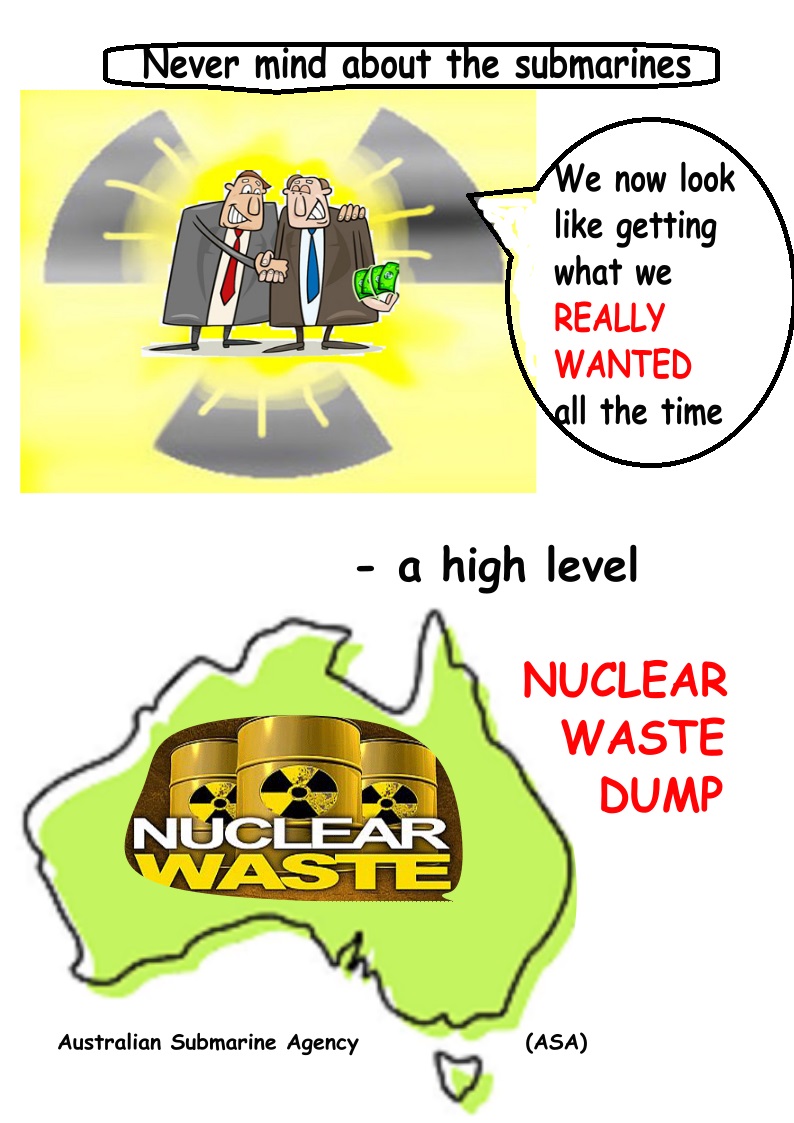
The $360 billion cost of AUKUS might be startling, but on top of that is another undiscussed figure: the cost of building storage for nuclear waste.
Crikey, DAVID HARDAKER, JUL 24, 2023
In late 2021, it came as a shock when Australia woke up to find that its government, under then-prime minister Scott Morrison, had secretly agreed to join the nuclear submarine club with old friends, the US and the UK.
The secret within that secret was that Australia would be responsible for the radioactive waste generated by its involvement in the AUKUS program. For the first time, Australia had signed up to construct a storage facility for high-grade nuclear waste, robust enough to last 1000 years.
Australia had never done it. Nor the US. Nor the UK. Was the iron-clad commitment to building a waste dump part of the deal struck by Morrison when he announced the AUKUS partnership? If so, he didn’t mention it at the time. Nor was it mentioned by US President Joe Biden, UK Prime Minister Rishi Sunak or Australian Prime Minister Anthony Albanese at the official AUKUS announcement in San Diego in March…………. (subscribers only) more https://www.crikey.com.au/2023/07/24/aukus-nuclear-waste-dump-cost-australia/
US Republicans threaten to block AUKUS deal

By Anthony Galloway, The Age, July 21, 2023
Australia’s AUKUS submarine deal with the United States has hit a hurdle with Senate Republicans threatening to block the sale unless President Joe Biden boosts funding for the domestic production line.
Republican members of the Senate Armed Services Committee on Friday moved to block legislation which would enable the sale of US Virginia-class submarines to Australia.
Under the AUKUS deal, Washington was set to sell Canberra between three and five of its own nuclear submarines in the 2030s before Australia begins building a new class of boat with Britain.
But the ranking Republican on the Senate Armed Services Committee, senator Roger Wicker, said Biden needed to commit more money to guarantee “we have enough submarines for our own security before we endorse that pillar of the agreement”.
Wicker said Australia’s commitment of US$3 billion ($4.4 billion) for the US production line would not be enough to meet the needs of both countries.
“The president needs to submit a supplemental request to give us an adequate number of submarines,” he told US news outlet Politico…………………………………………………….. https://www.theage.com.au/politics/federal/foolish-us-republicans-threaten-to-block-aukus-deal-20230721-p5dqc3.html
Karina’s father went blind at Emu Field. Now, she’s fighting for a treaty on nuclear weapons.

The Yankunytjatjara Anangu woman talked about the devastating effect the testing had on her family, including the loss of her father.
Karina Lester knows the fallout nuclear weapons can cause.
Her father, the late Yami Lester, went blind as a young man after the British tested atomic weapons in Emu Field.
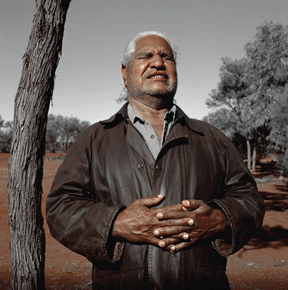
“The scars are still felt on our Country,” said Ms Lester, a Yankunytjatjara Anangu woman from north-west South Australia.
“And the scars are still evident on our people.”
A group of Australian atomic survivors and relatives visited Canberra on Wednesday to speak with government decision-makers about their experiences of the British nuclear testing program in WA and SA.
They are calling on Prime Minister Anthony Albanese to sign the Treaty on the Prohibition of Nuclear Weapons.
In 1953 the British initiated a program of nuclear testing in Australia at the Montebello Islands, off the coast of WA and in Emu Field in South Australia.
Two years later, the British government announced a larger site for the tests at Maralinga.
Ms Lester carries her family’s stories about the impacts of the tests on her people.
“I had a grandmother of mine needing to dig a grave to bury her parents because soon after the radiation fallout, the elderly people started to suffer and die,” she said.
“My father never saw me or my children.
“It’s all because of a decision by governments of the day to say ‘That is no man’s country, go and test your bombs’.
“It’s been a huge, painful journey for us but it’s such an important story that needs to be told.”
Maxine Goodwin is the daughter of an Australian nuclear veteran who became ill as a result of his involvement in the first atomic test in WA.
“Signing the Treaty on the Prohibition of Nuclear Weapons is a significant step towards addressing the harm experienced by individuals and communities,” she said.
In October 1953 when the British detonated the Totem I and II nuclear bombs at Emu Field, Yankunytjatjara, Antikarinya and Pitjantjatjara woman June Lennon was only a few months old.
Her family witnessed the tests and have suffered from ill-health since.
“The government didn’t tell the truth about the nuclear testing program,” she said.
“There were so many lies. They didn’t tell people what they were doing.”
International Campaign to Abolish Nuclear Weapons Australia director Gem Romuld said it was important for policy makers to hear stories firsthand.
“Nuclear survivors are experts on the devastating humanitarian impacts of nuclear weapons,” she said.
“Australia’s experience with nuclear weapons testing is a powerful motivation to join the nuclear weapon ban treaty.”
The delegation will be in Canberra on Wednesday and Thursday to meet parliamentarians, including Foreign Minister Penny Wong and speak at an event hosted by the Parliamentary Friends of the Treaty on the Prohibition of Nuclear Weapons.
Australia on track for exemption to accelerate AUKUS nuclear subs deal
SMH, By Farrah Tomazin, July 15, 2023
Washington: Australia will be given an exemption from strict US export control laws to help accelerate the delivery of its $368 billion AUKUS submarine deal, under a bipartisan proposal making its way through Congress.
In a boost for the Albanese government, the plan to bolster Australia’s defences in the Indo-Pacific moved a step closer to reality on Friday (AEST) after a powerful US Senate committee approved draft legislation designed to turbocharge the ambitious three-way military pact with the US and UK.
If approved, the proposal, which was given the green light by the Senate Foreign Relations Committee and is expected to be debated more broadly next week, will help facilitate the transfer of Virginia-class ships under the AUKUS agreement and strengthen the submarine industrial base of the three nations involved………………………………………………………………………………………….
But while AUKUS has received broad bipartisan support, questions remain about the lengthy time frame of AUKUS, the extraordinary cost to taxpayers, and the myriad of rules governing the deal. Among them is the International Traffic in Arms Regulations (ITAR) which could delay for years the transfer of crucial
technologies unless the system is reformed or a special waiver is granted.
To that end, the approval by the Foreign Relations Committee, which has jurisdiction over armed export controls and ship transfers, was an important boost for AUKUS, however there is still a long way to go before all the relevant
AUKUS legislation makes it through Congress.
Some US politicians have also raised concerns that AUKUS could stretch America’s industrial base “to breaking point”, given the industry was already struggling to meet its target to build two attack submarines a year. ……………………… https://www.smh.com.au/world/north-america/australia-on-track-for-exemption-to-accelerate-aukus-nuclear-subs-deal-20230715-p5dofd.html
Australia needs a nuclear power school to develop AUKUS capability: Navy chief.
Australian Navy Vice Admiral Mark Hammond says a nuclear power school should be developed out of Adelaide or Perth if Australia is serious about developing its sovereign AUKUS capability.
Mr Hammond believes a nuclear power school would help our nation reduce reliance on the US, according to Sky News host Amanda Stoker.
Inside ‘nuke school’, the elite US training ground preparing Australian submariners for an AUKUS future
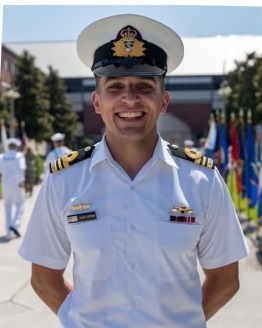
(Looking forward to? Life for months on end in a cramped space, no sunlight or fresh air, very little private space, closed atmosphere – all smells recirculated. Limited news, limited communication with family. Water supplies rationed. Stress and boredom. And it’s dangerous.)
The sale of Virginia-class submarines to Australia requires the approval of the US Congress, and significant changes are needed to a complex set of export controls restricting how sensitive technology is transferred.
By North America bureau chief Jade Macmillan and Bradley McLennan in Charleston
“………………. Three members of the Royal Australian Navy have graduated from the Nuclear Power School in South Carolina, more commonly known as ‘nuke school’.
Three members of the Royal Australian Navy have graduated from the Nuclear Power School in South Carolina, more commonly known as ‘nuke school’…………
Years out from Australia’s acquisition of nuclear-powered subs, the graduation is an early step towards making AUKUS a reality.
But there are still major hurdles ahead when it comes to the broader workforce challenges presented by the plan……………………….
The Australians will now have to complete another set of practical learning, which will include spending time on retired nuclear-powered subs known as moored training ships.
After that, they’ll receive further training in Connecticut before being assigned to a Virginia-class sub…………………..
AUKUS presents major workforce challenges for Australia
The AUKUS plan, announced in San Diego earlier this year, will see Australia acquire a total of eight nuclear-powered submarines at a cost of up to $368 billion.
US submarines are increasing their visits to Australian ports from this year, and from 2027 HMAS Stirling naval base in Western Australia will host rotations of American and British subs under what’s known as ‘Submarine Rotational Force-West’.
Australia is expected to buy at least three Virginia-class submarines from the US from the early 2030s, before building its own nuclear-powered boats in Adelaide to be known as SSN-AUKUS.
They will be based on a British design using US technology, with the first scheduled to be delivered in the early 2040s…………….
“It’s going to require a massive amount of infrastructure, incredible workforce demand, both in terms of technical skills and numbers.
“It just seems like that’s going to be a pretty heavy lift on the part of Australia to do nuclear ship construction.”…………………………….
Virginia-class submarines carry around 132 people, nearly three times the size of the crew onboard the Collins-class boats Australia has now.
And unlike the Collins, nuclear-powered subs do not need to surface regularly to recharge, meaning they can stay submerged for months at a time…………………………………………
The new subs will be built in South Australia, while Western Australia’s HMAS Stirling is undergoing an $8 billion expansion.
…………………………………………….. Challenges lie ahead to bring AUKUS to fruition
Aside from skills and workforce issues, there are other major challenges that still need to be overcome to bring AUKUS to fruition.
The sale of Virginia-class submarines to Australia requires the approval of the US Congress, and significant changes are needed to a complex set of export controls restricting how sensitive technology is transferred.
Questions also remain over how the US will deliver the promised Virginia-class submarines, given the pressure its own shipyards are under to meet local demand.
The US Chief of Naval Operations, Admiral Michael Gilday, last month said it was “too early” to provide an answer on exactly where the subs would come from…………… https://www.abc.net.au/news/2023-07-08/aukus-nuke-school-training-australian-navy-submariners/102572156
Australia’s Atomic Survivors want Prime Minister Albanese to sign treaty to ban nuclear weapons.
By Rudi Maxwell, June 14 2023 https://www.canberratimes.com.au/story/8232976/survivors-want-pm-to-sign-treaty-to-ban-nuclear-weapons/
Karina Lester (above) and June Lennon are still affected by the fallout from British nuclear tests on their country 70 years later.
The two First Nations women are part of a delegation of atomic survivors and relatives, which includes veterans, visiting Canberra to call on the government to sign an international treaty to ban nuclear weapons.
“We still see the craters and the scars that were left by those weapons tests, both at Emu Field and also at Maralinga Tjarutja,” Ms Lester, a Yankunytjatjara Anangu woman from north-west South Australia, said.
Greens Senator Jordon Steele-John and Labor MP Josh Wilson co-chair the Parliamentary Friends of the Treaty on the Prohibition of Nuclear Weapons, which heard from the delegation on Wednesday.
“It was so powerful to hear the stories of lived experience and direct connection to the impacts of nuclear testing,” Senator Steele-John said.
“That makes it viscerally real and really brings home the urgent need to eliminate nuclear weapons.”
Ms Lester’s father, the late Yami Lester, (above) went blind as a young man after the British tested atomic weapons in Emu Field.
“The scars are still felt on our country,” she said.
“And the scars are still evident on our people.”
The group of Australian atomic survivors and relatives are calling on Prime Minister Anthony Albanese to sign the Treaty on the Prohibition of Nuclear Weapons.
In 1953 the British initiated a program of nuclear testing in Australia at the Montebello Islands, off the coast of WA and in Emu Field in South Australia.
Two years later, the British government announced a larger site for the tests at Maralinga.
In October 1953 when the British detonated the Totem I and II nuclear bombs at Emu Field, Yankunytjatjara, Antikarinya and Pitjantjatjara woman June Lennon was only a few months old.
AUKUS Fissile or Fizzer? Rex Patrick on the trouble with Virginia Class second hand submarines.
In what Paul Keating has described as ‘the worst deal in all history’, we’ve decided to buy into more second hand military hardware from the US; this time Virginia class nuclear submarines.
ED note – and we are left with their toxic wastes, also
by Rex Patrick | Jun 5, 2023 https://michaelwest.com.au/aukus-fissile-or-fizzer-rex-patrick-on-the-trouble-with-virginia-class-second-hand-submarines/
Former submariner Rex Patrick looks under the hood of the second-hand Virginia-class nuclear submarines to see what Australia has bought. Even AUKUS fans might not like what they see.
February 2011 is a time many in the Royal Australian Navy (RAN) would certainly prefer to forget. Within the month, the Defence Minister Stephen Smith had announced a number of trouble-plagued military landing craft would be disposed of and a review would be conducted into Support Ship Repair and Management Practices. Four months later Chief of Navy, Vice Admiral Russ Crane, was gone.
On February 3, 2011, the biggest storm to have ever hit Queensland crossed the Australian coastline and carved a swath of destruction across the state. The storm displaced 10,000 people and caused $3.5 billion in damage. And the Navy was unable to respond with any amphibious ships to help Queenslanders.
On September 26, 2010, the Defence Minister had been advised that two former US Navy ships, HMAS Manoora and HMAS Kanimbla, were in what was described as an ‘operational pause’. By December the decision was made that Manoora would be decommissioned, although that news never made it to the Minister until January 28, 2011, when a tropical depression was forming off Queensland. The Minister was also advised that Kanimbla was to be unavailable to the RAN for 18 months.
That left HMAS Tobruk, a 30 year old ship, as the standby ship. On February 28, the Navy advised the Minister it was on 48 hours’ notice to go to sea. By February 2, with Yasi now a category 5 cyclone, Tobruk entered dock for emergence repairs. It left the dock two days later but was unfit to sail for any of the Yasi response.
The Navy had failed Australians.
Rust buckets
Manoora and Kanimbla were naval clunkers. The two elderly ships had been picked up from the US Navy as an ‘opportunity buy’. There’s normally a reason things come at a bargain basement price. (Our Air Force made the same mistake after it bought second hand C-27J Spartan light tactical aircraft from the US Air Force that don’t do the job… we never learn.)
The Auditor-General detailed the saga in his September 2000 Amphibious Transport Ship Project Audit. After the RAN inspected the two ships in early 1994 the ships were bought for the grand price of $61 million. A $55 million contract was immediately signed with Newcastle’s Forgacs shipyard to do a quick overhaul.
The quick upgrade went from 14 months to 44 months and the price went to $203 million. As the Auditor finished up his work at the turn of the millennium, the price was closing in on $450 million.
That Defence bought rust buckets and spent almost 10 times the purchase cost repairing them just meant It was ‘operations normal’.
Second hand Virginias
Fast forward to 2023. Have we learned any lessons? It appears not.
In what Paul Keating has described as ‘the worst deal in all history’, we’ve decided to buy into more second hand military hardware from the US; this time Virginia class nuclear submarines.
Under questioning from Senator Jacqui Lambie at Estimates last week, the Navy revealed that the submarines we’ll likely get in the mid-2030s are boats built from 2020.
The estimated reactor life of the Virginia-class boats is 33 years. So we will hope to get about 20-years out of these second-hand vessels. The actual time they’ll be available for operations will be much less when you take into extended maintenance and refits.
The head of the nuclear submarine program, Vice Admiral Mead, suggested that we might get one new boat, if we’re lucky (we’ll get what we’re told by the US Congress).
The Chief of Navy, Vice Admiral Hammond, assured the Senate that we won’t see a repeat of the Manoora and Kanimbla debacle, saying the Navy’s ‘subsafe’ program won’t allow that.
Getting a grip
But even if Admiral Hammond is right (and Defence’s credibility on procurement is pretty well shot), the fact is that the Virginia Class program has some problems Australia is unlikely to be able to deal with.
The first highly noticeable issue with the Virginia class is a problem that has surfaced with the submarine’s acoustic coating that’s designed to reduce the ‘target strength’ of the submarine (how much sound energy from an enemy active sonar bounces off the submarine, back to the enemy).
The coating is prone to peeling off at high speed leaving loose cladding that slaps against the hull, making dangerous noise, and causes turbulent water flow, which also causes dangerous hull resonance (where the hull sings at its resonant frequency, like a tuning fork) and extra propulsion noise. I know a bit about this as a former underwater acoustics specialist.
The issue, reported in 2017 and again in 2019, is easily seen on the side of the submarine andalmost certainly without a fix at this stage.
Admiral Hammond tried to brush off the issue in the Senate. In response to Senator Lambie, he claimed that the photos she had tabled were of submarines that had come to the end of long patrols. But submarines are designed to do long patrols. I wonder how comfortable the Admiral would be landing at Heathrow Airport in London from Sydney, with the aircraft captain advising the parts of the wings normally fall off on long haul flights.
It’s not OK for our submariners to find that the boats they are using to keep us safe become noisy, and thus increasingly vulnerable to detection and destruction, halfway through their deployment.
Lack of availability
The bigger problem for Australia is the challenge the US Navy is encountering keeping (particularly) aging Virginia-class submarines at sea. Part of the problem is parts supply difficulties, with cannibalisation (taking parts from other submarines) regularly happening to keep a diminished number of boats at sea.
A November 2022 press report stated, “The U.S. Navy has nearly twice as many submarines sidelined for maintenance than it should, and those boats in maintenance ultimately require three times more unplanned work than they should, the program executive officer for attacks subs has said”.
It went on to say, “Of the 50 attack subs, [Rear Admiral] Rucker said 18 are in maintenance or waiting for their turn. Industry best practice would call for just 20% to be tied up in repairs, or 10 boats instead of 18”.
If the US Navy is having difficulty with keeping its boats at sea, with significant in-country industrial capability, how will Australia hope to keep our Virginia subs at sea? Our second-hand, ageing boats may spend as much time undergoing maintenance at Australian dockyards, or more likely waiting in a queue at a US dockyard, as they might be available for operations.
We may be eventually end up getting eight AUKUS submarines, only to find we can only keep two, instead of three in a fully operational state.
Absurdity
That would be $368 billion to have only one or two submarines are sea. And that’s just absurd. There were, and still are other, more sensible and cost-effective paths available.
Sometime in the future Australia may face the strategic equivalent of Cyclone Yasi, a defence contingency in which the number of operational submarines we have available will be of vital importance to our national security.
Tragically, however, absurd is ‘operation normal’ for Defence procurement. SNAFU
Aukus ‘expensive’ and not ‘easy to replicate’, Australian officials told foreign diplomats
Exclusive: Documents obtained by Guardian Australia show Australia attempted to reassure countries amid nuclear proliferation concerns
Daniel Hurst, Guardian 29 May 23
Australian officials have told foreign diplomats that the Aukus submarine plan is “expensive” and not “easy to replicate”, as part of an effort to play down concerns about the risks of other countries racing to do the same, a newly released tranche of documents reveals…..
Briefing notes obtained by Guardian Australia under freedom of information laws lay bare the arguments the government is using to defend and explain Aukus to foreign diplomats posted to Canberra………………………………………
China’s mission to the UN said in March that “two nuclear weapons states who claim to uphold the highest nuclear non-proliferation standard” – the US and the UK – “are transferring tons of weapons-grade enriched uranium to a non-nuclear-weapon state”.
The new documents show that many of the answers given by Australian officials at the Aukus briefings aimed to reassure countries about nuclear non-proliferation issues.
The first assistant secretary of Dfat’s Aukus taskforce, Sarah deZoeten, told those in attendance that Australia would retain control of operational waste and spent fuel.
…………………………. Aukus is novel because it will be the first time a provision of the Nuclear Non-Proliferation Treaty regime has been used to transfer naval nuclear propulsion technology from a nuclear weapons state to a non-weapons state……………………………. https://www.theguardian.com/world/2023/may/30/aukus-expensive-and-not-easy-to-replicate-australian-officials-told-foreign-diplomats
1 This month
17 October, Free Public Talk on Nuclear Issues in South Australia
David Noonan will speak on public interest concerns over the new Roxby Downs Indenture Act 2026 on BHP copper-uranium mining and ore processing in SA, and on how AUKUS may face SA with a High-Level nuclear waste agenda.
Dr Jim Green will discuss international developments in the field of nuclear power including ‘small modular reactors’ and Generation 4 ‘advanced’ nuclear reactor concepts.


Help Aunty Sue Protect Her Land and Sacred Sites From Destructive Rocket Testing.
.

Australians deserve the truth
about
AUKUS – https://aukuspublicinquiry.com/

PETITION – To: Prime Minister Anthony Albanese and the Australian Labor Government

of the week – Australians for War Powers Reform (AWPR)
To see nuclear-related stories in greater depth and intensity

